Electron Configuration
The set of numbers used to describe the position and
energy of the electron in an atom.
From Previous Topic…
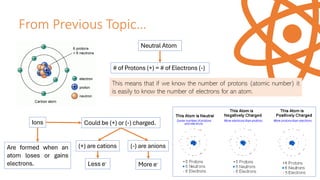
This means that if we know the number of protons (atomic number) it
is easily to know the number of electrons for an atom.
Neutral Atom
# of Protons (+) = # of Electrons (-)
Ions Could be (+) or (-) charged.
Are formed when an
atom loses or gains
electrons.
(+) are cations (-) are anions
Less e-
More e-
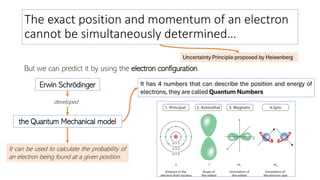
The exact position and momentum of an electron
cannot be simultaneously determined…
But we can predict it by using the electron configuration.
Uncertainty Principle proposed by Heisenberg
Erwin Schrödinger
developed
the Quantum Mechanical model
It can be used to calculate the probability of
an electron being found at a given position.
It has 4 numbers that can describe the position and energy of
electrons, they are called Quantum Numbers
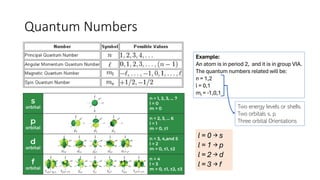
Quantum Numbers
Example:
An atom is in period 2, and it is in group VIA.
The quantum numbers related will be:
n = 1,2
l = 0,1
ml = -1,0,1
l = 0 → s
l = 1 → p
l = 2 → d
l = 3 → f
Two energy levels or shells.
Two orbitals s, p.
Three orbital Orientations
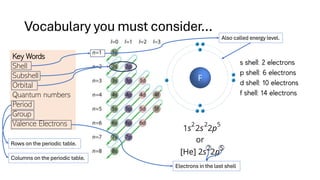
Vocabulary you must consider…
Key Words
Shell
Subshell
Orbital
Quantum numbers
Period
Group
Valence Electrons
Rows on the periodic table.
Columns on the periodic table.
Electrons in the last shell
Also called energy level.
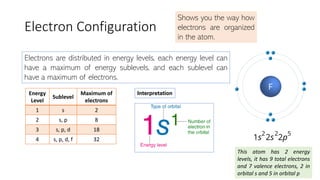
Electron Configuration
Shows you the way how
electrons are organized
in the atom.
Electrons are distributed in energy levels, each energy level can
have a maximum of energy sublevels, and each sublevel can
have a maximum of electrons.
Energy
Level
Sublevel
Maximum of
electrons
1 s 2
2 s, p 8
3 s, p, d 18
4 s, p, d, f 32
Interpretation
This atom has 2 energy
levels, it has 9 total electrons
and 7 valence electrons, 2 in
orbital s and 5 in orbital p
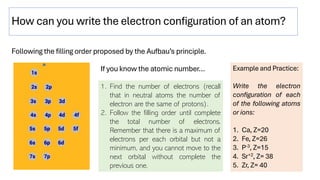
How can you write the electron configuration of an atom?
Following the filling order proposed by the Aufbau’s principle.
If you know the atomic number…
1. Find the number of electrons (recall
that in neutral atoms the number of
electron are the same of protons).
2. Follow the filling order until complete
the total number of electrons.
Remember that there is a maximum of
electrons per each orbital but not a
minimum, and you cannot move to the
next orbital without complete the
previous one.
Example and Practice:
Write the electron
configuration of each
of the following atoms
or ions:
1. Ca, Z=20
2. Fe, Z=26
3. P-3, Z=15
4. Sr+2, Z= 38
5. Zr, Z= 40
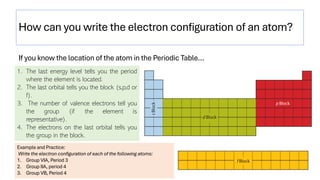
How can you write the electron configuration of an atom?
If you know the location of the atom in the Periodic Table…
1. The last energy level tells you the period
where the element is located.
2. The last orbital tells you the block (s,p,d or
f).
3. The number of valence electrons tell you
the group (if the element is
representative).
4. The electrons on the last orbital tells you
the group in the block.
Example and Practice:
Write the electron configuration of each of the following atoms:
1. Group VIA, Period 3
2. Group IIA, period 4
3. Group VB, Period 4
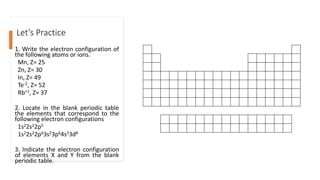
Let’s Practice
1. Write the electron configuration of
the following atoms or ions.
Mn, Z= 25
Zn, Z= 30
In, Z= 49
Te-2, Z= 52
Rb+1, Z= 37
2. Locate in the blank periodic table
the elements that correspond to the
following electron configurations
1s22s22p5
1s22s22p63s23p64s23d8
3. Indicate the electron configuration
of elements X and Y from the blank
periodic table.

Electron Configuration for 9th grade students

  • 1.
    Electron Configuration The setof numbers used to describe the position and energy of the electron in an atom.
  • 2.
    From Previous Topic… Thismeans that if we know the number of protons (atomic number) it is easily to know the number of electrons for an atom. Neutral Atom # of Protons (+) = # of Electrons (-) Ions Could be (+) or (-) charged. Are formed when an atom loses or gains electrons. (+) are cations (-) are anions Less e- More e-
  • 3.
    The exact positionand momentum of an electron cannot be simultaneously determined… But we can predict it by using the electron configuration. Uncertainty Principle proposed by Heisenberg Erwin Schrödinger developed the Quantum Mechanical model It can be used to calculate the probability of an electron being found at a given position. It has 4 numbers that can describe the position and energy of electrons, they are called Quantum Numbers
  • 4.
    Quantum Numbers Example: An atomis in period 2, and it is in group VIA. The quantum numbers related will be: n = 1,2 l = 0,1 ml = -1,0,1 l = 0 → s l = 1 → p l = 2 → d l = 3 → f Two energy levels or shells. Two orbitals s, p. Three orbital Orientations
  • 5.
    Vocabulary you mustconsider… Key Words Shell Subshell Orbital Quantum numbers Period Group Valence Electrons Rows on the periodic table. Columns on the periodic table. Electrons in the last shell Also called energy level.
  • 6.
    Electron Configuration Shows youthe way how electrons are organized in the atom. Electrons are distributed in energy levels, each energy level can have a maximum of energy sublevels, and each sublevel can have a maximum of electrons. Energy Level Sublevel Maximum of electrons 1 s 2 2 s, p 8 3 s, p, d 18 4 s, p, d, f 32 Interpretation This atom has 2 energy levels, it has 9 total electrons and 7 valence electrons, 2 in orbital s and 5 in orbital p
  • 7.
    How can youwrite the electron configuration of an atom? Following the filling order proposed by the Aufbau’s principle. If you know the atomic number… 1. Find the number of electrons (recall that in neutral atoms the number of electron are the same of protons). 2. Follow the filling order until complete the total number of electrons. Remember that there is a maximum of electrons per each orbital but not a minimum, and you cannot move to the next orbital without complete the previous one. Example and Practice: Write the electron configuration of each of the following atoms or ions: 1. Ca, Z=20 2. Fe, Z=26 3. P-3, Z=15 4. Sr+2, Z= 38 5. Zr, Z= 40
  • 8.
    How can youwrite the electron configuration of an atom? If you know the location of the atom in the Periodic Table… 1. The last energy level tells you the period where the element is located. 2. The last orbital tells you the block (s,p,d or f). 3. The number of valence electrons tell you the group (if the element is representative). 4. The electrons on the last orbital tells you the group in the block. Example and Practice: Write the electron configuration of each of the following atoms: 1. Group VIA, Period 3 2. Group IIA, period 4 3. Group VB, Period 4
  • 9.
    Let’s Practice 1. Writethe electron configuration of the following atoms or ions. Mn, Z= 25 Zn, Z= 30 In, Z= 49 Te-2, Z= 52 Rb+1, Z= 37 2. Locate in the blank periodic table the elements that correspond to the following electron configurations 1s22s22p5 1s22s22p63s23p64s23d8 3. Indicate the electron configuration of elements X and Y from the blank periodic table.