DISASTER
READINESS
AND RISK
REDUCTION
ALYSSA MAE ANTONIO
LEARNING COMPETENCIES:
1. Interpret different earthquake hazard maps; (DRR11/12-
If-g-20)
2. Apply precautionary and safety measures before,
during, and after an earthquake. (DRR11/12-If-g-21)
3. Explain various volcano-related hazards; (DRR11/12-Ih-i-
22)
4. Differentiate among different volcano hazards;
(DRR11/12-Ih-i-23)
5. Recognize signs of an impending volcanic eruption;
(DRR11/12-Ih-i-24)
6. Interpret different volcano hazard maps; (DRR11/12-Ih-i-
25)
7. Apply appropriate measures/interventions before,
Different
Earthquake
Hazard Maps
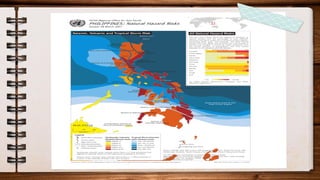
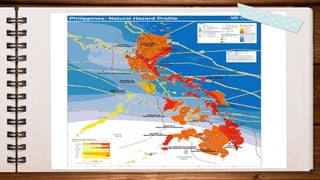
1. Presented below are different
Hazard Maps of the Philippines
designed by OCHA Regional Office
for Asia and the Pacific, and
PHIVOLCS.
- Learn to interpret each map by
giving attention to the color
codes and scalar system applied.
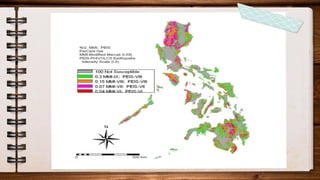
2. Earthquake - induced Landslide
Susceptibility Map
● Earthquake-triggered Landslide
Susceptibility Map Based on
Critical Acceleration Values and
Earthquake Intensities
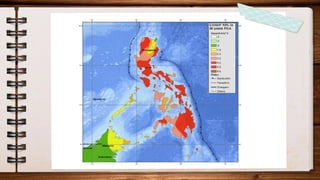
3. Seismic Hazard and Structures in
the Philippines
4. Floods and Landslide Hazard
Map
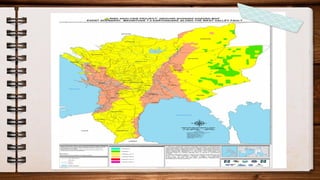
5. Ground Shaking Hazard Map
What to Do
Before,
During and
After an
Earthquake
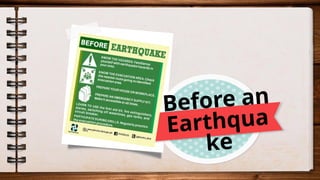
Before an
Earthqua
ke
1. Engage yourself in training activities
that promote safety and disaster
preparedness.
2. Participate in government-initiated
earthquake drills and evacuation drills.
3. Some private companies provide
training on emergency response skills.
Participate. This is part of your
preparation.
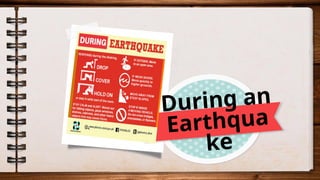
During an
Earthqua
ke
1. Stay indoors if you are within a
structurally sound building or
home.
2. If you feel the building were not
safe, quickly open the door for exit.
3. If you’re caught inside a room or
building, duck under a sturdy desk
or table, and hold on to it, or
protect your head with your hands
or arms.
5. Beware of falling objects. Be
alert and keep your eyes open.
6. Meanwhile, those who are
outside should move to an open
area, and follow these safety
measures (PHIVOLCS):
- Stay away from trees,
power lines, posts, and
concrete structures.
- Move away from steep slopes
which may be affected by
landslides.
- If near the shore and feeling an
earthquake, especially a strong
one, quickly move to higher
grounds in anticipation of
possible tsunamis.
7. Those who are in a moving vehicle
should stop and get out. Do not attempt
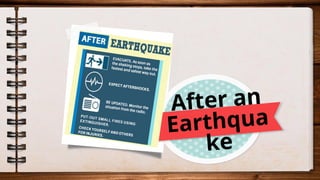
After an
Earthqua
ke
- Immediately after an earthquake:
1. Take the fastest and safest
way out of the building.
2. Do not use elevators.
3. Do not enter damaged
buildings.
4. Do not use telephones unless
necessary.
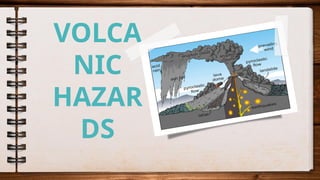
VOLCA
NIC
HAZAR
DS
- Volcanoes can be exciting and
fascinating because of their natural
formation, but they can also be very
dangerous.
- Any kind of active volcano is capable
of creating harmful or deadly
hazards, whether during an eruption
or a period of quiescence.
- Understanding what a volcano can
- However, it is noteworthy that even
if scientists have studied volcanoes
for decades, they do not
necessarily know everything about
what they are capable of.
- Volcanoes are natural systems, and
they always have some elements of
unpredictability.
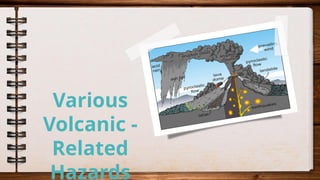
Various
Volcanic -
Related
Hazards
- Volcanologists are always
working to understand how
volcanic hazards behave, and
what can be done to avoid them.
- USGS Bulletin enumerates a few
of the more common volcanic
hazards, and some of the ways in
which they are formed and
behave.
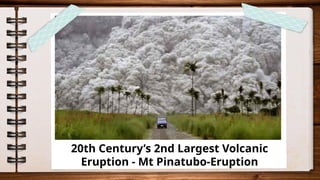
20th Century’s 2nd Largest Volcanic
Eruption - Mt Pinatubo-Eruption
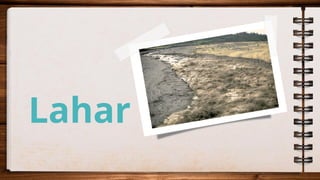
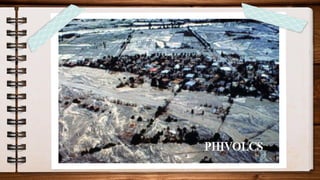
Lahar
- Lahars are a specific kind of
mudflow made up of volcanic
debris.
- They can form in a number of
situations, namely,
1. when small slope collapses
gather water on their way
down a volcano,
2. through rapid melting of snow
3. from heavy rainfall on loose
volcanic debris,
4. when a volcano erupts through a
crater lake, or
5. when a crater lake drains because
of overflow or wall collapse.
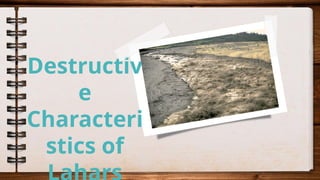
Destructiv
e
Characteri
stics of
1. Lahars move rapidly down valleys
like rivers of concrete.
2. Lahars can occur with or without a
volcanic eruption.
3. Lahars pick up material as they
travel, which can cause damage to
structures in their path.
4. Lahars and excess sediment cause
serious economic and environmental
damage to river valleys and flood
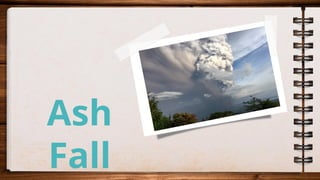
Ash
Fall
- Volcanic ash consists of
fragments of pulverized rock,
minerals and volcanic glass,
created during volcanic eruptions
and measuring less than 2 mm
(0.079 inches) in diameter.
- The term volcanic ash is also
often loosely used to refer to all
explosive eruption products
- Volcanic ash is formed during
explosive volcanic eruptions when
dissolved gases in magma expand
and escape violently into the
atmosphere.
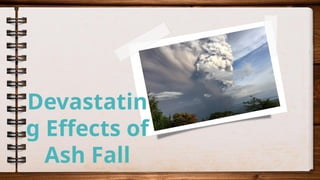
Devastatin
g Effects of
Ash Fall
- Ash fall rarely endangers human
lives, but it can have devastating
effects on the things that people
rely upon from day to day living.
- As a result of its fine-grained
abrasive character and widespread
distribution by wind, ash fall and
volcanic ash clouds are a major
hazard to aviation.
- Ash fallout to the ground can pose
significant disruption and damage to
buildings, transportation, water and
wastewater, power supply,
communications equipment,
agriculture, and primary production
leading to potentially substantial
societal impacts and costs, even at
thicknesses of only a few millimeters
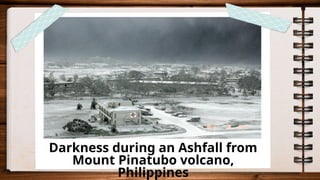
Darkness during an Ashfall from
Mount Pinatubo volcano,
Philippines
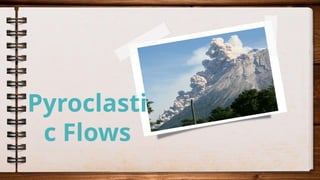
Pyroclasti
c Flows
- Pyroclastic flows contain a high-density mix
of hot lava blocks, pumice, ash and volcanic
gas.
- They move at very high speed down
volcanic slopes, typically following valleys.
- Most pyroclastic flows consist of two parts:
a lower (basal) flow of coarse fragments
that moves along the ground, and a
turbulent cloud of ash that rises above the
basal flow.
- Ash may fall from this cloud over a wide
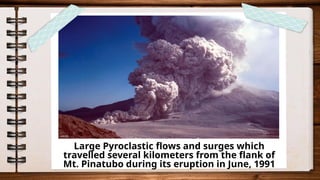
Large Pyroclastic flows and surges which
travelled several kilometers from the flank of
Mt. Pinatubo during its eruption in June, 1991
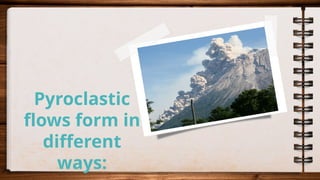
Pyroclastic
flows form in
different
ways:
- Collapse of eruption column:
during a highly explosive
eruption, the column ejected
upwards into the atmosphere
cools and can become too cool
and dense to maintain upward
momentum.
- “Boiling over” from an eruptive
vent: during an explosive
- Collapse of lava domes or flows:
The fronts of lava flows or domes
can become so steep that they
collapse due to gravitational force.
Volcanic
Gases
- Magma contains dissolved gases,
which provide the driving force that
causes most volcanic eruptions.
- As magma rises towards the
surface and pressure decreases,
gases are released from the liquid
portion of the magma (melt) and
continue to travel upward and are
eventually released into the
- Large eruptions can release enormous
amounts of gas in a short time.
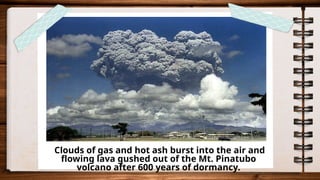
- The 1991 eruption of Mt. Pinatubo is
thought to have injected more than
250 megatons of gas into the upper
atmosphere on a single day.
- However, even if magma never
reaches the surface, gases can often
escape continuously into the
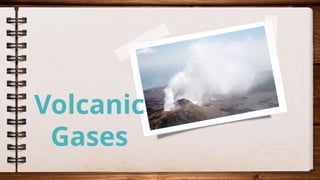
Clouds of gas and hot ash burst into the air and
flowing lava gushed out of the Mt. Pinatubo
volcano after 600 years of dormancy.
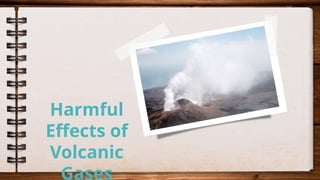
Harmful
Effects of
Volcanic
Gases
- By far the most abundant volcanic gas
is water vapor, which is harmless.
- However, significant amounts of carbon
dioxide, sulfur dioxide, hydrogen
sulfide and hydrogen halides can also
be emitted from volcanoes.
- Depending on their concentrations,
these gases are all potentially
hazardous to people, animals,
agriculture, and property.
- The harmful effects of these gases
are summarized below:
1. Carbon dioxide (CO2) trapped in low-
lying areas can be lethal to people
and animals.
2. Sulfur dioxide (SO2) is irritating to the
eyes, skin and respiratory system.
3. Hydrogen sulfide (H2S) is very toxic in
high concentrations.
4. Hydrogen halides (HF, HCI, HBr) are
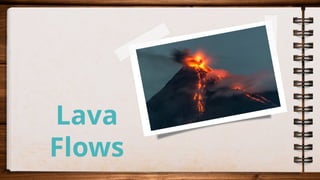
Lava
Flows
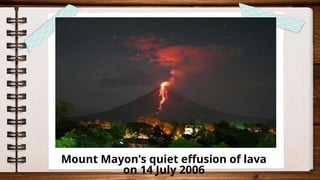
- Lava flows are streams of
molten rock that pour or ooze
from an erupting vent.
- Lava is erupted during either
non-explosive activity or
explosive lava fountains.
- The speed at which lava moves
across the ground depends on
several factors, including (1) type of
lava erupted and its viscosity; (2)
steepness of the ground over which
it travels; (3) whether the lava flows
as a broad sheet, through a
confined channel, or down a lava
tube; and (4) rate of lava production
Mount Mayon's quiet effusion of lava
on 14 July 2006
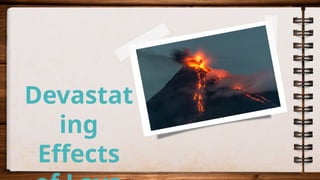
Devastat
ing
Effects
1. Lava flows may instigate other types
of hazards.
2. Everything in the path of an advancing
lava flow will be knocked over,
surrounded, buried, or ignited by the
extremely hot temperature of lava.
3. When lava erupts beneath a glacier or
flows over snow and ice, melt water
from the ice and snow can result in
4. If it enters a body of water or water
enters a lava tube, the water may boil
violently and cause an explosive shower
of molten spatter over a wide area.
5. Methane gas, produced as lava buries
vegetation, can migrate in subsurface
voids and explode when heated.
6. Thick viscous lava flows, especially
those that build a dome, can collapse to
form fast-moving pyroclastic flows.
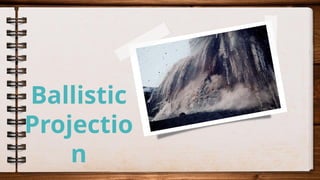
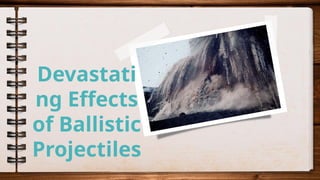
Ballistic
Projectio
n
- Volcanic explosions can propel
rock fragments on ballistic
trajectories that may differ from
the wind direction.
- These are known as ballistic
projectiles.
- Ballistic projectiles are rocks that
an erupting volcano may hurl into
the air.
- These blocks and bombs travel like
- These events may occur without
warning and in the absence of a
larger magmatic eruption.
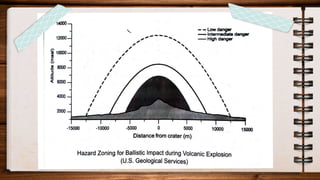
- More typically, ballistic
projectiles are limited to within
about 5 km (3 mi) of vents.
- (See Illustration below)
Devastati
ng Effects
of Ballistic
Projectiles
- Tephra falls and ballistic projectiles
endanger life and property by:
1. the force of impact of falling
fragments, but this occurs only
close to an eruption;
2. loss of agricultural lands if burial is
greater than 10 cm depth;
3. producing suspensions of fine-
grained particles in air and water which
clogs filters and vents of motors,
human lungs, industrial machines, and
nuclear power plants;
4. carrying of noxious gases, acids, salts,
and, close to the vent, heat; and
5. burial by tephra can collapse roofs of
buildings, break power and
Signs of an
Impending
Volcanic
Eruption
- The following are
some of the
observable signs
volcanologists have
identified when a
volcano is about to
erupt:
●Most volcanoes provide
various types of warnings
before eruptions begin.
- Although an
explosive
eruption could
occur without
warning, some
premonitory
events more
likely will
precede the
- Steam-blast
eruptions
could occur
with little or no
warning as
superheated
water flashes
to steam.
- Magmatic
eruptions,
however,
involve a rise of
magma toward
the surface.
- Such an upward
movement of
magma
- earthquakes,
may deform the
ground surface,
and may cause
anomalous heat
flow or changes
in the
temperature and
chemistry of the
groundwater and
●People living near
volcanoes may detect
premonitory events before
an eruption.
- Both the
frequency of
occurrence and
intensity of felt
earthquakes
commonly
increase before
eruptions
begin.
- Eruptions may
also be preceded
by noticeable
steaming or
fumarolic activity
and perhaps by
new or enlarged
areas of hot
ground.
- However, most
precursory
changes are
subtle and the
most effective
means of
monitoring are
instrumental and
include a variety
of geophysical,
geodetic, and
- Seismometers
are used to
detect and
locate
earthquakes
associated with
the rise of
magma.
- Swelling of the
ground surface
can be detected
by using
precision
instruments
and techniques
that measure
minute
- changes in slope,
distance, or
elevation at the
ground surface.
●Measurement of
Changes in Heat Flow
- Other techniques
involve
measurement of
changes in heat
flow at a volcano
by repeated
infrared surveys
or by direct
measurements of
hot spring or
- Changes in the
composition or
relative
abundances of
fumarolic gases
may also precede
eruptions and
can be detected
by frequent or
continuous
- These and
other types of
monitoring
may be useful
in detecting
warning signs
of an
impending
eruption.
●Detection and
Interpretation of
Precursory Events
- The overall
success of a
monitoring
system depends
on detection and
interpretation of
precursory events
in time to warn
and evacuate
people from
threatened areas
and to initiate
- Although
monitoring systems
may be useful in
indicating an
increase in the
probability of
volcanic activity and
its possible location,
they typically do not
indicate the kind or
scale of an expected
eruption,
particularly the first
magmatic event, or
- Precursors to
volcanic activity
may continue for
weeks, months, or
even years before
eruptive activity
begins, or they can
subside at any time
and not be
followed by an
eruption.
- Thus, monitoring
of volcanic
precursors may
provide a general
warning that
volcanic activity in
a specific area is
becoming more
likely, but it often
does not pinpoint
the nature or
timing of an
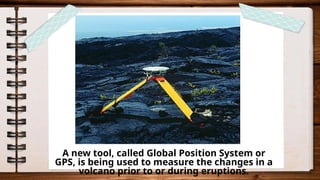
A new tool, called Global Position System or
GPS, is being used to measure the changes in a
volcano prior to or during eruptions.
Interpreting
Different
Volcano Hazard
Maps
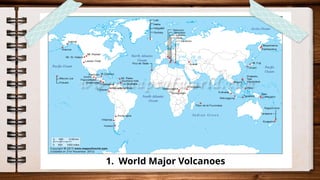
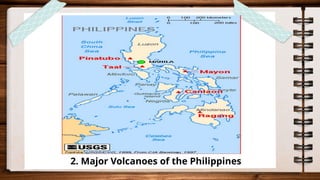
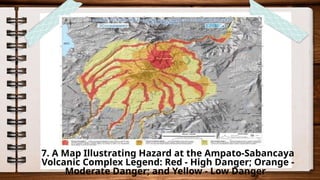
- On the succeeding pages are different
Volcano Hazard Maps.
- The first two maps show the
locations/sites of active and major
volcanoes in different parts of the
globe and in the Philippines
respectively.
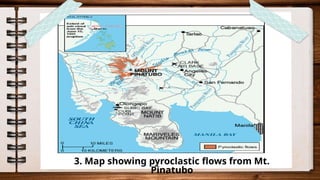
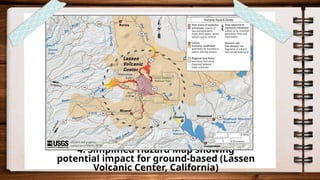
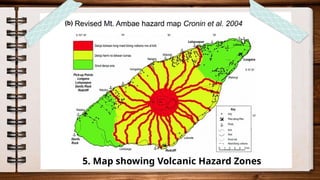
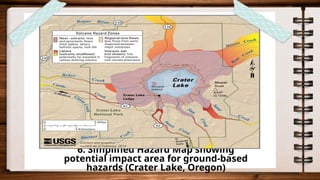
- The other maps indicate potential
hazard zones, extent of vulnerability,
potential impact areas and possible
- Read the maps one by one and learn how to
interpret them.
- The maps show different data and
information by employing color codes and a
scalar system of illustration.
- Knowing how to interpret volcano hazard
maps may help in drawing emergency plans
in the event of volcanic eruption, and in
taking precautionary measures even before
the event of volcanic eruption, and in taking
precautionary measures even before the
1. World Major Volcanoes
2. Major Volcanoes of the Philippines
3. Map showing pyroclastic flows from Mt.
Pinatubo
4. Simplified Hazard Map showing
potential impact for ground-based (Lassen
Volcanic Center, California)
5. Map showing Volcanic Hazard Zones
6. Simplified Hazard Map showing
potential impact area for ground-based
hazards (Crater Lake, Oregon)
7. A Map Illustrating Hazard at the Ampato-Sabancaya
Volcanic Complex Legend: Red - High Danger; Orange -
Moderate Danger; and Yellow - Low Danger
Precautionar
y measures
before,
during and
after
volcanic
eruption
- There are dangers that volcanic
eruptions pose to people so it is
important that they know how to
handle situations before, during and
after volcanic eruptions to avoid
serious problems.
- The following are precautionary
measures before, during and after
volcanic eruption that may help save
lives: (Adopted from PHIVOLCS
- Be aware of the dangers that volcanic
eruptions pose to lives and be
prepared to face whatever
circumstances the eruption may bring.
- Prepare all necessary things to bring
once evacuation is needed. Those in
danger zones are warned when to
evacuate. Once given the signal, obey
instructions. Refusing to evacuate will
Before volcanic
eruption:
- Store as much food, water, light
sources and batteries that are very
useful in case of emergency.
- Volcanic eruptions have ash falls so be
prepared for masks or anything to
cover nose and mouth.
- Prioritize the safety of children and
the elderly before other things. Take
them to relatives who are far from the
volcano, and let them stay there until
Before volcanic
eruption:
- Avoid all low-lying places because lava flows
and mudflows are more likely to pass here.
- Seek cover in case of pyroclastic falls and
ballistic projectiles.
- Use masks and cover your mouth and nose to
avoid breathing in ashes.
- If inside a house, close all doors and windows
to avoid ashes from getting inside. Stay
indoors.
- If evacuated, stay in the evacuation center
until further instructions. Do not attempt to
During volcanic
eruption:
- Check the house and place if it is
already safe.
- Clean everything around and check all
damages incurred.
- Use masks while cleaning ash and
other debris.
- Wait for further announcements
related to the volcano activities.
- Make sure that house is still safe for
the whole family.
After volcanic
eruption:

CORE11-A_W5Q3.pptxxxxxxxxxxxxxxxxxxxxxxxxxxx

  • 1.
  • 2.
    LEARNING COMPETENCIES: 1. Interpretdifferent earthquake hazard maps; (DRR11/12- If-g-20) 2. Apply precautionary and safety measures before, during, and after an earthquake. (DRR11/12-If-g-21) 3. Explain various volcano-related hazards; (DRR11/12-Ih-i- 22) 4. Differentiate among different volcano hazards; (DRR11/12-Ih-i-23) 5. Recognize signs of an impending volcanic eruption; (DRR11/12-Ih-i-24) 6. Interpret different volcano hazard maps; (DRR11/12-Ih-i- 25) 7. Apply appropriate measures/interventions before,
  • 3.
  • 4.
    1. Presented beloware different Hazard Maps of the Philippines designed by OCHA Regional Office for Asia and the Pacific, and PHIVOLCS. - Learn to interpret each map by giving attention to the color codes and scalar system applied.
  • 6.
    2. Earthquake -induced Landslide Susceptibility Map ● Earthquake-triggered Landslide Susceptibility Map Based on Critical Acceleration Values and Earthquake Intensities
  • 8.
    3. Seismic Hazardand Structures in the Philippines
  • 10.
    4. Floods andLandslide Hazard Map
  • 12.
  • 14.
    What to Do Before, Duringand After an Earthquake
  • 15.
  • 16.
    1. Engage yourselfin training activities that promote safety and disaster preparedness. 2. Participate in government-initiated earthquake drills and evacuation drills. 3. Some private companies provide training on emergency response skills. Participate. This is part of your preparation.
  • 17.
  • 18.
    1. Stay indoorsif you are within a structurally sound building or home. 2. If you feel the building were not safe, quickly open the door for exit. 3. If you’re caught inside a room or building, duck under a sturdy desk or table, and hold on to it, or protect your head with your hands or arms.
  • 19.
    5. Beware offalling objects. Be alert and keep your eyes open. 6. Meanwhile, those who are outside should move to an open area, and follow these safety measures (PHIVOLCS): - Stay away from trees, power lines, posts, and concrete structures.
  • 20.
    - Move awayfrom steep slopes which may be affected by landslides. - If near the shore and feeling an earthquake, especially a strong one, quickly move to higher grounds in anticipation of possible tsunamis. 7. Those who are in a moving vehicle should stop and get out. Do not attempt
  • 21.
  • 22.
    - Immediately afteran earthquake: 1. Take the fastest and safest way out of the building. 2. Do not use elevators. 3. Do not enter damaged buildings. 4. Do not use telephones unless necessary.
  • 23.
  • 24.
    - Volcanoes canbe exciting and fascinating because of their natural formation, but they can also be very dangerous. - Any kind of active volcano is capable of creating harmful or deadly hazards, whether during an eruption or a period of quiescence. - Understanding what a volcano can
  • 25.
    - However, itis noteworthy that even if scientists have studied volcanoes for decades, they do not necessarily know everything about what they are capable of. - Volcanoes are natural systems, and they always have some elements of unpredictability.
  • 26.
  • 27.
    - Volcanologists arealways working to understand how volcanic hazards behave, and what can be done to avoid them. - USGS Bulletin enumerates a few of the more common volcanic hazards, and some of the ways in which they are formed and behave.
  • 28.
    20th Century’s 2ndLargest Volcanic Eruption - Mt Pinatubo-Eruption
  • 29.
  • 30.
    - Lahars area specific kind of mudflow made up of volcanic debris. - They can form in a number of situations, namely, 1. when small slope collapses gather water on their way down a volcano, 2. through rapid melting of snow
  • 31.
    3. from heavyrainfall on loose volcanic debris, 4. when a volcano erupts through a crater lake, or 5. when a crater lake drains because of overflow or wall collapse.
  • 32.
  • 33.
    1. Lahars moverapidly down valleys like rivers of concrete. 2. Lahars can occur with or without a volcanic eruption. 3. Lahars pick up material as they travel, which can cause damage to structures in their path. 4. Lahars and excess sediment cause serious economic and environmental damage to river valleys and flood
  • 35.
  • 36.
    - Volcanic ashconsists of fragments of pulverized rock, minerals and volcanic glass, created during volcanic eruptions and measuring less than 2 mm (0.079 inches) in diameter. - The term volcanic ash is also often loosely used to refer to all explosive eruption products
  • 37.
    - Volcanic ashis formed during explosive volcanic eruptions when dissolved gases in magma expand and escape violently into the atmosphere.
  • 38.
  • 39.
    - Ash fallrarely endangers human lives, but it can have devastating effects on the things that people rely upon from day to day living. - As a result of its fine-grained abrasive character and widespread distribution by wind, ash fall and volcanic ash clouds are a major hazard to aviation.
  • 40.
    - Ash falloutto the ground can pose significant disruption and damage to buildings, transportation, water and wastewater, power supply, communications equipment, agriculture, and primary production leading to potentially substantial societal impacts and costs, even at thicknesses of only a few millimeters
  • 41.
    Darkness during anAshfall from Mount Pinatubo volcano, Philippines
  • 42.
  • 43.
    - Pyroclastic flowscontain a high-density mix of hot lava blocks, pumice, ash and volcanic gas. - They move at very high speed down volcanic slopes, typically following valleys. - Most pyroclastic flows consist of two parts: a lower (basal) flow of coarse fragments that moves along the ground, and a turbulent cloud of ash that rises above the basal flow. - Ash may fall from this cloud over a wide
  • 44.
    Large Pyroclastic flowsand surges which travelled several kilometers from the flank of Mt. Pinatubo during its eruption in June, 1991
  • 45.
  • 46.
    - Collapse oferuption column: during a highly explosive eruption, the column ejected upwards into the atmosphere cools and can become too cool and dense to maintain upward momentum. - “Boiling over” from an eruptive vent: during an explosive
  • 47.
    - Collapse oflava domes or flows: The fronts of lava flows or domes can become so steep that they collapse due to gravitational force.
  • 48.
  • 49.
    - Magma containsdissolved gases, which provide the driving force that causes most volcanic eruptions. - As magma rises towards the surface and pressure decreases, gases are released from the liquid portion of the magma (melt) and continue to travel upward and are eventually released into the
  • 50.
    - Large eruptionscan release enormous amounts of gas in a short time. - The 1991 eruption of Mt. Pinatubo is thought to have injected more than 250 megatons of gas into the upper atmosphere on a single day. - However, even if magma never reaches the surface, gases can often escape continuously into the
  • 51.
    Clouds of gasand hot ash burst into the air and flowing lava gushed out of the Mt. Pinatubo volcano after 600 years of dormancy.
  • 52.
  • 53.
    - By farthe most abundant volcanic gas is water vapor, which is harmless. - However, significant amounts of carbon dioxide, sulfur dioxide, hydrogen sulfide and hydrogen halides can also be emitted from volcanoes. - Depending on their concentrations, these gases are all potentially hazardous to people, animals, agriculture, and property.
  • 54.
    - The harmfuleffects of these gases are summarized below: 1. Carbon dioxide (CO2) trapped in low- lying areas can be lethal to people and animals. 2. Sulfur dioxide (SO2) is irritating to the eyes, skin and respiratory system. 3. Hydrogen sulfide (H2S) is very toxic in high concentrations. 4. Hydrogen halides (HF, HCI, HBr) are
  • 55.
  • 56.
    - Lava flowsare streams of molten rock that pour or ooze from an erupting vent. - Lava is erupted during either non-explosive activity or explosive lava fountains.
  • 57.
    - The speedat which lava moves across the ground depends on several factors, including (1) type of lava erupted and its viscosity; (2) steepness of the ground over which it travels; (3) whether the lava flows as a broad sheet, through a confined channel, or down a lava tube; and (4) rate of lava production
  • 58.
    Mount Mayon's quieteffusion of lava on 14 July 2006
  • 59.
  • 60.
    1. Lava flowsmay instigate other types of hazards. 2. Everything in the path of an advancing lava flow will be knocked over, surrounded, buried, or ignited by the extremely hot temperature of lava. 3. When lava erupts beneath a glacier or flows over snow and ice, melt water from the ice and snow can result in
  • 61.
    4. If itenters a body of water or water enters a lava tube, the water may boil violently and cause an explosive shower of molten spatter over a wide area. 5. Methane gas, produced as lava buries vegetation, can migrate in subsurface voids and explode when heated. 6. Thick viscous lava flows, especially those that build a dome, can collapse to form fast-moving pyroclastic flows.
  • 62.
  • 63.
    - Volcanic explosionscan propel rock fragments on ballistic trajectories that may differ from the wind direction. - These are known as ballistic projectiles. - Ballistic projectiles are rocks that an erupting volcano may hurl into the air. - These blocks and bombs travel like
  • 64.
    - These eventsmay occur without warning and in the absence of a larger magmatic eruption. - More typically, ballistic projectiles are limited to within about 5 km (3 mi) of vents. - (See Illustration below)
  • 66.
  • 67.
    - Tephra fallsand ballistic projectiles endanger life and property by: 1. the force of impact of falling fragments, but this occurs only close to an eruption; 2. loss of agricultural lands if burial is greater than 10 cm depth;
  • 68.
    3. producing suspensionsof fine- grained particles in air and water which clogs filters and vents of motors, human lungs, industrial machines, and nuclear power plants; 4. carrying of noxious gases, acids, salts, and, close to the vent, heat; and 5. burial by tephra can collapse roofs of buildings, break power and
  • 69.
  • 70.
    - The followingare some of the observable signs volcanologists have identified when a volcano is about to erupt:
  • 71.
    ●Most volcanoes provide varioustypes of warnings before eruptions begin.
  • 72.
    - Although an explosive eruptioncould occur without warning, some premonitory events more likely will precede the - Steam-blast eruptions could occur with little or no warning as superheated water flashes to steam.
  • 73.
    - Magmatic eruptions, however, involve arise of magma toward the surface. - Such an upward movement of magma - earthquakes, may deform the ground surface, and may cause anomalous heat flow or changes in the temperature and chemistry of the groundwater and
  • 74.
    ●People living near volcanoesmay detect premonitory events before an eruption.
  • 75.
    - Both the frequencyof occurrence and intensity of felt earthquakes commonly increase before eruptions begin. - Eruptions may also be preceded by noticeable steaming or fumarolic activity and perhaps by new or enlarged areas of hot ground.
  • 76.
    - However, most precursory changesare subtle and the most effective means of monitoring are instrumental and include a variety of geophysical, geodetic, and - Seismometers are used to detect and locate earthquakes associated with the rise of magma.
  • 77.
    - Swelling ofthe ground surface can be detected by using precision instruments and techniques that measure minute - changes in slope, distance, or elevation at the ground surface.
  • 78.
  • 79.
    - Other techniques involve measurementof changes in heat flow at a volcano by repeated infrared surveys or by direct measurements of hot spring or - Changes in the composition or relative abundances of fumarolic gases may also precede eruptions and can be detected by frequent or continuous
  • 80.
    - These and othertypes of monitoring may be useful in detecting warning signs of an impending eruption.
  • 81.
  • 82.
    - The overall successof a monitoring system depends on detection and interpretation of precursory events in time to warn and evacuate people from threatened areas and to initiate - Although monitoring systems may be useful in indicating an increase in the probability of volcanic activity and its possible location, they typically do not indicate the kind or scale of an expected eruption, particularly the first magmatic event, or
  • 83.
    - Precursors to volcanicactivity may continue for weeks, months, or even years before eruptive activity begins, or they can subside at any time and not be followed by an eruption. - Thus, monitoring of volcanic precursors may provide a general warning that volcanic activity in a specific area is becoming more likely, but it often does not pinpoint the nature or timing of an
  • 84.
    A new tool,called Global Position System or GPS, is being used to measure the changes in a volcano prior to or during eruptions.
  • 85.
  • 86.
    - On thesucceeding pages are different Volcano Hazard Maps. - The first two maps show the locations/sites of active and major volcanoes in different parts of the globe and in the Philippines respectively. - The other maps indicate potential hazard zones, extent of vulnerability, potential impact areas and possible
  • 87.
    - Read themaps one by one and learn how to interpret them. - The maps show different data and information by employing color codes and a scalar system of illustration. - Knowing how to interpret volcano hazard maps may help in drawing emergency plans in the event of volcanic eruption, and in taking precautionary measures even before the event of volcanic eruption, and in taking precautionary measures even before the
  • 88.
    1. World MajorVolcanoes
  • 89.
    2. Major Volcanoesof the Philippines
  • 90.
    3. Map showingpyroclastic flows from Mt. Pinatubo
  • 91.
    4. Simplified HazardMap showing potential impact for ground-based (Lassen Volcanic Center, California)
  • 92.
    5. Map showingVolcanic Hazard Zones
  • 93.
    6. Simplified HazardMap showing potential impact area for ground-based hazards (Crater Lake, Oregon)
  • 94.
    7. A MapIllustrating Hazard at the Ampato-Sabancaya Volcanic Complex Legend: Red - High Danger; Orange - Moderate Danger; and Yellow - Low Danger
  • 95.
  • 96.
    - There aredangers that volcanic eruptions pose to people so it is important that they know how to handle situations before, during and after volcanic eruptions to avoid serious problems. - The following are precautionary measures before, during and after volcanic eruption that may help save lives: (Adopted from PHIVOLCS
  • 97.
    - Be awareof the dangers that volcanic eruptions pose to lives and be prepared to face whatever circumstances the eruption may bring. - Prepare all necessary things to bring once evacuation is needed. Those in danger zones are warned when to evacuate. Once given the signal, obey instructions. Refusing to evacuate will Before volcanic eruption:
  • 98.
    - Store asmuch food, water, light sources and batteries that are very useful in case of emergency. - Volcanic eruptions have ash falls so be prepared for masks or anything to cover nose and mouth. - Prioritize the safety of children and the elderly before other things. Take them to relatives who are far from the volcano, and let them stay there until Before volcanic eruption:
  • 99.
    - Avoid alllow-lying places because lava flows and mudflows are more likely to pass here. - Seek cover in case of pyroclastic falls and ballistic projectiles. - Use masks and cover your mouth and nose to avoid breathing in ashes. - If inside a house, close all doors and windows to avoid ashes from getting inside. Stay indoors. - If evacuated, stay in the evacuation center until further instructions. Do not attempt to During volcanic eruption:
  • 100.
    - Check thehouse and place if it is already safe. - Clean everything around and check all damages incurred. - Use masks while cleaning ash and other debris. - Wait for further announcements related to the volcano activities. - Make sure that house is still safe for the whole family. After volcanic eruption: