International Research Journal of Engineering and Technology (IRJET) e-ISSN: 2395 -0056
Volume: 04 Issue: 02 | Feb -2017 www.irjet.net p-ISSN: 2395-0072
© 2017, IRJET | Impact Factor value: 5.181 | ISO 9001:2008 Certified Journal | Page 1249
Steganography System for Hiding Text and Images Using Improved LSB
Method
Deepika, Er. Jasdeep Singh Mann
Deepika, Student
Er. Jasdeep Singh Mann, Assistant Professor
BMSCE, Shri Muktsar Sahib, Punjab
----------------------------------------------------------------------***-----------------------------------------------------------------------
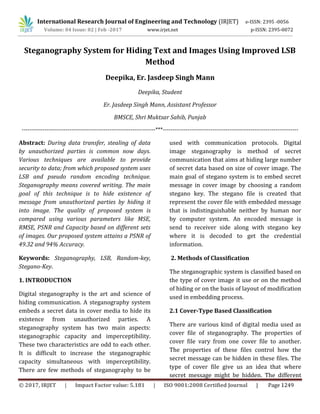
Abstract: During data transfer, stealing of data
by unauthorized parties is common now days.
Various techniques are available to provide
security to data; from which proposed system uses
LSB and pseudo random encoding technique.
Steganography means covered writing. The main
goal of this technique is to hide existence of
message from unauthorized parties by hiding it
into image. The quality of proposed system is
compared using various parameters like MSE,
RMSE, PSNR and Capacity based on different sets
of images. Our proposed system attains a PSNR of
49.32 and 94% Accuracy.
Keywords: Steganography, LSB, Random-key,
Stegano-Key.
1. INTRODUCTION
Digital steganography is the art and science of
hiding communication. A steganography system
embeds a secret data in cover media to hide its
existence from unauthorized parties. A
steganography system has two main aspects:
steganographic capacity and imperceptibility.
These two characteristics are odd to each other.
It is difficult to increase the steganographic
capacity simultaneous with imperceptibility.
There are few methods of steganography to be
used with communication protocols. Digital
image steganography is method of secret
communication that aims at hiding large number
of secret data based on size of cover image. The
main goal of stegano system is to embed secret
message in cover image by choosing a random
stegano key. The stegano file is created that
represent the cover file with embedded message
that is indistinguishable neither by human nor
by computer system. An encoded message is
send to receiver side along with stegano key
where it is decoded to get the credential
information.
2. Methods of Classification
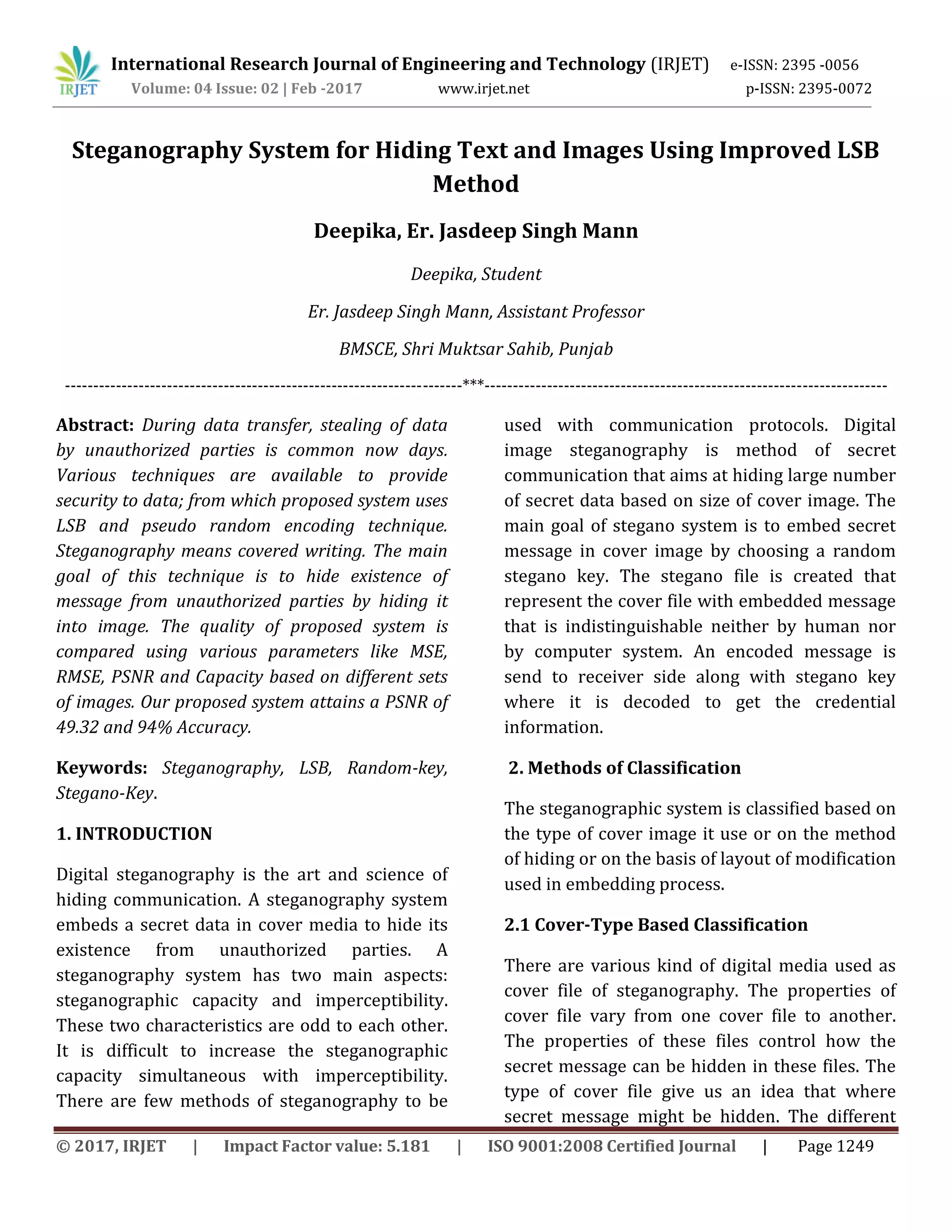
The steganographic system is classified based on
the type of cover image it use or on the method
of hiding or on the basis of layout of modification
used in embedding process.
2.1 Cover-Type Based Classification
There are various kind of digital media used as
cover file of steganography. The properties of
cover file vary from one cover file to another.
The properties of these files control how the
secret message can be hidden in these files. The
type of cover file give us an idea that where
secret message might be hidden. The different
International Research Journal of Engineering and Technology (IRJET) e-ISSN: 2395 -0056
Volume: 04 Issue: 02 | Feb -2017 www.irjet.net p-ISSN: 2395-0072
© 2017, IRJET | Impact Factor value: 5.181 | ISO 9001:2008 Certified Journal | Page 1250
kind of media cover files are image, audio, video
and text. The system that uses video as cover
image is video-based steganographic system. Our
proposed system is image-based steganographic
system.
2.2 Hiding Method-Based Classification
The other method on which steganographic
system is classified is method used to hide secret
data. There are three ways in which secret data
is hided in cover files: insertion-based,
substitution-based and generation-based
methods.
Insertion-Based Method: This method focused
on finding the areas that are usually ignored by
applications that read any type of cover image
and then embed secret data at that area. The
main condition that is size of stegano file would
be larger than the size of cover file. The main
advantage of this method is that contents of
cover file are unchanged after embedding
process.
Substitution-Based Method: As insertion-based
method, this method doesn’t base on adding
secret data to cover file. As its name suggests,
substitution-based method finds some
insignificant area in cover file and replace that
information with secret data. The size of both
stegano and cover file is similar because some of
data is either modified or replaced without any
additional data. The quality of cover file is
degraded by embedding data using this method.
Generation-Based Method: This method
doesn’t need any cover file to embed secret data.
It uses secret data to generate a stegano file. The
main advantage of this method is stegano files,
which are difficult to detect. While the main
disadvantage of this system is that the generated
stegano files might be unrealistic for end user.
3. PROPOSED ALGORITHM: The proposed
system is based on cover-based method that uses
digital image as cover image and hides the secret
message in form of text file. The main objective
of proposed system is to encode and decode the
cover image using LSB (Least Significant Bit) and
Random Improved LSB techniques. The
proposed system comprises of two components:
Embedding module and Extracting module.
Embedding Module: Embedding is the process
of hiding the embedded message and generates a
stegano image. Hiding of data may require a
stegano key which is additional information that
protects it from unauthorized parties, example-
password. When secret message is hidden within
cover image the resulting product is called as
stegano image or stegano object.
The algorithm for above method is
summarized as follows:
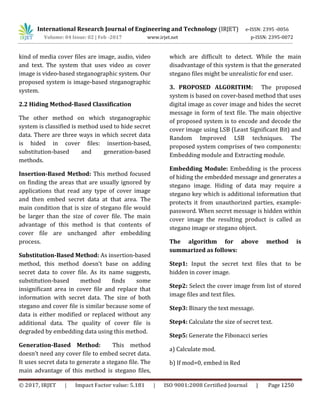
Step1: Input the secret text files that to be
hidden in cover image.
Step2: Select the cover image from list of stored
image files and text files.
Step3: Binary the text message.
Step4: Calculate the size of secret text.
Step5: Generate the Fibonacci series
a) Calculate mod.
b) If mod=0, embed in Red
International Research Journal of Engineering and Technology (IRJET) e-ISSN: 2395 -0056
Volume: 04 Issue: 02 | Feb -2017 www.irjet.net p-ISSN: 2395-0072
© 2017, IRJET | Impact Factor value: 5.181 | ISO 9001:2008 Certified Journal | Page 1251
c) If mod=1, embed in Green
d) If mod=2, embed in Blue
Step6: If I<=N, Then I=I+1, Else display the
stegano image.
Extracting Module: Extracting is process of
getting embedded message from stegano image.
The algorithm for above method is
summarized as follows:
Step1: Select the stegano image.
Step2: Count the number of pixel and store in N.
Step3: Select the Ith pixel, generate Fibonacci
series
Step4: Calculate mod.
b) If mod=0, extract from Red
c) If mod=1, extract from Green
d) If mod=2, extract from Blue
Step5: Add LSB into message.
Step6: If I<=N, Set I=I+1, Else generate ASCI
code and display the message.
4. CONCLUSION
The main aim of steganography is to embed
secret message into cover image without
knowledge of unauthorized parties. The
proposed system is based on achieving this aim
and compares the existing and proposed system.
The proposed system is tested on various set of
images with different watermarks for data
hiding. The proposed system gives 94% accurate
results.
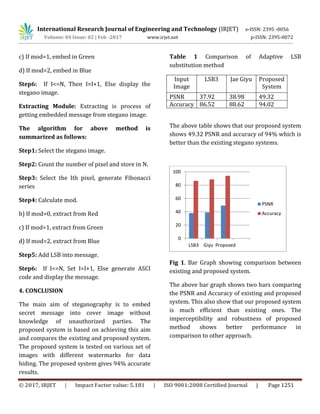
Table 1 Comparison of Adaptive LSB
substitution method
Input
Image
LSB3 Jae Giyu Proposed
System
PSNR 37.92 38.98 49.32
Accuracy 86.52 88.62 94.02
The above table shows that our proposed system
shows 49.32 PSNR and accuracy of 94% which is
better than the existing stegano systems.
Fig 1. Bar Graph showing comparison between
existing and proposed system.
The above bar graph shows two bars comparing
the PSNR and Accuracy of existing and proposed
system. This also show that our proposed system
is much efficient than existing ones. The
imperceptibility and robustness of proposed
method shows better performance in
comparison to other approach.
0
20
40
60
80
100
LSB3 Giyu Proposed
PSNR
Accuracy
International Research Journal of Engineering and Technology (IRJET) e-ISSN: 2395 -0056
Volume: 04 Issue: 02 | Feb -2017 www.irjet.net p-ISSN: 2395-0072
© 2017, IRJET | Impact Factor value: 5.181 | ISO 9001:2008 Certified Journal | Page 1252
5. REFRENCES
[1] Vijay Kumar Sharma, Vishal Shrivastavaa,
Steganography Algorithm for Hiding Image In
Image By Improved LSB Substitution By
Minimize Detection.
[2] Gurpreet Kaur, Kamaljeet Kaur, Image
Watermarking Using LSB (Least Significant Bit).
[3] Amit Singh, Susheel Jain, Anurag Jain, Digital
watermarking method using replacement of
second Least Significant Bit(LSB) with inverse of
LSB
[4] Nayan K. Dey, Suman K. Mitra, Ashish N.
Jadhav, Hybrid Scheme for Robust Digital Image
Watermarking Using Dirty Paper Trellis Codes.
[5] Lahouri Ghoti, Ahmed Bouridane,
Mohammad K. Ibrahim, and Said Boussakta,
Digital Image Watermarking Using Balanced
Multiwavelets.
[6] Amir Houmansadr, Shahrokh
Ghaemmaghami, A Digital Image Watermarking
Scheme based on Visual Cryptography.
[7] Neil F. Johnson2, Zoran Duric1, and Sushil
Jajodia2, recovery of Watermarks from Distorted
Images.
[8] Henri Bruno Razafindradina and Attumani
Mohamed Karim, Blind and Robust Images
watermarking based on Wavelet and Edge
Insertion.
[9] Prabhishek Singh, R S Chadha, A survey of
Digital Watermarking Techniques, Applications
and Attacks.
[10]Vinita Gupta, Mr. Atul Barve, A Review on
Image Watermarking and its Techniques.

Steganography System for Hiding Text and Images Using Improved LSB Method

  • 1.
    International Research Journalof Engineering and Technology (IRJET) e-ISSN: 2395 -0056 Volume: 04 Issue: 02 | Feb -2017 www.irjet.net p-ISSN: 2395-0072 © 2017, IRJET | Impact Factor value: 5.181 | ISO 9001:2008 Certified Journal | Page 1249 Steganography System for Hiding Text and Images Using Improved LSB Method Deepika, Er. Jasdeep Singh Mann Deepika, Student Er. Jasdeep Singh Mann, Assistant Professor BMSCE, Shri Muktsar Sahib, Punjab ----------------------------------------------------------------------***----------------------------------------------------------------------- Abstract: During data transfer, stealing of data by unauthorized parties is common now days. Various techniques are available to provide security to data; from which proposed system uses LSB and pseudo random encoding technique. Steganography means covered writing. The main goal of this technique is to hide existence of message from unauthorized parties by hiding it into image. The quality of proposed system is compared using various parameters like MSE, RMSE, PSNR and Capacity based on different sets of images. Our proposed system attains a PSNR of 49.32 and 94% Accuracy. Keywords: Steganography, LSB, Random-key, Stegano-Key. 1. INTRODUCTION Digital steganography is the art and science of hiding communication. A steganography system embeds a secret data in cover media to hide its existence from unauthorized parties. A steganography system has two main aspects: steganographic capacity and imperceptibility. These two characteristics are odd to each other. It is difficult to increase the steganographic capacity simultaneous with imperceptibility. There are few methods of steganography to be used with communication protocols. Digital image steganography is method of secret communication that aims at hiding large number of secret data based on size of cover image. The main goal of stegano system is to embed secret message in cover image by choosing a random stegano key. The stegano file is created that represent the cover file with embedded message that is indistinguishable neither by human nor by computer system. An encoded message is send to receiver side along with stegano key where it is decoded to get the credential information. 2. Methods of Classification The steganographic system is classified based on the type of cover image it use or on the method of hiding or on the basis of layout of modification used in embedding process. 2.1 Cover-Type Based Classification There are various kind of digital media used as cover file of steganography. The properties of cover file vary from one cover file to another. The properties of these files control how the secret message can be hidden in these files. The type of cover file give us an idea that where secret message might be hidden. The different
  • 2.
    International Research Journalof Engineering and Technology (IRJET) e-ISSN: 2395 -0056 Volume: 04 Issue: 02 | Feb -2017 www.irjet.net p-ISSN: 2395-0072 © 2017, IRJET | Impact Factor value: 5.181 | ISO 9001:2008 Certified Journal | Page 1250 kind of media cover files are image, audio, video and text. The system that uses video as cover image is video-based steganographic system. Our proposed system is image-based steganographic system. 2.2 Hiding Method-Based Classification The other method on which steganographic system is classified is method used to hide secret data. There are three ways in which secret data is hided in cover files: insertion-based, substitution-based and generation-based methods. Insertion-Based Method: This method focused on finding the areas that are usually ignored by applications that read any type of cover image and then embed secret data at that area. The main condition that is size of stegano file would be larger than the size of cover file. The main advantage of this method is that contents of cover file are unchanged after embedding process. Substitution-Based Method: As insertion-based method, this method doesn’t base on adding secret data to cover file. As its name suggests, substitution-based method finds some insignificant area in cover file and replace that information with secret data. The size of both stegano and cover file is similar because some of data is either modified or replaced without any additional data. The quality of cover file is degraded by embedding data using this method. Generation-Based Method: This method doesn’t need any cover file to embed secret data. It uses secret data to generate a stegano file. The main advantage of this method is stegano files, which are difficult to detect. While the main disadvantage of this system is that the generated stegano files might be unrealistic for end user. 3. PROPOSED ALGORITHM: The proposed system is based on cover-based method that uses digital image as cover image and hides the secret message in form of text file. The main objective of proposed system is to encode and decode the cover image using LSB (Least Significant Bit) and Random Improved LSB techniques. The proposed system comprises of two components: Embedding module and Extracting module. Embedding Module: Embedding is the process of hiding the embedded message and generates a stegano image. Hiding of data may require a stegano key which is additional information that protects it from unauthorized parties, example- password. When secret message is hidden within cover image the resulting product is called as stegano image or stegano object. The algorithm for above method is summarized as follows: Step1: Input the secret text files that to be hidden in cover image. Step2: Select the cover image from list of stored image files and text files. Step3: Binary the text message. Step4: Calculate the size of secret text. Step5: Generate the Fibonacci series a) Calculate mod. b) If mod=0, embed in Red
  • 3.
    International Research Journalof Engineering and Technology (IRJET) e-ISSN: 2395 -0056 Volume: 04 Issue: 02 | Feb -2017 www.irjet.net p-ISSN: 2395-0072 © 2017, IRJET | Impact Factor value: 5.181 | ISO 9001:2008 Certified Journal | Page 1251 c) If mod=1, embed in Green d) If mod=2, embed in Blue Step6: If I<=N, Then I=I+1, Else display the stegano image. Extracting Module: Extracting is process of getting embedded message from stegano image. The algorithm for above method is summarized as follows: Step1: Select the stegano image. Step2: Count the number of pixel and store in N. Step3: Select the Ith pixel, generate Fibonacci series Step4: Calculate mod. b) If mod=0, extract from Red c) If mod=1, extract from Green d) If mod=2, extract from Blue Step5: Add LSB into message. Step6: If I<=N, Set I=I+1, Else generate ASCI code and display the message. 4. CONCLUSION The main aim of steganography is to embed secret message into cover image without knowledge of unauthorized parties. The proposed system is based on achieving this aim and compares the existing and proposed system. The proposed system is tested on various set of images with different watermarks for data hiding. The proposed system gives 94% accurate results. Table 1 Comparison of Adaptive LSB substitution method Input Image LSB3 Jae Giyu Proposed System PSNR 37.92 38.98 49.32 Accuracy 86.52 88.62 94.02 The above table shows that our proposed system shows 49.32 PSNR and accuracy of 94% which is better than the existing stegano systems. Fig 1. Bar Graph showing comparison between existing and proposed system. The above bar graph shows two bars comparing the PSNR and Accuracy of existing and proposed system. This also show that our proposed system is much efficient than existing ones. The imperceptibility and robustness of proposed method shows better performance in comparison to other approach. 0 20 40 60 80 100 LSB3 Giyu Proposed PSNR Accuracy
  • 4.
    International Research Journalof Engineering and Technology (IRJET) e-ISSN: 2395 -0056 Volume: 04 Issue: 02 | Feb -2017 www.irjet.net p-ISSN: 2395-0072 © 2017, IRJET | Impact Factor value: 5.181 | ISO 9001:2008 Certified Journal | Page 1252 5. REFRENCES [1] Vijay Kumar Sharma, Vishal Shrivastavaa, Steganography Algorithm for Hiding Image In Image By Improved LSB Substitution By Minimize Detection. [2] Gurpreet Kaur, Kamaljeet Kaur, Image Watermarking Using LSB (Least Significant Bit). [3] Amit Singh, Susheel Jain, Anurag Jain, Digital watermarking method using replacement of second Least Significant Bit(LSB) with inverse of LSB [4] Nayan K. Dey, Suman K. Mitra, Ashish N. Jadhav, Hybrid Scheme for Robust Digital Image Watermarking Using Dirty Paper Trellis Codes. [5] Lahouri Ghoti, Ahmed Bouridane, Mohammad K. Ibrahim, and Said Boussakta, Digital Image Watermarking Using Balanced Multiwavelets. [6] Amir Houmansadr, Shahrokh Ghaemmaghami, A Digital Image Watermarking Scheme based on Visual Cryptography. [7] Neil F. Johnson2, Zoran Duric1, and Sushil Jajodia2, recovery of Watermarks from Distorted Images. [8] Henri Bruno Razafindradina and Attumani Mohamed Karim, Blind and Robust Images watermarking based on Wavelet and Edge Insertion. [9] Prabhishek Singh, R S Chadha, A survey of Digital Watermarking Techniques, Applications and Attacks. [10]Vinita Gupta, Mr. Atul Barve, A Review on Image Watermarking and its Techniques.