Useful For ITI Exam
Automotive Steering system by Pratik Rode
Function of steering system
Function :-
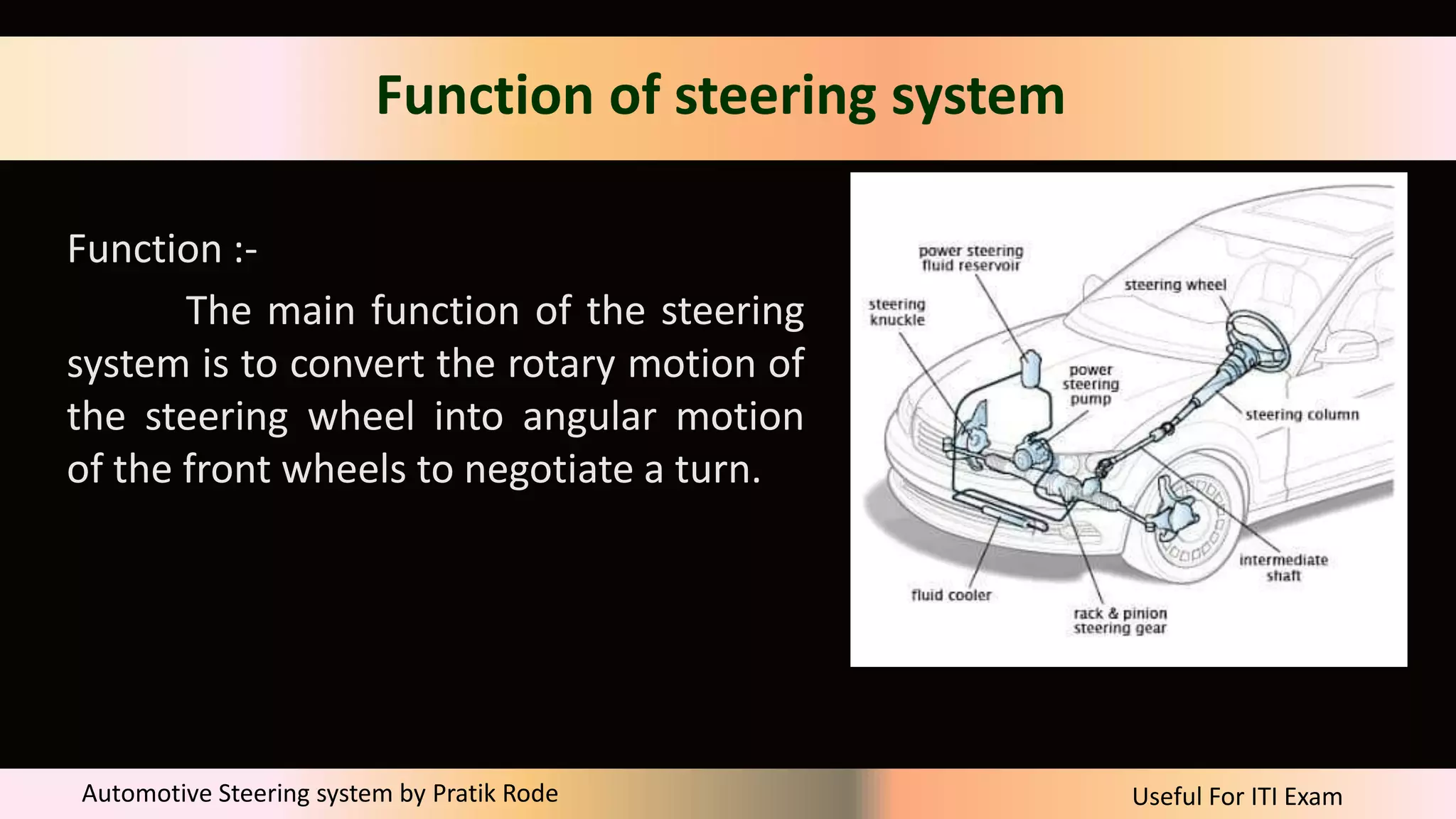
The main function of the steering
system is to convert the rotary motion of
the steering wheel into angular motion
of the front wheels to negotiate a turn.
Useful For ITI Exam
Automotive Steering system by Pratik Rode
Function
 The Secondary functions of steering system are as
follows.
I. To turn the vehicle whenever required.
II. To provide stability to the vehicle on road.
III. To provide true rolling motion of the wheels at all times.
IV. To provide self-centering action after negotiating a turn.
V. To minimize tyre wear.
VI. To multiply the driver's effort to turn the vehicle for
easy operation.
VII. To prevent road shocks reaching the driver.
Useful For ITI Exam
Automotive Steering system by Pratik Rode
Principles of steering
• The steering system along with the suspension system,
allow the driver to safely and easily control the vehicle's direction
while driving.
• steering systems use several basic principles to decrease driver
effort. These include leverage, hydraulics, and in some systems,
electricity.
• Leverage, or mechanical advantage, is used at the steering wheel
and in the gearbox to increase the force supplied by the driver.
The gears inside the gearbox act as levers, increasing mechanical
advantage and reducing driver effort to turn the wheels.
• The gearbox also converts the rotary motion of the steering
wheel and shaft into a linear or back-and-forth motion that
moves the wheels.
Useful For ITI Exam
Automotive Steering system by Pratik Rode
Components of Steering System
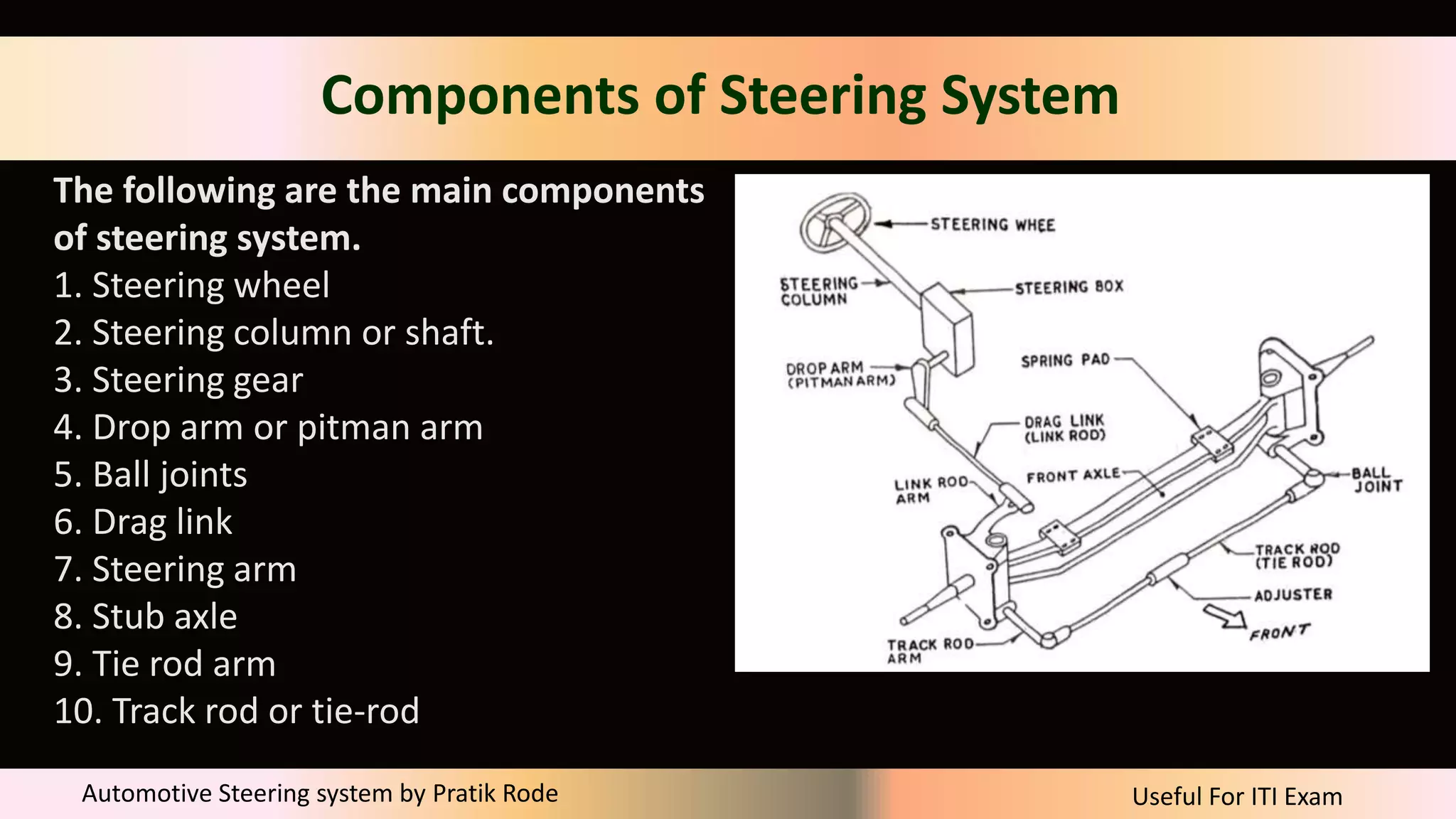
The following are the main components
of steering system.
1. Steering wheel
2. Steering column or shaft.
3. Steering gear
4. Drop arm or pitman arm
5. Ball joints
6. Drag link
7. Steering arm
8. Stub axle
9. Tie rod arm
10. Track rod or tie-rod
Useful For ITI Exam
Automotive Steering system by Pratik Rode
Components of Steering System
1.Steering wheel:
• It is the control wheel to steer a vehicle by the driver.
2. Steering linkage:
• The steering wheels are turned by the steering linkage.
The steering linkage consists of pitman arm, ball joints,
drag link, steering arm, spindle, tie rod and kingpin
assembly.
(a) Pitman arm:
• It is also called drop arm which converts the output
torque from the steering gear into force to the drag link.
Useful For ITI Exam
Automotive Steering system by Pratik Rode
Components of Steering System
(b) Ball joints:
• These joints are connected at both ends of the drag link
and tie rod. It performs the angular displacement,
rotational movement of the drag link and the tie rod
produced by the front wheel rotation and suspension
articulation.
(c) Drag link:
• It is connected between pitman arm and steering arm. It
is a single press forged component having a ball joint
socket formed at the end in some other cases.
• (d) Steering arm:
Useful For ITI Exam
Automotive Steering system by Pratik Rode
Components of Steering System
(d) tie rod arm:
• It converts the available torque to turn the right wheel
into force in the tie rod. The tie rod has a tapered hole to
receive the tie rod ball stud.
(e) Tie rod:
• The tie rod is a tubular member. Both the left and right
tie rod arms are connected by this tie rod. The length of
the tie rod is an adjustable one to the specified amount.
Useful For ITI Exam
Automotive Steering system by Pratik Rode
Components of Steering System
3. Steering shaft:
• The steering shaft is fitted inside the hollow steering
column. When the steering wheel is turned, the
steering shaft will also be rotated. Due to this, the
motion is transmitted to the steering box.
4. Steering gear:
• The pitman arm is splined to the steering gear box
rocker arm at one end and the other end is connected
to the drag link by a ball joint.
Useful For ITI Exam
Automotive Steering system by Pratik Rode
Working
• When the steering wheel is turned its motion is carried to
the steering box through steering shaft. In the steering
box, this motion is converted into angular motion of the
drop arm which is connected to the drag link rod.
• The drag link rod at the other end is connected to the
steering lever arm. The steering arm is connected to the
stub Exit spindle At the lower end of the stub axle the
spindle arm which is called the steering lower arm is fitted.
• Drop arm moves drag link. Drag link moves steering lever
arm which in turn rotates stub axle accordingly.
Useful For ITI Exam
Automotive Steering system by Pratik Rode
Function of Steering Gear
The gear converts the rotary motion
of the steering wheel into a straight line
motion, which is transmitted to the steering
linkage to turn the front wheels to the left
or right side as required.
• It is also provide necessary leverage so
that the driver is able to steer the vehicle
without fatigue.
Useful For ITI Exam
Automotive Steering system by Pratik Rode
Types of Steering Gear Box
• There are many types of steering gears are as follows :
I. Worm and wheel steering gear.
II. Cam and double roller steering gear.
III. Worm and nut steering gear.
IV. Recirculating Ball Type Steering gear.
V. Rack and pinion steering gear.
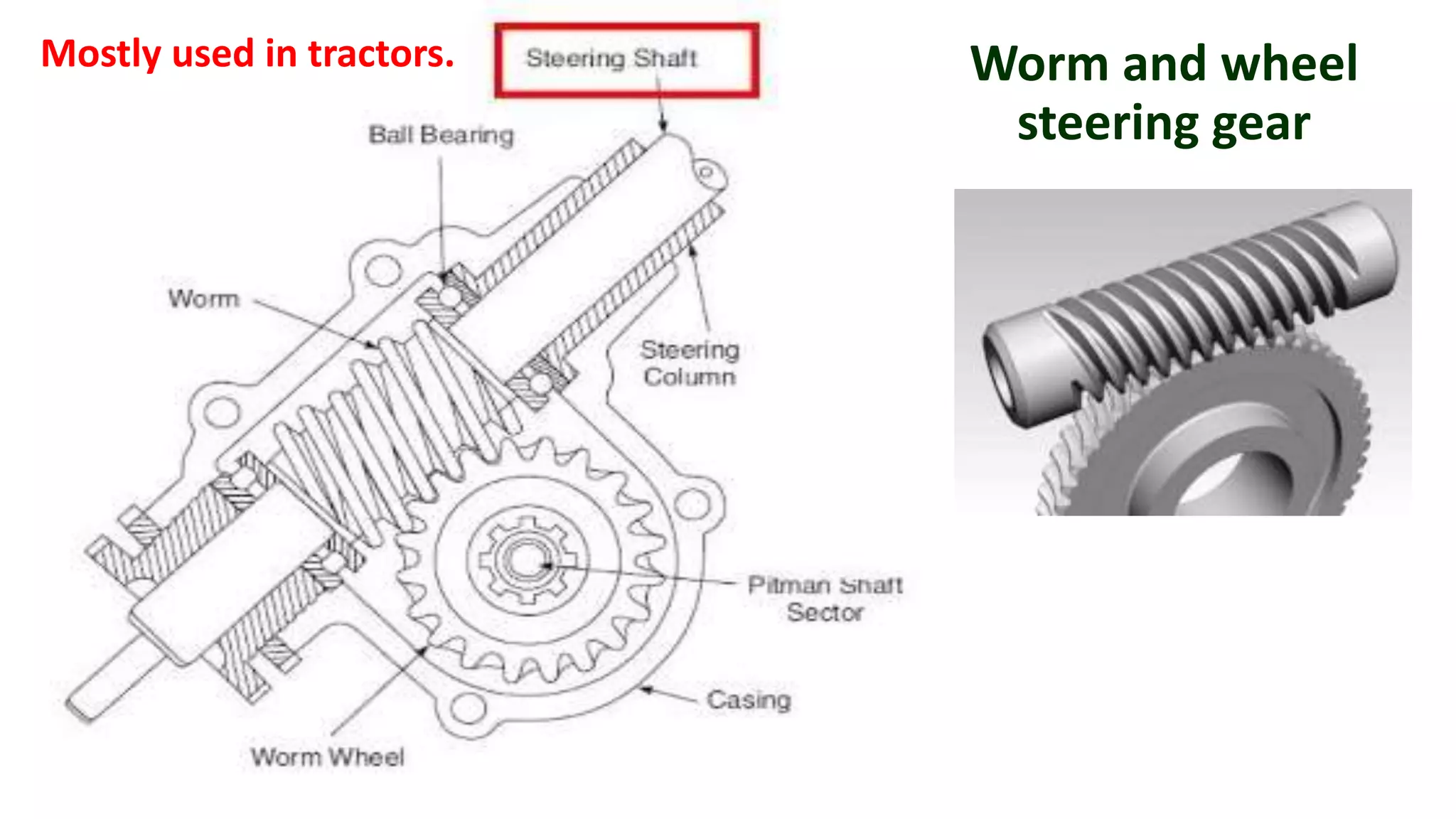
Worm and wheel
steering gear
Mostly used in tractors.
Useful For ITI Exam
Automotive Steering system by Pratik Rode
Worm and Wheel Steering Gear
• The movement of the steering wheel turns the worm,
which in turn drives the worm wheel.
• Attached to the wheel spindle rigidly is drop arm, so
that a rotation of the steering wheel corresponds to a
linear motion of the drop Arm end, which is connected
to the link rod.
• In place of worm wheel, only a sector is also
sometimes used, but the complete wheel has an
advantage over the later in that in this case back lash
due to wearing out of teeth of worm and worm wheel
can be adjusted.
Useful For ITI Exam
Automotive Steering system by Pratik Rode
Cam and Double Roller Steering Gear
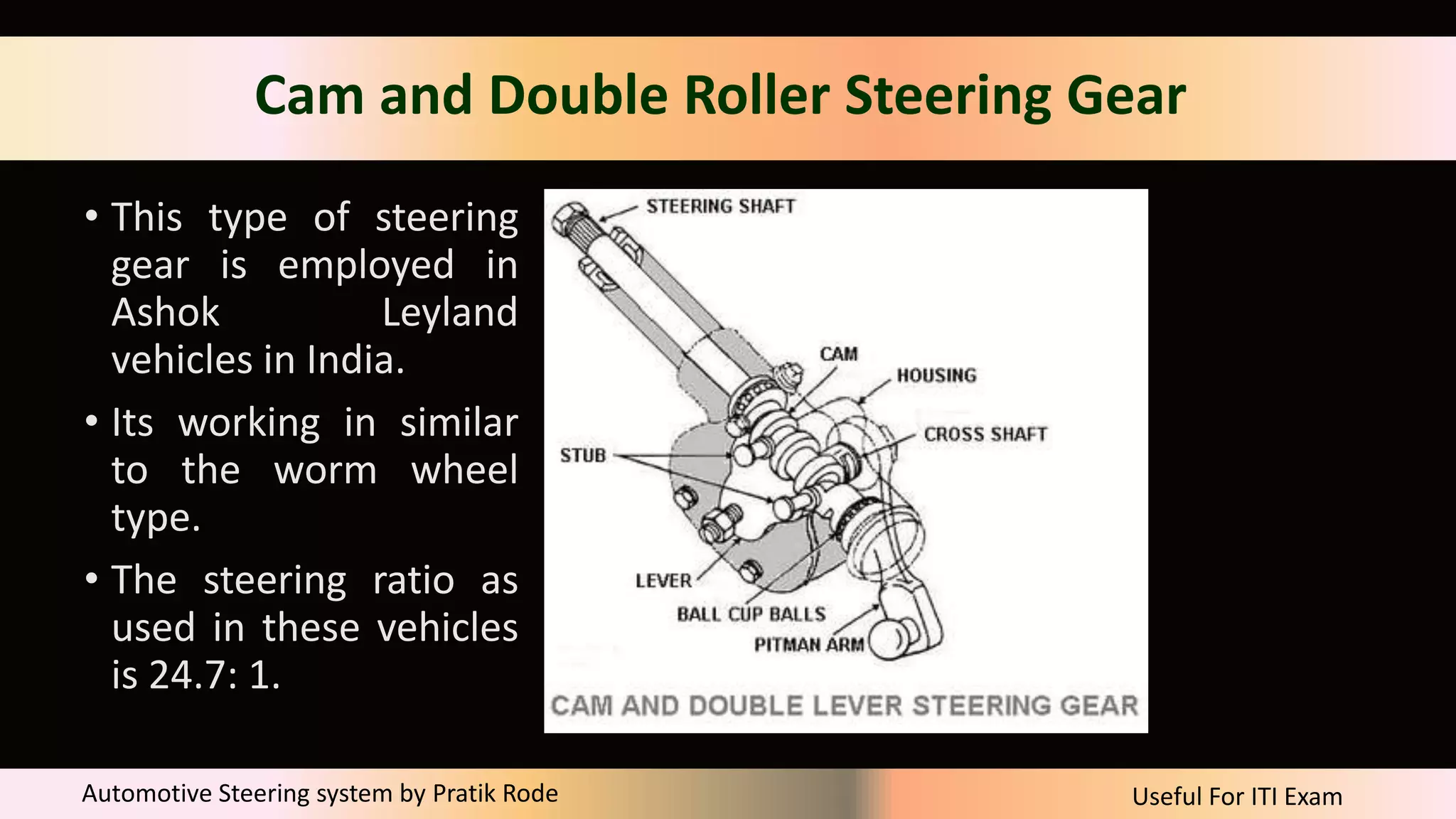
• This type of steering
gear is employed in
Ashok Leyland
vehicles in India.
• Its working in similar
to the worm wheel
type.
• The steering ratio as
used in these vehicles
is 24.7: 1.
Useful For ITI Exam
Automotive Steering system by Pratik Rode
Worm and Nut Steering Gear
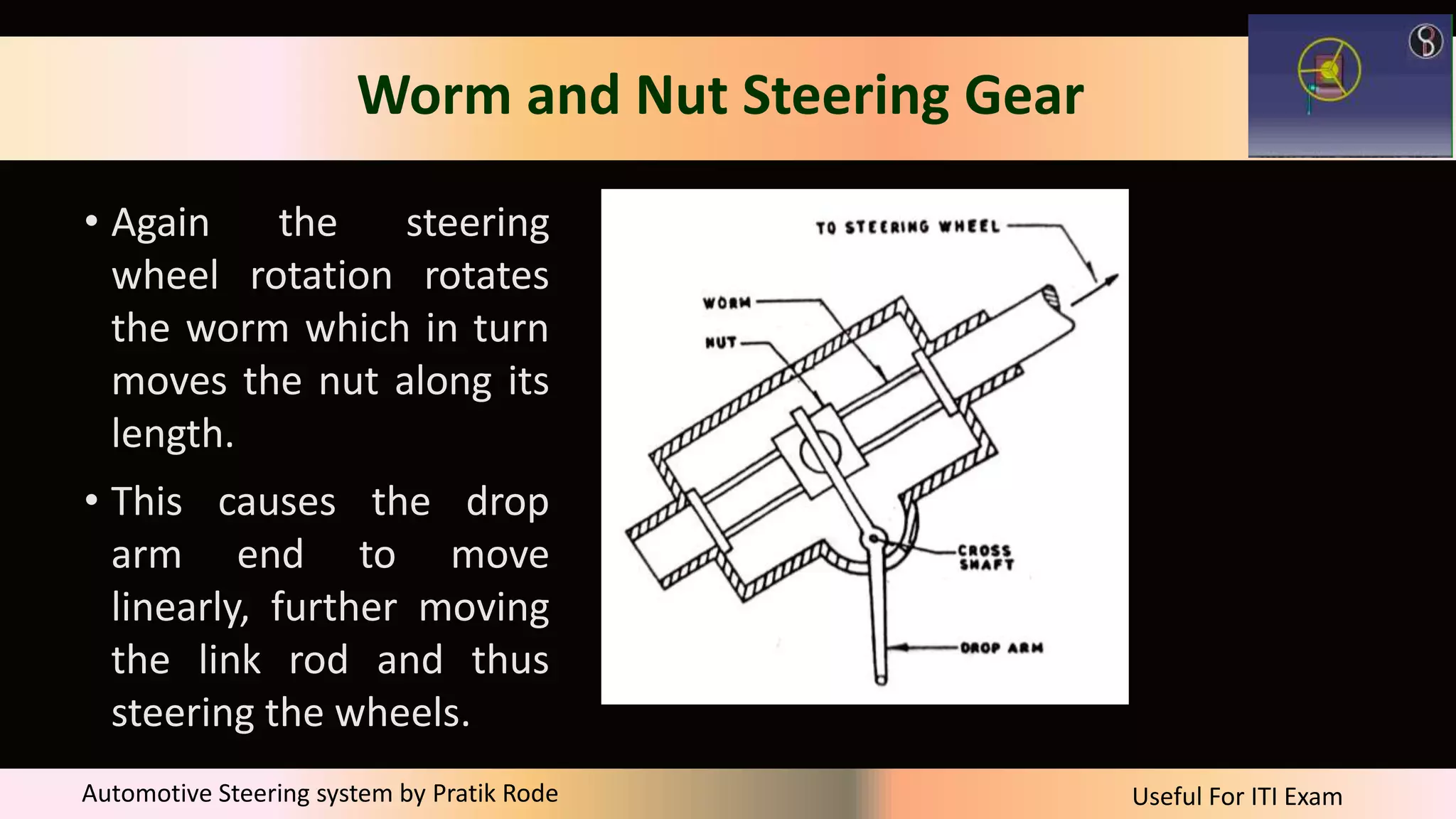
• Again the steering
wheel rotation rotates
the worm which in turn
moves the nut along its
length.
• This causes the drop
arm end to move
linearly, further moving
the link rod and thus
steering the wheels.
Useful For ITI Exam
Automotive Steering system by Pratik Rode
Recirculating Ball Type
Steering Gear
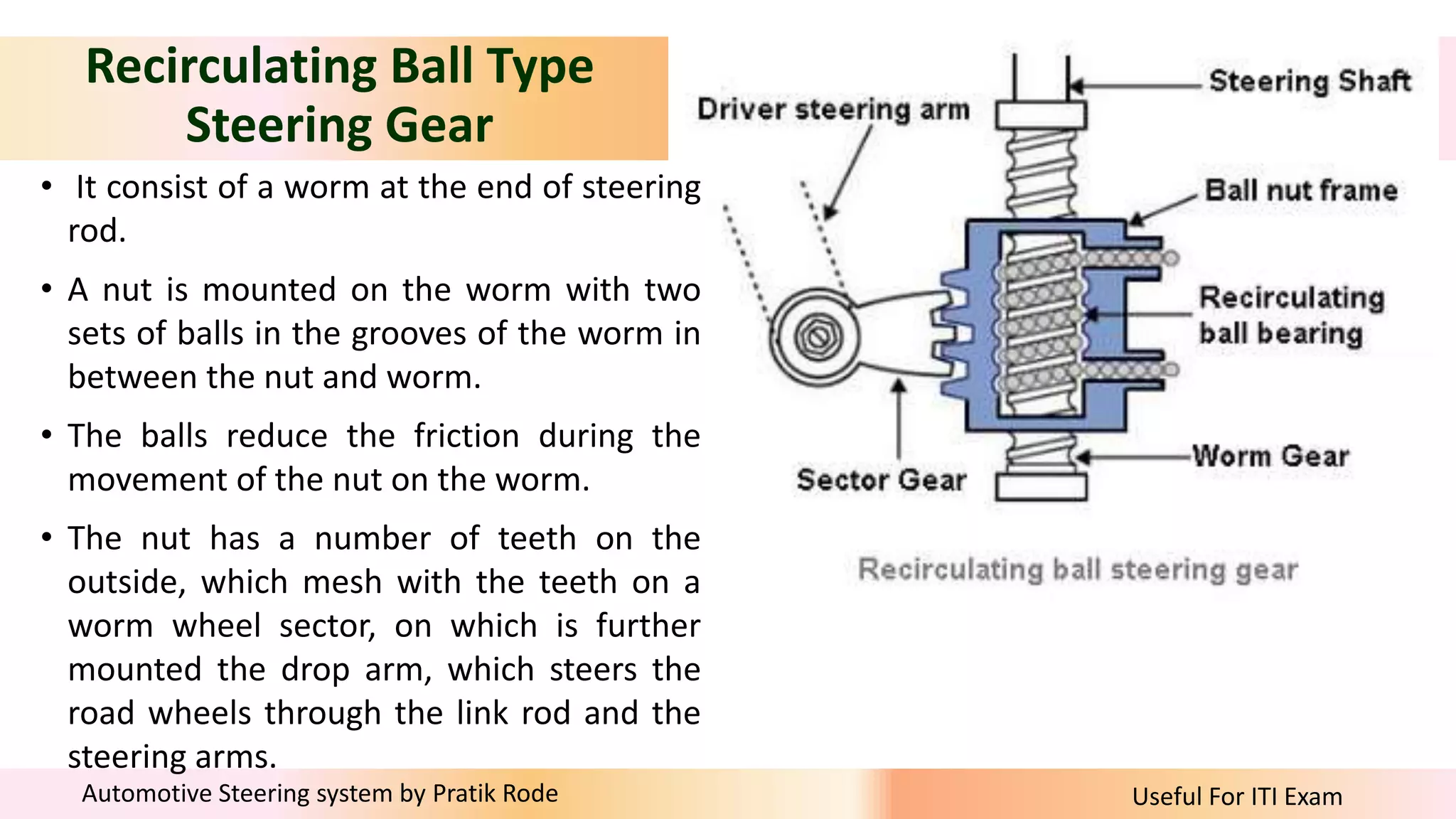
• It consist of a worm at the end of steering
rod.
• A nut is mounted on the worm with two
sets of balls in the grooves of the worm in
between the nut and worm.
• The balls reduce the friction during the
movement of the nut on the worm.
• The nut has a number of teeth on the
outside, which mesh with the teeth on a
worm wheel sector, on which is further
mounted the drop arm, which steers the
road wheels through the link rod and the
steering arms.
Useful For ITI Exam
Automotive Steering system by Pratik Rode
Recirculating Ball Type Steering Gear
• When the steering wheel is turned, the balls in the worm
roll in the grooves and cause the nut to travel along the
length of the worm.
• The balls, which are in 2 sets, are recirculated through
the guides.
• The movement of the nut causes the wheel sector to
turn at an angle and actuate the link rod through the
drop arm, resulting in the desired steering of the wheels.
Useful For ITI Exam
Automotive Steering system by Pratik Rode
Rack and pinion steering gear
Useful For ITI Exam
Automotive Steering system by Pratik Rode
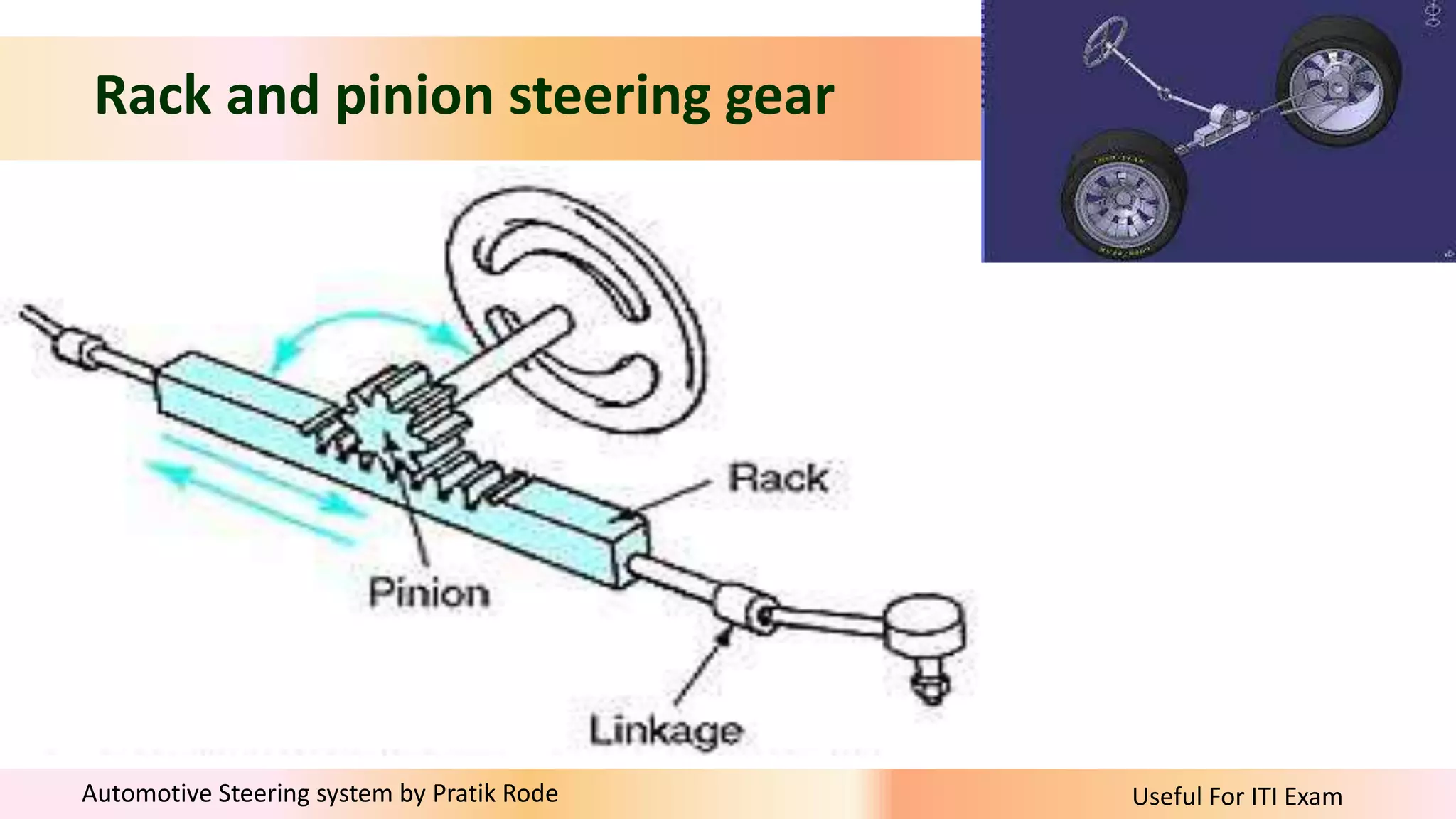
Rack and pinion steering gear
• The rotary motion of steering wheel is transmitted to the
pinion of the steering gear through universal joints.
• The pinion is in mesh with a rack. The circular motion of
the pinion is transferred into the linear rack movement,
which is further relayed through the ball joints and tie
rods to the stub axles for the wheels to be steered.
• Helical teeth are invariably employed so that the teeth
engage progressively and some contact between the
teeth is always there, due to which the gears can operate
smoothly and quietly.
Useful For ITI Exam
Automotive Steering system by Pratik Rode
Rack and pinion steering gear
• This type of steering gear is used on light vehicles like
cars and in power steering.
• Maruti 800 cars employ this steering gear.
• it is simple, light and responsive.
• It occupies very small space and uses lesser number of
linkage components compared to the worm and wheel
type of gear.
Useful For ITI Exam
Automotive Steering system by Pratik Rode
Steering column
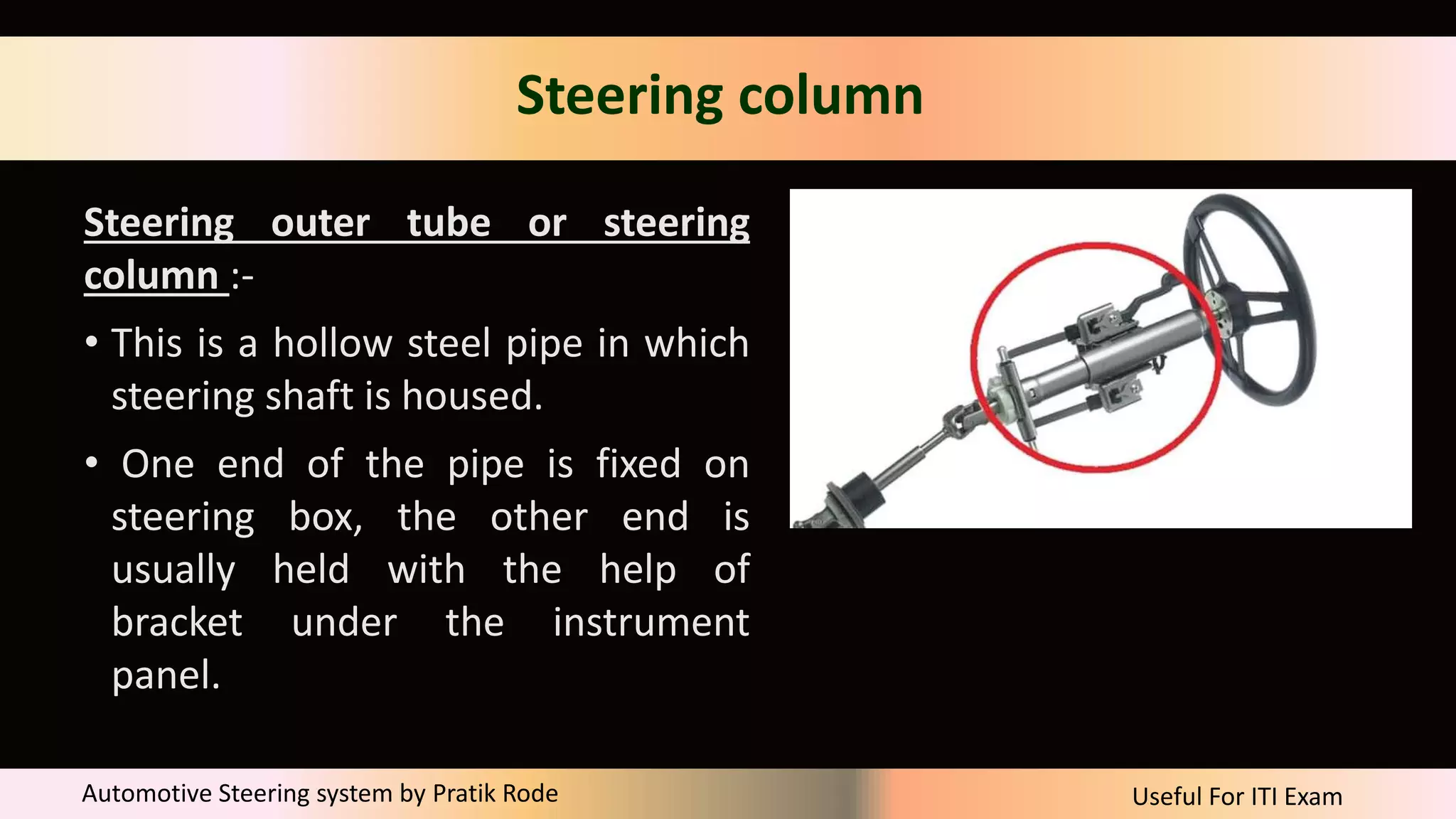
Steering outer tube or steering
column :-
• This is a hollow steel pipe in which
steering shaft is housed.
• One end of the pipe is fixed on
steering box, the other end is
usually held with the help of
bracket under the instrument
panel.
Useful For ITI Exam
Automotive Steering system by Pratik Rode
Collapsible steering column
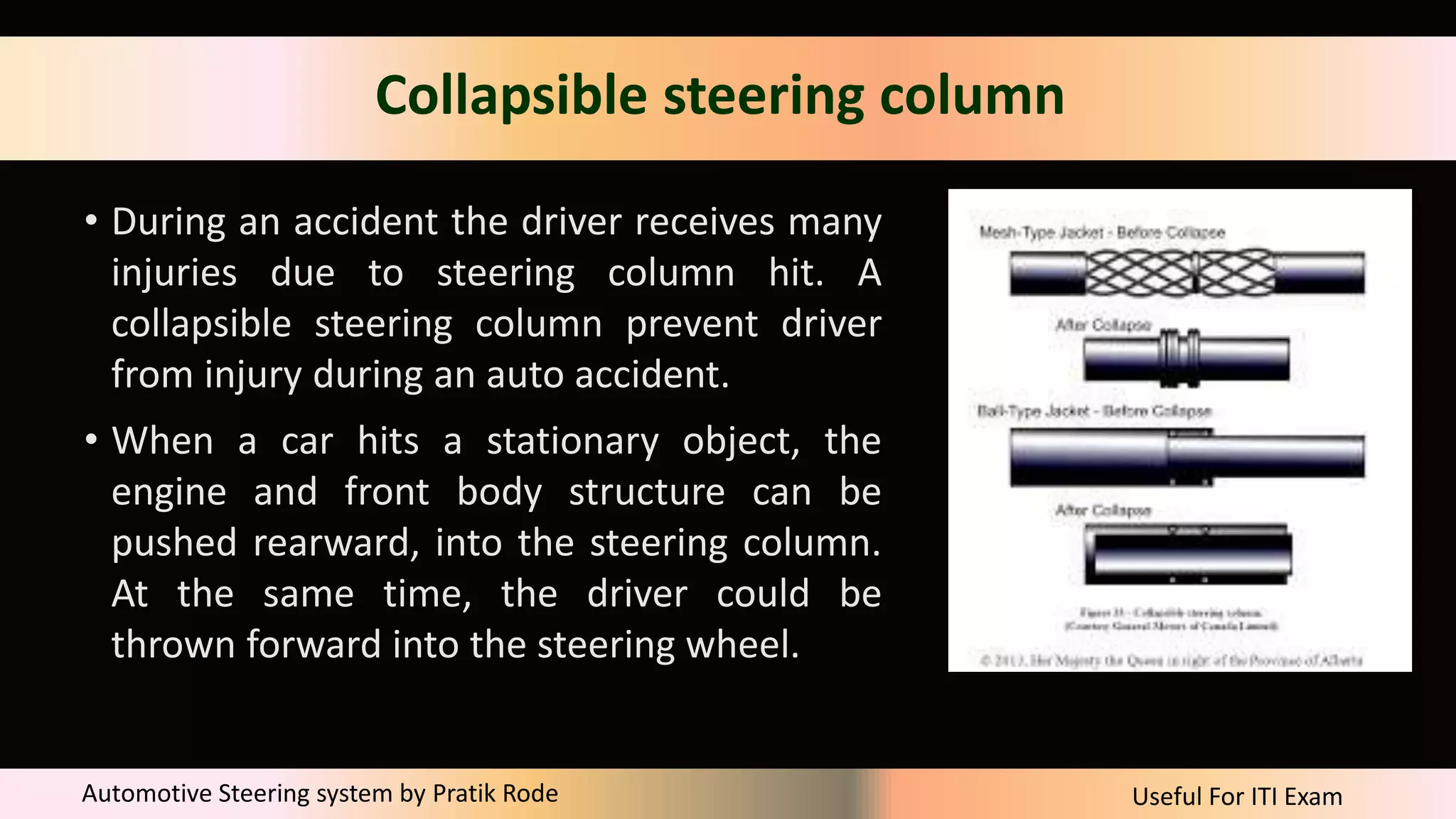
• During an accident the driver receives many
injuries due to steering column hit. A
collapsible steering column prevent driver
from injury during an auto accident.
• When a car hits a stationary object, the
engine and front body structure can be
pushed rearward, into the steering column.
At the same time, the driver could be
thrown forward into the steering wheel.
Useful For ITI Exam
Automotive Steering system by Pratik Rode
Collapsible steering column
• When there is a rigid steering column, the
driver's chest will injure.
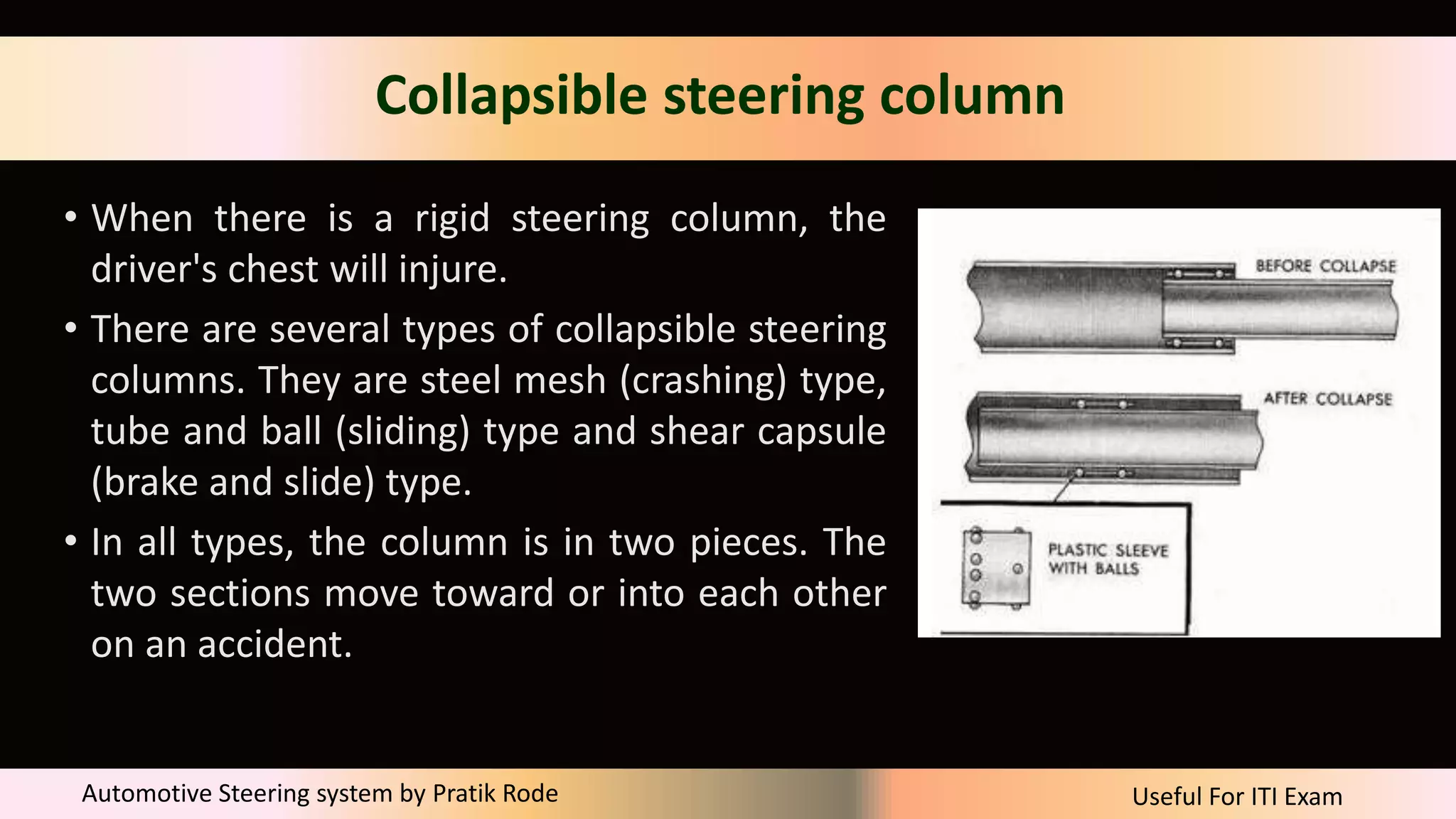
• There are several types of collapsible steering
columns. They are steel mesh (crashing) type,
tube and ball (sliding) type and shear capsule
(brake and slide) type.
• In all types, the column is in two pieces. The
two sections move toward or into each other
on an accident.

STEERING SYSTEM PART 1.pptx

  • 1.
    Useful For ITIExam Automotive Steering system by Pratik Rode Function of steering system Function :- The main function of the steering system is to convert the rotary motion of the steering wheel into angular motion of the front wheels to negotiate a turn.
  • 2.
    Useful For ITIExam Automotive Steering system by Pratik Rode Function  The Secondary functions of steering system are as follows. I. To turn the vehicle whenever required. II. To provide stability to the vehicle on road. III. To provide true rolling motion of the wheels at all times. IV. To provide self-centering action after negotiating a turn. V. To minimize tyre wear. VI. To multiply the driver's effort to turn the vehicle for easy operation. VII. To prevent road shocks reaching the driver.
  • 3.
    Useful For ITIExam Automotive Steering system by Pratik Rode Principles of steering • The steering system along with the suspension system, allow the driver to safely and easily control the vehicle's direction while driving. • steering systems use several basic principles to decrease driver effort. These include leverage, hydraulics, and in some systems, electricity. • Leverage, or mechanical advantage, is used at the steering wheel and in the gearbox to increase the force supplied by the driver. The gears inside the gearbox act as levers, increasing mechanical advantage and reducing driver effort to turn the wheels. • The gearbox also converts the rotary motion of the steering wheel and shaft into a linear or back-and-forth motion that moves the wheels.
  • 4.
    Useful For ITIExam Automotive Steering system by Pratik Rode Components of Steering System The following are the main components of steering system. 1. Steering wheel 2. Steering column or shaft. 3. Steering gear 4. Drop arm or pitman arm 5. Ball joints 6. Drag link 7. Steering arm 8. Stub axle 9. Tie rod arm 10. Track rod or tie-rod
  • 5.
    Useful For ITIExam Automotive Steering system by Pratik Rode Components of Steering System 1.Steering wheel: • It is the control wheel to steer a vehicle by the driver. 2. Steering linkage: • The steering wheels are turned by the steering linkage. The steering linkage consists of pitman arm, ball joints, drag link, steering arm, spindle, tie rod and kingpin assembly. (a) Pitman arm: • It is also called drop arm which converts the output torque from the steering gear into force to the drag link.
  • 6.
    Useful For ITIExam Automotive Steering system by Pratik Rode Components of Steering System (b) Ball joints: • These joints are connected at both ends of the drag link and tie rod. It performs the angular displacement, rotational movement of the drag link and the tie rod produced by the front wheel rotation and suspension articulation. (c) Drag link: • It is connected between pitman arm and steering arm. It is a single press forged component having a ball joint socket formed at the end in some other cases. • (d) Steering arm:
  • 7.
    Useful For ITIExam Automotive Steering system by Pratik Rode Components of Steering System (d) tie rod arm: • It converts the available torque to turn the right wheel into force in the tie rod. The tie rod has a tapered hole to receive the tie rod ball stud. (e) Tie rod: • The tie rod is a tubular member. Both the left and right tie rod arms are connected by this tie rod. The length of the tie rod is an adjustable one to the specified amount.
  • 8.
    Useful For ITIExam Automotive Steering system by Pratik Rode Components of Steering System 3. Steering shaft: • The steering shaft is fitted inside the hollow steering column. When the steering wheel is turned, the steering shaft will also be rotated. Due to this, the motion is transmitted to the steering box. 4. Steering gear: • The pitman arm is splined to the steering gear box rocker arm at one end and the other end is connected to the drag link by a ball joint.
  • 9.
    Useful For ITIExam Automotive Steering system by Pratik Rode Working • When the steering wheel is turned its motion is carried to the steering box through steering shaft. In the steering box, this motion is converted into angular motion of the drop arm which is connected to the drag link rod. • The drag link rod at the other end is connected to the steering lever arm. The steering arm is connected to the stub Exit spindle At the lower end of the stub axle the spindle arm which is called the steering lower arm is fitted. • Drop arm moves drag link. Drag link moves steering lever arm which in turn rotates stub axle accordingly.
  • 10.
    Useful For ITIExam Automotive Steering system by Pratik Rode Function of Steering Gear The gear converts the rotary motion of the steering wheel into a straight line motion, which is transmitted to the steering linkage to turn the front wheels to the left or right side as required. • It is also provide necessary leverage so that the driver is able to steer the vehicle without fatigue.
  • 11.
    Useful For ITIExam Automotive Steering system by Pratik Rode Types of Steering Gear Box • There are many types of steering gears are as follows : I. Worm and wheel steering gear. II. Cam and double roller steering gear. III. Worm and nut steering gear. IV. Recirculating Ball Type Steering gear. V. Rack and pinion steering gear.
  • 12.
    Worm and wheel steeringgear Mostly used in tractors.
  • 13.
    Useful For ITIExam Automotive Steering system by Pratik Rode Worm and Wheel Steering Gear • The movement of the steering wheel turns the worm, which in turn drives the worm wheel. • Attached to the wheel spindle rigidly is drop arm, so that a rotation of the steering wheel corresponds to a linear motion of the drop Arm end, which is connected to the link rod. • In place of worm wheel, only a sector is also sometimes used, but the complete wheel has an advantage over the later in that in this case back lash due to wearing out of teeth of worm and worm wheel can be adjusted.
  • 14.
    Useful For ITIExam Automotive Steering system by Pratik Rode Cam and Double Roller Steering Gear • This type of steering gear is employed in Ashok Leyland vehicles in India. • Its working in similar to the worm wheel type. • The steering ratio as used in these vehicles is 24.7: 1.
  • 15.
    Useful For ITIExam Automotive Steering system by Pratik Rode Worm and Nut Steering Gear • Again the steering wheel rotation rotates the worm which in turn moves the nut along its length. • This causes the drop arm end to move linearly, further moving the link rod and thus steering the wheels.
  • 16.
    Useful For ITIExam Automotive Steering system by Pratik Rode Recirculating Ball Type Steering Gear • It consist of a worm at the end of steering rod. • A nut is mounted on the worm with two sets of balls in the grooves of the worm in between the nut and worm. • The balls reduce the friction during the movement of the nut on the worm. • The nut has a number of teeth on the outside, which mesh with the teeth on a worm wheel sector, on which is further mounted the drop arm, which steers the road wheels through the link rod and the steering arms.
  • 17.
    Useful For ITIExam Automotive Steering system by Pratik Rode Recirculating Ball Type Steering Gear • When the steering wheel is turned, the balls in the worm roll in the grooves and cause the nut to travel along the length of the worm. • The balls, which are in 2 sets, are recirculated through the guides. • The movement of the nut causes the wheel sector to turn at an angle and actuate the link rod through the drop arm, resulting in the desired steering of the wheels.
  • 18.
    Useful For ITIExam Automotive Steering system by Pratik Rode Rack and pinion steering gear
  • 19.
    Useful For ITIExam Automotive Steering system by Pratik Rode Rack and pinion steering gear • The rotary motion of steering wheel is transmitted to the pinion of the steering gear through universal joints. • The pinion is in mesh with a rack. The circular motion of the pinion is transferred into the linear rack movement, which is further relayed through the ball joints and tie rods to the stub axles for the wheels to be steered. • Helical teeth are invariably employed so that the teeth engage progressively and some contact between the teeth is always there, due to which the gears can operate smoothly and quietly.
  • 20.
    Useful For ITIExam Automotive Steering system by Pratik Rode Rack and pinion steering gear • This type of steering gear is used on light vehicles like cars and in power steering. • Maruti 800 cars employ this steering gear. • it is simple, light and responsive. • It occupies very small space and uses lesser number of linkage components compared to the worm and wheel type of gear.
  • 21.
    Useful For ITIExam Automotive Steering system by Pratik Rode Steering column Steering outer tube or steering column :- • This is a hollow steel pipe in which steering shaft is housed. • One end of the pipe is fixed on steering box, the other end is usually held with the help of bracket under the instrument panel.
  • 22.
    Useful For ITIExam Automotive Steering system by Pratik Rode Collapsible steering column • During an accident the driver receives many injuries due to steering column hit. A collapsible steering column prevent driver from injury during an auto accident. • When a car hits a stationary object, the engine and front body structure can be pushed rearward, into the steering column. At the same time, the driver could be thrown forward into the steering wheel.
  • 23.
    Useful For ITIExam Automotive Steering system by Pratik Rode Collapsible steering column • When there is a rigid steering column, the driver's chest will injure. • There are several types of collapsible steering columns. They are steel mesh (crashing) type, tube and ball (sliding) type and shear capsule (brake and slide) type. • In all types, the column is in two pieces. The two sections move toward or into each other on an accident.