Socio-Economic Problems of
Infertility
By:
Vishakha Kumar
13MSG0025
Definition of Infertility
 Infertility is the inability of
a sexually active, non-
contracepting couple to
achieve pregnancy in one
year.
 The reasons constituting
infertility are many. These
include low hormonal
levels, malformations of
the gametes or
reproductive organs and
over dosage of certain
Reasons for wanting a baby
 In many cultures it is considered a standard norm for
a couple to have at least one child that is ‘their own’.
 Though adoption is a suitable option for couples
struggling to conceive there is still a desire for having
a child that was produced from their own gametes.
 The reasons for this are believed to be
psychologically associated with the concept of
‘extending one’s bloodline’ and in more orthodox
families, to have a natural ‘heir’ to one’s property and
other possessions.
 Some mothers have also expressed that they wish for
their own child because any behaviors an adopted
child might possess cannot be predicted and is not
something they want to deal with as the child ages
Social problems of infertility
 In a survey conducted by Oxford College
of Medical Sciences in 2009, infertile
couples of reproducible age were
interviewed about how their infertility had
affected their social life. The couples
chosen had varied ethnic backgrounds,
coming from different parts of the USA,
Europe, India, China, Africa, Japan, and
Australia.
 Most of the participants said their
infertility had changed their social
interactions over progressive years. The
common events reported are mentioned.
Social problems of infertility
 Initially, most couples were surprised to learn of their
infertility and though slightly saddened, remained
optimistic about conceiving through ART. They
maintained normal relations with their family and friends.
 As time progressed, multiple attempts of failed
pregnancies caused the couples to become less social.
It began as declining invitations to events like weddings
and holidays then social withdrawal from friends and
even some family members. Based on where the
couples were from, withdrawal ranged from meeting
people very occasionally to complete absence of a
social life, shutting out almost everyone except for in-
laws and a few close friends.
 In most cases the main reason for withdrawal appeared
to be unwillingness to share problems with others and
Social impact
 Western countries appear to show more of an
empathetic and understanding approach to infertile
individuals.
 Asian and African countries such as Ghana, India and
China look upon infertility as a hindrance to the overall
happiness of the couple. Middle and high class families
have fewer withdrawals as the family and peer groups
gave moral support. However, weaker sections of
society believe infertility to be a ‘bad omen’ and a
‘waste of womanhood’ if the woman cannot bear a
child.
 In some households, women are treated as
untouchables and even ignored by family members.
Sometimes even in educated families, use of ART to
conceive is being met with ethical clashes.
 The inability to conceive puts anxiety and frustration on
Economic problems of
infertility Treatments for infertility are very costly and most
are not insured. Some places where treatments
are insured are the USA, Germany, Britain, and
Melbourne.
 Even with insurance, most plans only allow a
limited number of treatments. Once the allowance
is finished, affording separate fertility treatments is
usually very taxing for the pair.
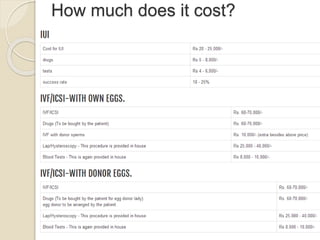
 Different treatments have various pricings
depending on the procedures involved and
expenditure depends on the individual’s financial
capacity.
 Even by using ART there is no guarantee of a
pregnancy occurring especially if the couple has
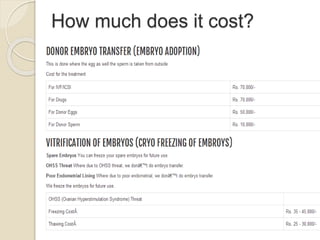
How much does it cost?
References
 Psychosocial experiences in women facing fertility problems—a
comparative survey- Björn J. Oddens, Isolde den Tonkelaar and
Hugo Nieuwenhuyse1- Oxford Journal of Science-2010
 Social problems of infertile women in India.-Jindal UN, Gupta
AN-Department of Obstetrics and Gynaecology, Postgraduate
Institute of Medical Education and Research, Chandigarh,
India.-International Journal of Fertility [1989, 34(1):30-33]
 Epidemiology of infertility: social problems of the infertile
couples- Margaret O Araoye- AJOL-2003
 Management of the infertile couple: an evidence-based
protocol- Remah M Kamel- Reproductive Biology and
Endocrinology 2014, 12:1 (3 January 2014)
 The social meaning of infertility in Southwest Nigeria-
http://hdl.handle.net/1885/41267
 The Importance of Social Relationships for Infertile Couples’
Well-Being- Antonia Abbey, Frank M. Andrews, L. Jill Halman
 Psychosocial experiences in women facing fertility problems--a
comparative survey.-Oddens BJ1, den Tonkelaar I,
Nieuwenhuyse H.
 The Economics of Assisted Reproduction- Sherrie A. Kossoudji
-Current Practices and Controversies in Assisted Reproduction-
University of Michigan- Discussion Paper No. 1458
Acknowledgement

Socio economic problems of infertility

  • 1.
  • 2.
    Definition of Infertility Infertility is the inability of a sexually active, non- contracepting couple to achieve pregnancy in one year.  The reasons constituting infertility are many. These include low hormonal levels, malformations of the gametes or reproductive organs and over dosage of certain
  • 3.
    Reasons for wantinga baby  In many cultures it is considered a standard norm for a couple to have at least one child that is ‘their own’.  Though adoption is a suitable option for couples struggling to conceive there is still a desire for having a child that was produced from their own gametes.  The reasons for this are believed to be psychologically associated with the concept of ‘extending one’s bloodline’ and in more orthodox families, to have a natural ‘heir’ to one’s property and other possessions.  Some mothers have also expressed that they wish for their own child because any behaviors an adopted child might possess cannot be predicted and is not something they want to deal with as the child ages
  • 4.
    Social problems ofinfertility  In a survey conducted by Oxford College of Medical Sciences in 2009, infertile couples of reproducible age were interviewed about how their infertility had affected their social life. The couples chosen had varied ethnic backgrounds, coming from different parts of the USA, Europe, India, China, Africa, Japan, and Australia.  Most of the participants said their infertility had changed their social interactions over progressive years. The common events reported are mentioned.
  • 5.
    Social problems ofinfertility  Initially, most couples were surprised to learn of their infertility and though slightly saddened, remained optimistic about conceiving through ART. They maintained normal relations with their family and friends.  As time progressed, multiple attempts of failed pregnancies caused the couples to become less social. It began as declining invitations to events like weddings and holidays then social withdrawal from friends and even some family members. Based on where the couples were from, withdrawal ranged from meeting people very occasionally to complete absence of a social life, shutting out almost everyone except for in- laws and a few close friends.  In most cases the main reason for withdrawal appeared to be unwillingness to share problems with others and
  • 6.
    Social impact  Westerncountries appear to show more of an empathetic and understanding approach to infertile individuals.  Asian and African countries such as Ghana, India and China look upon infertility as a hindrance to the overall happiness of the couple. Middle and high class families have fewer withdrawals as the family and peer groups gave moral support. However, weaker sections of society believe infertility to be a ‘bad omen’ and a ‘waste of womanhood’ if the woman cannot bear a child.  In some households, women are treated as untouchables and even ignored by family members. Sometimes even in educated families, use of ART to conceive is being met with ethical clashes.  The inability to conceive puts anxiety and frustration on
  • 7.
    Economic problems of infertilityTreatments for infertility are very costly and most are not insured. Some places where treatments are insured are the USA, Germany, Britain, and Melbourne.  Even with insurance, most plans only allow a limited number of treatments. Once the allowance is finished, affording separate fertility treatments is usually very taxing for the pair.  Different treatments have various pricings depending on the procedures involved and expenditure depends on the individual’s financial capacity.  Even by using ART there is no guarantee of a pregnancy occurring especially if the couple has
  • 8.
    How much doesit cost?
  • 9.
    How much doesit cost?
  • 10.
    References  Psychosocial experiencesin women facing fertility problems—a comparative survey- Björn J. Oddens, Isolde den Tonkelaar and Hugo Nieuwenhuyse1- Oxford Journal of Science-2010  Social problems of infertile women in India.-Jindal UN, Gupta AN-Department of Obstetrics and Gynaecology, Postgraduate Institute of Medical Education and Research, Chandigarh, India.-International Journal of Fertility [1989, 34(1):30-33]  Epidemiology of infertility: social problems of the infertile couples- Margaret O Araoye- AJOL-2003  Management of the infertile couple: an evidence-based protocol- Remah M Kamel- Reproductive Biology and Endocrinology 2014, 12:1 (3 January 2014)  The social meaning of infertility in Southwest Nigeria- http://hdl.handle.net/1885/41267  The Importance of Social Relationships for Infertile Couples’ Well-Being- Antonia Abbey, Frank M. Andrews, L. Jill Halman  Psychosocial experiences in women facing fertility problems--a comparative survey.-Oddens BJ1, den Tonkelaar I, Nieuwenhuyse H.  The Economics of Assisted Reproduction- Sherrie A. Kossoudji -Current Practices and Controversies in Assisted Reproduction- University of Michigan- Discussion Paper No. 1458
  • 11.