Statistical Survey ProjectBy: Jonathan Peñate andArnold Gonzalez
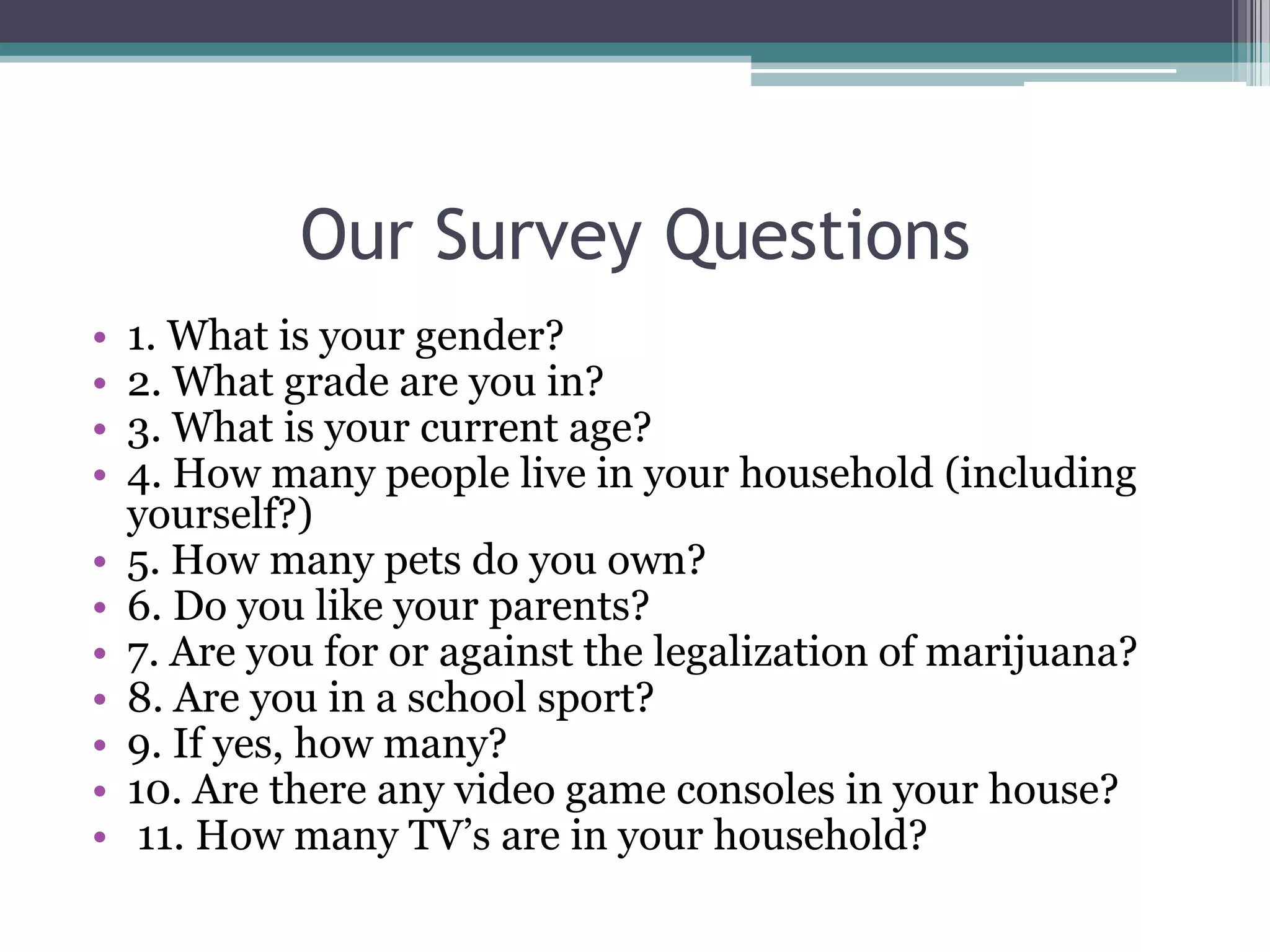
Our Survey Questions1. What is your gender?2. What grade are you in?3. What is your current age?4. How many people live in your household (including yourself?) 5. How many pets do you own?6. Do you like your parents?7. Are you for or against the legalization of marijuana? 8. Are you in a school sport?9. If yes, how many?10. Are there any video game consoles in your house? 11. How many TV’s are in your household?
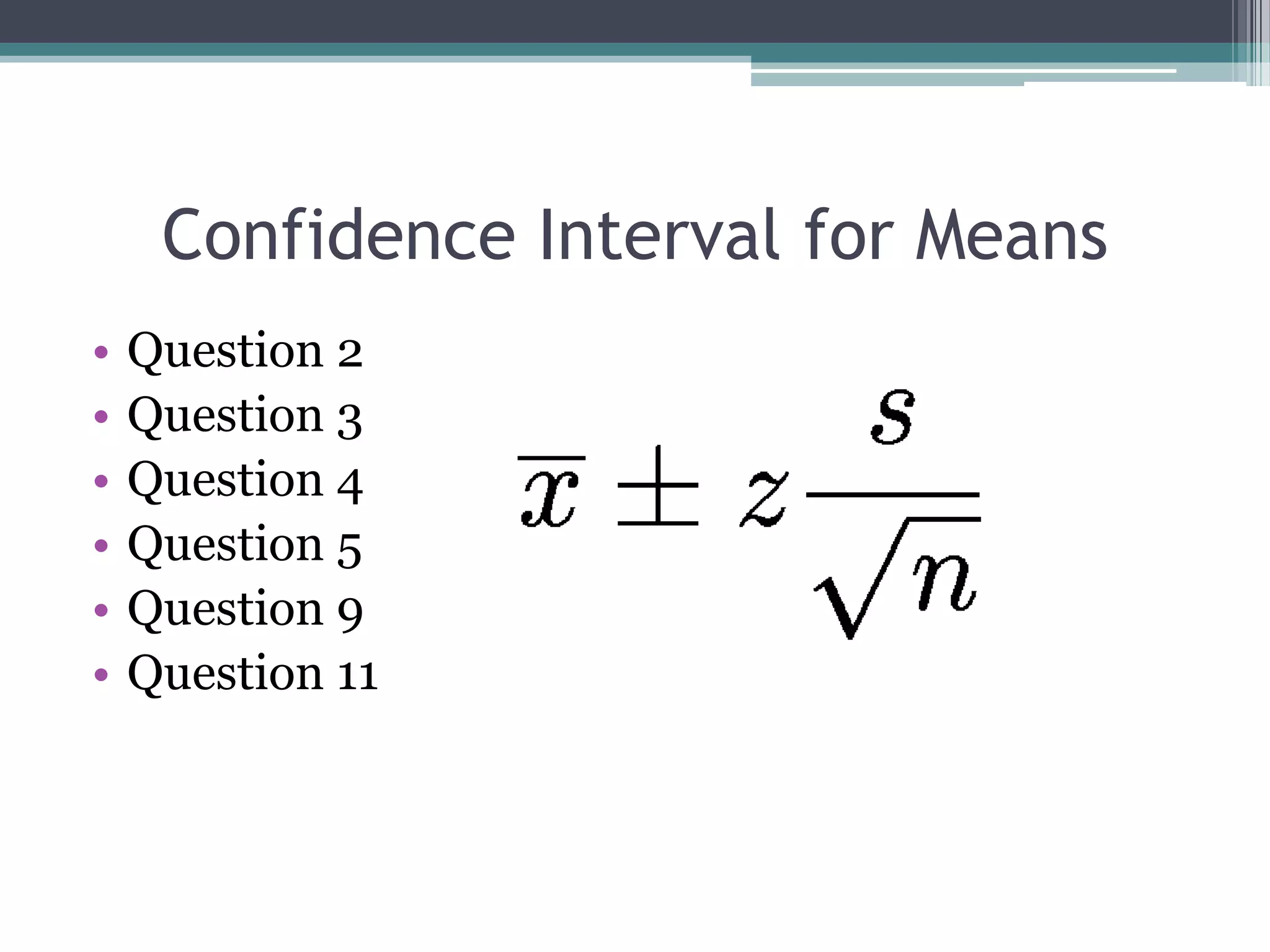
Confidence Interval for MeansQuestion 2Question 3Question 4Question 5Question 9Question 11
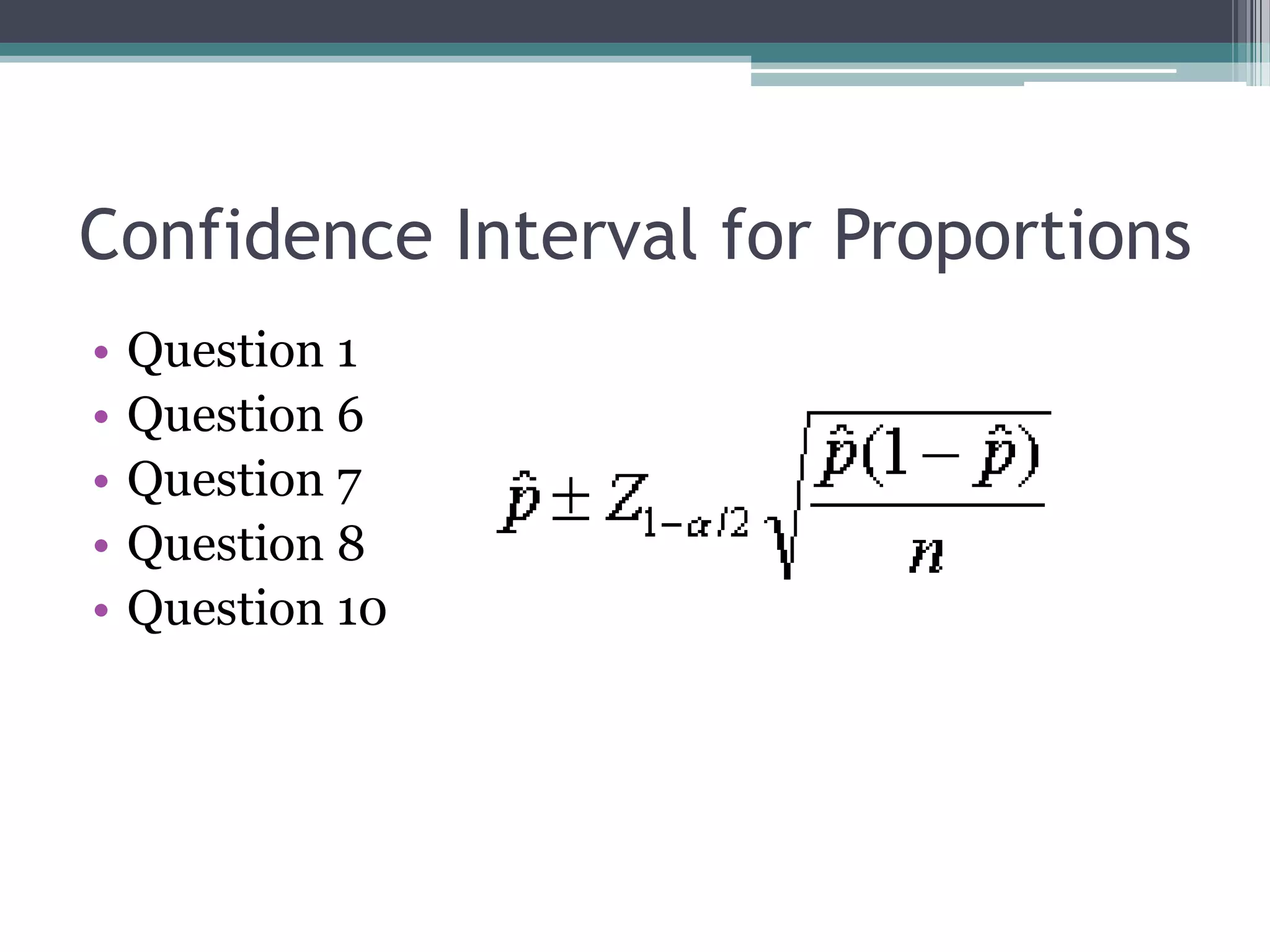
Confidence Interval for ProportionsQuestion 1Question 6Question 7Question 8Question 10
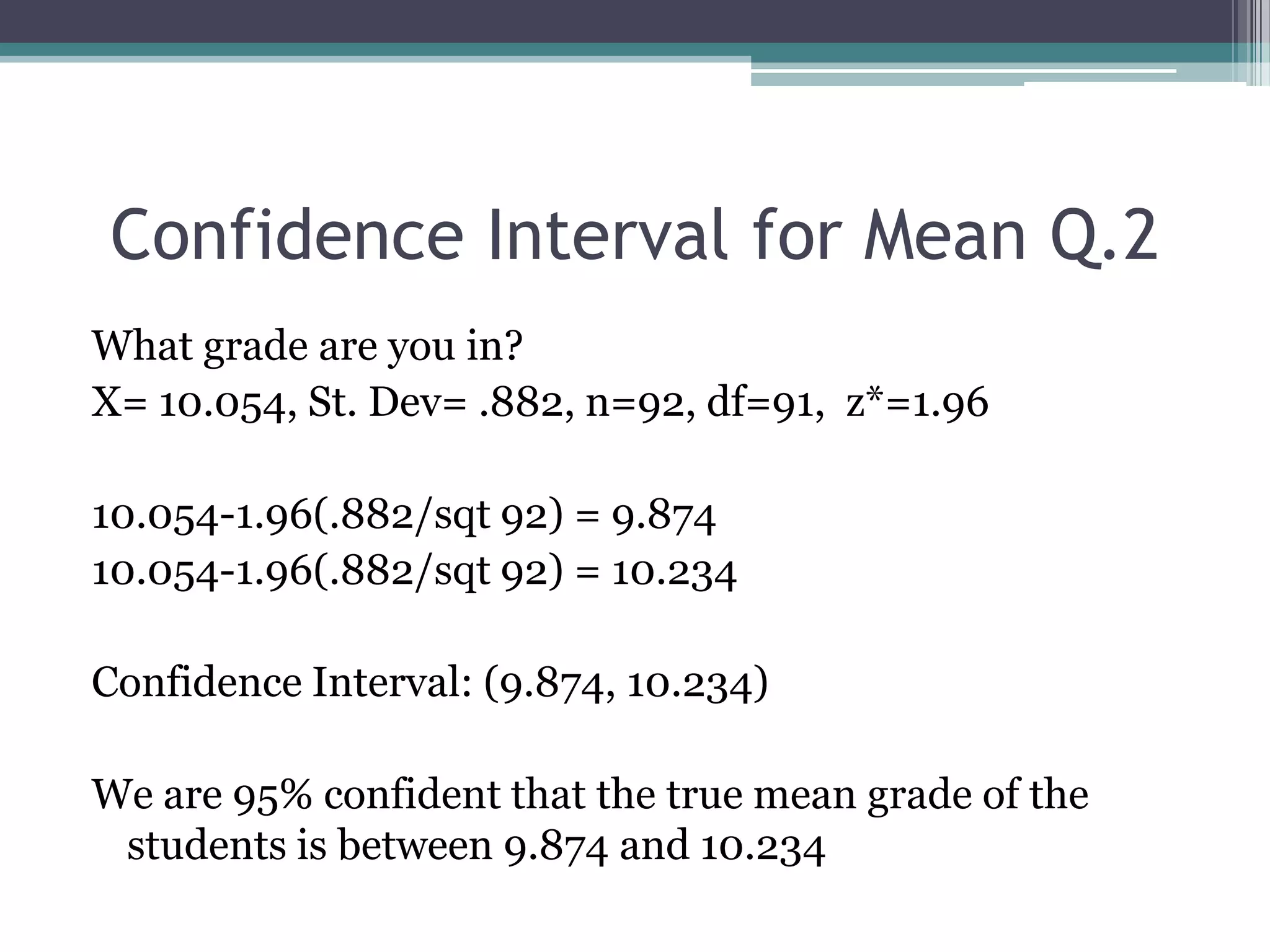
Confidence Interval for Mean Q.2What grade are you in?X= 10.054, St. Dev= .882, n=92, df=91,  z*=1.9610.054-1.96(.882/sqt 92) = 9.87410.054-1.96(.882/sqt 92) = 10.234Confidence Interval: (9.874, 10.234)We are 95% confident that the true mean grade of the students is between 9.874 and 10.234
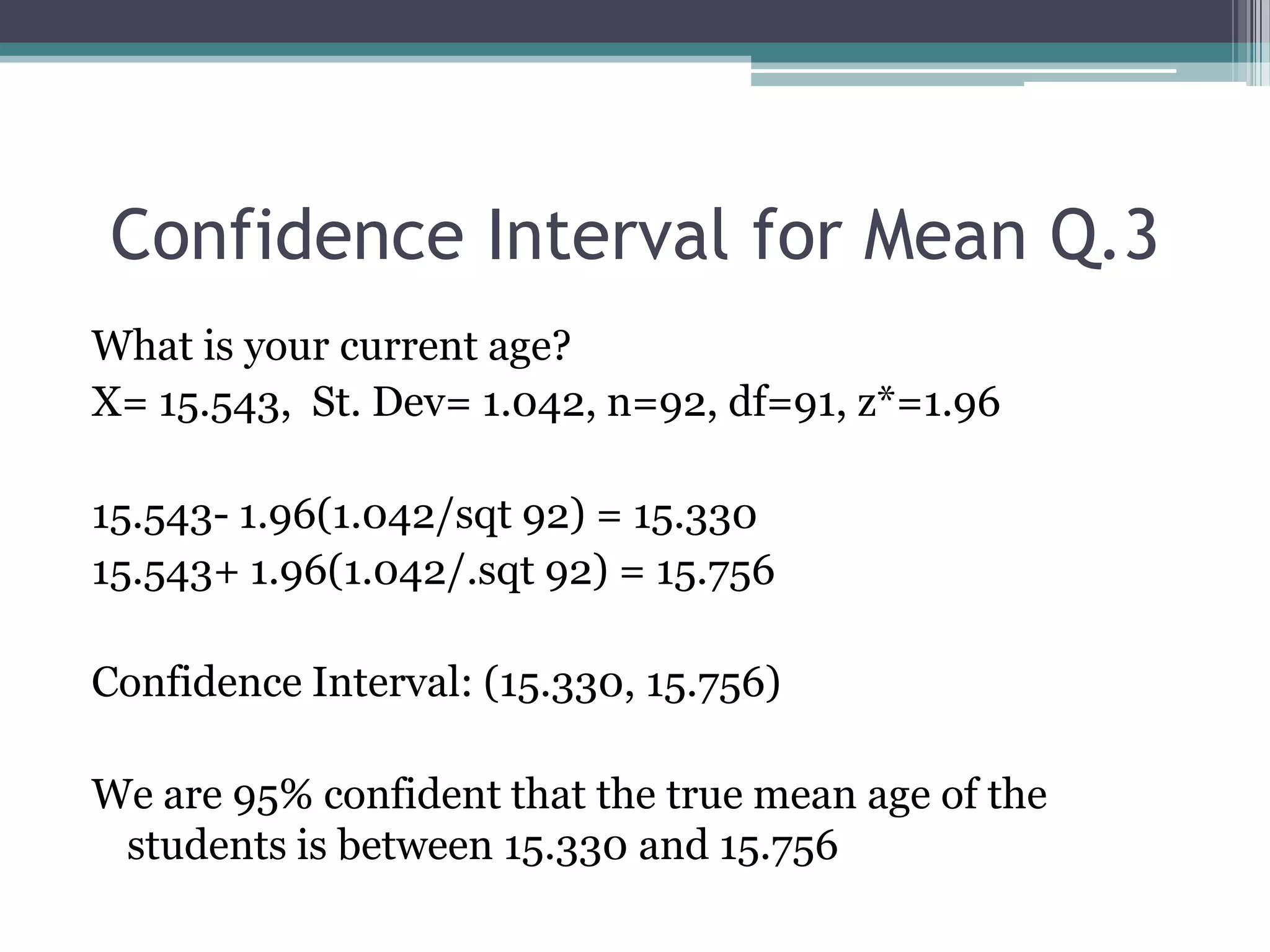
Confidence Interval for Mean Q.3What is your current age?X= 15.543,  St. Dev= 1.042, n=92, df=91, z*=1.9615.543- 1.96(1.042/sqt 92) = 15.33015.543+ 1.96(1.042/.sqt 92) = 15.756Confidence Interval: (15.330, 15.756)We are 95% confident that the true mean age of the students is between 15.330 and 15.756
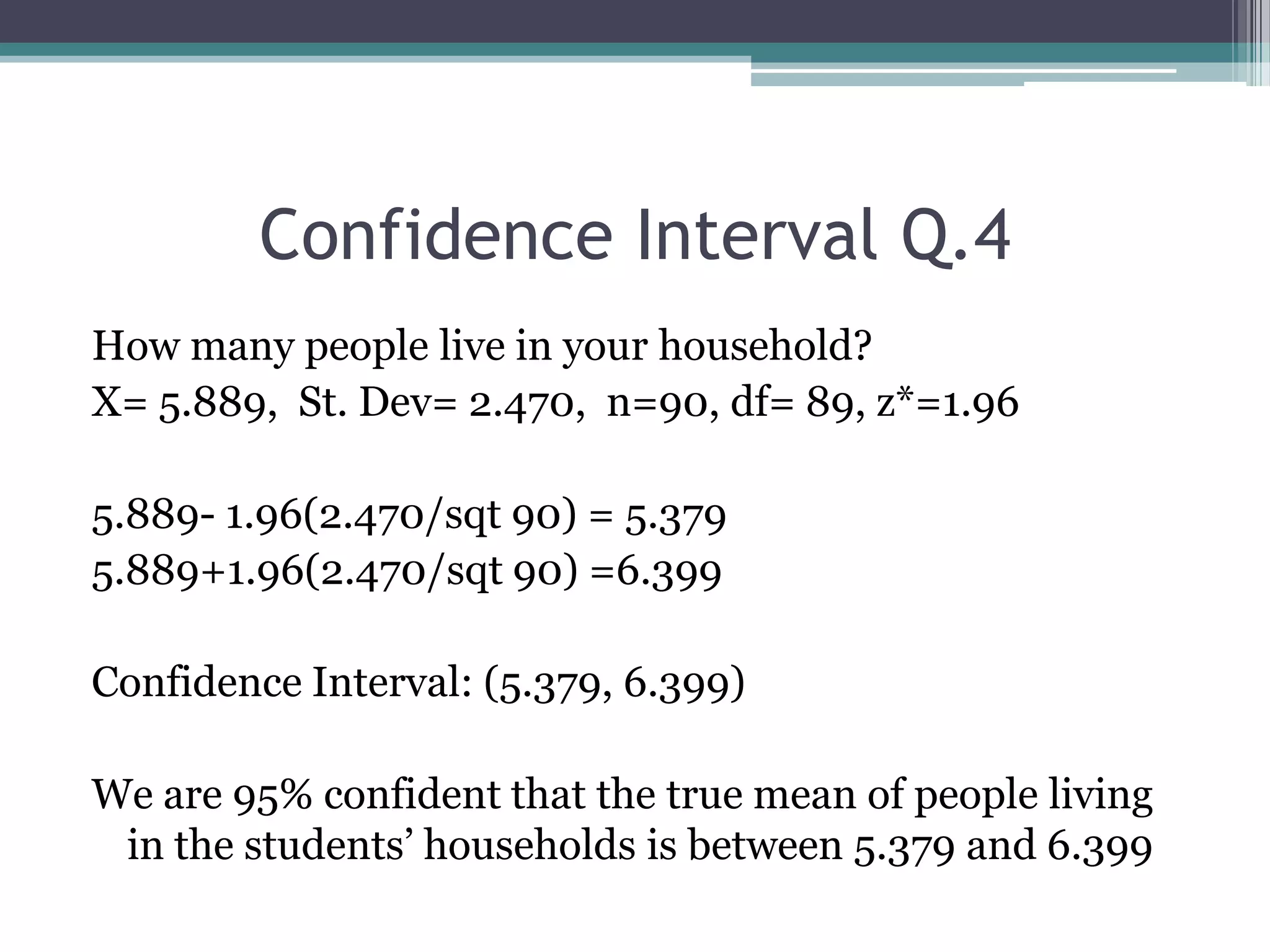
Confidence Interval Q.4How many people live in your household?X= 5.889,  St. Dev= 2.470,  n=90, df= 89, z*=1.965.889- 1.96(2.470/sqt 90) = 5.3795.889+1.96(2.470/sqt 90) =6.399Confidence Interval: (5.379, 6.399)We are 95% confident that the true mean of people living in the students’ households is between 5.379 and 6.399
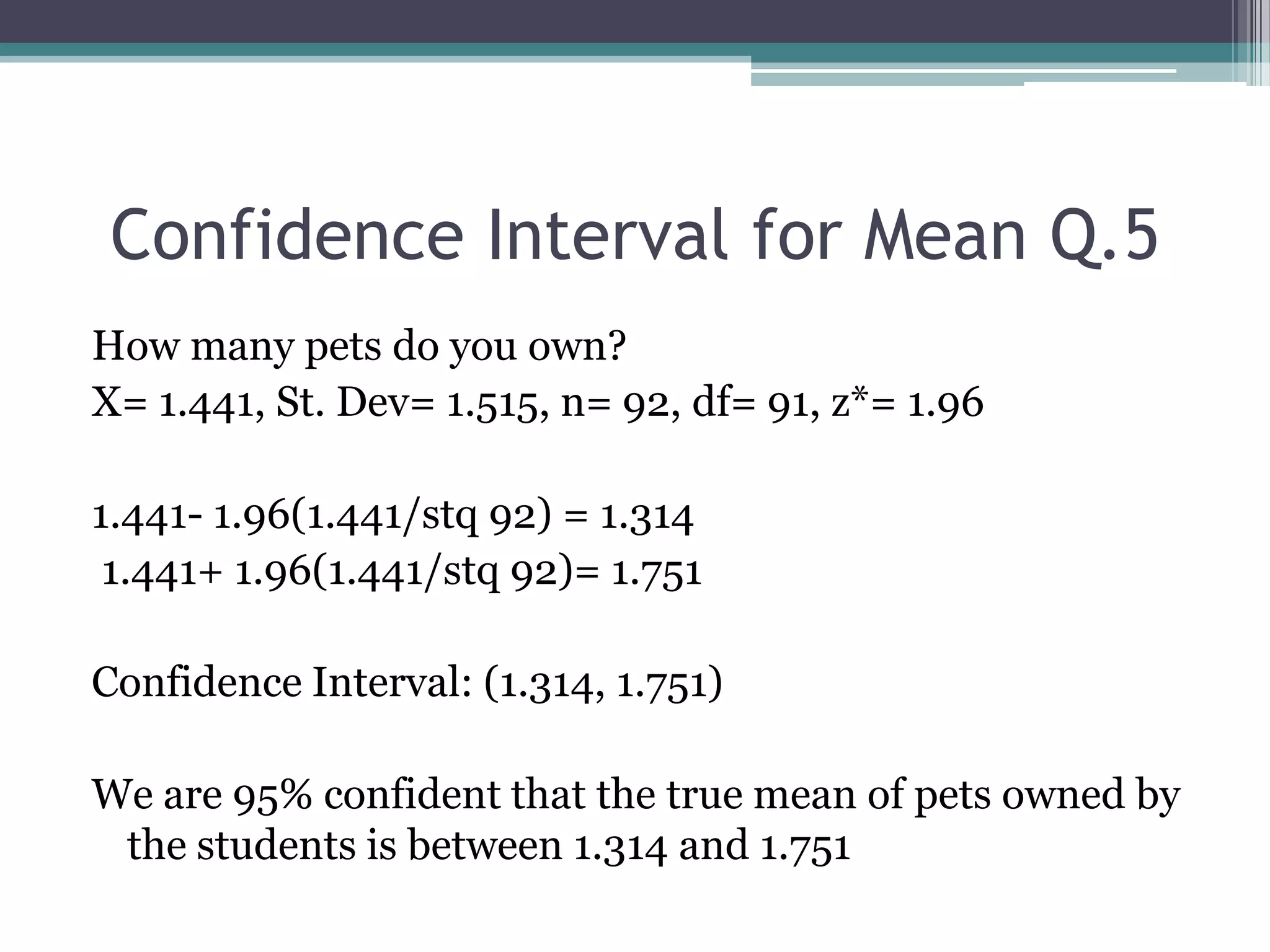
Confidence Interval for Mean Q.5How many pets do you own?X= 1.441, St. Dev= 1.515, n= 92, df= 91, z*= 1.961.441- 1.96(1.441/stq 92) = 1.314 1.441+ 1.96(1.441/stq 92)= 1.751Confidence Interval: (1.314, 1.751)We are 95% confident that the true mean of pets owned by the students is between 1.314 and 1.751
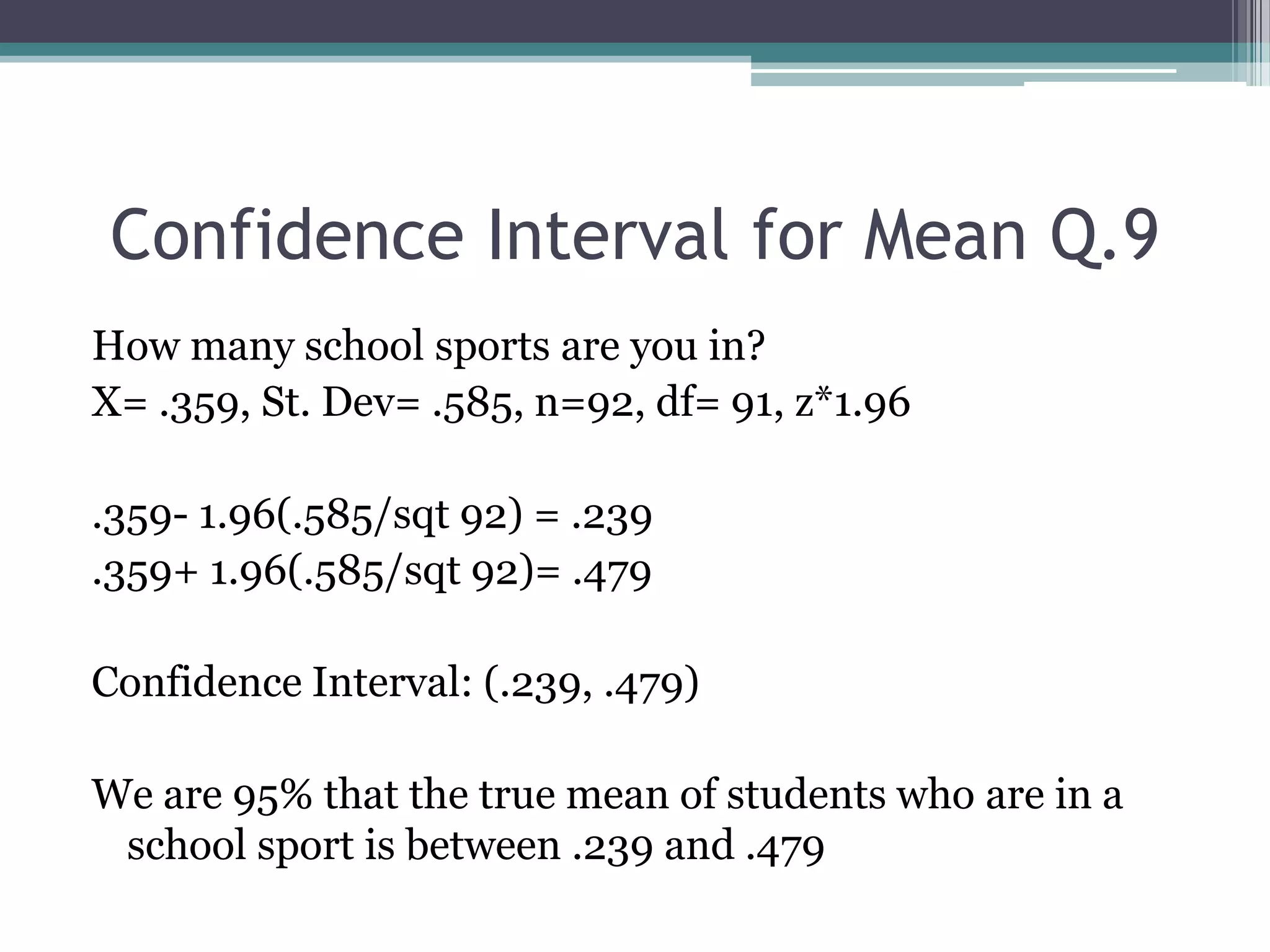
Confidence Interval for Mean Q.9How many school sports are you in?X= .359, St. Dev= .585, n=92, df= 91, z*1.96.359- 1.96(.585/sqt 92) = .239.359+ 1.96(.585/sqt 92)= .479Confidence Interval: (.239, .479)We are 95% that the true mean of students who are in a school sport is between .239 and .479
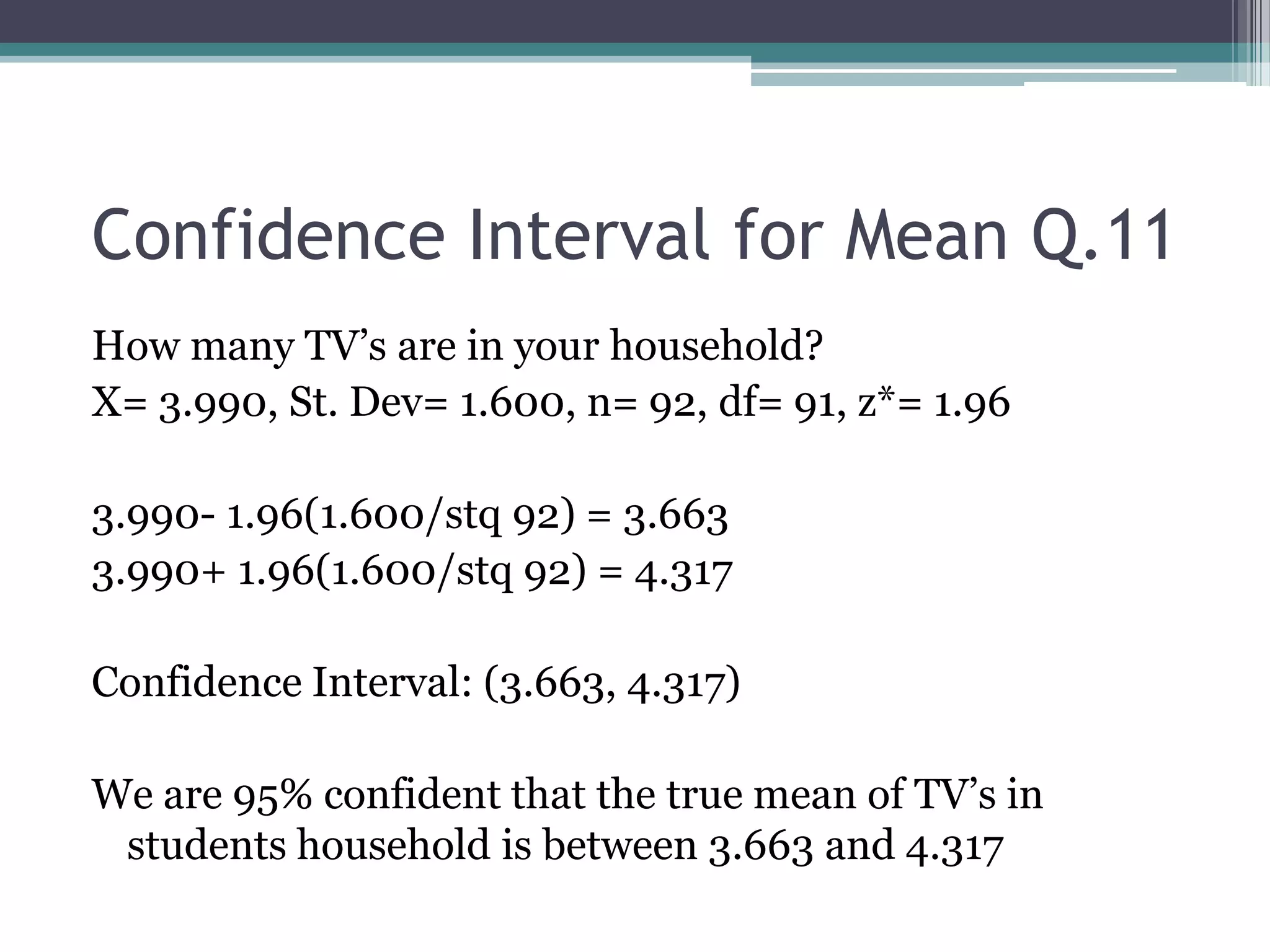
Confidence Interval for Mean Q.11How many TV’s are in your household?X= 3.990, St. Dev= 1.600, n= 92, df= 91, z*= 1.963.990- 1.96(1.600/stq 92) = 3.6633.990+ 1.96(1.600/stq 92) = 4.317Confidence Interval: (3.663, 4.317)We are 95% confident that the true mean of TV’s in students household is between 3.663 and 4.317
Confidence Interval for Proportion Q.1What is your gender?  p= malesp= .467, q= .532,  z*=1.96, n=92.467- 1.96*sqt[(.467)(.532)/92]= .365.467+ 1.96*sqt[(.467)(.532)/92] = .569Confidence Interval= (.365, .569)We are 95% that the proportion of male students is between .365 and .569
Confidence Interval for Proportion Q.6Do you like you parents? p= .887, q= .123, z*= 1.96, n=89.887- 1.96*sqt[(.822)(.178)/89)] = .822.887+ 1.96*sqt[(.822)(.178)/89)] = .953Confidence Interval: (.822, .953)We are 95% confident that the true proportion of students who like their parents is between .822 and .953
Confidence Interval for Proportion Q.7Are you for or against marijuana? p= forp= .473, q= .527, z*= 1.96, n= 91.473- 1.96*sqt[(.473)(.527)/(89)]= .369.473+ 1.96*sqt[(.473)(.527)/(89)]= .575Confidence Interval: (.369, .575)We are 95% confident that the true proportion of students who are for marijuana are between .369 and .575
Confidence Interval for Proportion Q.8Are you in a school sport?p= .696, q= .304, z*= 1.96, n= 92.696- 1.96*sqt[(.696)(.304)/92]= .376.696+ 1.96*sqt[(.696)(.304)/92]= .583Confidence Interval: (.376, .583)We are 95% confident that the true proportion of students who are in a school sport is between .376 and .583
Confidence Interval from Proportion Q.10 Are there any video game consoles in your house?p= .867, q= .133, z*= 1.96, n= 90.867- 1.96* sqt[(.867)(.133)/90]= .063.867+ 1.96* sqt[(.867)(.133)/90]= .203Confidence Interval: (.063, .203)We are 95% confident that the true proportion of students who own have a video game console in their house is between .063 and .203
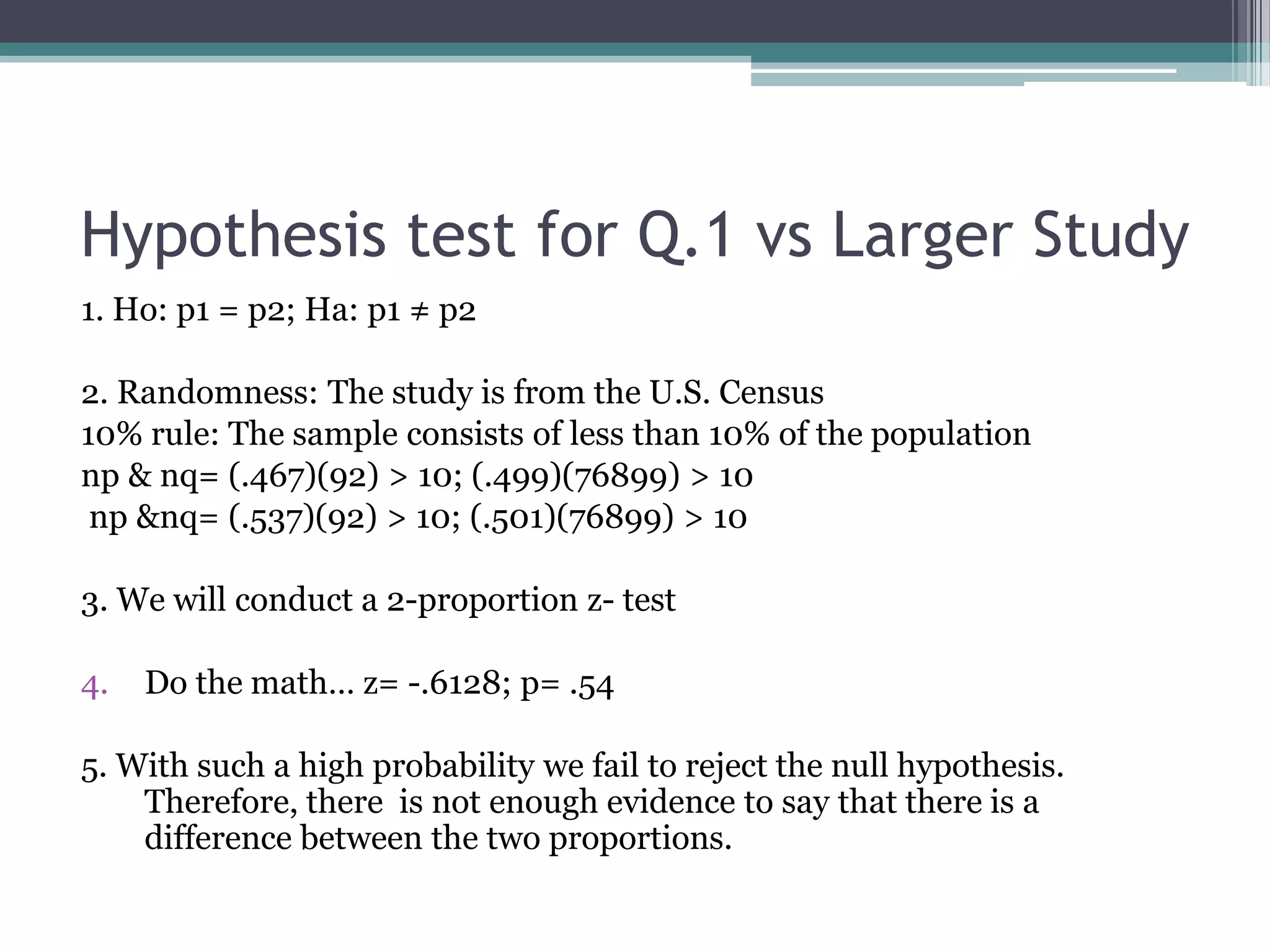
Hypothesis test for Q.1 vs Larger Study1. Ho: p1 = p2; Ha: p1 ≠ p22. Randomness: The study is from the U.S. Census10% rule: The sample consists of less than 10% of the populationnp & nq= (.467)(92) > 10; (.499)(76899) > 10np &nq= (.537)(92) > 10; (.501)(76899) > 103. We will conduct a 2-proportion z- testDo the math… z= -.6128; p= .545. With such a high probability we fail to reject the null hypothesis. Therefore, there  is not enough evidence to say that there is a difference between the two proportions.
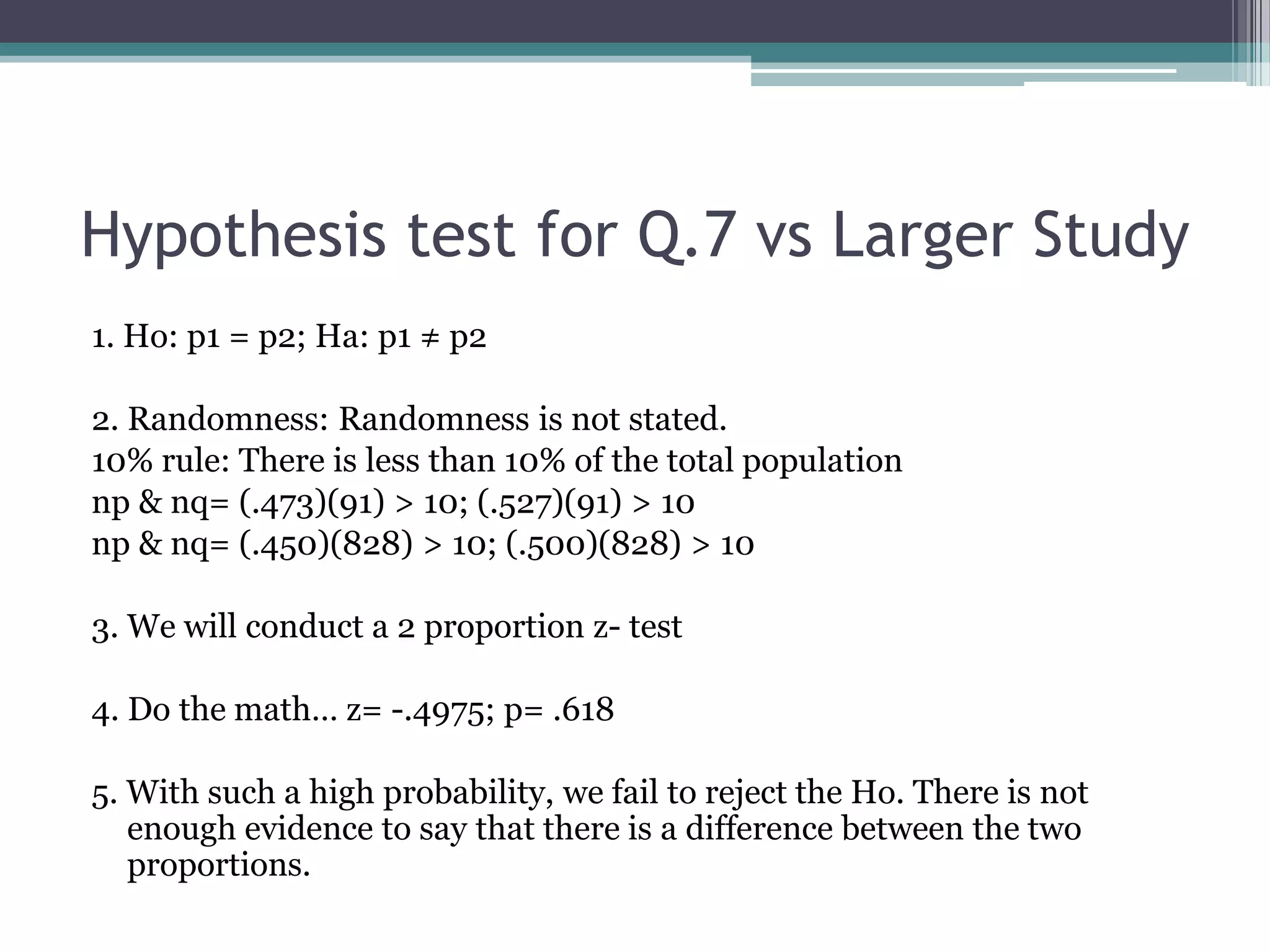
Hypothesis test for Q.7 vs Larger Study 1. Ho: p1 = p2; Ha: p1 ≠ p22. Randomness: Randomness is not stated.10% rule: There is less than 10% of the total populationnp & nq= (.473)(91) > 10; (.527)(91) > 10np & nq= (.450)(828) > 10; (.500)(828) > 103. We will conduct a 2 proportion z- test4. Do the math… z= -.4975; p= .6185. With such a high probability, we fail to reject the Ho. There is not enough evidence to say that there is a difference between the two proportions.
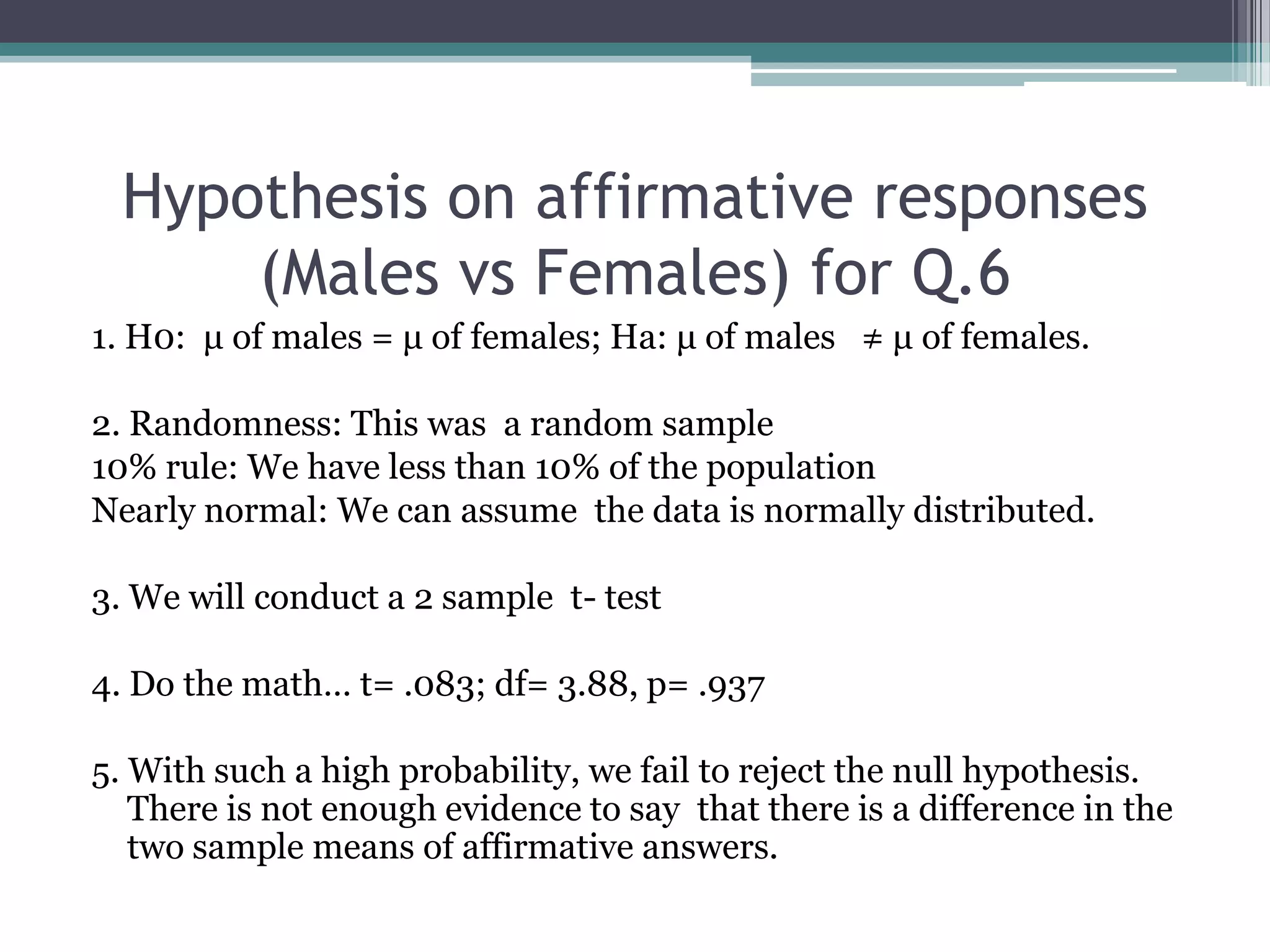
Hypothesis on affirmative responses (Males vs Females) for Q.61. H0:  μ of males = μ of females; Ha: μ of males   ≠ μ of females.2. Randomness: This was  a random sample10% rule: We have less than 10% of the populationNearly normal: We can assume  the data is normally distributed.3. We will conduct a 2 sample  t- test4. Do the math… t= .083; df= 3.88, p= .9375. With such a high probability, we fail to reject the null hypothesis. There is not enough evidence to say  that there is a difference in the two sample means of affirmative answers.
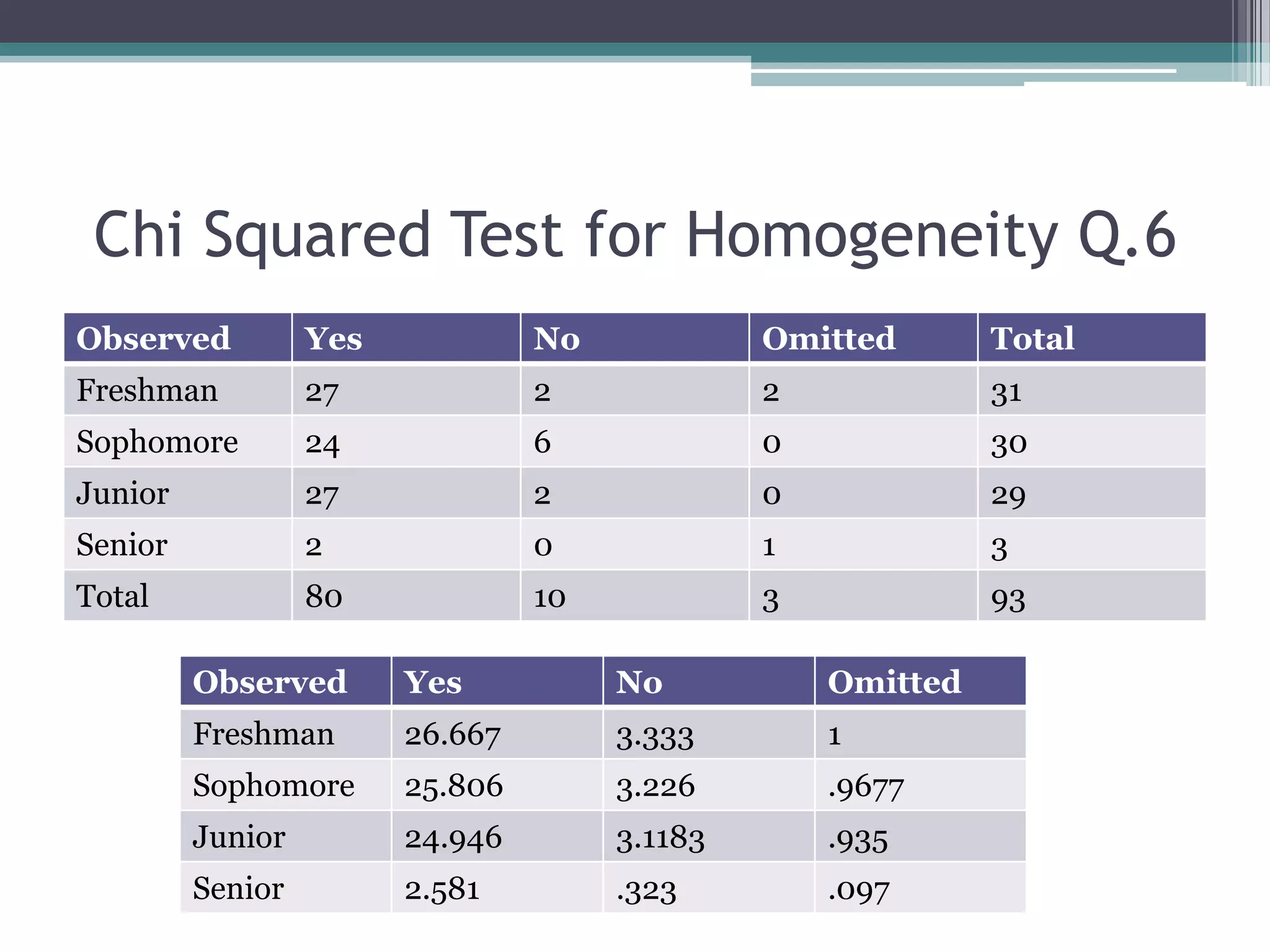
Chi Squared Test for Homogeneity Q.6
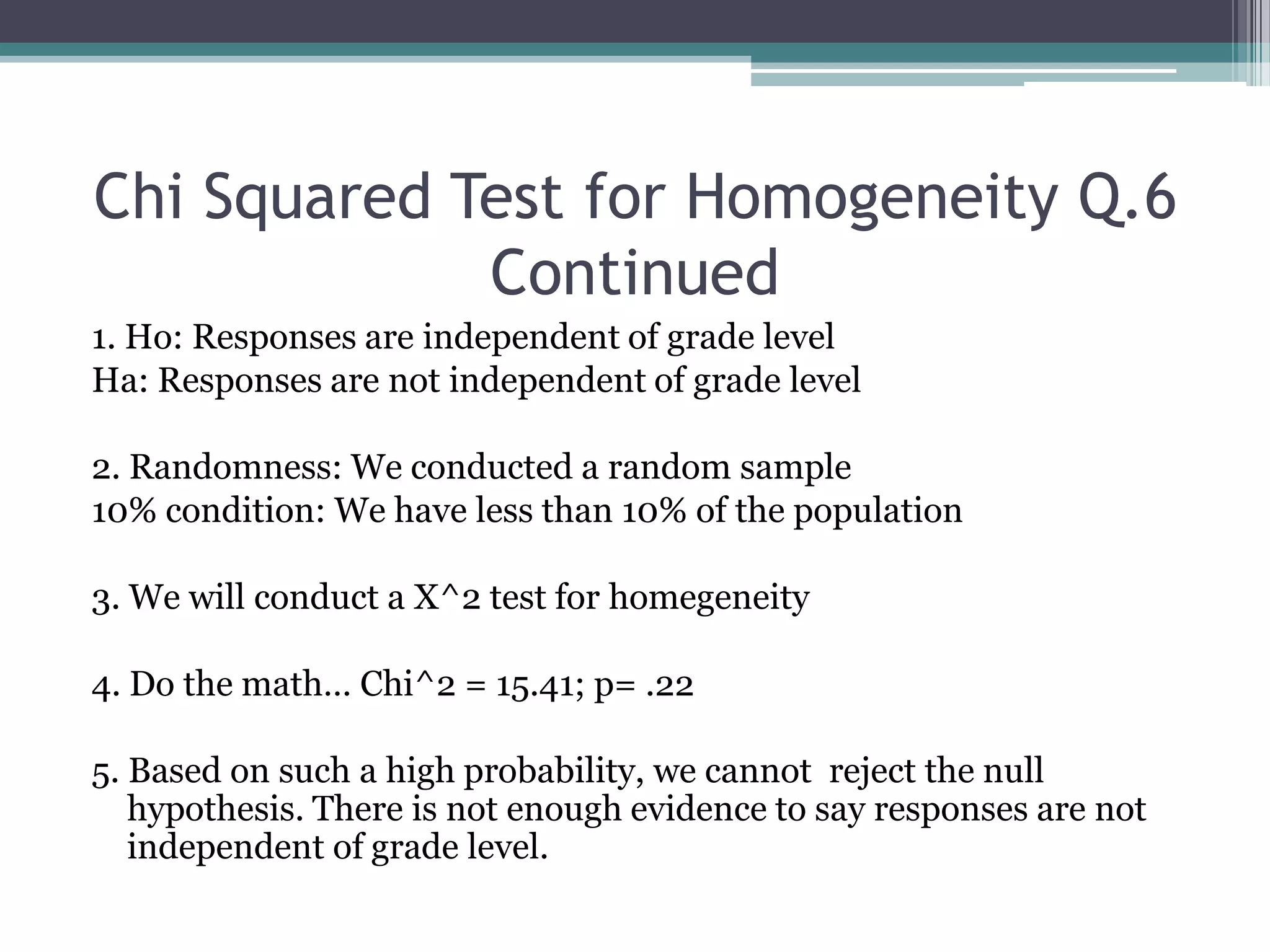
Chi Squared Test for Homogeneity Q.6 Continued1. Ho: Responses are independent of grade levelHa: Responses are not independent of grade level2. Randomness: We conducted a random sample10% condition: We have less than 10% of the population3. We will conduct a X^2 test for homegeneity4. Do the math… Chi^2 = 15.41; p= .225. Based on such a high probability, we cannot  reject the null  hypothesis. There is not enough evidence to say responses are not independent of grade level.
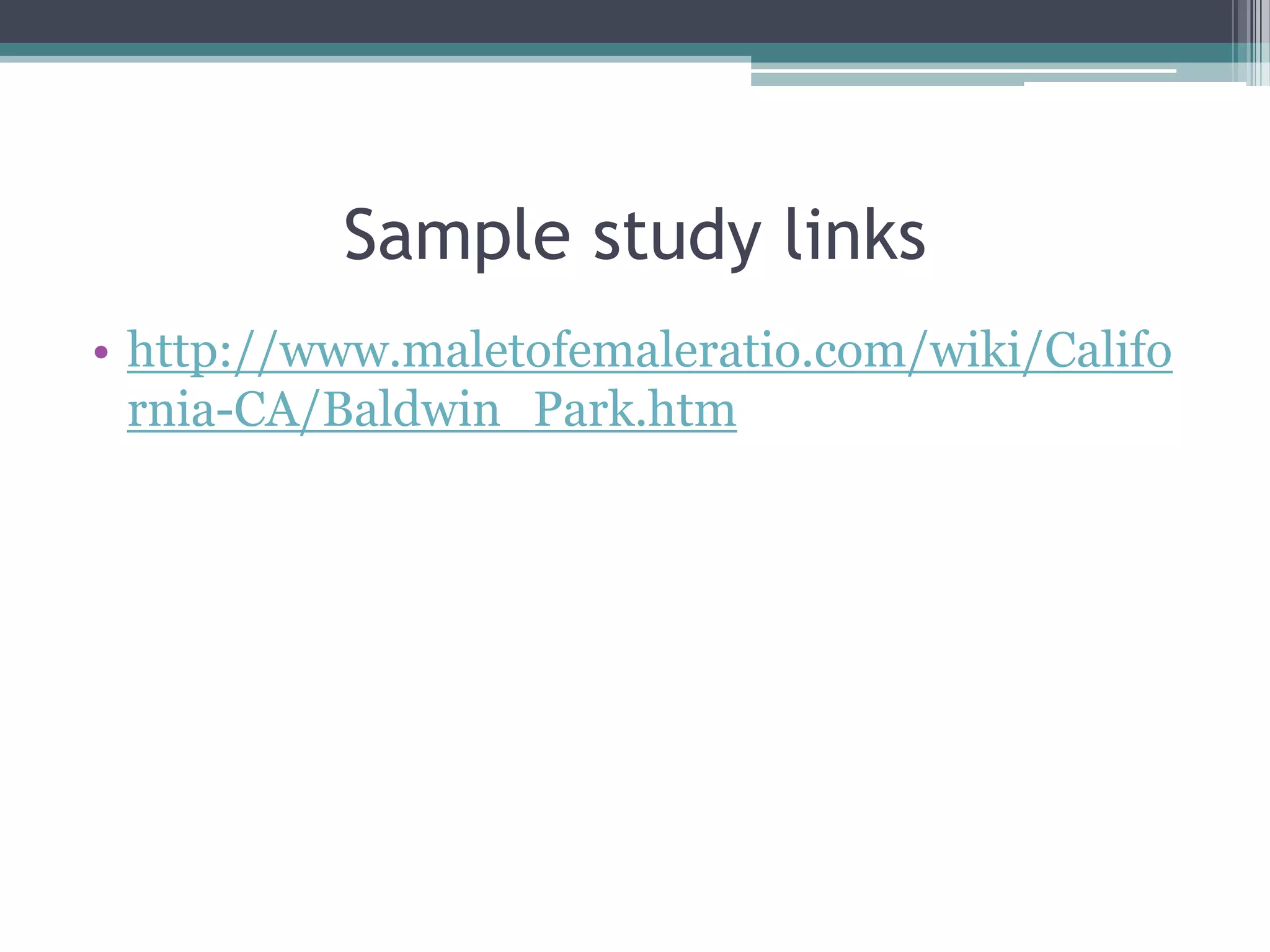
Sample study linkshttp://www.maletofemaleratio.com/wiki/California-CA/Baldwin_Park.htm

Statistical survey project

  • 1.
    Statistical Survey ProjectBy:Jonathan Peñate andArnold Gonzalez
  • 2.
    Our Survey Questions1.What is your gender?2. What grade are you in?3. What is your current age?4. How many people live in your household (including yourself?) 5. How many pets do you own?6. Do you like your parents?7. Are you for or against the legalization of marijuana? 8. Are you in a school sport?9. If yes, how many?10. Are there any video game consoles in your house? 11. How many TV’s are in your household?
  • 3.
    Confidence Interval forMeansQuestion 2Question 3Question 4Question 5Question 9Question 11
  • 4.
    Confidence Interval forProportionsQuestion 1Question 6Question 7Question 8Question 10
  • 5.
    Confidence Interval forMean Q.2What grade are you in?X= 10.054, St. Dev= .882, n=92, df=91, z*=1.9610.054-1.96(.882/sqt 92) = 9.87410.054-1.96(.882/sqt 92) = 10.234Confidence Interval: (9.874, 10.234)We are 95% confident that the true mean grade of the students is between 9.874 and 10.234
  • 6.
    Confidence Interval forMean Q.3What is your current age?X= 15.543, St. Dev= 1.042, n=92, df=91, z*=1.9615.543- 1.96(1.042/sqt 92) = 15.33015.543+ 1.96(1.042/.sqt 92) = 15.756Confidence Interval: (15.330, 15.756)We are 95% confident that the true mean age of the students is between 15.330 and 15.756
  • 7.
    Confidence Interval Q.4Howmany people live in your household?X= 5.889, St. Dev= 2.470, n=90, df= 89, z*=1.965.889- 1.96(2.470/sqt 90) = 5.3795.889+1.96(2.470/sqt 90) =6.399Confidence Interval: (5.379, 6.399)We are 95% confident that the true mean of people living in the students’ households is between 5.379 and 6.399
  • 8.
    Confidence Interval forMean Q.5How many pets do you own?X= 1.441, St. Dev= 1.515, n= 92, df= 91, z*= 1.961.441- 1.96(1.441/stq 92) = 1.314 1.441+ 1.96(1.441/stq 92)= 1.751Confidence Interval: (1.314, 1.751)We are 95% confident that the true mean of pets owned by the students is between 1.314 and 1.751
  • 9.
    Confidence Interval forMean Q.9How many school sports are you in?X= .359, St. Dev= .585, n=92, df= 91, z*1.96.359- 1.96(.585/sqt 92) = .239.359+ 1.96(.585/sqt 92)= .479Confidence Interval: (.239, .479)We are 95% that the true mean of students who are in a school sport is between .239 and .479
  • 10.
    Confidence Interval forMean Q.11How many TV’s are in your household?X= 3.990, St. Dev= 1.600, n= 92, df= 91, z*= 1.963.990- 1.96(1.600/stq 92) = 3.6633.990+ 1.96(1.600/stq 92) = 4.317Confidence Interval: (3.663, 4.317)We are 95% confident that the true mean of TV’s in students household is between 3.663 and 4.317
  • 11.
    Confidence Interval forProportion Q.1What is your gender? p= malesp= .467, q= .532, z*=1.96, n=92.467- 1.96*sqt[(.467)(.532)/92]= .365.467+ 1.96*sqt[(.467)(.532)/92] = .569Confidence Interval= (.365, .569)We are 95% that the proportion of male students is between .365 and .569
  • 12.
    Confidence Interval forProportion Q.6Do you like you parents? p= .887, q= .123, z*= 1.96, n=89.887- 1.96*sqt[(.822)(.178)/89)] = .822.887+ 1.96*sqt[(.822)(.178)/89)] = .953Confidence Interval: (.822, .953)We are 95% confident that the true proportion of students who like their parents is between .822 and .953
  • 13.
    Confidence Interval forProportion Q.7Are you for or against marijuana? p= forp= .473, q= .527, z*= 1.96, n= 91.473- 1.96*sqt[(.473)(.527)/(89)]= .369.473+ 1.96*sqt[(.473)(.527)/(89)]= .575Confidence Interval: (.369, .575)We are 95% confident that the true proportion of students who are for marijuana are between .369 and .575
  • 14.
    Confidence Interval forProportion Q.8Are you in a school sport?p= .696, q= .304, z*= 1.96, n= 92.696- 1.96*sqt[(.696)(.304)/92]= .376.696+ 1.96*sqt[(.696)(.304)/92]= .583Confidence Interval: (.376, .583)We are 95% confident that the true proportion of students who are in a school sport is between .376 and .583
  • 15.
    Confidence Interval fromProportion Q.10 Are there any video game consoles in your house?p= .867, q= .133, z*= 1.96, n= 90.867- 1.96* sqt[(.867)(.133)/90]= .063.867+ 1.96* sqt[(.867)(.133)/90]= .203Confidence Interval: (.063, .203)We are 95% confident that the true proportion of students who own have a video game console in their house is between .063 and .203
  • 16.
    Hypothesis test forQ.1 vs Larger Study1. Ho: p1 = p2; Ha: p1 ≠ p22. Randomness: The study is from the U.S. Census10% rule: The sample consists of less than 10% of the populationnp & nq= (.467)(92) > 10; (.499)(76899) > 10np &nq= (.537)(92) > 10; (.501)(76899) > 103. We will conduct a 2-proportion z- testDo the math… z= -.6128; p= .545. With such a high probability we fail to reject the null hypothesis. Therefore, there is not enough evidence to say that there is a difference between the two proportions.
  • 17.
    Hypothesis test forQ.7 vs Larger Study 1. Ho: p1 = p2; Ha: p1 ≠ p22. Randomness: Randomness is not stated.10% rule: There is less than 10% of the total populationnp & nq= (.473)(91) > 10; (.527)(91) > 10np & nq= (.450)(828) > 10; (.500)(828) > 103. We will conduct a 2 proportion z- test4. Do the math… z= -.4975; p= .6185. With such a high probability, we fail to reject the Ho. There is not enough evidence to say that there is a difference between the two proportions.
  • 18.
    Hypothesis on affirmativeresponses (Males vs Females) for Q.61. H0: μ of males = μ of females; Ha: μ of males ≠ μ of females.2. Randomness: This was a random sample10% rule: We have less than 10% of the populationNearly normal: We can assume the data is normally distributed.3. We will conduct a 2 sample t- test4. Do the math… t= .083; df= 3.88, p= .9375. With such a high probability, we fail to reject the null hypothesis. There is not enough evidence to say that there is a difference in the two sample means of affirmative answers.
  • 19.
    Chi Squared Testfor Homogeneity Q.6
  • 20.
    Chi Squared Testfor Homogeneity Q.6 Continued1. Ho: Responses are independent of grade levelHa: Responses are not independent of grade level2. Randomness: We conducted a random sample10% condition: We have less than 10% of the population3. We will conduct a X^2 test for homegeneity4. Do the math… Chi^2 = 15.41; p= .225. Based on such a high probability, we cannot reject the null hypothesis. There is not enough evidence to say responses are not independent of grade level.
  • 21.