Statins are associated with aStatins are associated with a
reduced incidence of perioperativereduced incidence of perioperative
mortality in patients undergoingmortality in patients undergoing
major vascular surgerymajor vascular surgery
Poldermans D, Bax JJ, Kertai MD,
Krenning B, Westerhout CW, Schinkel AF, Thomson
IR, Lansberg PJ, Fleisher LA, Klein J, van Urk H,
Roelandt JRTC, Boersma E
Erasmus MC, Departments of Cardiology and
Anaesthesiology
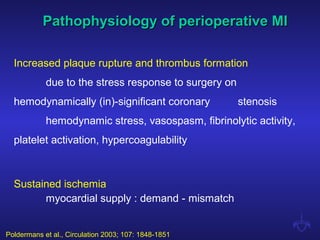
Increased plaque rupture and thrombus formation
due to the stress response to surgery on
hemodynamically (in)-significant coronary stenosis
hemodynamic stress, vasospasm, fibrinolytic activity,
platelet activation, hypercoagulability
Sustained ischemia
myocardial supply : demand - mismatch
Pathophysiology of perioperative MIPathophysiology of perioperative MI
Poldermans et al., Circulation 2003; 107: 1848-1851
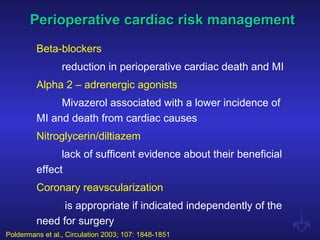
Perioperative cardiac risk managementPerioperative cardiac risk management
Beta-blockers
reduction in perioperative cardiac death and MI
Alpha 2 – adrenergic agonists
Mivazerol associated with a lower incidence of
MI and death from cardiac causes
Nitroglycerin/diltiazem
lack of sufficent evidence about their beneficial
effect
Coronary reavscularization
is appropriate if indicated independently of the
need for surgery
Poldermans et al., Circulation 2003; 107: 1848-1851
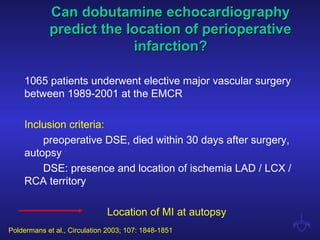
1065 patients underwent elective major vascular surgery
between 1989-2001 at the EMCR
Inclusion criteria:
preoperative DSE, died within 30 days after surgery,
autopsy
DSE: presence and location of ischemia LAD / LCX /
RCA territory
Location of MI at autopsy
Can dobutamine echocardiographyCan dobutamine echocardiography
predict the location of perioperativepredict the location of perioperative
infarction?infarction?
Poldermans et al., Circulation 2003; 107: 1848-1851
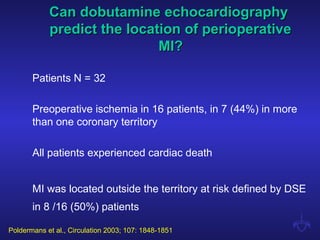
Patients N = 32
Preoperative ischemia in 16 patients, in 7 (44%) in more
than one coronary territory
All patients experienced cardiac death
MI was located outside the territory at risk defined by DSE
in 8 /16 (50%) patients
Can dobutamine echocardiographyCan dobutamine echocardiography
predict the location of perioperativepredict the location of perioperative
MI?MI?
Poldermans et al., Circulation 2003; 107: 1848-1851
BackgroundBackground
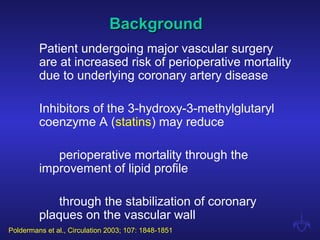
Patient undergoing major vascular surgery
are at increased risk of perioperative mortality
due to underlying coronary artery disease
Inhibitors of the 3-hydroxy-3-methylglutaryl
coenzyme A (statins) may reduce
perioperative mortality through the
improvement of lipid profile
through the stabilization of coronary
plaques on the vascular wall
Poldermans et al., Circulation 2003; 107: 1848-1851
AimAim
To evaluate the association between statin
use and perioperative mortality in patient
undergoing major vascular surgery
Poldermans et al., Circulation 2003; 107: 1848-1851
Study DesignStudy Design
• retrospective case-control study among of
2816 patients aged 18 years or older
• scheduled for acute or elective abdominal
aortic repair, carotid endarterectomy, or lower
extremity revascularization
Poldermans et al., Circulation 2003; 107: 1848-1851
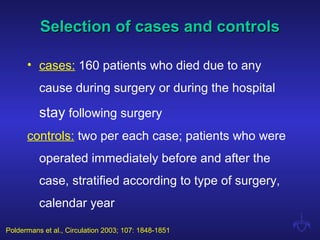
Selection of cases and controlsSelection of cases and controls
• cases: 160 patients who died due to any
cause during surgery or during the hospital
stay following surgery
controls: two per each case; patients who were
operated immediately before and after the
case, stratified according to type of surgery,
calendar year
Poldermans et al., Circulation 2003; 107: 1848-1851
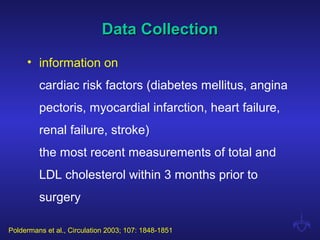
Data CollectionData Collection
• information on
cardiac risk factors (diabetes mellitus, angina
pectoris, myocardial infarction, heart failure,
renal failure, stroke)
the most recent measurements of total and
LDL cholesterol within 3 months prior to
surgery
Poldermans et al., Circulation 2003; 107: 1848-1851
Results – Table 1Results – Table 1
Characteristics Cases
(N=160), [%]
Controls
(N=320), [%]
P-Value
Age 72 (66-77) 69 (62-75) <0.001
COPD 58 (36) 64 (20) <0.001
Renal failure 34 (21) 37 (12) 0.005
Angina pectoris 55 (34) 76 (24) 0.01
Myocardial infarction 84 (53) 109 (34) <0.001
Heart failure 44 (28) 35 (11) <0.001
Stroke 35 (22) 29 (9) <0.001
Type of surgery 1.0
Poldermans et al., Circulation 2003; 107: 1848-1851
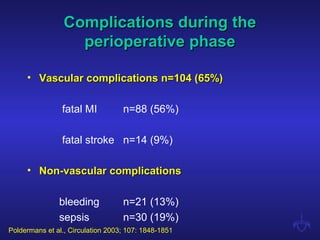
Complications during theComplications during the
perioperative phaseperioperative phase
• Vascular complications n=104 (65%)Vascular complications n=104 (65%)
fatal MI n=88 (56%)
fatal stroke n=14 (9%)
• Non-vascular complicationsNon-vascular complications
bleeding n=21 (13%)
sepsis n=30 (19%)
Poldermans et al., Circulation 2003; 107: 1848-1851
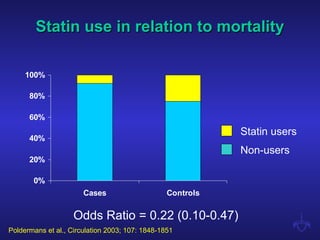
Statin use in relation to mortalityStatin use in relation to mortality
0%
20%
40%
60%
80%
100%
Cases Controls
Odds Ratio = 0.22 (0.10-0.47)
Statin users
Non-users
Poldermans et al., Circulation 2003; 107: 1848-1851
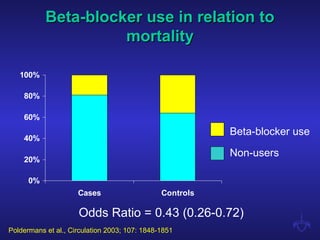
Beta-blocker use in relation toBeta-blocker use in relation to
mortalitymortality
0%
20%
40%
60%
80%
100%
Cases Controls
Odds Ratio = 0.43 (0.26-0.72)
Beta-blocker use
Non-users
Poldermans et al., Circulation 2003; 107: 1848-1851
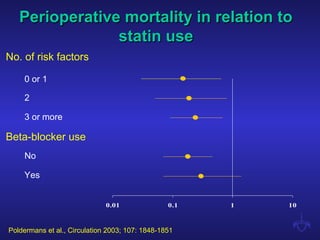
Perioperative mortality in relation toPerioperative mortality in relation to
statin usestatin use
0.01 0.1 1 10
No. of risk factors
0 or 1
2
3 or more
Beta-blocker use
No
Yes
Poldermans et al., Circulation 2003; 107: 1848-1851
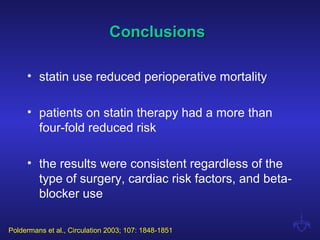
ConclusionsConclusions
• statin use reduced perioperative mortality
• patients on statin therapy had a more than
four-fold reduced risk
• the results were consistent regardless of the
type of surgery, cardiac risk factors, and beta-
blocker use
Poldermans et al., Circulation 2003; 107: 1848-1851

Statins are associated

  • 1.
    Statins are associatedwith aStatins are associated with a reduced incidence of perioperativereduced incidence of perioperative mortality in patients undergoingmortality in patients undergoing major vascular surgerymajor vascular surgery Poldermans D, Bax JJ, Kertai MD, Krenning B, Westerhout CW, Schinkel AF, Thomson IR, Lansberg PJ, Fleisher LA, Klein J, van Urk H, Roelandt JRTC, Boersma E Erasmus MC, Departments of Cardiology and Anaesthesiology
  • 2.
    Increased plaque ruptureand thrombus formation due to the stress response to surgery on hemodynamically (in)-significant coronary stenosis hemodynamic stress, vasospasm, fibrinolytic activity, platelet activation, hypercoagulability Sustained ischemia myocardial supply : demand - mismatch Pathophysiology of perioperative MIPathophysiology of perioperative MI Poldermans et al., Circulation 2003; 107: 1848-1851
  • 3.
    Perioperative cardiac riskmanagementPerioperative cardiac risk management Beta-blockers reduction in perioperative cardiac death and MI Alpha 2 – adrenergic agonists Mivazerol associated with a lower incidence of MI and death from cardiac causes Nitroglycerin/diltiazem lack of sufficent evidence about their beneficial effect Coronary reavscularization is appropriate if indicated independently of the need for surgery Poldermans et al., Circulation 2003; 107: 1848-1851
  • 4.
    1065 patients underwentelective major vascular surgery between 1989-2001 at the EMCR Inclusion criteria: preoperative DSE, died within 30 days after surgery, autopsy DSE: presence and location of ischemia LAD / LCX / RCA territory Location of MI at autopsy Can dobutamine echocardiographyCan dobutamine echocardiography predict the location of perioperativepredict the location of perioperative infarction?infarction? Poldermans et al., Circulation 2003; 107: 1848-1851
  • 5.
    Patients N =32 Preoperative ischemia in 16 patients, in 7 (44%) in more than one coronary territory All patients experienced cardiac death MI was located outside the territory at risk defined by DSE in 8 /16 (50%) patients Can dobutamine echocardiographyCan dobutamine echocardiography predict the location of perioperativepredict the location of perioperative MI?MI? Poldermans et al., Circulation 2003; 107: 1848-1851
  • 6.
    BackgroundBackground Patient undergoing majorvascular surgery are at increased risk of perioperative mortality due to underlying coronary artery disease Inhibitors of the 3-hydroxy-3-methylglutaryl coenzyme A (statins) may reduce perioperative mortality through the improvement of lipid profile through the stabilization of coronary plaques on the vascular wall Poldermans et al., Circulation 2003; 107: 1848-1851
  • 7.
    AimAim To evaluate theassociation between statin use and perioperative mortality in patient undergoing major vascular surgery Poldermans et al., Circulation 2003; 107: 1848-1851
  • 8.
    Study DesignStudy Design •retrospective case-control study among of 2816 patients aged 18 years or older • scheduled for acute or elective abdominal aortic repair, carotid endarterectomy, or lower extremity revascularization Poldermans et al., Circulation 2003; 107: 1848-1851
  • 9.
    Selection of casesand controlsSelection of cases and controls • cases: 160 patients who died due to any cause during surgery or during the hospital stay following surgery controls: two per each case; patients who were operated immediately before and after the case, stratified according to type of surgery, calendar year Poldermans et al., Circulation 2003; 107: 1848-1851
  • 10.
    Data CollectionData Collection •information on cardiac risk factors (diabetes mellitus, angina pectoris, myocardial infarction, heart failure, renal failure, stroke) the most recent measurements of total and LDL cholesterol within 3 months prior to surgery Poldermans et al., Circulation 2003; 107: 1848-1851
  • 11.
    Results – Table1Results – Table 1 Characteristics Cases (N=160), [%] Controls (N=320), [%] P-Value Age 72 (66-77) 69 (62-75) <0.001 COPD 58 (36) 64 (20) <0.001 Renal failure 34 (21) 37 (12) 0.005 Angina pectoris 55 (34) 76 (24) 0.01 Myocardial infarction 84 (53) 109 (34) <0.001 Heart failure 44 (28) 35 (11) <0.001 Stroke 35 (22) 29 (9) <0.001 Type of surgery 1.0 Poldermans et al., Circulation 2003; 107: 1848-1851
  • 12.
    Complications during theComplicationsduring the perioperative phaseperioperative phase • Vascular complications n=104 (65%)Vascular complications n=104 (65%) fatal MI n=88 (56%) fatal stroke n=14 (9%) • Non-vascular complicationsNon-vascular complications bleeding n=21 (13%) sepsis n=30 (19%) Poldermans et al., Circulation 2003; 107: 1848-1851
  • 13.
    Statin use inrelation to mortalityStatin use in relation to mortality 0% 20% 40% 60% 80% 100% Cases Controls Odds Ratio = 0.22 (0.10-0.47) Statin users Non-users Poldermans et al., Circulation 2003; 107: 1848-1851
  • 14.
    Beta-blocker use inrelation toBeta-blocker use in relation to mortalitymortality 0% 20% 40% 60% 80% 100% Cases Controls Odds Ratio = 0.43 (0.26-0.72) Beta-blocker use Non-users Poldermans et al., Circulation 2003; 107: 1848-1851
  • 15.
    Perioperative mortality inrelation toPerioperative mortality in relation to statin usestatin use 0.01 0.1 1 10 No. of risk factors 0 or 1 2 3 or more Beta-blocker use No Yes Poldermans et al., Circulation 2003; 107: 1848-1851
  • 16.
    ConclusionsConclusions • statin usereduced perioperative mortality • patients on statin therapy had a more than four-fold reduced risk • the results were consistent regardless of the type of surgery, cardiac risk factors, and beta- blocker use Poldermans et al., Circulation 2003; 107: 1848-1851