Tourism as an
Economic Pillar
Mary Vrolijk
25 September 2015
Tourism Trends.
• Tourism: a key role player in economies.
Spinoff effects:
• Job creation,
• New small and medium enterprises(SME’s),
• Country competiveness,
• Productivity,
• Innovation and
• Creativity.
Tourism Trends.
• Trends over last 6 decades:
• Continued expansion and diversification,
• Become one of the largest and fastest-growing
economic sectors in the world.
• New destinations in addition favorites of Europe and
North America.
• Tourism has shown uninterrupted growth.
• International tourist arrivals have increased.
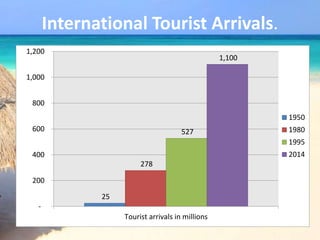
International Tourist Arrivals.
25
278
527
1,100
-
200
400
600
800
1,000
1,200
Tourist arrivals in millions
1950
1980
1995
2014
International Tourism Receipts.
$2
$104
$415
$1,200
$-
$200
$400
$600
$800
$1,000
$1,200
$1,400
Tourist receipts in US$ billions
1950
1980
1995
2014
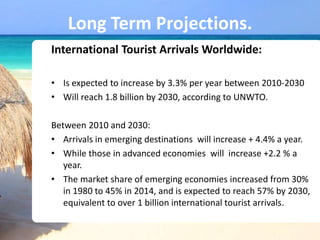
Long Term Projections.
International Tourist Arrivals Worldwide:
• Is expected to increase by 3.3% per year between 2010-2030
• Will reach 1.8 billion by 2030, according to UNWTO.
Between 2010 and 2030:
• Arrivals in emerging destinations will increase + 4.4% a year.
• While those in advanced economies will increase +2.2 % a
year.
• The market share of emerging economies increased from 30%
in 1980 to 45% in 2014, and is expected to reach 57% by 2030,
equivalent to over 1 billion international tourist arrivals.
Receipts from international visitor spending on
accommodation, food and drink,
entertainment, shopping and other
services and goods reached
an estimated US$ 1.2
trillion (euro 937
billion) in 2014, an
increase of 3.7% in real
terms
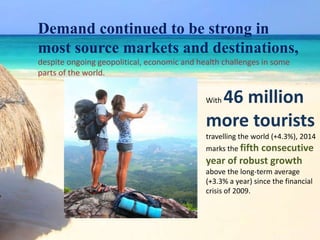
Demand continued to be strong in
most source markets and destinations,
despite ongoing geopolitical, economic and health challenges in some
parts of the world.
With 46 million
more tourists
travelling the world (+4.3%), 2014
marks the fifth consecutive
year of robust growth
above the long-term average
(+3.3% a year) since the financial
crisis of 2009.
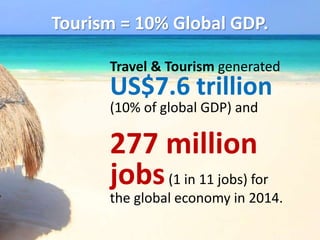
Travel & Tourism generated
US$7.6 trillion
(10% of global GDP) and
277 million
jobs(1 in 11 jobs) for
the global economy in 2014.
Tourism = 10% Global GDP.
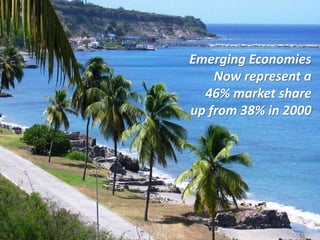
Emerging Economies now represent a 46%
market share (up from 38% from 2000)
Emerging Economies
Now represent a
46% market share
up from 38% in 2000
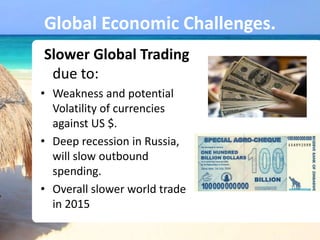
Global Economic Challenges.
Slower Global Trading
due to:
• Weakness and potential
Volatility of currencies
against US $.
• Deep recession in Russia,
will slow outbound
spending.
• Overall slower world trade
in 2015
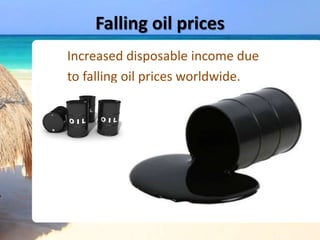
Increased disposable income due
to falling oil prices worldwide.
Falling oil prices
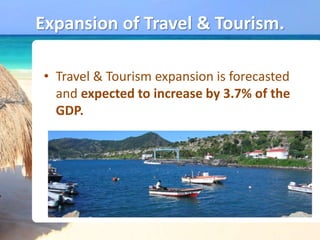
Expansion of Travel & Tourism.
• Travel & Tourism expansion is forecasted
and expected to increase by 3.7% of the
GDP.
Caribbean Performance.
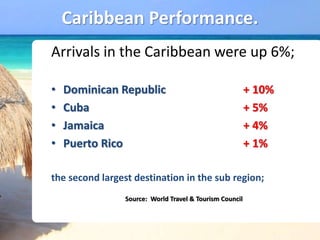
Arrivals in the Caribbean were up 6%;
• Dominican Republic + 10%
• Cuba + 5%
• Jamaica + 4%
• Puerto Rico + 1%
the second largest destination in the sub region;
Source: World Travel & Tourism Council
‘Smaller’ Destinations.
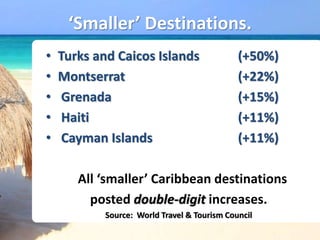
• Turks and Caicos Islands (+50%)
• Montserrat (+22%)
• Grenada (+15%)
• Haiti (+11%)
• Cayman Islands (+11%)
All ‘smaller’ Caribbean destinations
posted double-digit increases.
Source: World Travel & Tourism Council
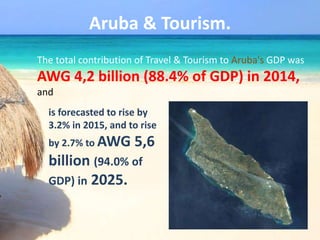
The total contribution of Travel & Tourism to Aruba's GDP was
AWG 4,2 billion (88.4% of GDP) in 2014,
and
is forecasted to rise by
3.2% in 2015, and to rise
by 2.7% to AWG 5,6
billion (94.0% of
GDP) in 2025.
Aruba & Tourism.
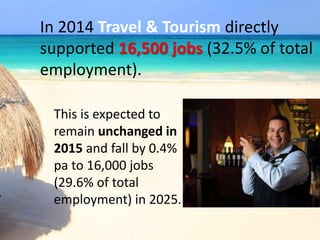
In 2014 Travel & Tourism directly
supported 16,500 jobs (32.5% of total
employment).
This is expected to
remain unchanged in
2015 and fall by 0.4%
pa to 16,000 jobs
(29.6% of total
employment) in 2025.
In 2014, the total contribution of Travel &
Tourism to employment, including jobs
indirectly supported by the industry, was
90.8% of total employment (46,000 jobs).
This is expected to rise
by 2.5% in 2015 to
47,000 jobs and rise by
0.5% pa to 49,000 jobs
in 2025 (91.2% of total).
Visitor exports.
• Visitor exports generated
AWG 2,9 billion
(66.9% of total
exports) in 2014.
• This is forecasted to grow by 2.9%
in 2015, and grow by 2.8% pa,
from 2015-2025, to AWG 3,9
billion in 2025 (64.6% of total).
Travel & Tourism investment in
2014 was AWG 334.8 million, or
31.0% of total investment.
It should rise by
4.8% in
2015,
and rise by 3.0% over the
next ten years to
AWG 469.8 million
in 2025
(34.0% of total).
International Tourism - Top Spenders
• Chinese travellers spent
a record US$ 165 billion
abroad in 2014 – an
exceptional 27%
increase over 2013
and US$ 36 billion
more in absolute
terms
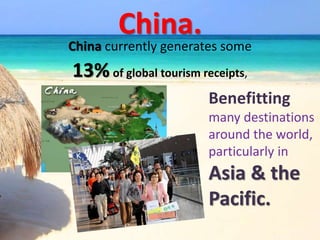
China.
China currently generates some
13% of global tourism receipts,
Benefitting
many destinations
around the world,
particularly in
Asia & the
Pacific.
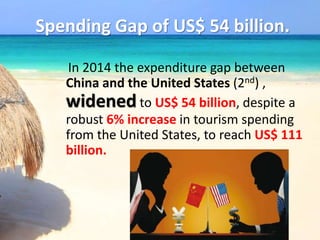
Spending Gap of US$ 54 billion.
In 2014 the expenditure gap between
China and the United States (2nd) ,
widened to US$ 54 billion, despite a
robust 6% increase in tourism spending
from the United States, to reach US$ 111
billion.
Germany reported a modest 1% increase in
expenditure to US$ 92 billion.
• The United Kingdom (+4%), with US$ 58
billion, overtaking the Russian Federation, which
is now 5th with US$ 50 billion.
• France (+11%) and Canada (+3%) with
expenditures of US$ 48 billion and US$ 34 billion
respectively, while Italy (+7%) moved up one
place into 8th position with US$ 29 billion.
France (+11%) and Canada (+3%) with expenditures of
US$ 48 billion and US$ 34 billion respectively, while Italy
(+7%) moved up one place into 8th position with US$ 29
billion.
• Australia moved down one place in the ranking into 9th
position as expenditure decreased by 2% to US$ 26 billion.
• Brazil remained in 10th place in the ranking, with an
expenditure of US$ 26 billion.
Other source markets in addition to the Top 10
which showed double-digit growth in
expenditure were:
Saudi Arabia, Norway,
Sweden, Spain,
India, Taiwan (pr. of China),
the Philippines, Qatar,
Thailand, Czech Republic &
Colombia.
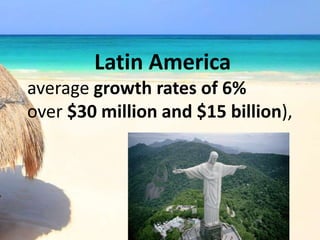
Latin America
average growth rates of 6%
over $30 million and $15 billion),
During the past year, significant growth was
experienced by
Brazil (+30%),
Uruguay (+22%),
Paraguay (+13%),
Chile (+11%),
Panama (+11%).
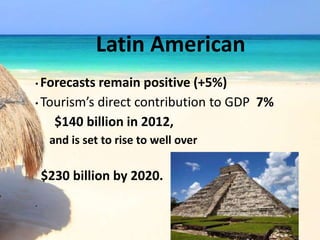
Latin American
• Forecasts remain positive (+5%)
• Tourism’s direct contribution to GDP 7%
$140 billion in 2012,
and is set to rise to well over
$230 billion by 2020.
.
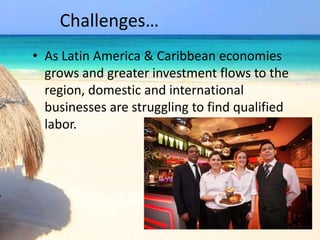
Challenges…
• As Latin America & Caribbean economies
grows and greater investment flows to the
region, domestic and international
businesses are struggling to find qualified
labor.
• Education directed to demands
of this economic sector
• A well managed migration in
order to control extensive growth
of the population not to put
pressure on infrastructure & other
• Not to ‘loose’ authenticity in
culture & heritage
• country’s product branding in
quality of service
• Job creation is necessary to
address poverty and to give
stability, opportunity and
prosperity.
Sustainability in tourism industry
Sustainability within the tourism industry
 Tools for measuring and criteria for certifying ‘green’
destinations
 Consumers & destination’s reputation for social and
environment responsibility.
Ecotourism can return as much as 95% of revenues
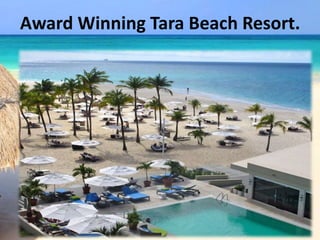
Award Winning Tara Beach Resort.
Investor’s Perspective
• Desired return on capital invested
• Global crisis intensifies the need for more
detailed pre-investment analysis…making values
more scrutinized in markets with greater
macroeconomic risks
• Yields may be compared with capital market
yields
• Emerging markets are expected to provide
greater returns
• Seasonality is generally not perceived well
From Investor’s prospective
Operating History
Hotel often cannot substantially
outperform its true competitive set
 Equally important to investments in
new developments or existing hotels
 soundness defines future performance
of hotels (new or existing)
,
hotel value–“the appetite of
investor”
Statia… discover & experience… the
unexpected!
The Mar Linda Resort
The concept
My vision is to play a key role in developing this project
to reach a niche & beyond eco-tourism on the island,
by being self-supportive by using reusable energy, eco-
friendly, with low carbon emissions and to guarantee
the authenticity of the country's culture and to provide
services to the people of Statia by contributing to
preservation of nature.
My Mission
• My mission is being a key role player in the
island's economy to provide resources to
stimulate the above, education &
economic development, a well skilled
employment force, to cater and to provide
a high standard service. The geographical
situation of the island gives an additional
edge of reaching and providing services to
other islands as well.
•
•
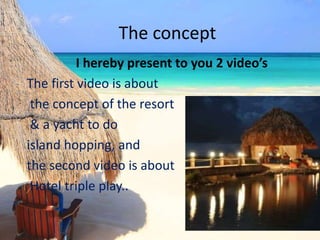
The concept
I hereby present to you 2 video’s
The first video is about
the concept of the resort
& a yacht to do
island hopping, and
the second video is about
Hotel triple play..
Summary
This will give the resort the edge of being
trendy in technology advances combined
with eco-tourism making Statia the ultimate
innovative adventure ever.
thank you for your time and your attention.
Questions?

statia tourism final mv

  • 1.
    Tourism as an EconomicPillar Mary Vrolijk 25 September 2015
  • 2.
    Tourism Trends. • Tourism:a key role player in economies. Spinoff effects: • Job creation, • New small and medium enterprises(SME’s), • Country competiveness, • Productivity, • Innovation and • Creativity.
  • 3.
    Tourism Trends. • Trendsover last 6 decades: • Continued expansion and diversification, • Become one of the largest and fastest-growing economic sectors in the world. • New destinations in addition favorites of Europe and North America. • Tourism has shown uninterrupted growth. • International tourist arrivals have increased.
  • 4.
  • 5.
  • 6.
    Long Term Projections. InternationalTourist Arrivals Worldwide: • Is expected to increase by 3.3% per year between 2010-2030 • Will reach 1.8 billion by 2030, according to UNWTO. Between 2010 and 2030: • Arrivals in emerging destinations will increase + 4.4% a year. • While those in advanced economies will increase +2.2 % a year. • The market share of emerging economies increased from 30% in 1980 to 45% in 2014, and is expected to reach 57% by 2030, equivalent to over 1 billion international tourist arrivals.
  • 7.
    Receipts from internationalvisitor spending on accommodation, food and drink, entertainment, shopping and other services and goods reached an estimated US$ 1.2 trillion (euro 937 billion) in 2014, an increase of 3.7% in real terms
  • 8.
    Demand continued tobe strong in most source markets and destinations, despite ongoing geopolitical, economic and health challenges in some parts of the world. With 46 million more tourists travelling the world (+4.3%), 2014 marks the fifth consecutive year of robust growth above the long-term average (+3.3% a year) since the financial crisis of 2009.
  • 9.
    Travel & Tourismgenerated US$7.6 trillion (10% of global GDP) and 277 million jobs(1 in 11 jobs) for the global economy in 2014. Tourism = 10% Global GDP.
  • 10.
    Emerging Economies nowrepresent a 46% market share (up from 38% from 2000) Emerging Economies Now represent a 46% market share up from 38% in 2000
  • 11.
    Global Economic Challenges. SlowerGlobal Trading due to: • Weakness and potential Volatility of currencies against US $. • Deep recession in Russia, will slow outbound spending. • Overall slower world trade in 2015
  • 12.
    Increased disposable incomedue to falling oil prices worldwide. Falling oil prices
  • 13.
    Expansion of Travel& Tourism. • Travel & Tourism expansion is forecasted and expected to increase by 3.7% of the GDP.
  • 14.
    Caribbean Performance. Arrivals inthe Caribbean were up 6%; • Dominican Republic + 10% • Cuba + 5% • Jamaica + 4% • Puerto Rico + 1% the second largest destination in the sub region; Source: World Travel & Tourism Council
  • 15.
    ‘Smaller’ Destinations. • Turksand Caicos Islands (+50%) • Montserrat (+22%) • Grenada (+15%) • Haiti (+11%) • Cayman Islands (+11%) All ‘smaller’ Caribbean destinations posted double-digit increases. Source: World Travel & Tourism Council
  • 16.
    The total contributionof Travel & Tourism to Aruba's GDP was AWG 4,2 billion (88.4% of GDP) in 2014, and is forecasted to rise by 3.2% in 2015, and to rise by 2.7% to AWG 5,6 billion (94.0% of GDP) in 2025. Aruba & Tourism.
  • 17.
    In 2014 Travel& Tourism directly supported 16,500 jobs (32.5% of total employment). This is expected to remain unchanged in 2015 and fall by 0.4% pa to 16,000 jobs (29.6% of total employment) in 2025.
  • 18.
    In 2014, thetotal contribution of Travel & Tourism to employment, including jobs indirectly supported by the industry, was 90.8% of total employment (46,000 jobs). This is expected to rise by 2.5% in 2015 to 47,000 jobs and rise by 0.5% pa to 49,000 jobs in 2025 (91.2% of total).
  • 19.
    Visitor exports. • Visitorexports generated AWG 2,9 billion (66.9% of total exports) in 2014. • This is forecasted to grow by 2.9% in 2015, and grow by 2.8% pa, from 2015-2025, to AWG 3,9 billion in 2025 (64.6% of total).
  • 20.
    Travel & Tourisminvestment in 2014 was AWG 334.8 million, or 31.0% of total investment. It should rise by 4.8% in 2015, and rise by 3.0% over the next ten years to AWG 469.8 million in 2025 (34.0% of total).
  • 21.
    International Tourism -Top Spenders • Chinese travellers spent a record US$ 165 billion abroad in 2014 – an exceptional 27% increase over 2013 and US$ 36 billion more in absolute terms
  • 22.
    China. China currently generatessome 13% of global tourism receipts, Benefitting many destinations around the world, particularly in Asia & the Pacific.
  • 23.
    Spending Gap ofUS$ 54 billion. In 2014 the expenditure gap between China and the United States (2nd) , widened to US$ 54 billion, despite a robust 6% increase in tourism spending from the United States, to reach US$ 111 billion.
  • 24.
    Germany reported amodest 1% increase in expenditure to US$ 92 billion. • The United Kingdom (+4%), with US$ 58 billion, overtaking the Russian Federation, which is now 5th with US$ 50 billion. • France (+11%) and Canada (+3%) with expenditures of US$ 48 billion and US$ 34 billion respectively, while Italy (+7%) moved up one place into 8th position with US$ 29 billion.
  • 25.
    France (+11%) andCanada (+3%) with expenditures of US$ 48 billion and US$ 34 billion respectively, while Italy (+7%) moved up one place into 8th position with US$ 29 billion. • Australia moved down one place in the ranking into 9th position as expenditure decreased by 2% to US$ 26 billion. • Brazil remained in 10th place in the ranking, with an expenditure of US$ 26 billion.
  • 26.
    Other source marketsin addition to the Top 10 which showed double-digit growth in expenditure were: Saudi Arabia, Norway, Sweden, Spain, India, Taiwan (pr. of China), the Philippines, Qatar, Thailand, Czech Republic & Colombia.
  • 27.
    Latin America average growthrates of 6% over $30 million and $15 billion),
  • 28.
    During the pastyear, significant growth was experienced by Brazil (+30%), Uruguay (+22%), Paraguay (+13%), Chile (+11%), Panama (+11%).
  • 29.
    Latin American • Forecastsremain positive (+5%) • Tourism’s direct contribution to GDP 7% $140 billion in 2012, and is set to rise to well over $230 billion by 2020. .
  • 30.
    Challenges… • As LatinAmerica & Caribbean economies grows and greater investment flows to the region, domestic and international businesses are struggling to find qualified labor.
  • 31.
    • Education directedto demands of this economic sector • A well managed migration in order to control extensive growth of the population not to put pressure on infrastructure & other • Not to ‘loose’ authenticity in culture & heritage • country’s product branding in quality of service • Job creation is necessary to address poverty and to give stability, opportunity and prosperity.
  • 32.
    Sustainability in tourismindustry Sustainability within the tourism industry  Tools for measuring and criteria for certifying ‘green’ destinations  Consumers & destination’s reputation for social and environment responsibility. Ecotourism can return as much as 95% of revenues
  • 33.
    Award Winning TaraBeach Resort.
  • 34.
    Investor’s Perspective • Desiredreturn on capital invested • Global crisis intensifies the need for more detailed pre-investment analysis…making values more scrutinized in markets with greater macroeconomic risks • Yields may be compared with capital market yields • Emerging markets are expected to provide greater returns • Seasonality is generally not perceived well
  • 35.
    From Investor’s prospective OperatingHistory Hotel often cannot substantially outperform its true competitive set  Equally important to investments in new developments or existing hotels  soundness defines future performance of hotels (new or existing) , hotel value–“the appetite of investor”
  • 36.
    Statia… discover &experience… the unexpected! The Mar Linda Resort The concept My vision is to play a key role in developing this project to reach a niche & beyond eco-tourism on the island, by being self-supportive by using reusable energy, eco- friendly, with low carbon emissions and to guarantee the authenticity of the country's culture and to provide services to the people of Statia by contributing to preservation of nature.
  • 37.
    My Mission • Mymission is being a key role player in the island's economy to provide resources to stimulate the above, education & economic development, a well skilled employment force, to cater and to provide a high standard service. The geographical situation of the island gives an additional edge of reaching and providing services to other islands as well. • •
  • 38.
    The concept I herebypresent to you 2 video’s The first video is about the concept of the resort & a yacht to do island hopping, and the second video is about Hotel triple play..
  • 39.
    Summary This will givethe resort the edge of being trendy in technology advances combined with eco-tourism making Statia the ultimate innovative adventure ever. thank you for your time and your attention.
  • 40.

Editor's Notes

  • #12 .
  • #18 Discuss outcomes of the case study or class simulation. Cover best practices.
  • #19 What will the audience be able to do after this training is complete? Briefly describe each objective how the audience will benefit from this presentation.
  • #20 Add a case study or class simulation to encourage discussion and apply lessons.
  • #21 What will the audience be able to do after this training is complete? Briefly describe each objective how the audience will benefit from this presentation.
  • #25 What will the audience be able to do after this training is complete? Briefly describe each objective how the audience will benefit from this presentation.
  • #27 What will the audience be able to do after this training is complete? Briefly describe each objective how the audience will benefit from this presentation.
  • #28 What will the audience be able to do after this training is complete? Briefly describe each objective how the audience will benefit from this presentation.
  • #29 What will the audience be able to do after this training is complete? Briefly describe each objective how the audience will benefit from this presentation.
  • #30 What will the audience be able to do after this training is complete? Briefly describe each objective how the audience will benefit from this presentation.
  • #31 Discuss outcomes of the case study or class simulation. Cover best practices.
  • #32 Discuss outcomes of the case study or class simulation. Cover best practices.
  • #33 Discuss outcomes of the case study or class simulation. Cover best practices.
  • #36 Microsoft Confidential
  • #40 Summarize presentation content by restating the important points from the lessons. What do you want the audience to remember when they leave your presentation? Save your presentation to a video for easy distribution (To create a video, click the File tab, and then click Share.  Under File Types, click Create a Video.)
  • #41 Microsoft Confidential