Tourism in the world
 Tourism is travel for pleasure or business; also the theory and practice of touring, the business of
attracting, accommodating, and entertaining tourists, and the business of operating tours. Tourism
may be international, or within the traveller's country. The World Tourism Organization defines
tourism more generally, in terms which go "beyond the common perception of tourism as being
limited to holiday activity only", as people "traveling to and staying in places outside their usual
environment for not more than one consecutive year for leisure, business and other purposes"
 Tourism can be domestic or international, and international tourism has both
incoming and outgoing implications on a country's balance of payments. Today,
tourism is a major source of income for many countries, and affects the economy
of both the source and host countries, in some cases being of vital importance.
 Tourism is an important, even vital, source of income for many regions and countries. Its
importance was recognized in the Manila Declaration on World Tourism of 1980 as "an activity
essential to the life of nations because of its direct effects on the social, cultural,
educational, and economic sectors of national societies and on their international relations."
 Tourism brings in large amounts of income into a local economy in the form of payment for
goods and services needed by tourists, accounting for 30% of the world's trade of services,
and 6% of overall exports of goods and services.[6] It also creates opportunities for
employment in the service sector of the economy associated with tourism. The service
industries which benefit from tourism include transportation services, such as airlines, cruise
ships, and taxicabs; hospitality services, such as accommodations, including hotels and
resorts; and entertainment venues, such as amusement parks, casinos, shopping malls, music
venues, and theaters. This is in addition to goods bought by tourists, including souvenirs.
 Over the decades, tourism has experienced continued growth and
deepening diversification to become one of the fastest growing economic sectors in
the world. Modern tourism is closely linked to development and encompasses a
growing number of new destinations. These dynamics have turned tourism into a key
driver for socio-economic progress. Today, the business volume of tourism equals or
even surpasses that of oil exports, food products or automobiles. Tourism has become
one of the major players in international commerce, and represents at the same time
one of the main income sources for many developing countries. This growth goes
hand in hand with an increasing diversification and competition among destinations.
 The World Tourism rankings are compiled by the United Nations
World Tourism Organization as part of their World Tourism Barometer
publication, which is released three times throughout the year. In
the publication, UN regions and subregions are ranked by the
number of international visitor arrivals, by the revenue generated by
inbound tourism, and by the expenditures of outbound travelers.
 International tourist arrivals reached
1.035 billion in 2012, up from over 996
million in 2011, and 952 million in 2010.
In 2011 and 2012, international travel
demand continued to recover from the
losses resulting from the late-2000s
recession, where tourism suffered a
strong slowdown from the second half of
2008 through the end of 2009. After a 5%
increase in the first half of 2008, growth
in international tourist arrivals moved
into negative territory in the second half
of 2008, and ended up only 2% for the
year, compared to a 7% increase in 2007.
The negative trend intensified during
2009, exacerbated in some countries due
to the outbreak of the H1N1 influenza
virus, resulting in a worldwide decline of
4.2% in 2009 to 880 million international
tourists arrivals, and a 5.7% decline in
international tourism receipts.
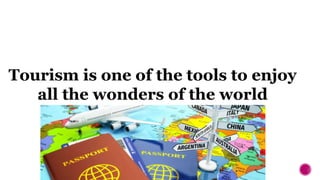
Tourism is one of the tools to enjoy
all the wonders of the world

Tourism

  • 1.
  • 2.
     Tourism istravel for pleasure or business; also the theory and practice of touring, the business of attracting, accommodating, and entertaining tourists, and the business of operating tours. Tourism may be international, or within the traveller's country. The World Tourism Organization defines tourism more generally, in terms which go "beyond the common perception of tourism as being limited to holiday activity only", as people "traveling to and staying in places outside their usual environment for not more than one consecutive year for leisure, business and other purposes"
  • 3.
     Tourism canbe domestic or international, and international tourism has both incoming and outgoing implications on a country's balance of payments. Today, tourism is a major source of income for many countries, and affects the economy of both the source and host countries, in some cases being of vital importance.
  • 4.
     Tourism isan important, even vital, source of income for many regions and countries. Its importance was recognized in the Manila Declaration on World Tourism of 1980 as "an activity essential to the life of nations because of its direct effects on the social, cultural, educational, and economic sectors of national societies and on their international relations."  Tourism brings in large amounts of income into a local economy in the form of payment for goods and services needed by tourists, accounting for 30% of the world's trade of services, and 6% of overall exports of goods and services.[6] It also creates opportunities for employment in the service sector of the economy associated with tourism. The service industries which benefit from tourism include transportation services, such as airlines, cruise ships, and taxicabs; hospitality services, such as accommodations, including hotels and resorts; and entertainment venues, such as amusement parks, casinos, shopping malls, music venues, and theaters. This is in addition to goods bought by tourists, including souvenirs.
  • 5.
     Over thedecades, tourism has experienced continued growth and deepening diversification to become one of the fastest growing economic sectors in the world. Modern tourism is closely linked to development and encompasses a growing number of new destinations. These dynamics have turned tourism into a key driver for socio-economic progress. Today, the business volume of tourism equals or even surpasses that of oil exports, food products or automobiles. Tourism has become one of the major players in international commerce, and represents at the same time one of the main income sources for many developing countries. This growth goes hand in hand with an increasing diversification and competition among destinations.
  • 6.
     The WorldTourism rankings are compiled by the United Nations World Tourism Organization as part of their World Tourism Barometer publication, which is released three times throughout the year. In the publication, UN regions and subregions are ranked by the number of international visitor arrivals, by the revenue generated by inbound tourism, and by the expenditures of outbound travelers.
  • 7.
     International touristarrivals reached 1.035 billion in 2012, up from over 996 million in 2011, and 952 million in 2010. In 2011 and 2012, international travel demand continued to recover from the losses resulting from the late-2000s recession, where tourism suffered a strong slowdown from the second half of 2008 through the end of 2009. After a 5% increase in the first half of 2008, growth in international tourist arrivals moved into negative territory in the second half of 2008, and ended up only 2% for the year, compared to a 7% increase in 2007. The negative trend intensified during 2009, exacerbated in some countries due to the outbreak of the H1N1 influenza virus, resulting in a worldwide decline of 4.2% in 2009 to 880 million international tourists arrivals, and a 5.7% decline in international tourism receipts.
  • 8.
    Tourism is oneof the tools to enjoy all the wonders of the world