THIS IS ABOUT THE START UPS AND WE PRESENT INDAIN STARTUPS
1.
Content :
Introduction
Definition of startup & Why Startup
Key points of startups india scheme
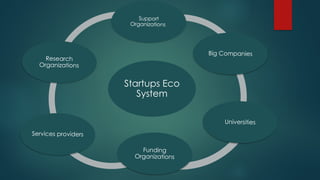
Startups Eco system
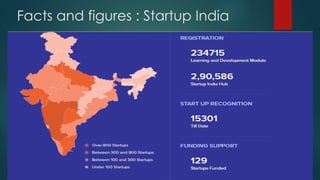
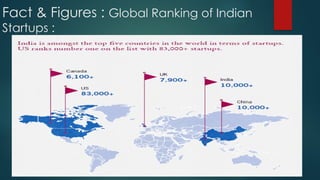
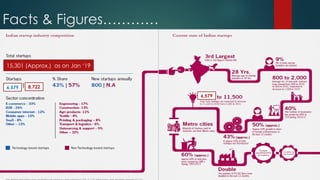
Fact & Figures : Startups India
Challenges faces by Indian startups
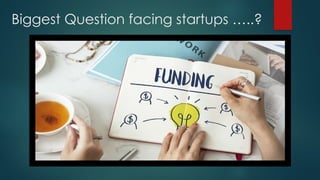
Startup finance : Biggest question facing new startups
Startups that are changing the face of virtual reality in india
2.
Introduction:
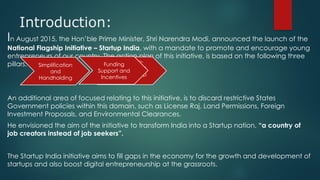
In August 2015,the Hon’ble Prime Minister, Shri Narendra Modi, announced the launch of the
National Flagship Initiative – Startup India, with a mandate to promote and encourage young
entrepreneurs of our country. The action plan of this initiative, is based on the following three
pillars:
An additional area of focused relating to this initiative, is to discard restrictive States
Government policies within this domain, such as License Raj, Land Permissions, Foreign
Investment Proposals, and Environmental Clearances.
He envisioned the aim of the initiative to transform India into a Startup nation, “a country of
job creators instead of job seekers”.
The Startup India initiative aims to fill gaps in the economy for the growth and development of
startups and also boost digital entrepreneurship at the grassroots.
Industry-
Academia
Partnership
and
Simplification
and
Handholding
Funding
Support and
Incentives
3.
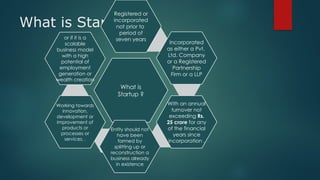
What is Startup?
What is
Startup ?
Registered or
incorporated
not prior to
period of
seven years
Incorporated
as either a Pvt.
Ltd. Company
or a Registered
Partnership
Firm or a LLP
With an annual
turnover not
exceeding Rs.
25 crore for any
of the financial
years since
incorporation .
Entity should not
have been
formed by
splitting up or
reconstruction a
business already
in existence
Working towards
innovation,
development or
improvement of
products or
processes or
services, .
or if it is a
scalable
business model
with a high
potential of
employment
generation or
wealth creation
4.
Why Startups india?
To Boost up / Promote startup / Entrepreneurship
Core objective is to generate maximum Employment
Encourage the people who have the potential to innovate and start their
own business
To boost up Banking & Finance sector
Be a job creator (Then why remain a job seeker? Become a job provider )
5.
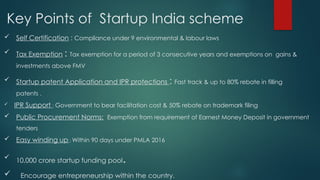
Key Points ofStartup India scheme
Self Certification : Compliance under 9 environmental & labour laws
Tax Exemption : Tax exemption for a period of 3 consecutive years and exemptions on gains &
investments above FMV
Startup patent Application and IPR protections : Fast track & up to 80% rebate in filling
patents .
IPR Support : Government to bear facilitation cost & 50% rebate on trademark filing
Public Procurement Norms: Exemption from requirement of Earnest Money Deposit in government
tenders
Easy winding up : Within 90 days under PMLA 2016
10,000 crore startup funding pool.
Encourage entrepreneurship within the country.
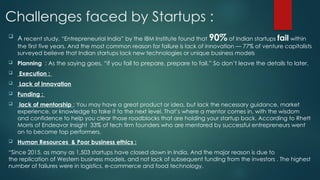
Challenges faced byStartups :
A recent study, “Entrepreneurial India” by the IBM Institute found that 90% of Indian startups fail within
the first five years. And the most common reason for failure is lack of innovation — 77% of venture capitalists
surveyed believe that Indian startups lack new technologies or unique business models
Planning : As the saying goes, “if you fail to prepare, prepare to fail.” So don’t leave the details to later.
Execution :
Lack of Innovation
Funding :
lack of mentorship : You may have a great product or idea, but lack the necessary guidance, market
experience, or knowledge to take it to the next level. That’s where a mentor comes in, with the wisdom
and confidence to help you clear those roadblocks that are holding your startup back. According to Rhett
Morris of Endeavor Insight 33% of tech firm founders who are mentored by successful entrepreneurs went
on to become top performers.
Human Resources & Poor business ethics :
“Since 2015, as many as 1,503 startups have closed down in India. And the major reason is due to
the replication of Western business models, and not lack of subsequent funding from the investors . The highest
number of failures were in logistics, e-commerce and food technology.
Fund raising Questions
Howmuch Fund should I raise ?
When should I raise money ?
At what stage should I not ?
What are the relevant sources of finance for me and how should I prioritize them ?
How much equity should I give ?
How should I give equity when I am unable to value my startup ?
How should I reach out to investors ?
What is right structure / instrument ?
14.
Here are theways for Funding to a startup .
1. Bootstrapping : Self-funding is also known as bootstrapping , is an effective
way startup financing , especially when you are starting your business . You
can invest from your own saving or can get from family and friends.
2. Crowd funding : is “the practice of Funding a project or venture by raising
many small amounts of money from a large number of people , typically
over the internet. Some of the popular crowdfunding sites in india are
Indiegogo , Wishberry , Ketto and Fundlined .
3. Angel Investors : Angel investors are individuals with surplus cash and a
keen interest to invest in upcoming startups .They can also offers mentoring
or advice along with capital . Angel investor have helped many indian
startups (Unacademy ,Crown-it , BookEventz, WittyFeed .Some of top
Angel investors are Mr. Ratan Tata Rajan Anandan , Vijay shekhar
Sharma , Sachin Bansal
15.
4. Venture Capital: Venture capitals are professionally managed funds
who invest in companies that have huge potential to grow .
They usually invest in a business against equity and exit when there is an IPO
or an acquisition .
Some of the well known Venture Capitalists in india are Helion Venture Partners ,
Accel Partners , Blume Ventures , Nexus Venture Partners .
5. Funding From Business Incubators & Accelerators : Early stage businesses can
consider Incubator and Accelerator programs as a funding option.
Found in almost every major city, these programs assist hundreds of startup businesses
every year.
Incubators are like a parent to a child, who nurtures the business providing shelter tools
and training and network to a business.
Accelerators so more or less the same thing, but an incubator helps/ assists/ nurtures a
business to walk, while accelerator helps to run/take a giant leap.
Popular names are Amity Innovation Incubator, AngelPrime, CIIE, IAN Business Incubator,
Villgro, Startup Village and TLabs.
16.
6. Govt ProgramsThat Offer Startup Capital :
Government has launched ‘Bank of Ideas and Innovations’ program. The
Government of India has launched 10,000 Crore Startup Fund in Union budget 2014-15
Government backed ‘Pradhan Mantri Micro Units Development and Refinance Agency
Limited (MUDRA)’ starts with an initial corpus of Rs. 20,000 crore to extend benefits to
around 10 lakhs SMEs.
7. Raise Money Through Bank Loans :
Normally, banks are the first place that entrepreneurs go when thinking about
funding. • The bank provides two kinds of financing for businesses. One is working capital
loan and other is funding. Working Capital loan is the loan required to run one complete
cycle of revenue generating operations and the limit is usually decided by
hypothecating stocks and debtors. • Funding from bank would involve the usual process
of sharing the business plan and the valuation details, along with the project report,
based on which the loan is sanctioned. • Almost every bank in India offers SME finance
through various programs.
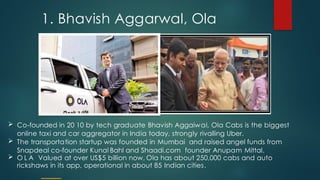
1. Bhavish Aggarwal,Ola
Co-founded in 20 10 by tech graduate Bhavish Aggaiwal, Ola Cabs is the biggest
online taxi and car aggregator in India today, strongly rivalling Uber.
The transportation startup was founded in Mumbai and raised angel funds from
Snapdeal co-founder Kunal Bahl and Shaadi.com founder Anupam Mittal.
O L A Valued at over US$5 billion now, Ola has about 250,000 cabs and auto
rickshaws in its app, operational in about 85 Indian cities.
19.
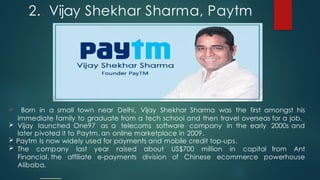
2.. Vijay ShekharSharma, Paytm
Born in a small town near Delhi, Vijay Shekhar Sharma was the first amongst his
immediate family to graduate from a tech school and then travel overseas for a job.
Vijay launched One97 as a telecoms software company in the early 2000s and
later pivoted it to Paytm, an online marketplace in 2009.
Paytm Is now widely used for payments and mobile credit top-ups.
The company last year raised about US$700 million in capital from Ant
Financial, the affiliate e-payments division of Chinese ecommerce powerhouse
Alibaba.
20.
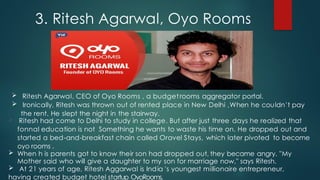
Ritesh Agarwal,CEO of Oyo Rooms , a budgetrooms aggregator portal.
Ironically, Ritesh was thrown out of rented place in New Delhi ,When he couldn't pay
the rent. He slept the night in the stairway.
Ritesh had come to Delhi to study in college. But after just three days he realized that
fonnal education is not Something he wants to waste his time on. He dropped out and
started a bed-and-breakfast chain called Oravel Stays, which later pivoted to become
oyo rooms .
When h is parents got to know their son had dropped out, they became angry. "My
Mother said who will give a daughter to my son for marriage now," says Ritesh.
At 21 years of age, Ritesh Aggarwal is India 's youngest millionaire entrepreneur,
having created budget hotel startup OyoRooms.
3. Ritesh Agarwal, Oyo Rooms
21.
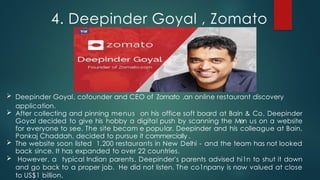
Deepinder Goyal,cofounder and CEO of Zomato ,an online restaurant discovery
application.
After collecting and pinning menus on his office soft board at Bain & Co, Deepinder
Goyal decided to give his hobby a digital push by scanning the Men us on a website
for everyone to see. The site becam e popular. Deepinder and his colleague at Bain,
Pankaj Chaddah, decided to pursue it commercially .
The website soon listed 1,200 restaurants in New Delhi - and the team has not looked
back since. It has expanded to over 22 countries.
However, a typical Indian parents, Deepinder's parents advised hi1n to shut it down
and go back to a proper job. He did not listen. The co1npany is now valued at close
to US$1 billion.
4. Deepinder Goyal , Zomato
22.
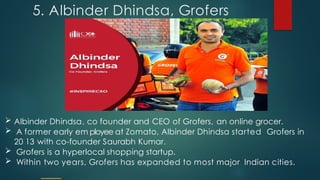
5. Albinder Dhindsa,Grofers
Albinder Dhindsa, co founder and CEO of Grofers, an online grocer.
A former early em ployee at Zomato, Albinder Dhindsa started Grofers in
20 13 with co-founder Saurabh Kumar.
Grofers is a hyperlocal shopping startup.
Within two years, Grofers has expanded to most major Indian cities.
23.
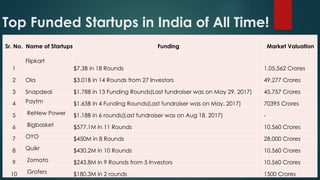
Top Funded Startupsin India of All Time!
Sr. No. Name of Startups Funding Market Valuation
1
Flipkart
$7.3B in 18 Rounds 1,05,562 Crores
2 Ola $3.01B in 14 Rounds from 27 Investors 49,277 Crores
3 Snapdeal $1.78B in 13 Funding Rounds(Last fundraiser was on May 29, 2017) 45,757 Crores
4 Paytm $1.65B in 4 Funding Rounds(Last fundraiser was on May, 2017) 70395 Crores
5 ReNew Power $1.18B in 6 rounds(Last fundraiser was on Aug 18, 2017) -
6 Bigbasket $577.1M in 11 Rounds 10,560 Crores
7 OYO $450M in 8 Rounds 28,000 Crores
8 Quikr $430.2M in 10 Rounds 10,560 Crores
9 Zomato $243.8M in 9 Rounds from 5 Investors 10,560 Crores
10 Grofers $180.3M in 2 rounds 1500 Crores
24.
CONCLUSION :
Startup Indiais as flagship initiative of the government of india , intended to
build a strong eco-system for nurturing innovation and startups in the country that will drive
sustainable economic growth and generate large scale employment opportunities .
In Order to meet the objectives of the initiatives , Government of India is announcing this
action plan that addresses all aspect of the Startup ecosystem
This is a most effective campaign which will create more jobs opportunities to the Indian
youth.
This scheme will directly help people in their own successful entrepreneurship .
It will help our country to show the talent of youths through their innovative business all
across the world .





![[PreMoney MENA 2015] Kalaari Capital >> Vani Kola, "THE GLOBAL VC: India"](https://cdn.slidesharecdn.com/ss_thumbnails/pjyhbxh8rpuchh2ijwfr-signature-509e38f284dbf8630eeef5bb32c36869f5e8403f416289e9cfa4c580d0b84e6c-poli-151206033113-lva1-app6891-thumbnail.jpg?width=640&height=640&fit=bounds)


