www.isoc.gh
Cybersecurity
Internet Governance & Standards Development Workshop, Accra
Edwin A. Opare
edwin.opare@isoc.gh
www.isoc.gh
www.isoc.gh
Cybersecurity – The situation
• The Internet was originally designed for use by a
closed circle of mainly academics without security
concerns.
• They communicated openly and addressed possible
security problems informally.
2
www.isoc.gh
Classification of Cybersecurity issues
• Type of action
• data interception, data interference, illegal access, spyware,
data corruption, sabotage, denial-of-service, and identity theft
• Type of perpetrator
• hackers, cybercriminals, cyberwarriors, and cyberterrorists
• Type targets
• individuals, private companies, and public institutions to
critical infrastructures, governments, and military assets.
3
www.isoc.gh
Cybersecurity policy initiatives
• National level
• DHS for the United States
• MoC for Ghana
• International level
• ITU (X.509 ) – PKI
• ITU - Global Cybersecurity Agenda(legal measures, policy
cooperation, and capacity building )
• The G8 - 24/7(High Tech Crime )
• UN General Assembly resolutions on ‘developments in the
field of information and telecommunications in the context of
international security’
4
www.isoc.gh
Cybersecurity policy initiatives cont.
• CoE, Convention on Cybercrime, (1 July 2004)
• Bilateral arrangements and agreements
• Stanford Draft Convention on Protection from Cyber
Crime and Terrorism. This draft recommends the
establishment of an international body, named the
Agency for Information Infrastructure Protection
(AIIP).
5
www.isoc.gh
Cybersecurity - The issues
• Influence of Internet architecture on cybersecurity
• DNSSEC
• for ccTLDs
• for the root zone in 2010
6
www.isoc.gh
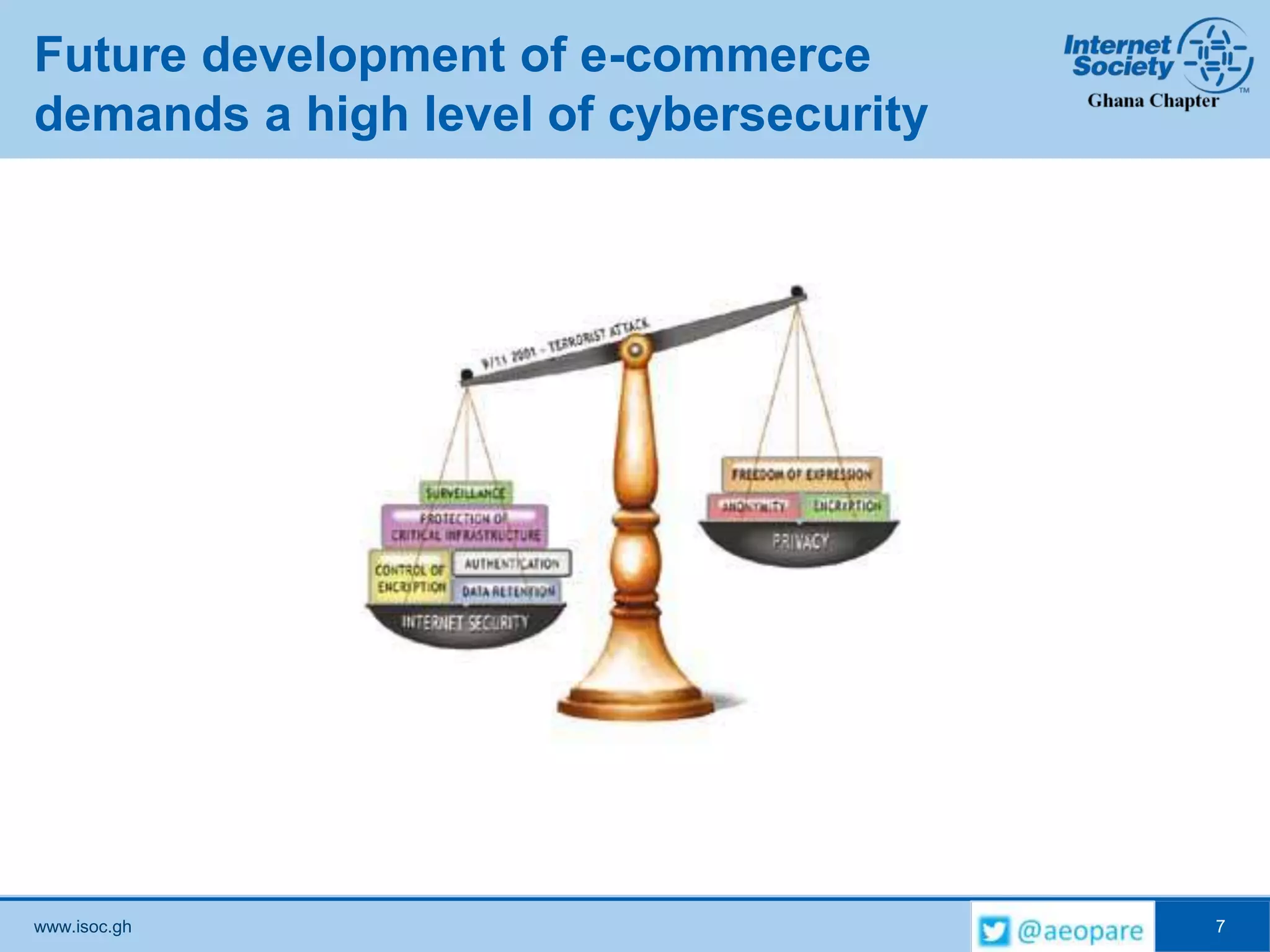
Future development of e-commerce
demands a high level of cybersecurity
7
www.isoc.gh
Cybersecurity and privacy
• Will additional cybersecurity measures imply some
loss of privacy?
• What regulation should apply to encryption software,
which can be used both for the legitimate protection of
communication privacy and for the protection of
communications of terrorists and criminals?
• Extension of the CoE Convention on Cybercrime to
8

Cybersecurity

  • 1.
    www.isoc.gh Cybersecurity Internet Governance &Standards Development Workshop, Accra Edwin A. Opare edwin.opare@isoc.gh www.isoc.gh
  • 2.
    www.isoc.gh Cybersecurity – Thesituation • The Internet was originally designed for use by a closed circle of mainly academics without security concerns. • They communicated openly and addressed possible security problems informally. 2
  • 3.
    www.isoc.gh Classification of Cybersecurityissues • Type of action • data interception, data interference, illegal access, spyware, data corruption, sabotage, denial-of-service, and identity theft • Type of perpetrator • hackers, cybercriminals, cyberwarriors, and cyberterrorists • Type targets • individuals, private companies, and public institutions to critical infrastructures, governments, and military assets. 3
  • 4.
    www.isoc.gh Cybersecurity policy initiatives •National level • DHS for the United States • MoC for Ghana • International level • ITU (X.509 ) – PKI • ITU - Global Cybersecurity Agenda(legal measures, policy cooperation, and capacity building ) • The G8 - 24/7(High Tech Crime ) • UN General Assembly resolutions on ‘developments in the field of information and telecommunications in the context of international security’ 4
  • 5.
    www.isoc.gh Cybersecurity policy initiativescont. • CoE, Convention on Cybercrime, (1 July 2004) • Bilateral arrangements and agreements • Stanford Draft Convention on Protection from Cyber Crime and Terrorism. This draft recommends the establishment of an international body, named the Agency for Information Infrastructure Protection (AIIP). 5
  • 6.
    www.isoc.gh Cybersecurity - Theissues • Influence of Internet architecture on cybersecurity • DNSSEC • for ccTLDs • for the root zone in 2010 6
  • 7.
    www.isoc.gh Future development ofe-commerce demands a high level of cybersecurity 7
  • 8.
    www.isoc.gh Cybersecurity and privacy •Will additional cybersecurity measures imply some loss of privacy? • What regulation should apply to encryption software, which can be used both for the legitimate protection of communication privacy and for the protection of communications of terrorists and criminals? • Extension of the CoE Convention on Cybercrime to 8