
Trends and Patterns:
     Observations for Silicon Valley

Chris Burry, SVP Strategy
US Market Access Center
Trends and Patterns: Observations from SV
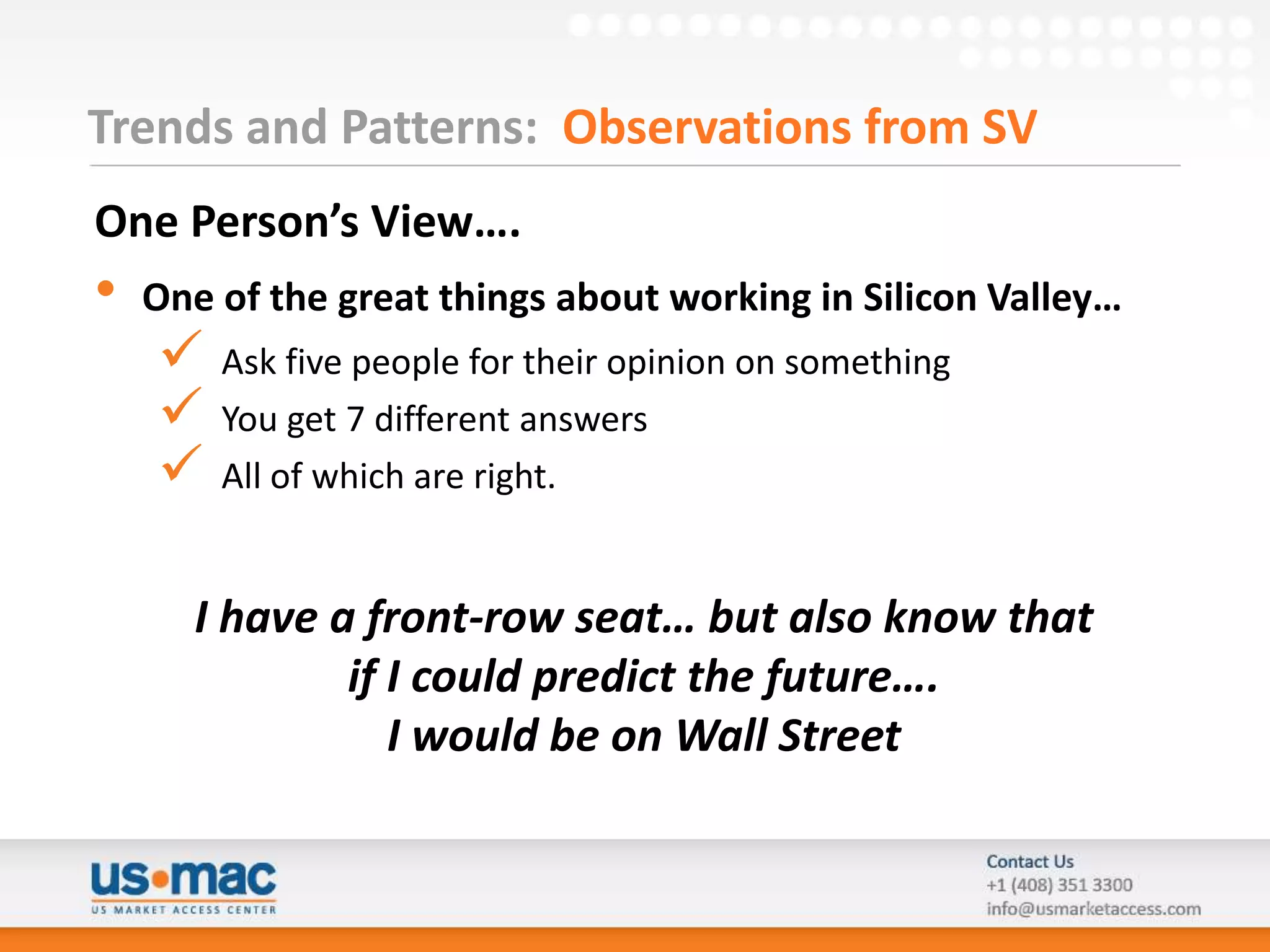
One Person’s View….
•   One of the great things about working in Silicon Valley…
       Ask five people for their opinion on something
       You get 7 different answers
       All of which are right.


      I have a front-row seat… but also know that
              if I could predict the future….
                 I would be on Wall Street
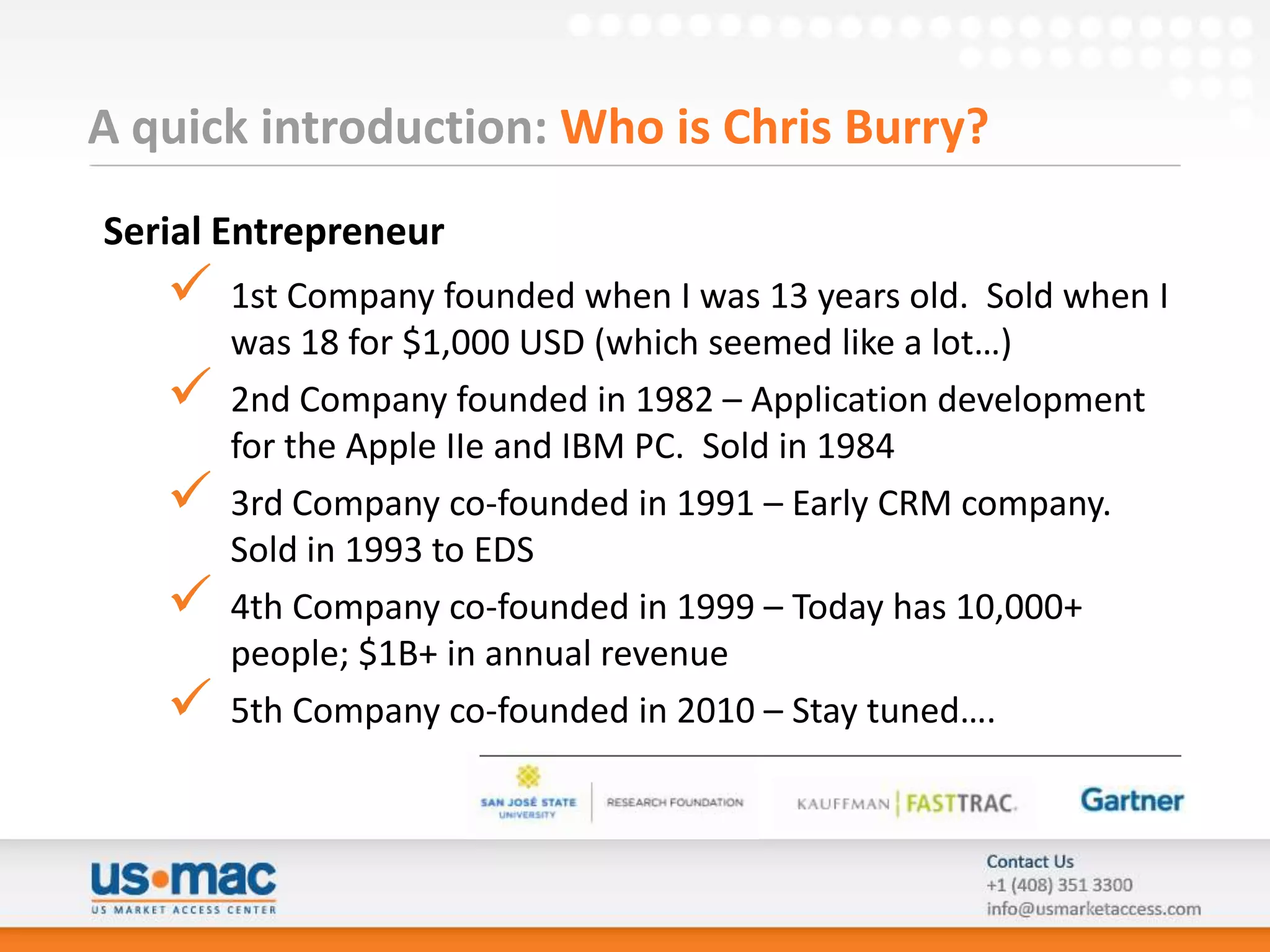
A quick introduction: Who is Chris Burry?
Serial Entrepreneur
      1st Company founded when I was 13 years old. Sold when I
       was 18 for $1,000 USD (which seemed like a lot…)
      2nd Company founded in 1982 – Application development
       for the Apple IIe and IBM PC. Sold in 1984
      3rd Company co-founded in 1991 – Early CRM company.
       Sold in 1993 to EDS
      4th Company co-founded in 1999 – Today has 10,000+
       people; $1B+ in annual revenue
      5th Company co-founded in 2010 – Stay tuned….
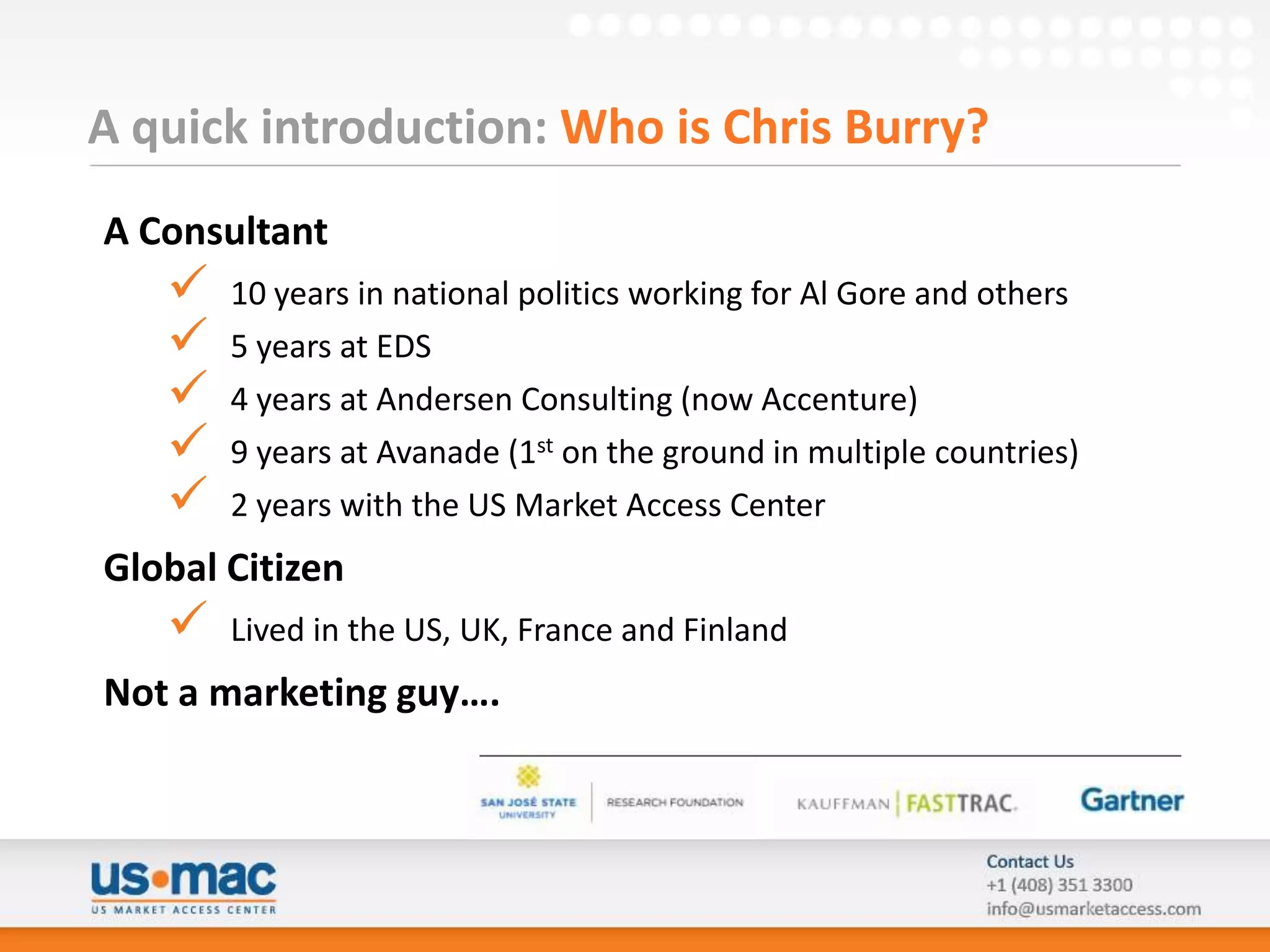
A quick introduction: Who is Chris Burry?
A Consultant
      10 years in national politics working for Al Gore and others
      5 years at EDS
      4 years at Andersen Consulting (now Accenture)
      9 years at Avanade (1st on the ground in multiple countries)
      2 years with the US Market Access Center
Global Citizen
      Lived in the US, UK, France and Finland
Not a marketing guy….
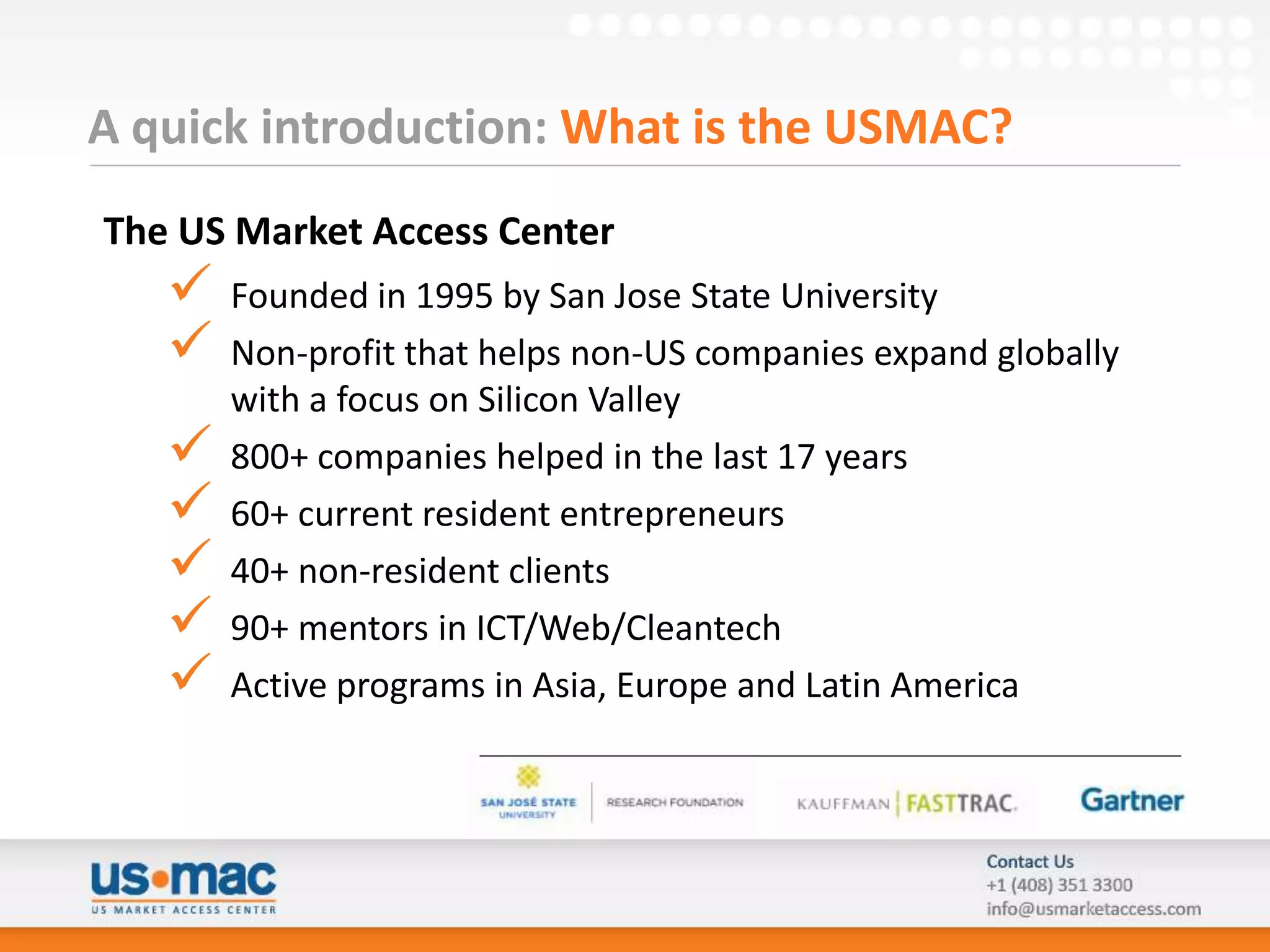
A quick introduction: What is the USMAC?
The US Market Access Center
      Founded in 1995 by San Jose State University
      Non-profit that helps non-US companies expand globally
       with a focus on Silicon Valley
      800+ companies helped in the last 17 years
      60+ current resident entrepreneurs
      40+ non-resident clients
      90+ mentors in ICT/Web/Cleantech
      Active programs in Asia, Europe and Latin America
Trends and Patterns : Level of Activity
After the Internet Bubble
       The over-all energy and activity level was way down
       Angel and venture funding was almost zero
       Many people lost their jobs
Today
       Everywhere you go from San Francisco to San Jose there is
        an incredible amount of energy and activity
       Competition for the best talent has returned
       Investing is back… but still uneven
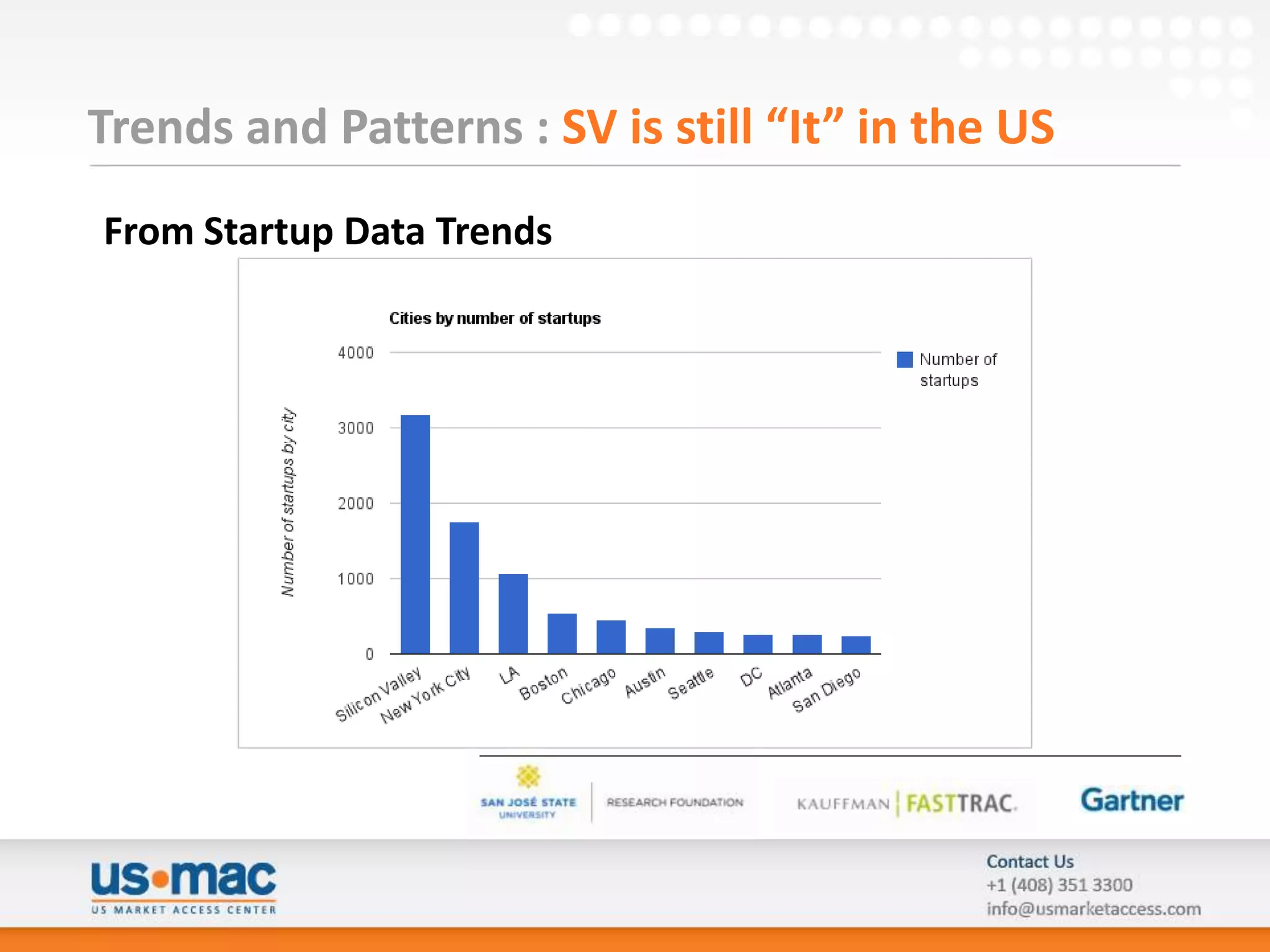
Trends and Patterns : SV is still “It” in the US
From Startup Data Trends
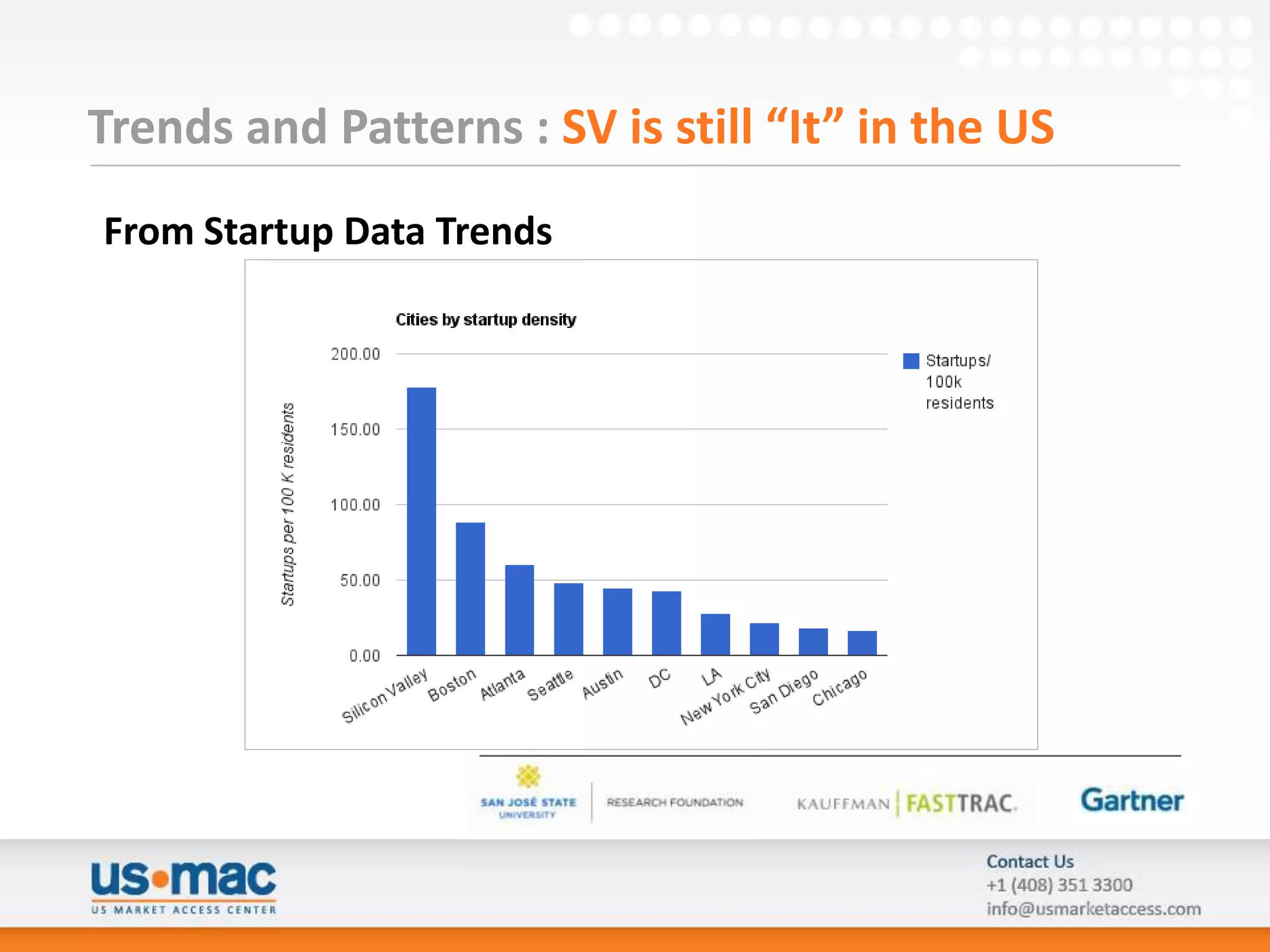
Trends and Patterns : SV is still “It” in the US
From Startup Data Trends
Trends and Patterns : What’s Hot
The obvious
      All things mobile (including NFC)
      Social media
      Gaming
Not so obvious
      Healthcare (software and devices)
      Education (gamification of education is interesting)
      Big data
      Consumerization of the enterprise
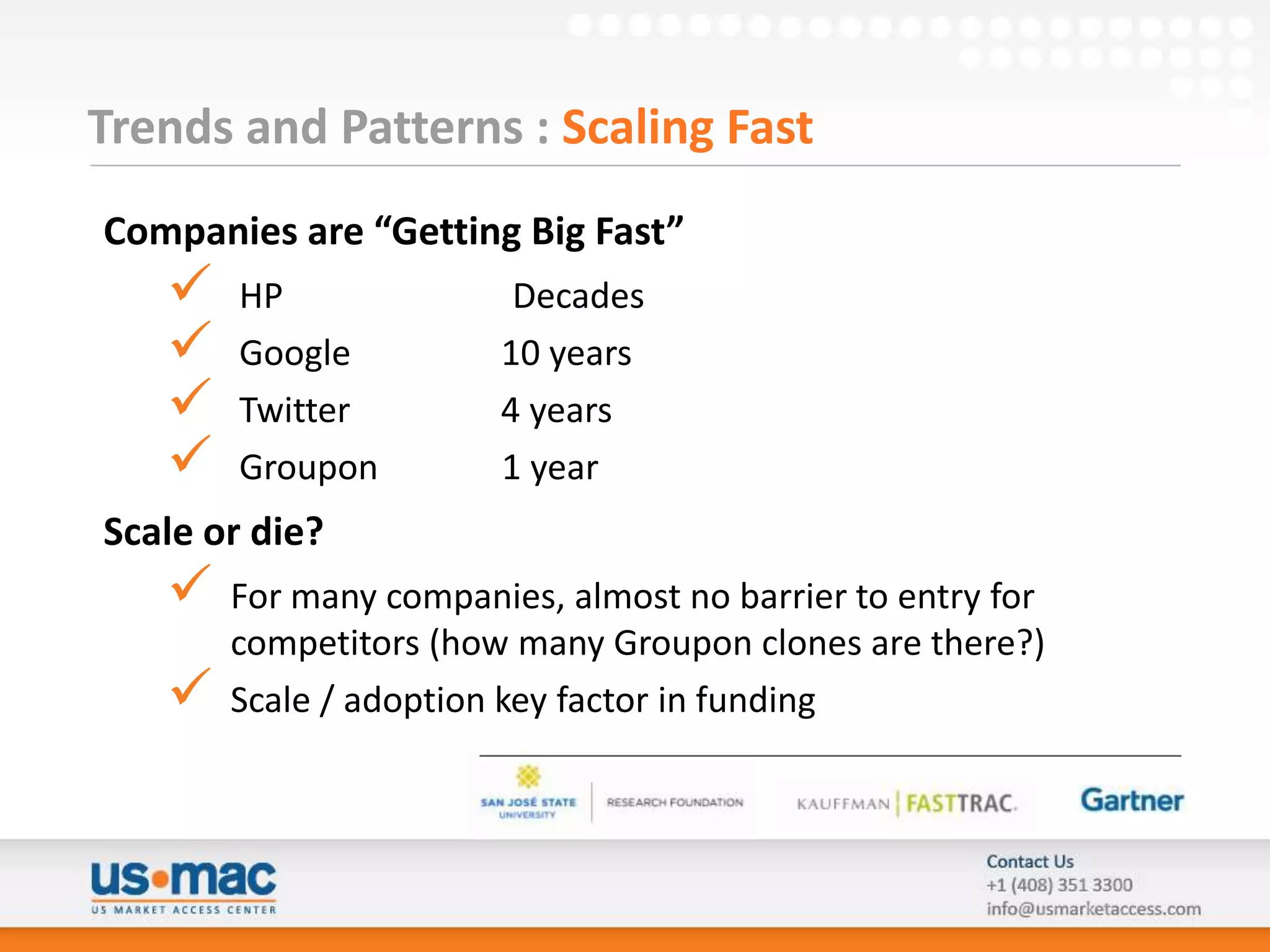
Trends and Patterns : Scaling Fast
Companies are “Getting Big Fast”
      HP               Decades
      Google          10 years
      Twitter         4 years
      Groupon         1 year
Scale or die?
      For many companies, almost no barrier to entry for
       competitors (how many Groupon clones are there?)
      Scale / adoption key factor in funding
Trends and Patterns : Globalization
In Silicon Valley today
      54% of startups are founded by individuals who were not
       born in the US
      Almost every startup has at least 1 non-US citizen
Born-global companies
      University connections are key enabler
      They blend and blur the distinction between the developed
       and developing world
      Social media plays a role here
Trends and Patterns : Globalization
Investing
      More US venture funds are seeking opportunities to fund
       outside of the US
      More non-US venture funds are being created (but Silicon
       Valley is still the center)
      These non-US venture funds appear are seeking
       opportunities in the US and outside the US
      Greater willingness to fund “remotely”
      BRIC’s having an increasing impact
Trends and Patterns : Globalization
Investing
      More US venture funds are seeking opportunities to fund
       outside of the US
      More non-US venture funds are being created (but Silicon
       Valley is still the center)
      These non-US venture funds appear are seeking
       opportunities in the US and outside the US
      Greater willingness to fund “remotely”
      BRIC’s having an increasing impact
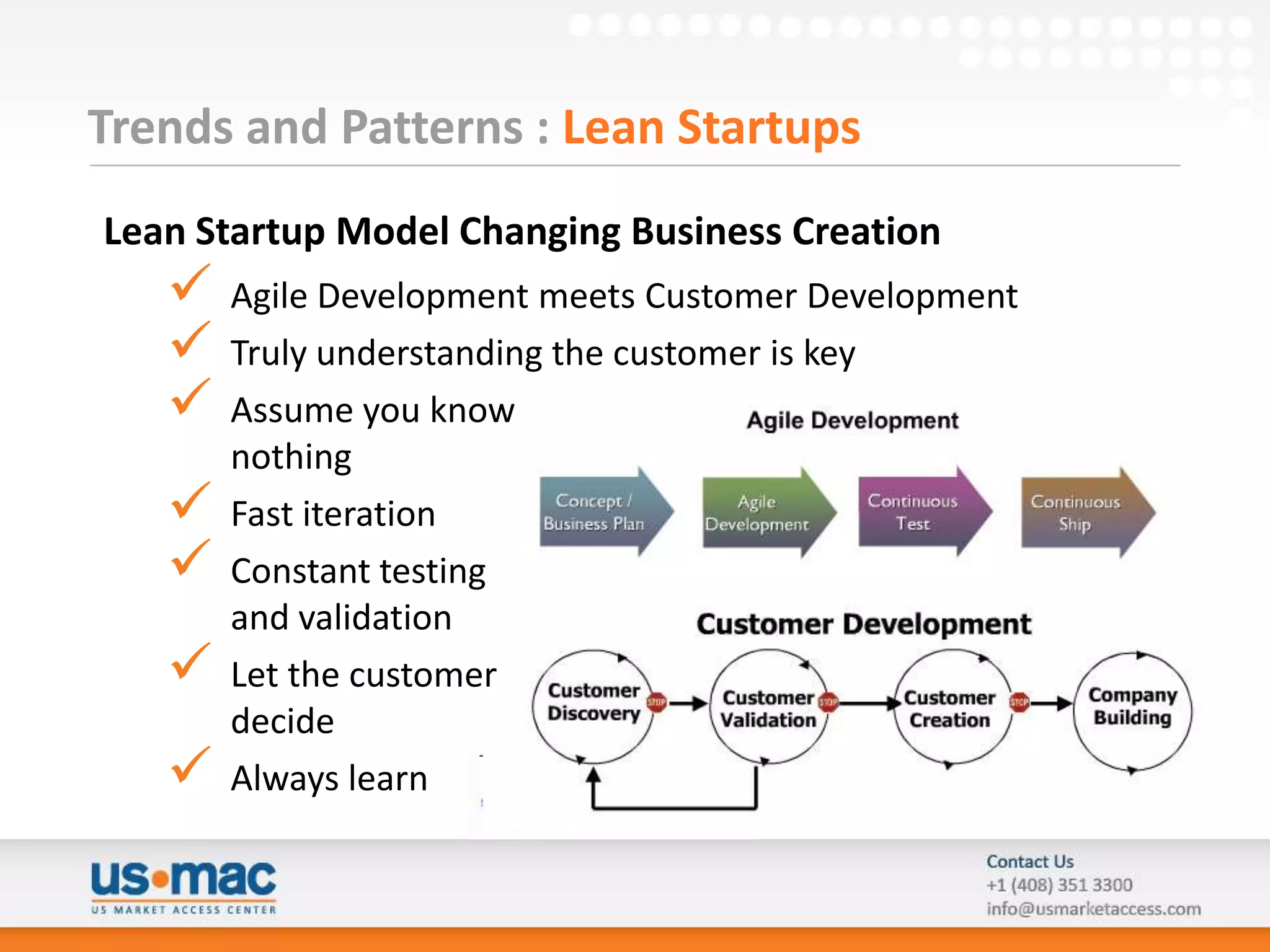
Trends and Patterns : Lean Startups
Lean Startup Model Changing Business Creation
      Agile Development meets Customer Development
      Truly understanding the customer is key
      Assume you know
       nothing
      Fast iteration
      Constant testing
       and validation
      Let the customer
       decide
      Always learn
Trends and Patterns : Lean Startups
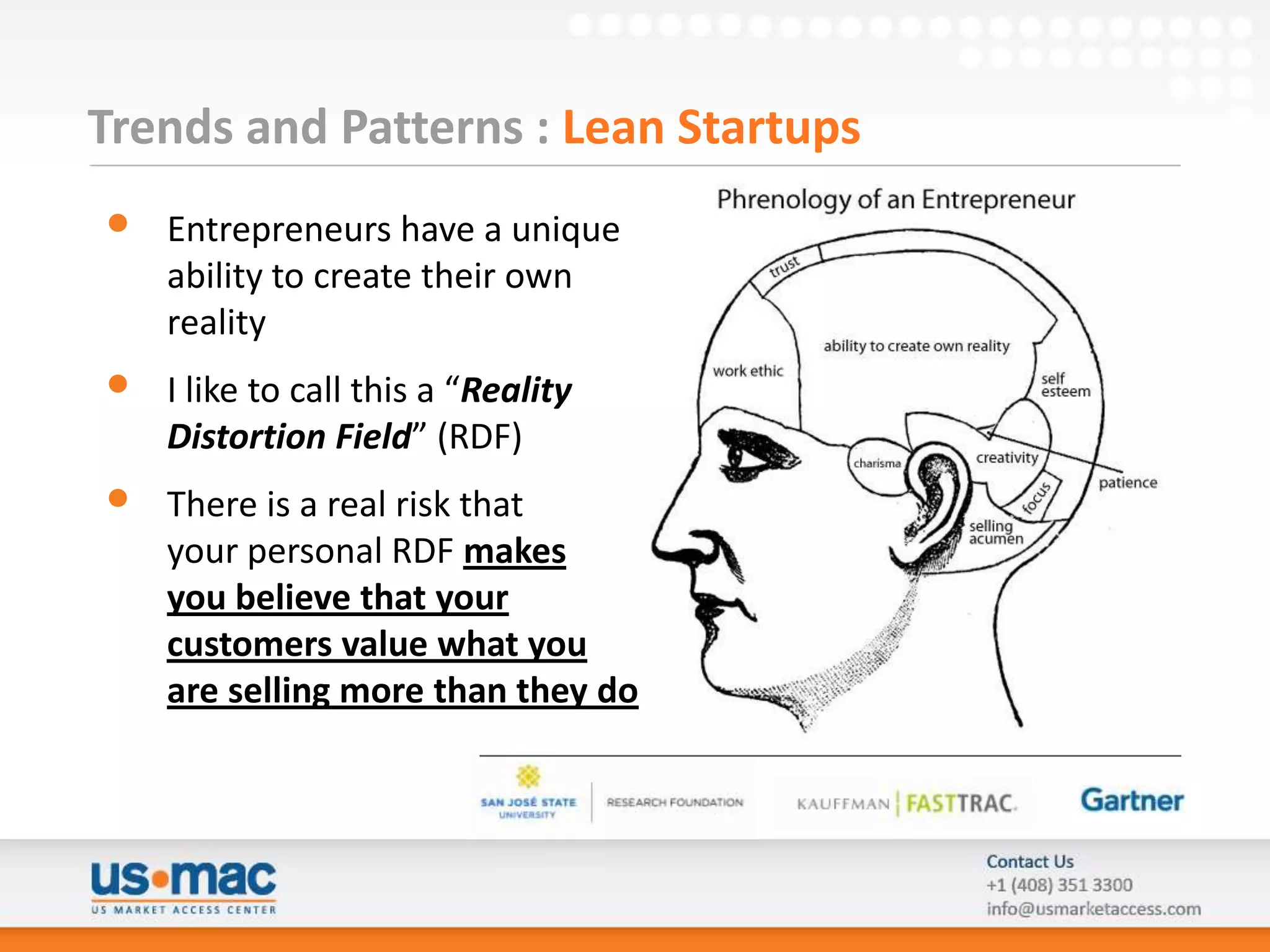
•   Entrepreneurs have a unique
    ability to create their own
    reality
•   I like to call this a “Reality
    Distortion Field” (RDF)
•   There is a real risk that
    your personal RDF makes
    you believe that your
    customers value what you
    are selling more than they do
Trends and Patterns : Lean Startups
•   We have all seen the Reality Distortion Field in Action
       We are going to be bigger than Google in 2 years
       The size of the market is HUGE… we will only capture .05%
        of the market and make $1B
       And my all time favorite…. We are losing $.02 on every
        transaction but we will make it up on volume
      Your Business Model, won’t work if it is not
                 grounded in reality
        Lean Startup Methods keep you in reality
Trends and Patterns : Lean Startups
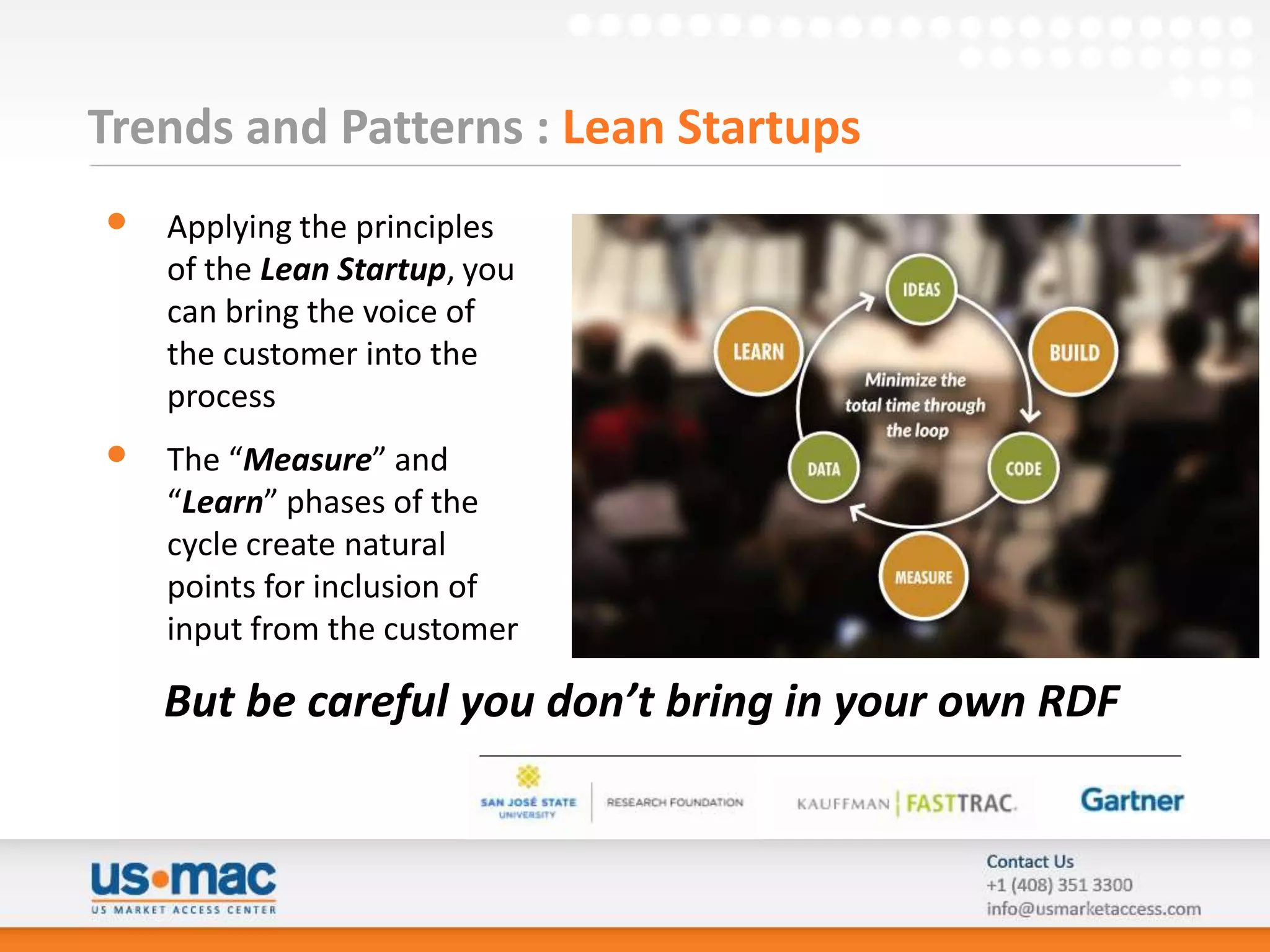
•   Applying the principles
    of the Lean Startup, you
    can bring the voice of
    the customer into the
    process
•   The “Measure” and
    “Learn” phases of the
    cycle create natural
    points for inclusion of
    input from the customer

    But be careful you don’t bring in your own RDF
Trends and Patterns : Lean Startups
•   How do you know if people will buy what you are selling?
       Are there are real people who want to buy from you?
       Do they have money to spend
       Do they have a real problem (need, or want)?
       Are they are willing to pay you to make their problem go
        away?
                   If customers won’t pay
               to make their problem go away,
                  you don’t have a business
Lean Startups: A Great Example
•   Mobile Gaming Company Business Model
       Attract very larger number of users
       Relatively low Average Revenue per User and lower lifetime
        value of user
       Requires them to capture and hold the user’s attention to
        keep them in the app
•   What was needed
       Needed to find a way to limit investment in games that
        won’t hold attention
       Focus resources on the ones that will
Lean Startups: A Great Example
•   Finding a new way of thinking about mobile gaming
       Pattern analysis shows that games go viral in the first 14
        days, or they don’t go viral at all
       “Fast to Die” – if a game doesn’t show signs that it is going
        viral during the beta… pull the plug. Don’t waste any more
        time on the product.
       The customer is telling you that they don’t like it
•   Does it work?
       $5m+ raised
       50m+ downloads since in less than 3 years
Trends and Patterns : Required Reading
In 2011, researchers at Stanford and UC Berkeley released the
Startup Genome Report to understand why startups succeed or fail.
Four types of companies identified.
• The Automizer: Self-service, consumer-focused offerings that often
   automate a process. Examples of Automizers include
   Google, Dropbox, Mint, Groupon and Zynga.
• The Social Transformer: The Automizers, these startups offer self-
   service and consumer-focused products but operate in ‘winner
   takes all’ markets and typically offer products that give customers a
   new way to interact with others. Examples include
   Facebook, Twitter, eBay, Skype, Airbnb, Flickr, LinkedIn and
   Foursquare.
Trends and Patterns : Required Reading
Types of Companies (continued)
• Integrator: These enterprise-focused startups target the SME
   market and look for early monetization, often transferring
   innovations from consumer products into the enterprise market.
   Integrators include PBworks, Uservoice, Kissmetrics, Zendesk and
   GetSatisfaction.
• The Challenger: Challengers operate in the enterprise market with
   high customer dependency and a repeatable sales process. Look to
   Salesforce, Oracle, MySQL, Redhat and Yammer for examples of this
   type of startup.
Trends and Patterns : Required Reading
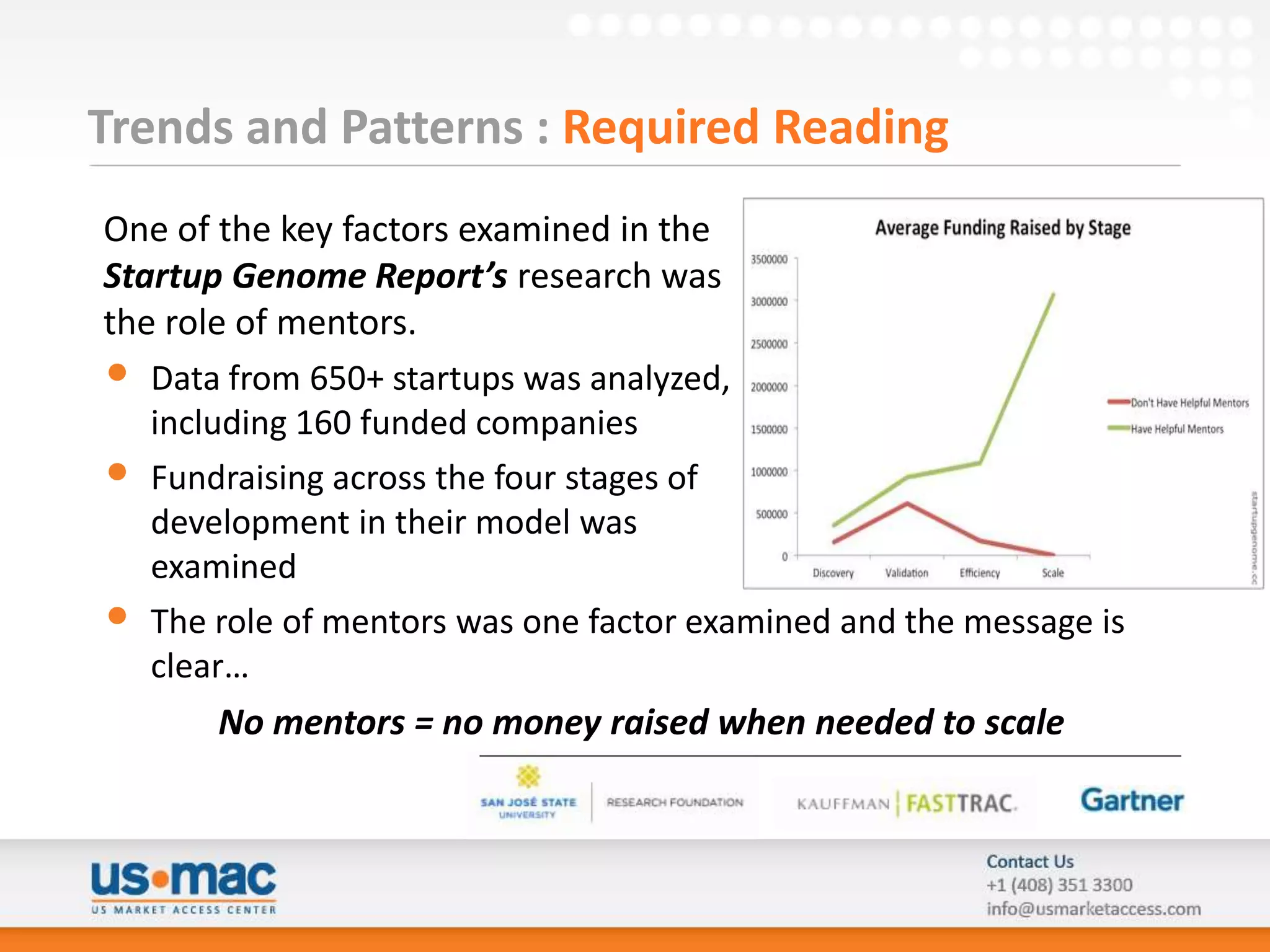
One of the key factors examined in the
Startup Genome Report’s research was
the role of mentors.
• Data from 650+ startups was analyzed,
   including 160 funded companies
• Fundraising across the four stages of
   development in their model was
   examined
• The role of mentors was one factor examined and the message is
   clear…
        No mentors = no money raised when needed to scale
Trends and Patterns : In closing
•   Questions?
    (To answer in advance, I don’t have an opinion on the
    Facebook IPO.
•   Comments?
•   Care to share your own experiences? (Good and bad)
•   Happy to talk one-on-one with anyone
San Francisco


                                                 Palo Alto


Let’s Connect
                                                             San Jose


                                    Our Headquarters
                                    US Market Access Center
 facebook.com/usmarketaccess        10 South Third Street, 3rd Floor
                                    San Jose, CA 95113
 @usmarketaccess                    Contact for the Nordic Region
                                    Adiba Cremonini
 linkedin.com                       Vice President International Relations
 Groups – US Market Access Center   Phone
                                    +1 (917) 767 0077
 www.usmarketaccess.com
                                    Email
                                    adiba@usmarketaccess.com

Start up in Silicon Valley

  • 1.
    Trends and Patterns: Observations for Silicon Valley Chris Burry, SVP Strategy US Market Access Center
  • 2.
    Trends and Patterns:Observations from SV One Person’s View…. • One of the great things about working in Silicon Valley…  Ask five people for their opinion on something  You get 7 different answers  All of which are right. I have a front-row seat… but also know that if I could predict the future…. I would be on Wall Street
  • 3.
    A quick introduction:Who is Chris Burry? Serial Entrepreneur  1st Company founded when I was 13 years old. Sold when I was 18 for $1,000 USD (which seemed like a lot…)  2nd Company founded in 1982 – Application development for the Apple IIe and IBM PC. Sold in 1984  3rd Company co-founded in 1991 – Early CRM company. Sold in 1993 to EDS  4th Company co-founded in 1999 – Today has 10,000+ people; $1B+ in annual revenue  5th Company co-founded in 2010 – Stay tuned….
  • 4.
    A quick introduction:Who is Chris Burry? A Consultant  10 years in national politics working for Al Gore and others  5 years at EDS  4 years at Andersen Consulting (now Accenture)  9 years at Avanade (1st on the ground in multiple countries)  2 years with the US Market Access Center Global Citizen  Lived in the US, UK, France and Finland Not a marketing guy….
  • 5.
    A quick introduction:What is the USMAC? The US Market Access Center  Founded in 1995 by San Jose State University  Non-profit that helps non-US companies expand globally with a focus on Silicon Valley  800+ companies helped in the last 17 years  60+ current resident entrepreneurs  40+ non-resident clients  90+ mentors in ICT/Web/Cleantech  Active programs in Asia, Europe and Latin America
  • 6.
    Trends and Patterns: Level of Activity After the Internet Bubble  The over-all energy and activity level was way down  Angel and venture funding was almost zero  Many people lost their jobs Today  Everywhere you go from San Francisco to San Jose there is an incredible amount of energy and activity  Competition for the best talent has returned  Investing is back… but still uneven
  • 7.
    Trends and Patterns: SV is still “It” in the US From Startup Data Trends
  • 8.
    Trends and Patterns: SV is still “It” in the US From Startup Data Trends
  • 9.
    Trends and Patterns: What’s Hot The obvious  All things mobile (including NFC)  Social media  Gaming Not so obvious  Healthcare (software and devices)  Education (gamification of education is interesting)  Big data  Consumerization of the enterprise
  • 10.
    Trends and Patterns: Scaling Fast Companies are “Getting Big Fast”  HP Decades  Google 10 years  Twitter 4 years  Groupon 1 year Scale or die?  For many companies, almost no barrier to entry for competitors (how many Groupon clones are there?)  Scale / adoption key factor in funding
  • 11.
    Trends and Patterns: Globalization In Silicon Valley today  54% of startups are founded by individuals who were not born in the US  Almost every startup has at least 1 non-US citizen Born-global companies  University connections are key enabler  They blend and blur the distinction between the developed and developing world  Social media plays a role here
  • 12.
    Trends and Patterns: Globalization Investing  More US venture funds are seeking opportunities to fund outside of the US  More non-US venture funds are being created (but Silicon Valley is still the center)  These non-US venture funds appear are seeking opportunities in the US and outside the US  Greater willingness to fund “remotely”  BRIC’s having an increasing impact
  • 13.
    Trends and Patterns: Globalization Investing  More US venture funds are seeking opportunities to fund outside of the US  More non-US venture funds are being created (but Silicon Valley is still the center)  These non-US venture funds appear are seeking opportunities in the US and outside the US  Greater willingness to fund “remotely”  BRIC’s having an increasing impact
  • 14.
    Trends and Patterns: Lean Startups Lean Startup Model Changing Business Creation  Agile Development meets Customer Development  Truly understanding the customer is key  Assume you know nothing  Fast iteration  Constant testing and validation  Let the customer decide  Always learn
  • 15.
    Trends and Patterns: Lean Startups • Entrepreneurs have a unique ability to create their own reality • I like to call this a “Reality Distortion Field” (RDF) • There is a real risk that your personal RDF makes you believe that your customers value what you are selling more than they do
  • 16.
    Trends and Patterns: Lean Startups • We have all seen the Reality Distortion Field in Action  We are going to be bigger than Google in 2 years  The size of the market is HUGE… we will only capture .05% of the market and make $1B  And my all time favorite…. We are losing $.02 on every transaction but we will make it up on volume Your Business Model, won’t work if it is not grounded in reality Lean Startup Methods keep you in reality
  • 17.
    Trends and Patterns: Lean Startups • Applying the principles of the Lean Startup, you can bring the voice of the customer into the process • The “Measure” and “Learn” phases of the cycle create natural points for inclusion of input from the customer But be careful you don’t bring in your own RDF
  • 18.
    Trends and Patterns: Lean Startups • How do you know if people will buy what you are selling?  Are there are real people who want to buy from you?  Do they have money to spend  Do they have a real problem (need, or want)?  Are they are willing to pay you to make their problem go away? If customers won’t pay to make their problem go away, you don’t have a business
  • 19.
    Lean Startups: AGreat Example • Mobile Gaming Company Business Model  Attract very larger number of users  Relatively low Average Revenue per User and lower lifetime value of user  Requires them to capture and hold the user’s attention to keep them in the app • What was needed  Needed to find a way to limit investment in games that won’t hold attention  Focus resources on the ones that will
  • 20.
    Lean Startups: AGreat Example • Finding a new way of thinking about mobile gaming  Pattern analysis shows that games go viral in the first 14 days, or they don’t go viral at all  “Fast to Die” – if a game doesn’t show signs that it is going viral during the beta… pull the plug. Don’t waste any more time on the product.  The customer is telling you that they don’t like it • Does it work?  $5m+ raised  50m+ downloads since in less than 3 years
  • 21.
    Trends and Patterns: Required Reading In 2011, researchers at Stanford and UC Berkeley released the Startup Genome Report to understand why startups succeed or fail. Four types of companies identified. • The Automizer: Self-service, consumer-focused offerings that often automate a process. Examples of Automizers include Google, Dropbox, Mint, Groupon and Zynga. • The Social Transformer: The Automizers, these startups offer self- service and consumer-focused products but operate in ‘winner takes all’ markets and typically offer products that give customers a new way to interact with others. Examples include Facebook, Twitter, eBay, Skype, Airbnb, Flickr, LinkedIn and Foursquare.
  • 22.
    Trends and Patterns: Required Reading Types of Companies (continued) • Integrator: These enterprise-focused startups target the SME market and look for early monetization, often transferring innovations from consumer products into the enterprise market. Integrators include PBworks, Uservoice, Kissmetrics, Zendesk and GetSatisfaction. • The Challenger: Challengers operate in the enterprise market with high customer dependency and a repeatable sales process. Look to Salesforce, Oracle, MySQL, Redhat and Yammer for examples of this type of startup.
  • 23.
    Trends and Patterns: Required Reading One of the key factors examined in the Startup Genome Report’s research was the role of mentors. • Data from 650+ startups was analyzed, including 160 funded companies • Fundraising across the four stages of development in their model was examined • The role of mentors was one factor examined and the message is clear… No mentors = no money raised when needed to scale
  • 24.
    Trends and Patterns: In closing • Questions? (To answer in advance, I don’t have an opinion on the Facebook IPO. • Comments? • Care to share your own experiences? (Good and bad) • Happy to talk one-on-one with anyone
  • 25.
    San Francisco Palo Alto Let’s Connect San Jose Our Headquarters US Market Access Center facebook.com/usmarketaccess 10 South Third Street, 3rd Floor San Jose, CA 95113 @usmarketaccess Contact for the Nordic Region Adiba Cremonini linkedin.com Vice President International Relations Groups – US Market Access Center Phone +1 (917) 767 0077 www.usmarketaccess.com Email adiba@usmarketaccess.com