The book The effortThe effort
Book name: ZERO TO ONE
Notes on start-ups,
OR
how to build the future
Author : PETER THIEL
FACULTY CO-ORDINATORS:
Prof : Jaya Lakshmi
Prof : Lohith Kumar
REVIEWED BY: Sarella Sreeja
M11-TPS-37
SEC- C
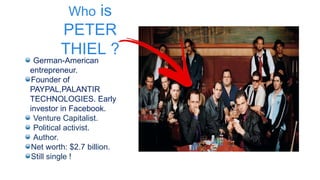
Who is
PETER
THIEL ?
German-American
entrepreneur.
Founder of
PAYPAL,PALANTIR
TECHNOLOGIES. Early
investor in Facebook.
Venture Capitalist.
Political activist.
Author.
Net worth: $2.7 billion.
Still single !
CONTENTS
The challenge of the
Future.
On “lean startup”
dogmas.
Competition is for
losers.
Business vs startup.
Building a monopoly.
Foundations.
7 questions every
startup should answer.
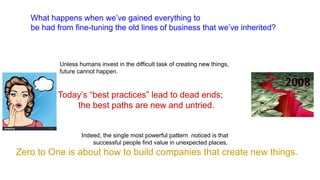
Unless humans invest in the difficult task of creating new things,
future cannot happen.
Today’s “best practices” lead to dead ends;
the best paths are new and untried.
Indeed, the single most powerful pattern noticed is that
successful people find value in unexpected places,
Zero to One is about how to build companies that create new things.
What happens when we’ve gained everything to
be had from fine-tuning the old lines of business that we’ve inherited?
GLOBALIZATION TECHNOLOGY
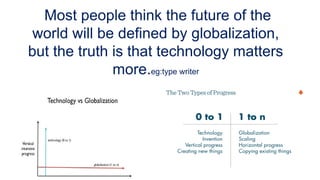
Most people think the future of the
world will be defined by globalization,
but the truth is that technology matters
more.eg:type writer
e
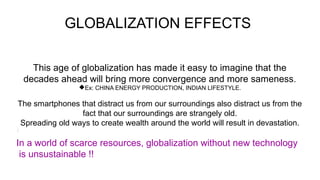
GLOBALIZATION EFFECTS
This age of globalization has made it easy to imagine that the
decades ahead will bring more convergence and more sameness.
Ex: CHINA ENERGY PRODUCTION, INDIAN LIFESTYLE.
The smartphones that distract us from our surroundings also distract us from the
fact that our surroundings are strangely old.
Spreading old ways to create wealth around the world will result in devastation.
In a world of scarce resources, globalization without new technology
is unsustainable !!
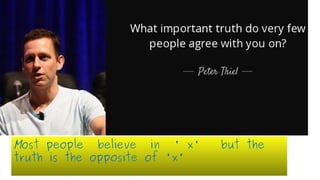
Most people believe in ' x' but the
truth is the opposite of 'x'
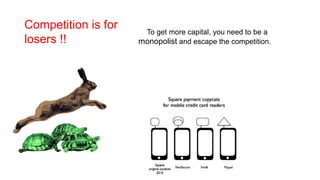
Competition is for
losers !!
To get more capital, you need to be a
monopolist and escape the competition.
•
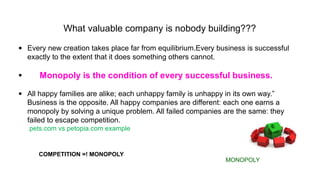
What valuable company is nobody building???
• Every new creation takes place far from equilibrium.Every business is successful
exactly to the extent that it does something others cannot.
• Monopoly is the condition of every successful business.
• All happy families are alike; each unhappy family is unhappy in its own way.”
Business is the opposite. All happy companies are different: each one earns a
monopoly by solving a unique problem. All failed companies are the same: they
failed to escape competition.
pets.com vs petopia.com example
MONOPOLY
COMPETITION =! MONOPOLY
HAVE A VISION
• It’s true that every great entrepreneur is first and foremost a designer. Ex: Steve Jobs , iDevice,
MacBook.
• The greatest thing Jobs designed was his business.
• Definite founders with robust plans don’t sell.
• Ex: When Yahoo offered to buy Facebook for $1 billion.
• Fermat's theorem
• A startup is the largest endeavor over which you can have definite mastery. You can have agency
not just over your own life, but over a small and important part of the world. It begins by rejecting
the unjust tyranny of Chance.
You
Are
Not
a
Lottery
Ticket !!
WELCOME
ENTREPRENEURS

Zero to one.PETER THIEL

  • 1.
    The book TheeffortThe effort Book name: ZERO TO ONE Notes on start-ups, OR how to build the future Author : PETER THIEL FACULTY CO-ORDINATORS: Prof : Jaya Lakshmi Prof : Lohith Kumar REVIEWED BY: Sarella Sreeja M11-TPS-37 SEC- C
  • 3.
    Who is PETER THIEL ? German-American entrepreneur. Founderof PAYPAL,PALANTIR TECHNOLOGIES. Early investor in Facebook. Venture Capitalist. Political activist. Author. Net worth: $2.7 billion. Still single !
  • 4.
    CONTENTS The challenge ofthe Future. On “lean startup” dogmas. Competition is for losers. Business vs startup. Building a monopoly. Foundations. 7 questions every startup should answer.
  • 5.
    Unless humans investin the difficult task of creating new things, future cannot happen. Today’s “best practices” lead to dead ends; the best paths are new and untried. Indeed, the single most powerful pattern noticed is that successful people find value in unexpected places, Zero to One is about how to build companies that create new things. What happens when we’ve gained everything to be had from fine-tuning the old lines of business that we’ve inherited?
  • 6.
  • 7.
    Most people thinkthe future of the world will be defined by globalization, but the truth is that technology matters more.eg:type writer e
  • 8.
    GLOBALIZATION EFFECTS This ageof globalization has made it easy to imagine that the decades ahead will bring more convergence and more sameness. Ex: CHINA ENERGY PRODUCTION, INDIAN LIFESTYLE. The smartphones that distract us from our surroundings also distract us from the fact that our surroundings are strangely old. Spreading old ways to create wealth around the world will result in devastation. In a world of scarce resources, globalization without new technology is unsustainable !!
  • 9.
    Most people believein ' x' but the truth is the opposite of 'x'
  • 11.
    Competition is for losers!! To get more capital, you need to be a monopolist and escape the competition. •
  • 12.
    What valuable companyis nobody building??? • Every new creation takes place far from equilibrium.Every business is successful exactly to the extent that it does something others cannot. • Monopoly is the condition of every successful business. • All happy families are alike; each unhappy family is unhappy in its own way.” Business is the opposite. All happy companies are different: each one earns a monopoly by solving a unique problem. All failed companies are the same: they failed to escape competition. pets.com vs petopia.com example MONOPOLY COMPETITION =! MONOPOLY
  • 13.
    HAVE A VISION •It’s true that every great entrepreneur is first and foremost a designer. Ex: Steve Jobs , iDevice, MacBook. • The greatest thing Jobs designed was his business. • Definite founders with robust plans don’t sell. • Ex: When Yahoo offered to buy Facebook for $1 billion. • Fermat's theorem • A startup is the largest endeavor over which you can have definite mastery. You can have agency not just over your own life, but over a small and important part of the world. It begins by rejecting the unjust tyranny of Chance. You Are Not a Lottery Ticket !!
  • 14.

Editor's Notes

  • #6 Unlikely as it sounds, the answer threatens to be far worse than the crisis of 2008. Animals are instinctively driven to build things. But we are the only ones that can invent new things and better ways of making them. These are the kind of elementary truths we teach to second graders, but they are easy to forget in a world where so much of what we do is repeat what has been done before. The paradox of teaching entrepreneurship is that such a formula necessarily cannot exist; because every innovation is new and unique, no authority can prescribe in concrete terms how to be innovative.
  • #9 When we think about the future, we hope for a future of progress. That progress can take one of two forms. Horizontal or extensive progress means copying things that work—going from 1 to n. . Vertical or intensive progress means doing new things—going from 0 to 1. Vertical progress is harder to imagine because it requires doing something nobody else has ever done. If you take one typewriter and build 100, you have made horizontal progress. If you have a typewriter and build a word processor, you have made vertical progress.
  • #10 Even our everyday language suggests we believe in a kind of technological end of history: the division of the world into the so-called developed and developing nations implies that the “developed” world has already achieved the achievable, and that poorer nations just need to catch up.
  • #13 Capitalism means capital. Competition means there would be no capital for you. The pie will be eaten by the other players You may argue that monopolies are bad, but this is true only in a world where nothing changes. In our world it’s possible to invent new & better things. .
  • #14 BM’s hardware monopoly of the ’60s and ’70s was overtaken by Microsoft’s software monopoly. Microsoft had a huge monopoly in operating systems.
  • #15 In business, equilibrium means stasis, and stasis means death. If your industry is in a competitive equilibrium, the death of your business won’t matter to the world; some other undifferentiated competitor will always be ready to take your place Competition can make people hallucinate opportunities where none exist. The crazy ’90s version of this was the fierce battle for the online pet store market. It was Pets.com vs. PetStore.com vs. Petopia.com vs. what seemed like dozens of others. Each company was obsessed with defeating its rivals, precisely because there were no substantive differences to focus on. Amid all the tactical questions—Who could price chewy dog toys most aggressively? Who could create the best Super Bowl ads?—these companies totally lost sight of the wider question of whether the online pet supply market was the right space to be in. Winning is better than losing, but everybody loses when the war isn’t one worth fighting.
  • #16 Proprietary technology (10 times better than any existing solution) pg.49 Network effect (start with a niche market) refer pg:50- mark facebook started with just Harvard students—Mark Zuckerberg’s first product was designed to get all his classmates signed up, not to attract all people of Earth. Perfect target market for a startup is a small group of particular people concentrated together and served by few or no competitors. once you dominate a niche market expand to adjancent markets (always expand, example amazon and ebay pg.55) the last will be the first, instead of first mover advantage make the last great development in a specific market and reap the fruits of a mature ecosystem.
  • #17 The definite optimist has a concrete plan for the future and strongly believes in that future being better than today. The indefinite optimist is bullish on the future but lacks any design and plan for how to make such a future possible. The definite pessimist has a specific vision for the future but believes that future to be bleak. The indefinite pessimist has a bearish view on the future but no idea what to do about it.
  • #20 The best entrepreneurs know this: every great business is built around a secret that’s hidden from the outside. A great company is a conspiracy to change the world; when you share your secret, the recipient becomes a fellow conspirator.
  • #21 Anyone who has held an iDevice or a smoothly machined MacBook has felt the result of Steve Jobs’s obsession with visual and experiential perfection. But the most important lesson to learn from Jobs has nothing to do with aesthetics Apple imagined and executed definite multi-year plans to create new products and distribute them effectively. Forget “minimum viable products”—ever since he started Apple in 1976, Jobs saw that you can change the world through careful planning, not by listening to focus group feedback or copying others’ successes in July 2006, everybody thought we should at least consider it. Mark saw where he could take the company, and Yahoo! didn’t. And today Facebook accounts to be $33.3 billion !! But Mark Zuckerberg walked into the board meeting and announced: “Okay, guys, this is just a formality, it shouldn’t take more than 10 minutes. We’re obviously not going to sell here.”