Role of Cross Functional Teams in a New Store Roll Out
Abul Hasan Rajani
IT IS NOT JUST COFFEE, IT IS STARBUCKS COFFEE
TATA Starbucks - Overview
• Tata Starbucks Ltd is a 50:50 joint venture company,
owned by Starbucks Corporation and Tata Global
Beverages.
• Headquarters – Mumbai
• No. of stores in India – 63 (as of January, ‘15)
• Starbucks, through an agreement with Tata Coffee,
serves coffee that is 100% locally sourced and roasted.
The Cross functional Team
• The different functions that are involved in the
roll-out of a new Starbucks Outlet:
• Business/ Store development team
• Operations team
• Marketing team
• Supply Chain Management team
• Finance
The Process of launching a new store
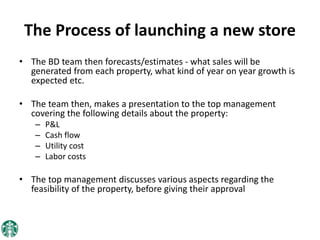
• BD team uses an excel based analytical tool – SSP tool, to identify
potential locations
• INPUT
– Population
– Income
– Residential/commercial/office premises/educational institutes/malls,
etc
– Competitive profile of the catchment area (What sales are being
achieved by competitors in that area)
• Based on these inputs SSP tool identifies attractive properties
• The BD team then visits these properties and analyses them . Every
property is considered for a lease period of 9-12 years.
s
The Process of launching a new store
• The BD team then forecasts/estimates - what sales will be
generated from each property, what kind of year on year growth is
expected etc.
• The team then, makes a presentation to the top management
covering the following details about the property:
– P&L
– Cash flow
– Utility cost
– Labor costs
• The top management discusses various aspects regarding the
feasibility of the property, before giving their approval
Architects and Construction Team
• Once the top management approves and signs off on a particular
property, the architects and the legal team comes into picture
• A team of architects operates from Starbucks, US.
• Usually there are dedicated teams for different regions. E.g.: APAC
region, Americas Region, Middle-East region, China
• Architects have certain pre-defined templates of store layout
(around 15 design templates)
• Based on the catchment and whether they are targeting a
residential area or an office/corporate area, a particular template is
chosen.
Architects and Construction Team
• The team of architects then sends a design docket team to the construction team
in India
• At this stage the legal team is parallely working to get the required permissions
• Once all permissions are got and approval from the construction team, the
designs are passed on to builders/contractors
• The contractors do the actual fit-out of the store
• The team of architects from US usually visit every 2 months to supervise the
construction work
• Starbucks also has a unique concept of adorning its stores with artifacts that are
unique to a particular city or location
• At this stage the marketing and branding teams come into picture, to start pre-
launch communication.
HR and Recruitment
• 30 days before the construction begins, the HR
head starts with recruitment activities.
• HR functions are centralized, Each city has one
HR.
• Most of the regulations and HR policies are
uniform across all stores in India, except few like
the leave policy
• Leave policy is subject to state and area level
rules. For e.g. employee may be eligible for leave
on Gudi Padwa in Maharashtra, while in Kerala
the same may hold true for Onam
HR and Recruitment
• Intended Career growth:
• Partner  Supervisor ASM  Store
manager District Manager (8 stores)
• Every city has a Operations manager who
reports to the General Manager
Parameters involved in selecting a
location
• BD team identifies areas known a focal points
• A focal point is typically an area which has attractive demographics and
presents an attractive opportunity for a potential store
• The profiles of people in a particular focal point are studied and based on
these they decide how many outlets can a single focal point have.
• E.g.: Starbucks in Matunga area (as suggested by Mr. Parthiban)
• Standard checklist is followed which is developed by the company and is
confidential to the company.
• This checklist contains a list of amenities and basic facilities a particular
location or property must have in order to be eligible to house a Starbucks
outlet
Opening in new cities
• As of now Starbucks has 63 stores in India, majorly in the
metros and Tier-1 cities
• Before launching of a store in a city, one of the major
criteria that Starbucks considers apart from the
environmental scan and market analysis, is the presence of
an airport
• Because where ever there is an airport, TajSats is present
there
• Hence most cities where Starbucks is looking at launching a
store is based on the proximity of that city to a TajSats
Warehouse
Cross Functional Leadership Team
• Heads of 5 functions come together to form a cross functional team
of leaders who overlook the entire process of the store layout.
• Typical points of concern for each functional head:
• BD head – getting the best location at the best price
• Operations head – can efficiency be achieved at all levels, if we put
up a store at this location. For e.g. Is the location well connected by
public transport systems? Will the store associates (partners) be
able to travel with ease from this location ?
• Marketing head – making sure the target customer gets the right
message (Mahavir Nagar example). Branding, Engaging through
social media, creating a hype before the launch of the store
Cross Functional Leadership Team
• Finance head – will we be able to achieve the
required ROI at this location
• SCM head – concerned with distribution. E.g.
connectivity of that location to the Warehouse
for food, located at Bhiwandi
Distribution
• Coffee is sourced from the Tata Coffee co. a subsidiary of TATA global beverages,
which operates for Starbucks only.
• The main supplier of foods is TajSATS. Food is shipped from TajSATS warehouse.
• A dedicated Starbucks team does ethical sourcing of coffee beans all over the
world and carries out activities of quality assurance in roasting plants.
• The logistics for delivery of food is handled by a third party. They work towards
minimizing the logistics cost. Shipping cost vs WH cost.
• If at times, it is not feasible to source foods from TajSATS, they pick a local vendor,
but only after he meets the high quality standards required by Starbucks. Chennai
is an example of this.
• Lead times are based on the perishability of the product. They say that JIT is
usually not possible for them.
Licenses Required
• Construction team hands over the process flow to the Maintenance and
Operations team;
• Meanwhile, Liaisoning team applies for licenses.
• 33 different signatures are required to get started with the licensing
process.
• Ex: Due to their own regulations (like music volume constraints, marathi
signage mandates) Mumbai BMC becomes the toughest to deal with in
terms of licensing.
• After the agreement is signed, Legal team prepares legal documents to
talk to the landlord post which they apply for licenses.
• OC (Occupation Certificate) is also required.
• Construction duration is 45 days.
Quality and compliance handling
• The SCM team has a logistics head and a quality
head.
• The category manager (called chef) is responsible
for handling the assortment at the stores.
Assortment has 80% coffee and 20% food.
• The Chef reports to 2 heads, the head of the
category team under marketing and the head of
the quality team, under SCM
Flow of tasks in a store roll out
Leadership team
Finance
Supply chain Team
Store Operations team
Marketing
Construction team/Architects
Business development Team
• Decision Makers
• Investment evaluation and financial strategies
• Supply of perishable food stuff
• Store Manager
• Store Employees
• Promotions (Locally)
• Brand Awareness(Globally)[Brewing soon]
• India
• USA
• Finding Location as per
Focal point
THANK YOU

Starbucks | Cross Functional Teams

  • 1.
    Role of CrossFunctional Teams in a New Store Roll Out Abul Hasan Rajani IT IS NOT JUST COFFEE, IT IS STARBUCKS COFFEE
  • 2.
    TATA Starbucks -Overview • Tata Starbucks Ltd is a 50:50 joint venture company, owned by Starbucks Corporation and Tata Global Beverages. • Headquarters – Mumbai • No. of stores in India – 63 (as of January, ‘15) • Starbucks, through an agreement with Tata Coffee, serves coffee that is 100% locally sourced and roasted.
  • 3.
    The Cross functionalTeam • The different functions that are involved in the roll-out of a new Starbucks Outlet: • Business/ Store development team • Operations team • Marketing team • Supply Chain Management team • Finance
  • 4.
    The Process oflaunching a new store • BD team uses an excel based analytical tool – SSP tool, to identify potential locations • INPUT – Population – Income – Residential/commercial/office premises/educational institutes/malls, etc – Competitive profile of the catchment area (What sales are being achieved by competitors in that area) • Based on these inputs SSP tool identifies attractive properties • The BD team then visits these properties and analyses them . Every property is considered for a lease period of 9-12 years.
  • 5.
  • 6.
    The Process oflaunching a new store • The BD team then forecasts/estimates - what sales will be generated from each property, what kind of year on year growth is expected etc. • The team then, makes a presentation to the top management covering the following details about the property: – P&L – Cash flow – Utility cost – Labor costs • The top management discusses various aspects regarding the feasibility of the property, before giving their approval
  • 7.
    Architects and ConstructionTeam • Once the top management approves and signs off on a particular property, the architects and the legal team comes into picture • A team of architects operates from Starbucks, US. • Usually there are dedicated teams for different regions. E.g.: APAC region, Americas Region, Middle-East region, China • Architects have certain pre-defined templates of store layout (around 15 design templates) • Based on the catchment and whether they are targeting a residential area or an office/corporate area, a particular template is chosen.
  • 8.
    Architects and ConstructionTeam • The team of architects then sends a design docket team to the construction team in India • At this stage the legal team is parallely working to get the required permissions • Once all permissions are got and approval from the construction team, the designs are passed on to builders/contractors • The contractors do the actual fit-out of the store • The team of architects from US usually visit every 2 months to supervise the construction work • Starbucks also has a unique concept of adorning its stores with artifacts that are unique to a particular city or location • At this stage the marketing and branding teams come into picture, to start pre- launch communication.
  • 9.
    HR and Recruitment •30 days before the construction begins, the HR head starts with recruitment activities. • HR functions are centralized, Each city has one HR. • Most of the regulations and HR policies are uniform across all stores in India, except few like the leave policy • Leave policy is subject to state and area level rules. For e.g. employee may be eligible for leave on Gudi Padwa in Maharashtra, while in Kerala the same may hold true for Onam
  • 10.
    HR and Recruitment •Intended Career growth: • Partner  Supervisor ASM  Store manager District Manager (8 stores) • Every city has a Operations manager who reports to the General Manager
  • 11.
    Parameters involved inselecting a location • BD team identifies areas known a focal points • A focal point is typically an area which has attractive demographics and presents an attractive opportunity for a potential store • The profiles of people in a particular focal point are studied and based on these they decide how many outlets can a single focal point have. • E.g.: Starbucks in Matunga area (as suggested by Mr. Parthiban) • Standard checklist is followed which is developed by the company and is confidential to the company. • This checklist contains a list of amenities and basic facilities a particular location or property must have in order to be eligible to house a Starbucks outlet
  • 12.
    Opening in newcities • As of now Starbucks has 63 stores in India, majorly in the metros and Tier-1 cities • Before launching of a store in a city, one of the major criteria that Starbucks considers apart from the environmental scan and market analysis, is the presence of an airport • Because where ever there is an airport, TajSats is present there • Hence most cities where Starbucks is looking at launching a store is based on the proximity of that city to a TajSats Warehouse
  • 13.
    Cross Functional LeadershipTeam • Heads of 5 functions come together to form a cross functional team of leaders who overlook the entire process of the store layout. • Typical points of concern for each functional head: • BD head – getting the best location at the best price • Operations head – can efficiency be achieved at all levels, if we put up a store at this location. For e.g. Is the location well connected by public transport systems? Will the store associates (partners) be able to travel with ease from this location ? • Marketing head – making sure the target customer gets the right message (Mahavir Nagar example). Branding, Engaging through social media, creating a hype before the launch of the store
  • 14.
    Cross Functional LeadershipTeam • Finance head – will we be able to achieve the required ROI at this location • SCM head – concerned with distribution. E.g. connectivity of that location to the Warehouse for food, located at Bhiwandi
  • 15.
    Distribution • Coffee issourced from the Tata Coffee co. a subsidiary of TATA global beverages, which operates for Starbucks only. • The main supplier of foods is TajSATS. Food is shipped from TajSATS warehouse. • A dedicated Starbucks team does ethical sourcing of coffee beans all over the world and carries out activities of quality assurance in roasting plants. • The logistics for delivery of food is handled by a third party. They work towards minimizing the logistics cost. Shipping cost vs WH cost. • If at times, it is not feasible to source foods from TajSATS, they pick a local vendor, but only after he meets the high quality standards required by Starbucks. Chennai is an example of this. • Lead times are based on the perishability of the product. They say that JIT is usually not possible for them.
  • 16.
    Licenses Required • Constructionteam hands over the process flow to the Maintenance and Operations team; • Meanwhile, Liaisoning team applies for licenses. • 33 different signatures are required to get started with the licensing process. • Ex: Due to their own regulations (like music volume constraints, marathi signage mandates) Mumbai BMC becomes the toughest to deal with in terms of licensing. • After the agreement is signed, Legal team prepares legal documents to talk to the landlord post which they apply for licenses. • OC (Occupation Certificate) is also required. • Construction duration is 45 days.
  • 17.
    Quality and compliancehandling • The SCM team has a logistics head and a quality head. • The category manager (called chef) is responsible for handling the assortment at the stores. Assortment has 80% coffee and 20% food. • The Chef reports to 2 heads, the head of the category team under marketing and the head of the quality team, under SCM
  • 18.
    Flow of tasksin a store roll out Leadership team Finance Supply chain Team Store Operations team Marketing Construction team/Architects Business development Team • Decision Makers • Investment evaluation and financial strategies • Supply of perishable food stuff • Store Manager • Store Employees • Promotions (Locally) • Brand Awareness(Globally)[Brewing soon] • India • USA • Finding Location as per Focal point
  • 19.