Standing Seam Metal Roofing
AIA Course: EDC714F
GBCI Course: 920000164
1 AIA HSW/LU and 1 GBCI CE Hour
Credit earned on completion of this
course will be reported to AIA CES
for AIA members.
To receive a Certificate of
Completion you must complete and
pass the 10 question quiz following
this presentation with an 80% or
higher, then a certificate of
completion will be available for
immediate download.
This course is registered with AIA CES
for continuing professional
education. As such, it does not
include content that may be deemed
or construed to be an approval or
endorsement by the AIA of any
material of construction or any
method or manner of
handling, using, distributing, or
dealing in any material or product.
___________________________________________
Questions related to specific materials, methods, and
services will be addressed at the conclusion of this
presentation.
Learning Objectives
 Understand the differences in application parameters for
various standing seam metal roofing systems
 Understand wind uplift testing as prescribed by
Underwriters Laboratories and ASTM E1592
 Recognize complicated design details that should be
carefully specified and reviewed when using metal roofing
 Comprehend available warranties and be able to select the
appropriate one for a project
3
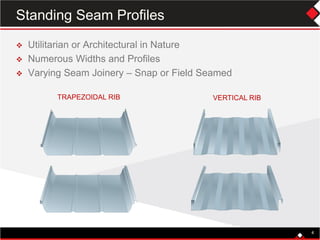
TRAPEZOIDAL RIB VERTICAL RIB
 Utilitarian or Architectural in Nature
 Numerous Widths and Profiles
 Varying Seam Joinery – Snap or Field Seamed
4
Standing Seam Profiles
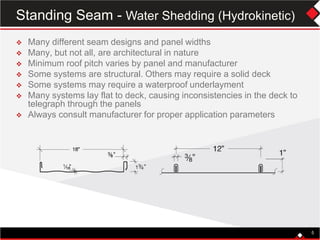
 Many different seam designs and panel widths
 Many, but not all, are architectural in nature
 Minimum roof pitch varies by panel and manufacturer
 Some systems are structural. Others may require a solid deck
 Some systems may require a waterproof underlayment
 Many systems lay flat to deck, causing inconsistencies in the deck to
telegraph through the panels
 Always consult manufacturer for proper application parameters
5
Standing Seam - Water Shedding (Hydrokinetic)
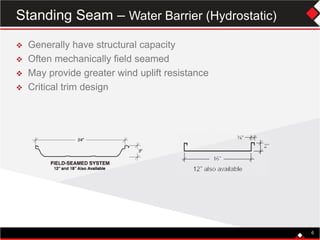
 Generally have structural capacity
 Often mechanically field seamed
 May provide greater wind uplift resistance
 Critical trim design
6
Standing Seam – Water Barrier (Hydrostatic)
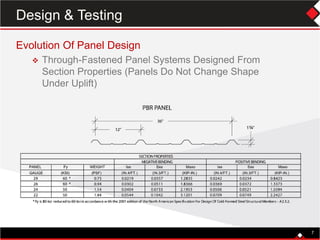
Evolution Of Panel Design
 Through-Fastened Panel Systems Designed From
Section Properties (Panels Do Not Change Shape
Under Uplift)
7
Design & Testing
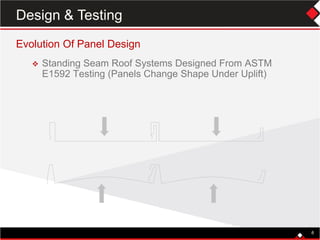
Evolution Of Panel Design
 Standing Seam Roof Systems Designed From ASTM
E1592 Testing (Panels Change Shape Under Uplift)
8
Design & Testing
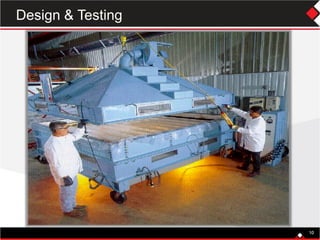
UL-90 - 580 Test
 Includes deck/roof assembly - not just panels alone
 Test specimen allows for perimeter fastening
 Field of roof and Product comparison test only
 Test does not simulate real conditions
9
Design & Testing
1010
Design & Testing
1111
Design & Testing
12
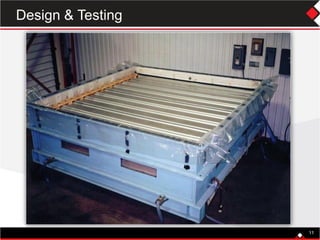
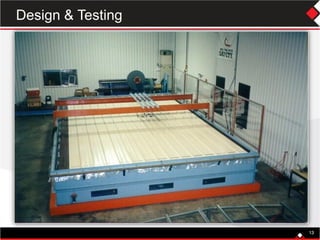
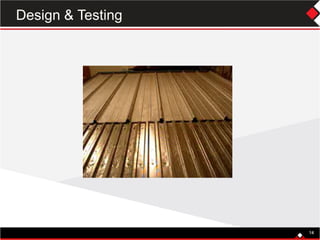
ASTM E-1592
 Panel Length Based On Number And Length Of Clip
Spacings
 Panel End(s) Fastened based on Panel Length
 Evaluates Panels And Clips, But Not Attachment To
Substructure
 Tests To Ultimate Failure
12
Design & Testing
1313
Design & Testing
1414
Design & Testing
1515
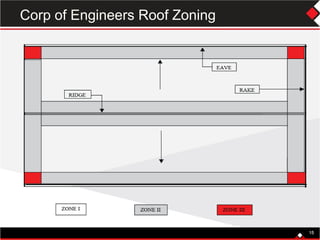
Corp of Engineers Roof Zoning
16
Design Conditions That Require Special Attention
 Roof Transitions
 Dead Valleys
 Dormers
 Eave Offsets
 Ridge Offsets
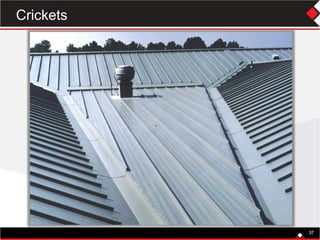
 Crickets
16
Special Details
1717
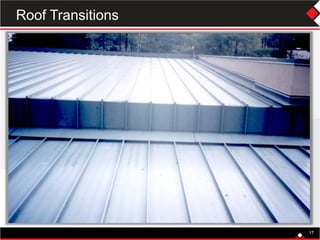
Roof Transitions
18
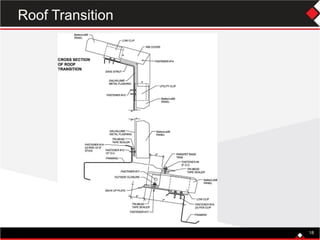
Roof Transition
19
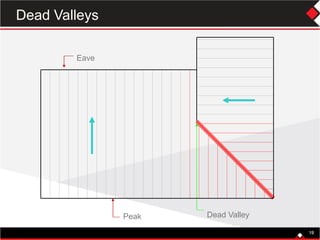
Peak
Eave
Dead Valley
19
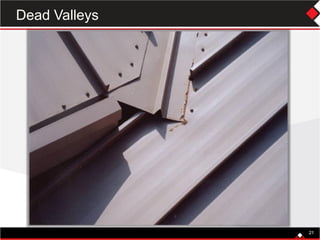
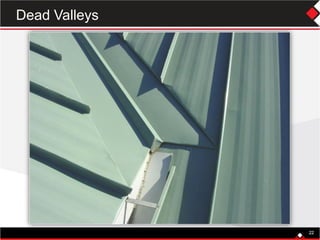
Dead Valleys
2020
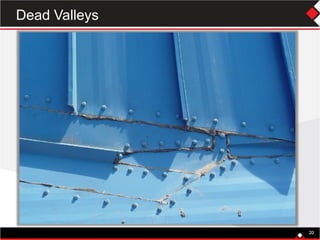
Dead Valleys
2121
Dead Valleys
2222
Dead Valleys
23
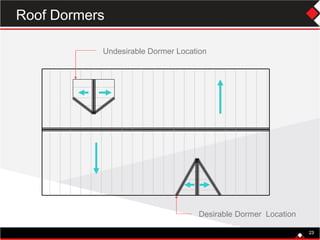
Desirable Dormer Location
Undesirable Dormer Location
23
Roof Dormers
24
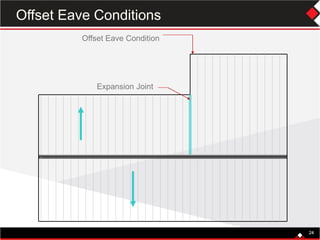
Offset Eave Condition
Expansion Joint
24
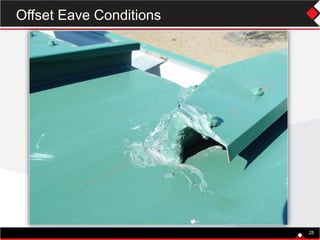
Offset Eave Conditions
2525
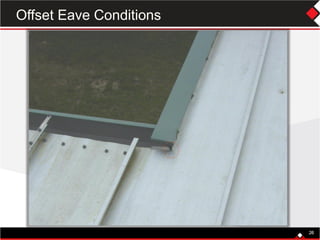
Offset Eave Conditions
2626
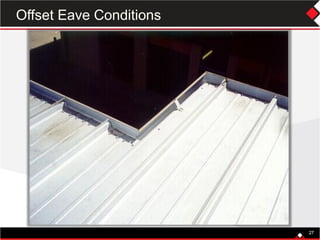
Offset Eave Conditions
2727
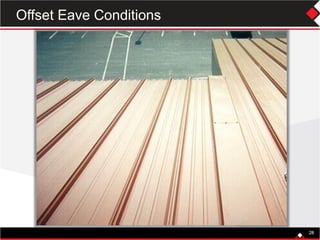
Offset Eave Conditions
2828
Offset Eave Conditions
29
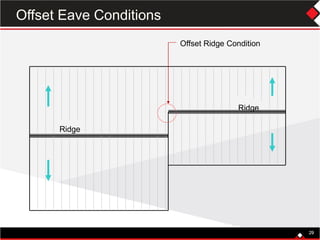
Ridge
Ridge
Offset Ridge Condition
29
Offset Eave Conditions
3030
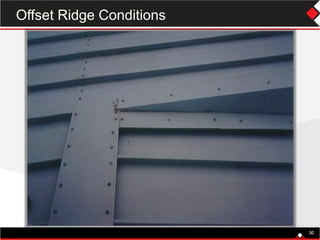
Offset Ridge Conditions
3131
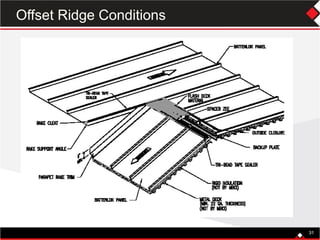
Offset Ridge Conditions
3232
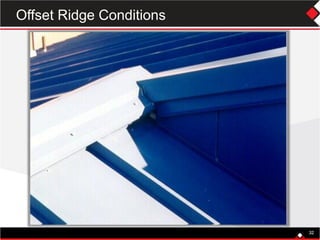
Offset Ridge Conditions
3333
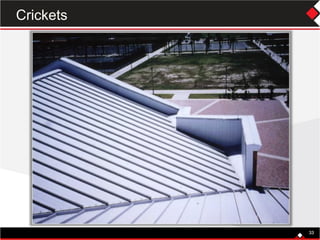
Crickets
34
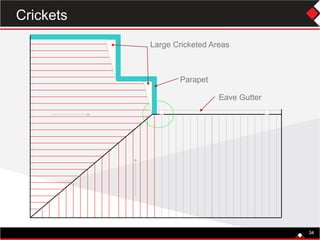
Large Cricketed Areas
Parapet
Eave Gutter
34
Crickets
3535
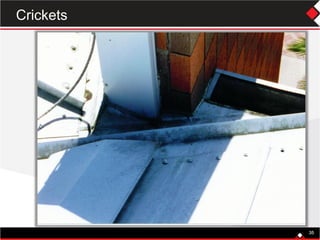
Crickets
3636
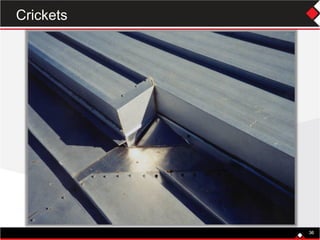
Crickets
3737
Crickets
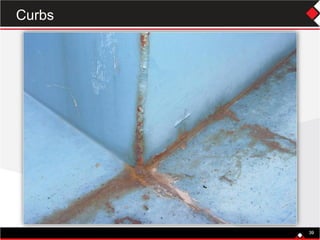
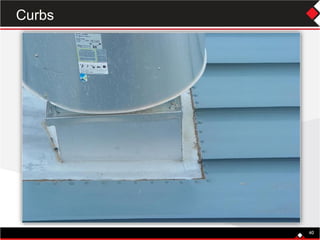
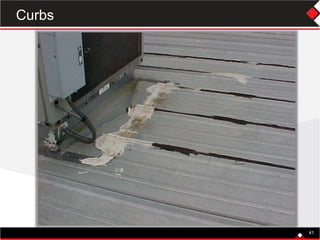
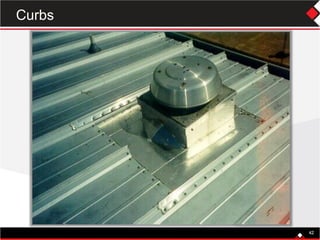
Curbs
 Roofer To Furnish And Install
 Made From Aluminum
 Over/Under, Rib-To-Rib Style
 Provide Clearance At Sides And Upslope End
38
Roof Penetrations
3939
Curbs
4040
Curbs
4141
Curbs
4242
Curbs
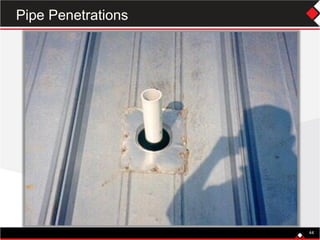
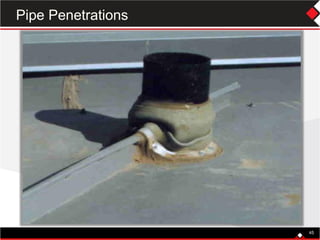
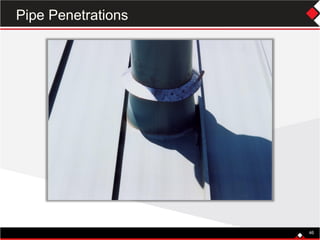
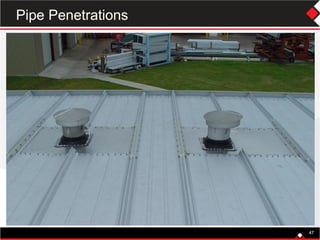
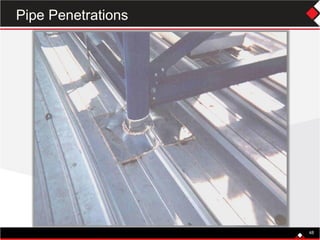
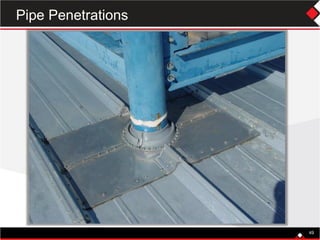
Pipe Penetrations
 Roofer To Furnish And Install
 Use Rubber Roof Jacks
 Don’t Cut Through Panel Seam
 Don’t Block Water Flow
43
Roof Penetrations
44
Pipe Penetrations
45
Pipe Penetrations
46
Pipe Penetrations
4747
Pipe Penetrations
48
Pipe Penetrations
49
Pipe Penetrations
50
 Galvalume Substrate
 Finish Warranties
• Silicone Polyester - 25 years
• Fluoropolymers -(Kynars) - 25 years
 Weathertightness Warranties
• Industry Standard
• “Day One” Responsibility
50
Warranties
51
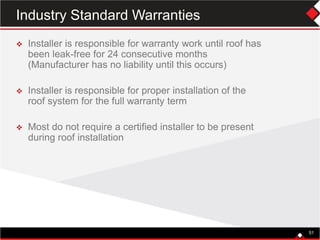
 Installer is responsible for warranty work until roof has
been leak-free for 24 consecutive months
(Manufacturer has no liability until this occurs)
 Installer is responsible for proper installation of the
roof system for the full warranty term
 Most do not require a certified installer to be present
during roof installation
51
Industry Standard Warranties
52
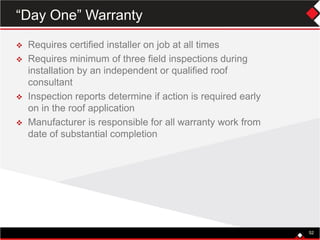
 Requires certified installer on job at all times
 Requires minimum of three field inspections during
installation by an independent or qualified roof
consultant
 Inspection reports determine if action is required early
on in the roof application
 Manufacturer is responsible for all warranty work from
date of substantial completion
52
“Day One” Warranty
53
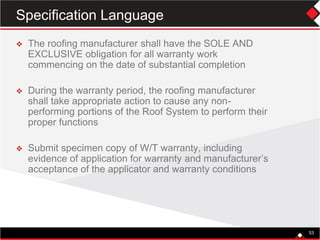
 The roofing manufacturer shall have the SOLE AND
EXCLUSIVE obligation for all warranty work
commencing on the date of substantial completion
 During the warranty period, the roofing manufacturer
shall take appropriate action to cause any non-
performing portions of the Roof System to perform their
proper functions
 Submit specimen copy of W/T warranty, including
evidence of application for warranty and manufacturer’s
acceptance of the applicator and warranty conditions
53
Specification Language
54
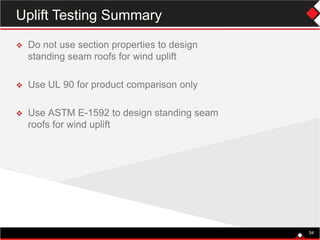
 Do not use section properties to design
standing seam roofs for wind uplift
 Use UL 90 for product comparison only
 Use ASTM E-1592 to design standing seam
roofs for wind uplift
54
Uplift Testing Summary
55
 Read and become familiar with manufacturer’s standard
warranty offerings
 If you do specify a “Day One” type warranty, make sure you
are getting what you specified
 If the Architectural Community embraces this warranty, then all
manufacturers will adopt the same or similar warranty
 Get the Manufacturer Involved during the design stage!!
55
Warranty Summary
THANK YOU FOR YOUR ATTENDANCE
QUESTIONS?
www.mbci.com
This concludes the American Institute of Architects
Continuing Education Systems Program
CEcampus@bnpmedia.com

Standing seam metal roofing edc1

  • 1.
    Standing Seam MetalRoofing AIA Course: EDC714F GBCI Course: 920000164 1 AIA HSW/LU and 1 GBCI CE Hour
  • 2.
    Credit earned oncompletion of this course will be reported to AIA CES for AIA members. To receive a Certificate of Completion you must complete and pass the 10 question quiz following this presentation with an 80% or higher, then a certificate of completion will be available for immediate download. This course is registered with AIA CES for continuing professional education. As such, it does not include content that may be deemed or construed to be an approval or endorsement by the AIA of any material of construction or any method or manner of handling, using, distributing, or dealing in any material or product. ___________________________________________ Questions related to specific materials, methods, and services will be addressed at the conclusion of this presentation.
  • 3.
    Learning Objectives  Understandthe differences in application parameters for various standing seam metal roofing systems  Understand wind uplift testing as prescribed by Underwriters Laboratories and ASTM E1592  Recognize complicated design details that should be carefully specified and reviewed when using metal roofing  Comprehend available warranties and be able to select the appropriate one for a project 3
  • 4.
    TRAPEZOIDAL RIB VERTICALRIB  Utilitarian or Architectural in Nature  Numerous Widths and Profiles  Varying Seam Joinery – Snap or Field Seamed 4 Standing Seam Profiles
  • 5.
     Many differentseam designs and panel widths  Many, but not all, are architectural in nature  Minimum roof pitch varies by panel and manufacturer  Some systems are structural. Others may require a solid deck  Some systems may require a waterproof underlayment  Many systems lay flat to deck, causing inconsistencies in the deck to telegraph through the panels  Always consult manufacturer for proper application parameters 5 Standing Seam - Water Shedding (Hydrokinetic)
  • 6.
     Generally havestructural capacity  Often mechanically field seamed  May provide greater wind uplift resistance  Critical trim design 6 Standing Seam – Water Barrier (Hydrostatic)
  • 7.
    Evolution Of PanelDesign  Through-Fastened Panel Systems Designed From Section Properties (Panels Do Not Change Shape Under Uplift) 7 Design & Testing
  • 8.
    Evolution Of PanelDesign  Standing Seam Roof Systems Designed From ASTM E1592 Testing (Panels Change Shape Under Uplift) 8 Design & Testing
  • 9.
    UL-90 - 580Test  Includes deck/roof assembly - not just panels alone  Test specimen allows for perimeter fastening  Field of roof and Product comparison test only  Test does not simulate real conditions 9 Design & Testing
  • 10.
  • 11.
  • 12.
    12 ASTM E-1592  PanelLength Based On Number And Length Of Clip Spacings  Panel End(s) Fastened based on Panel Length  Evaluates Panels And Clips, But Not Attachment To Substructure  Tests To Ultimate Failure 12 Design & Testing
  • 13.
  • 14.
  • 15.
  • 16.
    16 Design Conditions ThatRequire Special Attention  Roof Transitions  Dead Valleys  Dormers  Eave Offsets  Ridge Offsets  Crickets 16 Special Details
  • 17.
  • 18.
  • 19.
  • 20.
  • 21.
  • 22.
  • 23.
    23 Desirable Dormer Location UndesirableDormer Location 23 Roof Dormers
  • 24.
    24 Offset Eave Condition ExpansionJoint 24 Offset Eave Conditions
  • 25.
  • 26.
  • 27.
  • 28.
  • 29.
  • 30.
  • 31.
  • 32.
  • 33.
  • 34.
  • 35.
  • 36.
  • 37.
  • 38.
    Curbs  Roofer ToFurnish And Install  Made From Aluminum  Over/Under, Rib-To-Rib Style  Provide Clearance At Sides And Upslope End 38 Roof Penetrations
  • 39.
  • 40.
  • 41.
  • 42.
  • 43.
    Pipe Penetrations  RooferTo Furnish And Install  Use Rubber Roof Jacks  Don’t Cut Through Panel Seam  Don’t Block Water Flow 43 Roof Penetrations
  • 44.
  • 45.
  • 46.
  • 47.
  • 48.
  • 49.
  • 50.
    50  Galvalume Substrate Finish Warranties • Silicone Polyester - 25 years • Fluoropolymers -(Kynars) - 25 years  Weathertightness Warranties • Industry Standard • “Day One” Responsibility 50 Warranties
  • 51.
    51  Installer isresponsible for warranty work until roof has been leak-free for 24 consecutive months (Manufacturer has no liability until this occurs)  Installer is responsible for proper installation of the roof system for the full warranty term  Most do not require a certified installer to be present during roof installation 51 Industry Standard Warranties
  • 52.
    52  Requires certifiedinstaller on job at all times  Requires minimum of three field inspections during installation by an independent or qualified roof consultant  Inspection reports determine if action is required early on in the roof application  Manufacturer is responsible for all warranty work from date of substantial completion 52 “Day One” Warranty
  • 53.
    53  The roofingmanufacturer shall have the SOLE AND EXCLUSIVE obligation for all warranty work commencing on the date of substantial completion  During the warranty period, the roofing manufacturer shall take appropriate action to cause any non- performing portions of the Roof System to perform their proper functions  Submit specimen copy of W/T warranty, including evidence of application for warranty and manufacturer’s acceptance of the applicator and warranty conditions 53 Specification Language
  • 54.
    54  Do notuse section properties to design standing seam roofs for wind uplift  Use UL 90 for product comparison only  Use ASTM E-1592 to design standing seam roofs for wind uplift 54 Uplift Testing Summary
  • 55.
    55  Read andbecome familiar with manufacturer’s standard warranty offerings  If you do specify a “Day One” type warranty, make sure you are getting what you specified  If the Architectural Community embraces this warranty, then all manufacturers will adopt the same or similar warranty  Get the Manufacturer Involved during the design stage!! 55 Warranty Summary
  • 56.
    THANK YOU FORYOUR ATTENDANCE QUESTIONS? www.mbci.com This concludes the American Institute of Architects Continuing Education Systems Program CEcampus@bnpmedia.com