INFECTION PREVENTION
AND CONTROL (IPC)
LECTURE II
Standard infection control precautions (SICPs)
By
Mr. Osman Hassan Ali (B.sc, MPH & HDCH)
 Standard infection control precautions (SICPs)
 SICPs are the basic infection prevention and control (IPC) measures necessary to reduce the
risk of transmitting infectious agents from both recognised and unrecognised sources of
infection.
 Standard infection control precautions (SICPs) are to be used by:
 all staff,
 in all care area,
 at all times,
 for all patients
 whether infection is known to be present or not, to ensure the safety of those being cared for,
staff and visitors in the care environment.
 Sources of (potential) infection include:
 blood and other body fluids,
 secretions or excretions (excluding sweat),
 non-intact skin or mucous membranes and
 any equipment or items in the care environment that could have become contaminated.
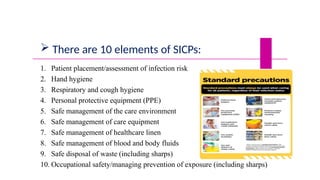
 There are 10 elements of SICPs:
1. Patient placement/assessment of infection risk
2. Hand hygiene
3. Respiratory and cough hygiene
4. Personal protective equipment (PPE)
5. Safe management of the care environment
6. Safe management of care equipment
7. Safe management of healthcare linen
8. Safe management of blood and body fluids
9. Safe disposal of waste (including sharps)
10. Occupational safety/managing prevention of exposure (including sharps)
1. Patient placement/assessment for infection risk
 Mean that patients must be promptly assessed for infection risk on arrival at the
care area, e.g. inpatient/outpatient, (if possible, prior to accepting a patient from
another care area) and should be continuously reviewed throughout their stay.
 This assessment should influence placement decisions in accordance with
clinical/care need(s).
 Patients who may present a cross-infection risk include those:
1. with diarrhea, vomiting, an unexplained rash, fever or respiratory
symptoms
2. known to have been previously positive with a multi-drug resistant
organism (MDRO), eg MRSA, CPE
2. Hand hygiene
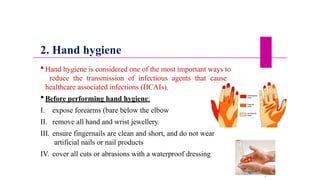
 Hand hygiene is considered one of the most important ways to
reduce the transmission of infectious agents that cause
healthcare associated infections (HCAIs).
 Before performing hand hygiene:
I. expose forearms (bare below the elbow
II. remove all hand and wrist jewellery.
III. ensure fingernails are clean and short, and do not wear
artificial nails or nail products
IV. cover all cuts or abrasions with a waterproof dressing
3
4
2. Hand hygiene (cont.)
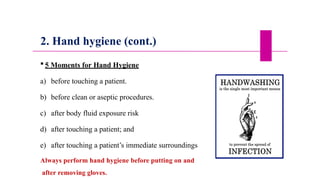
 5 Moments for Hand Hygiene
a) before touching a patient.
b) before clean or aseptic procedures.
c) after body fluid exposure risk
d) after touching a patient; and
e) after touching a patient’s immediate surroundings
Always perform hand hygiene before putting on and
after removing gloves.
2. Hand hygiene (cont.)
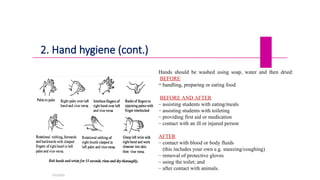
Hands should be washed using soap, water and then dried:
BEFORE
– handling, preparing or eating food
BEFORE AND AFTER
– assisting students with eating/meals
– assisting students with toileting
– providing first aid or medication
– contact with an ill or injured person
AFTER
– contact with blood or body fluids
(this includes your own e.g. sneezing/coughing)
– removal of protective gloves
– using the toilet; and
– after contact with animals.
5/9/2023
3. Respiratory and cough hygiene
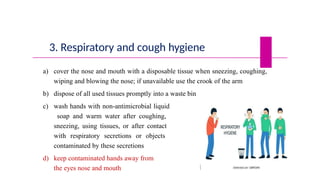
a) cover the nose and mouth with a disposable tissue when sneezing, coughing,
wiping and blowing the nose; if unavailable use the crook of the arm
b) dispose of all used tissues promptly into a waste bin
c) wash hands with non-antimicrobial liquid
soap and warm water after coughing,
sneezing, using tissues, or after contact
with respiratory secretions or objects
contaminated by these secretions
d) keep contaminated hands away from
the eyes nose and mouth
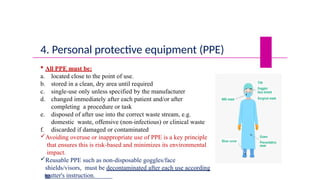
4. Personal protective equipment (PPE)
 All PPE must be:
a. located close to the point of use.
b. stored in a clean, dry area until required
c. single-use only unless specified by the manufacturer
d. changed immediately after each patient and/or after
completing a procedure or task
e. disposed of after use into the correct waste stream, e.g.
domestic waste, offensive (non-infectious) or clinical waste
f. discarded if damaged or contaminated
Avoiding overuse or inappropriate use of PPE is a key principle
that ensures this is risk-based and minimizes its environmental
impact.
Reusable PPE such as non-disposable goggles/face
shields/visors, must be decontaminated after each use according
to
mutter's instruction.
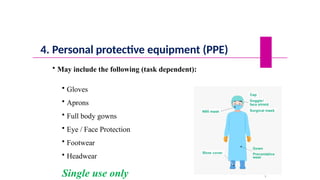
• May include the following (task dependent):
• Gloves
• Aprons
• Full body gowns
• Eye / Face Protection
• Footwear
• Headwear
Single use only 3
9
4. Personal protective equipment (PPE)
A) Gloves:
40
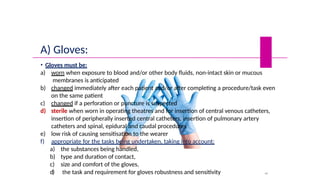
• Gloves must be:
a) worn when exposure to blood and/or other body fluids, non-intact skin or mucous
membranes is anticipated
b) changed immediately after each patient and/or after completing a procedure/task even
on the same patient
c) changed if a perforation or puncture is suspected
d) sterile when worn in operating theatres and for insertion of central venous catheters,
insertion of peripherally inserted central catheters, insertion of pulmonary artery
catheters and spinal, epidural and caudal procedures
e) low risk of causing sensitisation to the wearer
f) appropriate for the tasks being undertaken, taking into account:
a) the substances being handled,
b) type and duration of contact,
c) size and comfort of the gloves,
d) the task and requirement for gloves robustness and sensitivity
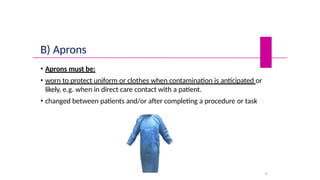
B) Aprons
• Aprons must be:
• worn to protect uniform or clothes when contamination is anticipated or
likely, e.g. when in direct care contact with a patient.
• changed between patients and/or after completing a procedure or task
41
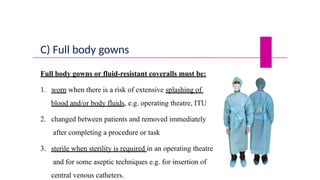
C) Full body gowns
Full body gowns or fluid-resistant coveralls must be:
1. worn when there is a risk of extensive splashing of
blood and/or body fluids, e.g. operating theatre, ITU
2. changed between patients and removed immediately
after completing a procedure or task
3. sterile when sterility is required in an operating theatre
and for some aseptic techniques e.g. for insertion of
central venous catheters.
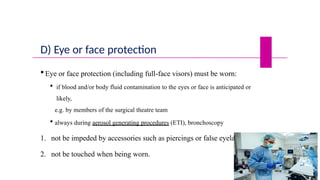
D) Eye or face protection
 Eye or face protection (including full-face visors) must be worn:
 if blood and/or body fluid contamination to the eyes or face is anticipated or
likely,
e.g. by members of the surgical theatre team
 always during aerosol generating procedures (ETI), bronchoscopy
1. not be impeded by accessories such as piercings or false eyelashes
2. not be touched when being worn.
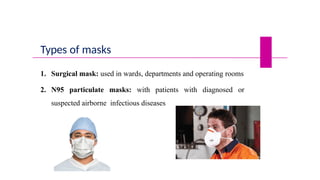
Types of masks
1. Surgical mask: used in wards, departments and operating rooms
2. N95 particulate masks: with patients with diagnosed or
suspected airborne infectious diseases
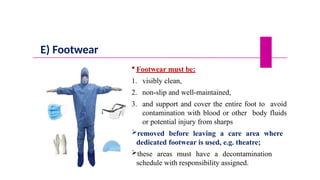
E) Footwear
 Footwear must be:
1. visibly clean,
2. non-slip and well-maintained,
3. and support and cover the entire foot to avoid
contamination with blood or other body fluids
or potential injury from sharps
removed before leaving a care area where
dedicated footwear is used, e.g. theatre;
these areas must have a decontamination
schedule with responsibility assigned.
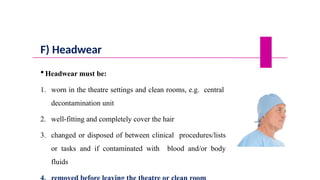
F) Headwear
 Headwear must be:
1. worn in the theatre settings and clean rooms, e.g. central
decontamination unit
2. well-fitting and completely cover the hair
3. changed or disposed of between clinical procedures/lists
or tasks and if contaminated with blood and/or body
fluids
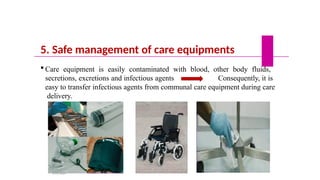
5. Safe management of care equipments
 Care equipment is easily contaminated with blood, other body fluids,
secretions, excretions and infectious agents Consequently, it is
easy to transfer infectious agents from communal care equipment during care
delivery.
5/19/2023
5. Safe management of care equipments
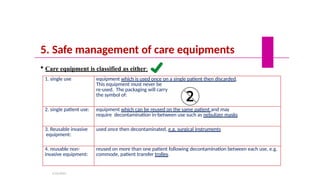
 Care equipment is classified as either:
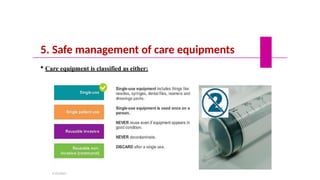
1. single use equipment which is used once on a single patient then discarded.
This equipment must never be
re-used. The packaging will carry
the symbol of:
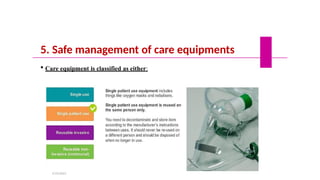
2. single patient use: equipment which can be reused on the same patient and may
require decontamination in-between use such as nebulizer masks
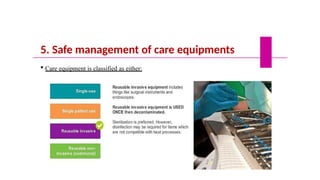
3. Reusable invasive
equipment:
used once then decontaminated, e.g. surgical instruments
4. reusable non-
invasive equipment:
reused on more than one patient following decontamination between each use, e.g.
commode, patient transfer trolley.
5/19/2023
5. Safe management of care equipments
 Care equipment is classified as either:
5/19/2023
5. Safe management of care equipments
 Care equipment is classified as either:
5/19/2023
5. Safe management of care equipments
 Care equipment is classified as either:
5. Safe management of care equipment (cont.)
 Before using any sterile equipment check that:
1. the packaging is intact
2. there are no obvious signs of packaging contamination
3. the expiry date remains valid
4. any sterility indicators are consistent with the process being completed
successfully.
5. Safe management of care equipment
(cont.)
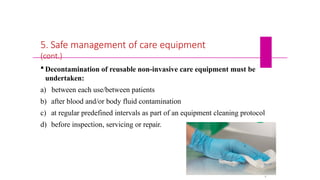
 Decontamination of reusable non-invasive care equipment must be
undertaken:
a) between each use/between patients
b) after blood and/or body fluid contamination
c) at regular predefined intervals as part of an equipment cleaning protocol
d) before inspection, servicing or repair.
5
4
5. Safe management of care equipment
(cont.)
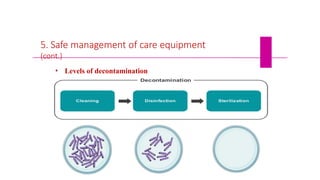
• Levels of decontamination
5. Safe management of care equipment (cont.)
 Always adhere to Control of Substances Hazardous to Health (COSHH)
guidance for use and decontamination of all care equipment:
1. all reusable non-invasive care equipment must be decontaminated between
patients/clients using either approved detergent wipes or detergent solution,
in line with manufacturers’ instructions, before being stored clean and dry.
2. decontamination protocols must include responsibility for; frequency of;
and method of environmental decontamination
3. an equipment decontamination status certificate will be required if any item
of equipment is being sent to a third party, e.g. for inspection ‫ايص‬‫ن‬‫ه‬,
servicing or repair
5/19/2023
6. Safe management of the care environment
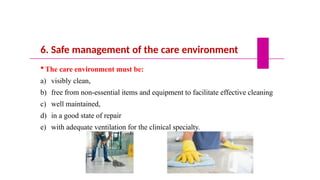
 The care environment must be:
a) visibly clean,
b) free from non-essential items and equipment to facilitate effective cleaning
c) well maintained,
d) in a good state of repair
e) with adequate ventilation for the clinical specialty.
6. Safe management of the care environment
 Routine cleaning
a) the environment should be routinely cleaned in accordance with the National
Cleaning Standards (NCS).
b) use of detergent wipes are acceptable for cleaning surfaces/frequently
touched sites within the care area. a fresh solution of general-purpose neutral
detergent in warm water is recommended for routine cleaning. This should
be changed when dirty or when changing tasks
c) routine disinfection of the environment is not recommended however,
1,000ppm available chlorine should be used routinely on sanitary fittings
d) staff groups should be aware of their environmental cleaning schedules for their area and clear on
their specific responsibilities
e) cleaning protocols should include responsibility for, frequency of, and method of environmental
decontamination
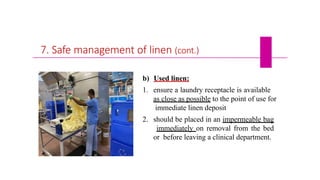
7. Safe management of linen (cont.)
b) Used linen:
1. ensure a laundry receptacle is available
as close as possible to the point of use for
immediate linen deposit
2. should be placed in an impermeable bag
immediately on removal from the bed
or before leaving a clinical department.
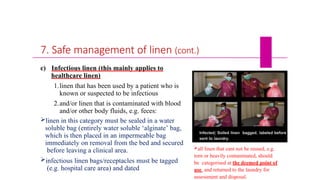
7. Safe management of linen (cont.)
c) Infectious linen (this mainly applies to
healthcare linen)
1.linen that has been used by a patient who is
known or suspected to be infectious
2.and/or linen that is contaminated with blood
and/or other body fluids, e.g. feces:
linen in this category must be sealed in a water
soluble bag (entirely water soluble ‘alginate’ bag,
which is then placed in an impermeable bag
immediately on removal from the bed and secured
before leaving a clinical area.
infectious linen bags/receptacles must be tagged
(e.g. hospital care area) and dated
all linen that cant not be reused, e.g.
torn or heavily contaminated, should
be categorised at the deemed point of
use and returned to the laundry for
assessment and disposal.
Standard infection control precautions.pptx

Standard infection control precautions.pptx

  • 1.
    INFECTION PREVENTION AND CONTROL(IPC) LECTURE II Standard infection control precautions (SICPs) By Mr. Osman Hassan Ali (B.sc, MPH & HDCH)
  • 2.
     Standard infectioncontrol precautions (SICPs)  SICPs are the basic infection prevention and control (IPC) measures necessary to reduce the risk of transmitting infectious agents from both recognised and unrecognised sources of infection.  Standard infection control precautions (SICPs) are to be used by:  all staff,  in all care area,  at all times,  for all patients  whether infection is known to be present or not, to ensure the safety of those being cared for, staff and visitors in the care environment.  Sources of (potential) infection include:  blood and other body fluids,  secretions or excretions (excluding sweat),  non-intact skin or mucous membranes and  any equipment or items in the care environment that could have become contaminated.
  • 3.
     There are10 elements of SICPs: 1. Patient placement/assessment of infection risk 2. Hand hygiene 3. Respiratory and cough hygiene 4. Personal protective equipment (PPE) 5. Safe management of the care environment 6. Safe management of care equipment 7. Safe management of healthcare linen 8. Safe management of blood and body fluids 9. Safe disposal of waste (including sharps) 10. Occupational safety/managing prevention of exposure (including sharps)
  • 4.
    1. Patient placement/assessmentfor infection risk  Mean that patients must be promptly assessed for infection risk on arrival at the care area, e.g. inpatient/outpatient, (if possible, prior to accepting a patient from another care area) and should be continuously reviewed throughout their stay.  This assessment should influence placement decisions in accordance with clinical/care need(s).  Patients who may present a cross-infection risk include those: 1. with diarrhea, vomiting, an unexplained rash, fever or respiratory symptoms 2. known to have been previously positive with a multi-drug resistant organism (MDRO), eg MRSA, CPE
  • 5.
    2. Hand hygiene Hand hygiene is considered one of the most important ways to reduce the transmission of infectious agents that cause healthcare associated infections (HCAIs).  Before performing hand hygiene: I. expose forearms (bare below the elbow II. remove all hand and wrist jewellery. III. ensure fingernails are clean and short, and do not wear artificial nails or nail products IV. cover all cuts or abrasions with a waterproof dressing 3 4
  • 6.
    2. Hand hygiene(cont.)  5 Moments for Hand Hygiene a) before touching a patient. b) before clean or aseptic procedures. c) after body fluid exposure risk d) after touching a patient; and e) after touching a patient’s immediate surroundings Always perform hand hygiene before putting on and after removing gloves.
  • 7.
    2. Hand hygiene(cont.) Hands should be washed using soap, water and then dried: BEFORE – handling, preparing or eating food BEFORE AND AFTER – assisting students with eating/meals – assisting students with toileting – providing first aid or medication – contact with an ill or injured person AFTER – contact with blood or body fluids (this includes your own e.g. sneezing/coughing) – removal of protective gloves – using the toilet; and – after contact with animals. 5/9/2023
  • 8.
    3. Respiratory andcough hygiene a) cover the nose and mouth with a disposable tissue when sneezing, coughing, wiping and blowing the nose; if unavailable use the crook of the arm b) dispose of all used tissues promptly into a waste bin c) wash hands with non-antimicrobial liquid soap and warm water after coughing, sneezing, using tissues, or after contact with respiratory secretions or objects contaminated by these secretions d) keep contaminated hands away from the eyes nose and mouth
  • 9.
    4. Personal protectiveequipment (PPE)  All PPE must be: a. located close to the point of use. b. stored in a clean, dry area until required c. single-use only unless specified by the manufacturer d. changed immediately after each patient and/or after completing a procedure or task e. disposed of after use into the correct waste stream, e.g. domestic waste, offensive (non-infectious) or clinical waste f. discarded if damaged or contaminated Avoiding overuse or inappropriate use of PPE is a key principle that ensures this is risk-based and minimizes its environmental impact. Reusable PPE such as non-disposable goggles/face shields/visors, must be decontaminated after each use according to mutter's instruction.
  • 10.
    • May includethe following (task dependent): • Gloves • Aprons • Full body gowns • Eye / Face Protection • Footwear • Headwear Single use only 3 9 4. Personal protective equipment (PPE)
  • 11.
    A) Gloves: 40 • Glovesmust be: a) worn when exposure to blood and/or other body fluids, non-intact skin or mucous membranes is anticipated b) changed immediately after each patient and/or after completing a procedure/task even on the same patient c) changed if a perforation or puncture is suspected d) sterile when worn in operating theatres and for insertion of central venous catheters, insertion of peripherally inserted central catheters, insertion of pulmonary artery catheters and spinal, epidural and caudal procedures e) low risk of causing sensitisation to the wearer f) appropriate for the tasks being undertaken, taking into account: a) the substances being handled, b) type and duration of contact, c) size and comfort of the gloves, d) the task and requirement for gloves robustness and sensitivity
  • 12.
    B) Aprons • Apronsmust be: • worn to protect uniform or clothes when contamination is anticipated or likely, e.g. when in direct care contact with a patient. • changed between patients and/or after completing a procedure or task 41
  • 13.
    C) Full bodygowns Full body gowns or fluid-resistant coveralls must be: 1. worn when there is a risk of extensive splashing of blood and/or body fluids, e.g. operating theatre, ITU 2. changed between patients and removed immediately after completing a procedure or task 3. sterile when sterility is required in an operating theatre and for some aseptic techniques e.g. for insertion of central venous catheters.
  • 14.
    D) Eye orface protection  Eye or face protection (including full-face visors) must be worn:  if blood and/or body fluid contamination to the eyes or face is anticipated or likely, e.g. by members of the surgical theatre team  always during aerosol generating procedures (ETI), bronchoscopy 1. not be impeded by accessories such as piercings or false eyelashes 2. not be touched when being worn.
  • 15.
    Types of masks 1.Surgical mask: used in wards, departments and operating rooms 2. N95 particulate masks: with patients with diagnosed or suspected airborne infectious diseases
  • 16.
    E) Footwear  Footwearmust be: 1. visibly clean, 2. non-slip and well-maintained, 3. and support and cover the entire foot to avoid contamination with blood or other body fluids or potential injury from sharps removed before leaving a care area where dedicated footwear is used, e.g. theatre; these areas must have a decontamination schedule with responsibility assigned.
  • 17.
    F) Headwear  Headwearmust be: 1. worn in the theatre settings and clean rooms, e.g. central decontamination unit 2. well-fitting and completely cover the hair 3. changed or disposed of between clinical procedures/lists or tasks and if contaminated with blood and/or body fluids
  • 18.
    5. Safe managementof care equipments  Care equipment is easily contaminated with blood, other body fluids, secretions, excretions and infectious agents Consequently, it is easy to transfer infectious agents from communal care equipment during care delivery. 5/19/2023
  • 19.
    5. Safe managementof care equipments  Care equipment is classified as either: 1. single use equipment which is used once on a single patient then discarded. This equipment must never be re-used. The packaging will carry the symbol of: 2. single patient use: equipment which can be reused on the same patient and may require decontamination in-between use such as nebulizer masks 3. Reusable invasive equipment: used once then decontaminated, e.g. surgical instruments 4. reusable non- invasive equipment: reused on more than one patient following decontamination between each use, e.g. commode, patient transfer trolley. 5/19/2023
  • 20.
    5. Safe managementof care equipments  Care equipment is classified as either: 5/19/2023
  • 21.
    5. Safe managementof care equipments  Care equipment is classified as either: 5/19/2023
  • 22.
    5. Safe managementof care equipments  Care equipment is classified as either:
  • 23.
    5. Safe managementof care equipment (cont.)  Before using any sterile equipment check that: 1. the packaging is intact 2. there are no obvious signs of packaging contamination 3. the expiry date remains valid 4. any sterility indicators are consistent with the process being completed successfully.
  • 24.
    5. Safe managementof care equipment (cont.)  Decontamination of reusable non-invasive care equipment must be undertaken: a) between each use/between patients b) after blood and/or body fluid contamination c) at regular predefined intervals as part of an equipment cleaning protocol d) before inspection, servicing or repair. 5 4
  • 25.
    5. Safe managementof care equipment (cont.) • Levels of decontamination
  • 26.
    5. Safe managementof care equipment (cont.)  Always adhere to Control of Substances Hazardous to Health (COSHH) guidance for use and decontamination of all care equipment: 1. all reusable non-invasive care equipment must be decontaminated between patients/clients using either approved detergent wipes or detergent solution, in line with manufacturers’ instructions, before being stored clean and dry. 2. decontamination protocols must include responsibility for; frequency of; and method of environmental decontamination 3. an equipment decontamination status certificate will be required if any item of equipment is being sent to a third party, e.g. for inspection ‫ايص‬‫ن‬‫ه‬, servicing or repair 5/19/2023
  • 27.
    6. Safe managementof the care environment  The care environment must be: a) visibly clean, b) free from non-essential items and equipment to facilitate effective cleaning c) well maintained, d) in a good state of repair e) with adequate ventilation for the clinical specialty.
  • 28.
    6. Safe managementof the care environment  Routine cleaning a) the environment should be routinely cleaned in accordance with the National Cleaning Standards (NCS). b) use of detergent wipes are acceptable for cleaning surfaces/frequently touched sites within the care area. a fresh solution of general-purpose neutral detergent in warm water is recommended for routine cleaning. This should be changed when dirty or when changing tasks c) routine disinfection of the environment is not recommended however, 1,000ppm available chlorine should be used routinely on sanitary fittings d) staff groups should be aware of their environmental cleaning schedules for their area and clear on their specific responsibilities e) cleaning protocols should include responsibility for, frequency of, and method of environmental decontamination
  • 29.
    7. Safe managementof linen (cont.) b) Used linen: 1. ensure a laundry receptacle is available as close as possible to the point of use for immediate linen deposit 2. should be placed in an impermeable bag immediately on removal from the bed or before leaving a clinical department.
  • 30.
    7. Safe managementof linen (cont.) c) Infectious linen (this mainly applies to healthcare linen) 1.linen that has been used by a patient who is known or suspected to be infectious 2.and/or linen that is contaminated with blood and/or other body fluids, e.g. feces: linen in this category must be sealed in a water soluble bag (entirely water soluble ‘alginate’ bag, which is then placed in an impermeable bag immediately on removal from the bed and secured before leaving a clinical area. infectious linen bags/receptacles must be tagged (e.g. hospital care area) and dated all linen that cant not be reused, e.g. torn or heavily contaminated, should be categorised at the deemed point of use and returned to the laundry for assessment and disposal.