
STAKEHOLDER
RELATIONS:
AN OXYMORON INTHE
MINING INDUSTRY?
Reana Rossouw
Next Generation Consultants
Oxymoron? Research Evidence
Sources: Globescan : Mining industry faces a struggle to win public hearts and minds IFC: Stakeholder Engagement in the mining sector
• In Nigeria, community disruptions to pipelines
lowered oil production by 18 percent between
2005 and 2008.
• Strikes at platinum mines in South Africa in
2012 caused production to drop by 12 percent
of the total annual global supply.
• In 2013, an indigenous group twice forced
shutdowns of BHP Billiton’s Cerro Matoso, the
world’s second-largest ferronickel mine (4
percent of world output).
• In 2013, Barrick Gold’s share price plunged
nearly 30 percent in two months, due in part to
an announcement that community protests
based on environmental concerns had led the
Chilean government to paralyze its operations
in Pascua Lama.
• A report on 25 cases of company-community
conflict concluded that the net present value
of major, world-class mining projects with
capital expenditures of between $3-5 billion
will decrease by $20 million for each week of
delayed production.
ICMM: Conflict and Mining Report
From the horses mouth
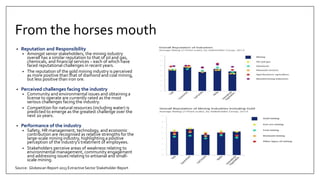
• Reputation and Responsibility
• Amongst senior stakeholders, the mining industry
overall has a similar reputation to that of oil and gas,
chemicals, and financial services – each of which have
faced reputational challenges in recent years.
• The reputation of the gold mining industry is perceived
as more positive than that of diamond and coal mining,
but less positive than iron ore.
• Perceived challenges facing the industry
• Community and environmental issues and obtaining a
license to operate are currently rated as the most
serious challenges facing the industry.
• Competition for natural resources (including water) is
predicted to emerge as the greatest challenge over the
next 20 years.
• Performance of the industry
• Safety, HR management, technology, and economic
contribution are recognised as relative strengths for the
large-scale mining industry, highlighting a positive
perception of the industry’s treatment of employees.
• Stakeholders perceive areas of weakness relating to
environmental management, community engagement
and addressing issues relating to artisanal and small-
scale mining.
Source: Globescan Report 2013 ExtractiveSector Stakeholder Report
Persistent Challenges
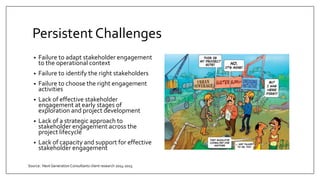
• Failure to adapt stakeholder engagement
to the operational context
• Failure to identify the right stakeholders
• Failure to choose the right engagement
activities
• Lack of effective stakeholder
engagement at early stages of
exploration and project development
• Lack of a strategic approach to
stakeholder engagement across the
project lifecycle
• Lack of capacity and support for effective
stakeholder engagement
Source: Next Generation Consultants client research 2014-2015
Getting it wrong
• Among the reasons that some companies are getting this wrong are inadequate risk
assessments prior to engagement that result in limited understanding of political
dynamics, local culture, customs and decision-making processes
• Furthermore, most companies do not involve stakeholders in designing or validating the
processes and mechanisms for stakeholder engagement
• Another potential pitfall for some companies is a limited understanding of legacy issues
related to their specific project or to the extractive industry in the local area
• One of the key challenges for extractive industry companies is to develop a strategic approach
to stakeholder engagement across the lifecycle of a project, due to the long timeframes,
lifecycle transitions (from exploration to development to construction to operation and
closure) and potential changes in ownership
• Stakeholder engagement is a complex activity and requires special skills that are quite
different from the technical skills needed to design, construct and operate an extractive
industry project
Human Rights Perspective
• From a human rights perspective, ineffective stakeholder engagement leads
directly and indirectly to adverse impacts and infringements on human rights.
• For instance, ineffective stakeholder engagement may infringe directly on the
rights of indigenous peoples to consultation and participation in resource
development, as well as the right to information of individual community
members.
• For example, companies may fail to recognize that a project is on land that has
been previously expropriated or acquired without adequate compensation or
recognition of collective ownership rights. Companies may not be aware that
impacts within a community are falling disproportionately on certain groups
such as women and the poor. Or companies may not understand how local
cultural and religious practices are being affected by reduced access to certain
sites.
Its tough
• In general – stakeholder engagement:
• Takes twice as long as you have planned
• Costs three times as much as you have budgeted
• Requires on average four times more stakeholder groups/information/databases
Getting it right
• Who decides who is involved
• As the selection of participants can be a politically charged responsibility, the selection process must be as
transparent as possible. It is wise to ensure that the reasons for selection are noted/documented so that any
questions about selection can be answered.
• Resist pressure on numbers
• There is often internal and external pressure to expand or reduce the list of those involved. The number of
people involved should not be arbitrary but based on a coherent understanding of the purpose and the context
of the process.
• Marginalising “Usual suspects”
• Organisations sometimes try to avoid involving the “usual suspects”, which has become a term of denigration
for people who habitually give time and effort to what they see as their civic responsibilities. Describing
someone as a ‘usual suspect’ should never be grounds to exclude them from a process any more than it is
grounds for including them: people should be involved because they are the right people.
• Opponents
• It is equally wrong to exclude an individual or an organisation for being a known opponent of a given purpose
or process.There are often good reasons for keeping opponents “inside the tent”: these can be the people
who most need to be involved so that they gain some ownership of the process and perhaps become more
likely to support the final outcome (or at least, less inclined to undermine it as they might have, had they been
excluded).
Other Considerations
• Hard to Reach Groups
• It is important to try to include all relevant stakeholders, and those who often get omitted are the hard to
reach groups. Extra effort and innovation will be needed to contact and engage with these groups or
individuals, who do not generally come forward by their own volition. Including these minority or “hard to
reach” groups is important to obtaining a more balanced picture from the engagement process.
• Not Everyone has to be involved in everything
• With good planning, and the agreement of participants, different people can be involved only in those parts of
the process which are most relevant to them.
• Campaigning organisations
• Many campaigning bodies, especially national NGOs, are constantly asked to be involved in participatory
exercises, and do not always see these as the most effective use of their limited resources. In addition, some
see the compromise that can be inherent in some participatory processes as conflicting with their primary
purposes. It can be useful to consider (and discuss with them) at which stage of the policy process NGOs are
best suited to participate: agenda setting, policy development, policy implementation or policy review.
• What’s In It forThem (WIIFT)?
• It is important to consider and discuss with participants what they want to get out of the process and what
could prevent them from participating. If everyone’s motivations can be clarified at the start, there will be less
confusion and everyone is more likely to be satisfied with the outcomes.This is especially important in an area
that is suffering from consultation fatigue.
Rules of the Game (1)
• Engage on issues that matter
• Focus on clear objectives that require action. Stakeholders have limited time and will prefer
to engage only on really important project /company/risk based concerns.
• Engage empowered representatives
• Engage stakeholder representatives who are empowered to take decisions for their
constituents
• Seek shared value
• Ensure that each stakeholder benefits directly from the engagement and understands how
future decisions will impact on stakeholders/stakeholder groups
• Agree rules of engagement
• Establish the scope, objectives, roles, rules and risks of engagement at the beginning. Agree
the process of decision-making, conflict resolution and evaluation
• Manage exceptions and expectations
• Make certain that all parties have realistic ambitions and agree on clear outcomes of the
engagement
Rules of the Game (2)
• Provide adequate resources
• Devote adequate resources (time, money and people) to ensure success
• Choose the right formats
• Choose the appropriate format (e.g. private meeting, roundtable discussions, stakeholder
panels, etc.) to achieve the objective of the each engagement
• Act fairly
• Be sensitive to perceived or actual power differences and facilitate the process to allow fair
participation
• Listen to (critical) stakeholder views
• Ensure engagement is a dialogue and not a one-way information feed. Allow stakeholders to
voice their views
• Look beyond the engagement
• Learn from the engagement. Involve stakeholders to assess the success of the engagement
as well as the engagement outcome. Examine whether any next steps are required
Rules of the Game (3)
• Start early
• Relationships take time to build. Trust and mutual respect are established over time.Trust is also much harder
to build if stakeholders are only consulted when there is a problem or crisis.
• Keep an open mind
• The outcome of a truly open and responsive stakeholder engagement process cannot be defined in advance as
solutions that satisfy multiple parties can seldom be guessed at beforehand. Consultation where the company
has already determined their plan of action is likely to be perceived as an untrustworthy public relations
exercise.
• Tailor engagement practices to the needs and interests of the company and its stakeholders
• Explain what input is needed from stakeholders and how it will be used in the decision-making process —
driving a “shared values” continuum. Ask for input on how information should be disclosed.
• Manage engagement as a business function
• Taking a systematic approach that is grounded in the business strategy and operations increases the likelihood
that engagement will create value. As with other key business functions, direct reporting lines and the
engagement of senior management are critical.
• Take a long-term view
• For issues that are intrinsically related to company strategy, on-going dialogue and standing stakeholder
bodies can be more valuable than one time, ad hoc engagement. Publicly disclosing information that is
important to stakeholders helps to ensure that on-going dialogue is useful for all parties involved.
Contact
• Reana Rossouw
• Next Generation Consultants - Specialists in Engagement
• E-mail: rrossouw@nextgeneration.co.za
• Web: www.nextgeneration.co.za
• PLEASE NOTE: THIS PRESENTATION IS PART OF A LARGER
BODY OF RESEARCH! More information, guidance, resources
and training is provided on LinkedIn, Facebook,Slideshare and
Google+.

Stakeholder engagement in the mining sector

  • 1.
    STAKEHOLDER RELATIONS: AN OXYMORON INTHE MININGINDUSTRY? Reana Rossouw Next Generation Consultants
  • 2.
    Oxymoron? Research Evidence Sources:Globescan : Mining industry faces a struggle to win public hearts and minds IFC: Stakeholder Engagement in the mining sector • In Nigeria, community disruptions to pipelines lowered oil production by 18 percent between 2005 and 2008. • Strikes at platinum mines in South Africa in 2012 caused production to drop by 12 percent of the total annual global supply. • In 2013, an indigenous group twice forced shutdowns of BHP Billiton’s Cerro Matoso, the world’s second-largest ferronickel mine (4 percent of world output). • In 2013, Barrick Gold’s share price plunged nearly 30 percent in two months, due in part to an announcement that community protests based on environmental concerns had led the Chilean government to paralyze its operations in Pascua Lama. • A report on 25 cases of company-community conflict concluded that the net present value of major, world-class mining projects with capital expenditures of between $3-5 billion will decrease by $20 million for each week of delayed production. ICMM: Conflict and Mining Report
  • 3.
    From the horsesmouth • Reputation and Responsibility • Amongst senior stakeholders, the mining industry overall has a similar reputation to that of oil and gas, chemicals, and financial services – each of which have faced reputational challenges in recent years. • The reputation of the gold mining industry is perceived as more positive than that of diamond and coal mining, but less positive than iron ore. • Perceived challenges facing the industry • Community and environmental issues and obtaining a license to operate are currently rated as the most serious challenges facing the industry. • Competition for natural resources (including water) is predicted to emerge as the greatest challenge over the next 20 years. • Performance of the industry • Safety, HR management, technology, and economic contribution are recognised as relative strengths for the large-scale mining industry, highlighting a positive perception of the industry’s treatment of employees. • Stakeholders perceive areas of weakness relating to environmental management, community engagement and addressing issues relating to artisanal and small- scale mining. Source: Globescan Report 2013 ExtractiveSector Stakeholder Report
  • 4.
    Persistent Challenges • Failureto adapt stakeholder engagement to the operational context • Failure to identify the right stakeholders • Failure to choose the right engagement activities • Lack of effective stakeholder engagement at early stages of exploration and project development • Lack of a strategic approach to stakeholder engagement across the project lifecycle • Lack of capacity and support for effective stakeholder engagement Source: Next Generation Consultants client research 2014-2015
  • 5.
    Getting it wrong •Among the reasons that some companies are getting this wrong are inadequate risk assessments prior to engagement that result in limited understanding of political dynamics, local culture, customs and decision-making processes • Furthermore, most companies do not involve stakeholders in designing or validating the processes and mechanisms for stakeholder engagement • Another potential pitfall for some companies is a limited understanding of legacy issues related to their specific project or to the extractive industry in the local area • One of the key challenges for extractive industry companies is to develop a strategic approach to stakeholder engagement across the lifecycle of a project, due to the long timeframes, lifecycle transitions (from exploration to development to construction to operation and closure) and potential changes in ownership • Stakeholder engagement is a complex activity and requires special skills that are quite different from the technical skills needed to design, construct and operate an extractive industry project
  • 6.
    Human Rights Perspective •From a human rights perspective, ineffective stakeholder engagement leads directly and indirectly to adverse impacts and infringements on human rights. • For instance, ineffective stakeholder engagement may infringe directly on the rights of indigenous peoples to consultation and participation in resource development, as well as the right to information of individual community members. • For example, companies may fail to recognize that a project is on land that has been previously expropriated or acquired without adequate compensation or recognition of collective ownership rights. Companies may not be aware that impacts within a community are falling disproportionately on certain groups such as women and the poor. Or companies may not understand how local cultural and religious practices are being affected by reduced access to certain sites.
  • 7.
    Its tough • Ingeneral – stakeholder engagement: • Takes twice as long as you have planned • Costs three times as much as you have budgeted • Requires on average four times more stakeholder groups/information/databases
  • 8.
    Getting it right •Who decides who is involved • As the selection of participants can be a politically charged responsibility, the selection process must be as transparent as possible. It is wise to ensure that the reasons for selection are noted/documented so that any questions about selection can be answered. • Resist pressure on numbers • There is often internal and external pressure to expand or reduce the list of those involved. The number of people involved should not be arbitrary but based on a coherent understanding of the purpose and the context of the process. • Marginalising “Usual suspects” • Organisations sometimes try to avoid involving the “usual suspects”, which has become a term of denigration for people who habitually give time and effort to what they see as their civic responsibilities. Describing someone as a ‘usual suspect’ should never be grounds to exclude them from a process any more than it is grounds for including them: people should be involved because they are the right people. • Opponents • It is equally wrong to exclude an individual or an organisation for being a known opponent of a given purpose or process.There are often good reasons for keeping opponents “inside the tent”: these can be the people who most need to be involved so that they gain some ownership of the process and perhaps become more likely to support the final outcome (or at least, less inclined to undermine it as they might have, had they been excluded).
  • 9.
    Other Considerations • Hardto Reach Groups • It is important to try to include all relevant stakeholders, and those who often get omitted are the hard to reach groups. Extra effort and innovation will be needed to contact and engage with these groups or individuals, who do not generally come forward by their own volition. Including these minority or “hard to reach” groups is important to obtaining a more balanced picture from the engagement process. • Not Everyone has to be involved in everything • With good planning, and the agreement of participants, different people can be involved only in those parts of the process which are most relevant to them. • Campaigning organisations • Many campaigning bodies, especially national NGOs, are constantly asked to be involved in participatory exercises, and do not always see these as the most effective use of their limited resources. In addition, some see the compromise that can be inherent in some participatory processes as conflicting with their primary purposes. It can be useful to consider (and discuss with them) at which stage of the policy process NGOs are best suited to participate: agenda setting, policy development, policy implementation or policy review. • What’s In It forThem (WIIFT)? • It is important to consider and discuss with participants what they want to get out of the process and what could prevent them from participating. If everyone’s motivations can be clarified at the start, there will be less confusion and everyone is more likely to be satisfied with the outcomes.This is especially important in an area that is suffering from consultation fatigue.
  • 10.
    Rules of theGame (1) • Engage on issues that matter • Focus on clear objectives that require action. Stakeholders have limited time and will prefer to engage only on really important project /company/risk based concerns. • Engage empowered representatives • Engage stakeholder representatives who are empowered to take decisions for their constituents • Seek shared value • Ensure that each stakeholder benefits directly from the engagement and understands how future decisions will impact on stakeholders/stakeholder groups • Agree rules of engagement • Establish the scope, objectives, roles, rules and risks of engagement at the beginning. Agree the process of decision-making, conflict resolution and evaluation • Manage exceptions and expectations • Make certain that all parties have realistic ambitions and agree on clear outcomes of the engagement
  • 11.
    Rules of theGame (2) • Provide adequate resources • Devote adequate resources (time, money and people) to ensure success • Choose the right formats • Choose the appropriate format (e.g. private meeting, roundtable discussions, stakeholder panels, etc.) to achieve the objective of the each engagement • Act fairly • Be sensitive to perceived or actual power differences and facilitate the process to allow fair participation • Listen to (critical) stakeholder views • Ensure engagement is a dialogue and not a one-way information feed. Allow stakeholders to voice their views • Look beyond the engagement • Learn from the engagement. Involve stakeholders to assess the success of the engagement as well as the engagement outcome. Examine whether any next steps are required
  • 12.
    Rules of theGame (3) • Start early • Relationships take time to build. Trust and mutual respect are established over time.Trust is also much harder to build if stakeholders are only consulted when there is a problem or crisis. • Keep an open mind • The outcome of a truly open and responsive stakeholder engagement process cannot be defined in advance as solutions that satisfy multiple parties can seldom be guessed at beforehand. Consultation where the company has already determined their plan of action is likely to be perceived as an untrustworthy public relations exercise. • Tailor engagement practices to the needs and interests of the company and its stakeholders • Explain what input is needed from stakeholders and how it will be used in the decision-making process — driving a “shared values” continuum. Ask for input on how information should be disclosed. • Manage engagement as a business function • Taking a systematic approach that is grounded in the business strategy and operations increases the likelihood that engagement will create value. As with other key business functions, direct reporting lines and the engagement of senior management are critical. • Take a long-term view • For issues that are intrinsically related to company strategy, on-going dialogue and standing stakeholder bodies can be more valuable than one time, ad hoc engagement. Publicly disclosing information that is important to stakeholders helps to ensure that on-going dialogue is useful for all parties involved.
  • 13.
    Contact • Reana Rossouw •Next Generation Consultants - Specialists in Engagement • E-mail: rrossouw@nextgeneration.co.za • Web: www.nextgeneration.co.za • PLEASE NOTE: THIS PRESENTATION IS PART OF A LARGER BODY OF RESEARCH! More information, guidance, resources and training is provided on LinkedIn, Facebook,Slideshare and Google+.