Multistakeholder Processes
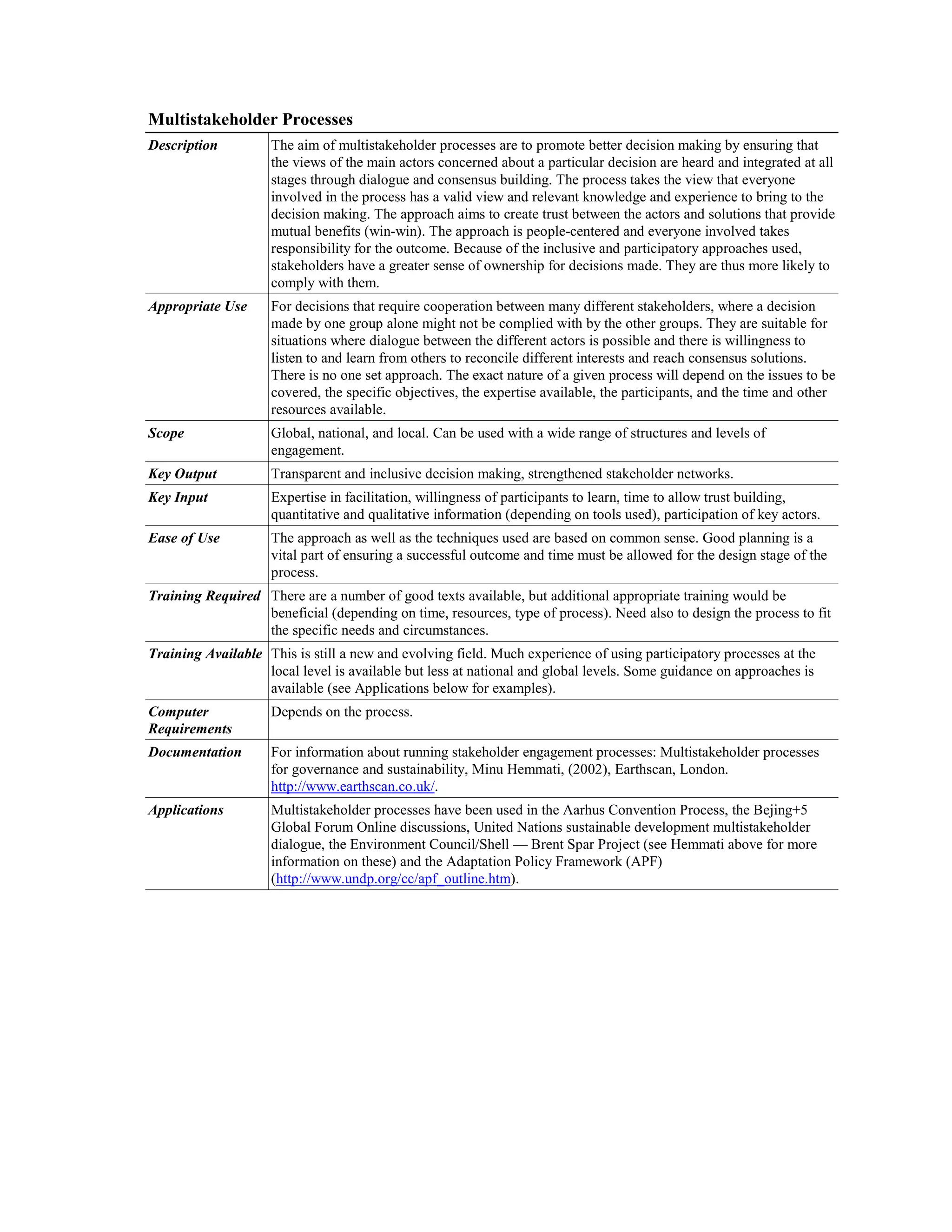
Description         The aim of multistakeholder processes are to promote better decision making by ensuring that
                    the views of the main actors concerned about a particular decision are heard and integrated at all
                    stages through dialogue and consensus building. The process takes the view that everyone
                    involved in the process has a valid view and relevant knowledge and experience to bring to the
                    decision making. The approach aims to create trust between the actors and solutions that provide
                    mutual benefits (win-win). The approach is people-centered and everyone involved takes
                    responsibility for the outcome. Because of the inclusive and participatory approaches used,
                    stakeholders have a greater sense of ownership for decisions made. They are thus more likely to
                    comply with them.
Appropriate Use     For decisions that require cooperation between many different stakeholders, where a decision
                    made by one group alone might not be complied with by the other groups. They are suitable for
                    situations where dialogue between the different actors is possible and there is willingness to
                    listen to and learn from others to reconcile different interests and reach consensus solutions.
                    There is no one set approach. The exact nature of a given process will depend on the issues to be
                    covered, the specific objectives, the expertise available, the participants, and the time and other
                    resources available.
Scope               Global, national, and local. Can be used with a wide range of structures and levels of
                    engagement.
Key Output          Transparent and inclusive decision making, strengthened stakeholder networks.
Key Input           Expertise in facilitation, willingness of participants to learn, time to allow trust building,
                    quantitative and qualitative information (depending on tools used), participation of key actors.
Ease of Use         The approach as well as the techniques used are based on common sense. Good planning is a
                    vital part of ensuring a successful outcome and time must be allowed for the design stage of the
                    process.
Training Required There are a number of good texts available, but additional appropriate training would be
                  beneficial (depending on time, resources, type of process). Need also to design the process to fit
                  the specific needs and circumstances.
Training Available This is still a new and evolving field. Much experience of using participatory processes at the
                   local level is available but less at national and global levels. Some guidance on approaches is
                   available (see Applications below for examples).
Computer            Depends on the process.
Requirements
Documentation       For information about running stakeholder engagement processes: Multistakeholder processes
                    for governance and sustainability, Minu Hemmati, (2002), Earthscan, London.
                    http://www.earthscan.co.uk/.
Applications        Multistakeholder processes have been used in the Aarhus Convention Process, the Bejing+5
                    Global Forum Online discussions, United Nations sustainable development multistakeholder
                    dialogue, the Environment Council/Shell — Brent Spar Project (see Hemmati above for more
                    information on these) and the Adaptation Policy Framework (APF)
                    (http://www.undp.org/cc/apf_outline.htm).
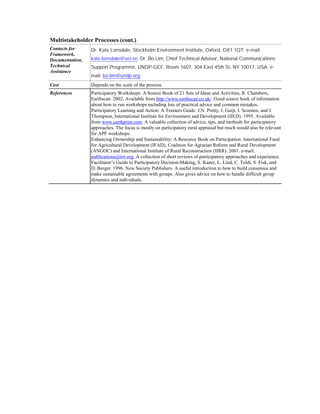
Multistakeholder Processes (cont.)
Contacts for     Dr. Kate Lonsdale, Stockholm Environment Institute, Oxford, OX1 1QT; e-mail:
Framework,
Documentation,   kate.lonsdale@sei.se; Dr. Bo Lim, Chief Technical Advisor, National Communications
Technical        Support Programme, UNDP-GEF, Room 1607, 304 East 45th St, NY 10017, USA; e-
Assistance
                 mail: bo.lim@undp.org.
Cost             Depends on the scale of the process.
References       Participatory Workshops: A Source Book of 21 Sets of Ideas and Activities, R. Chambers,
                 Earthscan. 2002. Available from http://www.earthscan.co.uk/. Good source book of information
                 about how to run workshops including lots of practical advice and common mistakes.
                 Participatory Learning and Action: A Trainers Guide. J.N. Pretty, I. Guijt, I. Scoones, and J.
                 Thompson, International Institute for Environment and Development (IIED). 1995. Available
                 from www.earthprint.com. A valuable collection of advice, tips, and methods for participatory
                 approaches. The focus is mostly on participatory rural appraisal but much would also be relevant
                 for APF workshops.
                 Enhancing Ownership and Sustainability: A Resource Book on Participation. International Fund
                 for Agricultural Development (IFAD), Coalition for Agrarian Reform and Rural Development
                 (ANGOC) and International Institute of Rural Reconstruction (IIRR). 2001. e-mail:
                 publications@iirr.org. A collection of short reviews of participatory approaches and experience.
                 Facilitator’s Guide to Participatory Decision-Making, S. Kaner, L. Lind, C. Toldi, S. Fisk, and
                 D. Berger. 1996. New Society Publishers. A useful introduction to how to build consensus and
                 make sustainable agreements with groups. Also gives advice on how to handle difficult group
                 dynamics and individuals.

Multistakeholder processes

  • 1.
    Multistakeholder Processes Description The aim of multistakeholder processes are to promote better decision making by ensuring that the views of the main actors concerned about a particular decision are heard and integrated at all stages through dialogue and consensus building. The process takes the view that everyone involved in the process has a valid view and relevant knowledge and experience to bring to the decision making. The approach aims to create trust between the actors and solutions that provide mutual benefits (win-win). The approach is people-centered and everyone involved takes responsibility for the outcome. Because of the inclusive and participatory approaches used, stakeholders have a greater sense of ownership for decisions made. They are thus more likely to comply with them. Appropriate Use For decisions that require cooperation between many different stakeholders, where a decision made by one group alone might not be complied with by the other groups. They are suitable for situations where dialogue between the different actors is possible and there is willingness to listen to and learn from others to reconcile different interests and reach consensus solutions. There is no one set approach. The exact nature of a given process will depend on the issues to be covered, the specific objectives, the expertise available, the participants, and the time and other resources available. Scope Global, national, and local. Can be used with a wide range of structures and levels of engagement. Key Output Transparent and inclusive decision making, strengthened stakeholder networks. Key Input Expertise in facilitation, willingness of participants to learn, time to allow trust building, quantitative and qualitative information (depending on tools used), participation of key actors. Ease of Use The approach as well as the techniques used are based on common sense. Good planning is a vital part of ensuring a successful outcome and time must be allowed for the design stage of the process. Training Required There are a number of good texts available, but additional appropriate training would be beneficial (depending on time, resources, type of process). Need also to design the process to fit the specific needs and circumstances. Training Available This is still a new and evolving field. Much experience of using participatory processes at the local level is available but less at national and global levels. Some guidance on approaches is available (see Applications below for examples). Computer Depends on the process. Requirements Documentation For information about running stakeholder engagement processes: Multistakeholder processes for governance and sustainability, Minu Hemmati, (2002), Earthscan, London. http://www.earthscan.co.uk/. Applications Multistakeholder processes have been used in the Aarhus Convention Process, the Bejing+5 Global Forum Online discussions, United Nations sustainable development multistakeholder dialogue, the Environment Council/Shell — Brent Spar Project (see Hemmati above for more information on these) and the Adaptation Policy Framework (APF) (http://www.undp.org/cc/apf_outline.htm).
  • 2.
    Multistakeholder Processes (cont.) Contactsfor Dr. Kate Lonsdale, Stockholm Environment Institute, Oxford, OX1 1QT; e-mail: Framework, Documentation, kate.lonsdale@sei.se; Dr. Bo Lim, Chief Technical Advisor, National Communications Technical Support Programme, UNDP-GEF, Room 1607, 304 East 45th St, NY 10017, USA; e- Assistance mail: bo.lim@undp.org. Cost Depends on the scale of the process. References Participatory Workshops: A Source Book of 21 Sets of Ideas and Activities, R. Chambers, Earthscan. 2002. Available from http://www.earthscan.co.uk/. Good source book of information about how to run workshops including lots of practical advice and common mistakes. Participatory Learning and Action: A Trainers Guide. J.N. Pretty, I. Guijt, I. Scoones, and J. Thompson, International Institute for Environment and Development (IIED). 1995. Available from www.earthprint.com. A valuable collection of advice, tips, and methods for participatory approaches. The focus is mostly on participatory rural appraisal but much would also be relevant for APF workshops. Enhancing Ownership and Sustainability: A Resource Book on Participation. International Fund for Agricultural Development (IFAD), Coalition for Agrarian Reform and Rural Development (ANGOC) and International Institute of Rural Reconstruction (IIRR). 2001. e-mail: publications@iirr.org. A collection of short reviews of participatory approaches and experience. Facilitator’s Guide to Participatory Decision-Making, S. Kaner, L. Lind, C. Toldi, S. Fisk, and D. Berger. 1996. New Society Publishers. A useful introduction to how to build consensus and make sustainable agreements with groups. Also gives advice on how to handle difficult group dynamics and individuals.