Stakeholders and Issues
Management Approaches
PRESENTED TO:
• RESPECTED COL IJAZ KHALID
PRESENTED BY:
• Muhammad Shahroze Ilyas
• Mubeen Abdul Shakoor
• Adeel Asif
• Muhammad Fahad Khan
What is a stake?
• A stake is any interest, share, or claim that
a group or individual has in the outcome of
a corporation’ policies, procedures, or
actions towards others.
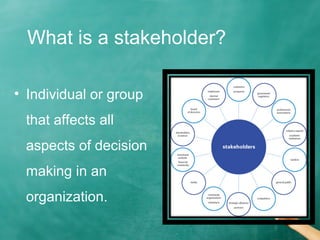
What is a stakeholder?
• Individual or group
that affects all
aspects of decision
making in an
organization.
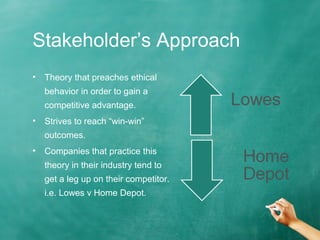
Stakeholder’s Approach
• Theory that preaches ethical
behavior in order to gain a
competitive advantage.
• Strives to reach “win-win”
outcomes.
• Companies that practice this
theory in their industry tend to
get a leg up on their competitor.
i.e. Lowes v Home Depot.
Stakeholder Analysis
• Assist in the understanding between an
organization and its constituents.
• Due to the uniqueness of each situation, the
approach must be mapped out in order to develop
a strategy.
• The framework is developed not only for
individuals in high ranking positions, but also so
any employee may see the corporate dealings.
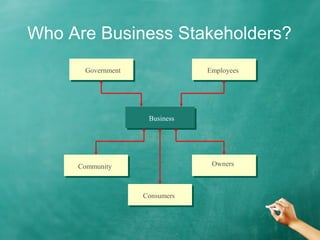
Who Are Business Stakeholders?
Government Employees
Business
Community
Consumers
Owners
Who Are Business Stakeholders?
Primary and Secondary Stakeholders
•Primary stakeholders are those stakeholders that
have a direct stake in the organization and its success
•Secondary stakeholders are those that have a public
or special interest stake in the organization
Who Are Business Stakeholders?
Core, Strategic, and Environmental Stakeholders
• Core stakeholders are essential to the survival of the
firm
• Strategic stakeholders are vital to the organization
and the threats and opportunities the organization
faces
• Environmental stakeholders are all others in the
organization's environment
Who Are Business Stakeholders?
• Legitimacy refers to the perceived validity of
the stakeholder’s claim to a stake
• Power refers to the ability or capacity of a
stakeholder to produce an effect
• Urgency refers to the degree to which the
stakeholder’s claim demands immediate
attention
Legitimacy, Power, Urgency:
A Typology of Stakeholder Attributes
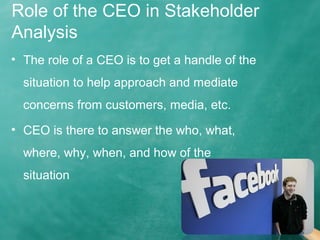
Role of the CEO in Stakeholder
Analysis
• The role of a CEO is to get a handle of the
situation to help approach and mediate
concerns from customers, media, etc.
• CEO is there to answer the who, what,
where, why, when, and how of the
situation
Stakeholder Analysis in 7
Steps
1. Map stakeholder relationships
2. Map stakeholder coalitions
3. Assess the nature of each stakeholder’s
interest
4. Assess the nature of each stakeholder’s
power
5. Construct a matrix of stakeholder moral
responsibilities
6. Develop specific strategies and tactics
7. Monitor shifting coalitions
Stakeholder Dispute Resolution
Methods
• Dispute resolution is a tactic also known
as “alternative dispute resolution”
• Dispute resolution is a variety of methods
to help possible litigants resolve conflicts
• Ranges from parties taking control of
process to giving control to a third party
– i.e. face to face negotiation and litigation
Ethical Reasoning for Stakeholders
• Ethical reasoning involves trying to
analyze what is fair and who is being
affected by the actions.
• Involves helping and identifying the
weaker and quiet stakeholders getting
their voices heard in the decision process
• What can be done when stakeholder are
not being treated fairly?
Moral Responsibilities
• The analysis ensures that managers are prepared to define
their own moral responsibilities, as well as those of the
company.
• The approach focuses the organization’s attention on both
internal and external areas.
• Managers are liable for the morals of the company, that can
quickly be made public due to technology.
• If a stakeholder knows the roles, it clarifies the
responsibilities of the task.
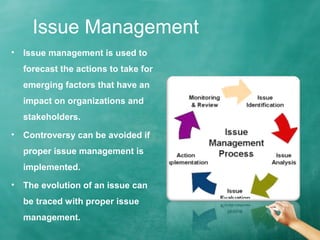
Issue Management
• Issue management is used to
forecast the actions to take for
emerging factors that have an
impact on organizations and
stakeholders.
• Controversy can be avoided if
proper issue management is
implemented.
• The evolution of an issue can
be traced with proper issue
management.
•
Moral Dimension of Stakeholder and Issue
Management
• Studies argue that being moral is “issue dependent”
• They argue that the severity of the issue is what
triggers reasoning.
• Morals are necessary in leadership positions, as the
decisions affect all stakeholders.
• Identifying issues and ensuring that they are moral
is a goal for all managers to benefit their company.
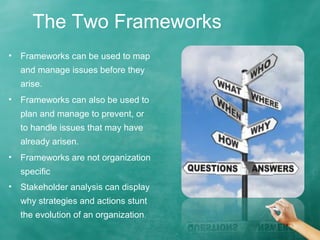
The Two Frameworks
• Frameworks can be used to map
and manage issues before they
arise.
• Frameworks can also be used to
plan and manage to prevent, or
to handle issues that may have
already arisen.
• Frameworks are not organization
specific
• Stakeholder analysis can display
why strategies and actions stunt
the evolution of an organization.
First Approach
• The six-step issue management
process.
–Environmental scanning and issues
identification.
–Issue analysis
–Issue ranking prioritizing
–Issue resolution strategizing
–Issue response and implementation
–Issue evaluation and monitoring
.
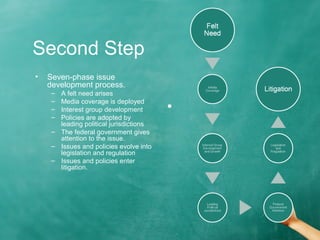
Second Step
• Seven-phase issue
development process.
– A felt need arises
– Media coverage is deployed
– Interest group development
– Policies are adopted by
leading political jurisdictions
– The federal government gives
attention to the issue.
– Issues and policies evolve into
legislation and regulation
– Issues and policies enter
litigation.
•
Managing Crises
• Crisis management emerged from
observing how corporations and leaders
react to crises.
• Steven Fink describes crisis as “a turning
point for better or worse.”
• The direction that organization moves into
is dependent on the leaders’ reaction.
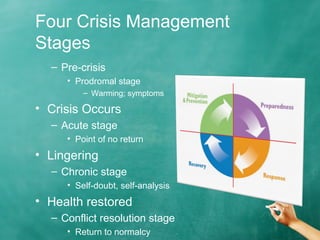
Four Crisis Management
Stages
– Pre-crisis
• Prodromal stage
– Warming; symptoms
• Crisis Occurs
– Acute stage
• Point of no return
• Lingering
– Chronic stage
• Self-doubt, self-analysis
• Health restored
– Conflict resolution stage
• Return to normalcy
First Stage
• Prodromal Stage
• Warning stage
• Does not always occur or is not evident.
• This stage should be carefully observed.
• Must be taken seriously in order to prevent
crisis.
• If does not occur, or is ignored, the point of
no return quickly occurs.
Second Stage
• Acute Crisis
• Damage has already occurred
• Damage control must be administered
• Stage where the severe damage occurs
• Considered the shortest stage
Third Stage
• Chronic crisis
• Clean up phase
• Time of healing,
recovery ,and self analysis
• Studies have shown when
there is no crisis plan set
companies stay in this
phase 2.5 time longer
Fourth Stage
• Crisis Resolution
• Final stage – Crisis Management
Goal
• “What can and should an
organization do to speed up this
phase and resolve crisis once and for
all?”
Strategic, Multifiduciary, and
Synthesis Views of Stakeholders
• Strategic approach considers
stakeholders primarily as factors
managers should manage in pursuit of
shareholder profits
• Multifiduciary approach considers
stakeholders as a group to which
management has a fiduciary responsibility
• Synthesis approach considers
stakeholders as a group to whom
management owes an ethical, but not a
fiduciary responsibility
Effective Stakeholder
Management
Careful assessment of the five core questions:
• Who are our stakeholders?
• What are our stakeholders’ stakes?
• What opportunities and challenges do stakeholders present?
• What economic, legal, ethical, and philanthropic
responsibilities does our firm have?
• What strategies or actions should our firm take to best
manage stakeholder challenges and opportunities?
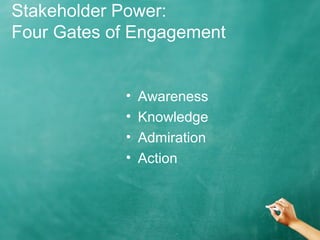
Stakeholder Power:
Four Gates of Engagement
• Awareness
• Knowledge
• Admiration
• Action
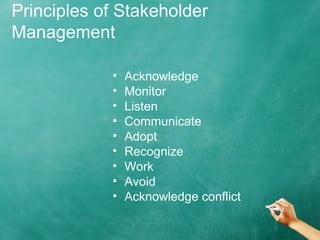
Principles of Stakeholder
Management
• Acknowledge
• Monitor
• Listen
• Communicate
• Adopt
• Recognize
• Work
• Avoid
• Acknowledge conflict
Any Questions?

Stake Holders Management Issues

  • 2.
  • 3.
  • 4.
    PRESENTED BY: • MuhammadShahroze Ilyas • Mubeen Abdul Shakoor • Adeel Asif • Muhammad Fahad Khan
  • 5.
    What is astake? • A stake is any interest, share, or claim that a group or individual has in the outcome of a corporation’ policies, procedures, or actions towards others.
  • 6.
    What is astakeholder? • Individual or group that affects all aspects of decision making in an organization.
  • 7.
    Stakeholder’s Approach • Theorythat preaches ethical behavior in order to gain a competitive advantage. • Strives to reach “win-win” outcomes. • Companies that practice this theory in their industry tend to get a leg up on their competitor. i.e. Lowes v Home Depot.
  • 8.
    Stakeholder Analysis • Assistin the understanding between an organization and its constituents. • Due to the uniqueness of each situation, the approach must be mapped out in order to develop a strategy. • The framework is developed not only for individuals in high ranking positions, but also so any employee may see the corporate dealings.
  • 9.
    Who Are BusinessStakeholders? Government Employees Business Community Consumers Owners
  • 10.
    Who Are BusinessStakeholders? Primary and Secondary Stakeholders •Primary stakeholders are those stakeholders that have a direct stake in the organization and its success •Secondary stakeholders are those that have a public or special interest stake in the organization
  • 11.
    Who Are BusinessStakeholders? Core, Strategic, and Environmental Stakeholders • Core stakeholders are essential to the survival of the firm • Strategic stakeholders are vital to the organization and the threats and opportunities the organization faces • Environmental stakeholders are all others in the organization's environment
  • 12.
    Who Are BusinessStakeholders? • Legitimacy refers to the perceived validity of the stakeholder’s claim to a stake • Power refers to the ability or capacity of a stakeholder to produce an effect • Urgency refers to the degree to which the stakeholder’s claim demands immediate attention Legitimacy, Power, Urgency: A Typology of Stakeholder Attributes
  • 13.
    Role of theCEO in Stakeholder Analysis • The role of a CEO is to get a handle of the situation to help approach and mediate concerns from customers, media, etc. • CEO is there to answer the who, what, where, why, when, and how of the situation
  • 14.
    Stakeholder Analysis in7 Steps 1. Map stakeholder relationships 2. Map stakeholder coalitions 3. Assess the nature of each stakeholder’s interest 4. Assess the nature of each stakeholder’s power 5. Construct a matrix of stakeholder moral responsibilities 6. Develop specific strategies and tactics 7. Monitor shifting coalitions
  • 15.
    Stakeholder Dispute Resolution Methods •Dispute resolution is a tactic also known as “alternative dispute resolution” • Dispute resolution is a variety of methods to help possible litigants resolve conflicts • Ranges from parties taking control of process to giving control to a third party – i.e. face to face negotiation and litigation
  • 16.
    Ethical Reasoning forStakeholders • Ethical reasoning involves trying to analyze what is fair and who is being affected by the actions. • Involves helping and identifying the weaker and quiet stakeholders getting their voices heard in the decision process • What can be done when stakeholder are not being treated fairly?
  • 17.
    Moral Responsibilities • Theanalysis ensures that managers are prepared to define their own moral responsibilities, as well as those of the company. • The approach focuses the organization’s attention on both internal and external areas. • Managers are liable for the morals of the company, that can quickly be made public due to technology. • If a stakeholder knows the roles, it clarifies the responsibilities of the task.
  • 18.
    Issue Management • Issuemanagement is used to forecast the actions to take for emerging factors that have an impact on organizations and stakeholders. • Controversy can be avoided if proper issue management is implemented. • The evolution of an issue can be traced with proper issue management. •
  • 19.
    Moral Dimension ofStakeholder and Issue Management • Studies argue that being moral is “issue dependent” • They argue that the severity of the issue is what triggers reasoning. • Morals are necessary in leadership positions, as the decisions affect all stakeholders. • Identifying issues and ensuring that they are moral is a goal for all managers to benefit their company.
  • 20.
    The Two Frameworks •Frameworks can be used to map and manage issues before they arise. • Frameworks can also be used to plan and manage to prevent, or to handle issues that may have already arisen. • Frameworks are not organization specific • Stakeholder analysis can display why strategies and actions stunt the evolution of an organization.
  • 21.
    First Approach • Thesix-step issue management process. –Environmental scanning and issues identification. –Issue analysis –Issue ranking prioritizing –Issue resolution strategizing –Issue response and implementation –Issue evaluation and monitoring .
  • 22.
    Second Step • Seven-phaseissue development process. – A felt need arises – Media coverage is deployed – Interest group development – Policies are adopted by leading political jurisdictions – The federal government gives attention to the issue. – Issues and policies evolve into legislation and regulation – Issues and policies enter litigation. •
  • 23.
    Managing Crises • Crisismanagement emerged from observing how corporations and leaders react to crises. • Steven Fink describes crisis as “a turning point for better or worse.” • The direction that organization moves into is dependent on the leaders’ reaction.
  • 24.
    Four Crisis Management Stages –Pre-crisis • Prodromal stage – Warming; symptoms • Crisis Occurs – Acute stage • Point of no return • Lingering – Chronic stage • Self-doubt, self-analysis • Health restored – Conflict resolution stage • Return to normalcy
  • 25.
    First Stage • ProdromalStage • Warning stage • Does not always occur or is not evident. • This stage should be carefully observed. • Must be taken seriously in order to prevent crisis. • If does not occur, or is ignored, the point of no return quickly occurs.
  • 26.
    Second Stage • AcuteCrisis • Damage has already occurred • Damage control must be administered • Stage where the severe damage occurs • Considered the shortest stage
  • 27.
    Third Stage • Chroniccrisis • Clean up phase • Time of healing, recovery ,and self analysis • Studies have shown when there is no crisis plan set companies stay in this phase 2.5 time longer
  • 28.
    Fourth Stage • CrisisResolution • Final stage – Crisis Management Goal • “What can and should an organization do to speed up this phase and resolve crisis once and for all?”
  • 29.
    Strategic, Multifiduciary, and SynthesisViews of Stakeholders • Strategic approach considers stakeholders primarily as factors managers should manage in pursuit of shareholder profits • Multifiduciary approach considers stakeholders as a group to which management has a fiduciary responsibility • Synthesis approach considers stakeholders as a group to whom management owes an ethical, but not a fiduciary responsibility
  • 30.
    Effective Stakeholder Management Careful assessmentof the five core questions: • Who are our stakeholders? • What are our stakeholders’ stakes? • What opportunities and challenges do stakeholders present? • What economic, legal, ethical, and philanthropic responsibilities does our firm have? • What strategies or actions should our firm take to best manage stakeholder challenges and opportunities?
  • 31.
    Stakeholder Power: Four Gatesof Engagement • Awareness • Knowledge • Admiration • Action
  • 32.
    Principles of Stakeholder Management •Acknowledge • Monitor • Listen • Communicate • Adopt • Recognize • Work • Avoid • Acknowledge conflict
  • 33.