SERGIO
OSMEÑA
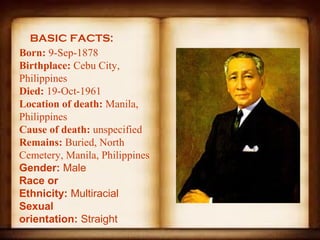
BASIC FACTS:
Born: 9-Sep-1878
Birthplace: Cebu City, 
Philippines
Died: 19-Oct-1961
Location of death: Manila, 
Philippines
Cause of death: unspecified
Remains: Buried, North 
Cemetery, Manila, Philippines
Gender: Male
Race or
Ethnicity: Multiracial
Sexual
orientation: Straight
Occupation: Head of State
         Nationality: Philippines
Executive summary: 4th President of the
                Philippines
  Co-Founder of the Nacionalista Party.
 Editor of El Nuevo Día newspaper, from
                   1903.
  Died at Veteran's Memorial Hospital in
           Quezon City, Manila.
      Mother: Juana Osmeña y Suico
Son: Sergio Osmeña Jr. (Philippine Senator)
    University: University of San Carlos
                  (1892)
  University: San Juan de Letran College,
                  Manila
Sergio Osmeña y Suico (9
September 1878 – 19
October 1961) was a
politician of Chinese
Filipino who served as
the 4th President of the
Philippines from 1944 to
1946.
He was Vice President
under Manuel L. Quezon, and
rose to the presidency upon
Quezon's death in 1944, being
the oldest Philippine president
to hold office at age 65. A
founder of Nacionalista Party,
he was the first Visayan to
become President of the
Philippines.
Prior to his succession to the
Presidency in 1944, Osmeña served as
Governor of Cebu from 1901–1907,
Member and Speaker of the Philippine
House of Representatives from 1907–
1922, and Senator from the 10th
Senatorial District for thirteen years,
in which capacity he served as Senate
President pro tempore. In 1935, he was
nominated to be the running-mate of
Senate President Manuel L. Quezon for
the presidential election that year. The
tandem was overwhelmingly re-elected
in 1941.
Osmeña is the patriarch of
the prominent Osmeña family,
which includes his son
(former Senator Sergio
Osmeña, Jr.) and his
grandsons (senators Sergio
Osmeña III and John Henry
Osmeña), ex-governor Lito
Osmeña and Cebu
City mayor Tomas Osmeña.
Sergio Osmeña was born
in Cebu to Juana Osmeña y Suico, who
was reportedly only 14 years of age
when she gave birth to him. Owing to
the circumstances of his birth, the
identity of his father had been a
closely guarded family secret.
Though an illegitimate child – Juana
never married his father – he didn't
allow this aspect to affect his
standing in society. The Osmeña
family, a rich and prominent clan
of Chinese Filipino heritage
He took his elementary education in
the Colegio de San Carlos and
graduated in 1892. Osmeña
continued his education in Manila,
studying in San Juan de Letran
College where he first metManuel
L. Quezon, a classmate of his, as
well as Juan Sumulong and Emilio
Jacinto. He took up law at
the University of Santo Tomas and
was second place in the bar
examination in 1903.
He served on the war staff of
General Emilio Aguinaldo as a
courier and journalist. In 1900,
he founded the Cebu
newspaper, El Nuevo Día which
lasted for three years. In 1904,
the American colonial
administration appointed him
governor of Cebu. Two years
later he was elected governor
of Cebu
HIS
POLITICAL
 CAREER
House of Representatives
   While governor, he ran for election to the 
  first Philippine Assembly of 1907 and was 
elected Speaker of that body. Osmeña was 29 
   years old and already the highest-ranking 
 Filipino official. He and another provincial 
politician, Manuel L. Quezon of Tayabas, set 
      up the Nacionalista Party as a foil to 
   the Partido Federalista of Manila-based 
politicians. The two would engage in a rivalry 
       for political dominance ever since. 
SENATE
Osmeña was elected to the Philippine 
National Assembly in 1907 and remained 
a member of the lower house until 1922. 
In 1922 he was elected to the Senate. He 
went to the United States as part of 
the OsRox Mission in 1933, to secure 
passage of the Hare-Hawes-Cutting 
Independence Bill which was superseded 
by the Tydings-McDuffie Act in March 
1934 
Together with Manuel Roxas,
Pres. Sergio Osmeña went on a
mission to the US to ask for the
Philippines' independence. The
mission was called OSROX,
coined from combining the first
letters of their family names.
The mission was successful. The
Philippines was granted its
independence.
PRESIDENCY
 Osmeña became president of the Commonwealth on 
Quezon's death in 1944. He returned to the Philippines 
 the same year with General Douglas MacArthur and 
 the liberation forces. After the war, Osmeña restored 
    the Commonwealth government and the various 
   executive departments. He continued the fight for 
Philippine independence. For the presidential election 
of 1946, Osmeña refused to campaign, saying that the 
   Filipino people knew of his record of 40 years of 
honest and faithful service. He lost to Manuel Roxas, 
who won 54 percent of the vote and became president 
    of the independent Republic of the Philippines. 
WHO IS THE
  MOTHER OF
SERGIO OSMENA?
WHAT DO THEY CALL
TO THEIR MISSION US
     FOR PHIL.
  INDEPENDENCE.
THANK YOU

SergioOsmena

  • 1.
  • 2.
    BASIC FACTS: Born: 9-Sep-1878 Birthplace: Cebu City,  Philippines Died: 19-Oct-1961 Location ofdeath: Manila,  Philippines Cause of death: unspecified Remains: Buried, North  Cemetery, Manila, Philippines Gender: Male Race or Ethnicity: Multiracial Sexual orientation: Straight
  • 3.
    Occupation: Head ofState Nationality: Philippines Executive summary: 4th President of the Philippines Co-Founder of the Nacionalista Party. Editor of El Nuevo Día newspaper, from 1903. Died at Veteran's Memorial Hospital in Quezon City, Manila. Mother: Juana Osmeña y Suico Son: Sergio Osmeña Jr. (Philippine Senator) University: University of San Carlos (1892) University: San Juan de Letran College, Manila
  • 7.
    Sergio Osmeña ySuico (9 September 1878 – 19 October 1961) was a politician of Chinese Filipino who served as the 4th President of the Philippines from 1944 to 1946.
  • 8.
    He was VicePresident under Manuel L. Quezon, and rose to the presidency upon Quezon's death in 1944, being the oldest Philippine president to hold office at age 65. A founder of Nacionalista Party, he was the first Visayan to become President of the Philippines.
  • 9.
    Prior to hissuccession to the Presidency in 1944, Osmeña served as Governor of Cebu from 1901–1907, Member and Speaker of the Philippine House of Representatives from 1907– 1922, and Senator from the 10th Senatorial District for thirteen years, in which capacity he served as Senate President pro tempore. In 1935, he was nominated to be the running-mate of Senate President Manuel L. Quezon for the presidential election that year. The tandem was overwhelmingly re-elected in 1941.
  • 10.
    Osmeña is thepatriarch of the prominent Osmeña family, which includes his son (former Senator Sergio Osmeña, Jr.) and his grandsons (senators Sergio Osmeña III and John Henry Osmeña), ex-governor Lito Osmeña and Cebu City mayor Tomas Osmeña.
  • 11.
    Sergio Osmeña wasborn in Cebu to Juana Osmeña y Suico, who was reportedly only 14 years of age when she gave birth to him. Owing to the circumstances of his birth, the identity of his father had been a closely guarded family secret. Though an illegitimate child – Juana never married his father – he didn't allow this aspect to affect his standing in society. The Osmeña family, a rich and prominent clan of Chinese Filipino heritage
  • 12.
    He took hiselementary education in the Colegio de San Carlos and graduated in 1892. Osmeña continued his education in Manila, studying in San Juan de Letran College where he first metManuel L. Quezon, a classmate of his, as well as Juan Sumulong and Emilio Jacinto. He took up law at the University of Santo Tomas and was second place in the bar examination in 1903.
  • 13.
    He served onthe war staff of General Emilio Aguinaldo as a courier and journalist. In 1900, he founded the Cebu newspaper, El Nuevo Día which lasted for three years. In 1904, the American colonial administration appointed him governor of Cebu. Two years later he was elected governor of Cebu
  • 14.
  • 15.
    House of Representatives While governor, he ran for election to the  first Philippine Assembly of 1907 and was  elected Speaker of that body. Osmeña was 29  years old and already the highest-ranking  Filipino official. He and another provincial  politician, Manuel L. Quezon of Tayabas, set  up the Nacionalista Party as a foil to  the Partido Federalista of Manila-based  politicians. The two would engage in a rivalry  for political dominance ever since. 
  • 16.
  • 17.
    Together with ManuelRoxas, Pres. Sergio Osmeña went on a mission to the US to ask for the Philippines' independence. The mission was called OSROX, coined from combining the first letters of their family names. The mission was successful. The Philippines was granted its independence.
  • 18.
    PRESIDENCY Osmeña became president of the Commonwealth on  Quezon's death in 1944. He returned to the Philippines  the same year with General Douglas MacArthur and  the liberation forces. After the war, Osmeña restored  the Commonwealth government and the various  executive departments. He continued the fight for  Philippine independence. For the presidential election  of 1946, Osmeña refused to campaign, saying that the  Filipino people knew of his record of 40 years of  honest and faithful service. He lost to Manuel Roxas,  who won 54 percent of the vote and became president  of the independent Republic of the Philippines. 
  • 20.
    WHO IS THE MOTHER OF SERGIO OSMENA?
  • 21.
    WHAT DO THEYCALL TO THEIR MISSION US FOR PHIL. INDEPENDENCE.
  • 22.