Section 2.1 Personality
Slide 1 of 23
Objectives
Name five traits that are used to define
personality.
Identify two factors that determine how your
personality develops.
Section 2.1
Personality
Describe what happens to personality over
a lifetime.
Section 2.1 Personality
Slide 2 of 23
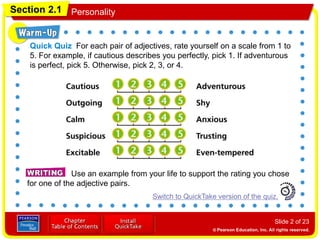
Use an example from your life to support the rating you chose
for one of the adjective pairs.
Switch to QuickTake version of the quiz.
Quick Quiz For each pair of adjectives, rate yourself on a scale from 1 to
5. For example, if cautious describes you perfectly, pick 1. If adventurous
is perfect, pick 5. Otherwise, pick 2, 3, or 4.
Section 2.1 Personality
Slide 3 of 23
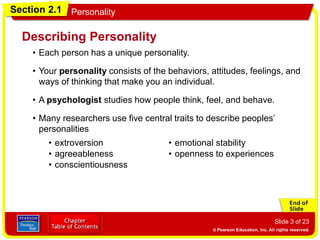
• Each person has a unique personality.
Describing Personality
• Your personality consists of the behaviors, attitudes, feelings, and
ways of thinking that make you an individual.
• A psychologist studies how people think, feel, and behave.
• Many researchers use five central traits to describe peoples’
personalities
• extroversion
• agreeableness
• conscientiousness
• emotional stability
• openness to experiences
Section 2.1 Personality
Slide 4 of 23
• This trait describes how much you like being with
other people.
Extroversion
• An extrovert tends to be outgoing, talkative,
and sociable.
• An introvert tends to be shy, quiet, and reserved.
Section 2.1 Personality
Slide 5 of 23
• This trait describes your tendency to relate to other
people in a friendly way.
Agreeableness
• People who are agreeable tend to cooperate
with others.
• People who are disagreeable tend to be suspicious
or hostile.
Section 2.1 Personality
Slide 6 of 23
• This trait describes how responsible and self-
disciplined you are.
Conscientiousness
• Conscientious people tend to be dependable and
make good decisions.
• On the other end of the scale are people who do not
think through decisions, are careless, and easily
distracted.
Section 2.1 Personality
Slide 7 of 23
• People who are emotionally stable tend to be
relaxed, secure, and calm, even during difficult
situations.
Emotional Stability
• On the other end of the scale are people who are
fearful, worried, and angry.
Section 2.1 Personality
Slide 8 of 23
• People who are open to new experiences tend to be
curious, imaginative, and creative.
Openness to Experiences
• People who are less open tend to be more
predictable and less independent.
Section 2.1 Personality
Slide 9 of 23
Personality traits are influenced by a combination of
heredity and environment.
How Personality Forms
Section 2.1 Personality
Slide 10 of 23
Infants are born with distinct tendencies to act in
certain ways.
Heredity
• Traits such as cheerfulness and shyness may be
inherited.
• Talents such as musical and artistic abilities may be
inherited.
Section 2.1 Personality
Slide 11 of 23
Heredity is only half the picture. Your family, your
friends, and your cultural group are important parts of
your environment. They all have an influence on your
personality.
Environment
• Family Experiences you had as a child helped to
shape your personality. Children learn about
feelings, attitudes, and appropriate ways to behave
from their families. As children develop, they copy
the behavior of others. This is called modeling.
• Friends Starting in childhood and throughout the
teenage years, friends become an increasingly
important influence on personality. These friends,
who are about the same age and share similar
interests, are called a peer group.
• Culture Personality traits that are valued in one
culture may not be as highly valued in another
culture.
Section 2.1 Personality
Slide 12 of 23
Click above to go online.
For: More on personality
Section 2.1 Personality
Slide 13 of 23
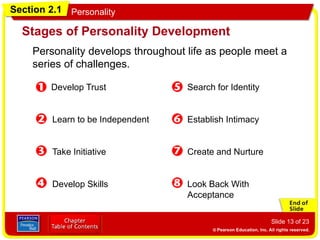
Personality develops throughout life as people meet a
series of challenges.
Stages of Personality Development
Develop Trust
Learn to be Independent
Take Initiative
Develop Skills
Search for Identity
Establish Intimacy
Create and Nurture
Look Back With
Acceptance
Section 2.1 Personality
Slide 14 of 23
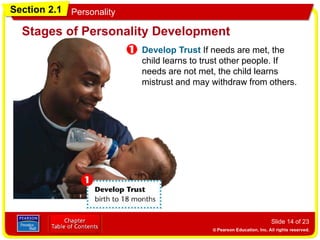
Develop Trust If needs are met, the
child learns to trust other people. If
needs are not met, the child learns
mistrust and may withdraw from others.
Stages of Personality Development
Section 2.1 Personality
Slide 15 of 23
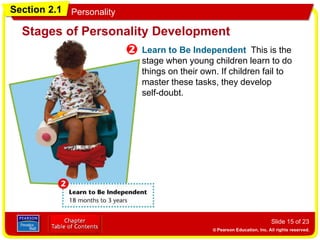
Learn to Be Independent This is the
stage when young children learn to do
things on their own. If children fail to
master these tasks, they develop
self-doubt.
Stages of Personality Development
Section 2.1 Personality
Slide 16 of 23
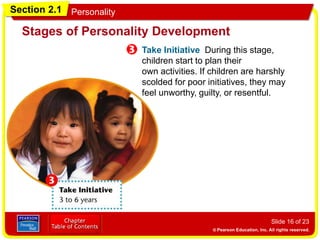
Take Initiative During this stage,
children start to plan their
own activities. If children are harshly
scolded for poor initiatives, they may
feel unworthy, guilty, or resentful.
Stages of Personality Development
Section 2.1 Personality
Slide 17 of 23
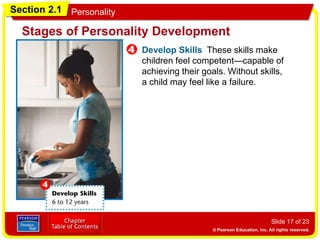
Develop Skills These skills make
children feel competent—capable of
achieving their goals. Without skills,
a child may feel like a failure.
Stages of Personality Development
Section 2.1 Personality
Slide 18 of 23
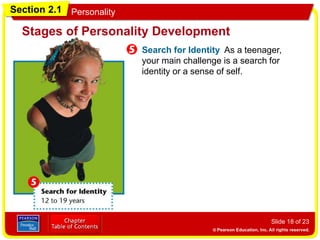
Search for Identity As a teenager,
your main challenge is a search for
identity or a sense of self.
Stages of Personality Development
Section 2.1 Personality
Slide 19 of 23
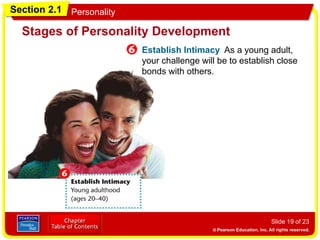
Establish Intimacy As a young adult,
your challenge will be to establish close
bonds with others.
Stages of Personality Development
Section 2.1 Personality
Slide 20 of 23
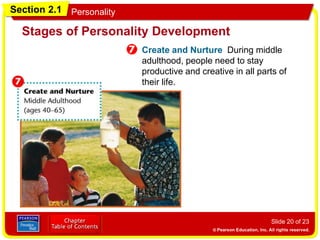
Create and Nurture During middle
adulthood, people need to stay
productive and creative in all parts of
their life.
Stages of Personality Development
Section 2.1 Personality
Slide 21 of 23
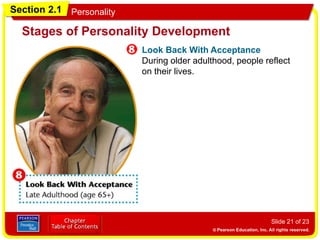
Look Back With Acceptance
During older adulthood, people reflect
on their lives.
Stages of Personality Development
Section 2.1 Personality
Slide 22 of 23
Vocabulary
personality A set of behaviors, attitudes, feelings, and ways
of thinking that are unique to an individual.
psychologist A person who studies how people think, feel,
and behave.
modeling Learning how to behave by copying the
behavior of others.
peer group A group of people who are about the same age
and share similar interests.
identity A sense of self.
Section 2.1 Personality
Slide 23 of 23
QuickTake Quiz
Click to start quiz.
Section 2.1 Personality
Slide 24 of 23
End of Section 2.1
Click on this slide to end this presentation.

Stages of personality Development.ppt

  • 1.
    Section 2.1 Personality Slide1 of 23 Objectives Name five traits that are used to define personality. Identify two factors that determine how your personality develops. Section 2.1 Personality Describe what happens to personality over a lifetime.
  • 2.
    Section 2.1 Personality Slide2 of 23 Use an example from your life to support the rating you chose for one of the adjective pairs. Switch to QuickTake version of the quiz. Quick Quiz For each pair of adjectives, rate yourself on a scale from 1 to 5. For example, if cautious describes you perfectly, pick 1. If adventurous is perfect, pick 5. Otherwise, pick 2, 3, or 4.
  • 3.
    Section 2.1 Personality Slide3 of 23 • Each person has a unique personality. Describing Personality • Your personality consists of the behaviors, attitudes, feelings, and ways of thinking that make you an individual. • A psychologist studies how people think, feel, and behave. • Many researchers use five central traits to describe peoples’ personalities • extroversion • agreeableness • conscientiousness • emotional stability • openness to experiences
  • 4.
    Section 2.1 Personality Slide4 of 23 • This trait describes how much you like being with other people. Extroversion • An extrovert tends to be outgoing, talkative, and sociable. • An introvert tends to be shy, quiet, and reserved.
  • 5.
    Section 2.1 Personality Slide5 of 23 • This trait describes your tendency to relate to other people in a friendly way. Agreeableness • People who are agreeable tend to cooperate with others. • People who are disagreeable tend to be suspicious or hostile.
  • 6.
    Section 2.1 Personality Slide6 of 23 • This trait describes how responsible and self- disciplined you are. Conscientiousness • Conscientious people tend to be dependable and make good decisions. • On the other end of the scale are people who do not think through decisions, are careless, and easily distracted.
  • 7.
    Section 2.1 Personality Slide7 of 23 • People who are emotionally stable tend to be relaxed, secure, and calm, even during difficult situations. Emotional Stability • On the other end of the scale are people who are fearful, worried, and angry.
  • 8.
    Section 2.1 Personality Slide8 of 23 • People who are open to new experiences tend to be curious, imaginative, and creative. Openness to Experiences • People who are less open tend to be more predictable and less independent.
  • 9.
    Section 2.1 Personality Slide9 of 23 Personality traits are influenced by a combination of heredity and environment. How Personality Forms
  • 10.
    Section 2.1 Personality Slide10 of 23 Infants are born with distinct tendencies to act in certain ways. Heredity • Traits such as cheerfulness and shyness may be inherited. • Talents such as musical and artistic abilities may be inherited.
  • 11.
    Section 2.1 Personality Slide11 of 23 Heredity is only half the picture. Your family, your friends, and your cultural group are important parts of your environment. They all have an influence on your personality. Environment • Family Experiences you had as a child helped to shape your personality. Children learn about feelings, attitudes, and appropriate ways to behave from their families. As children develop, they copy the behavior of others. This is called modeling. • Friends Starting in childhood and throughout the teenage years, friends become an increasingly important influence on personality. These friends, who are about the same age and share similar interests, are called a peer group. • Culture Personality traits that are valued in one culture may not be as highly valued in another culture.
  • 12.
    Section 2.1 Personality Slide12 of 23 Click above to go online. For: More on personality
  • 13.
    Section 2.1 Personality Slide13 of 23 Personality develops throughout life as people meet a series of challenges. Stages of Personality Development Develop Trust Learn to be Independent Take Initiative Develop Skills Search for Identity Establish Intimacy Create and Nurture Look Back With Acceptance
  • 14.
    Section 2.1 Personality Slide14 of 23 Develop Trust If needs are met, the child learns to trust other people. If needs are not met, the child learns mistrust and may withdraw from others. Stages of Personality Development
  • 15.
    Section 2.1 Personality Slide15 of 23 Learn to Be Independent This is the stage when young children learn to do things on their own. If children fail to master these tasks, they develop self-doubt. Stages of Personality Development
  • 16.
    Section 2.1 Personality Slide16 of 23 Take Initiative During this stage, children start to plan their own activities. If children are harshly scolded for poor initiatives, they may feel unworthy, guilty, or resentful. Stages of Personality Development
  • 17.
    Section 2.1 Personality Slide17 of 23 Develop Skills These skills make children feel competent—capable of achieving their goals. Without skills, a child may feel like a failure. Stages of Personality Development
  • 18.
    Section 2.1 Personality Slide18 of 23 Search for Identity As a teenager, your main challenge is a search for identity or a sense of self. Stages of Personality Development
  • 19.
    Section 2.1 Personality Slide19 of 23 Establish Intimacy As a young adult, your challenge will be to establish close bonds with others. Stages of Personality Development
  • 20.
    Section 2.1 Personality Slide20 of 23 Create and Nurture During middle adulthood, people need to stay productive and creative in all parts of their life. Stages of Personality Development
  • 21.
    Section 2.1 Personality Slide21 of 23 Look Back With Acceptance During older adulthood, people reflect on their lives. Stages of Personality Development
  • 22.
    Section 2.1 Personality Slide22 of 23 Vocabulary personality A set of behaviors, attitudes, feelings, and ways of thinking that are unique to an individual. psychologist A person who studies how people think, feel, and behave. modeling Learning how to behave by copying the behavior of others. peer group A group of people who are about the same age and share similar interests. identity A sense of self.
  • 23.
    Section 2.1 Personality Slide23 of 23 QuickTake Quiz Click to start quiz.
  • 24.
    Section 2.1 Personality Slide24 of 23 End of Section 2.1 Click on this slide to end this presentation.