GC1: Job Roles in the Production Arts Industry
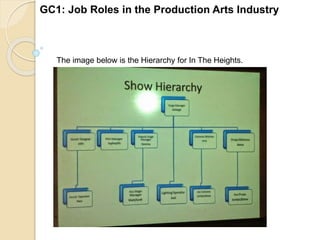
The image below is the Hierarchy for In The Heights.
Stage Manager:
 An essential skill for theatre stage managers is people
management, as it is their role to coordinate all aspects
of a theatre company to ensure the successful delivery
of the performance.
 This involves managing rehearsals, actors, technicians,
props and costume fittings, as well as liaising with front
of house staff and the director.
 A stage manager needs to have a good understanding
of both the technical and artistic elements of a
performance so that they can ensure it is delivered
exactly to the director's requirements. They will be
involved from the rehearsal stage through to the live
performances, where they will be on hand to deal with
any emergencies or issues that may hinder the show.
Stage Manager:
Roles vary depending on the size and type of organisation, but
the tasks stage managers will typically be expected to carry out
include:
 Setting up and running rehearsal schedules;
 Procuring all props, furniture and set dressings. In small companies, the theatre stage
manager may also assist in set construction;
 Arranging costume and wig fittings;
 Distributing information to other theatre departments;
 Managing the props and possibly the design budgets and liaising with the production manager
regarding costs;
 Supervising the 'get in' to the theatre, when the set, lighting and sound are installed, and the
'get out', when all the equipment is removed;
 Compiling and operating prompt copy - also known as the 'prompt script' or 'the book' - which
notes actors' moves and the requirements for props, lighting and sound;
 Making changes to the set between scene changes, prompting actors and cueing technicians;
 Ensuring the company's welfare and maintaining a good working knowledge of all relevant
health and Safety, legislation and good working practice;
 Running the backstage and onstage areas during performances;
 Liaising with the director, stage personnel and other technical departments, e.g. costume,
lighting, sound;
 Calling actors for rehearsals and performances;
 During a long run, maintaining and replacing props and costumes as required;
 Liaising with resident staff at other performance venues (if touring).
Sound Designer & Operator:
Sound Designer:
The sound designer plans and provides the sound effects in the
play. The composer writes any original music the show may
require. All the music and effects in a play considered as a
whole make up the "soundscape.“
Sound designers and composers begin their work by studying
the script, gathering as much information as they can about any
sound or music it calls for. As in all other aspects of design, an
early meeting with the director and the design team is essential
to get a clear understanding of the production concept.
Some directors will already have very clear ideas about what
the sound effects and music should sound like, while others may
request that the sound designer/composer sit in on rehearsals to
assist with developing effects and music to fit the specific
contexts in which they will be used. Once they have a precise
sense of what the production needs out of the music or sound,
the composer begins composing the necessary musical pieces
and the sound designer begins to gather and create the
necessary sounds.
Sound Design & Operator:
Sound Operator:
The Sound operator is responsible for the sound
operation in the rehearsals and the actual shows.
They will use various different programmes and
editing software on the sound after the sound
designer has created/sourced it to fit with the
production. They will keep queues for each sound to
ensure that the sound is played at the correct
moment. They will work closely with the director and
lighting operator, whilst closely following queues and
the script to ensure that anything that needs to work
simultaneously works with everybody else.
If the sound operator doesn’t do his job properly then
it will effect the performers and potentially the lighting
operator. The sound may be a Que for the performers
to perform or a specific part in the performance.
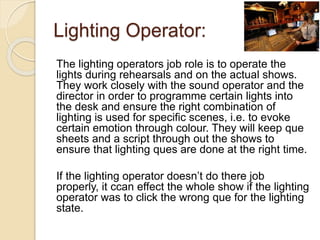
Lighting Operator:
The lighting operators job role is to operate the
lights during rehearsals and on the actual shows.
They work closely with the sound operator and the
director in order to programme certain lights into
the desk and ensure the right combination of
lighting is used for specific scenes, i.e. to evoke
certain emotion through colour. They will keep que
sheets and a script through out the shows to
ensure that lighting ques are done at the right time.
If the lighting operator doesn’t do there job
properly, it ccan effect the whole show if the lighting
operator was to click the wrong que for the lighting
state.
FOH (Front Of House)
The front of house manager assists the
front of house assistants when the paying
public are entering for the performance.
They are responsible for managing,
maintaining and developing the image ,
quality and coordination of service delivery
for the front of house areas.
If front of house don’t do their job correctly,
it will effect the whole front of house team
and can also affect the customers which
could potentially harm the business in the
future.
Props Mistress
The props mistress has to ensure that all props are all
allocated in one area, before hand they have to source the
props. The props mistress has contact with the director to
make sure that she knows every prop going on stage.
Props mistress should:
- Manage props budget
- Make a list of props needed
- Order or buy props
- Liaising with the director and production manager
- Attending rehearsals to access changes that could
possibly change props
- Supervising other members of staff in the props
department and making sure that every prop has been
collected.
- Instructing cast members on how to take care of the
props

Gc1

  • 1.
    GC1: Job Rolesin the Production Arts Industry The image below is the Hierarchy for In The Heights.
  • 2.
    Stage Manager:  Anessential skill for theatre stage managers is people management, as it is their role to coordinate all aspects of a theatre company to ensure the successful delivery of the performance.  This involves managing rehearsals, actors, technicians, props and costume fittings, as well as liaising with front of house staff and the director.  A stage manager needs to have a good understanding of both the technical and artistic elements of a performance so that they can ensure it is delivered exactly to the director's requirements. They will be involved from the rehearsal stage through to the live performances, where they will be on hand to deal with any emergencies or issues that may hinder the show.
  • 3.
    Stage Manager: Roles varydepending on the size and type of organisation, but the tasks stage managers will typically be expected to carry out include:  Setting up and running rehearsal schedules;  Procuring all props, furniture and set dressings. In small companies, the theatre stage manager may also assist in set construction;  Arranging costume and wig fittings;  Distributing information to other theatre departments;  Managing the props and possibly the design budgets and liaising with the production manager regarding costs;  Supervising the 'get in' to the theatre, when the set, lighting and sound are installed, and the 'get out', when all the equipment is removed;  Compiling and operating prompt copy - also known as the 'prompt script' or 'the book' - which notes actors' moves and the requirements for props, lighting and sound;  Making changes to the set between scene changes, prompting actors and cueing technicians;  Ensuring the company's welfare and maintaining a good working knowledge of all relevant health and Safety, legislation and good working practice;  Running the backstage and onstage areas during performances;  Liaising with the director, stage personnel and other technical departments, e.g. costume, lighting, sound;  Calling actors for rehearsals and performances;  During a long run, maintaining and replacing props and costumes as required;  Liaising with resident staff at other performance venues (if touring).
  • 4.
    Sound Designer &Operator: Sound Designer: The sound designer plans and provides the sound effects in the play. The composer writes any original music the show may require. All the music and effects in a play considered as a whole make up the "soundscape.“ Sound designers and composers begin their work by studying the script, gathering as much information as they can about any sound or music it calls for. As in all other aspects of design, an early meeting with the director and the design team is essential to get a clear understanding of the production concept. Some directors will already have very clear ideas about what the sound effects and music should sound like, while others may request that the sound designer/composer sit in on rehearsals to assist with developing effects and music to fit the specific contexts in which they will be used. Once they have a precise sense of what the production needs out of the music or sound, the composer begins composing the necessary musical pieces and the sound designer begins to gather and create the necessary sounds.
  • 5.
    Sound Design &Operator: Sound Operator: The Sound operator is responsible for the sound operation in the rehearsals and the actual shows. They will use various different programmes and editing software on the sound after the sound designer has created/sourced it to fit with the production. They will keep queues for each sound to ensure that the sound is played at the correct moment. They will work closely with the director and lighting operator, whilst closely following queues and the script to ensure that anything that needs to work simultaneously works with everybody else. If the sound operator doesn’t do his job properly then it will effect the performers and potentially the lighting operator. The sound may be a Que for the performers to perform or a specific part in the performance.
  • 6.
    Lighting Operator: The lightingoperators job role is to operate the lights during rehearsals and on the actual shows. They work closely with the sound operator and the director in order to programme certain lights into the desk and ensure the right combination of lighting is used for specific scenes, i.e. to evoke certain emotion through colour. They will keep que sheets and a script through out the shows to ensure that lighting ques are done at the right time. If the lighting operator doesn’t do there job properly, it ccan effect the whole show if the lighting operator was to click the wrong que for the lighting state.
  • 7.
    FOH (Front OfHouse) The front of house manager assists the front of house assistants when the paying public are entering for the performance. They are responsible for managing, maintaining and developing the image , quality and coordination of service delivery for the front of house areas. If front of house don’t do their job correctly, it will effect the whole front of house team and can also affect the customers which could potentially harm the business in the future.
  • 8.
    Props Mistress The propsmistress has to ensure that all props are all allocated in one area, before hand they have to source the props. The props mistress has contact with the director to make sure that she knows every prop going on stage. Props mistress should: - Manage props budget - Make a list of props needed - Order or buy props - Liaising with the director and production manager - Attending rehearsals to access changes that could possibly change props - Supervising other members of staff in the props department and making sure that every prop has been collected. - Instructing cast members on how to take care of the props