SHUNMUGAVADIVOO.T,
ASST PROFESSOR,
DEPARTMENT OF COMPUTER SCIENCE,
S.A.COLLEGE OF ARTS & SCIENCE,
CHENNAI – 600077
TAMILNADU
DATA STRUCTURE – STACK AND QUEUE
UNIT 2
DATA
STRUCTURES
1
The stack abstract data type is defined by the following structure and
operations. A stack is structured, as described above, as an ordered collection of
items where items are added to and removed from the end called the “top.”
Stacks are ordered LIFO.
Primitive Stack Operations
Stack operations may involve initializing the stack, using it and then de-
initializing it. Apart from these basic stuffs, a stack is used for the following two
primary operations −
push() − Pushing (storing) an element on the stack.
pop() − Removing (accessing) an element from the stack.
3
THE STACK ABSTRACT
DATA TYPE
PRIMITIVE STACK
OPERATIONS
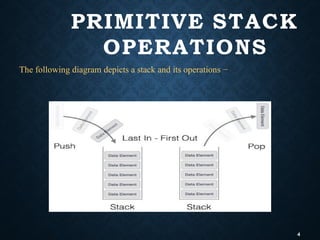
The following diagram depicts a stack and its operations −
4
PUSH
OPERATION
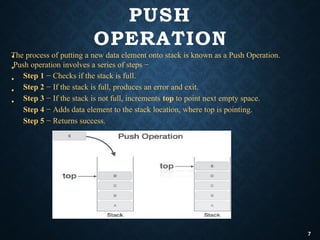
The process of putting a new data element onto stack is known as a Push Operation.
Push operation involves a series of steps −
•
•
•
•
•
Step 1 − Checks if the stack is full.
Step 2 − If the stack is full, produces an error and exit.
Step 3 − If the stack is not full, increments top to point next empty space.
Step 4 − Adds data element to the stack location, where top is pointing.
Step 5 − Returns success.
7
POP
OPERATION
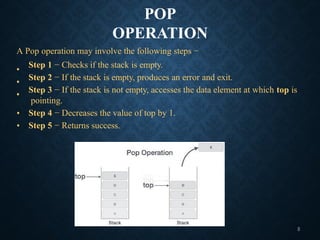
A Pop operation may involve the following steps −
•
•
•
•
•
Step 1 − Checks if the stack is empty.
Step 2 − If the stack is empty, produces an error and exit.
Step 3 − If the stack is not empty, accesses the data element at which top is
pointing.
Step 4 − Decreases the value of top by 1.
Step 5 − Returns success.
8
Algorithm of Push and Pop Operation
7
PUS H
begin procedure push: stack,
data
if stack is full
return null
endif top ← top + 1
stack[top] ← data
end procedure
Pop
begin procedure pop: stack
if stack is empty
return null
endif data ← stack[top]
top ← top – 1
return data
end procedure
ARRAY
REPRESENTATION OF
STACK
Stack can be represented by means of a one way list or a linear array.
A pointer variable top contains the locations of the top element of
the stack and a variable max stk gives the maximum number of
elements of the Stack that can be held by Stack.
the condition top=0 will indicate that the stack is empty.
This procedure pushes an item onto the Stack via Top.
PUSH(Stack, Top, MaxStk, Item)
1. If Top = = MaxStk //check Stack already fill or not
then print "Overflow" and return
2. Set Top = Top + 1 //increase top by 1
3.Stack[Top] = Item //insert item in new top position 4. Return
Let MaxStk=8, the array Stack contains M, N, O in it. Perform
operations on it
8
ARRAY REPRESENTATION OF
STACK
Pop operation on Stack
This procedures deletes the top element of Stack and assigns
it to the variable item.
POP(Stack, top, Item)
1.If Top = = Null //check Stack top element to be deleted is
empty
then print "Underflow" and return
2. Item = Stack[Top] //assign top element to item
3. Set Top = Top - 1 //decrease top by 1
4. Return
pop 3 elements
11
REPRESENTATION OF
STACK
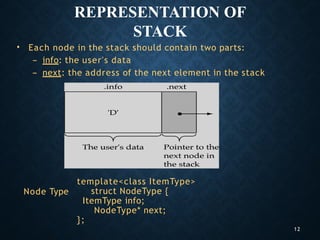
• Each node in the stack should contain two parts:
– info: the user's data
– next: the address of the next element in the stack
12
Node Type
template<class ItemType>
struct NodeType {
ItemType info;
NodeType* next;
};
LINKED
REPRESENTATION OF
STACK
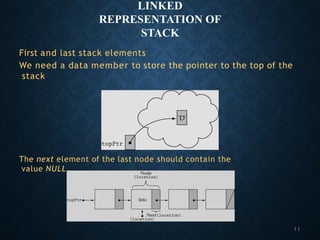
First and last stack elements
We need a data member to store the pointer to the top of the
stack
The next element of the last node should contain the
value NULL
11
APPLICATIONS OF
STACKS
1)Reversing Strings:
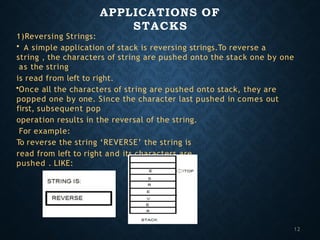
• A simple application of stack is reversing strings.To reverse a
string , the characters of string are pushed onto the stack one by one
as the string
is read from left to right.
•Once all the characters of string are pushed onto stack, they are
popped one by one. Since the character last pushed in comes out
first, subsequent pop
operation results in the reversal of the string.
For example:
To reverse the string ‘REVERSE’ the string is
read from left to right and its characters are
pushed . LIKE:
12
APPLICATIONS OF
STACKS
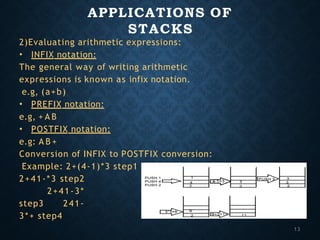
2)Evaluating arithmetic expressions:
• INFIX notation:
The general way of writing arithmetic
expressions is known as infix notation.
e.g, (a+b)
• PREFIX notation:
e.g, + A B
• POSTFIX notation:
e.g: A B +
Conversion of INFIX to POSTFIX conversion:
Example: 2+(4-1)*3 step1
2+41-*3 step2
2+41-3*
step3 241-
3*+ step4
13
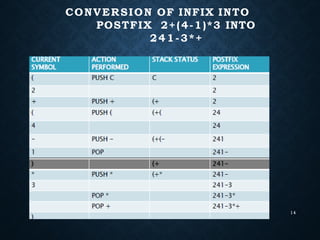
CONVERSION OF INFIX INTO
POSTFIX 2+(4-1)*3 INTO
241-3*+
14
APPLICATIONS OF
STACKS
15
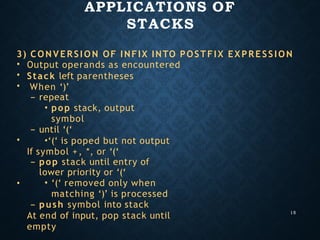
3) CONVERSION OF INFIX INTO POSTFIX EXPRESSION
•
•
•
•
•
Output operands as encountered
Stack left parentheses
When ‘)’
– repeat
• pop stack, output
symbol
– until ‘(‘
•‘(‘ is poped but not output
If symbol +, *, or ‘(‘
– pop stack until entry of
lower priority or ‘(‘
• ‘(‘ removed only when
matching ‘)’ is processed
– push symbol into stack
At end of input, pop stack until
empty
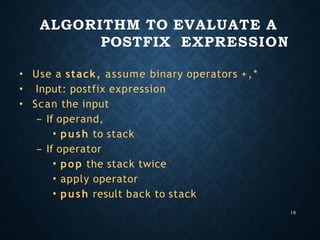
ALGORITHM TO EVALUATE A
POSTFIX EXPRESSION
16
•
•
•
Use a stack, assume binary operators +,*
Input: postfix expression
Scan the input
– If operand,
• push to stack
– If operator
• pop the stack twice
• apply operator
• push result back to stack
QUEUE
17
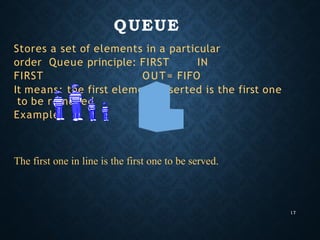
Stores a set of elements in a particular
order Queue principle: FIRST IN
FIRST OUT= FIFO
It means: the first element inserted is the first one
to be removed
Example
The first one in line is the first one to be served.
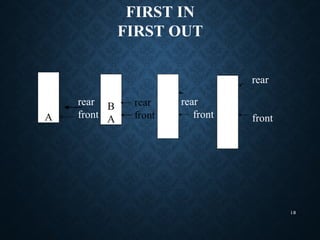
FIRST IN
FIRST OUT
18
rear
front
C
B
A
rear
front
D
C
B
A
rear
front
ARRAY-BASED QUEUE
IMPLEMENTATION
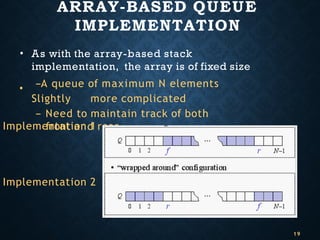
• As with the array-based stack
implementation, the array is of fixed size
–A queue of maximum N elements
Slightly more complicated
– Need to maintain track of both
front and rear
•
Implementation 1
Implementation 2
19
IMPLEMENTATION
enqueue
void enqueue(int *rear,
element item)
{
/* add an item to the queue */
if (*rear = =
MAX_QUEUE_SIZE_1) {
queue_full( );
return;
}
queue [++*rear]
= item;
}
Dequeue
element dequeue(int *front,
int rear)
{
/* remove element at the
front of the queue */
if ( *front = = rear)
return
queue_empty( );
/* return an error key */
return queue [ + + *front];
}
23
IMPLEMENTING QUEUES USING
LINKED LISTS
21
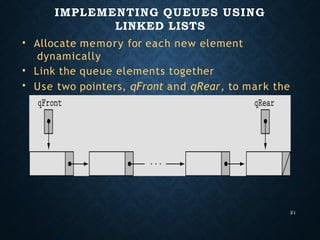
•
•
•
Allocate memory for each new element
dynamically
Link the queue elements together
Use two pointers, qFront and qRear, to mark the
front and rear of the queue
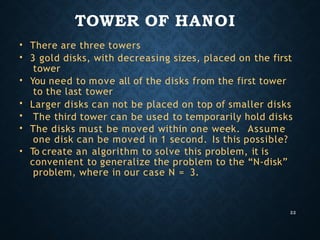
TOWER OF HANOI
22
•
•
•
•
•
•
•
There are three towers
3 gold disks, with decreasing sizes, placed on the first
tower
You need to move all of the disks from the first tower
to the last tower
Larger disks can not be placed on top of smaller disks
The third tower can be used to temporarily hold disks
The disks must be moved within one week. Assume
one disk can be moved in 1 second. Is this possible?
To create an algorithm to solve this problem, it is
convenient to generalize the problem to the “N-disk”
problem, where in our case N = 3.
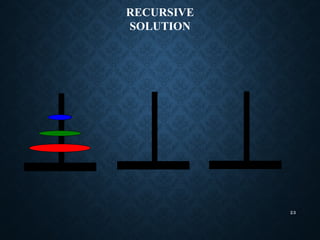
RECURSIVE
SOLUTION
23
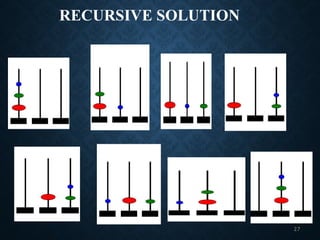
RECURSIVE SOLUTION
27
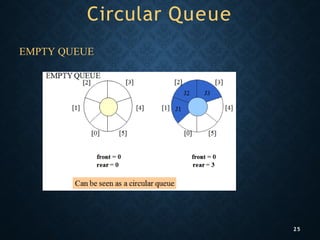
Circular Queue
EMPTY QUEUE
25
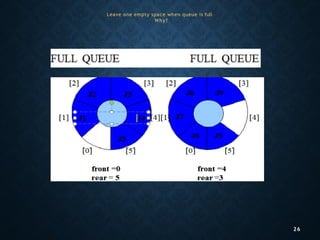
Leave one empty space when queue is full
Why?
26
ABSTRACT DATA TYPE:
PRIORITY QUEUE
• A priority queue is a collection of zero or more items,
– associated with each item is a priority
• A priority queue has at least three operations
– insert(item i) (enqueue) a new item
– delete() (dequeue) the member with the highest
priority
– find() the item with the highest priority
– decreasePriority(item i, p) decrease the priority
of ith item to p
• Note that in a priority queue "first in first out" does not apply in general.
30
PRIORITY QUEUES:
ASSUMPTIONS
• The highest priority can be either the minimum
value of all the items, or the maximum.
– We will assume the highest priority is the
minimum.
– Call the delete operation deleteMin().
– Call the find operation findMin().
• Assume the priority queue has n members
31

DS UNIT 2 PPT.pptx stack queue representations

  • 1.
    SHUNMUGAVADIVOO.T, ASST PROFESSOR, DEPARTMENT OFCOMPUTER SCIENCE, S.A.COLLEGE OF ARTS & SCIENCE, CHENNAI – 600077 TAMILNADU DATA STRUCTURE – STACK AND QUEUE
  • 2.
  • 3.
    The stack abstractdata type is defined by the following structure and operations. A stack is structured, as described above, as an ordered collection of items where items are added to and removed from the end called the “top.” Stacks are ordered LIFO. Primitive Stack Operations Stack operations may involve initializing the stack, using it and then de- initializing it. Apart from these basic stuffs, a stack is used for the following two primary operations − push() − Pushing (storing) an element on the stack. pop() − Removing (accessing) an element from the stack. 3 THE STACK ABSTRACT DATA TYPE
  • 4.
    PRIMITIVE STACK OPERATIONS The followingdiagram depicts a stack and its operations − 4
  • 5.
    PUSH OPERATION The process ofputting a new data element onto stack is known as a Push Operation. Push operation involves a series of steps − • • • • • Step 1 − Checks if the stack is full. Step 2 − If the stack is full, produces an error and exit. Step 3 − If the stack is not full, increments top to point next empty space. Step 4 − Adds data element to the stack location, where top is pointing. Step 5 − Returns success. 7
  • 6.
    POP OPERATION A Pop operationmay involve the following steps − • • • • • Step 1 − Checks if the stack is empty. Step 2 − If the stack is empty, produces an error and exit. Step 3 − If the stack is not empty, accesses the data element at which top is pointing. Step 4 − Decreases the value of top by 1. Step 5 − Returns success. 8
  • 7.
    Algorithm of Pushand Pop Operation 7 PUS H begin procedure push: stack, data if stack is full return null endif top ← top + 1 stack[top] ← data end procedure Pop begin procedure pop: stack if stack is empty return null endif data ← stack[top] top ← top – 1 return data end procedure
  • 8.
    ARRAY REPRESENTATION OF STACK Stack canbe represented by means of a one way list or a linear array. A pointer variable top contains the locations of the top element of the stack and a variable max stk gives the maximum number of elements of the Stack that can be held by Stack. the condition top=0 will indicate that the stack is empty. This procedure pushes an item onto the Stack via Top. PUSH(Stack, Top, MaxStk, Item) 1. If Top = = MaxStk //check Stack already fill or not then print "Overflow" and return 2. Set Top = Top + 1 //increase top by 1 3.Stack[Top] = Item //insert item in new top position 4. Return Let MaxStk=8, the array Stack contains M, N, O in it. Perform operations on it 8
  • 9.
    ARRAY REPRESENTATION OF STACK Popoperation on Stack This procedures deletes the top element of Stack and assigns it to the variable item. POP(Stack, top, Item) 1.If Top = = Null //check Stack top element to be deleted is empty then print "Underflow" and return 2. Item = Stack[Top] //assign top element to item 3. Set Top = Top - 1 //decrease top by 1 4. Return pop 3 elements 11
  • 10.
    REPRESENTATION OF STACK • Eachnode in the stack should contain two parts: – info: the user's data – next: the address of the next element in the stack 12 Node Type template<class ItemType> struct NodeType { ItemType info; NodeType* next; };
  • 11.
    LINKED REPRESENTATION OF STACK First andlast stack elements We need a data member to store the pointer to the top of the stack The next element of the last node should contain the value NULL 11
  • 12.
    APPLICATIONS OF STACKS 1)Reversing Strings: •A simple application of stack is reversing strings.To reverse a string , the characters of string are pushed onto the stack one by one as the string is read from left to right. •Once all the characters of string are pushed onto stack, they are popped one by one. Since the character last pushed in comes out first, subsequent pop operation results in the reversal of the string. For example: To reverse the string ‘REVERSE’ the string is read from left to right and its characters are pushed . LIKE: 12
  • 13.
    APPLICATIONS OF STACKS 2)Evaluating arithmeticexpressions: • INFIX notation: The general way of writing arithmetic expressions is known as infix notation. e.g, (a+b) • PREFIX notation: e.g, + A B • POSTFIX notation: e.g: A B + Conversion of INFIX to POSTFIX conversion: Example: 2+(4-1)*3 step1 2+41-*3 step2 2+41-3* step3 241- 3*+ step4 13
  • 14.
    CONVERSION OF INFIXINTO POSTFIX 2+(4-1)*3 INTO 241-3*+ 14
  • 15.
    APPLICATIONS OF STACKS 15 3) CONVERSIONOF INFIX INTO POSTFIX EXPRESSION • • • • • Output operands as encountered Stack left parentheses When ‘)’ – repeat • pop stack, output symbol – until ‘(‘ •‘(‘ is poped but not output If symbol +, *, or ‘(‘ – pop stack until entry of lower priority or ‘(‘ • ‘(‘ removed only when matching ‘)’ is processed – push symbol into stack At end of input, pop stack until empty
  • 16.
    ALGORITHM TO EVALUATEA POSTFIX EXPRESSION 16 • • • Use a stack, assume binary operators +,* Input: postfix expression Scan the input – If operand, • push to stack – If operator • pop the stack twice • apply operator • push result back to stack
  • 17.
    QUEUE 17 Stores a setof elements in a particular order Queue principle: FIRST IN FIRST OUT= FIFO It means: the first element inserted is the first one to be removed Example The first one in line is the first one to be served.
  • 18.
  • 19.
    ARRAY-BASED QUEUE IMPLEMENTATION • Aswith the array-based stack implementation, the array is of fixed size –A queue of maximum N elements Slightly more complicated – Need to maintain track of both front and rear • Implementation 1 Implementation 2 19
  • 20.
    IMPLEMENTATION enqueue void enqueue(int *rear, elementitem) { /* add an item to the queue */ if (*rear = = MAX_QUEUE_SIZE_1) { queue_full( ); return; } queue [++*rear] = item; } Dequeue element dequeue(int *front, int rear) { /* remove element at the front of the queue */ if ( *front = = rear) return queue_empty( ); /* return an error key */ return queue [ + + *front]; } 23
  • 21.
    IMPLEMENTING QUEUES USING LINKEDLISTS 21 • • • Allocate memory for each new element dynamically Link the queue elements together Use two pointers, qFront and qRear, to mark the front and rear of the queue
  • 22.
    TOWER OF HANOI 22 • • • • • • • Thereare three towers 3 gold disks, with decreasing sizes, placed on the first tower You need to move all of the disks from the first tower to the last tower Larger disks can not be placed on top of smaller disks The third tower can be used to temporarily hold disks The disks must be moved within one week. Assume one disk can be moved in 1 second. Is this possible? To create an algorithm to solve this problem, it is convenient to generalize the problem to the “N-disk” problem, where in our case N = 3.
  • 23.
  • 24.
  • 25.
  • 26.
    Leave one emptyspace when queue is full Why? 26
  • 27.
    ABSTRACT DATA TYPE: PRIORITYQUEUE • A priority queue is a collection of zero or more items, – associated with each item is a priority • A priority queue has at least three operations – insert(item i) (enqueue) a new item – delete() (dequeue) the member with the highest priority – find() the item with the highest priority – decreasePriority(item i, p) decrease the priority of ith item to p • Note that in a priority queue "first in first out" does not apply in general. 30
  • 28.
    PRIORITY QUEUES: ASSUMPTIONS • Thehighest priority can be either the minimum value of all the items, or the maximum. – We will assume the highest priority is the minimum. – Call the delete operation deleteMin(). – Call the find operation findMin(). • Assume the priority queue has n members 31