Stabilization of soil using
BITUMENOUS EMULSIONS
Presented by:
k.Prashanth kumar
Introduction:
For any land-based structure, the foundation is very important and has
to be strong to support the entire structure. in order for the foundation to
be strong, the soil around it plays a very critical role. so, to work with soils,
we need to have proper knowledge about their properties and factors
which affect their behavior. the process of soil stabilization helps to achieve
the required properties in a soil needed for the construction work.
From the beginning of construction work, the necessity of enhancing
soil properties has come to the light. Ancient civilizations of the Chinese,
Romans and Incas utilized various methods to improve soil strength etc.,
some of these methods were so effective that their buildings and roads still
exist.
Here, in this project, soil stabilization has been done with the help of
randomly distributed polypropylene fibers obtained from waste materials.
the improvement in the shear strength parameters has been stressed upon
and comparative studies have been carried out using different methods of
shear resistance measurement.
Definitions and Terminology:
SOIL
CLAY
LIME
CEMENT
ATTERBERG LIMITS
LL (LIQUID LIMIT)
PL (PLASTIC LIMIT)
SL (SHRINKAGE LIMIT)
DENSITY
PI (PLASTICITY INDEX)
STABILIZING ADDITIVE
Soil – soil is sediment or other unconsolidated accumulation of solid
particles produced by the physical and/or chemical disintegration of rock,
soil may or may not contain organic material (ASTMD2487).
Clay – Clay is type of cohesive soil composed of very fine material
particles; clay is one of the fine-grained soils defined by the Unified Soil
Classification System.
Lime – Lime is a white or grayish-white, odorless, lumpy, very slightly
water soluble solid, CaO, that when combined with water forms Calcium
Hydroxide (Slaked Lime). Calcium Hydroxide is chiefly used in mortars,
plasters, and cements.
Cement – Portland cement is hydraulic cement made by heating
limestone and clay mixture in a kiln and pulverizing the resulting material.
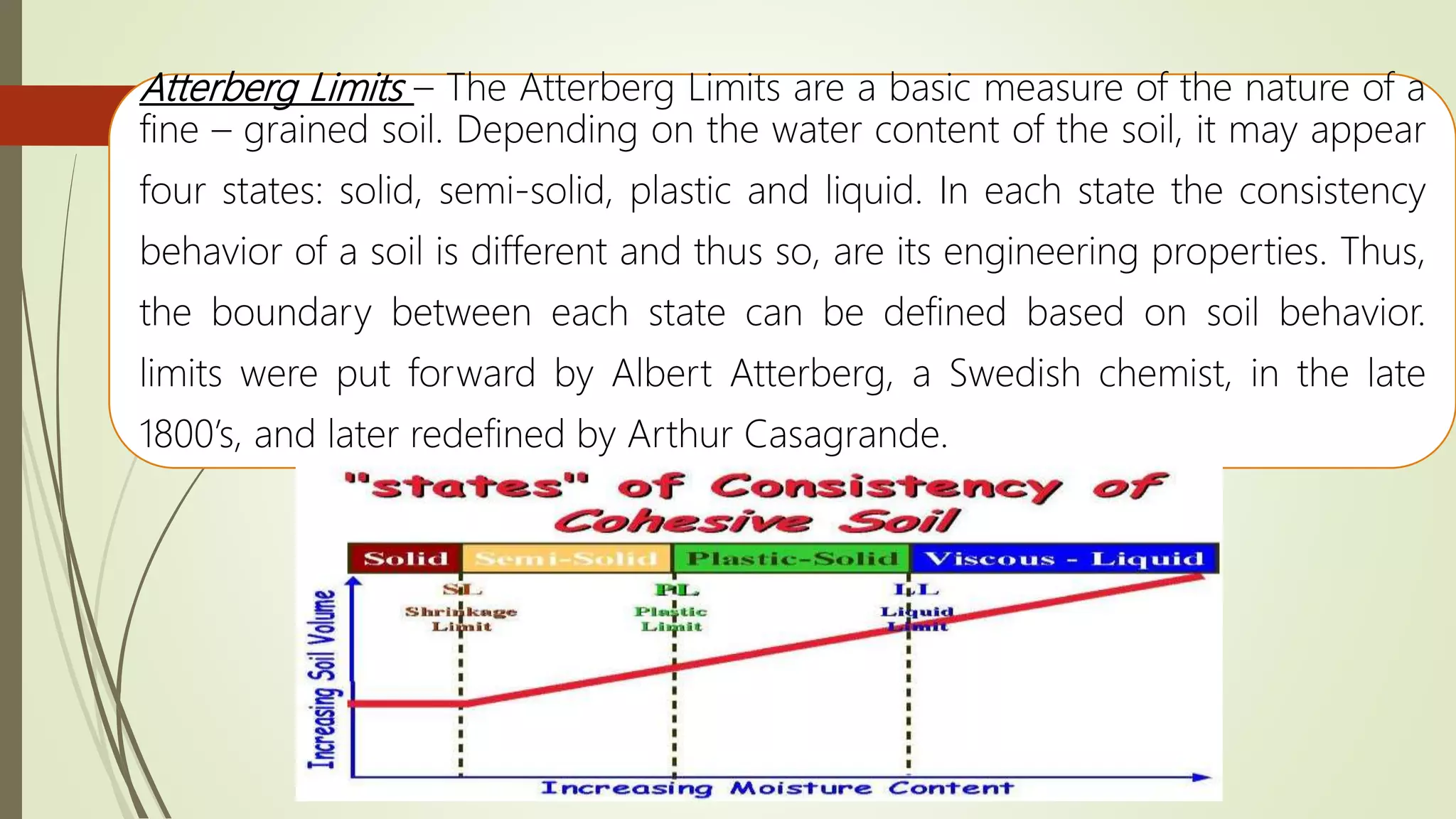
Atterberg Limits – The Atterberg Limits are a basic measure of the nature of a
fine – grained soil. Depending on the water content of the soil, it may appear
four states: solid, semi-solid, plastic and liquid. In each state the consistency
behavior of a soil is different and thus so, are its engineering properties. Thus,
the boundary between each state can be defined based on soil behavior.
limits were put forward by Albert Atterberg, a Swedish chemist, in the late
1800’s, and later redefined by Arthur Casagrande.
ll (liquid limit) – The liquid limit of a fine-grained soil is a boundary between the
liquid and plastic state of that particular soil, expressed as a moisture content
percentage (by weight).
Pl (plastic limit) – The plastic limit of a fine-grained soil is the boundary between
the plastic and semi-solid states for that particular soil, expressed as a moisture
percentage (by weight).
SL (Shrinkage Limit) – The shrinkage limit of a fine grained soil is defined as the
moisture content at which no further volume change occurs with further reduction in
moisture content (SL represents the amount of water required to fully saturated the soil
(100% of Saturation))
Density – density is the measure of the relative weight of any material compared to its
occupied volume, expressed in kilograms per cubic meter (pounds per cubic foot). the
increase in density is limited only by the degree of solidity that can be achieved in a
material by total elimination of voids between the particles in the mass.
PI (plasticity index or ip) – PI is the numerical difference of liquid limit and plastic
limit of a fine grained soil.
Ip= wl - w p
Stabilizing additive – A stabilizing additive is a mechanical, chemical or bituminous
additive (or other material) used to maintain or increase the strength and durability,
decrease the moisture sensitivity, or otherwise improve the engineering properties of a
soil or other materials used for construction.
SOIL STABLIZATION:
PRINCIPLES OF SOIL STABILIZATION
 Evaluating the soil properties of the area under consideration.
 Deciding the property of soil which needs to be altered to get
the design value and choose the effective and economical
method for stabilization.
 Designing the Stabilized soil mix sample and testing it in the
lab for intended stability and durability values.
Advantages:
 It Improves The Strength Of The Soil, Thus, Increasing The Soil Bearing Capacity.
 It Is More Economical Both In Terms Of Cost And Energy To Increase The Bearing Capacity Of the
Soil Rather Than Going For Deep Foundation Or Raft Foundation.
 It Is Also Used To Provide More Stability To The Soil In Slopes Or Other Such Places.
 Sometimes Soil Stabilization Is Also Used To Prevent Soil Erosion Or Formation Of Dust, Which is
Very Useful Especially In Dry And Arid Weather.
 Stabilization Is Also Done For Soil Water-proofing; This Prevents Water From Entering Into The
soil And Hence Helps The Soil From Losing Its Strength.
 It Helps In Reducing The Soil Volume Change Due To Change In Temperature Or Moisture
content.
 Stabilization Improves The Workability And The Durability Of The Soil.
Methods of stabilization:
I. Mechanical Method Of Stabilization.
II. Additive method of stabilization:
a. Cementation Stabilization.
b. Bituminous Stabilization.
c. Argillation Stabilization.
d. Silicification Stabilization.
e. Electrochemical Stabilization.
f. Thermal Stabilization.
g. Fiber Reinforcements.
 Oriented Fiber Reinforcement.
 Random Fiber Reinforcement.
Uses of stabilization:
 Quality Improvement: The most common improvements achieved through
stabilization include better soil gradation, reduction of plasticity index or
swelling potential, and increases in durability and strength. in wet weather,
stabilization may also be used to provide a working platform for construction
operations. these types of soil quality improvement are referred to as soil
modification
 Thickness reduction: The strength and stiffness of a soil layer can be
improved through the use of additives to permit a reduction in design
thickness of the stabilized materials compared with an unsterilized or unbound
material. Procedures for designing pavements that includes stabilized soils are
presented in TM 5-822-5/AFM 88-7, Chap. 3, TM 5-825-2/AFM 88-6, Chap. 2,
TM 5-825-3/AFM 88-6, Chap. 3. The design thickness of abase or sub-base
course can be reduced if the stabilized materials meet the specified gradation,
strength, stability and durability requirements indicated in this Technical
Manual for the particular type of material.
Soil Stabilization Process
Stabilization with
BITUMENOUS EMULSIONS
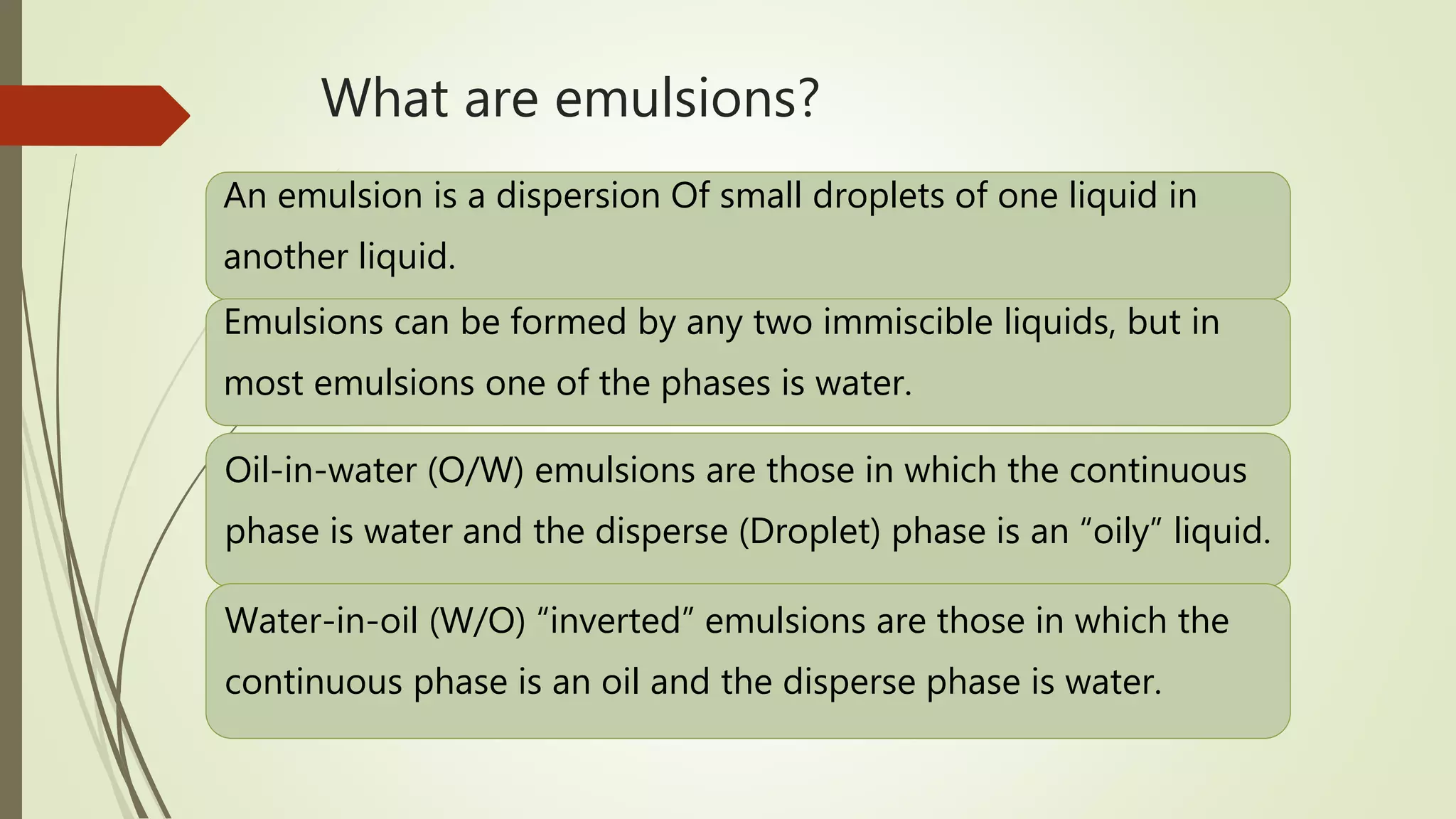
What are emulsions?
An emulsion is a dispersion Of small droplets of one liquid in
another liquid.
Emulsions can be formed by any two immiscible liquids, but in
most emulsions one of the phases is water.
Oil-in-water (O/W) emulsions are those in which the continuous
phase is water and the disperse (Droplet) phase is an “oily” liquid.
Water-in-oil (W/O) “inverted” emulsions are those in which the
continuous phase is an oil and the disperse phase is water.
Types of emulsions:
A. O/W emulsion,
B. W/O emulsion,
C. multiple W/O/W
Bitumen Emulsion Is A 2-phase System Consisting Of
 Bitumen
 Water
 Other Additives
• The bitumen is dispersed throughout the water phase in form of
discrete globules, held in suspension by electrostatic charges stabilized
by emulsifier
• The Emulsion contains 40-75% of bitumen,.1-2.5%emulsifier,25-
60%water and other ingredients
• Typically of .1 – 50 µm in diameter.
• It is mainly dark brown in color after breaking changes to black.
WHY BITUMEN EMULSIONS ?
Primary Objective Is To Use For Road Surfacing Without Much Heating.
 As main advantages this improves the handling of bitumen at room
temperature.
 Promotes surface interactions .
 Its mixture with the aggregate attains full strength.
 Economical and saves energy .
 Reduced atmosphere pollution.
 Water can also added before use to dilute as per requirement.
 Rains can not effect it at the time of use and after use.
Stabilization of chalky soil
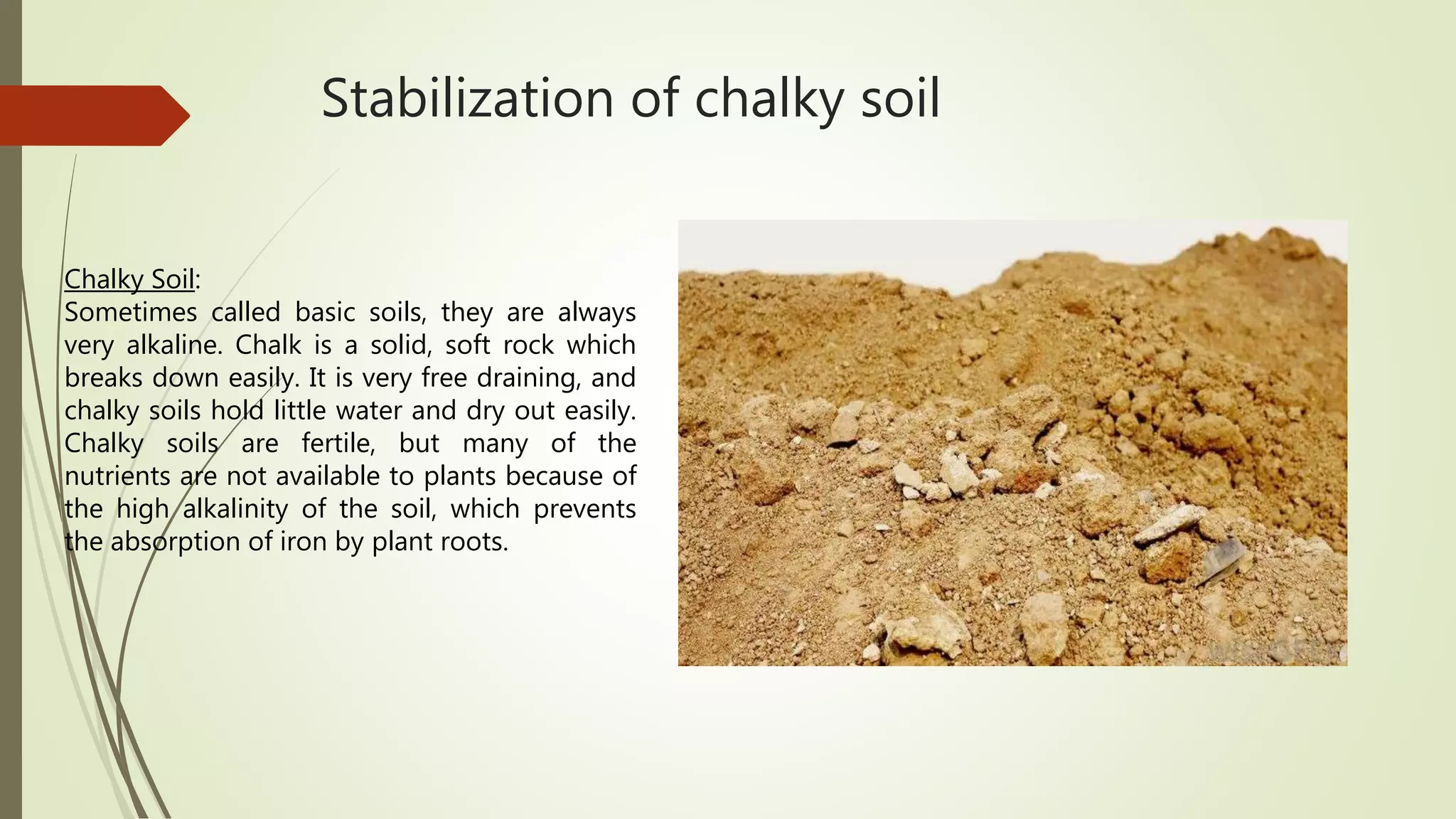
Chalky Soil:
Sometimes called basic soils, they are always
very alkaline. Chalk is a solid, soft rock which
breaks down easily. It is very free draining, and
chalky soils hold little water and dry out easily.
Chalky soils are fertile, but many of the
nutrients are not available to plants because of
the high alkalinity of the soil, which prevents
the absorption of iron by plant roots.
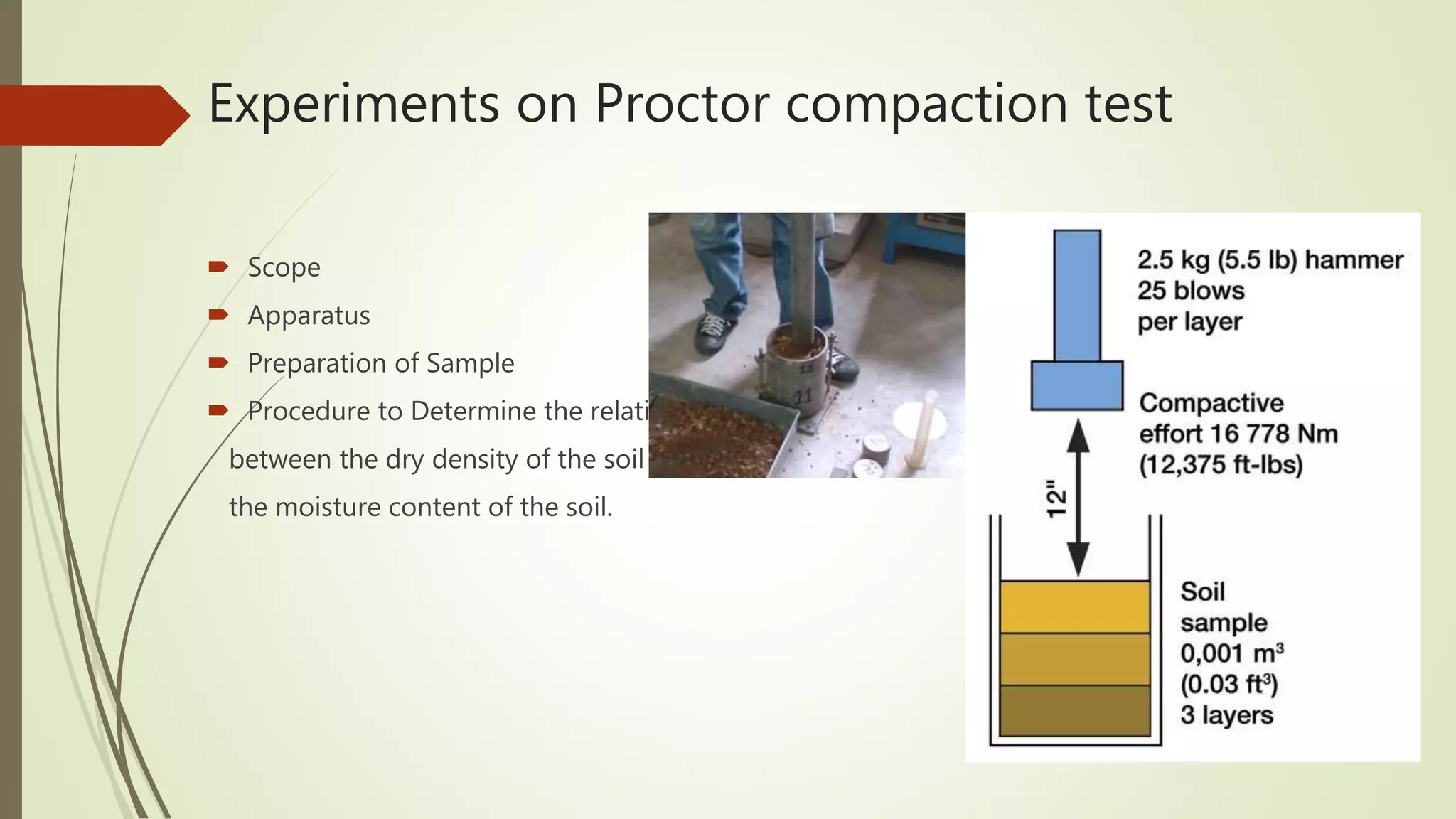
Experiments on Proctor compaction test
 Scope
 Apparatus
 Preparation of Sample
 Procedure to Determine the relationship
between the dry density of the soil and
the moisture content of the soil.
Proctor compaction test
1.878
1.923
1.95
1.971
2.019
1.942
1.85
1.9
1.95
2
2.05
0 2 4 6 8 10 12 14 16 18
Drydensitying/cc
Moisture content %
Relation between dry density and moisture content% of soil
Computing from graph
Optimum Moisture Content (OMC) = 13.9%
Maximum Dry Density (MDD) = 2.019 g/cc
Proctor Compaction Test Using 6% Bitumenous Emulsions
2.019 2.043
2.113
2
1.9
2
2.1
2.2
0 2 4 6 8 10 12 14
Drydensitying/cc
Moisture content %
Relation between Dry density and moisture content% of soil using 6% of
Bitumenous Emulsions
Computing from graph
Optimum Moisture Content (OMC) = 9.9%
Maximum Dry Density (MDD) = 2.113 g/cc
Proctor Compaction Test Using 7% Bitumenous Emulsions
1.968 1.971
1.985
1.966
1.96
1.98
2
0 2 4 6 8 10 12 14
Drydensitying/cc
Moisture content %
Relation between Dry density and moisture content% of soil using 7% of
Bitumenous Emulsions
Computing from graph
Optimum Moisture Content (OMC) = 9.92%
Maximum Dry Density (MDD) = 1.985 g/cc
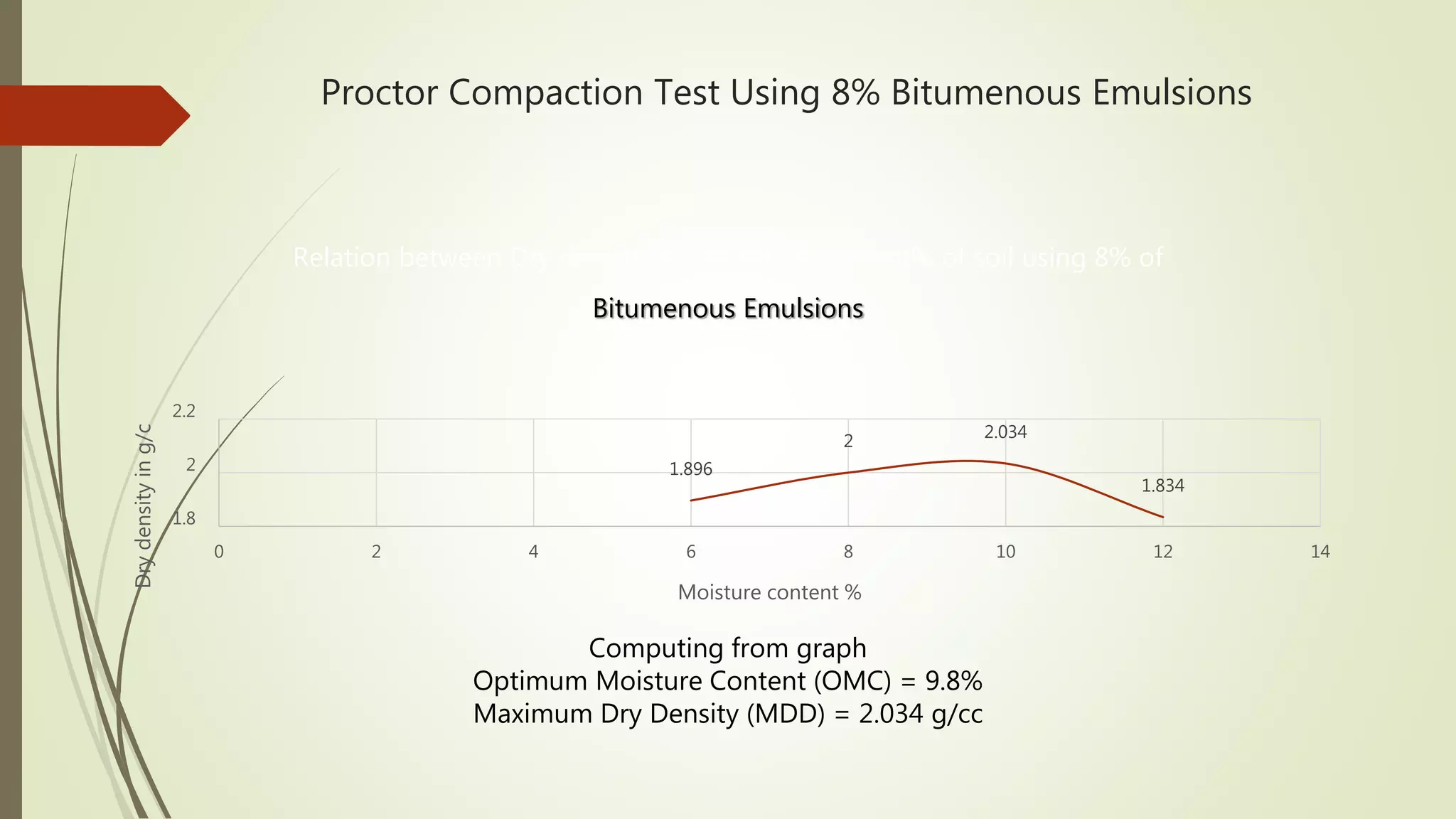
Proctor Compaction Test Using 8% Bitumenous Emulsions
1.896
2
2.034
1.834
1.8
2
2.2
0 2 4 6 8 10 12 14
Drydensitying/c
Moisture content %
Relation between Dry density and moisture content% of soil using 8% of
Bitumenous Emulsions
Computing from graph
Optimum Moisture Content (OMC) = 9.8%
Maximum Dry Density (MDD) = 2.034 g/cc
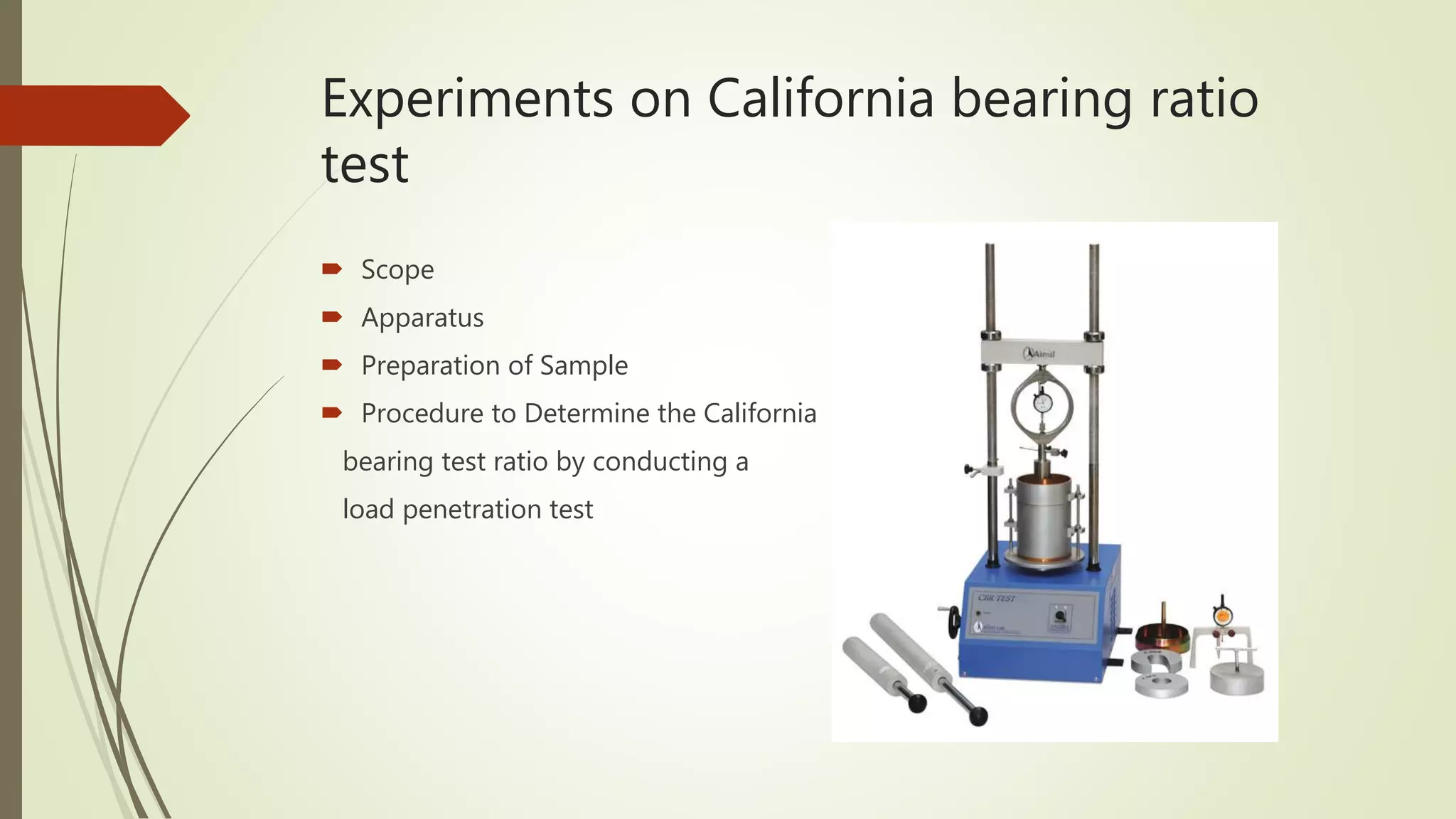
Experiments on California bearing ratio
test
 Scope
 Apparatus
 Preparation of Sample
 Procedure to Determine the California
bearing test ratio by conducting a
load penetration test
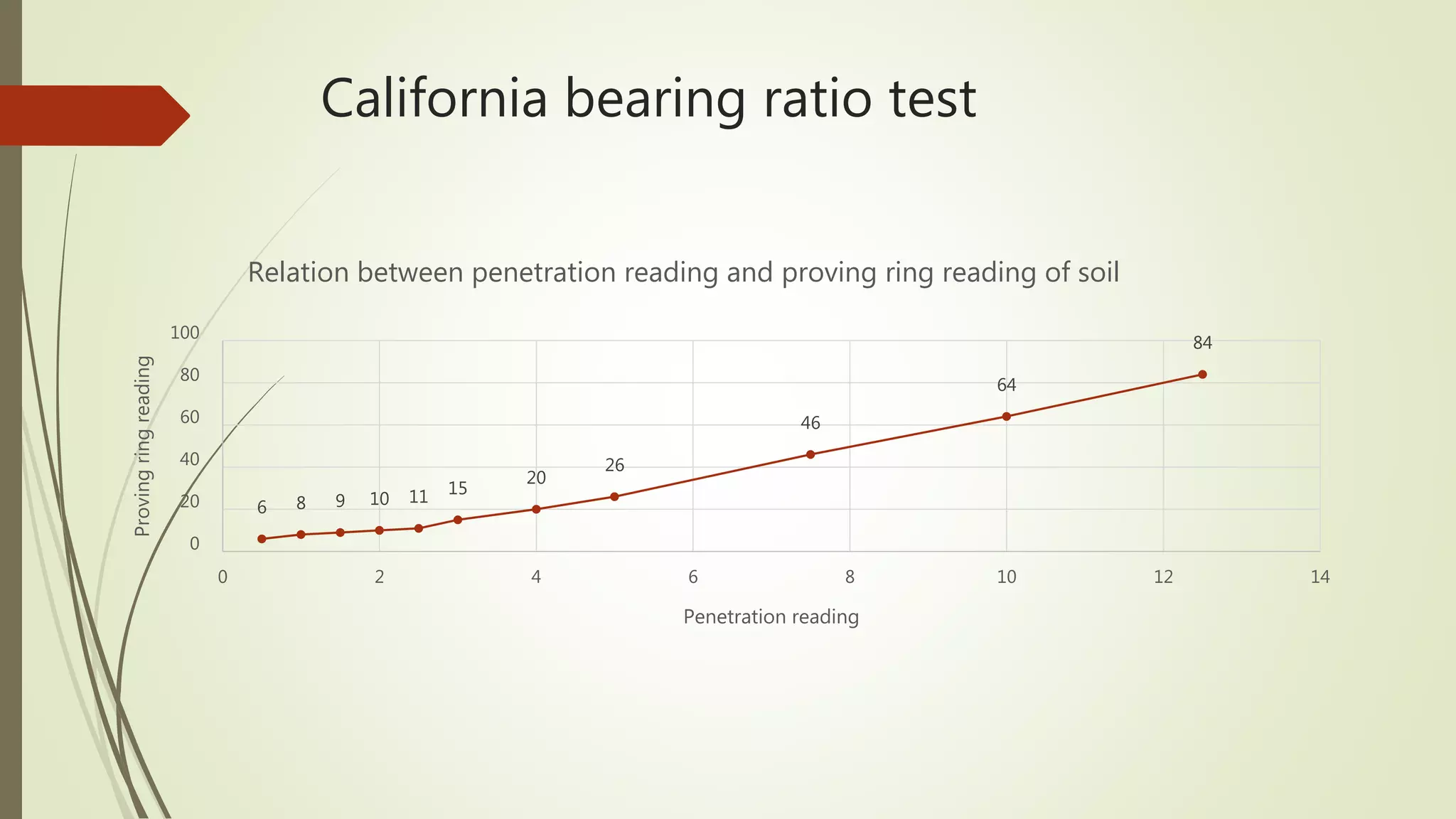
California bearing ratio test
6 8 9 10 11 15
20
26
46
64
84
0
20
40
60
80
100
0 2 4 6 8 10 12 14
Provingringreading
Penetration reading
Relation between penetration reading and proving ring reading of soil
California bearing ratio test using 7% Bitumenous Emulsions
20 32 46 62 78 90
126 142
210
282
334
0
100
200
300
400
0 2 4 6 8 10 12 14
relation between penetration reading and proving ring reading of soil using
Bitumenous Emulsions
Conclusion
1. Base On Proctor Compaction Test On Soil Sample
Maximum Dry Density Is 2.019 g/cc
Optimum Moisture Content Is 13.9%
 By Addition Of 6% BITUMENOUS EMULSION To The Soil Sample
Increase In Maximum Dry Density And Decrease In Optimum Moisture Content
Maximum Dry Density Is 2.113 g/cc
Optimum Moisture Content Is 9.9%
 By Addition Of 7% BITUMENOUS EMULSION To The Soil Sample
Maximum Dry Density Is 1.985 g/cc
Optimum Moisture Content Is 9.92%
 By Addition Of 8% BITUMENOUS EMULSION To The Soil Sample
Maximum Dry Density Is 2.034 g/cc
Optimum Moisture Content Is 9.8%
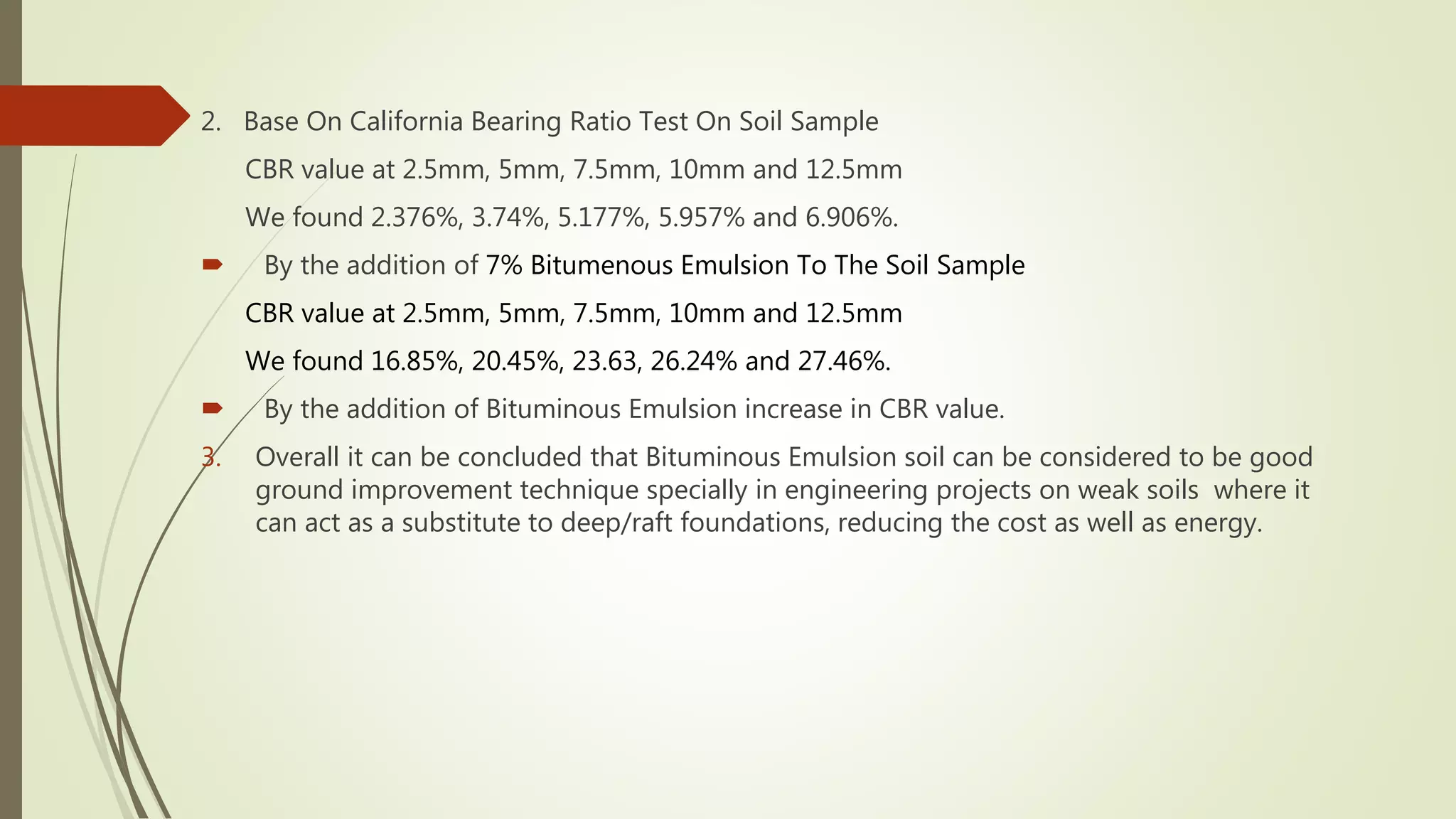
2. Base On California Bearing Ratio Test On Soil Sample
CBR value at 2.5mm, 5mm, 7.5mm, 10mm and 12.5mm
We found 2.376%, 3.74%, 5.177%, 5.957% and 6.906%.
 By the addition of 7% Bitumenous Emulsion To The Soil Sample
CBR value at 2.5mm, 5mm, 7.5mm, 10mm and 12.5mm
We found 16.85%, 20.45%, 23.63, 26.24% and 27.46%.
 By the addition of Bituminous Emulsion increase in CBR value.
3. Overall it can be concluded that Bituminous Emulsion soil can be considered to be good
ground improvement technique specially in engineering projects on weak soils where it
can act as a substitute to deep/raft foundations, reducing the cost as well as energy.
Soil Types
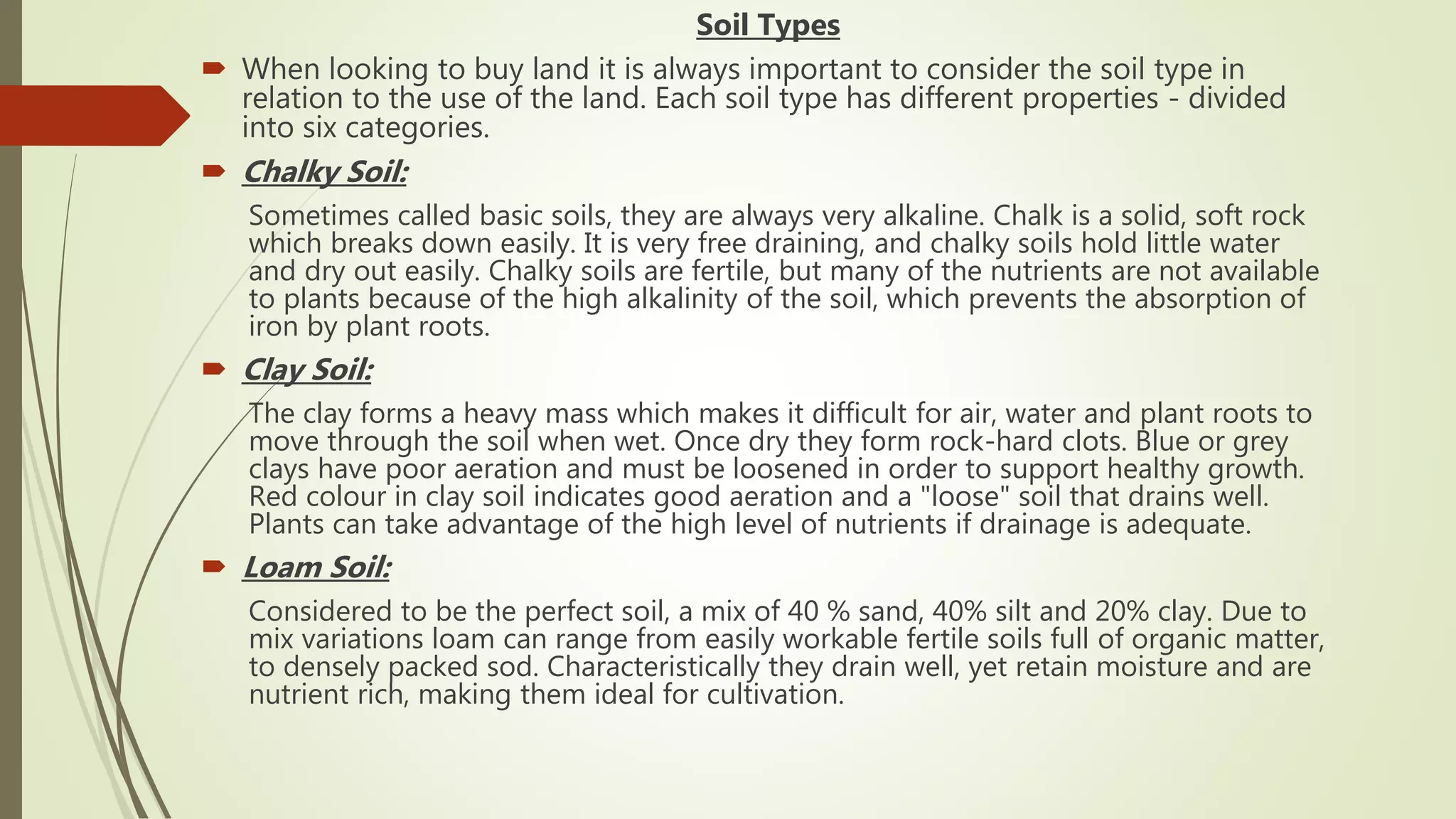
 When looking to buy land it is always important to consider the soil type in
relation to the use of the land. Each soil type has different properties - divided
into six categories.
 Chalky Soil:
Sometimes called basic soils, they are always very alkaline. Chalk is a solid, soft rock
which breaks down easily. It is very free draining, and chalky soils hold little water
and dry out easily. Chalky soils are fertile, but many of the nutrients are not available
to plants because of the high alkalinity of the soil, which prevents the absorption of
iron by plant roots.
 Clay Soil:
The clay forms a heavy mass which makes it difficult for air, water and plant roots to
move through the soil when wet. Once dry they form rock-hard clots. Blue or grey
clays have poor aeration and must be loosened in order to support healthy growth.
Red colour in clay soil indicates good aeration and a "loose" soil that drains well.
Plants can take advantage of the high level of nutrients if drainage is adequate.
 Loam Soil:
Considered to be the perfect soil, a mix of 40 % sand, 40% silt and 20% clay. Due to
mix variations loam can range from easily workable fertile soils full of organic matter,
to densely packed sod. Characteristically they drain well, yet retain moisture and are
nutrient rich, making them ideal for cultivation.
 Peat Soil:
Provided they are not too acid and have effective sub drainage, these are rich in plant foods.
Converting existing soil into a peat type soil is achieved by adding large amounts of organic
matter. You must avoid making your soil too acid though, and careful choice of organic matter is
needed.
 Sandy Soils:
Sandy soils generally have a fine grained texture. They retain very little in the way of water,
fertilizers or nutrients which means they are extremely poor. Prone to over-draining and summer
dehydration, and in wet weather can have problems retaining moisture and nutrients and can
only be revitalized by the addition of organic matter. Sandy soils are light and easy to dig, hoe
and weed.
 Silty Soil:
Silty soil is considered to be among the most fertile of soils. Silt is often found in river estauries,
because the fine particles are washed downstream and deposited when the water flows more
slowly. It is also soft and smooth, with individual pieces close together. It too holds a lot of water,
but the slightly larger particles make it a little better at draining than clay.

Stabilization of soil using bitumenous emulsions

  • 1.
    Stabilization of soilusing BITUMENOUS EMULSIONS Presented by: k.Prashanth kumar
  • 2.
    Introduction: For any land-basedstructure, the foundation is very important and has to be strong to support the entire structure. in order for the foundation to be strong, the soil around it plays a very critical role. so, to work with soils, we need to have proper knowledge about their properties and factors which affect their behavior. the process of soil stabilization helps to achieve the required properties in a soil needed for the construction work.
  • 3.
    From the beginningof construction work, the necessity of enhancing soil properties has come to the light. Ancient civilizations of the Chinese, Romans and Incas utilized various methods to improve soil strength etc., some of these methods were so effective that their buildings and roads still exist. Here, in this project, soil stabilization has been done with the help of randomly distributed polypropylene fibers obtained from waste materials. the improvement in the shear strength parameters has been stressed upon and comparative studies have been carried out using different methods of shear resistance measurement.
  • 4.
    Definitions and Terminology: SOIL CLAY LIME CEMENT ATTERBERGLIMITS LL (LIQUID LIMIT) PL (PLASTIC LIMIT) SL (SHRINKAGE LIMIT) DENSITY PI (PLASTICITY INDEX) STABILIZING ADDITIVE
  • 5.
    Soil – soilis sediment or other unconsolidated accumulation of solid particles produced by the physical and/or chemical disintegration of rock, soil may or may not contain organic material (ASTMD2487). Clay – Clay is type of cohesive soil composed of very fine material particles; clay is one of the fine-grained soils defined by the Unified Soil Classification System. Lime – Lime is a white or grayish-white, odorless, lumpy, very slightly water soluble solid, CaO, that when combined with water forms Calcium Hydroxide (Slaked Lime). Calcium Hydroxide is chiefly used in mortars, plasters, and cements. Cement – Portland cement is hydraulic cement made by heating limestone and clay mixture in a kiln and pulverizing the resulting material.
  • 6.
    Atterberg Limits –The Atterberg Limits are a basic measure of the nature of a fine – grained soil. Depending on the water content of the soil, it may appear four states: solid, semi-solid, plastic and liquid. In each state the consistency behavior of a soil is different and thus so, are its engineering properties. Thus, the boundary between each state can be defined based on soil behavior. limits were put forward by Albert Atterberg, a Swedish chemist, in the late 1800’s, and later redefined by Arthur Casagrande.
  • 7.
    ll (liquid limit)– The liquid limit of a fine-grained soil is a boundary between the liquid and plastic state of that particular soil, expressed as a moisture content percentage (by weight). Pl (plastic limit) – The plastic limit of a fine-grained soil is the boundary between the plastic and semi-solid states for that particular soil, expressed as a moisture percentage (by weight). SL (Shrinkage Limit) – The shrinkage limit of a fine grained soil is defined as the moisture content at which no further volume change occurs with further reduction in moisture content (SL represents the amount of water required to fully saturated the soil (100% of Saturation))
  • 8.
    Density – densityis the measure of the relative weight of any material compared to its occupied volume, expressed in kilograms per cubic meter (pounds per cubic foot). the increase in density is limited only by the degree of solidity that can be achieved in a material by total elimination of voids between the particles in the mass. PI (plasticity index or ip) – PI is the numerical difference of liquid limit and plastic limit of a fine grained soil. Ip= wl - w p Stabilizing additive – A stabilizing additive is a mechanical, chemical or bituminous additive (or other material) used to maintain or increase the strength and durability, decrease the moisture sensitivity, or otherwise improve the engineering properties of a soil or other materials used for construction.
  • 9.
    SOIL STABLIZATION: PRINCIPLES OFSOIL STABILIZATION  Evaluating the soil properties of the area under consideration.  Deciding the property of soil which needs to be altered to get the design value and choose the effective and economical method for stabilization.  Designing the Stabilized soil mix sample and testing it in the lab for intended stability and durability values.
  • 10.
    Advantages:  It ImprovesThe Strength Of The Soil, Thus, Increasing The Soil Bearing Capacity.  It Is More Economical Both In Terms Of Cost And Energy To Increase The Bearing Capacity Of the Soil Rather Than Going For Deep Foundation Or Raft Foundation.  It Is Also Used To Provide More Stability To The Soil In Slopes Or Other Such Places.  Sometimes Soil Stabilization Is Also Used To Prevent Soil Erosion Or Formation Of Dust, Which is Very Useful Especially In Dry And Arid Weather.  Stabilization Is Also Done For Soil Water-proofing; This Prevents Water From Entering Into The soil And Hence Helps The Soil From Losing Its Strength.  It Helps In Reducing The Soil Volume Change Due To Change In Temperature Or Moisture content.  Stabilization Improves The Workability And The Durability Of The Soil.
  • 11.
    Methods of stabilization: I.Mechanical Method Of Stabilization. II. Additive method of stabilization: a. Cementation Stabilization. b. Bituminous Stabilization. c. Argillation Stabilization. d. Silicification Stabilization. e. Electrochemical Stabilization. f. Thermal Stabilization. g. Fiber Reinforcements.  Oriented Fiber Reinforcement.  Random Fiber Reinforcement.
  • 12.
    Uses of stabilization: Quality Improvement: The most common improvements achieved through stabilization include better soil gradation, reduction of plasticity index or swelling potential, and increases in durability and strength. in wet weather, stabilization may also be used to provide a working platform for construction operations. these types of soil quality improvement are referred to as soil modification  Thickness reduction: The strength and stiffness of a soil layer can be improved through the use of additives to permit a reduction in design thickness of the stabilized materials compared with an unsterilized or unbound material. Procedures for designing pavements that includes stabilized soils are presented in TM 5-822-5/AFM 88-7, Chap. 3, TM 5-825-2/AFM 88-6, Chap. 2, TM 5-825-3/AFM 88-6, Chap. 3. The design thickness of abase or sub-base course can be reduced if the stabilized materials meet the specified gradation, strength, stability and durability requirements indicated in this Technical Manual for the particular type of material.
  • 13.
  • 14.
    What are emulsions? Anemulsion is a dispersion Of small droplets of one liquid in another liquid. Emulsions can be formed by any two immiscible liquids, but in most emulsions one of the phases is water. Oil-in-water (O/W) emulsions are those in which the continuous phase is water and the disperse (Droplet) phase is an “oily” liquid. Water-in-oil (W/O) “inverted” emulsions are those in which the continuous phase is an oil and the disperse phase is water.
  • 15.
    Types of emulsions: A.O/W emulsion, B. W/O emulsion, C. multiple W/O/W
  • 16.
    Bitumen Emulsion IsA 2-phase System Consisting Of  Bitumen  Water  Other Additives • The bitumen is dispersed throughout the water phase in form of discrete globules, held in suspension by electrostatic charges stabilized by emulsifier • The Emulsion contains 40-75% of bitumen,.1-2.5%emulsifier,25- 60%water and other ingredients • Typically of .1 – 50 µm in diameter. • It is mainly dark brown in color after breaking changes to black.
  • 17.
    WHY BITUMEN EMULSIONS? Primary Objective Is To Use For Road Surfacing Without Much Heating.  As main advantages this improves the handling of bitumen at room temperature.  Promotes surface interactions .  Its mixture with the aggregate attains full strength.  Economical and saves energy .  Reduced atmosphere pollution.  Water can also added before use to dilute as per requirement.  Rains can not effect it at the time of use and after use.
  • 18.
    Stabilization of chalkysoil Chalky Soil: Sometimes called basic soils, they are always very alkaline. Chalk is a solid, soft rock which breaks down easily. It is very free draining, and chalky soils hold little water and dry out easily. Chalky soils are fertile, but many of the nutrients are not available to plants because of the high alkalinity of the soil, which prevents the absorption of iron by plant roots.
  • 19.
    Experiments on Proctorcompaction test  Scope  Apparatus  Preparation of Sample  Procedure to Determine the relationship between the dry density of the soil and the moisture content of the soil.
  • 20.
    Proctor compaction test 1.878 1.923 1.95 1.971 2.019 1.942 1.85 1.9 1.95 2 2.05 02 4 6 8 10 12 14 16 18 Drydensitying/cc Moisture content % Relation between dry density and moisture content% of soil Computing from graph Optimum Moisture Content (OMC) = 13.9% Maximum Dry Density (MDD) = 2.019 g/cc
  • 21.
    Proctor Compaction TestUsing 6% Bitumenous Emulsions 2.019 2.043 2.113 2 1.9 2 2.1 2.2 0 2 4 6 8 10 12 14 Drydensitying/cc Moisture content % Relation between Dry density and moisture content% of soil using 6% of Bitumenous Emulsions Computing from graph Optimum Moisture Content (OMC) = 9.9% Maximum Dry Density (MDD) = 2.113 g/cc
  • 22.
    Proctor Compaction TestUsing 7% Bitumenous Emulsions 1.968 1.971 1.985 1.966 1.96 1.98 2 0 2 4 6 8 10 12 14 Drydensitying/cc Moisture content % Relation between Dry density and moisture content% of soil using 7% of Bitumenous Emulsions Computing from graph Optimum Moisture Content (OMC) = 9.92% Maximum Dry Density (MDD) = 1.985 g/cc
  • 23.
    Proctor Compaction TestUsing 8% Bitumenous Emulsions 1.896 2 2.034 1.834 1.8 2 2.2 0 2 4 6 8 10 12 14 Drydensitying/c Moisture content % Relation between Dry density and moisture content% of soil using 8% of Bitumenous Emulsions Computing from graph Optimum Moisture Content (OMC) = 9.8% Maximum Dry Density (MDD) = 2.034 g/cc
  • 24.
    Experiments on Californiabearing ratio test  Scope  Apparatus  Preparation of Sample  Procedure to Determine the California bearing test ratio by conducting a load penetration test
  • 25.
    California bearing ratiotest 6 8 9 10 11 15 20 26 46 64 84 0 20 40 60 80 100 0 2 4 6 8 10 12 14 Provingringreading Penetration reading Relation between penetration reading and proving ring reading of soil
  • 26.
    California bearing ratiotest using 7% Bitumenous Emulsions 20 32 46 62 78 90 126 142 210 282 334 0 100 200 300 400 0 2 4 6 8 10 12 14 relation between penetration reading and proving ring reading of soil using Bitumenous Emulsions
  • 27.
    Conclusion 1. Base OnProctor Compaction Test On Soil Sample Maximum Dry Density Is 2.019 g/cc Optimum Moisture Content Is 13.9%  By Addition Of 6% BITUMENOUS EMULSION To The Soil Sample Increase In Maximum Dry Density And Decrease In Optimum Moisture Content Maximum Dry Density Is 2.113 g/cc Optimum Moisture Content Is 9.9%  By Addition Of 7% BITUMENOUS EMULSION To The Soil Sample Maximum Dry Density Is 1.985 g/cc Optimum Moisture Content Is 9.92%  By Addition Of 8% BITUMENOUS EMULSION To The Soil Sample Maximum Dry Density Is 2.034 g/cc Optimum Moisture Content Is 9.8%
  • 28.
    2. Base OnCalifornia Bearing Ratio Test On Soil Sample CBR value at 2.5mm, 5mm, 7.5mm, 10mm and 12.5mm We found 2.376%, 3.74%, 5.177%, 5.957% and 6.906%.  By the addition of 7% Bitumenous Emulsion To The Soil Sample CBR value at 2.5mm, 5mm, 7.5mm, 10mm and 12.5mm We found 16.85%, 20.45%, 23.63, 26.24% and 27.46%.  By the addition of Bituminous Emulsion increase in CBR value. 3. Overall it can be concluded that Bituminous Emulsion soil can be considered to be good ground improvement technique specially in engineering projects on weak soils where it can act as a substitute to deep/raft foundations, reducing the cost as well as energy.
  • 29.
    Soil Types  Whenlooking to buy land it is always important to consider the soil type in relation to the use of the land. Each soil type has different properties - divided into six categories.  Chalky Soil: Sometimes called basic soils, they are always very alkaline. Chalk is a solid, soft rock which breaks down easily. It is very free draining, and chalky soils hold little water and dry out easily. Chalky soils are fertile, but many of the nutrients are not available to plants because of the high alkalinity of the soil, which prevents the absorption of iron by plant roots.  Clay Soil: The clay forms a heavy mass which makes it difficult for air, water and plant roots to move through the soil when wet. Once dry they form rock-hard clots. Blue or grey clays have poor aeration and must be loosened in order to support healthy growth. Red colour in clay soil indicates good aeration and a "loose" soil that drains well. Plants can take advantage of the high level of nutrients if drainage is adequate.  Loam Soil: Considered to be the perfect soil, a mix of 40 % sand, 40% silt and 20% clay. Due to mix variations loam can range from easily workable fertile soils full of organic matter, to densely packed sod. Characteristically they drain well, yet retain moisture and are nutrient rich, making them ideal for cultivation.
  • 30.
     Peat Soil: Providedthey are not too acid and have effective sub drainage, these are rich in plant foods. Converting existing soil into a peat type soil is achieved by adding large amounts of organic matter. You must avoid making your soil too acid though, and careful choice of organic matter is needed.  Sandy Soils: Sandy soils generally have a fine grained texture. They retain very little in the way of water, fertilizers or nutrients which means they are extremely poor. Prone to over-draining and summer dehydration, and in wet weather can have problems retaining moisture and nutrients and can only be revitalized by the addition of organic matter. Sandy soils are light and easy to dig, hoe and weed.  Silty Soil: Silty soil is considered to be among the most fertile of soils. Silt is often found in river estauries, because the fine particles are washed downstream and deposited when the water flows more slowly. It is also soft and smooth, with individual pieces close together. It too holds a lot of water, but the slightly larger particles make it a little better at draining than clay.