Test Bank—Chapter One (Data Representation)
Multiple Choice Questions
1. Which of the following Boolean operations produces the output 1 for the fewest number of input
patterns?
A. AND B. OR C. XOR
ANSWER: A
2. Which of the following best describes the NOR operation?
A. An XOR followed by a NOT B. An OR followed by a NOT
C. A NOT followed by a NOT C. An AND followed by a NOT
ANSWER: B
3. Which of the following bit patterns cannot be expressed in hexadecimal notation?
A. 11111111 B. 1001 C. 110011 D. 100000000001
ANSWER: C
4. Which of the following is the binary representation of 4 5/8?
A. 100.11 B. 10.011 C. 110.101 D. 100.101
ANSWER: D
5. Which of the following bit patterns represents the value 5 in two’s complement notation?
A. 00011010 B. 11111011 C. 00000101 D. 11111011
ANSWER: C
6. Which of the following bit patterns represents the value -5 in two’s complement notation?
A. 00011010 B. 11111011 C. 00000101 D. 11111011
ANSWER: D
7. What is the result of the following addition problem (using two’s compliment notation)?
00001111
+ 10101010
A. 011000101 B. 10111001 C. 01010101 D. 10110101
ANSWER: B
8. What is the result of the following subtraction problem (using two’s compliment notation)?
00001111
- 10101010
A. 011000101 B. 10111001 C. 01010101 D. 10110101
ANSWER: A
9. In which of the following addition problems (using two’s complement notation) does an overflow error
occur?
A. 0011 B. 0100 C. 1100
+ 1010 + 0100 + 1100
ANSWER: B
10. Which of the following representations in two’s complement notation represents the largest value?
A. 00000010 B. 11111111 C. 00000001 D. 11111110
ANSWER: A
11. Which of the following representations in two’s complement notation represents the smallest value?
A. 00000010 B. 11111111 C. 00000001 D. 11111100
ANSWER: D
12. Which of the following bit patterns (represented in hexadecimal notation) represents a negative number
in two’s complement notation?
A. 7F B. 55 C. A6 D. 08
ANSWER: C
13. Which of the following bit patterns (represented in hexadecimal notation) represents a positive number
in two’s complement notation?
A. 7F B. F7 C. A8 D. 8A
ANSWER: A
14. What value is represented by the bit pattern 01011100 when interpreted using floating-point format in
which the most significant bit is the sign bit, the next three bits represent the exponent field in excess
notation, and the last four bits represent the mantissa?
A. -1 1/2 B. 1 1/2 C. -3/8 D. 3/8
ANSWER: B
15. Which of the following values cannot be stored accurately using a floating-point format in which the
most significant bit is the sign bit, the next three bits represent the exponent field in excess notation, and the
last four bits represent the mantissa?
A. 2 1/2 B. 3/16 C. 7 D. 6 1/4
ANSWER: D
16. Which of the following bit-patterns represents the smallest value using the floating-point format in
which the most significant bit is the sign bit, the next three bits represent the exponent field in excess
notation, and the last four bits represent the mantissa?
A. 01001000 B. 01011000 C. 00101000 D. 01111000
ANSWER: C
17. Which of the following data storage systems provides the most efficient random access to individual
data items?
A. Main memory B. Magnetic disk C. CDs/DVDs D. Flash drives
ANSWER: A
18. Which of the following storage systems is best suited for storing and retrieving long strings of data that
are processed in their sequential order?
A. Main memory B. Magnetic disk C. CDs/DVDs
ANSWER: C
19. Which of the following mass storage system does not require physical motion?
A. Magnetic tape B. Magnetic disk C. DVDs D. Flash drives
ANSWER: D
20. Assuming that each of the following bit patterns originally had even parity, which one contains an
error?
A. 100110100 B. 110000011 C. 000011000 D. 100001001
ANSWER: D
21. How many errors per pattern could be corrected when using an error-correcting code in which any two
code patterns differ by a Hamming distance of 8?
A. 3 B. 4 C. 5 D. 6
ANSWER: A
22. Which of the following is a possible LZW compression of the message “xyz xyz xyz”?
A. 1234 B. 1234545 C. 232 D. 12
ANSWER: B
23. How many different symbols can be encoded using Unicode?
A. 256 B. 4,096 C. 65,536 D. 1,046,476
ANSWER: C
24. Which of the following systems is least efficient when encoding numeric values?
A. Two’s complement notation B. Excess notation
C. ASCII D. Floating-point notation
ANSWER: C
25. Which of the following is a means of encoding music?
A. ASCII B. MIDI C. JPEG D. GIF
ANSWER: B
26. Which of the following provides a compressed representation of an image by limiting the number of
different pixel colors to 256, thereby enabling each pixel in an image to be represented by a single byte
whose value indicates which of a palette of entries represents the pixel’s color?
A. ASCII B. MPEG C. JPEG D. GIF
ANSWER: D
Fill-in-the-blank/Short-answer Questions
1. A computer’s main memory consists of numerous memory cells, each of which contains ________ bits.
Each memory cell is identified by a numeric value called the cell’s _________.
ANSWER: eight, address
2. Represent the bit pattern 1011010010011111 in hexadecimal notation.
_________
ANSWER: B49F
3. A7DF is the hexadecimal representation for what bit pattern?
____________
ANSWER: 1010 0111 1101 1111
4. How many different bit patterns can be formed if each must consist of exactly 6 bits?
____________
ANSWER: 64
5. How many bits are needed to represent 1024 different bit patterns?
____________
ANSWER: 10
6. Translate each of the following binary representations into its equivalent base ten representation.
A. 1100 __________
B. 10.011 __________
C. 0.01 __________
D. 10001 __________
ANSWER: A. 12 B. 2 3/8 C. 1/4 D. 17
7. Rewrite each of the following values (represented in base ten notation) in binary notation.
A. 7 __________
B. 23 __________
C. 2 1/4 __________
D. 5/8 __________
ANSWER: A. 111 B. 10111 C. 10.01 D. 0.101
8. If the patterns 101.11 and 1.011 represent values in binary notation, what is the binary representation of
their sum?
____________
ANSWER: 111.001
9. Using a two’s complement notation system in which each value is represented by a pattern of six bits,
represent the value 3.
____________
ANSWER: 000011
10. Using a two’s complement notation system in which each value is represented by a pattern of six bits,
represent the value -3.
____________
ANSWER: 111101
11. What is the largest positive integer that can be represented in a two’s complement system in which
each value is represented by eight bits?
____________
ANSWER: 127 (represented by 01111111)
12. What is the smallest negative integer that can be represented in a two’s complement system in which
each value is represented by eight bits?
____________
ANSWER: -128 (represented by 10000000)
13. In a two’s complement system, what value is represented by the pattern 11111111111111001?
____________
ANSWER: -7
14. When using two’s complement notation, what bit pattern represents the negation of 01101010?
____________
ANSWER: 10010110
15. What value is represented by each of the following patterns in excess notation?
A. 10000 ____ B. 0110 ____ C. 1011 ____
ANSWER: A. 0, B. -2, C. 3
16. Using an 8-bit floating-point format in which the most significant bit is the sign bit, the next three bits
represent the exponent field in excess notation, and the last four bits represent the mantissa, write the bit
pattern that represents the value 1 3/4. (Use normalized form.)
____________
ANSWER: 01011110
17. What is the largest value that can be represented in a floating-point system in which each value is
encoded by a byte whose most significant bit is the sign bit, the next three bits represent the exponent field
in excess notation, and the last four bits represent the mantissa?
____________
ANSWER: 7 1/2 (represented as 01111111)
18. Which of the following addition problems cannot be solved accurately when using a floating-point
system in which each value is encoded by a byte whose most significant bit is the sign bit, the next three
bits represent the exponent field in excess notation, and the last four bits represent the mantissa?
A. 2 1/2 + 1 3/8 B. 3 1/2 + 4 1/2 C. 7 + 3/4
____________
ANSWER: A, B, and C
19. The following is an error-correcting code in which any two patterns differ by a Hamming distance of at
least three.
Symbol Representation
A 000000
B 001111
C 010011
D 011100
E 100110
F 101001
G 110101
H 111010
Decode each of the following patterns
010011 ________ 101010 ________ 011000 ________ 101101 _______
ANSWER: C, H, D, F
20. How many errors in a single code pattern could be corrected when using an error-correcting code in
which each code pattern is a Hamming distance of at least seven from any other code pattern?
____________
ANSWER: 3
21. The following is a message that was originally encoded so that each pattern had odd parity. Circle the
patterns in which an error has definitely occurred.
101110101 111110000 100010010 000000000 111111111 010001000 100111101
______________________________________
ANSWER: First, fourth, sixth, and seventh
22. Data compression techniques apply various principles to reduce the size of data. One, called
_______________________, avoids repeating long strings of the same data item. Another, called
_______________________, encodes the difference between consecutive blocks of data rather than
encoding each block in its entirety. Still another, called _________________________, uses short bit
patterns to encode frequently occurring items and longer patterns to encode less frequent items.
ANSWER: Run-length encoding, relative encoding, and frequency-dependent encoding.
Vocabulary (Matching) Questions
The following is a list of terms from the chapter along with descriptive phrases that can be used to produce
questions (depending on the topics covered in your course) in which the students are ask to match phrases
and terms. An example would be a question of the form, “In the blank next to each phrase, write the term
from the following list that is best described by the phrase.”
Term Descriptive Phrase
bit Binary digit
Boolean operation AND, OR, XOR, NOT
address A numeric value used to identify a memory cell
hexadecimal notation An efficient way of representing bit patterns
track A circle on the surface of disk platter on which data is written/read
sector A segment of a track in a mass storage system
cylinder A set of tracks at a given position of the read/write heads
seek time The time required to move the read/write heads from one track to
another
latency time The average amount of time required for the desired data to rotate
around to the read/write head
transfer rate The rate at which data can be written to or read from a device
zoned-bit recording A means of increasing the storage capacity of a magnetic disk system
buffer A storage area used to hold data on a temporary basis, often as a step
in transferring the data from one device to another
ISO An international organization for establishing standards
ANSI A major standardization organization within the United States
ASCII A system developed by the American Standards Institute for encoding
text.
flip-flop A digital circuit capable of holding a single digit
two’s complement notation A means of encoding whole numbers
floating-point notation A means of encoding numeric values that may involve fractions
truncation An error that may occur when using floating-point notation
pixel A small part of an image
GIF A means of compressing an image file by restricting the number of
colors available
JPEG A means of compressing images by blurring the boundaries between
different colors while maintaining all brightness information
Unicode A means of encoding text in which each symbol is represented by 16
Bits
SD card An application of flash technology
Flash memory A mass storage device that traps electrons in tiny chambers of silicon
dioxide
LZW An example of adaptive dictionary encoding
MIDI A means of encoding music in terms of notes and instruments rather
than actual audio
Key field A part of a logical record in a file used to identify the record.
VLSI A means of constructing complex circuitry in a very small space.
General Format Questions
1. Describe how a computer can produce an incorrect answer when performing numerical computations
even though it has not malfunctioned.
ANSWER: Most students will probably refer to overflow and truncation errors.
2. Describe how the concept of Hamming distance is used to produce an error-correcting code.
ANSWER: By designing a code in which each pattern has a Hamming distance of n from any other pattern,
patterns with fewer than n/2 errors can be corrected by replacing them with the code pattern that is closest.
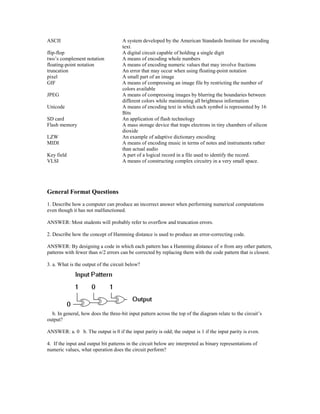
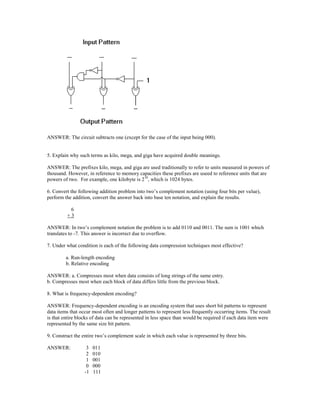
3. a. What is the output of the circuit below?
b. In general, how does the three-bit input pattern across the top of the diagram relate to the circuit’s
output?
ANSWER: a. 0 b. The output is 0 if the input parity is odd; the output is 1 if the input parity is even.
4. If the input and output bit patterns in the circuit below are interpreted as binary representations of
numeric values, what operation does the circuit perform?
ANSWER: The circuit subtracts one (except for the case of the input being 000).
5. Explain why such terms as kilo, mega, and giga have acquired double meanings.
ANSWER: The prefixes kilo, mega, and giga are used traditionally to refer to units measured in powers of
thousand. However, in reference to memory capacities these prefixes are useed to reference units that are
powers of two. For example, one kilobyte is 210
, which is 1024 bytes.
6. Convert the following addition problem into two’s complement notation (using four bits per value),
perform the addition, convert the answer back into base ten notation, and explain the results.
6
+ 3
ANSWER: In two’s complement notation the problem is to add 0110 and 0011. The sum is 1001 which
translates to -7. This answer is incorrect due to overflow.
7. Under what condition is each of the following data compression techniques most effective?
a. Run-length encoding
b. Relative encoding
ANSWER: a. Compresses most when data consists of long strings of the same entry.
b. Compresses most when each block of data differs little from the previous block.
8. What is frequency-dependent encoding?
ANSWER: Frequency-dependent encoding is an encoding system that uses short bit patterns to represent
data items that occur most often and longer patterns to represent less frequently occurring items. The result
is that entire blocks of data can be represented in less space than would be required if each data item were
represented by the same size bit pattern.
9. Construct the entire two’s complement scale in which each value is represented by three bits.
ANSWER: 3 011
2 010
1 001
0 000
-1 111
-2 110
-3 101
-4 100
10. To what does the term “normalized form” refer in the context of floating-point notation?
ANSWER: Normalized form refers to a standard for positioning the bit pattern within the mantissa field.
Many values can be represented in floating-point notation by different bit patterns, only one of which is in
normalized form. Hence, restricting representations to normalized form assures that each value is
represented by a unique pattern.
11. Explain why the final version of the dictionary need not be transmitted with a message encoded using
LZW compression.
ANSWER: The dictionary can be constructed during decompression in the same way it was constructed
during compression.
12. Among the Boolean operations AND, OR, EXCLUSIVE OR, and NOT, which is least like the others?
Explain your answer.
ANSWER: There is not really a right or wrong answer. The student’s explanation is the most important
part. Most students will probably answer NOT because it has only one input whereas the others have two.
13. If a term paper consisted 42 pages, each containing 40 lines of 100 symbols each (counting each space
as a symbol), was to be encoded using Unicode, how many bytes of storage space would be required?
ANSWER: 336,000 bytes (168,000 symbols times 2 bytes per symbol)
14. Explain why adding only a few characters to a text file may increase the file’s size by several hundred
bytes and at other times may not increase the file’s size at all.
ANSWER: File space is allocated in terms of physical records, each of which is several hundred bytes in
size. Thus, the size of a file grows by physical record units rather than by byte size units.
15. In a two’s complement system, what value can be added to any other value without causing an
overflow? How many values in the system have this property? Explain your answer.
ANSWER: Adding the value 0 to any other value will not produce an overflow. However, if m is the
largest positive integer that can be represented in the system, then any value in the range 1 to m will
produce an overflow when added to m, and any value in the range -1 to -( m + 1) will produce an overflow
when added to -( m + 1).
16. Why is the rightmost bit in a string of bits considered to be the least significant bit?
ANSWER: It is the least significant digit in a number. A change to this bit will have the least effect on the
value of the number. A change to any other bit will have a greater effect on the value of the number.

資管所數位邏輯補充考卷(適用交大、政大、中山、成大)

  • 1.
    Test Bank—Chapter One(Data Representation) Multiple Choice Questions 1. Which of the following Boolean operations produces the output 1 for the fewest number of input patterns? A. AND B. OR C. XOR ANSWER: A 2. Which of the following best describes the NOR operation? A. An XOR followed by a NOT B. An OR followed by a NOT C. A NOT followed by a NOT C. An AND followed by a NOT ANSWER: B 3. Which of the following bit patterns cannot be expressed in hexadecimal notation? A. 11111111 B. 1001 C. 110011 D. 100000000001 ANSWER: C 4. Which of the following is the binary representation of 4 5/8? A. 100.11 B. 10.011 C. 110.101 D. 100.101 ANSWER: D 5. Which of the following bit patterns represents the value 5 in two’s complement notation? A. 00011010 B. 11111011 C. 00000101 D. 11111011 ANSWER: C 6. Which of the following bit patterns represents the value -5 in two’s complement notation? A. 00011010 B. 11111011 C. 00000101 D. 11111011 ANSWER: D 7. What is the result of the following addition problem (using two’s compliment notation)? 00001111 + 10101010 A. 011000101 B. 10111001 C. 01010101 D. 10110101 ANSWER: B 8. What is the result of the following subtraction problem (using two’s compliment notation)? 00001111 - 10101010
  • 2.
    A. 011000101 B.10111001 C. 01010101 D. 10110101 ANSWER: A 9. In which of the following addition problems (using two’s complement notation) does an overflow error occur? A. 0011 B. 0100 C. 1100 + 1010 + 0100 + 1100 ANSWER: B 10. Which of the following representations in two’s complement notation represents the largest value? A. 00000010 B. 11111111 C. 00000001 D. 11111110 ANSWER: A 11. Which of the following representations in two’s complement notation represents the smallest value? A. 00000010 B. 11111111 C. 00000001 D. 11111100 ANSWER: D 12. Which of the following bit patterns (represented in hexadecimal notation) represents a negative number in two’s complement notation? A. 7F B. 55 C. A6 D. 08 ANSWER: C 13. Which of the following bit patterns (represented in hexadecimal notation) represents a positive number in two’s complement notation? A. 7F B. F7 C. A8 D. 8A ANSWER: A 14. What value is represented by the bit pattern 01011100 when interpreted using floating-point format in which the most significant bit is the sign bit, the next three bits represent the exponent field in excess notation, and the last four bits represent the mantissa? A. -1 1/2 B. 1 1/2 C. -3/8 D. 3/8 ANSWER: B 15. Which of the following values cannot be stored accurately using a floating-point format in which the most significant bit is the sign bit, the next three bits represent the exponent field in excess notation, and the last four bits represent the mantissa? A. 2 1/2 B. 3/16 C. 7 D. 6 1/4 ANSWER: D
  • 3.
    16. Which ofthe following bit-patterns represents the smallest value using the floating-point format in which the most significant bit is the sign bit, the next three bits represent the exponent field in excess notation, and the last four bits represent the mantissa? A. 01001000 B. 01011000 C. 00101000 D. 01111000 ANSWER: C 17. Which of the following data storage systems provides the most efficient random access to individual data items? A. Main memory B. Magnetic disk C. CDs/DVDs D. Flash drives ANSWER: A 18. Which of the following storage systems is best suited for storing and retrieving long strings of data that are processed in their sequential order? A. Main memory B. Magnetic disk C. CDs/DVDs ANSWER: C 19. Which of the following mass storage system does not require physical motion? A. Magnetic tape B. Magnetic disk C. DVDs D. Flash drives ANSWER: D 20. Assuming that each of the following bit patterns originally had even parity, which one contains an error? A. 100110100 B. 110000011 C. 000011000 D. 100001001 ANSWER: D 21. How many errors per pattern could be corrected when using an error-correcting code in which any two code patterns differ by a Hamming distance of 8? A. 3 B. 4 C. 5 D. 6 ANSWER: A 22. Which of the following is a possible LZW compression of the message “xyz xyz xyz”? A. 1234 B. 1234545 C. 232 D. 12 ANSWER: B 23. How many different symbols can be encoded using Unicode? A. 256 B. 4,096 C. 65,536 D. 1,046,476 ANSWER: C 24. Which of the following systems is least efficient when encoding numeric values?
  • 4.
    A. Two’s complementnotation B. Excess notation C. ASCII D. Floating-point notation ANSWER: C 25. Which of the following is a means of encoding music? A. ASCII B. MIDI C. JPEG D. GIF ANSWER: B 26. Which of the following provides a compressed representation of an image by limiting the number of different pixel colors to 256, thereby enabling each pixel in an image to be represented by a single byte whose value indicates which of a palette of entries represents the pixel’s color? A. ASCII B. MPEG C. JPEG D. GIF ANSWER: D Fill-in-the-blank/Short-answer Questions 1. A computer’s main memory consists of numerous memory cells, each of which contains ________ bits. Each memory cell is identified by a numeric value called the cell’s _________. ANSWER: eight, address 2. Represent the bit pattern 1011010010011111 in hexadecimal notation. _________ ANSWER: B49F 3. A7DF is the hexadecimal representation for what bit pattern? ____________ ANSWER: 1010 0111 1101 1111 4. How many different bit patterns can be formed if each must consist of exactly 6 bits? ____________ ANSWER: 64 5. How many bits are needed to represent 1024 different bit patterns? ____________ ANSWER: 10 6. Translate each of the following binary representations into its equivalent base ten representation. A. 1100 __________
  • 5.
    B. 10.011 __________ C.0.01 __________ D. 10001 __________ ANSWER: A. 12 B. 2 3/8 C. 1/4 D. 17 7. Rewrite each of the following values (represented in base ten notation) in binary notation. A. 7 __________ B. 23 __________ C. 2 1/4 __________ D. 5/8 __________ ANSWER: A. 111 B. 10111 C. 10.01 D. 0.101 8. If the patterns 101.11 and 1.011 represent values in binary notation, what is the binary representation of their sum? ____________ ANSWER: 111.001 9. Using a two’s complement notation system in which each value is represented by a pattern of six bits, represent the value 3. ____________ ANSWER: 000011 10. Using a two’s complement notation system in which each value is represented by a pattern of six bits, represent the value -3. ____________ ANSWER: 111101 11. What is the largest positive integer that can be represented in a two’s complement system in which each value is represented by eight bits? ____________ ANSWER: 127 (represented by 01111111) 12. What is the smallest negative integer that can be represented in a two’s complement system in which each value is represented by eight bits? ____________ ANSWER: -128 (represented by 10000000)
  • 6.
    13. In atwo’s complement system, what value is represented by the pattern 11111111111111001? ____________ ANSWER: -7 14. When using two’s complement notation, what bit pattern represents the negation of 01101010? ____________ ANSWER: 10010110 15. What value is represented by each of the following patterns in excess notation? A. 10000 ____ B. 0110 ____ C. 1011 ____ ANSWER: A. 0, B. -2, C. 3 16. Using an 8-bit floating-point format in which the most significant bit is the sign bit, the next three bits represent the exponent field in excess notation, and the last four bits represent the mantissa, write the bit pattern that represents the value 1 3/4. (Use normalized form.) ____________ ANSWER: 01011110 17. What is the largest value that can be represented in a floating-point system in which each value is encoded by a byte whose most significant bit is the sign bit, the next three bits represent the exponent field in excess notation, and the last four bits represent the mantissa? ____________ ANSWER: 7 1/2 (represented as 01111111) 18. Which of the following addition problems cannot be solved accurately when using a floating-point system in which each value is encoded by a byte whose most significant bit is the sign bit, the next three bits represent the exponent field in excess notation, and the last four bits represent the mantissa? A. 2 1/2 + 1 3/8 B. 3 1/2 + 4 1/2 C. 7 + 3/4 ____________ ANSWER: A, B, and C 19. The following is an error-correcting code in which any two patterns differ by a Hamming distance of at least three. Symbol Representation A 000000 B 001111 C 010011 D 011100 E 100110 F 101001 G 110101 H 111010
  • 7.
    Decode each ofthe following patterns 010011 ________ 101010 ________ 011000 ________ 101101 _______ ANSWER: C, H, D, F 20. How many errors in a single code pattern could be corrected when using an error-correcting code in which each code pattern is a Hamming distance of at least seven from any other code pattern? ____________ ANSWER: 3 21. The following is a message that was originally encoded so that each pattern had odd parity. Circle the patterns in which an error has definitely occurred. 101110101 111110000 100010010 000000000 111111111 010001000 100111101 ______________________________________ ANSWER: First, fourth, sixth, and seventh 22. Data compression techniques apply various principles to reduce the size of data. One, called _______________________, avoids repeating long strings of the same data item. Another, called _______________________, encodes the difference between consecutive blocks of data rather than encoding each block in its entirety. Still another, called _________________________, uses short bit patterns to encode frequently occurring items and longer patterns to encode less frequent items. ANSWER: Run-length encoding, relative encoding, and frequency-dependent encoding. Vocabulary (Matching) Questions The following is a list of terms from the chapter along with descriptive phrases that can be used to produce questions (depending on the topics covered in your course) in which the students are ask to match phrases and terms. An example would be a question of the form, “In the blank next to each phrase, write the term from the following list that is best described by the phrase.” Term Descriptive Phrase bit Binary digit Boolean operation AND, OR, XOR, NOT address A numeric value used to identify a memory cell hexadecimal notation An efficient way of representing bit patterns track A circle on the surface of disk platter on which data is written/read sector A segment of a track in a mass storage system cylinder A set of tracks at a given position of the read/write heads seek time The time required to move the read/write heads from one track to another latency time The average amount of time required for the desired data to rotate around to the read/write head transfer rate The rate at which data can be written to or read from a device zoned-bit recording A means of increasing the storage capacity of a magnetic disk system buffer A storage area used to hold data on a temporary basis, often as a step in transferring the data from one device to another ISO An international organization for establishing standards ANSI A major standardization organization within the United States
  • 8.
    ASCII A systemdeveloped by the American Standards Institute for encoding text. flip-flop A digital circuit capable of holding a single digit two’s complement notation A means of encoding whole numbers floating-point notation A means of encoding numeric values that may involve fractions truncation An error that may occur when using floating-point notation pixel A small part of an image GIF A means of compressing an image file by restricting the number of colors available JPEG A means of compressing images by blurring the boundaries between different colors while maintaining all brightness information Unicode A means of encoding text in which each symbol is represented by 16 Bits SD card An application of flash technology Flash memory A mass storage device that traps electrons in tiny chambers of silicon dioxide LZW An example of adaptive dictionary encoding MIDI A means of encoding music in terms of notes and instruments rather than actual audio Key field A part of a logical record in a file used to identify the record. VLSI A means of constructing complex circuitry in a very small space. General Format Questions 1. Describe how a computer can produce an incorrect answer when performing numerical computations even though it has not malfunctioned. ANSWER: Most students will probably refer to overflow and truncation errors. 2. Describe how the concept of Hamming distance is used to produce an error-correcting code. ANSWER: By designing a code in which each pattern has a Hamming distance of n from any other pattern, patterns with fewer than n/2 errors can be corrected by replacing them with the code pattern that is closest. 3. a. What is the output of the circuit below? b. In general, how does the three-bit input pattern across the top of the diagram relate to the circuit’s output? ANSWER: a. 0 b. The output is 0 if the input parity is odd; the output is 1 if the input parity is even. 4. If the input and output bit patterns in the circuit below are interpreted as binary representations of numeric values, what operation does the circuit perform?
  • 9.
    ANSWER: The circuitsubtracts one (except for the case of the input being 000). 5. Explain why such terms as kilo, mega, and giga have acquired double meanings. ANSWER: The prefixes kilo, mega, and giga are used traditionally to refer to units measured in powers of thousand. However, in reference to memory capacities these prefixes are useed to reference units that are powers of two. For example, one kilobyte is 210 , which is 1024 bytes. 6. Convert the following addition problem into two’s complement notation (using four bits per value), perform the addition, convert the answer back into base ten notation, and explain the results. 6 + 3 ANSWER: In two’s complement notation the problem is to add 0110 and 0011. The sum is 1001 which translates to -7. This answer is incorrect due to overflow. 7. Under what condition is each of the following data compression techniques most effective? a. Run-length encoding b. Relative encoding ANSWER: a. Compresses most when data consists of long strings of the same entry. b. Compresses most when each block of data differs little from the previous block. 8. What is frequency-dependent encoding? ANSWER: Frequency-dependent encoding is an encoding system that uses short bit patterns to represent data items that occur most often and longer patterns to represent less frequently occurring items. The result is that entire blocks of data can be represented in less space than would be required if each data item were represented by the same size bit pattern. 9. Construct the entire two’s complement scale in which each value is represented by three bits. ANSWER: 3 011 2 010 1 001 0 000 -1 111
  • 10.
    -2 110 -3 101 -4100 10. To what does the term “normalized form” refer in the context of floating-point notation? ANSWER: Normalized form refers to a standard for positioning the bit pattern within the mantissa field. Many values can be represented in floating-point notation by different bit patterns, only one of which is in normalized form. Hence, restricting representations to normalized form assures that each value is represented by a unique pattern. 11. Explain why the final version of the dictionary need not be transmitted with a message encoded using LZW compression. ANSWER: The dictionary can be constructed during decompression in the same way it was constructed during compression. 12. Among the Boolean operations AND, OR, EXCLUSIVE OR, and NOT, which is least like the others? Explain your answer. ANSWER: There is not really a right or wrong answer. The student’s explanation is the most important part. Most students will probably answer NOT because it has only one input whereas the others have two. 13. If a term paper consisted 42 pages, each containing 40 lines of 100 symbols each (counting each space as a symbol), was to be encoded using Unicode, how many bytes of storage space would be required? ANSWER: 336,000 bytes (168,000 symbols times 2 bytes per symbol) 14. Explain why adding only a few characters to a text file may increase the file’s size by several hundred bytes and at other times may not increase the file’s size at all. ANSWER: File space is allocated in terms of physical records, each of which is several hundred bytes in size. Thus, the size of a file grows by physical record units rather than by byte size units. 15. In a two’s complement system, what value can be added to any other value without causing an overflow? How many values in the system have this property? Explain your answer. ANSWER: Adding the value 0 to any other value will not produce an overflow. However, if m is the largest positive integer that can be represented in the system, then any value in the range 1 to m will produce an overflow when added to m, and any value in the range -1 to -( m + 1) will produce an overflow when added to -( m + 1). 16. Why is the rightmost bit in a string of bits considered to be the least significant bit? ANSWER: It is the least significant digit in a number. A change to this bit will have the least effect on the value of the number. A change to any other bit will have a greater effect on the value of the number.