單元二

組織心理學 :工作動機


              1
工作動機

 Work Motivation


人為何要   打拼      ?!

                    2
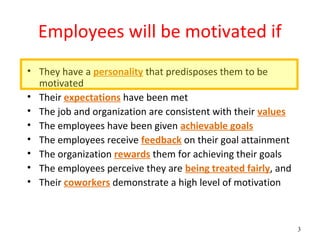
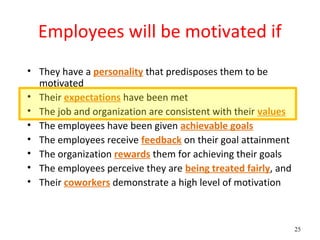
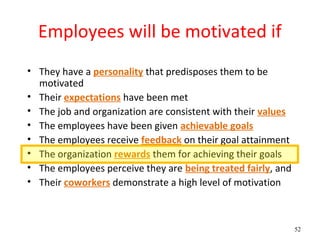
Employees will be motivated if
• They have a personality that predisposes them to be
  motivated
• Their expectations have been met
• The job and organization are consistent with their values
• The employees have been given achievable goals
• The employees receive feedback on their goal attainment
• The organization rewards them for achieving their goals
• The employees perceive they are being treated fairly, and
• Their coworkers demonstrate a high level of motivation


                                                              3
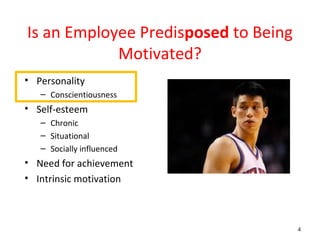
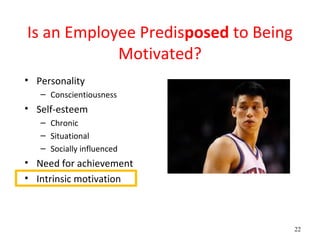
Is an Employee Predisposed to Being
            Motivated?
• Personality
   – Conscientiousness
• Self-esteem
   – Chronic
   – Situational
   – Socially influenced
• Need for achievement
• Intrinsic motivation


                                      4
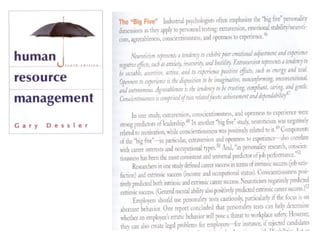
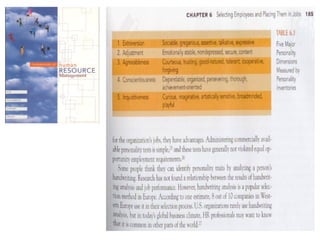
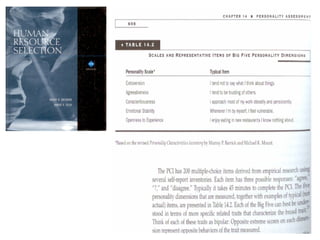
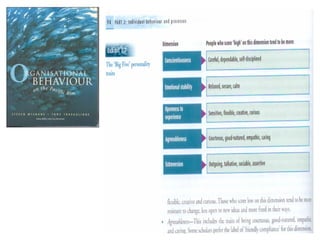
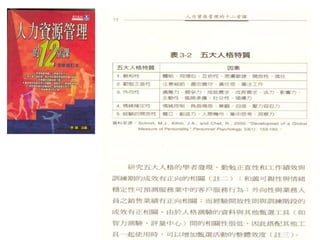
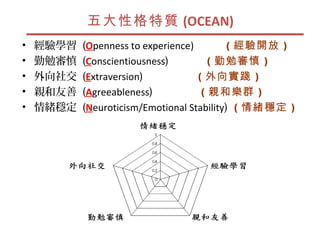
五大性格特質 (OCEAN)
•   經驗學習   (Openness to experience)        (經驗開放 )
•   勤勉審慎   (Conscientiousness)       (勤勉審慎 )
•   外向社交   (Extraversion)           (外向實踐 )
•   親和友善   (Agreeableness)          (親和樂群 )
•   情緒穩定   (Neuroticism/Emotional Stability) (情緒穩定 )
五大性格特質 (OCEAN)

• 穩定的特質
• 測驗結果之信度
• 測驗結果之效度
• 跨文化與跨國家之應用
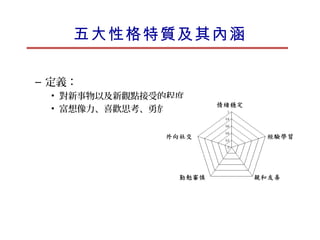
五大性格特質及其內涵
• 經驗學習 (Openness to experience)
  – 定義:
     • 對新事物以及新觀點接受的程度
     • 富想像力、喜歡思考、勇於嘗試新事物
五大性格特質及其內涵
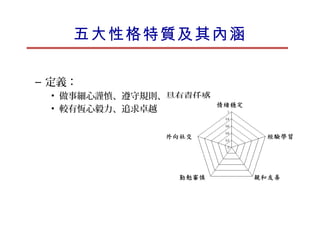
• 勤勉審慎 (Conscientiousness)
  – 定義:
    • 做事細心謹慎、遵守規則、具有責任感
    • 較有恆心毅力、追求卓越
五大性格特質及其內涵
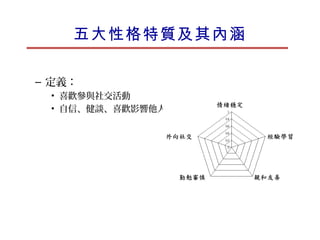
• 外向社交 (Extraversion)
  – 定義:
    • 喜歡參與社交活動
    • 自信、健談、喜歡影響他人
五大性格特質及其內涵
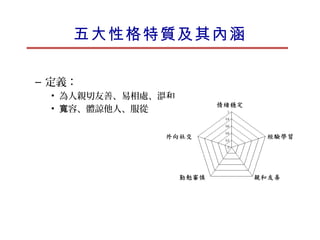
• 親和友善 (Agreeableness)
  – 定義:
    • 為人親切友善、易相處、溫和
    • 寬容、體諒他人、服從
五大性格特質及其內涵
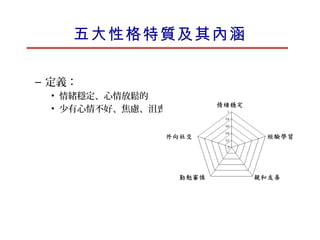
• 情緒穩定 (Neuroticism/Emotional Stability)
  – 定義:
     • 情緒穩定、心情放鬆的
     • 少有心情不好、焦慮、沮喪、適應不良
Is an Employee Predisposed to Being
            Motivated?
• Personality
   – Conscientiousness
• Self-esteem
   – Chronic
   – Situational
   – Socially influenced
• Need for achievement
• Intrinsic motivation


                                      18
Increasing Self-Esteem
• Self-esteem workshops
• Experience with success
   – self-fulfilling prophecy
   – trying new experiences and taking little steps
• Supervisor behavior
   – Pygmalion effect (是指我們會接受他人賦予我們的                     )
   – Golem effect (是指我們會接受他人賦予我們的                     )


                                                              19
Is an Employee Predisposed to Being
            Motivated?
• Personality
   – Conscientiousness
• Self-esteem
   – Chronic
   – Situational
   – Socially influenced
• Need for achievement
• Intrinsic motivation


                                      20
Need for Achievement
• McClelland (1961)
• Three needs
  – Need for
  – Need for
  – Need for


                             21
Is an Employee Predisposed to Being
            Motivated?
• Personality
   – Conscientiousness
• Self-esteem
   – Chronic
   – Situational
   – Socially influenced
• Need for achievement
• Intrinsic motivation


                                      22
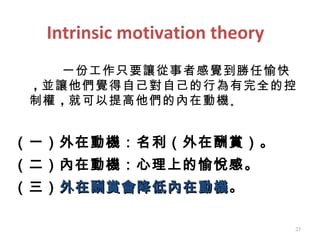
Intrinsic motivation theory
    一份工作只要讓從事者感覺到勝任愉快
 ,並讓他們覺得自己對自己的行為有完全的控
 制權 ,就可以提高他們的內在動機 。


(一)外在動機:名利(外在酬賞)。
(二)內在動機:心理上的愉悅感。
(三) 外在酬賞會降低內在動機。
    外在酬賞會降低內在動機

                                23
Employees will be motivated if
• They have a personality that predisposes them to be
  motivated
• Their expectations have been met
• The job and organization are consistent with their values
• The employees have been given achievable goals
• The employees receive feedback on their goal attainment
• The organization rewards them for achieving their goals
• The employees perceive they are being treated fairly, and
• Their coworkers demonstrate a high level of motivation


                                                              25
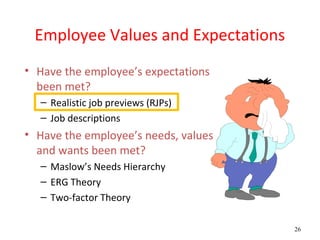
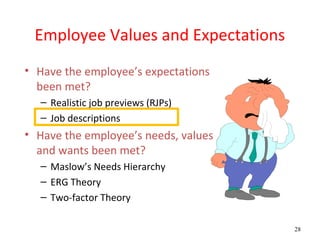
Employee Values and Expectations
• Have the employee’s expectations
  been met?
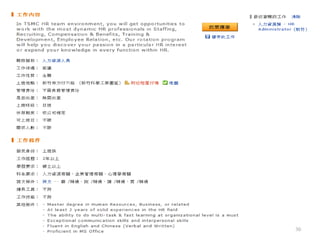
  – Realistic job previews (RJPs)
  – Job descriptions
• Have the employee’s needs, values
  and wants been met?
  – Maslow’s Needs Hierarchy
  – ERG Theory
  – Two-factor Theory

                                      26
27
Employee Values and Expectations
• Have the employee’s expectations
  been met?
  – Realistic job previews (RJPs)
  – Job descriptions
• Have the employee’s needs, values
  and wants been met?
  – Maslow’s Needs Hierarchy
  – ERG Theory
  – Two-factor Theory

                                      28
29
30
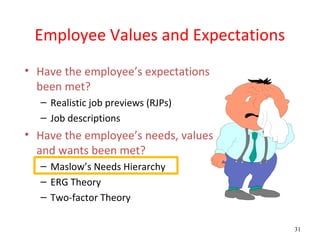
Employee Values and Expectations
• Have the employee’s expectations
  been met?
  – Realistic job previews (RJPs)
  – Job descriptions
• Have the employee’s needs, values
  and wants been met?
  – Maslow’s Needs Hierarchy
  – ERG Theory
  – Two-factor Theory

                                      31
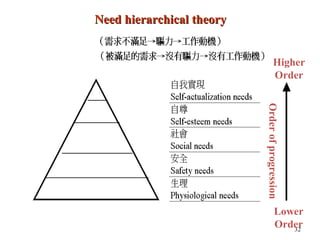
Need hierarchical theory


                                    Higher
                                    Order


                           Order of progression
                                      Lower
                                      Order
                                         32
Employee Values and Expectations
• Have the employee’s expectations
  been met?
  – Realistic job previews (RJPs)
  – Job descriptions
• Have the employee’s needs, values
  and wants been met?
  – Maslow’s Needs Hierarchy
  – ERG Theory
  – Two-factor Theory

                                      33
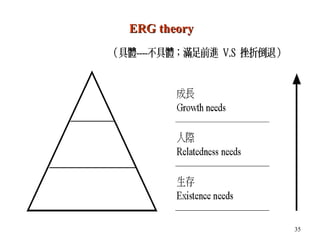
ERG Theory

• G
• R
• E


                   34
ERG theory


             35
Employee Values and Expectations
• Have the employee’s expectations
  been met?
  – Realistic job previews (RJPs)
  – Job descriptions
• Have the employee’s needs, values
  and wants been met?
  – Maslow’s Needs Hierarchy
  – ERG Theory
  – Two-factor Theory

                                      36
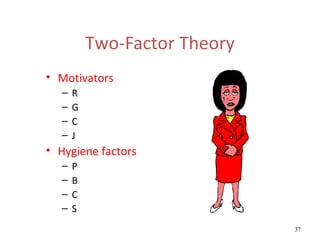
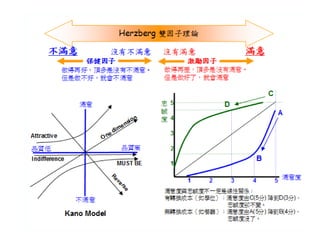
Two-Factor Theory
• Motivators
   –   R
   –   G
   –   C
   –   J
• Hygiene factors
   –   P
   –   B
   –   C
   –   S
                               37
38
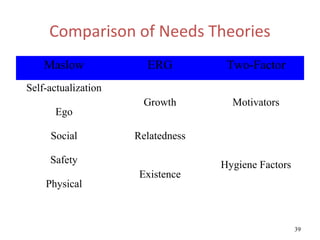
Comparison of Needs Theories
    Maslow             ERG          Two-Factor
Self-actualization
                      Growth         Motivators
      Ego

     Social          Relatedness

     Safety                        Hygiene Factors
                      Existence
    Physical


                                                     39
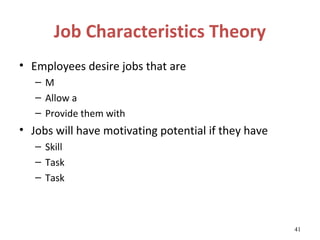
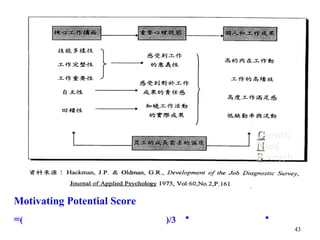
Job Characteristics Theory
• Employees desire jobs that are
   –M
   – Allow a
   – Provide them with
• Jobs will have motivating potential if they have
   – Skill
   – Task
   – Task


                                                     41
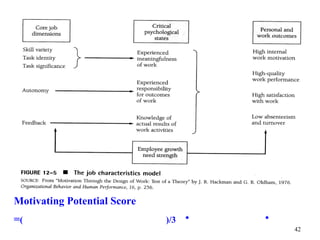
Motivating Potential Score
=(                           )/3 *   *
                                         42
Growth
                                     Need
                                     Strength


Motivating Potential Score
=(                           )/3 *    *
                                                43
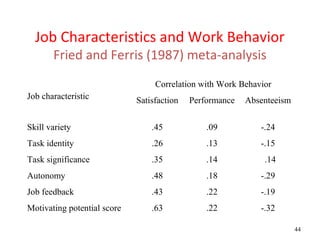
Job Characteristics and Work Behavior
       Fried and Ferris (1987) meta-analysis
                                  Correlation with Work Behavior
Job characteristic           Satisfaction   Performance   Absenteeism


Skill variety                    .45            .09          -.24
Task identity                    .26            .13          -.15
Task significance                .35            .14           .14
Autonomy                         .48            .18          -.29
Job feedback                     .43            .22          -.19
Motivating potential score       .63            .22          -.32

                                                                        44
Employees will be motivated if
• They have a personality that predisposes them to be
  motivated
• Their expectations have been met
• The job and organization are consistent with their values
• The employees have been given achievable goals
• The employees receive feedback on their goal attainment
• The organization rewards them for achieving their goals
• The employees perceive they are being treated fairly, and
• Their coworkers demonstrate a high level of motivation


                                                              45
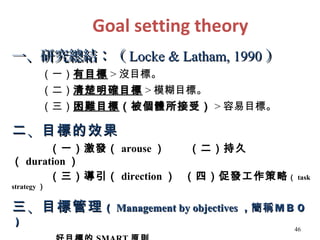
Goal setting theory
一、研究總結:( Locke & Latham, 1990 )
        (一)有目標 > 沒目標。
        (二)清楚明確目標 > 模糊目標。
        (三)困難目標 (被個體所接受) > 容易目標。

二 、目標的效果
      (一)激發( arouse )    (二)持久
( duration )
      (三)導引( direction ) (四)促發工作策略 ( task
strategy )


三 、目標管理 ( Management by objectives ,簡稱 MBO
)
                                        46
Setting Goals
      •   S
      •   M
      •   Difficult but A
      •   R
      •   T

      • Employee P


http://www.youtube.com/watch?v=qpmUYa1f_5Q&feature=youtu.be

                                                              47
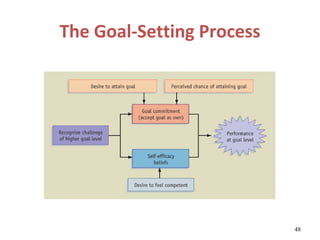
The Goal-Setting Process


                           48
Employees will be motivated if
• They have a personality that predisposes them to be
  motivated
• Their expectations have been met
• The job and organization are consistent with their values
• The employees have been given achievable goals
• The employees receive feedback on their goal attainment
• The organization rewards them for achieving their goals
• The employees perceive they are being treated fairly, and
• Their coworkers demonstrate a high level of motivation


                                                              49
Providing Feedback
• Positive Feedback
   – should be s
   – should be s
   – should be t
• Negative Feedback
   – should be c
   – concentrate on b
   – always give in p
• Self-Regulation Theory
                                 50
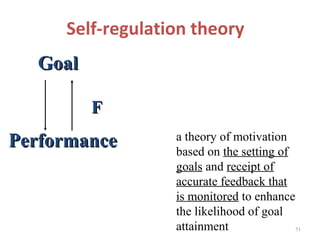
Self-regulation theory
  Goal

         F
Performance       a theory of motivation
                  based on the setting of
                  goals and receipt of
                  accurate feedback that
                  is monitored to enhance
                  the likelihood of goal
                  attainment              51
Employees will be motivated if
• They have a personality that predisposes them to be
  motivated
• Their expectations have been met
• The job and organization are consistent with their values
• The employees have been given achievable goals
• The employees receive feedback on their goal attainment
• The organization rewards them for achieving their goals
• The employees perceive they are being treated fairly, and
• Their coworkers demonstrate a high level of motivation


                                                              52
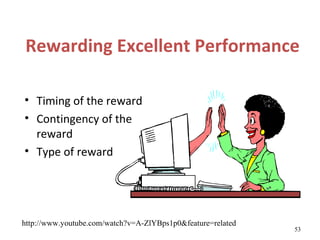
Rewarding Excellent Performance

• Timing of the reward
• Contingency of the
  reward
• Type of reward


http://www.youtube.com/watch?v=A-ZlYBps1p0&feature=related
                                                             53
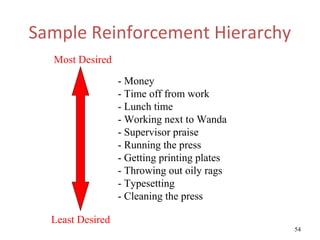
Sample Reinforcement Hierarchy
  Most Desired

                  - Money
                  - Time off from work
                  - Lunch time
                  - Working next to Wanda
                  - Supervisor praise
                  - Running the press
                  - Getting printing plates
                  - Throwing out oily rags
                  - Typesetting
                  - Cleaning the press

  Least Desired
                                              54
Financial Incentive Plans
  • Individual Incentive Plans
       – pay for performance
       – merit pay
  • Organizational Incentive Plans
       – profit sharing
       – gainsharing
       – stock options


http://www.youtube.com/watch?v=aRzkFCijjOQ&feature=youtu.be
                                                              55
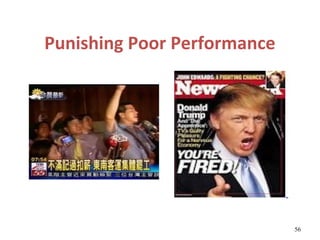
Punishing Poor Performance


                             56
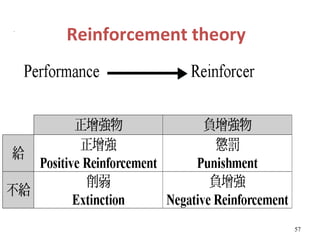
Reinforcement theory


                       57
The Premack Principle
• Different things reinforce different people
• We can get people to engage in behaviors they
  don’t like (e.g., studying) by reinforcing them
  with the opportunity to engage in behaviors
  they like better (e.g., taking out the trash)

利用個人較喜歡的活動 ,來增強較不喜歡的活
動。


                                                    58
Employees will be motivated if
• They have a personality that predisposes them to be
  motivated
• Their expectations have been met
• The job and organization are consistent with their values
• The employees have been given achievable goals
• The employees receive feedback on their goal attainment
• The organization rewards them for achieving their goals
• The employees perceive they are being treated fairly, and
• Their coworkers demonstrate a high level of motivation


                                                              59
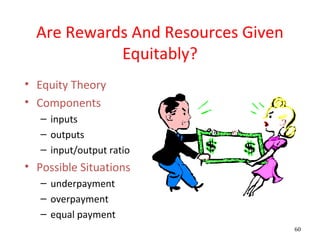
Are Rewards And Resources Given
            Equitably?
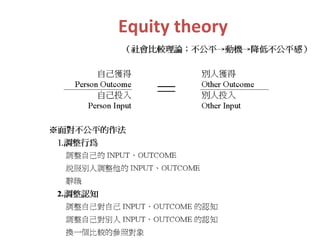
• Equity Theory
• Components
   – inputs
   – outputs
   – input/output ratio
• Possible Situations
   – underpayment
   – overpayment
   – equal payment
                                    60
Equity theory


                61
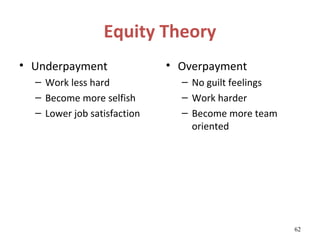
Equity Theory
• Underpayment               • Overpayment
  – Work less hard             – No guilt feelings
  – Become more selfish        – Work harder
  – Lower job satisfaction     – Become more team
                                 oriented


                                                     62
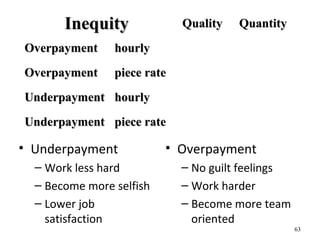
Inequity              Quality   Quantity
Overpayment     hourly
Overpayment     piece rate
Underpayment hourly
Underpayment piece rate

• Underpayment            • Overpayment
  – Work less hard           – No guilt feelings
  – Become more selfish      – Work harder
  – Lower job                – Become more team
    satisfaction               oriented
                                                   63
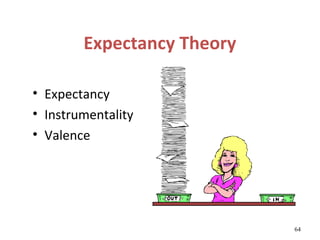
Expectancy Theory

• Expectancy
• Instrumentality
• Valence


                            64
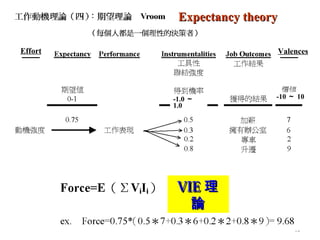
Expectancy theory

Effort                        Valences


         -1.0 ~           -10 ~ 10
         1.0


          VIE 理
            論
                                  65
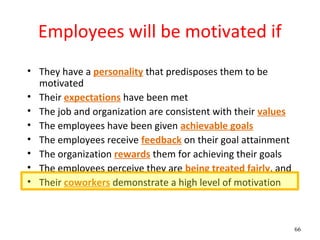
Employees will be motivated if
• They have a personality that predisposes them to be
  motivated
• Their expectations have been met
• The job and organization are consistent with their values
• The employees have been given achievable goals
• The employees receive feedback on their goal attainment
• The organization rewards them for achieving their goals
• The employees perceive they are being treated fairly, and
• Their coworkers demonstrate a high level of motivation


                                                              66
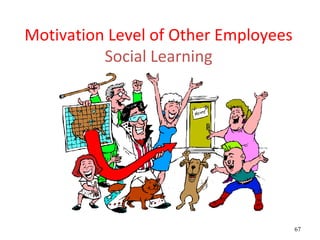
Motivation Level of Other Employees
          Social Learning


                                      67
68
作業
作業目標:
   請利用課程講授的動機理論(可以擇一或選擇多個),設
計一套方案:(三擇一)
  1. 讓系上學生與老師都樂於參與系學會舉辦的各項活動。
  2. 讓系上畢業學長姐都樂於參與系友會舉辦的各項活動。
  3. 讓學生能認真修習本課程(工商心理學概論)。
報告方式:
    1. 以 PPT 簡報方式進行,報告時間為 10 分鐘。
    2. 報告程序
       ( 1 )先以故事開場,說明貴組預擬解決的議題。
       ( 2 )說明方案的內容、運用的理論及期望產生的成效
。
     ( 3 )說明檢驗方案成效的指標。
備註:請在      23:00 之前,事先將 PPT 寄給助教與老師彙
整                                 69

單元二:組織心理學 工作動機 講義

  • 1.
  • 2.
  • 3.
    Employees will bemotivated if • They have a personality that predisposes them to be motivated • Their expectations have been met • The job and organization are consistent with their values • The employees have been given achievable goals • The employees receive feedback on their goal attainment • The organization rewards them for achieving their goals • The employees perceive they are being treated fairly, and • Their coworkers demonstrate a high level of motivation 3
  • 4.
    Is an EmployeePredisposed to Being Motivated? • Personality – Conscientiousness • Self-esteem – Chronic – Situational – Socially influenced • Need for achievement • Intrinsic motivation 4
  • 11.
    五大性格特質 (OCEAN) • 經驗學習 (Openness to experience) (經驗開放 ) • 勤勉審慎 (Conscientiousness) (勤勉審慎 ) • 外向社交 (Extraversion) (外向實踐 ) • 親和友善 (Agreeableness) (親和樂群 ) • 情緒穩定 (Neuroticism/Emotional Stability) (情緒穩定 )
  • 12.
    五大性格特質 (OCEAN) • 穩定的特質 •測驗結果之信度 • 測驗結果之效度 • 跨文化與跨國家之應用
  • 13.
    五大性格特質及其內涵 • 經驗學習 (Opennessto experience) – 定義: • 對新事物以及新觀點接受的程度 • 富想像力、喜歡思考、勇於嘗試新事物
  • 14.
    五大性格特質及其內涵 • 勤勉審慎 (Conscientiousness) – 定義: • 做事細心謹慎、遵守規則、具有責任感 • 較有恆心毅力、追求卓越
  • 15.
    五大性格特質及其內涵 • 外向社交 (Extraversion) – 定義: • 喜歡參與社交活動 • 自信、健談、喜歡影響他人
  • 16.
    五大性格特質及其內涵 • 親和友善 (Agreeableness) – 定義: • 為人親切友善、易相處、溫和 • 寬容、體諒他人、服從
  • 17.
    五大性格特質及其內涵 • 情緒穩定 (Neuroticism/EmotionalStability) – 定義: • 情緒穩定、心情放鬆的 • 少有心情不好、焦慮、沮喪、適應不良
  • 18.
    Is an EmployeePredisposed to Being Motivated? • Personality – Conscientiousness • Self-esteem – Chronic – Situational – Socially influenced • Need for achievement • Intrinsic motivation 18
  • 19.
    Increasing Self-Esteem • Self-esteemworkshops • Experience with success – self-fulfilling prophecy – trying new experiences and taking little steps • Supervisor behavior – Pygmalion effect (是指我們會接受他人賦予我們的 ) – Golem effect (是指我們會接受他人賦予我們的 ) 19
  • 20.
    Is an EmployeePredisposed to Being Motivated? • Personality – Conscientiousness • Self-esteem – Chronic – Situational – Socially influenced • Need for achievement • Intrinsic motivation 20
  • 21.
    Need for Achievement •McClelland (1961) • Three needs – Need for – Need for – Need for 21
  • 22.
    Is an EmployeePredisposed to Being Motivated? • Personality – Conscientiousness • Self-esteem – Chronic – Situational – Socially influenced • Need for achievement • Intrinsic motivation 22
  • 23.
    Intrinsic motivation theory 一份工作只要讓從事者感覺到勝任愉快 ,並讓他們覺得自己對自己的行為有完全的控 制權 ,就可以提高他們的內在動機 。 (一)外在動機:名利(外在酬賞)。 (二)內在動機:心理上的愉悅感。 (三) 外在酬賞會降低內在動機。 外在酬賞會降低內在動機 23
  • 25.
    Employees will bemotivated if • They have a personality that predisposes them to be motivated • Their expectations have been met • The job and organization are consistent with their values • The employees have been given achievable goals • The employees receive feedback on their goal attainment • The organization rewards them for achieving their goals • The employees perceive they are being treated fairly, and • Their coworkers demonstrate a high level of motivation 25
  • 26.
    Employee Values andExpectations • Have the employee’s expectations been met? – Realistic job previews (RJPs) – Job descriptions • Have the employee’s needs, values and wants been met? – Maslow’s Needs Hierarchy – ERG Theory – Two-factor Theory 26
  • 27.
  • 28.
    Employee Values andExpectations • Have the employee’s expectations been met? – Realistic job previews (RJPs) – Job descriptions • Have the employee’s needs, values and wants been met? – Maslow’s Needs Hierarchy – ERG Theory – Two-factor Theory 28
  • 29.
  • 30.
  • 31.
    Employee Values andExpectations • Have the employee’s expectations been met? – Realistic job previews (RJPs) – Job descriptions • Have the employee’s needs, values and wants been met? – Maslow’s Needs Hierarchy – ERG Theory – Two-factor Theory 31
  • 32.
    Need hierarchical theory Higher Order Order of progression Lower Order 32
  • 33.
    Employee Values andExpectations • Have the employee’s expectations been met? – Realistic job previews (RJPs) – Job descriptions • Have the employee’s needs, values and wants been met? – Maslow’s Needs Hierarchy – ERG Theory – Two-factor Theory 33
  • 34.
  • 35.
  • 36.
    Employee Values andExpectations • Have the employee’s expectations been met? – Realistic job previews (RJPs) – Job descriptions • Have the employee’s needs, values and wants been met? – Maslow’s Needs Hierarchy – ERG Theory – Two-factor Theory 36
  • 37.
    Two-Factor Theory • Motivators – R – G – C – J • Hygiene factors – P – B – C – S 37
  • 38.
  • 39.
    Comparison of NeedsTheories Maslow ERG Two-Factor Self-actualization Growth Motivators Ego Social Relatedness Safety Hygiene Factors Existence Physical 39
  • 41.
    Job Characteristics Theory •Employees desire jobs that are –M – Allow a – Provide them with • Jobs will have motivating potential if they have – Skill – Task – Task 41
  • 42.
  • 43.
    Growth Need Strength Motivating Potential Score =( )/3 * * 43
  • 44.
    Job Characteristics andWork Behavior Fried and Ferris (1987) meta-analysis Correlation with Work Behavior Job characteristic Satisfaction Performance Absenteeism Skill variety .45 .09 -.24 Task identity .26 .13 -.15 Task significance .35 .14 .14 Autonomy .48 .18 -.29 Job feedback .43 .22 -.19 Motivating potential score .63 .22 -.32 44
  • 45.
    Employees will bemotivated if • They have a personality that predisposes them to be motivated • Their expectations have been met • The job and organization are consistent with their values • The employees have been given achievable goals • The employees receive feedback on their goal attainment • The organization rewards them for achieving their goals • The employees perceive they are being treated fairly, and • Their coworkers demonstrate a high level of motivation 45
  • 46.
    Goal setting theory 一、研究總結:(Locke & Latham, 1990 ) (一)有目標 > 沒目標。 (二)清楚明確目標 > 模糊目標。 (三)困難目標 (被個體所接受) > 容易目標。 二 、目標的效果 (一)激發( arouse ) (二)持久 ( duration ) (三)導引( direction ) (四)促發工作策略 ( task strategy ) 三 、目標管理 ( Management by objectives ,簡稱 MBO ) 46
  • 47.
    Setting Goals • S • M • Difficult but A • R • T • Employee P http://www.youtube.com/watch?v=qpmUYa1f_5Q&feature=youtu.be 47
  • 48.
  • 49.
    Employees will bemotivated if • They have a personality that predisposes them to be motivated • Their expectations have been met • The job and organization are consistent with their values • The employees have been given achievable goals • The employees receive feedback on their goal attainment • The organization rewards them for achieving their goals • The employees perceive they are being treated fairly, and • Their coworkers demonstrate a high level of motivation 49
  • 50.
    Providing Feedback • PositiveFeedback – should be s – should be s – should be t • Negative Feedback – should be c – concentrate on b – always give in p • Self-Regulation Theory 50
  • 51.
    Self-regulation theory Goal F Performance a theory of motivation based on the setting of goals and receipt of accurate feedback that is monitored to enhance the likelihood of goal attainment 51
  • 52.
    Employees will bemotivated if • They have a personality that predisposes them to be motivated • Their expectations have been met • The job and organization are consistent with their values • The employees have been given achievable goals • The employees receive feedback on their goal attainment • The organization rewards them for achieving their goals • The employees perceive they are being treated fairly, and • Their coworkers demonstrate a high level of motivation 52
  • 53.
    Rewarding Excellent Performance •Timing of the reward • Contingency of the reward • Type of reward http://www.youtube.com/watch?v=A-ZlYBps1p0&feature=related 53
  • 54.
    Sample Reinforcement Hierarchy Most Desired - Money - Time off from work - Lunch time - Working next to Wanda - Supervisor praise - Running the press - Getting printing plates - Throwing out oily rags - Typesetting - Cleaning the press Least Desired 54
  • 55.
    Financial Incentive Plans • Individual Incentive Plans – pay for performance – merit pay • Organizational Incentive Plans – profit sharing – gainsharing – stock options http://www.youtube.com/watch?v=aRzkFCijjOQ&feature=youtu.be 55
  • 56.
  • 57.
  • 58.
    The Premack Principle •Different things reinforce different people • We can get people to engage in behaviors they don’t like (e.g., studying) by reinforcing them with the opportunity to engage in behaviors they like better (e.g., taking out the trash) 利用個人較喜歡的活動 ,來增強較不喜歡的活 動。 58
  • 59.
    Employees will bemotivated if • They have a personality that predisposes them to be motivated • Their expectations have been met • The job and organization are consistent with their values • The employees have been given achievable goals • The employees receive feedback on their goal attainment • The organization rewards them for achieving their goals • The employees perceive they are being treated fairly, and • Their coworkers demonstrate a high level of motivation 59
  • 60.
    Are Rewards AndResources Given Equitably? • Equity Theory • Components – inputs – outputs – input/output ratio • Possible Situations – underpayment – overpayment – equal payment 60
  • 61.
  • 62.
    Equity Theory • Underpayment • Overpayment – Work less hard – No guilt feelings – Become more selfish – Work harder – Lower job satisfaction – Become more team oriented 62
  • 63.
    Inequity Quality Quantity Overpayment hourly Overpayment piece rate Underpayment hourly Underpayment piece rate • Underpayment • Overpayment – Work less hard – No guilt feelings – Become more selfish – Work harder – Lower job – Become more team satisfaction oriented 63
  • 64.
    Expectancy Theory • Expectancy •Instrumentality • Valence 64
  • 65.
    Expectancy theory Effort Valences -1.0 ~ -10 ~ 10 1.0 VIE 理 論 65
  • 66.
    Employees will bemotivated if • They have a personality that predisposes them to be motivated • Their expectations have been met • The job and organization are consistent with their values • The employees have been given achievable goals • The employees receive feedback on their goal attainment • The organization rewards them for achieving their goals • The employees perceive they are being treated fairly, and • Their coworkers demonstrate a high level of motivation 66
  • 67.
    Motivation Level ofOther Employees Social Learning 67
  • 68.
  • 69.
    作業 作業目標: 請利用課程講授的動機理論(可以擇一或選擇多個),設 計一套方案:(三擇一) 1. 讓系上學生與老師都樂於參與系學會舉辦的各項活動。 2. 讓系上畢業學長姐都樂於參與系友會舉辦的各項活動。 3. 讓學生能認真修習本課程(工商心理學概論)。 報告方式: 1. 以 PPT 簡報方式進行,報告時間為 10 分鐘。 2. 報告程序 ( 1 )先以故事開場,說明貴組預擬解決的議題。 ( 2 )說明方案的內容、運用的理論及期望產生的成效 。 ( 3 )說明檢驗方案成效的指標。 備註:請在 23:00 之前,事先將 PPT 寄給助教與老師彙 整 69