Amos Tversky andDaniel Kahneman (1981)
A city of 600 people is likely to be attacked by a
deadly disease, that might result in the deaths of its
inhabitants. You've been asked to select a strategy out
of these that will help the city combat the epidemic.
7.
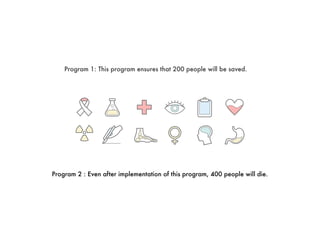
Program 1: Thisprogram ensures that 200 people will be saved.
Program 2 : Even after implementation of this program, 400 people will die.
8.
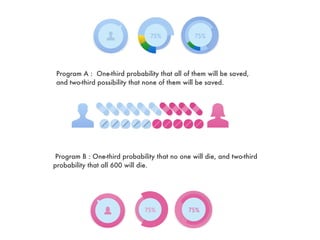
Program A :One-third probability that all of them will be saved,
and two-third possibility that none of them will be saved.
Program B : One-third probability that no one will die, and two-third
probability that all 600 will die.
75% 75%
75%75%
9.
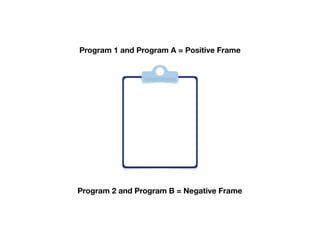
Program 1 andProgram A = Positive Frame
Program 2 and Program B = Negative Frame
10.
occur because ourminds are eager
to make quick judgments.
But this often leads to mistakes,
because we don’t always
have enough data to make an accurate call.
The halo effect and
confirmation bias
11.
how we seekdata that are likely to be
compatible with the beliefs we currently hold,
and avoid or reject information that
does not conform to our beliefs.
Confirmation bias
15.
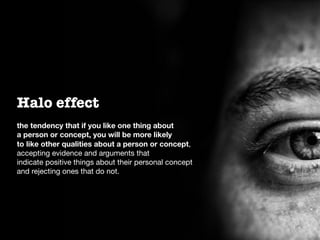
the tendency thatif you like one thing about
a person or concept, you will be more likely
to like other qualities about a person or concept,
accepting evidence and arguments that
indicate positive things about their personal concept
and rejecting ones that do not.
Halo effect
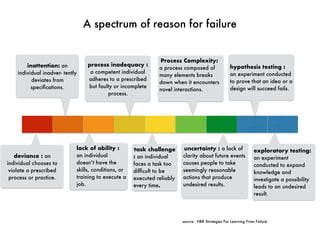
deviance : an
individualchooses to
violate a prescribed
process or practice.
inattention: an
individual inadver- tently
deviates from
specifications.
source : HBR Strategies For Learning From Failure
lack of ability :
an individual
doesn’t have the
skills, conditions, or
training to execute a
job.
process inadequacy :
a competent individual
adheres to a prescribed
but faulty or incomplete
process.
task challenge
: an individual
faces a task too
difficult to be
executed reliably
every time.
Process Complexity:
a process composed of
many elements breaks
down when it encounters
novel interactions.
uncertainty : a lack of
clarity about future events
causes people to take
seemingly reasonable
actions that produce
undesired results.
hypothesis testing :
an experiment conducted
to prove that an idea or a
design will succeed fails.
exploratory testing:
an experiment
conducted to expand
knowledge and
investigate a possibility
leads to an undesired
result.
A spectrum of reason for failure
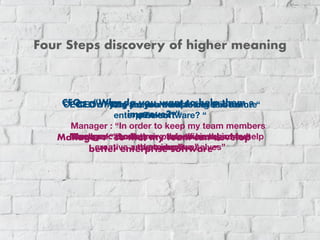
Four Steps discoveryof higher meaning
CEO : “Why do you want to build better
enterprise software? “
Manager : “to improve the efficiency of our
customer”
CEO : “Why are you completing this form? “
Manager : “In order to keep my team members
feedback about their performance and to help
them improve”
CEO : “Why do you want customer to be more
efficient? “
Manager : “so they are free to be their most
creative and productive selves”
CEO : “Why do you want to help them
improve? “
Manager : “so that my team can develop
better enterprise software”
75.
When they knowWHY they do it,
the WHAT will be less relevant
The importing thingfor this to work :
Delivering feedback is regular
part of everyone’s job
80.
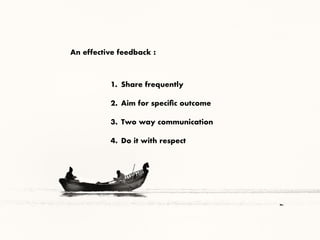
An effective feedback:
1. Share frequently
2. Aim for specific outcome
3. Two way communication
4. Do it with respect
81.
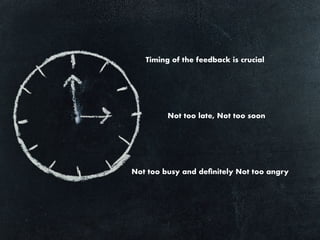
Timing of thefeedback is crucial
Not too late, Not too soon
Not too busy and definitely Not too angry
82.
Source : HBR
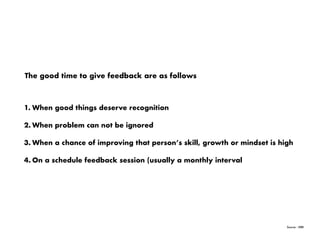
Thegood time to give feedback are as follows
1. When good things deserve recognition
2. When problem can not be ignored
3. When a chance of improving that person’s skill, growth or mindset is high
4. On a schedule feedback session (usually a monthly interval
Source : HBR
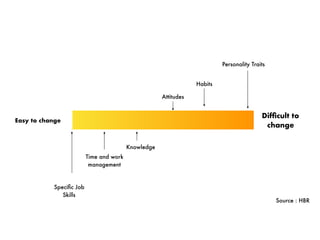
Easyto change
Difficult to
change
Specific Job
Skills
Time and work
management
Knowledge
Attitudes
Habits
Personality Traits
85.
What is thedifferent between
feedback, coaching and
performance evaluation?
86.
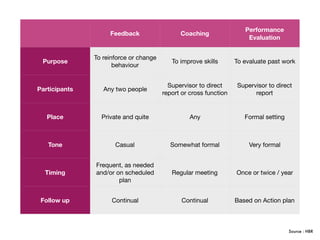
Feedback Coaching
Performance
Evaluation
Purpose
To reinforceor change
behaviour
To improve skills To evaluate past work
Participants Any two people
Supervisor to direct
report or cross function
Supervisor to direct
report
Place Private and quite Any Formal setting
Tone Casual Somewhat formal Very formal
Timing
Frequent, as needed
and/or on scheduled
plan
Regular meeting Once or twice / year
Follow up Continual Continual Based on Action plan
Source : HBR
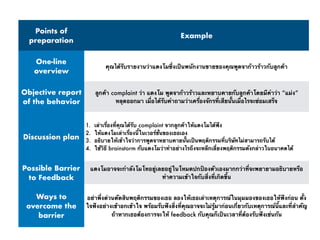
Points of
preparation
Example
One-line
overview
คุณได้รับรายงานว่าแตงโมซึ่งเป็นพนักงานขายของคุณพูดจาก้าวร้าวกับลูกค้า
Objective report
ofthe behavior
ลูกค้า complaint ว่า แตงโม พูดจาก้าวร้าวและหยาบคายกับลูกค้าโดยมีคำว่า “แม่ง”
หลุดออกมา เมื่อได้รับคำถามว่าเครื่องจักรที่เสียนั้นเมื่อไรจะซ่อมเสร็จ
Discussion plan
1. เล่าเรื่องที่คุณได้รับ complaint จากลูกค้าให้แตงโมได้ฟัง
2. ให้แตงโมเล่าเรื่องนี้ในเวอร์ชั่นของเธอเอง
3. อธิบายให้เข้าใจว่าการพูดจาหยาบคายนั้นเป็นพฤติกรรมที่บริษัทไม่สามารถรับได้
4. ใช้วิธี brainstorm กับแตงโมว่าทำอย่างไรถึงจะหลีกเลี่ยงพฤติกรรมดังกล่าวในอนาคตได้
Possible Barrier
to Feedback
แตงโมอาจจะกำลังโมโหอยู่เลยอยู่ในโหมดปกป้องตัวเองมากกว่าที่จะพยายามอธิบายหรือ
ทำความเข้าใจกับสิ่งที่เกิดขึ้น
Ways to
overcome the
barrier
อย่าพึ่งด่วนตัดสินพฤติกรรมของเธอ ลองให้เธอเล่าเหตุการณ์ในมุมมองของเธอให้ฟังก่อน ตั้ง
ใจฟังอย่างเข้าอกเข้าใจ พร้อมรับฟังสิ่งที่คุณอาจจะไม่รู้มาก่อนเกี่ยวกับเหตุการณ์นี้และที่สำคัญ
ถ้าหากเธอต้องการจะให้ feedback กับคุณก็เป็นเวลาที่ต้องรับฟังเช่นกัน
89.
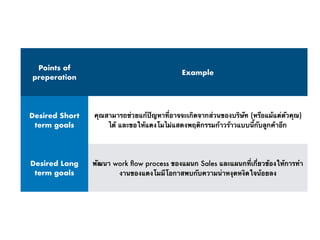
Points of
preperation
Example
Desired Short
termgoals
คุณสามารถช่วยแก้ปัญหาที่อาจจะเกิดจากส่วนของบริษัท (หรือแม้แต่ตัวคุณ)
ได้ และขอให้แตงโมไม่แสดงพฤติกรรมก้าวร้าวแบบนี้กับลูกค้าอีก
Desired Long
term goals
พัฒนา work flow process ของแผนก Sales และแผนกที่เกี่ยวข้องให้การทำ
งานของแตงโมมีโอกาสพบกับความน่าหงุดหงิดใจน้อยลง
90.
When develop anaction plan : Make sure that the
recipient feel that the plan belongs to both of you .
A mutual ownership will increase the chance that the
recipient will apply your feedback
91.
when I thoughtsomeone did something
stupid, I said so
and I expected them to tell me when I
did something stupid.
Each of us would be better for it.
Ray Dalio