X 
MATHEMATICS 
GOVERNMENT OF KERALA 
DEPARTMENT OF EDUCATION
MATHEMATICS 
Standard x 
Government of Kerala 
Department of education
Dear children, 
In farms and factories, 
Up the sky and in the mind. 
Mathematics blooms. 
Roots deep in history; 
Numbers, equations, 
Geometrical shapes, 
Forking braches. 
To know a little of all this, 
A small book. 
Fruit of knowledge- a mellow mind 
Right in thought, True in word, 
With regards, 
Director SCERT
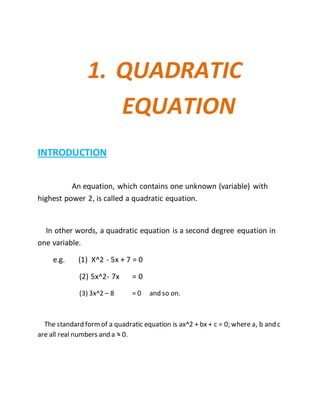
1. QUADRATIC 
EQUATION 
INTRODUCTION 
An equation, which contains one unknown (variable) with 
highest power 2, is called a quadratic equation. 
In other words, a quadratic equation is a second degree equation in 
one variable. 
e.g. (1) X^2 - 5x + 7 = 0 
(2) 5x^2- 7x = 0 
(3) 3x^2 – 8 = 0 and so on. 
The standard form of a quadratic equation is ax^2 + bx + c = 0; where a, b and c 
are all real numbers and a = 0.
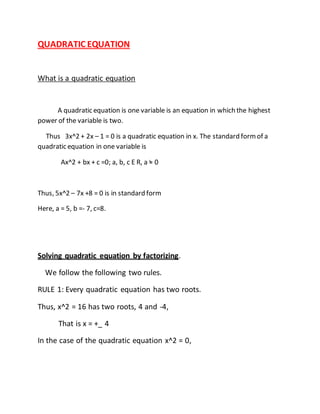
QUADRATIC EQUATION 
What is a quadratic equation 
A quadratic equation is one variable is an equation in which the highest 
power of the variable is two. 
Thus 3x^2 + 2x – 1 = 0 is a quadratic equation in x. The standard form of a 
quadratic equation in one variable is 
Ax^2 + bx + c =0; a, b, c E R, a = 0 
Thus, 5x^2 – 7x +8 = 0 is in standard form 
Here, a = 5, b =- 7, c=8. 
Solving quadratic equation by factorizing. 
We follow the following two rules. 
RULE 1: Every quadratic equation has two roots. 
Thus, x^2 = 16 has two roots, 4 and -4, 
That is x = +_ 4 
In the case of the quadratic equation x^2 = 0,
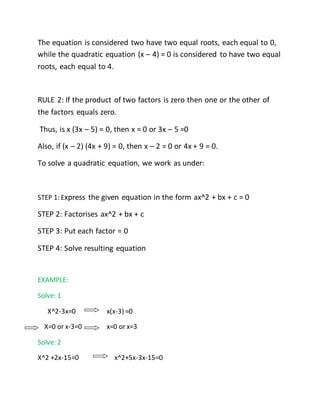
The equation is considered two have two equal roots, each equal to 0, 
while the quadratic equation (x – 4) = 0 is considered to have two equal 
roots, each equal to 4. 
RULE 2: If the product of two factors is zero then one or the other of 
the factors equals zero. 
Thus, is x (3x – 5) = 0, then x = 0 or 3x – 5 =0 
Also, if (x – 2) (4x + 9) = 0, then x – 2 = 0 or 4x + 9 = 0. 
To solve a quadratic equation, we work as under: 
STEP 1: Express the given equation in the form ax^2 + bx + c = 0 
STEP 2: Factorises ax^2 + bx + c 
STEP 3: Put each factor = 0 
STEP 4: Solve resulting equation 
EXAMPLE: 
Solve: 1 
X^2-3x=0 x(x-3) =0 
X=0 or x-3=0 x=0 or x=3 
Solve: 2 
X^2 +2x-15=0 x^2+5x-3x-15=0
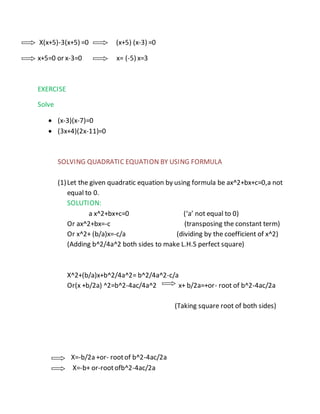
X(x+5)-3(x+5) =0 (x+5) (x-3) =0 
x+5=0 or x-3=0 x= (-5) x=3 
EXERCISE 
Solve 
 (x-3)(x-7)=0 
 (3x+4)(2x-11)=0 
SOLVING QUADRATIC EQUATION BY USING FORMULA 
(1) Let the given quadratic equation by using formula be ax^2+bx+c=0,a not 
equal to 0. 
SOLUTION: 
a x^2+bx+c=0 (‘a’ not equal to 0) 
Or ax^2+bx=-c (transposing the constant term) 
Or x^2+ (b/a)x=-c/a (dividing by the coefficient of x^2) 
(Adding b^2/4a^2 both sides to make L.H.S perfect square) 
X^2+(b/a)x+b^2/4a^2= b^2/4a^2-c/a 
Or(x +b/2a) ^2=b^2-4ac/4a^2 x+ b/2a=+or- root of b^2-4ac/2a 
(Taking square root of both sides) 
X=-b/2a +or- root of b^2-4ac/2a 
X=-b+ or-root ofb^2-4ac/2a
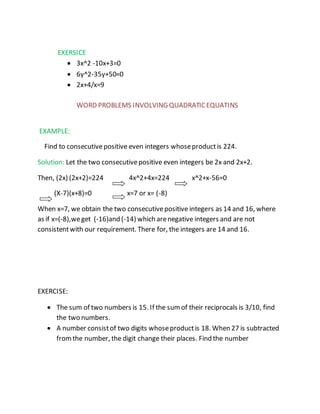
EXERSICE 
 3x^2 -10x+3=0 
 6y^2-35y+50=0 
 2x+4/x=9 
WORD PROBLEMS INVOLVING QUADRATIC EQUATINS 
EXAMPLE: 
Find to consecutive positive even integers whose product is 224. 
Solution: Let the two consecutive positive even integers be 2x and 2x+2. 
Then, (2x) (2x+2)=224 4x^2+4x=224 x^2+x-56=0 
(X-7)(x+8)=0 x=7 or x= (-8) 
When x=7, we obtain the two consecutive positive integers as 14 and 16, where 
as if x=(-8),we get (-16)and (-14) which are negative integers and are not 
consistent with our requirement. There for, the integers are 14 and 16. 
EXERCISE: 
 The sum of two numbers is 15. If the sum of their reciprocals is 3/10, find 
the two numbers. 
 A number consist of two digits whose product is 18. When 27 is subtracted 
from the number, the digit change their places. Find the number
Sreeku

Sreeku

  • 1.
    X MATHEMATICS GOVERNMENTOF KERALA DEPARTMENT OF EDUCATION
  • 2.
    MATHEMATICS Standard x Government of Kerala Department of education
  • 3.
    Dear children, Infarms and factories, Up the sky and in the mind. Mathematics blooms. Roots deep in history; Numbers, equations, Geometrical shapes, Forking braches. To know a little of all this, A small book. Fruit of knowledge- a mellow mind Right in thought, True in word, With regards, Director SCERT
  • 4.
    1. QUADRATIC EQUATION INTRODUCTION An equation, which contains one unknown (variable) with highest power 2, is called a quadratic equation. In other words, a quadratic equation is a second degree equation in one variable. e.g. (1) X^2 - 5x + 7 = 0 (2) 5x^2- 7x = 0 (3) 3x^2 – 8 = 0 and so on. The standard form of a quadratic equation is ax^2 + bx + c = 0; where a, b and c are all real numbers and a = 0.
  • 5.
    QUADRATIC EQUATION Whatis a quadratic equation A quadratic equation is one variable is an equation in which the highest power of the variable is two. Thus 3x^2 + 2x – 1 = 0 is a quadratic equation in x. The standard form of a quadratic equation in one variable is Ax^2 + bx + c =0; a, b, c E R, a = 0 Thus, 5x^2 – 7x +8 = 0 is in standard form Here, a = 5, b =- 7, c=8. Solving quadratic equation by factorizing. We follow the following two rules. RULE 1: Every quadratic equation has two roots. Thus, x^2 = 16 has two roots, 4 and -4, That is x = +_ 4 In the case of the quadratic equation x^2 = 0,
  • 6.
    The equation isconsidered two have two equal roots, each equal to 0, while the quadratic equation (x – 4) = 0 is considered to have two equal roots, each equal to 4. RULE 2: If the product of two factors is zero then one or the other of the factors equals zero. Thus, is x (3x – 5) = 0, then x = 0 or 3x – 5 =0 Also, if (x – 2) (4x + 9) = 0, then x – 2 = 0 or 4x + 9 = 0. To solve a quadratic equation, we work as under: STEP 1: Express the given equation in the form ax^2 + bx + c = 0 STEP 2: Factorises ax^2 + bx + c STEP 3: Put each factor = 0 STEP 4: Solve resulting equation EXAMPLE: Solve: 1 X^2-3x=0 x(x-3) =0 X=0 or x-3=0 x=0 or x=3 Solve: 2 X^2 +2x-15=0 x^2+5x-3x-15=0
  • 7.
    X(x+5)-3(x+5) =0 (x+5)(x-3) =0 x+5=0 or x-3=0 x= (-5) x=3 EXERCISE Solve  (x-3)(x-7)=0  (3x+4)(2x-11)=0 SOLVING QUADRATIC EQUATION BY USING FORMULA (1) Let the given quadratic equation by using formula be ax^2+bx+c=0,a not equal to 0. SOLUTION: a x^2+bx+c=0 (‘a’ not equal to 0) Or ax^2+bx=-c (transposing the constant term) Or x^2+ (b/a)x=-c/a (dividing by the coefficient of x^2) (Adding b^2/4a^2 both sides to make L.H.S perfect square) X^2+(b/a)x+b^2/4a^2= b^2/4a^2-c/a Or(x +b/2a) ^2=b^2-4ac/4a^2 x+ b/2a=+or- root of b^2-4ac/2a (Taking square root of both sides) X=-b/2a +or- root of b^2-4ac/2a X=-b+ or-root ofb^2-4ac/2a
  • 8.
    EXERSICE  3x^2-10x+3=0  6y^2-35y+50=0  2x+4/x=9 WORD PROBLEMS INVOLVING QUADRATIC EQUATINS EXAMPLE: Find to consecutive positive even integers whose product is 224. Solution: Let the two consecutive positive even integers be 2x and 2x+2. Then, (2x) (2x+2)=224 4x^2+4x=224 x^2+x-56=0 (X-7)(x+8)=0 x=7 or x= (-8) When x=7, we obtain the two consecutive positive integers as 14 and 16, where as if x=(-8),we get (-16)and (-14) which are negative integers and are not consistent with our requirement. There for, the integers are 14 and 16. EXERCISE:  The sum of two numbers is 15. If the sum of their reciprocals is 3/10, find the two numbers.  A number consist of two digits whose product is 18. When 27 is subtracted from the number, the digit change their places. Find the number