The Agile Method and AGILE ISD: How 
to Use Each to Improve Your Training 
Program 
Terry Chandler & Chris King 
TOC Annual Institute 
April 28-30, 2014
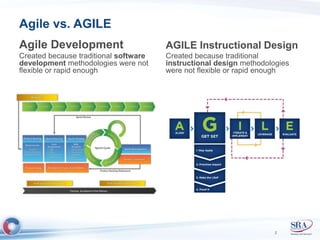
Agile Development 
Created because traditional software 
development methodologies were not 
flexible or rapid enough 
AGILE Instructional Design 
Created because traditional 
instructional design methodologies 
were not flexible or rapid enough 
2 
Agile vs. AGILE
Agile vs. AGILE 
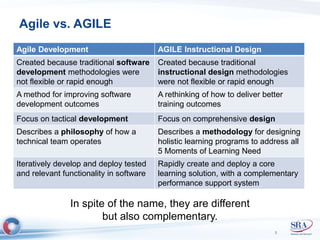
Agile Development AGILE Instructional Design 
Created because traditional software 
development methodologies were 
not flexible or rapid enough 
Created because traditional 
instructional design methodologies 
were not flexible or rapid enough 
A method for improving software 
development outcomes 
A rethinking of how to deliver better 
training outcomes 
Focus on tactical development Focus on comprehensive design 
Describes a philosophy of how a 
technical team operates 
Describes a methodology for designing 
holistic learning programs to address all 
5 Moments of Learning Need 
Iteratively develop and deploy tested 
and relevant functionality in software 
Rapidly create and deploy a core 
learning solution, with a complementary 
performance support system 
3 
In spite of the name, they are different 
but also complementary.
Agile Values 
(Agile Manifesto) 
Individuals and Interactions over Processes and Tools 
Working software over Comprehensive documentation 
Customer collaboration over Contract negotiation 
Responding to change over Following a plan 
That is, while we value the items on the right, we value the items on the left more 
4 
http://agilemanifesto.org/
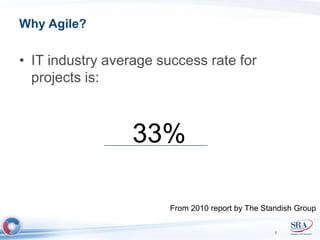
Why Agile? 
• IT industry average success rate for 
projects is: 
5 
33% 
From 2010 report by The Standish Group
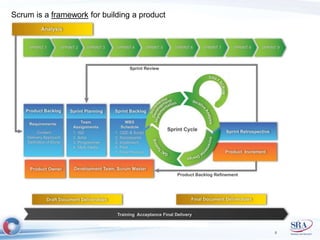
Scrum Defined 
“Scrum is not a process or a technique for building 
products; rather, it is a framework within which 
you can employ various processes and 
techniques… Scrum is grounded in empirical 
process control theory, and employs an iterative, 
incremental approach to optimize predictability 
and control risk.” 
- Scrum Guide 
6
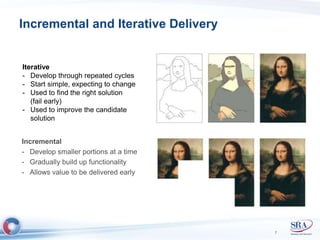
Incremental and Iterative Delivery 
Incremental 
- Develop smaller portions at a time 
- Gradually build up functionality 
- Allows value to be delivered early 
7 
Iterative 
- Develop through repeated cycles 
- Start simple, expecting to change 
- Used to find the right solution 
(fail early) 
- Used to improve the candidate 
solution
8 
Scrum is a framework for building a product
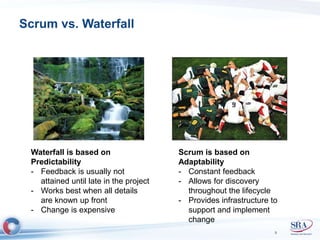
Scrum vs. Waterfall 
9 
Scrum is based on 
Adaptability 
- Constant feedback 
- Allows for discovery 
throughout the lifecycle 
- Provides infrastructure to 
support and implement 
change 
Waterfall is based on 
Predictability 
- Feedback is usually not 
attained until late in the project 
- Works best when all details 
are known up front 
- Change is expensive
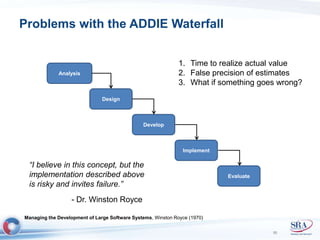
Problems with the ADDIE Waterfall 
1. Time to realize actual value 
2. False precision of estimates 
3. What if something goes wrong? 
10 
Analysis 
Design 
Develop 
Implement 
Evaluate 
“I believe in this concept, but the 
implementation described above 
is risky and invites failure.” 
- Dr. Winston Royce 
Managing the Development of Large Software Systems, Winston Royce (1970)
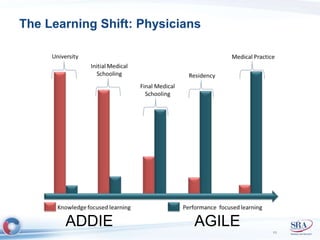
The Learning Shift: Physicians 
ADDIE AGILE 
11
Exercise 
• Index cards – write down a situation you 
face in your workplace where 
performance-focused learning is more 
important than knowledge-focused 
learning 
• Hand your card to someone sitting next to 
you, read theirs, and discuss these 
examples. 
12
AGILE Instructional Design 
13 
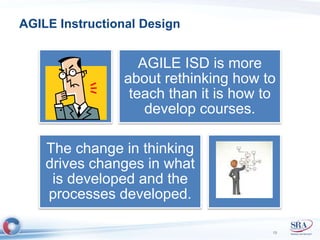
AGILE ISD is more 
about rethinking how to 
teach than it is how to 
develop courses. 
The change in thinking 
drives changes in what 
is developed and the 
processes developed.
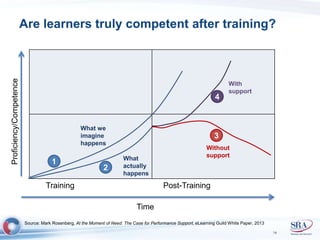
Are learners truly competent after training? 
14 
Proficiency/Competence 
Time 
1 
2 
4 
3 
What we 
imagine 
happens 
What 
actually 
happens 
With 
support 
Without 
support 
Training Post-Training 
Source: Mark Rosenberg, At the Moment of Need: The Case for Performance Support, eLearning Guild White Paper, 2013
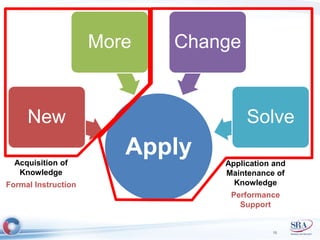
Apply 
New 
More Change 
Solve 
Acquisition of 
Knowledge 
Formal Instruction 
Application and 
Maintenance of 
Knowledge 
Performance 
Support 
15
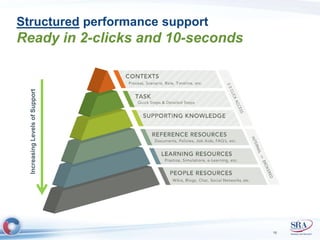
Structured performance support 
Ready in 2-clicks and 10-seconds 
Increasing Levels of Support 
16
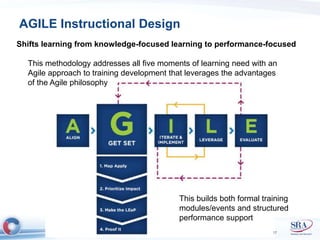
AGILE Instructional Design 
Shifts learning from knowledge-focused learning to performance-focused 
This methodology addresses all five moments of learning need with an 
Agile approach to training development that leverages the advantages 
of the Agile philosophy 
This builds both formal training 
modules/events and structured 
performance support 
17
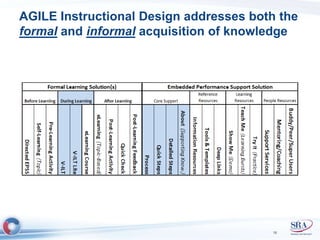
AGILE Instructional Design addresses both the 
formal and informal acquisition of knowledge 
18
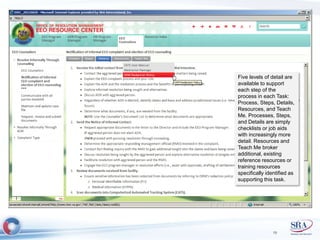
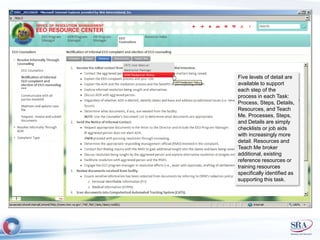
Five levels of detail are 
available to support 
each step of the 
process in each Task: 
Process, Steps, Details, 
Resources, and Teach 
Me. Processes, Steps, 
and Details are simply 
checklists or job aids 
with increasingly more 
detail. Resources and 
Teach Me broker 
additional, existing 
reference resources or 
training resources 
specifically identified as 
supporting this task. 
19
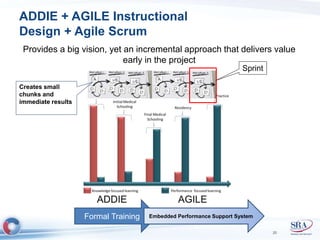
ADDIE + AGILE Instructional 
Design + Agile Scrum 
Provides a big vision, yet an incremental approach that delivers value 
20 
Sprint 
Creates small 
chunks and 
immediate results 
early in the project 
Formal Training Embedded Performance Support System
Conclusion 
• A combination of Agile, AGILE, and ADDIE is 
necessary to develop a comprehensive 
solution 
• This is rethinking how we design/develop 
training truly impact job performance 
• Caveat: It may not be any cheaper 
• Caveat to the Caveat: It may not be any 
cheaper, but it will be more effective at 
changing job performance 
21
terry_chandler@sra.com 
christopher_king@sra.com 
THANK YOU! 
22
SUPPLEMENTAL SLIDES 
23
What is all this about Agile 
• There is the Agile Development method 
– The Agile development method is designed to quickly and efficiently 
produce software products. Recently its application has expanded to 
other areas including training products. 
• There is an ISD philosophy called AGILE ISD which stands for <>… 
– AGILE ISD is a new way of thinking about education where 
performance is the metric that drives the development and delivery 
decisions in an organization’s training program. It recognizes the long 
tail of learning and the five moments of learning need. AGILE ISD 
provides strategies for creating a culture of learning at your 
organization. 
• While these two agile methods are for different purposes, they are 
not mutually exclusive. This session will explain how your 
organization can use both methods to your advantage and success.
The Agile Development Method - History 
• Agile is based on a software development manifesto defined during 
a 2 day meeting at Snowbird Ski resort in Wasatch Mountains, Utah 
in February 11- 13, 2001. 
• The 17 members attending represented several different programing 
approaches sympathetic to the need for an alternative to 
documentation driven heavyweight software development 
processes. 
• These light weight approaches include: Extreme Programming, 
SCRUM, DSDM, Adaptive Software Development, Crystall, Feature- 
Driven Development, Pragmatic Programming. 
• What emerged was an agile manifesto, 12 principles of Agile 
Software development, and the formation of the Agile Alliance 
25
Manifesto for Agile Software Development 
We are uncovering better ways of developing 
software by doing it and helping others do it. 
Through this work we have come to value: 
Individuals and interactions over processes and tools 
Working software over comprehensive documentation 
Customer collaboration over contract negotiation 
Responding to change over following a plan 
That is, while there is value in the items on 
the right, we value the items on the left more. 
26
12 Principles behind the Agile Manifesto 
1. Our highest priority is to satisfy the customer through early and continuous delivery 
of valuable software. 
2. Welcome changing requirements, even late in development. Agile processes 
harness change for the customer's competitive advantage. 
3. Deliver working software frequently, from a couple of weeks to a couple of months, 
with a preference to the shorter timescale. 
4. Business people and developers must work together daily throughout the project. 
5. Build projects around motivated individuals. Give them the environment and 
support they need, and trust them to get the job done. 
6. The most efficient and effective method of conveying information to and within a 
development team is face-to-face conversation. 
7. Working software is the primary measure of progress. 
8. Agile processes promote sustainable development. The sponsors, developers, and 
users should be able to maintain a constant pace indefinitely. 
9. Continuous attention to technical excellence and good design enhances agility. 
10. Simplicity--the art of maximizing the amount of work not done--is essential. 
11. The best architectures, requirements, and designs emerge from self-organizing 
teams. 
12. At regular intervals, the team reflects on how to become more effective, then tunes 
and adjusts its behavior accordingly. 
27
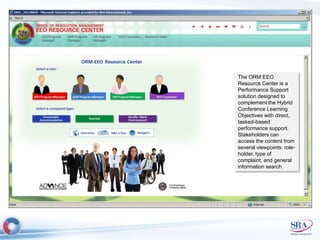
The ORM EEO 
Resource Center is a 
Performance Support 
solution designed to 
complement the Hybrid 
Conference Learning 
Objectives with direct, 
tasked-based 
performance support. 
Stakeholders can 
access the content from 
several viewpoints: role-holder, 
type of 
complaint, and general 
information search.
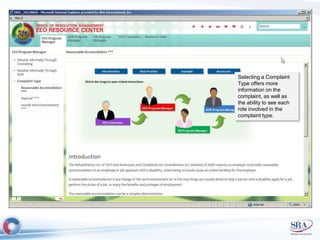
Selecting a Complaint 
Type offers more 
information on the 
complaint, as well as 
the ability to see each 
role involved in the 
complaint type.
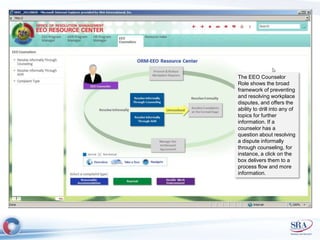
The EEO Counselor 
Role shows the broad 
framework of preventing 
and resolving workplace 
disputes, and offers the 
ability to drill into any of 
topics for further 
information. If a 
counselor has a 
question about resolving 
a dispute informally 
through counseling, for 
instance, a click on the 
box delivers them to a 
process flow and more 
information.
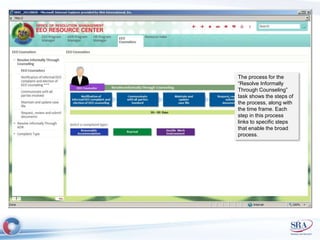
The process for the 
“Resolve Informally 
Through Counseling” 
task shows the steps of 
the process, along with 
the time frame. Each 
step in this process 
links to specific steps 
that enable the broad 
process.
Five levels of detail are 
available to support 
each step of the 
process in each Task: 
Process, Steps, Details, 
Resources, and Teach 
Me. Processes, Steps, 
and Details are simply 
checklists or job aids 
with increasingly more 
detail. Resources and 
Teach Me broker 
additional, existing 
reference resources or 
training resources 
specifically identified as 
supporting this task.

The Agile Method and AGILE ISD; how to use each to improve your training program

  • 1.
    The Agile Methodand AGILE ISD: How to Use Each to Improve Your Training Program Terry Chandler & Chris King TOC Annual Institute April 28-30, 2014
  • 2.
    Agile Development Createdbecause traditional software development methodologies were not flexible or rapid enough AGILE Instructional Design Created because traditional instructional design methodologies were not flexible or rapid enough 2 Agile vs. AGILE
  • 3.
    Agile vs. AGILE Agile Development AGILE Instructional Design Created because traditional software development methodologies were not flexible or rapid enough Created because traditional instructional design methodologies were not flexible or rapid enough A method for improving software development outcomes A rethinking of how to deliver better training outcomes Focus on tactical development Focus on comprehensive design Describes a philosophy of how a technical team operates Describes a methodology for designing holistic learning programs to address all 5 Moments of Learning Need Iteratively develop and deploy tested and relevant functionality in software Rapidly create and deploy a core learning solution, with a complementary performance support system 3 In spite of the name, they are different but also complementary.
  • 4.
    Agile Values (AgileManifesto) Individuals and Interactions over Processes and Tools Working software over Comprehensive documentation Customer collaboration over Contract negotiation Responding to change over Following a plan That is, while we value the items on the right, we value the items on the left more 4 http://agilemanifesto.org/
  • 5.
    Why Agile? •IT industry average success rate for projects is: 5 33% From 2010 report by The Standish Group
  • 6.
    Scrum Defined “Scrumis not a process or a technique for building products; rather, it is a framework within which you can employ various processes and techniques… Scrum is grounded in empirical process control theory, and employs an iterative, incremental approach to optimize predictability and control risk.” - Scrum Guide 6
  • 7.
    Incremental and IterativeDelivery Incremental - Develop smaller portions at a time - Gradually build up functionality - Allows value to be delivered early 7 Iterative - Develop through repeated cycles - Start simple, expecting to change - Used to find the right solution (fail early) - Used to improve the candidate solution
  • 8.
    8 Scrum isa framework for building a product
  • 9.
    Scrum vs. Waterfall 9 Scrum is based on Adaptability - Constant feedback - Allows for discovery throughout the lifecycle - Provides infrastructure to support and implement change Waterfall is based on Predictability - Feedback is usually not attained until late in the project - Works best when all details are known up front - Change is expensive
  • 10.
    Problems with theADDIE Waterfall 1. Time to realize actual value 2. False precision of estimates 3. What if something goes wrong? 10 Analysis Design Develop Implement Evaluate “I believe in this concept, but the implementation described above is risky and invites failure.” - Dr. Winston Royce Managing the Development of Large Software Systems, Winston Royce (1970)
  • 11.
    The Learning Shift:Physicians ADDIE AGILE 11
  • 12.
    Exercise • Indexcards – write down a situation you face in your workplace where performance-focused learning is more important than knowledge-focused learning • Hand your card to someone sitting next to you, read theirs, and discuss these examples. 12
  • 13.
    AGILE Instructional Design 13 AGILE ISD is more about rethinking how to teach than it is how to develop courses. The change in thinking drives changes in what is developed and the processes developed.
  • 14.
    Are learners trulycompetent after training? 14 Proficiency/Competence Time 1 2 4 3 What we imagine happens What actually happens With support Without support Training Post-Training Source: Mark Rosenberg, At the Moment of Need: The Case for Performance Support, eLearning Guild White Paper, 2013
  • 15.
    Apply New MoreChange Solve Acquisition of Knowledge Formal Instruction Application and Maintenance of Knowledge Performance Support 15
  • 16.
    Structured performance support Ready in 2-clicks and 10-seconds Increasing Levels of Support 16
  • 17.
    AGILE Instructional Design Shifts learning from knowledge-focused learning to performance-focused This methodology addresses all five moments of learning need with an Agile approach to training development that leverages the advantages of the Agile philosophy This builds both formal training modules/events and structured performance support 17
  • 18.
    AGILE Instructional Designaddresses both the formal and informal acquisition of knowledge 18
  • 19.
    Five levels ofdetail are available to support each step of the process in each Task: Process, Steps, Details, Resources, and Teach Me. Processes, Steps, and Details are simply checklists or job aids with increasingly more detail. Resources and Teach Me broker additional, existing reference resources or training resources specifically identified as supporting this task. 19
  • 20.
    ADDIE + AGILEInstructional Design + Agile Scrum Provides a big vision, yet an incremental approach that delivers value 20 Sprint Creates small chunks and immediate results early in the project Formal Training Embedded Performance Support System
  • 21.
    Conclusion • Acombination of Agile, AGILE, and ADDIE is necessary to develop a comprehensive solution • This is rethinking how we design/develop training truly impact job performance • Caveat: It may not be any cheaper • Caveat to the Caveat: It may not be any cheaper, but it will be more effective at changing job performance 21
  • 22.
  • 23.
  • 24.
    What is allthis about Agile • There is the Agile Development method – The Agile development method is designed to quickly and efficiently produce software products. Recently its application has expanded to other areas including training products. • There is an ISD philosophy called AGILE ISD which stands for <>… – AGILE ISD is a new way of thinking about education where performance is the metric that drives the development and delivery decisions in an organization’s training program. It recognizes the long tail of learning and the five moments of learning need. AGILE ISD provides strategies for creating a culture of learning at your organization. • While these two agile methods are for different purposes, they are not mutually exclusive. This session will explain how your organization can use both methods to your advantage and success.
  • 25.
    The Agile DevelopmentMethod - History • Agile is based on a software development manifesto defined during a 2 day meeting at Snowbird Ski resort in Wasatch Mountains, Utah in February 11- 13, 2001. • The 17 members attending represented several different programing approaches sympathetic to the need for an alternative to documentation driven heavyweight software development processes. • These light weight approaches include: Extreme Programming, SCRUM, DSDM, Adaptive Software Development, Crystall, Feature- Driven Development, Pragmatic Programming. • What emerged was an agile manifesto, 12 principles of Agile Software development, and the formation of the Agile Alliance 25
  • 26.
    Manifesto for AgileSoftware Development We are uncovering better ways of developing software by doing it and helping others do it. Through this work we have come to value: Individuals and interactions over processes and tools Working software over comprehensive documentation Customer collaboration over contract negotiation Responding to change over following a plan That is, while there is value in the items on the right, we value the items on the left more. 26
  • 27.
    12 Principles behindthe Agile Manifesto 1. Our highest priority is to satisfy the customer through early and continuous delivery of valuable software. 2. Welcome changing requirements, even late in development. Agile processes harness change for the customer's competitive advantage. 3. Deliver working software frequently, from a couple of weeks to a couple of months, with a preference to the shorter timescale. 4. Business people and developers must work together daily throughout the project. 5. Build projects around motivated individuals. Give them the environment and support they need, and trust them to get the job done. 6. The most efficient and effective method of conveying information to and within a development team is face-to-face conversation. 7. Working software is the primary measure of progress. 8. Agile processes promote sustainable development. The sponsors, developers, and users should be able to maintain a constant pace indefinitely. 9. Continuous attention to technical excellence and good design enhances agility. 10. Simplicity--the art of maximizing the amount of work not done--is essential. 11. The best architectures, requirements, and designs emerge from self-organizing teams. 12. At regular intervals, the team reflects on how to become more effective, then tunes and adjusts its behavior accordingly. 27
  • 28.
    The ORM EEO Resource Center is a Performance Support solution designed to complement the Hybrid Conference Learning Objectives with direct, tasked-based performance support. Stakeholders can access the content from several viewpoints: role-holder, type of complaint, and general information search.
  • 29.
    Selecting a Complaint Type offers more information on the complaint, as well as the ability to see each role involved in the complaint type.
  • 30.
    The EEO Counselor Role shows the broad framework of preventing and resolving workplace disputes, and offers the ability to drill into any of topics for further information. If a counselor has a question about resolving a dispute informally through counseling, for instance, a click on the box delivers them to a process flow and more information.
  • 31.
    The process forthe “Resolve Informally Through Counseling” task shows the steps of the process, along with the time frame. Each step in this process links to specific steps that enable the broad process.
  • 32.
    Five levels ofdetail are available to support each step of the process in each Task: Process, Steps, Details, Resources, and Teach Me. Processes, Steps, and Details are simply checklists or job aids with increasingly more detail. Resources and Teach Me broker additional, existing reference resources or training resources specifically identified as supporting this task.

Editor's Notes

  • #12 Unique performance Context (situation, Dynamic environment Forget, misunderstanding Environmental differences
  • #16 A Performance Support solution addresses the application and maintenance of knowledge through a performance support tool. This becomes the enduring product for attendees, accessed and utilized long after the conference itself is done. Consider it a 21st century version of the training binder. Five Moments are: When Learning for the First Time When Wanting to Learn More When Trying to Remember and/or Apply When Things Change When Something Goes Wrong