SQUEEZED MIDDLE?
THE POSITIONING OF
ACADEMIC LIBRARIES IN THE
INSTITUTION
John Cox, University Librarian, National University of Ireland Galway
@johncoxnuig
Outline
■ What positioning is and why it’s important
■ Shifting sands: higher education drivers & priorities
■ Library challenges and competition
■ Library opportunities, strategies and changes
■ Squeezed middle: balancing acts
WHAT IS POSITIONING
AND WHY IS IT
IMPORTANT?
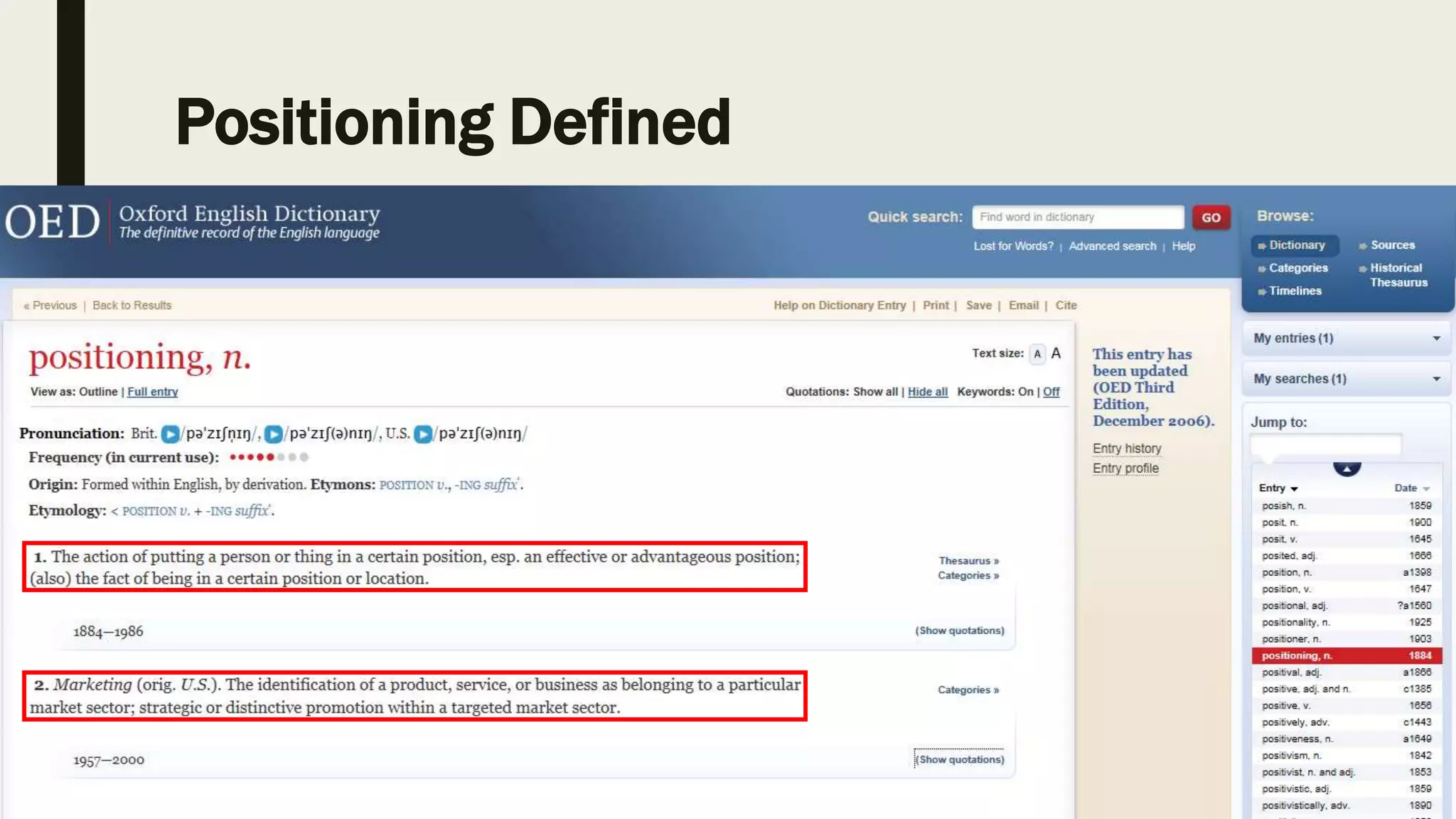
Positioning Defined
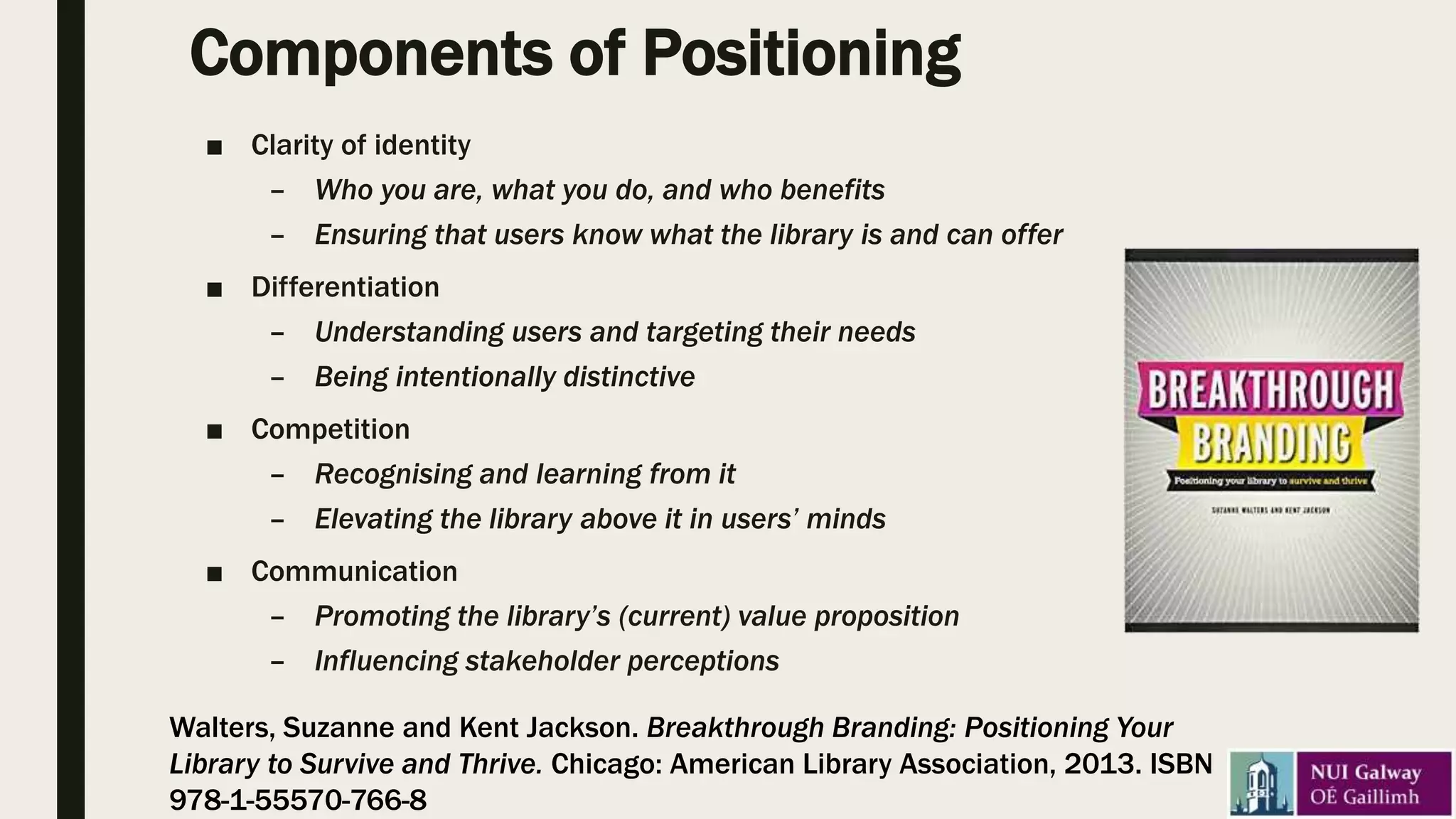
Components of Positioning
■ Clarity of identity
– Who you are, what you do, and who benefits
– Ensuring that users know what the library is and can offer
■ Differentiation
– Understanding users and targeting their needs
– Being intentionally distinctive
■ Competition
– Recognising and learning from it
– Elevating the library above it in users’ minds
■ Communication
– Promoting the library’s (current) value proposition
– Influencing stakeholder perceptions
Walters, Suzanne and Kent Jackson. Breakthrough Branding: Positioning Your
Library to Survive and Thrive. Chicago: American Library Association, 2013. ISBN
978-1-55570-766-8
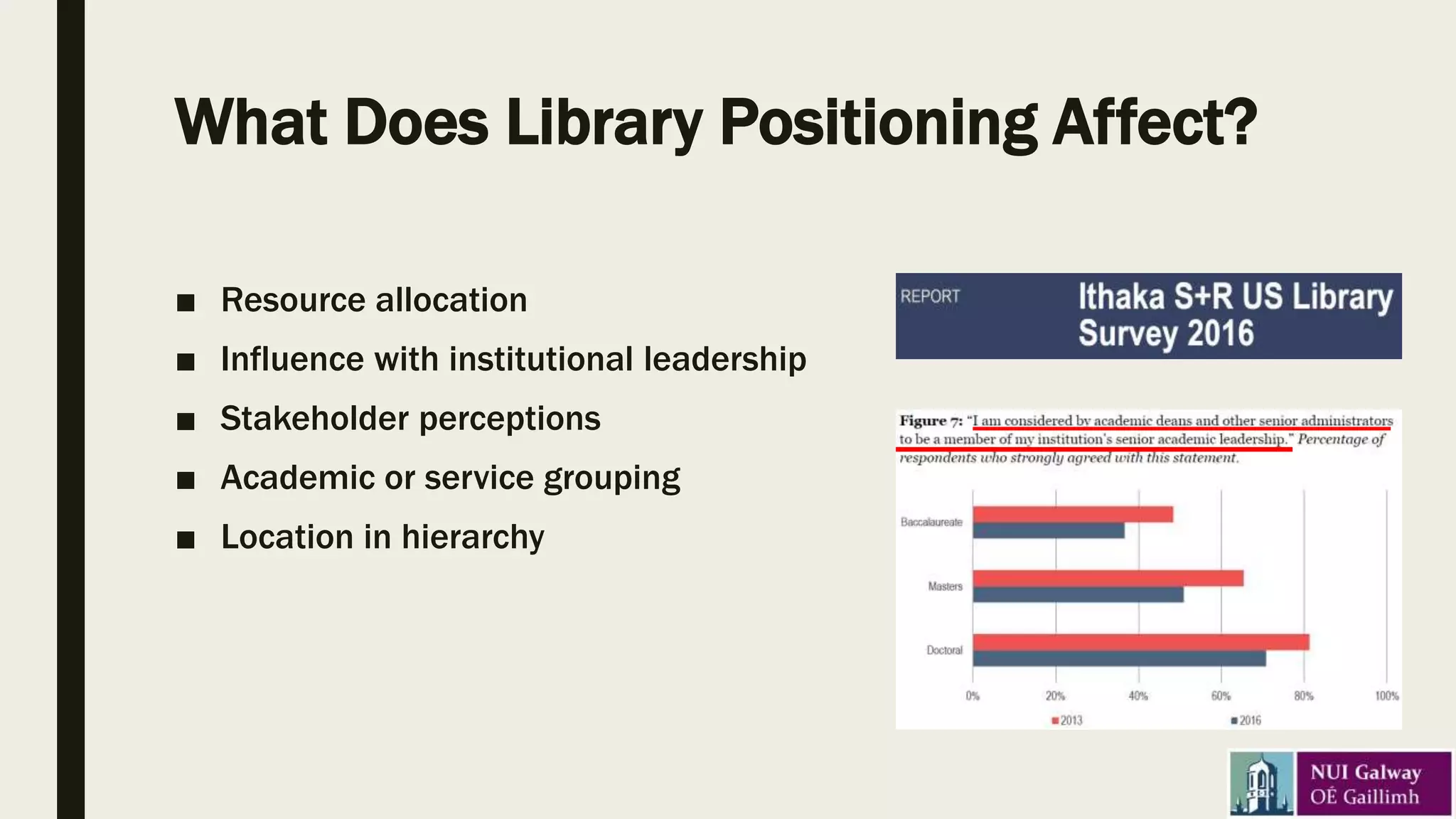
What Does Library Positioning Affect?
■ Resource allocation
■ Influence with institutional leadership
■ Stakeholder perceptions
■ Academic or service grouping
■ Location in hierarchy
SHIFTING SANDS:
HIGHER EDUCATION
DRIVERS AND PRIORITIES
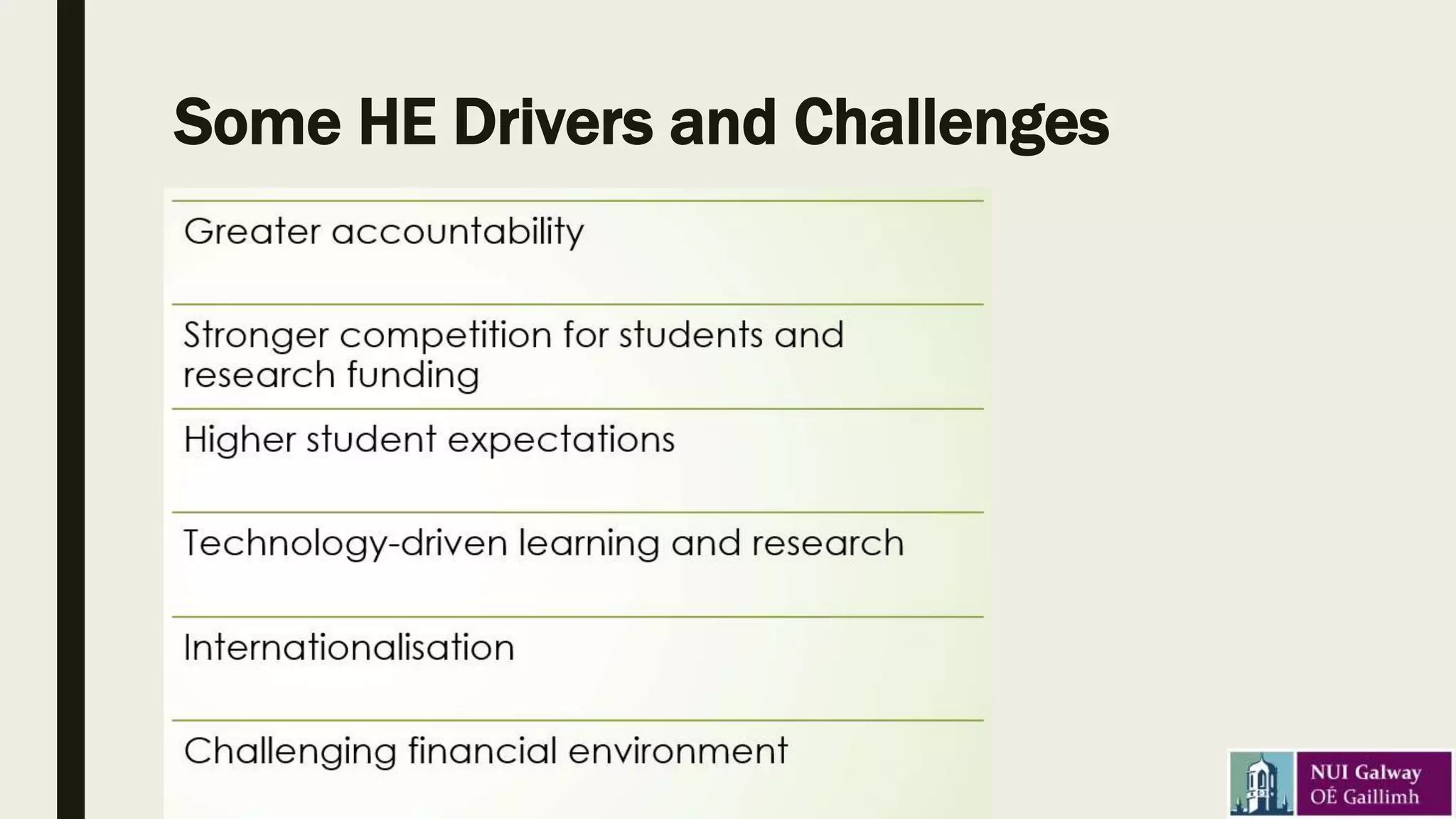
Some HE Drivers and Challenges
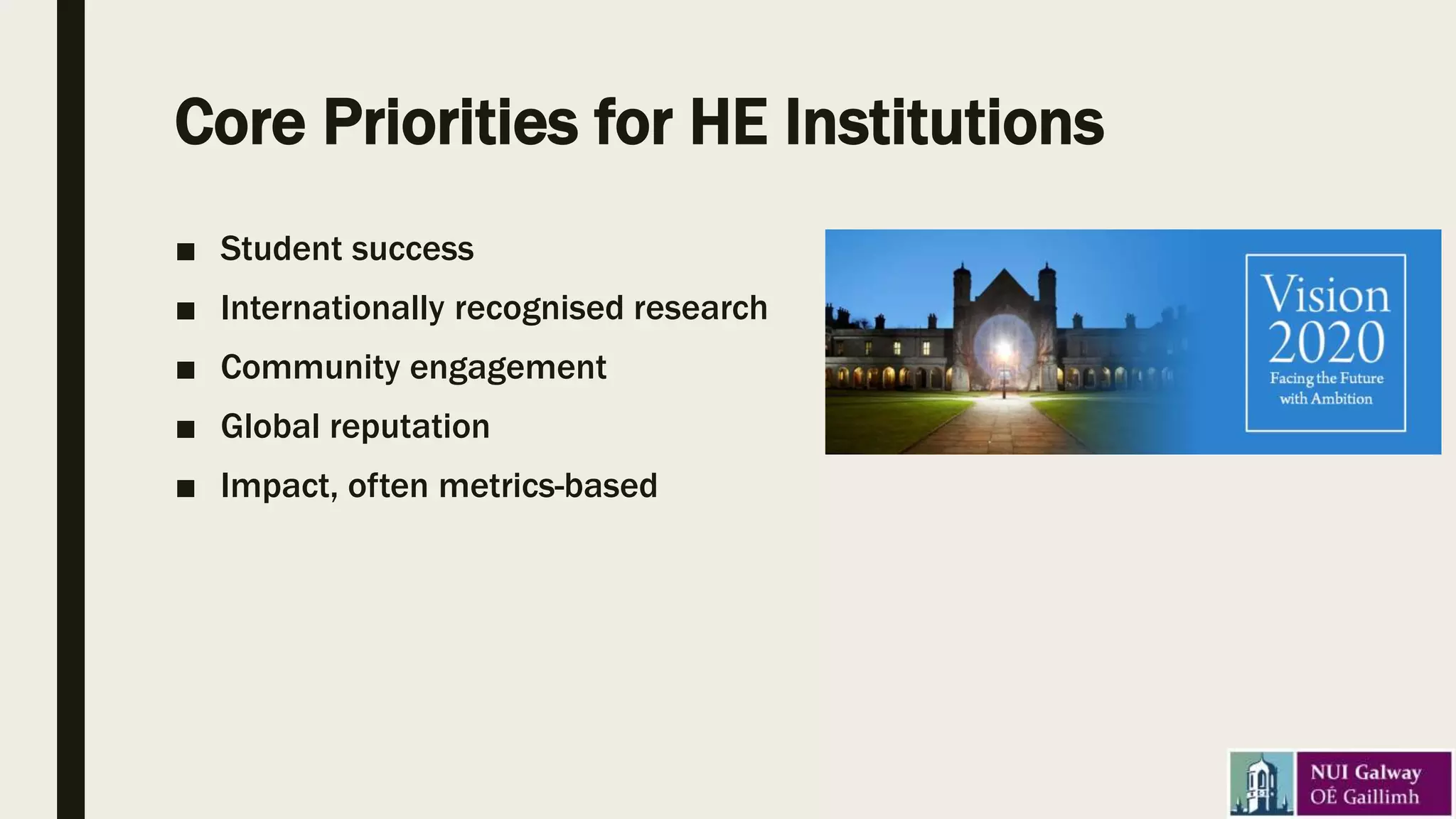
Core Priorities for HE Institutions
■ Student success
■ Internationally recognised research
■ Community engagement
■ Global reputation
■ Impact, often metrics-based
LIBRARY CHALLENGES
AND COMPETITION
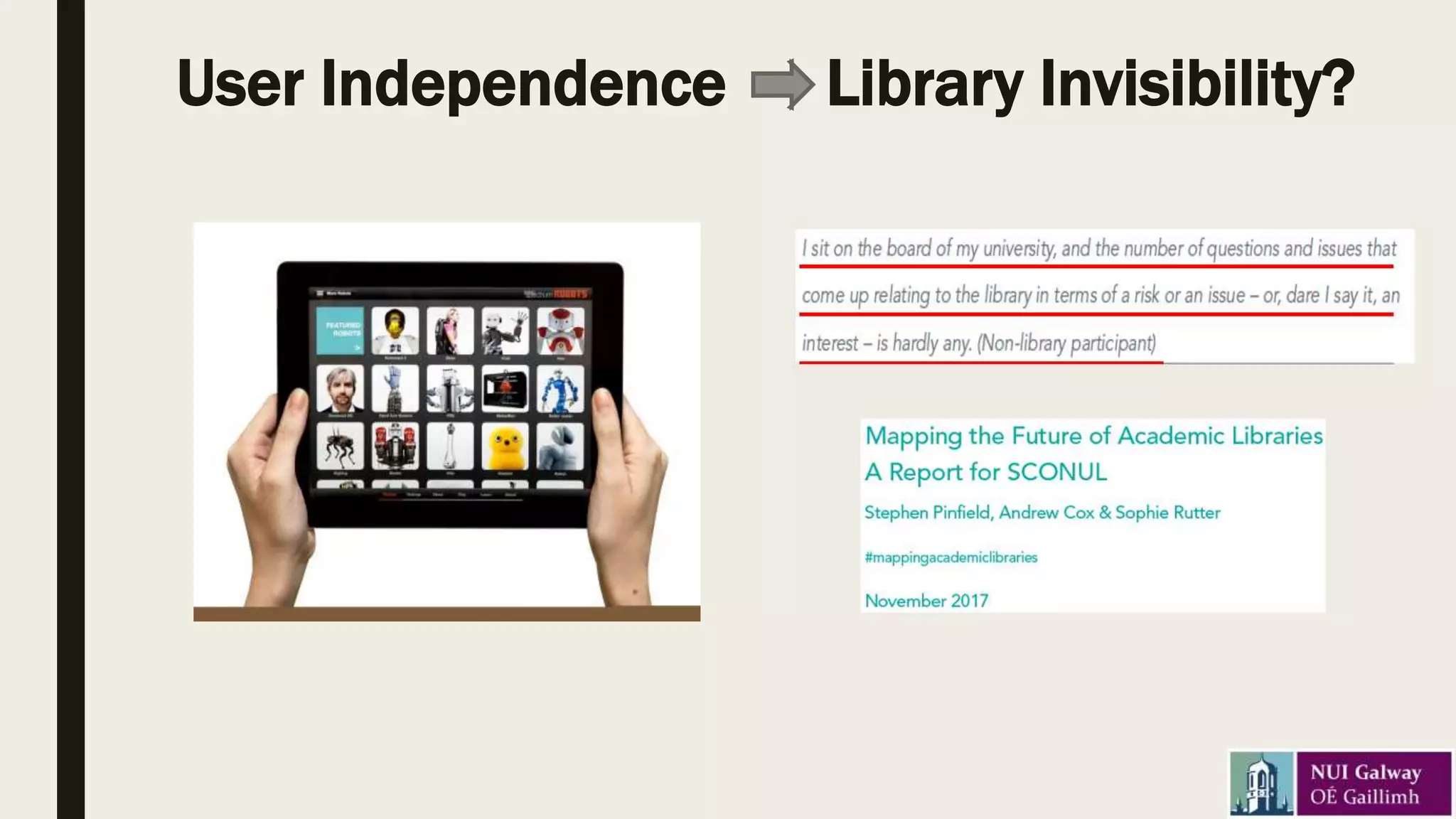
User Independence Library Invisibility?
Loss of Position?
“Academic libraries are no longer the symbolic
“heart of the university”.”
Murray, A., & Ireland, A. (2018). Provosts' perceptions of academic
library value & preferences for communication: a national study.
College & Research Libraries, 79(3), 336-365. [p.359]
https://crl.acrl.org/index.php/crl/article/view/16693/18647
Issues of Identity?
“Loss of identity in larger multi-professional alliances is a
significant risk.”
Cox, J. (2018): Positioning the academic library within the institution: a literature
review, New Review of Academic Librarianship. [p.8]
https://doi.org/10.1080/13614533.2018.1466342
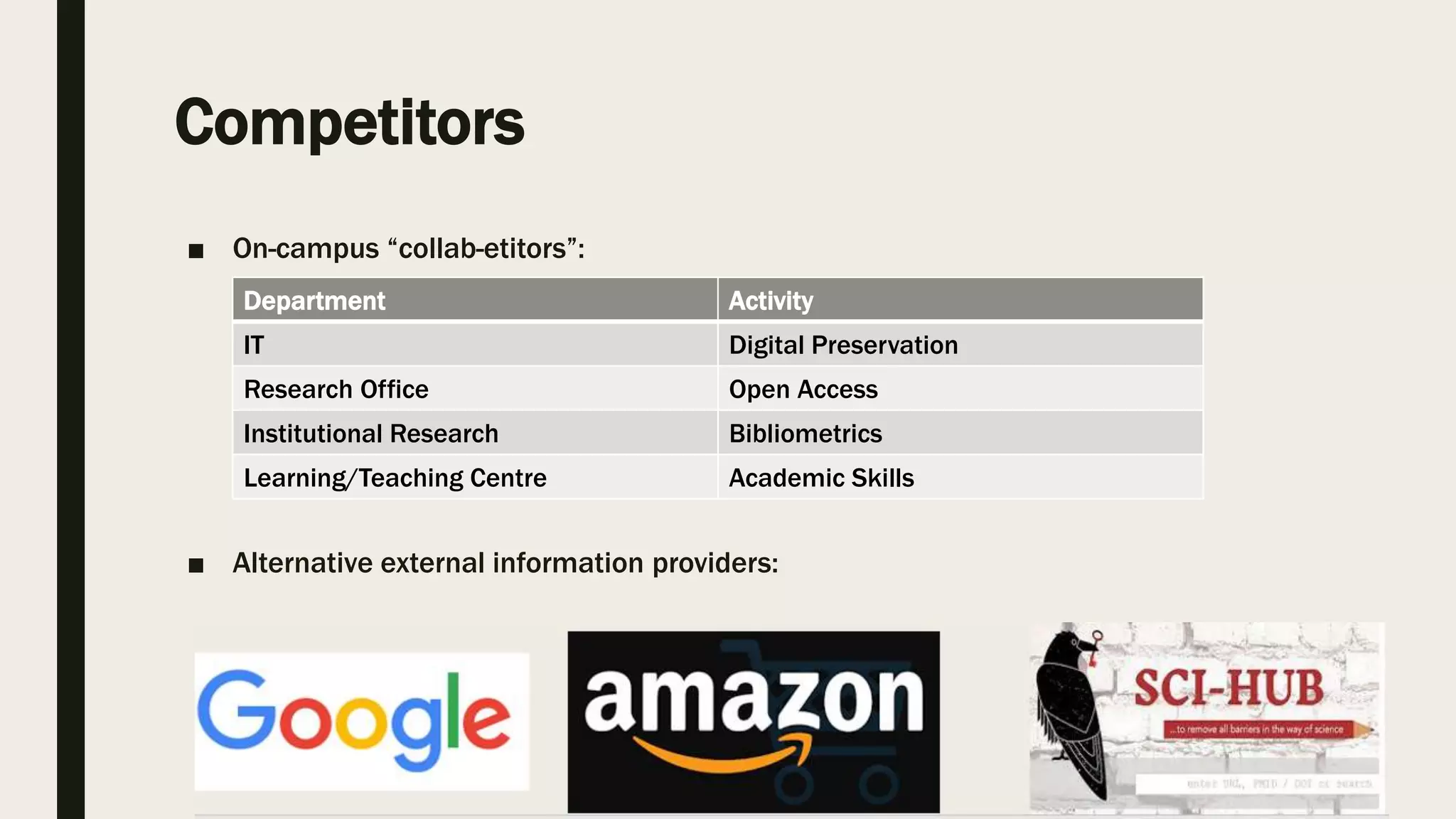
Competitors
■ On-campus “collab-etitors”:
■ Alternative external information providers:
Department Activity
IT Digital Preservation
Research Office Open Access
Institutional Research Bibliometrics
Learning/Teaching Centre Academic Skills
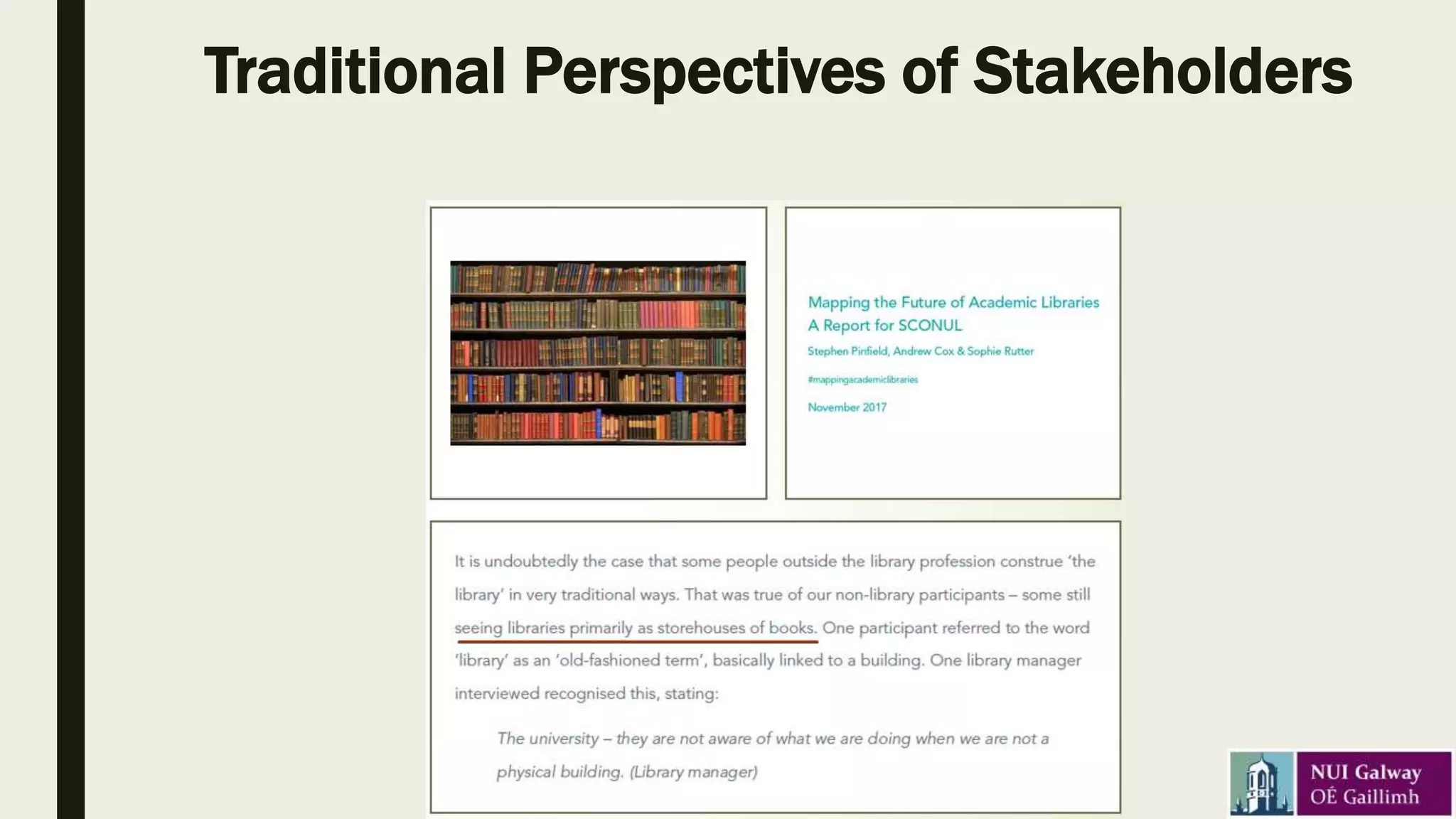
Traditional Perspectives of Stakeholders
Less Support?
“Library directors are pursuing strategic directions with a
decreasing sense of support from their institutions.”
Wolff-Eisenberg, C. Ithaka S+R US Library Survey 2016, [p.4] (New York: Ithaka, 2017),
available online at https://doi.org/10.18665/sr.303066
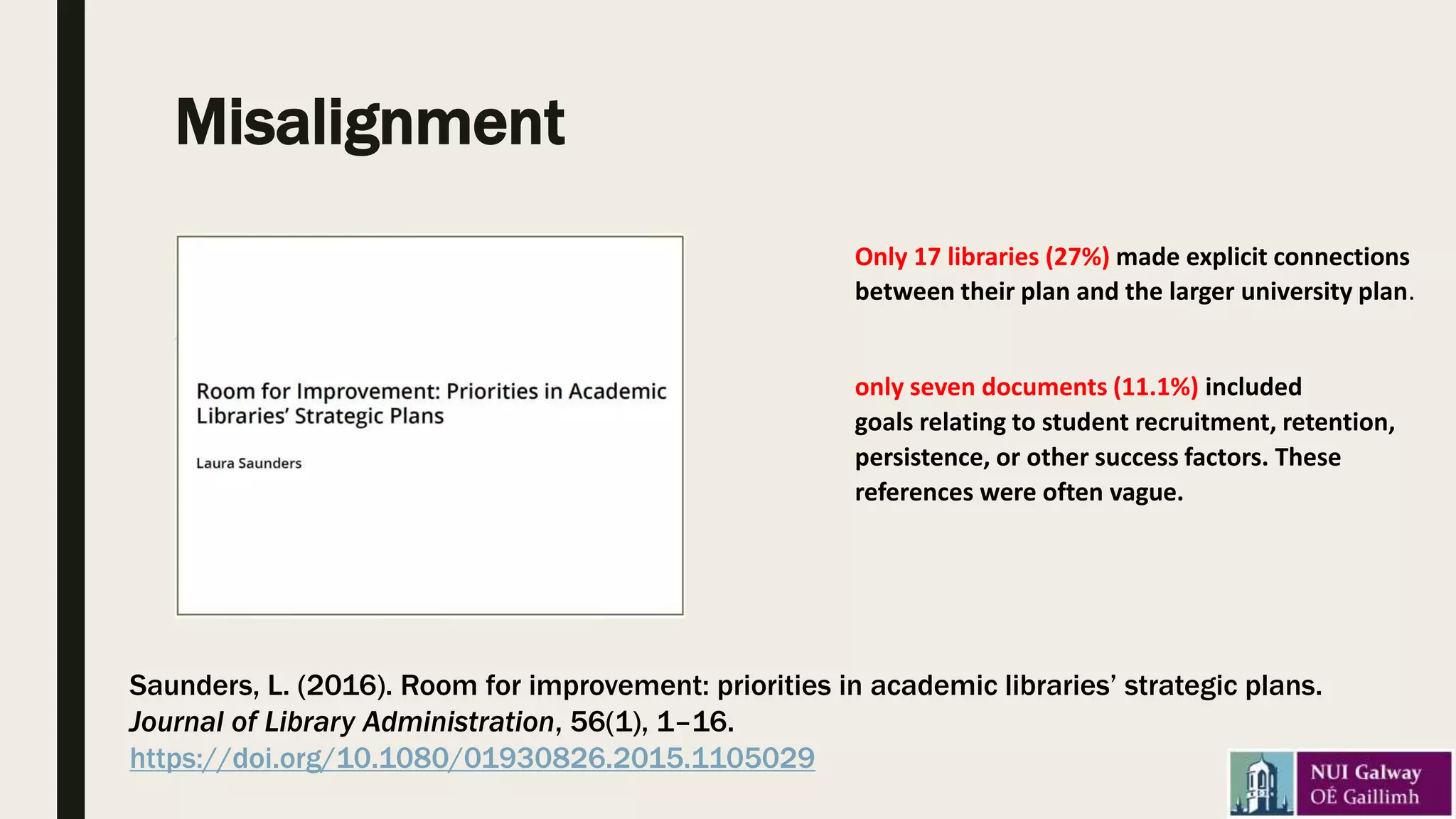
Misalignment
Only 17 libraries (27%) made explicit connections
between their plan and the larger university plan.
only seven documents (11.1%) included
goals relating to student recruitment, retention,
persistence, or other success factors. These
references were often vague.
Saunders, L. (2016). Room for improvement: priorities in academic libraries’ strategic plans.
Journal of Library Administration, 56(1), 1–16.
https://doi.org/10.1080/01930826.2015.1105029
Limited Recognition
Murray, A., & Ireland, A. (2018). Provosts' perceptions of academic library value &
preferences for communication: a national study. College & Research Libraries, 79(3),
336-365. [p.359] https://crl.acrl.org/index.php/crl/article/view/16693/18647
LIBRARY OPPORTUNITIES,
STRATEGIES AND
CHANGES
Strategies
■ Turning institutional priorities to advantage
■ Ensuring alignment/common purpose
■ Providing leadership
■ Refocusing and rebranding
■ Reorganising teams and roles
■ Communicating value
■ Acting globally as well as locally
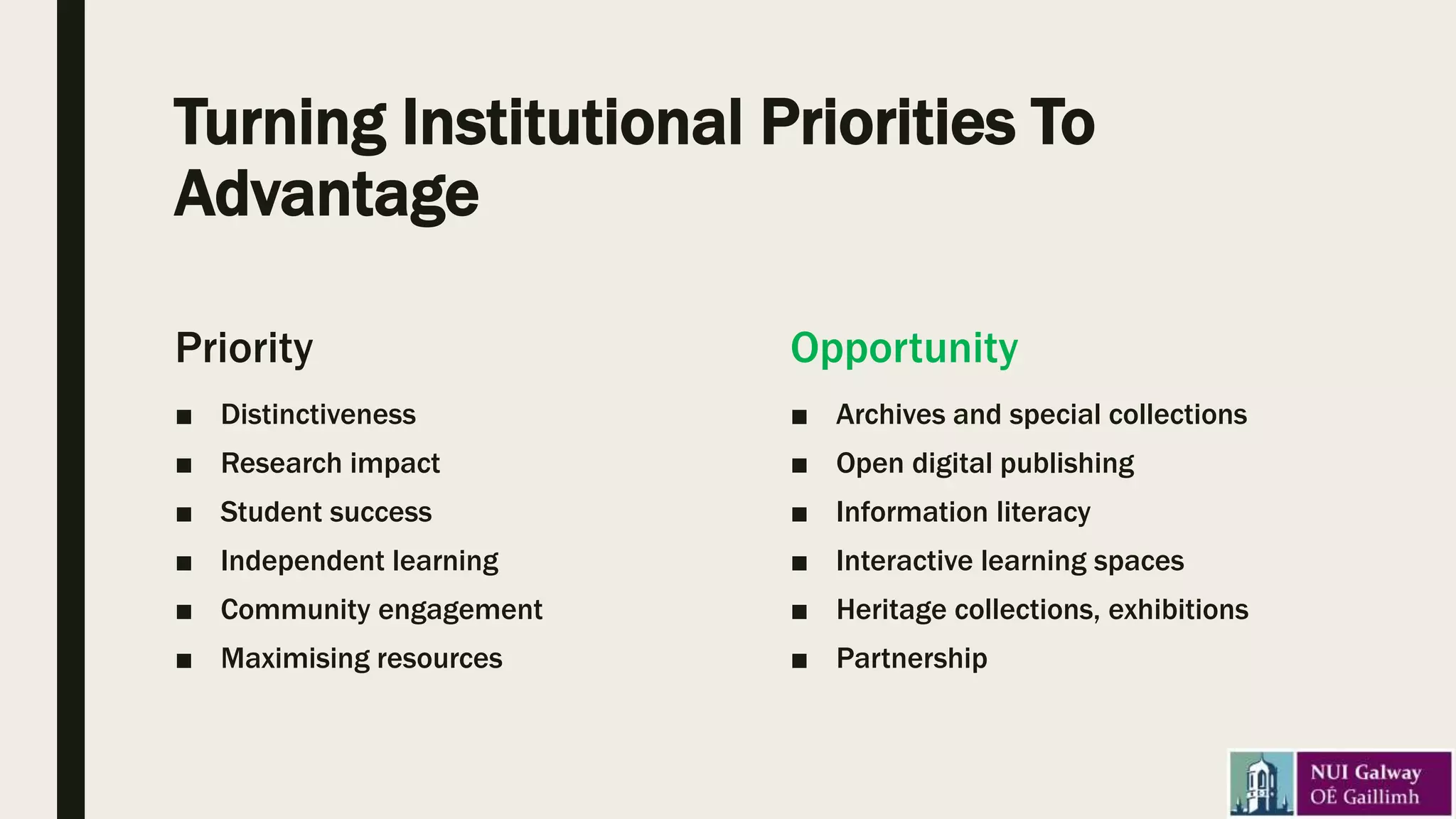
Turning Institutional Priorities To
Advantage
Priority
■ Distinctiveness
■ Research impact
■ Student success
■ Independent learning
■ Community engagement
■ Maximising resources
Opportunity
■ Archives and special collections
■ Open digital publishing
■ Information literacy
■ Interactive learning spaces
■ Heritage collections, exhibitions
■ Partnership
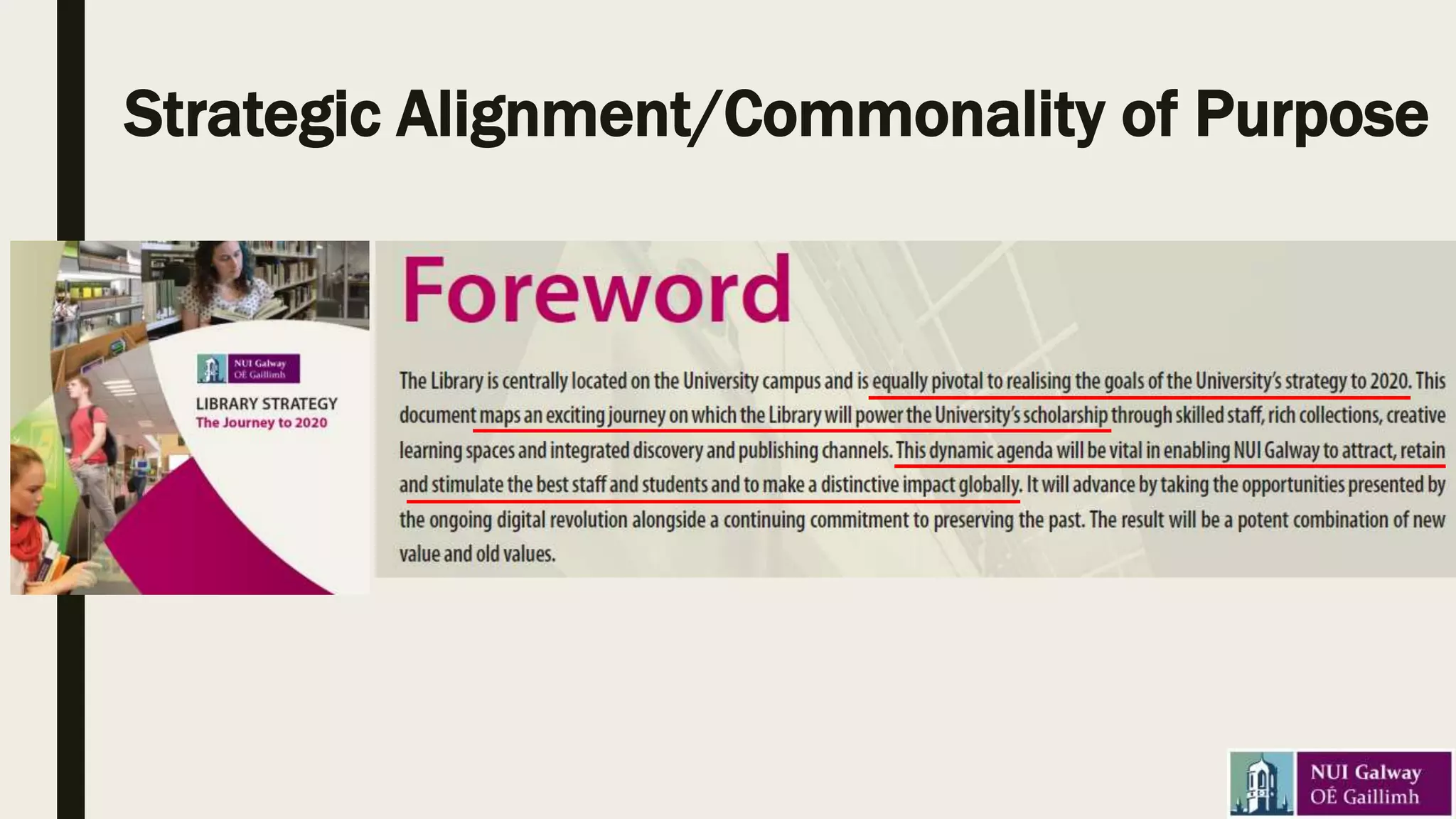
Strategic Alignment/Commonality of Purpose
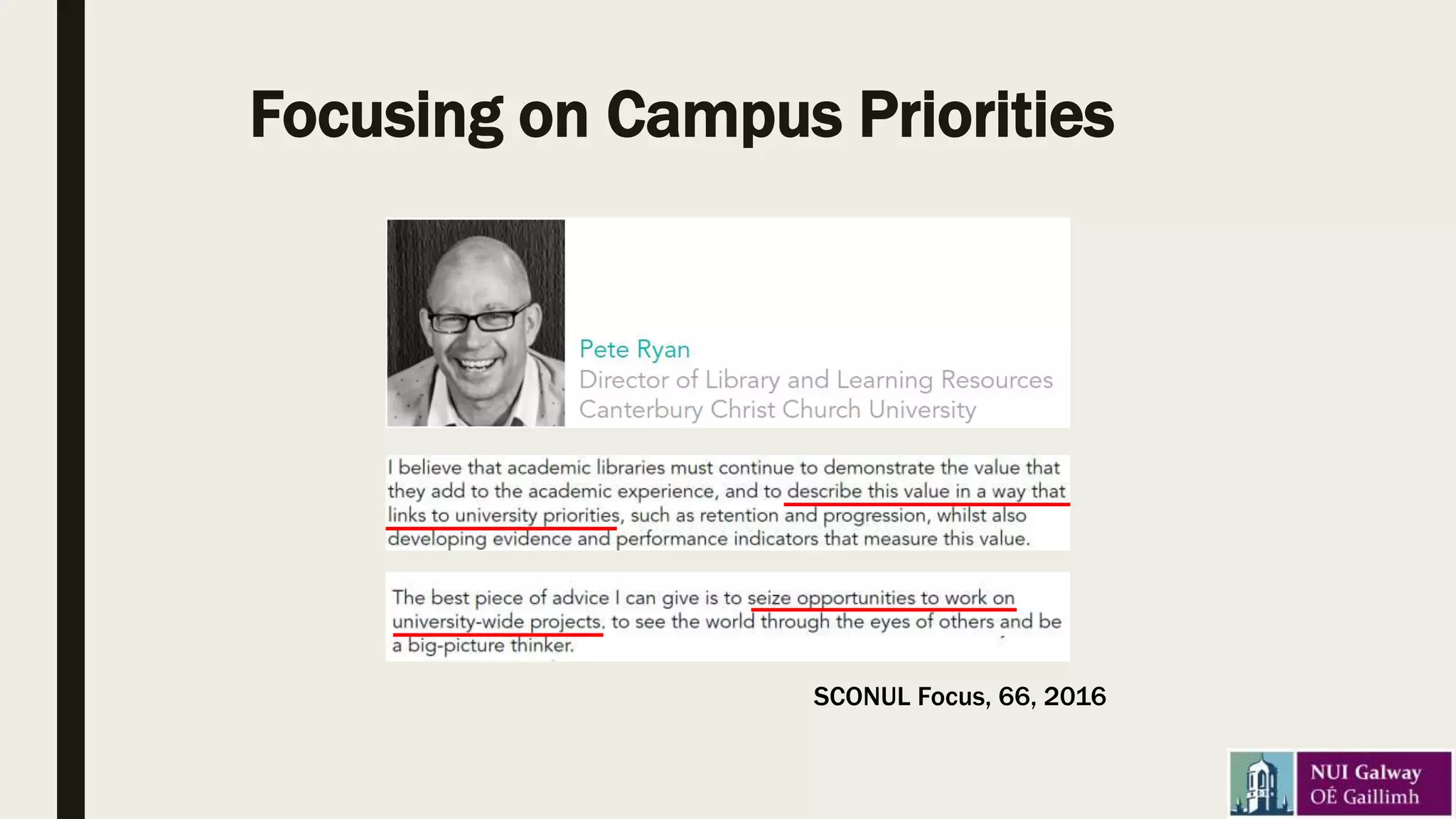
Focusing on Campus Priorities
SCONUL Focus, 66, 2016
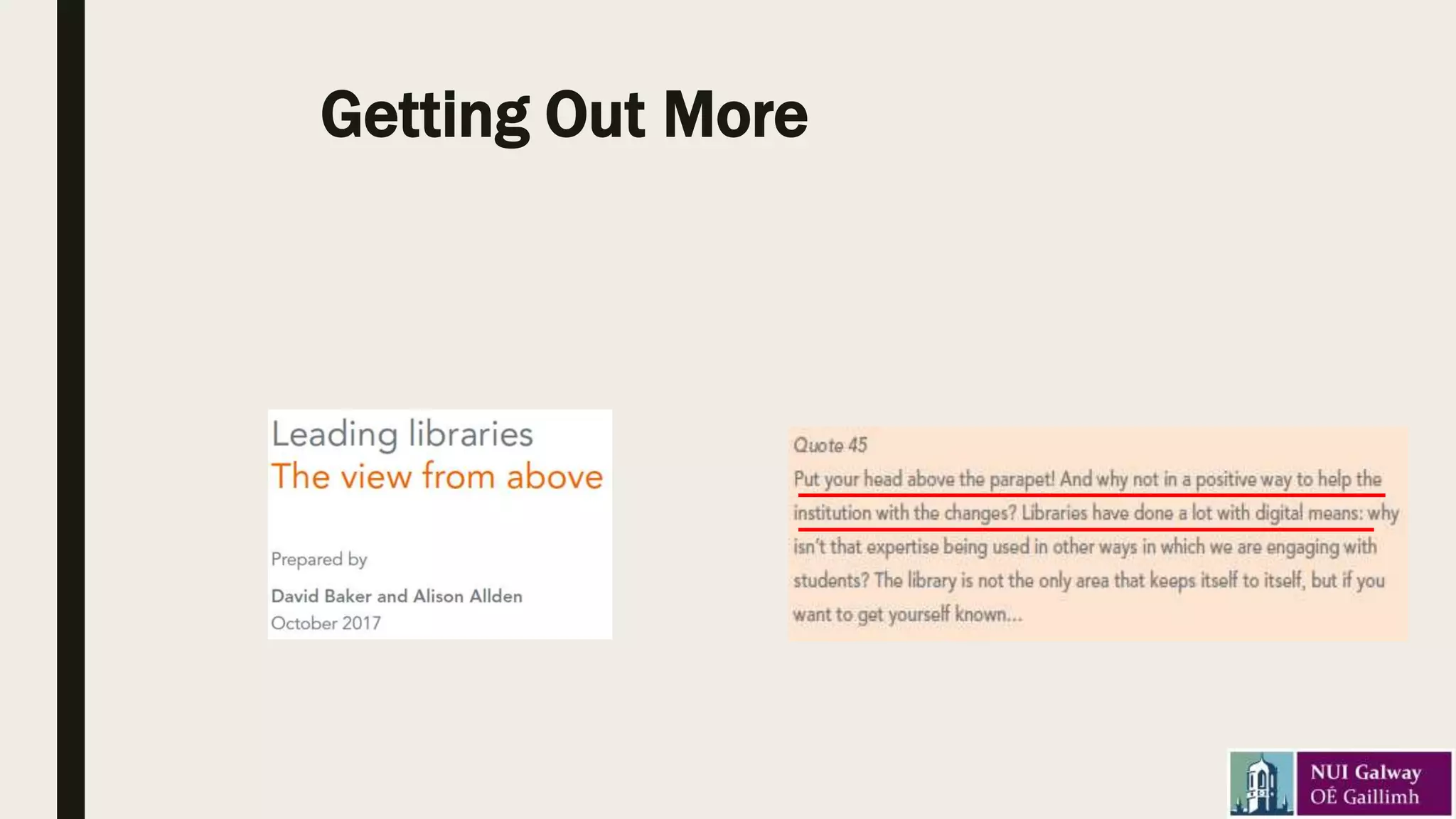
Getting Out More
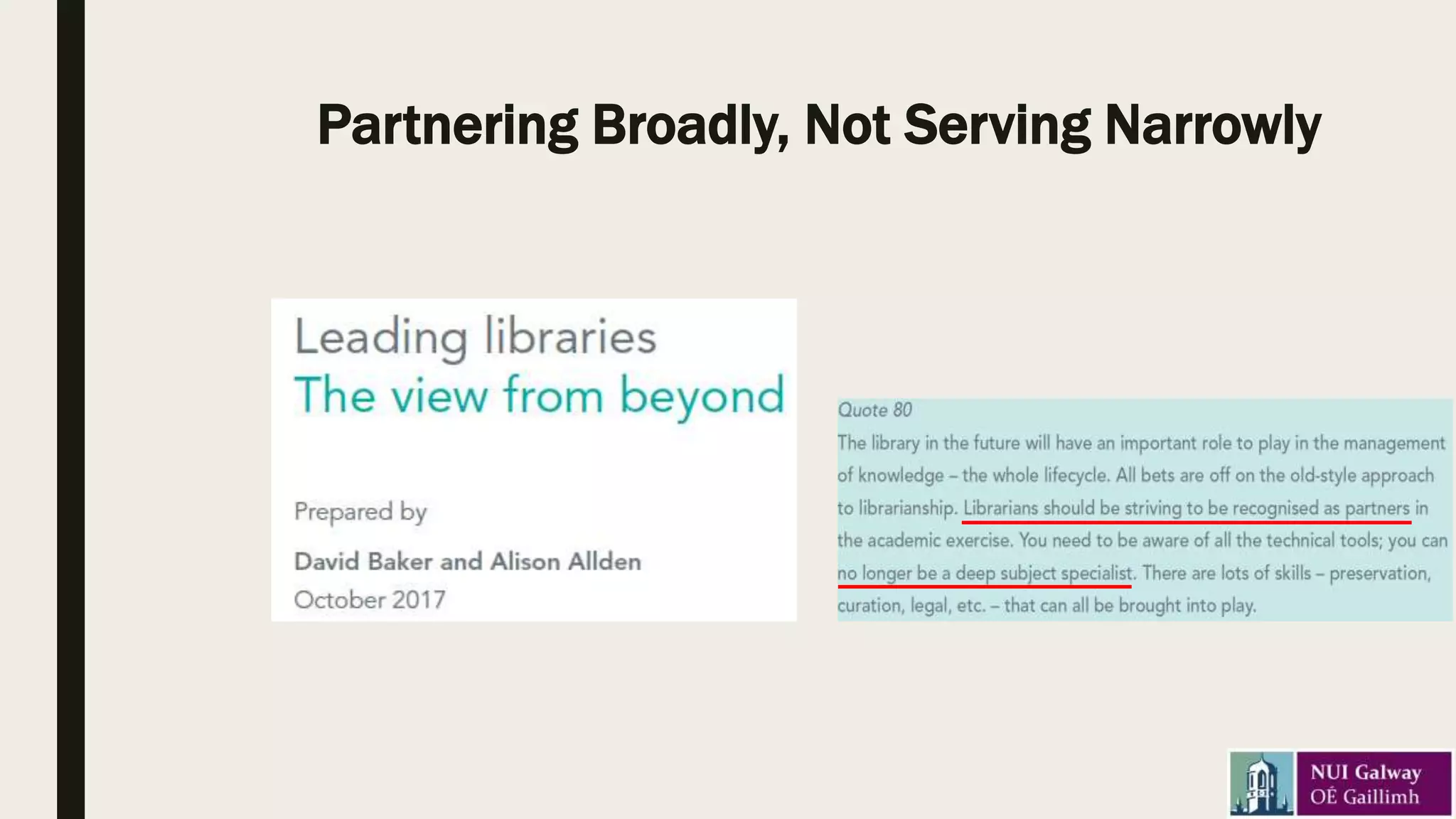
Partnering Broadly, Not Serving Narrowly
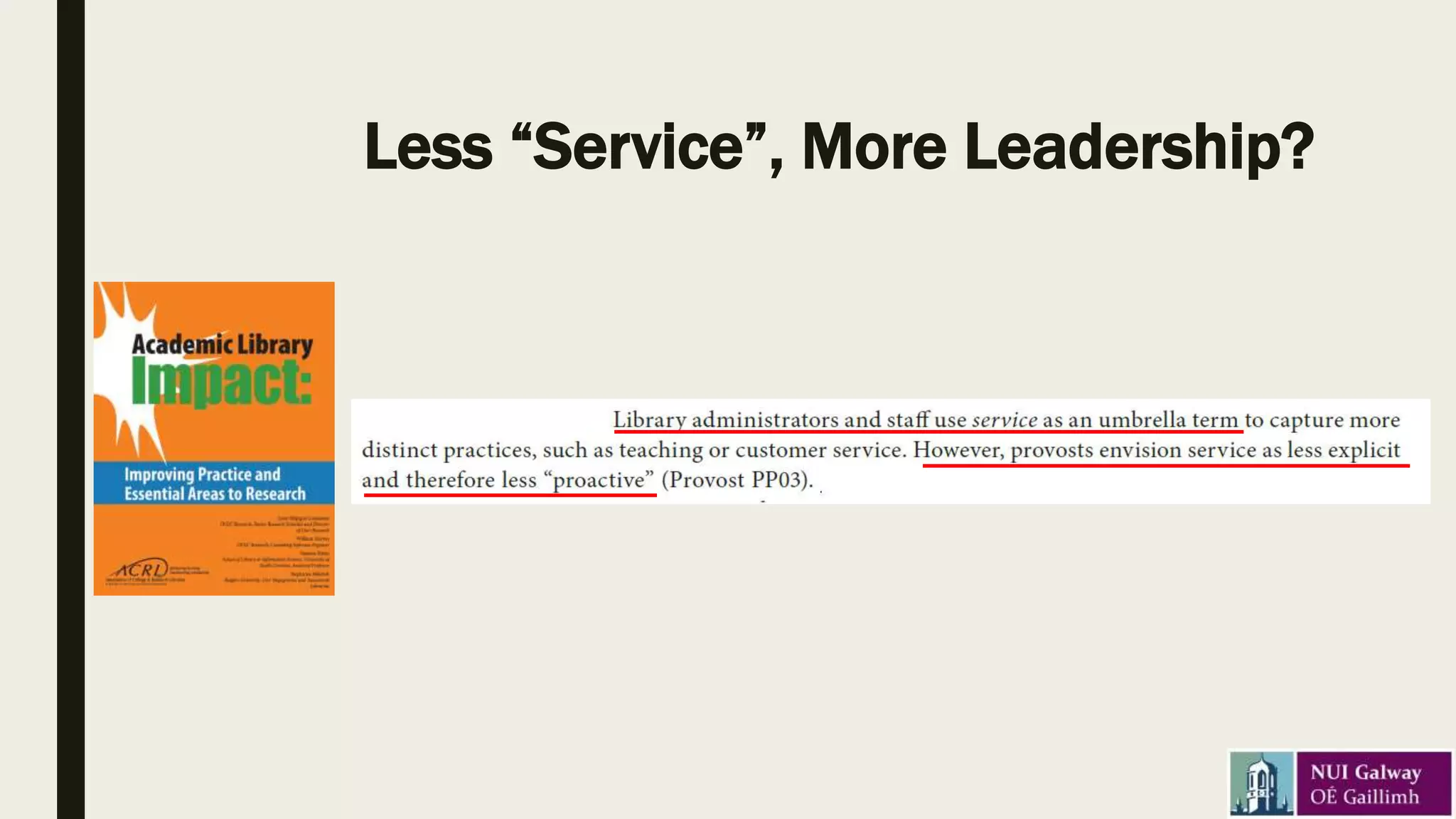
Less “Service”, More Leadership?
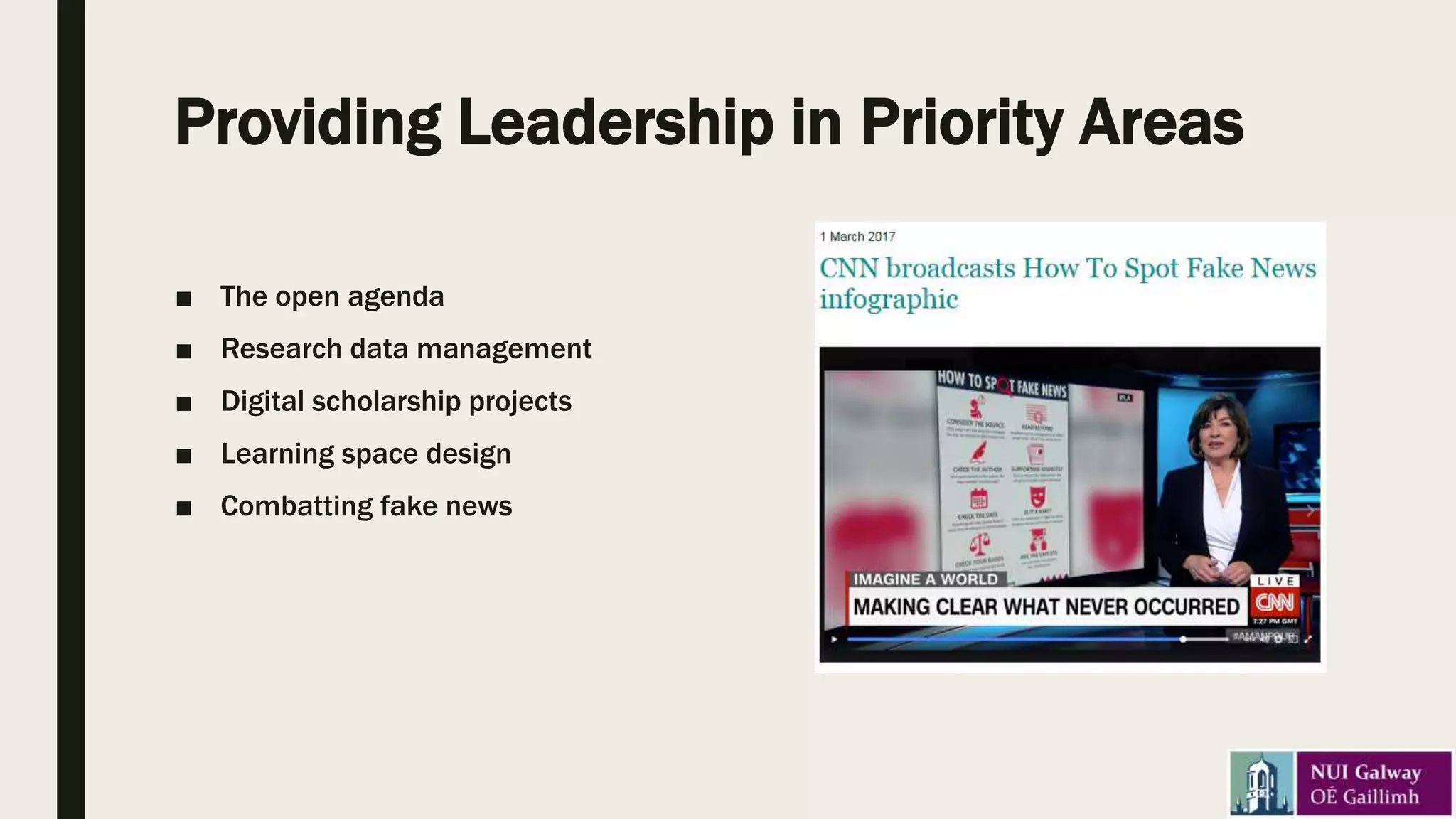
Providing Leadership in Priority Areas
■ The open agenda
■ Research data management
■ Digital scholarship projects
■ Learning space design
■ Combatting fake news
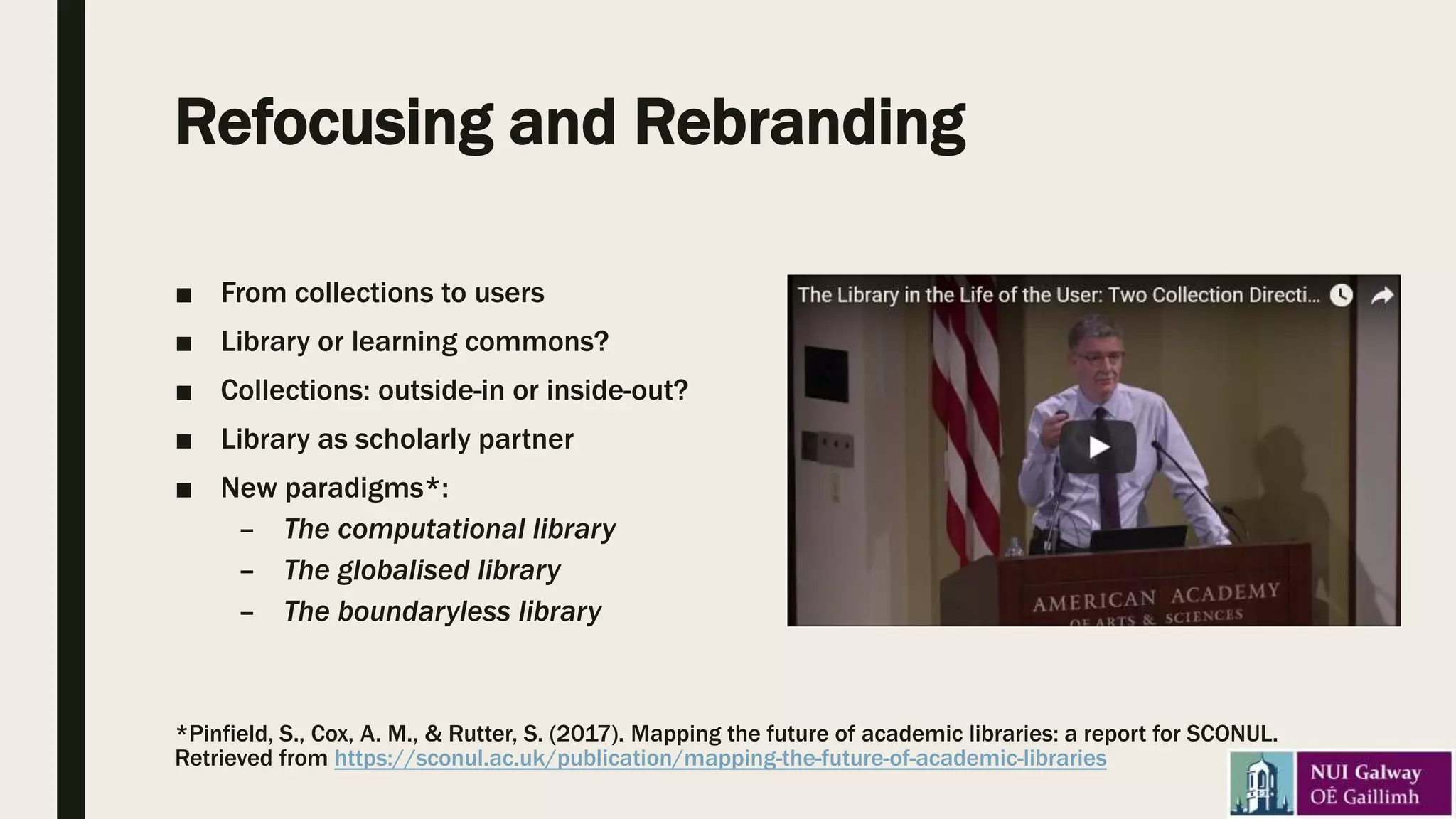
Refocusing and Rebranding
■ From collections to users
■ Library or learning commons?
■ Collections: outside-in or inside-out?
■ Library as scholarly partner
■ New paradigms*:
– The computational library
– The globalised library
– The boundaryless library
*Pinfield, S., Cox, A. M., & Rutter, S. (2017). Mapping the future of academic libraries: a report for SCONUL.
Retrieved from https://sconul.ac.uk/publication/mapping-the-future-of-academic-libraries
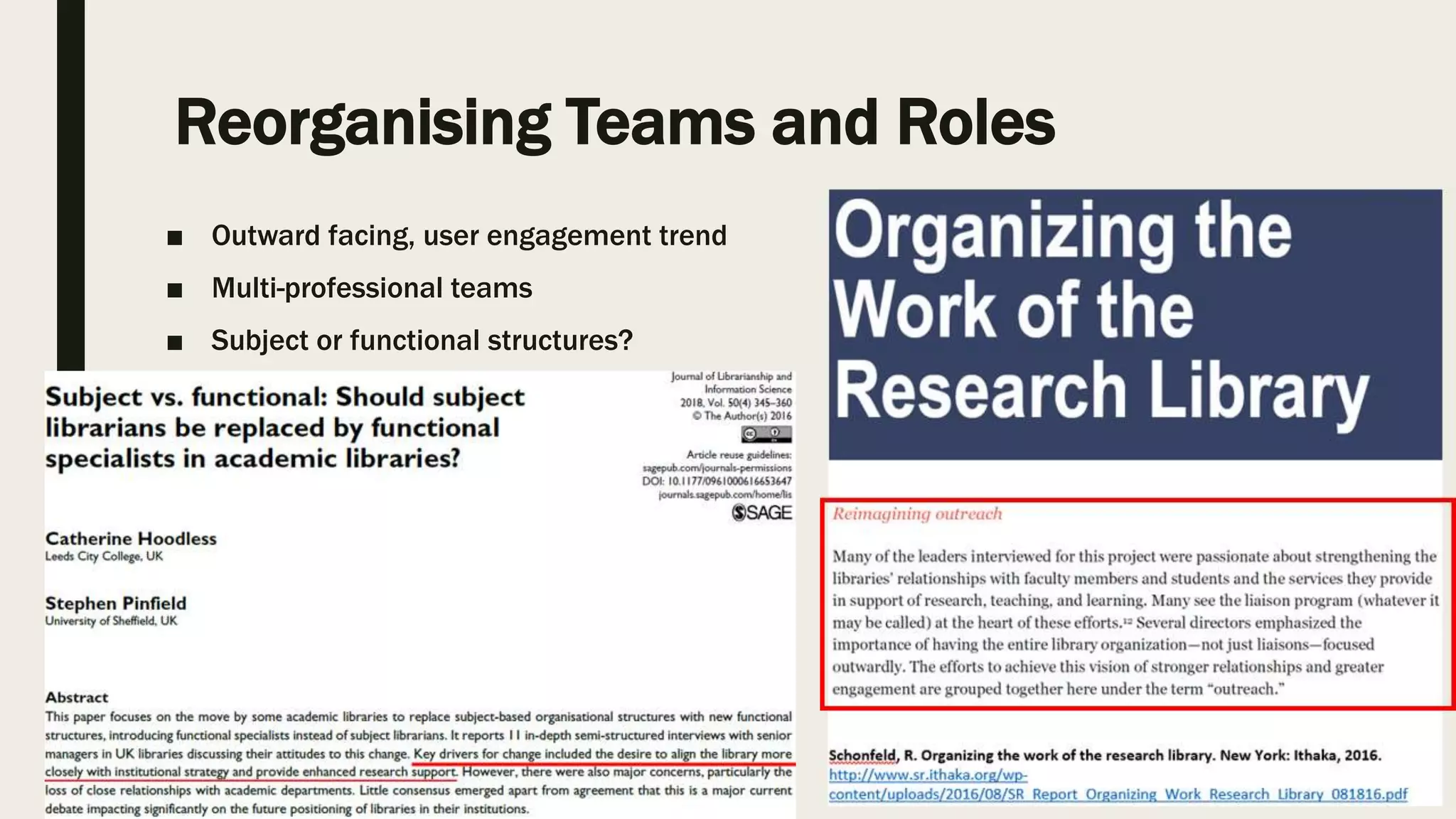
Reorganising Teams and Roles
■ Outward facing, user engagement trend
■ Multi-professional teams
■ Subject or functional structures?
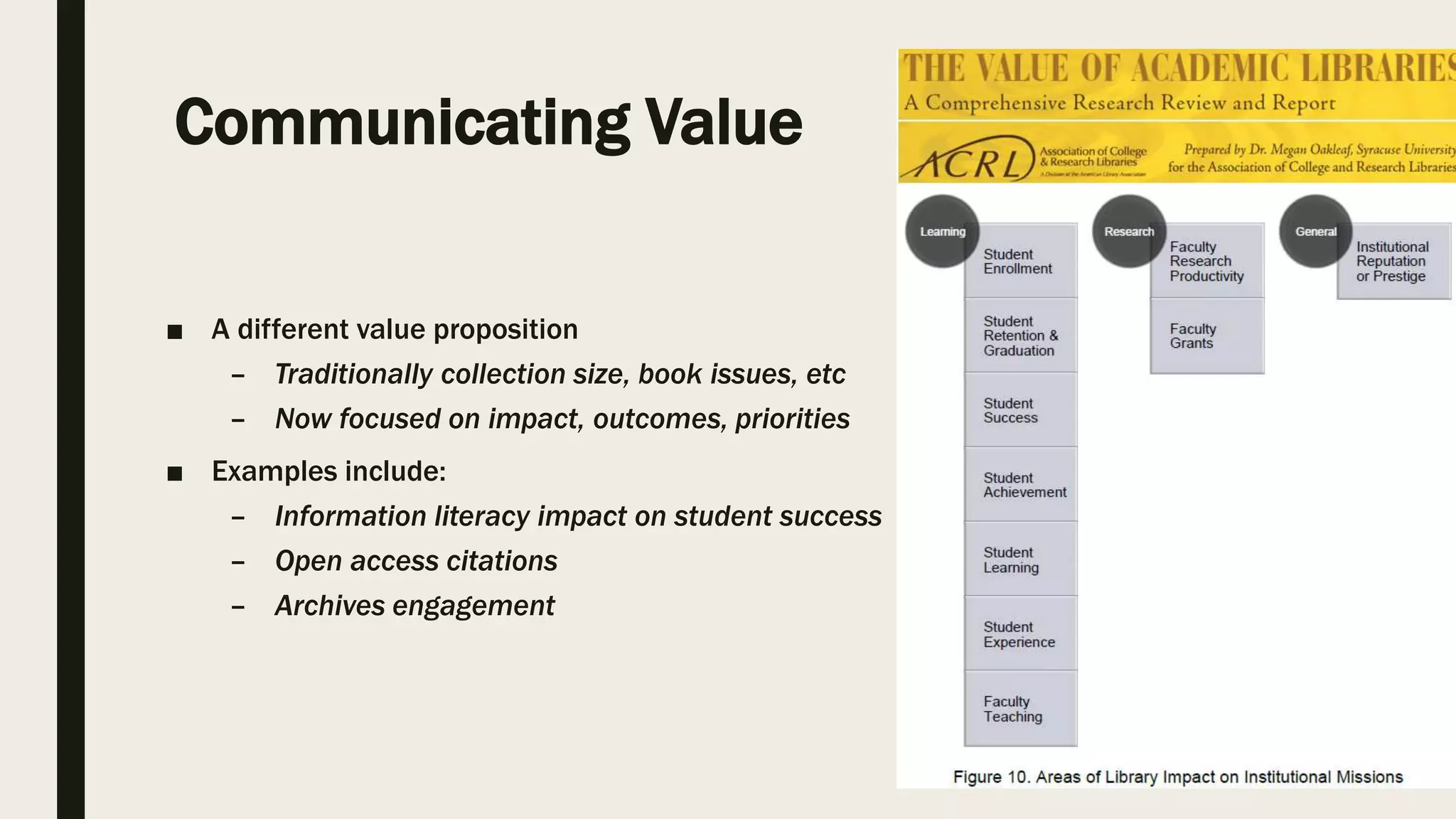
Communicating Value
■ A different value proposition
– Traditionally collection size, book issues, etc
– Now focused on impact, outcomes, priorities
■ Examples include:
– Information literacy impact on student success
– Open access citations
– Archives engagement
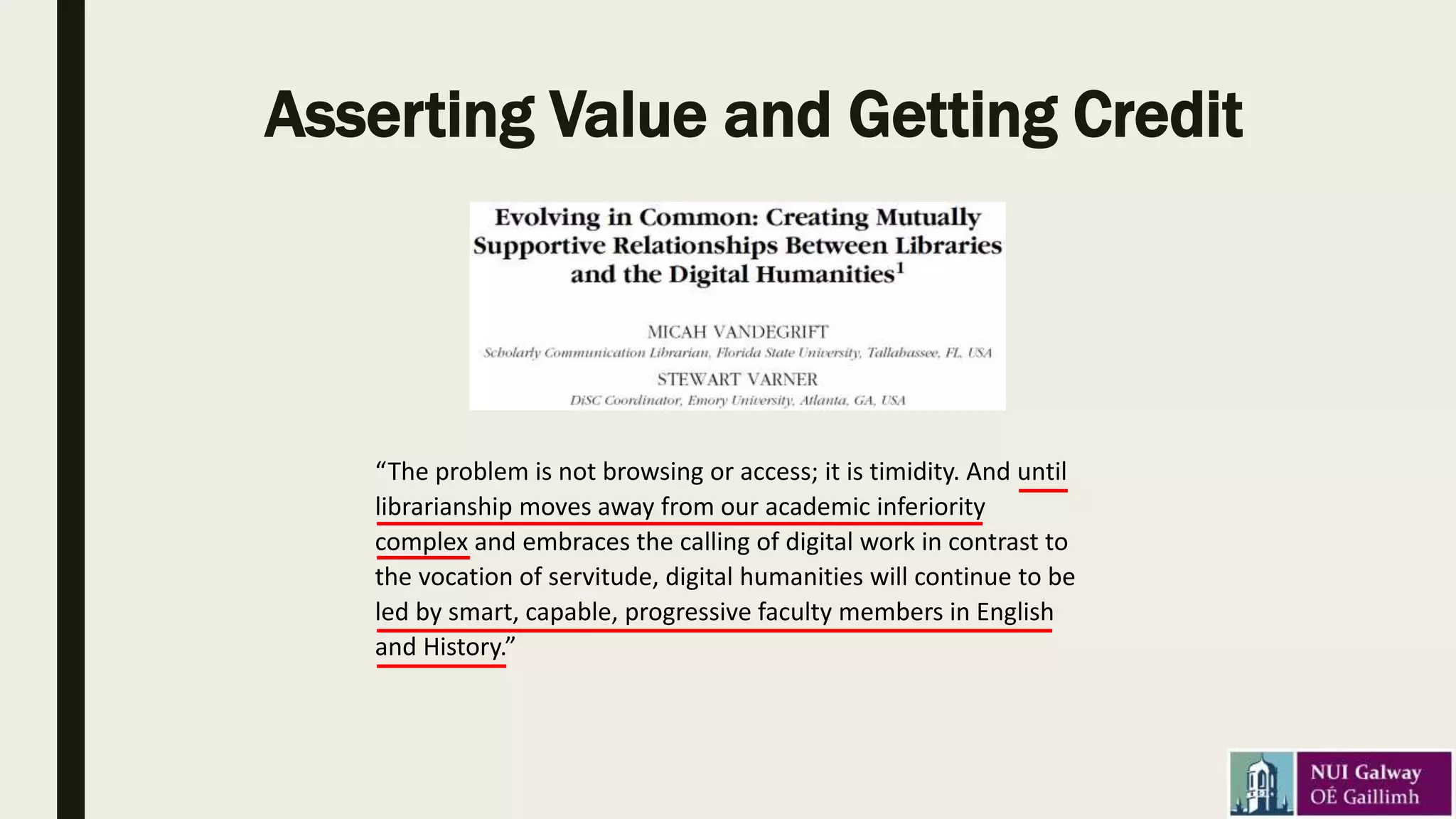
Asserting Value and Getting Credit
“The problem is not browsing or access; it is timidity. And until
librarianship moves away from our academic inferiority
complex and embraces the calling of digital work in contrast to
the vocation of servitude, digital humanities will continue to be
led by smart, capable, progressive faculty members in English
and History.”
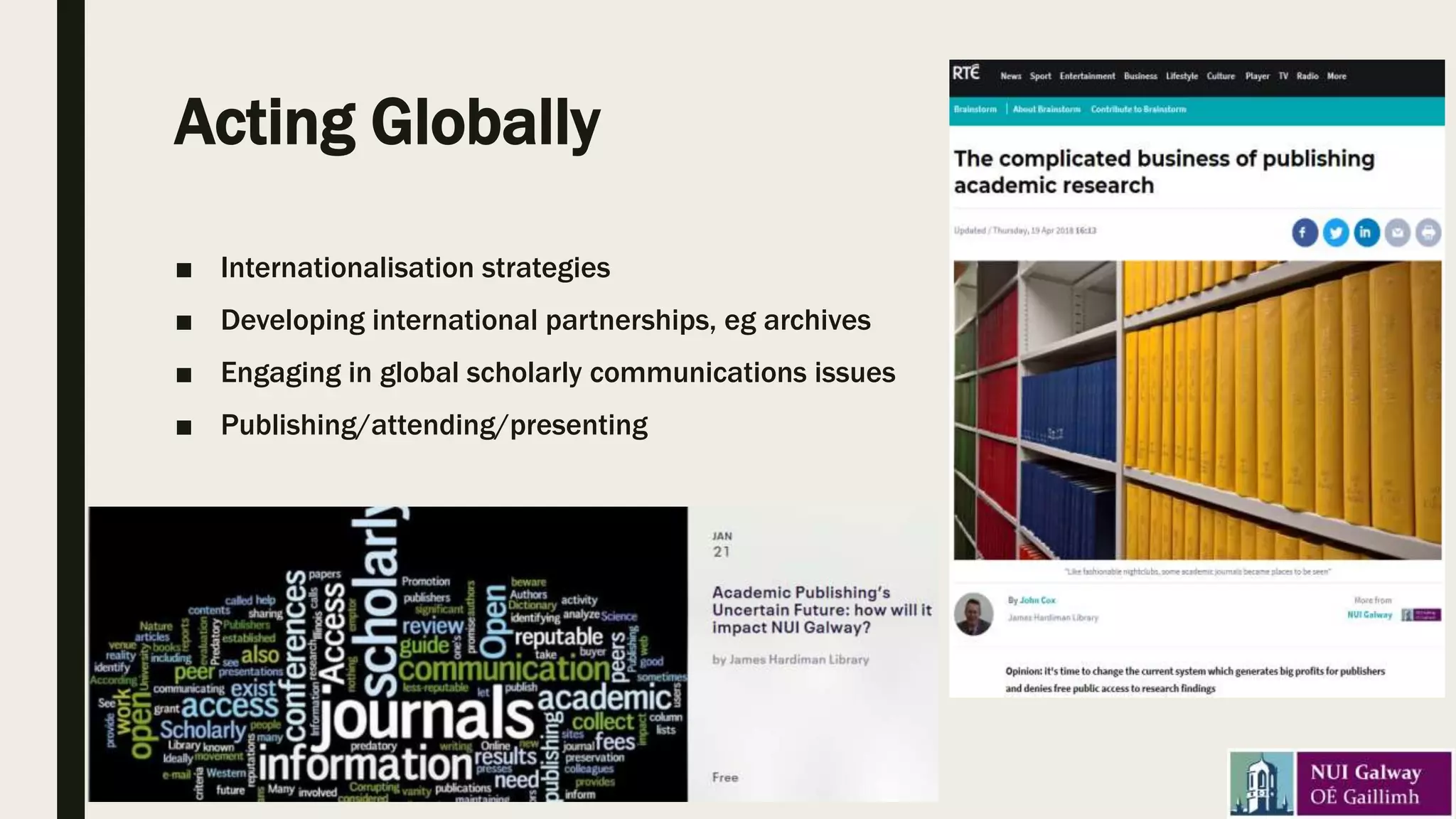
Acting Globally
■ Internationalisation strategies
■ Developing international partnerships, eg archives
■ Engaging in global scholarly communications issues
■ Publishing/attending/presenting
SQUEEZED MIDDLE?
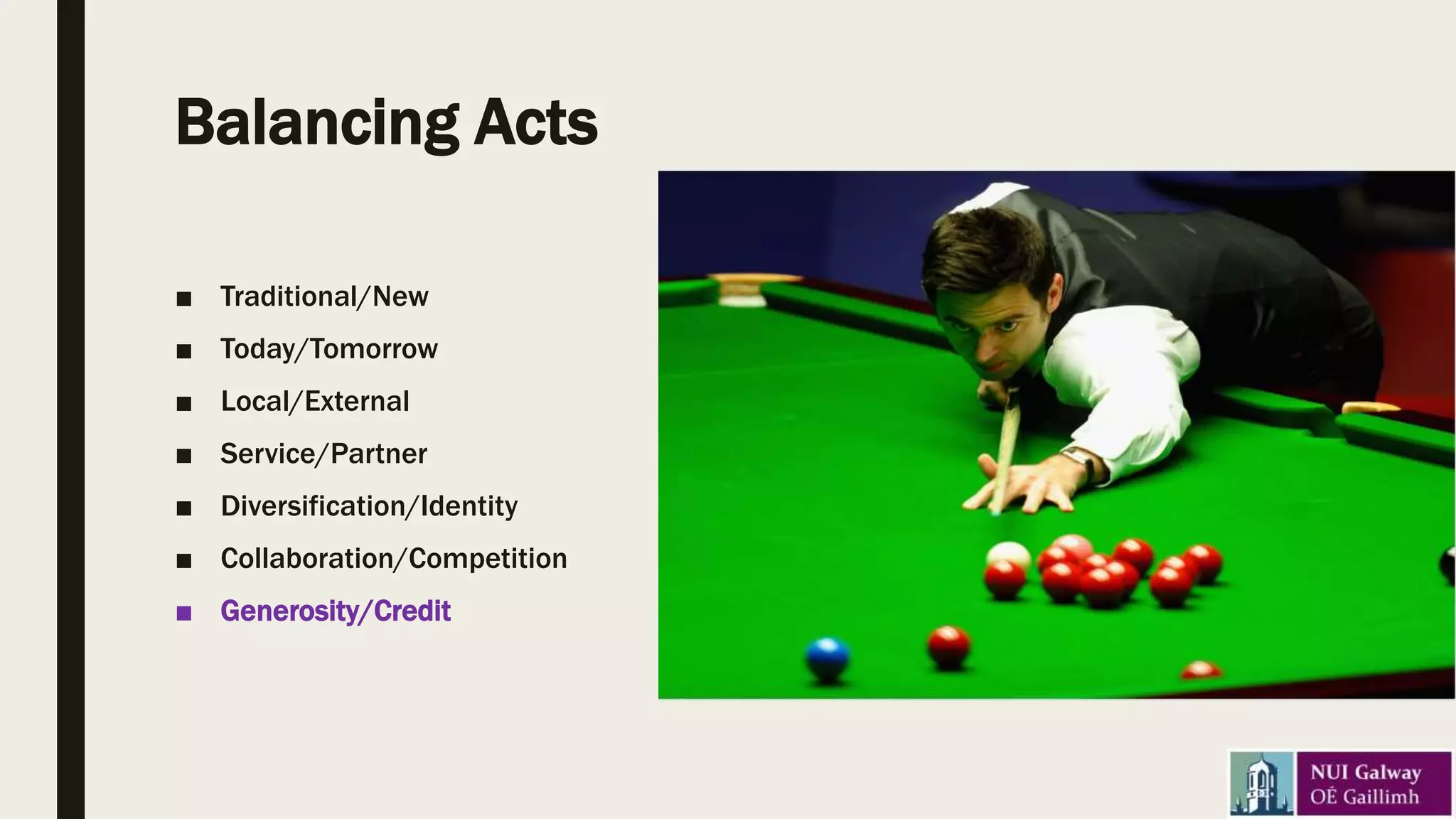
Balancing Acts
■ Traditional/New
■ Today/Tomorrow
■ Local/External
■ Service/Partner
■ Diversification/Identity
■ Collaboration/Competition
■ Generosity/Credit
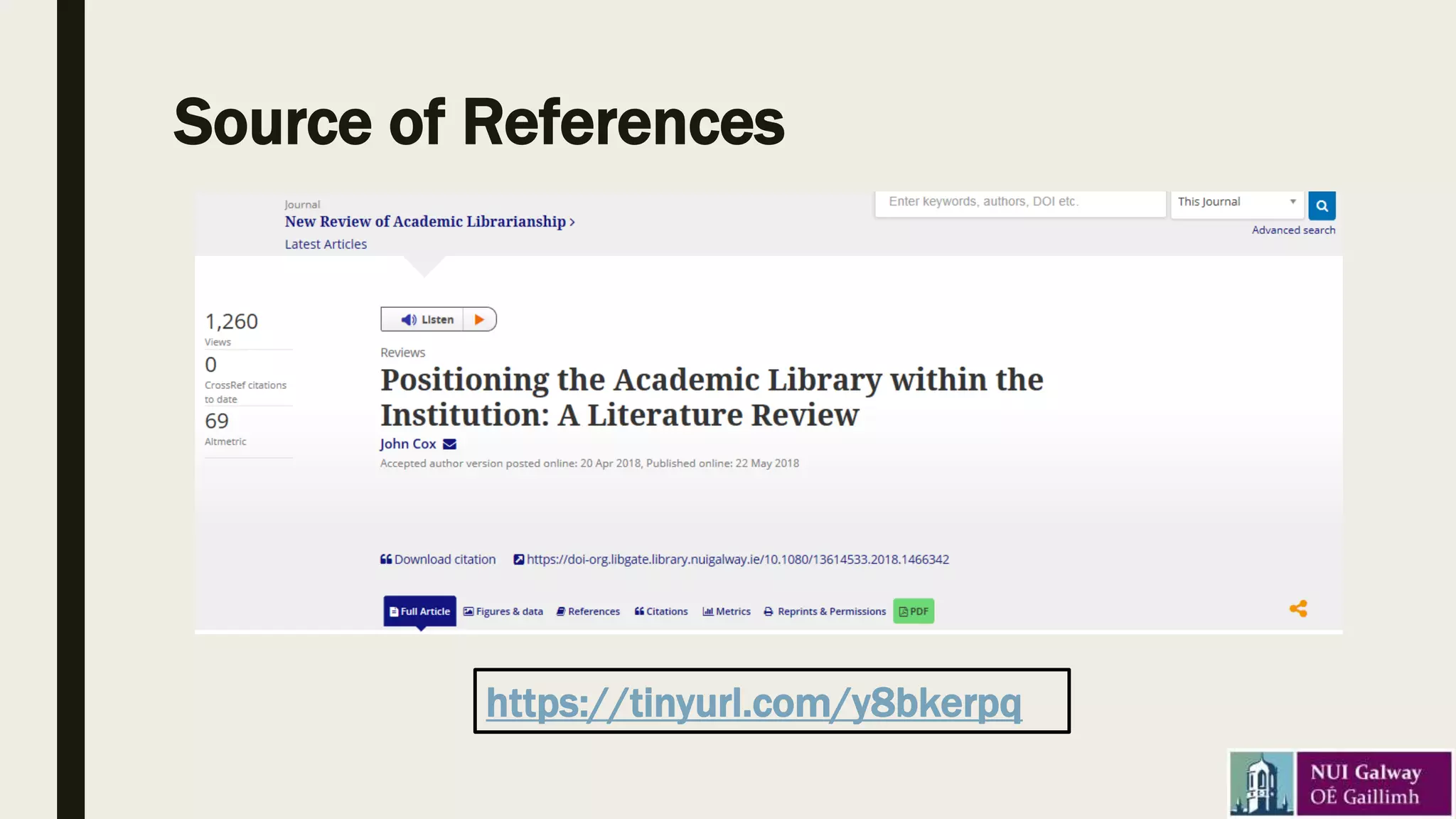
Source of References
https://tinyurl.com/y8bkerpq
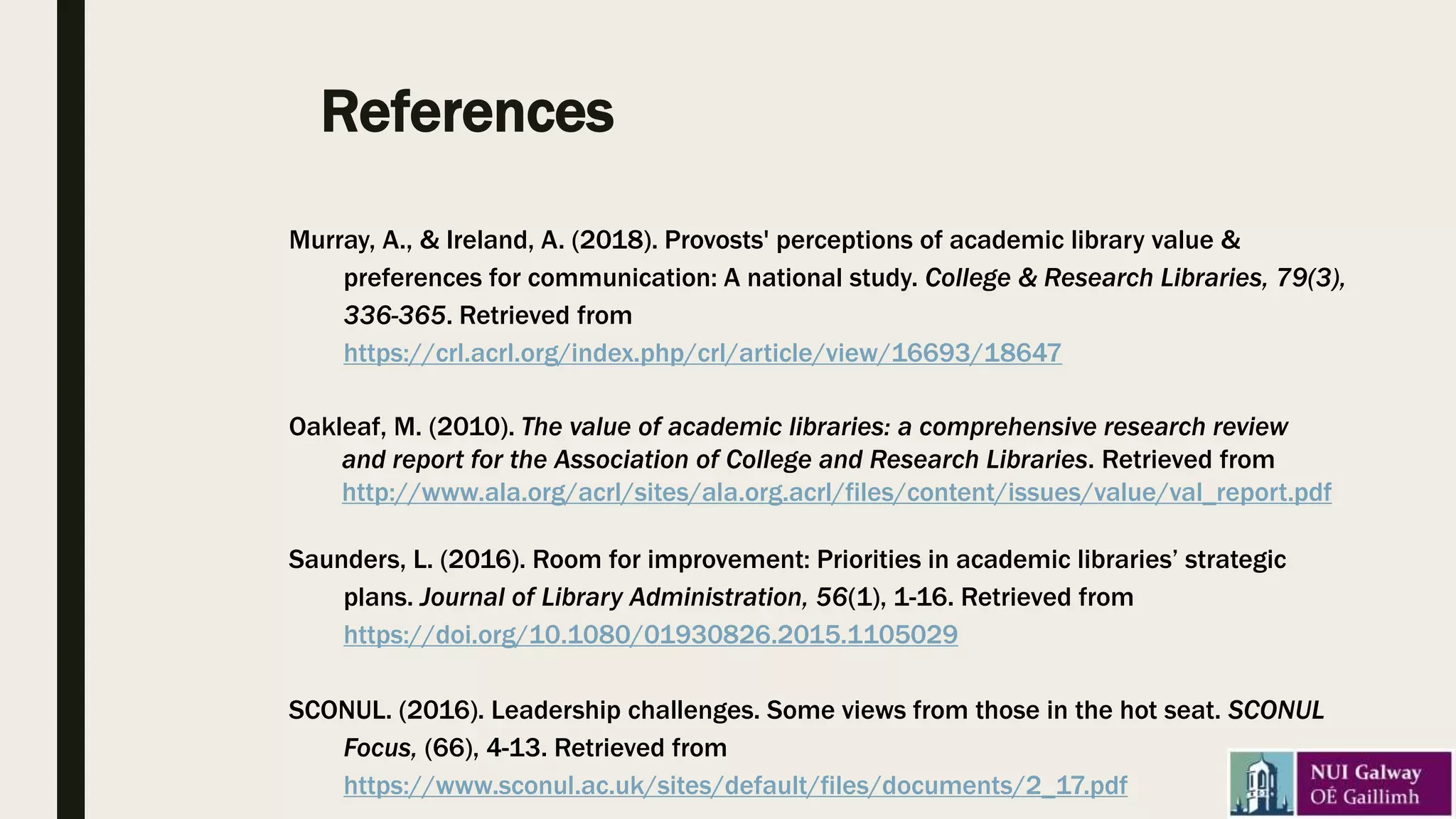
References
Baker, D., & Allden, A. (2017b). Leading libraries: the view from above.
Retrieved from https://www.sconul.ac.uk/publication/the-view-from-above
Baker, D., & Allden, A. (2017b). Leading libraries: the view from beyond.
Retrieved from
https://www.sconul.ac.uk/publication/the-view-from-beyond
Connaway, L. S., Harvey, W., Kitzie, V., & Mikitish, S. (2017). Academic library
impact: improving practice and essential areas to research. Retrieved from
http://www.ala.org/acrl/sites/ala.org.acrl/files/content/publications/whitepa
pers/academiclib.pdf
Hoodless, C., & Pinfield, S. Subject vs. functional: should subject librarians be
replaced by functional specialists in academic libraries? Journal of
Librarianship and Information Science, 50(4), 2018, pp. 345-360 Retrieved
from http://dx.doi.org/10.1177/0961000616653647
References
Murray, A., & Ireland, A. (2018). Provosts' perceptions of academic library value &
preferences for communication: A national study. College & Research Libraries, 79(3),
336-365. Retrieved from
https://crl.acrl.org/index.php/crl/article/view/16693/18647
Oakleaf, M. (2010). The value of academic libraries: a comprehensive research review
and report for the Association of College and Research Libraries. Retrieved from
http://www.ala.org/acrl/sites/ala.org.acrl/files/content/issues/value/val_report.pdf
Saunders, L. (2016). Room for improvement: Priorities in academic libraries’ strategic
plans. Journal of Library Administration, 56(1), 1-16. Retrieved from
https://doi.org/10.1080/01930826.2015.1105029
SCONUL. (2016). Leadership challenges. Some views from those in the hot seat. SCONUL
Focus, (66), 4-13. Retrieved from
https://www.sconul.ac.uk/sites/default/files/documents/2_17.pdf
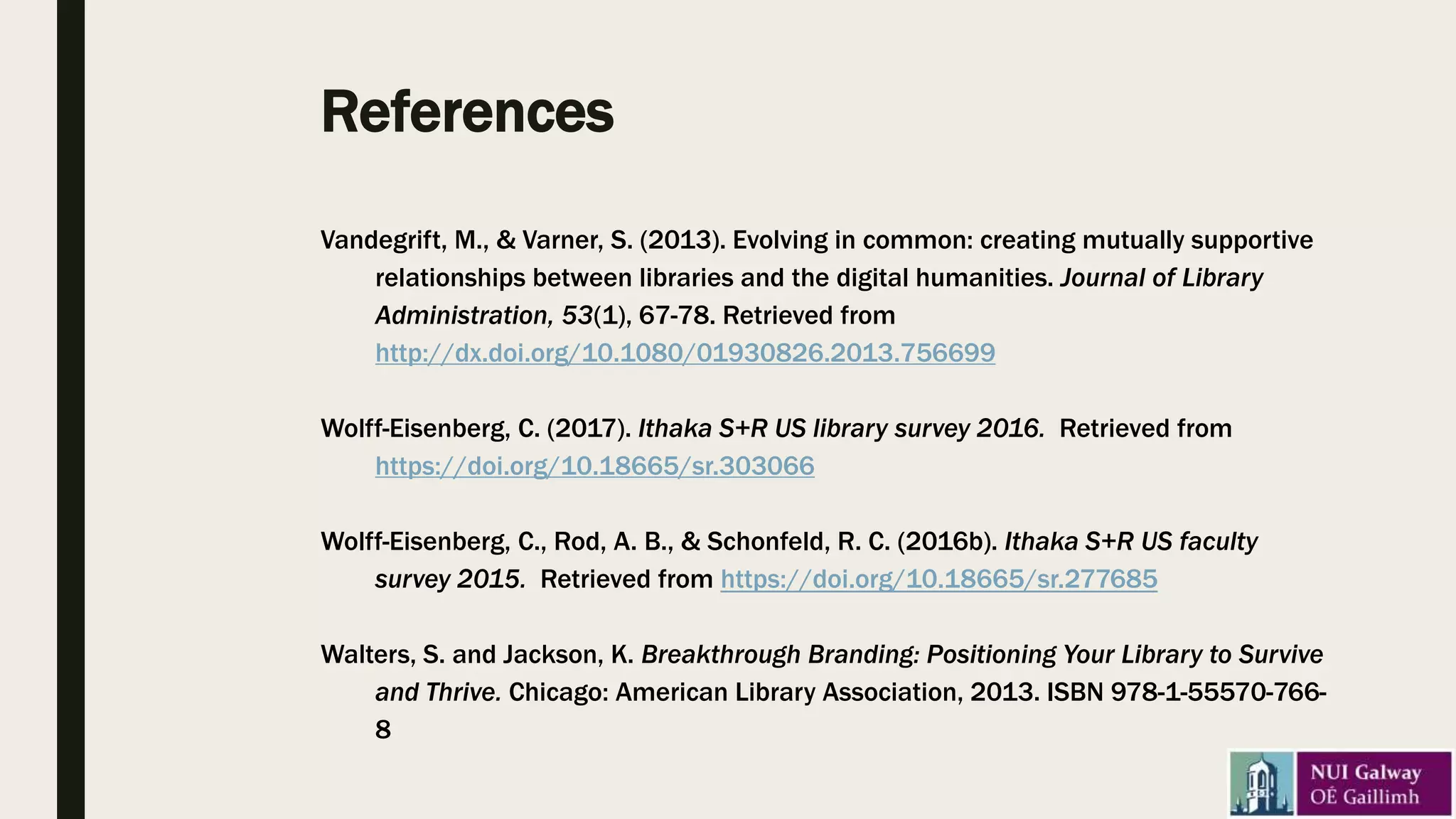
References
Vandegrift, M., & Varner, S. (2013). Evolving in common: creating mutually supportive
relationships between libraries and the digital humanities. Journal of Library
Administration, 53(1), 67-78. Retrieved from
http://dx.doi.org/10.1080/01930826.2013.756699
Wolff-Eisenberg, C. (2017). Ithaka S+R US library survey 2016. Retrieved from
https://doi.org/10.18665/sr.303066
Wolff-Eisenberg, C., Rod, A. B., & Schonfeld, R. C. (2016b). Ithaka S+R US faculty
survey 2015. Retrieved from https://doi.org/10.18665/sr.277685
Walters, S. and Jackson, K. Breakthrough Branding: Positioning Your Library to Survive
and Thrive. Chicago: American Library Association, 2013. ISBN 978-1-55570-766-
8

Squeezed middle? The positioning of academic libraries in the institution

  • 1.
    SQUEEZED MIDDLE? THE POSITIONINGOF ACADEMIC LIBRARIES IN THE INSTITUTION John Cox, University Librarian, National University of Ireland Galway @johncoxnuig
  • 2.
    Outline ■ What positioningis and why it’s important ■ Shifting sands: higher education drivers & priorities ■ Library challenges and competition ■ Library opportunities, strategies and changes ■ Squeezed middle: balancing acts
  • 3.
    WHAT IS POSITIONING ANDWHY IS IT IMPORTANT?
  • 4.
  • 5.
    Components of Positioning ■Clarity of identity – Who you are, what you do, and who benefits – Ensuring that users know what the library is and can offer ■ Differentiation – Understanding users and targeting their needs – Being intentionally distinctive ■ Competition – Recognising and learning from it – Elevating the library above it in users’ minds ■ Communication – Promoting the library’s (current) value proposition – Influencing stakeholder perceptions Walters, Suzanne and Kent Jackson. Breakthrough Branding: Positioning Your Library to Survive and Thrive. Chicago: American Library Association, 2013. ISBN 978-1-55570-766-8
  • 6.
    What Does LibraryPositioning Affect? ■ Resource allocation ■ Influence with institutional leadership ■ Stakeholder perceptions ■ Academic or service grouping ■ Location in hierarchy
  • 7.
  • 8.
    Some HE Driversand Challenges
  • 9.
    Core Priorities forHE Institutions ■ Student success ■ Internationally recognised research ■ Community engagement ■ Global reputation ■ Impact, often metrics-based
  • 10.
  • 11.
  • 12.
    Loss of Position? “Academiclibraries are no longer the symbolic “heart of the university”.” Murray, A., & Ireland, A. (2018). Provosts' perceptions of academic library value & preferences for communication: a national study. College & Research Libraries, 79(3), 336-365. [p.359] https://crl.acrl.org/index.php/crl/article/view/16693/18647
  • 13.
    Issues of Identity? “Lossof identity in larger multi-professional alliances is a significant risk.” Cox, J. (2018): Positioning the academic library within the institution: a literature review, New Review of Academic Librarianship. [p.8] https://doi.org/10.1080/13614533.2018.1466342
  • 14.
    Competitors ■ On-campus “collab-etitors”: ■Alternative external information providers: Department Activity IT Digital Preservation Research Office Open Access Institutional Research Bibliometrics Learning/Teaching Centre Academic Skills
  • 15.
  • 16.
    Less Support? “Library directorsare pursuing strategic directions with a decreasing sense of support from their institutions.” Wolff-Eisenberg, C. Ithaka S+R US Library Survey 2016, [p.4] (New York: Ithaka, 2017), available online at https://doi.org/10.18665/sr.303066
  • 17.
    Misalignment Only 17 libraries(27%) made explicit connections between their plan and the larger university plan. only seven documents (11.1%) included goals relating to student recruitment, retention, persistence, or other success factors. These references were often vague. Saunders, L. (2016). Room for improvement: priorities in academic libraries’ strategic plans. Journal of Library Administration, 56(1), 1–16. https://doi.org/10.1080/01930826.2015.1105029
  • 18.
    Limited Recognition Murray, A.,& Ireland, A. (2018). Provosts' perceptions of academic library value & preferences for communication: a national study. College & Research Libraries, 79(3), 336-365. [p.359] https://crl.acrl.org/index.php/crl/article/view/16693/18647
  • 19.
  • 20.
    Strategies ■ Turning institutionalpriorities to advantage ■ Ensuring alignment/common purpose ■ Providing leadership ■ Refocusing and rebranding ■ Reorganising teams and roles ■ Communicating value ■ Acting globally as well as locally
  • 21.
    Turning Institutional PrioritiesTo Advantage Priority ■ Distinctiveness ■ Research impact ■ Student success ■ Independent learning ■ Community engagement ■ Maximising resources Opportunity ■ Archives and special collections ■ Open digital publishing ■ Information literacy ■ Interactive learning spaces ■ Heritage collections, exhibitions ■ Partnership
  • 22.
  • 23.
    Focusing on CampusPriorities SCONUL Focus, 66, 2016
  • 24.
  • 25.
    Partnering Broadly, NotServing Narrowly
  • 26.
  • 27.
    Providing Leadership inPriority Areas ■ The open agenda ■ Research data management ■ Digital scholarship projects ■ Learning space design ■ Combatting fake news
  • 28.
    Refocusing and Rebranding ■From collections to users ■ Library or learning commons? ■ Collections: outside-in or inside-out? ■ Library as scholarly partner ■ New paradigms*: – The computational library – The globalised library – The boundaryless library *Pinfield, S., Cox, A. M., & Rutter, S. (2017). Mapping the future of academic libraries: a report for SCONUL. Retrieved from https://sconul.ac.uk/publication/mapping-the-future-of-academic-libraries
  • 29.
    Reorganising Teams andRoles ■ Outward facing, user engagement trend ■ Multi-professional teams ■ Subject or functional structures?
  • 30.
    Communicating Value ■ Adifferent value proposition – Traditionally collection size, book issues, etc – Now focused on impact, outcomes, priorities ■ Examples include: – Information literacy impact on student success – Open access citations – Archives engagement
  • 31.
    Asserting Value andGetting Credit “The problem is not browsing or access; it is timidity. And until librarianship moves away from our academic inferiority complex and embraces the calling of digital work in contrast to the vocation of servitude, digital humanities will continue to be led by smart, capable, progressive faculty members in English and History.”
  • 32.
    Acting Globally ■ Internationalisationstrategies ■ Developing international partnerships, eg archives ■ Engaging in global scholarly communications issues ■ Publishing/attending/presenting
  • 33.
  • 34.
    Balancing Acts ■ Traditional/New ■Today/Tomorrow ■ Local/External ■ Service/Partner ■ Diversification/Identity ■ Collaboration/Competition ■ Generosity/Credit
  • 35.
  • 36.
    References Baker, D., &Allden, A. (2017b). Leading libraries: the view from above. Retrieved from https://www.sconul.ac.uk/publication/the-view-from-above Baker, D., & Allden, A. (2017b). Leading libraries: the view from beyond. Retrieved from https://www.sconul.ac.uk/publication/the-view-from-beyond Connaway, L. S., Harvey, W., Kitzie, V., & Mikitish, S. (2017). Academic library impact: improving practice and essential areas to research. Retrieved from http://www.ala.org/acrl/sites/ala.org.acrl/files/content/publications/whitepa pers/academiclib.pdf Hoodless, C., & Pinfield, S. Subject vs. functional: should subject librarians be replaced by functional specialists in academic libraries? Journal of Librarianship and Information Science, 50(4), 2018, pp. 345-360 Retrieved from http://dx.doi.org/10.1177/0961000616653647
  • 37.
    References Murray, A., &Ireland, A. (2018). Provosts' perceptions of academic library value & preferences for communication: A national study. College & Research Libraries, 79(3), 336-365. Retrieved from https://crl.acrl.org/index.php/crl/article/view/16693/18647 Oakleaf, M. (2010). The value of academic libraries: a comprehensive research review and report for the Association of College and Research Libraries. Retrieved from http://www.ala.org/acrl/sites/ala.org.acrl/files/content/issues/value/val_report.pdf Saunders, L. (2016). Room for improvement: Priorities in academic libraries’ strategic plans. Journal of Library Administration, 56(1), 1-16. Retrieved from https://doi.org/10.1080/01930826.2015.1105029 SCONUL. (2016). Leadership challenges. Some views from those in the hot seat. SCONUL Focus, (66), 4-13. Retrieved from https://www.sconul.ac.uk/sites/default/files/documents/2_17.pdf
  • 38.
    References Vandegrift, M., &Varner, S. (2013). Evolving in common: creating mutually supportive relationships between libraries and the digital humanities. Journal of Library Administration, 53(1), 67-78. Retrieved from http://dx.doi.org/10.1080/01930826.2013.756699 Wolff-Eisenberg, C. (2017). Ithaka S+R US library survey 2016. Retrieved from https://doi.org/10.18665/sr.303066 Wolff-Eisenberg, C., Rod, A. B., & Schonfeld, R. C. (2016b). Ithaka S+R US faculty survey 2015. Retrieved from https://doi.org/10.18665/sr.277685 Walters, S. and Jackson, K. Breakthrough Branding: Positioning Your Library to Survive and Thrive. Chicago: American Library Association, 2013. ISBN 978-1-55570-766- 8