
























Future Transformational Leadership 
Strategies for Librarians 
Stephen Abram, MLS 
Manila, Philippines 
October 24, 2014
2 
Transformational Leadership 
• Leaders are nothing without followers. Seems simple but so much 
harder to do than to say. Stephen Abram discusses the role of leaders 
in the library movement, the role of collaboration, speaking with one 
voice, and most importantly * choosing your priorities for impact *. 
Stephen notes from his previous visit that the Philippines is on the 
cusp of greatness as an emerging economy ideally situated to engage 
with many countries globally. How do you build on your strengths? 
How do we think long term? What role can librarians play to have a 
solid impact on education, the economy, and quality of life for all? 
What is the role of collaboration within libraries, between library 
sectors and with government and other enterprises?
What is Leadership? 
Leaders see an improvement to be 
made – a desirable future state, 
sometimes before others, and 
actively seek to achieve those 
improvements.
Who is a Leader? 
Everyone can lead. 
Leadership is different from 
managing or supervising.
Lies we tell ourselves 
• I’m not a leader 
• Shyness versus introversion 
• I don’t do presentations to management 
• People will notice my good work 
• They’ll read my report, memo . . . 
• Leadership is someone else’s job 
• I don’t make the decisions around here… 
• That’s their responsibility – not mine 
• Criticism in the absence of constructive criticism and critical thinking
Followership
7 
Future Driven, Scalable Leadership Training for Librarians 
• Northern Exposure to Leadership Institute 
• iSchool at Toronto e.g. Public Library Institute 
• Crucial Conversations 
• ALA Emerging Leaders 
• Mountain Plains Leadership Institute 
• Tall Texans 
• Snowbird 
• iSchool @ Toronto Symposia 
▫ MOOCs, Makerspaces, New Measurements, 
Crowdfunding… 
• Etc.
Recent Research: PhD 
Dissertations on Leadership in 
Libraries 
8 
Mary-Jo Romaniuk, San Jose State Univ. 
Cheryl Stenstrom, San Jose State Univ. 
Donna Brockmeyer, Univ. of Saskatchewan, Thomas More College 
Ken Haycock, Marshall School, University of California
9 
Research Insights into what Makes a Difference 
• Passion is foremost 
• Confidence next 
• Influence not just Advocacy 
• Risk Taking – in context 
• Change Management 
• Flexibility 
• Dealing with Ambiguity – having the aptitude 
to introduce change aligned with the future 
state. 
• Influencing Skills = selling ideas
10 
What doesn’t help or work 
• Not taking the long view 
• A dysfunctional view of time 
• Being risk averse 
• Playground competition 
• Lack of cooperation 
• Backbiting and blamestorming 
• Fear of change or, indeed, fear at all 
• Generally – ‘negativity’
11 
Big Picture Thinking by Leaders 
• Giant Consortia 
• CNSLP /Canadian Knowledge Research Network 
• OCUL Scholars Portal 
• OCLC Linked Data and DPLA Metadata Vaults 
• … 
• What does this require? 
• Trust and Collaboration
SLA Alignment Research 
12 
• Key Highlights: 
• True Relationships (not just contacts) 
• Real Networks, Collaboration 
• Consultation – based on authority, expertise, 
quality and short conversations 
• Speed – Save Time 
• Packaging for Added Value Answers 
• Educate and Train 
• Understanding libraries/ians is an 
underserved and regularly expressed need
Positioning the Library and 
Librarian / Library Staff 
Real professionals have names and reputations 
What is your value proposition? 
You versus the library versus the institution? 
Why do you, the library, or your institution exist?
Librarian Magic
The Complex Value Proposition 
Smelly 
Yellow 
Liquid 
Or 
Sex 
Appeal?
SLA Alignment Research 
Highlights: 
• Relationships, Networks, Collaboration 
• Speed – Save Time 
• Packaging for Added Value Answers 
• Educate and Train 
17
Grocery Stores
Cookbooks, Chefs . . .
Meals
Remaining Relevant and Having a Positive Impact
Up Your Game 
• Know your local community demographics 
• Focus on needs assessment and social assessments 
• Outreach versus engagement and partnerships 
• Prioritize: Love all, Serve all, Save the World means nothing 
gets done 
• Priorities are SMART: Specific, Measurable, Attainable, 
Relevant, & Time bound 
• Look for partnerships that add value
Up Your Game 
• Mobile 
• Content 
• Merge with records management and archives 
• Sensemaking
What are the real issues? 
• Craft versus Industrial Strength 
• Personal service only when there’s impact 
• Pilot, Project, Initiative versus Portfolio Strategy 
• Hand-knitted prototypes versus Production 
• e.g. Information Literacy and Fluency initiatives 
• Discovery versus Search versus Deep Search 
• eLearning units and program dissemination 
• Citation and information ethics 
• Content and repository archipelagos 
• Strategic Analytics 
• Value & Impact Measures 
• Behaviours, Satisfaction 
• Economic and strategic alignment
Up Your Game 
• Start offering diplomas and certificates 
• The Non-credit Course 
• Look for internal partnerships that add value 
• Offer real educational opportunities not just adjacencies 
• What courses to you offer or recommend? (TED, Khan 
Academy, MOOCs, etc.) 
• Play and connect yourself
Up Your Game 
• Learn how to reach and teach online 
• Teach how to learn online 
• Teach how to research online 
• Everyone in academic libraries should be focused on 
teaching/researching first, then library 
• Learn more systems than one! 
• Be obsessive about consultation, recommendations and advice 
• Social alignment rules and use the tools
Up Your Game 
• Align with Collections – But add virtual experiences 
• Start being Mobile in the extreme 
• Look for partnerships that add value 
• Focus on relationship management / liaisons 
• Ensure the program delivery person is embedded including 
librarians 
• What are your top learning or research domains? Start there. 
• Don’t go it alone. Build scalability and sustainability. 
• Look for replicability – look for commonalities
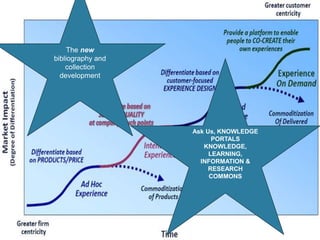
The new 
bibliography and 
collection 
development 
Ask Us, KNOWLEDGE 
PORTALS 
KNOWLEDGE, 
LEARNING, 
INFORMATION & 
RESEARCH 
COMMONS
Up Your Game 
• Take the strong ‘library’ brand and add dimension of “Librarian” 
• Personal branding –Who are you and your team? Promote them. 
• Program branding 
• Take risks for attention (AIDA) 
• Embed your brand beyond the library walls and virtually 
• Go beyond the information brand to informing, creating, and social
Up Your Game 
• Grow collections investments in strategic areas 
• Develop hybrid strategies that are consistent and integrated for 
digital and print and programs 
• Be obsessive about consultation, recommendations and advice 
• Integrate virtual and physical – hybridize 
• Social alignment rules
Up Your Game 
• OCLC Linked Data & APIs 
• DPLA Vault & APIs 
• 3D, learning object, LibGuides, audio, or streaming media repositories 
• Understand Pedagogy in the context of student experiences and 
educational goals 
• Understand human development from teens to adult learning 
• Understand the projects 
• Makerspace… laboratories – onsite relevance 
• Consider partnerships to put librarians into real liaison 
• Consider coaches and tutoring partnerships
Up Your Game 
• Embedded team member 
• Embedded teacher 
• Embedded research coach 
• Embedded personal librarian 
• Reintermediation
Up Your Game 
• Dog, Star, Cow, Problem Child/? 
• Reduce investment in successes – This isn’t a typo 
• Increase investment in future successes – learn from failing 
• Look at TCO - Do NOT value your own time at zero 
• Look at all costs incurred and not just hard costs 
• Review opportunity costs in soft costs
Entering the Knowledge Era 
• Right answers/facts give way to consensus answers/informed 
guesses 
• Information combined with Insight rules 
• Knowing where and how to look is infinitely more valuable than 
knowing facts 
• Knowledge is an immersion environment - an Information Ocean - 
where are the maps that work here?
Five Laws of Library Science 
• Books are for use. 
• Books are for all; or, Every reader his book. 
• Every book its reader. 
• Save the time of the reader. 
• A library is a growing organism. 
S.R. Ranganathan
Five New Laws of Library Science 
• Libraries serve humanity. 
• Respect all forms by which knowledge is communicated. 
• Use technology intelligently to enhance service. 
• Protect free access to knowledge. 
• Honor the past and create the future. 
Walt Crawford and Michael Gorman
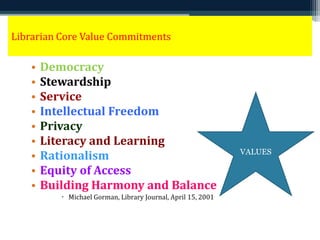
Librarian Core Value Commitments 
• Democracy 
• Stewardship 
• Service 
• Intellectual Freedom 
• Privacy 
• Literacy and Learning 
• Rationalism 
• Equity of Access 
• Building Harmony and Balance 
 Michael Gorman, Library Journal, April 15, 2001 
VALUES
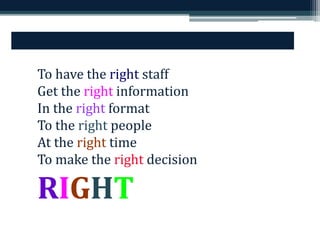
To have the right staff 
Get the right information 
In the right format 
To the right people 
At the right time 
To make the right decision 
RIGHT
Leadership is People not Projects 
• "Successful knowledge transfer involves neither computers nor 
documents but rather interactions between people." 
Tom Davenport 
People like librarians, teachers, faculty, 
counselors, therapists, social workers, 
advisors, . . .
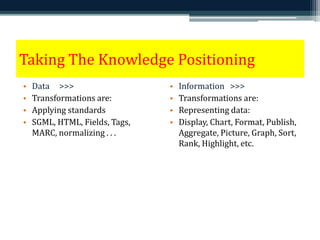
Taking The Knowledge Positioning 
• Data >>> 
• Transformations are: 
• Applying standards 
• SGML, HTML, Fields, Tags, 
MARC, normalizing . . . 
• Information >>> 
• Transformations are: 
• Representing data: 
• Display, Chart, Format, Publish, 
Aggregate, Picture, Graph, Sort, 
Rank, Highlight, etc.
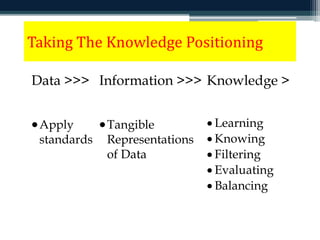
Taking The Knowledge Positioning 
Data >>> Information >>> Knowledge > 
Apply 
standards 
Tangible 
Representations 
of Data 
Learning 
Knowing 
Filtering 
Evaluating 
Balancing
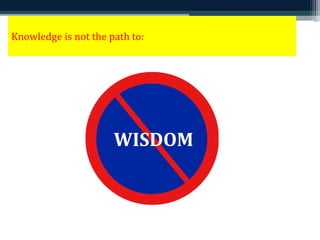
Knowledge is not the path to: 
WISDOM
Taking The Knowledge Positioning 
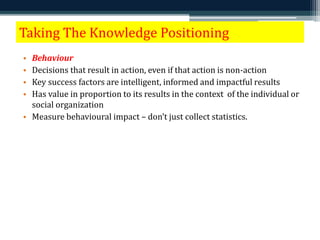
• Behaviour 
• Decisions that result in action, even if that action is non-action 
• Key success factors are intelligent, informed and impactful results 
• Has value in proportion to its results in the context of the individual or 
social organization 
• Measure behavioural impact – don’t just collect statistics.
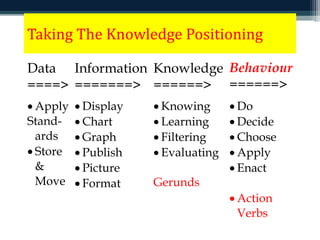
Taking The Knowledge Positioning 
Data 
====> 
Information 
=======> 
Knowledge 
======> 
Behaviour 
======> 
 Apply 
Stand-ards 
 Store 
& 
Move 
 Display 
 Chart 
 Graph 
 Publish 
 Picture 
 Format 
 Knowing 
 Learning 
 Filtering 
 Evaluating 
Gerunds 
 Do 
 Decide 
 Choose 
 Apply 
 Enact 
 Action 
Verbs
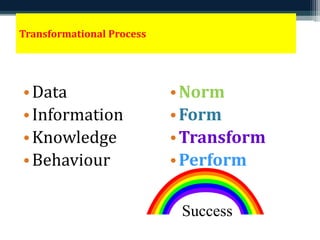
Transformational Process 
•Data 
• Information 
•Knowledge 
•Behaviour 
•Norm 
•Form 
•Transform 
•Perform 
Success
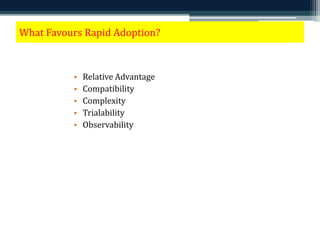
What Favours Rapid Adoption? 
• Relative Advantage 
• Compatibility 
• Complexity 
• Trialability 
• Observability
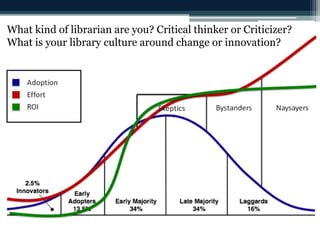
What kind of librarian are you? Critical thinker or Criticizer? 
What is your library culture around change or innovation?
Leaders have many modes. 
They choose to use the personal behaviour that 
works in the situation. 
Be 3D or 6D, but not 1D
"An optimist is someone who says a glass is half full. A pessimist says 
it's half empty. A leader might say, "Looks like we've got twice as 
much glass as we need. Let discuss it."
Are you on the ‘hits’ train?
DATA
QUALITATIVE INFORMATION 
and 
QUANTITATIVE DATA
STATISTICS 
versus 
MEASUREMENTS
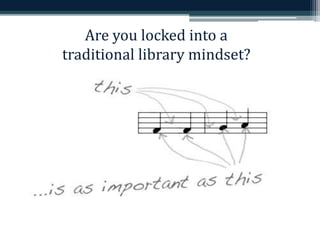
Are you locked into a 
traditional library mindset?
What about value and impact?
Exercise your mind about the rhythms of your 
work. . . 
59
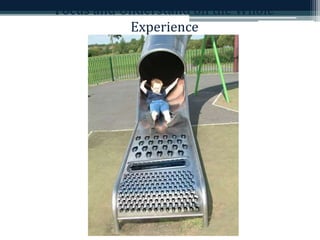
Or shall we stick with this?
Focus and Understand on the Whole 
Experience
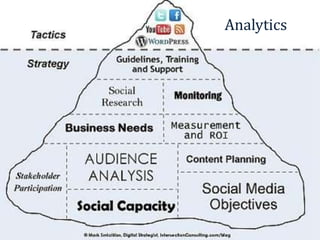
Analytics
Conclusion: 28 Key Tips 
 Good not Perfect 
 It’s not the steps that cause delays in development - it’s the space 
between the steps 
 No mistake is ever final. 
 Freeze and Go! The right metaphor is seasonal change - not revolution or 
evolution 
 Prefer action over study: If you’re studying something to death - 
remember that death was not the original goal!
Conclusion: 28 Key Tips 
 Mock-Up, Build, Rebuild, Beta, Pilot, Launch, Re-Do 
 Remember the rule of six (6). You get very diminishing returns after 
asking the same question of like people. 
 Remember the 15% rule: Humans have extreme difficulty in actually 
seeing a difference of less than 15%.
Conclusion: 28 Key Tips 
 Use the 70/30 rule: “I agree with 70% and can live with the other 
30%.” 
 Remember the old 80/20 rule standby: No matter how few or many 
users you have, 80% of your usage/revenue/etc. will come from 20% 
of your users. 
 Remember the 90/10 rule. 90% of your costs are in implementation, 
not development.
Conclusion: 28 Key Tips 
 “Productize”: Be able to physically point at your product or service. 
 Get out of your box! It is unlikely that you are the alpha user profile. 
 You can’t step in the same river twice. Your knowledge of the new 
development means you probably cannot see the potential pitfalls.
Conclusion: 28 Key Tips 
 Understand the differences between features, functions and benefits. 
 Understand your customer and don’t assume - TEST. 
 Don’t just ask your clients what they do, will do or want. OBSERVE 
them. 
 Have a vision and dream BIG!
Conclusion: 28 Key Tips 
 Ask the three magic questions: 
What keeps you awake at night? 
If you could solve only one problem at work, what would it be? 
If you could change one thing and one thing only, what would it be? 
 Never underestimate the user – especially students. 
 Seek the real user.
Conclusion: 28 Key Tips 
 Respect information literacy, learning styles and multiple intelligence. 
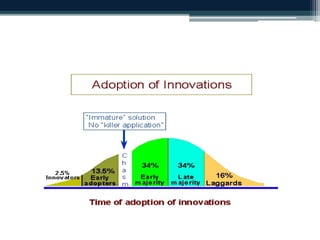
 Understand the adoption curve. 
 Do research for yourself too. Set up alerts on your hot issues. 
 Bring management on side first, then customers and users, BEFORE 
you launch.
Conclusion: 28 Key Tips 
 Feedback is a gift - you can keep it, return it, hide it in the closet. 
Don’t overvalue one piece of out-of-context feedback or let it loom out 
of perspective and balance. 
 Measure - don’t just count: Decision-makers CANNOT interpret your 
statistics. 
 When you have 100 options to choose from the critical skill isn’t 
choosing 5 but sacrificing 95.
The Library as Sandbox
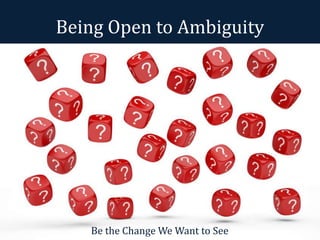
Being Open to Ambiguity 
Be the Change We Want to See
Stephen Abram, MLS, FSLA 
Consultant, Lighthouse Consulting 
Cel: 416-669-4855 
stephen.abram@gmail.com 
Stephen’s Lighthouse Blog 
http://stephenslighthouse.com 
Facebook, Pinterest, Tumblr: Stephen Abram 
LinkedIn / Plaxo: Stephen Abram 
Twitter: @sabram 
SlideShare: StephenAbram1

Atteneo manilaabram2

  • 1.
    Future Transformational Leadership Strategies for Librarians Stephen Abram, MLS Manila, Philippines October 24, 2014
  • 2.
    2 Transformational Leadership • Leaders are nothing without followers. Seems simple but so much harder to do than to say. Stephen Abram discusses the role of leaders in the library movement, the role of collaboration, speaking with one voice, and most importantly * choosing your priorities for impact *. Stephen notes from his previous visit that the Philippines is on the cusp of greatness as an emerging economy ideally situated to engage with many countries globally. How do you build on your strengths? How do we think long term? What role can librarians play to have a solid impact on education, the economy, and quality of life for all? What is the role of collaboration within libraries, between library sectors and with government and other enterprises?
  • 3.
    What is Leadership? Leaders see an improvement to be made – a desirable future state, sometimes before others, and actively seek to achieve those improvements.
  • 4.
    Who is aLeader? Everyone can lead. Leadership is different from managing or supervising.
  • 5.
    Lies we tellourselves • I’m not a leader • Shyness versus introversion • I don’t do presentations to management • People will notice my good work • They’ll read my report, memo . . . • Leadership is someone else’s job • I don’t make the decisions around here… • That’s their responsibility – not mine • Criticism in the absence of constructive criticism and critical thinking
  • 6.
  • 7.
    7 Future Driven,Scalable Leadership Training for Librarians • Northern Exposure to Leadership Institute • iSchool at Toronto e.g. Public Library Institute • Crucial Conversations • ALA Emerging Leaders • Mountain Plains Leadership Institute • Tall Texans • Snowbird • iSchool @ Toronto Symposia ▫ MOOCs, Makerspaces, New Measurements, Crowdfunding… • Etc.
  • 8.
    Recent Research: PhD Dissertations on Leadership in Libraries 8 Mary-Jo Romaniuk, San Jose State Univ. Cheryl Stenstrom, San Jose State Univ. Donna Brockmeyer, Univ. of Saskatchewan, Thomas More College Ken Haycock, Marshall School, University of California
  • 9.
    9 Research Insightsinto what Makes a Difference • Passion is foremost • Confidence next • Influence not just Advocacy • Risk Taking – in context • Change Management • Flexibility • Dealing with Ambiguity – having the aptitude to introduce change aligned with the future state. • Influencing Skills = selling ideas
  • 10.
    10 What doesn’thelp or work • Not taking the long view • A dysfunctional view of time • Being risk averse • Playground competition • Lack of cooperation • Backbiting and blamestorming • Fear of change or, indeed, fear at all • Generally – ‘negativity’
  • 11.
    11 Big PictureThinking by Leaders • Giant Consortia • CNSLP /Canadian Knowledge Research Network • OCUL Scholars Portal • OCLC Linked Data and DPLA Metadata Vaults • … • What does this require? • Trust and Collaboration
  • 12.
    SLA Alignment Research 12 • Key Highlights: • True Relationships (not just contacts) • Real Networks, Collaboration • Consultation – based on authority, expertise, quality and short conversations • Speed – Save Time • Packaging for Added Value Answers • Educate and Train • Understanding libraries/ians is an underserved and regularly expressed need
  • 13.
    Positioning the Libraryand Librarian / Library Staff Real professionals have names and reputations What is your value proposition? You versus the library versus the institution? Why do you, the library, or your institution exist?
  • 14.
  • 16.
    The Complex ValueProposition Smelly Yellow Liquid Or Sex Appeal?
  • 17.
    SLA Alignment Research Highlights: • Relationships, Networks, Collaboration • Speed – Save Time • Packaging for Added Value Answers • Educate and Train 17
  • 18.
  • 19.
  • 20.
  • 21.
  • 22.
    Remaining Relevant andHaving a Positive Impact
  • 23.
    Up Your Game • Know your local community demographics • Focus on needs assessment and social assessments • Outreach versus engagement and partnerships • Prioritize: Love all, Serve all, Save the World means nothing gets done • Priorities are SMART: Specific, Measurable, Attainable, Relevant, & Time bound • Look for partnerships that add value
  • 24.
    Up Your Game • Mobile • Content • Merge with records management and archives • Sensemaking
  • 25.
    What are thereal issues? • Craft versus Industrial Strength • Personal service only when there’s impact • Pilot, Project, Initiative versus Portfolio Strategy • Hand-knitted prototypes versus Production • e.g. Information Literacy and Fluency initiatives • Discovery versus Search versus Deep Search • eLearning units and program dissemination • Citation and information ethics • Content and repository archipelagos • Strategic Analytics • Value & Impact Measures • Behaviours, Satisfaction • Economic and strategic alignment
  • 26.
    Up Your Game • Start offering diplomas and certificates • The Non-credit Course • Look for internal partnerships that add value • Offer real educational opportunities not just adjacencies • What courses to you offer or recommend? (TED, Khan Academy, MOOCs, etc.) • Play and connect yourself
  • 27.
    Up Your Game • Learn how to reach and teach online • Teach how to learn online • Teach how to research online • Everyone in academic libraries should be focused on teaching/researching first, then library • Learn more systems than one! • Be obsessive about consultation, recommendations and advice • Social alignment rules and use the tools
  • 28.
    Up Your Game • Align with Collections – But add virtual experiences • Start being Mobile in the extreme • Look for partnerships that add value • Focus on relationship management / liaisons • Ensure the program delivery person is embedded including librarians • What are your top learning or research domains? Start there. • Don’t go it alone. Build scalability and sustainability. • Look for replicability – look for commonalities
  • 29.
    The new bibliographyand collection development Ask Us, KNOWLEDGE PORTALS KNOWLEDGE, LEARNING, INFORMATION & RESEARCH COMMONS
  • 30.
    Up Your Game • Take the strong ‘library’ brand and add dimension of “Librarian” • Personal branding –Who are you and your team? Promote them. • Program branding • Take risks for attention (AIDA) • Embed your brand beyond the library walls and virtually • Go beyond the information brand to informing, creating, and social
  • 31.
    Up Your Game • Grow collections investments in strategic areas • Develop hybrid strategies that are consistent and integrated for digital and print and programs • Be obsessive about consultation, recommendations and advice • Integrate virtual and physical – hybridize • Social alignment rules
  • 32.
    Up Your Game • OCLC Linked Data & APIs • DPLA Vault & APIs • 3D, learning object, LibGuides, audio, or streaming media repositories • Understand Pedagogy in the context of student experiences and educational goals • Understand human development from teens to adult learning • Understand the projects • Makerspace… laboratories – onsite relevance • Consider partnerships to put librarians into real liaison • Consider coaches and tutoring partnerships
  • 33.
    Up Your Game • Embedded team member • Embedded teacher • Embedded research coach • Embedded personal librarian • Reintermediation
  • 34.
    Up Your Game • Dog, Star, Cow, Problem Child/? • Reduce investment in successes – This isn’t a typo • Increase investment in future successes – learn from failing • Look at TCO - Do NOT value your own time at zero • Look at all costs incurred and not just hard costs • Review opportunity costs in soft costs
  • 35.
    Entering the KnowledgeEra • Right answers/facts give way to consensus answers/informed guesses • Information combined with Insight rules • Knowing where and how to look is infinitely more valuable than knowing facts • Knowledge is an immersion environment - an Information Ocean - where are the maps that work here?
  • 36.
    Five Laws ofLibrary Science • Books are for use. • Books are for all; or, Every reader his book. • Every book its reader. • Save the time of the reader. • A library is a growing organism. S.R. Ranganathan
  • 37.
    Five New Lawsof Library Science • Libraries serve humanity. • Respect all forms by which knowledge is communicated. • Use technology intelligently to enhance service. • Protect free access to knowledge. • Honor the past and create the future. Walt Crawford and Michael Gorman
  • 38.
    Librarian Core ValueCommitments • Democracy • Stewardship • Service • Intellectual Freedom • Privacy • Literacy and Learning • Rationalism • Equity of Access • Building Harmony and Balance  Michael Gorman, Library Journal, April 15, 2001 VALUES
  • 39.
    To have theright staff Get the right information In the right format To the right people At the right time To make the right decision RIGHT
  • 40.
    Leadership is Peoplenot Projects • "Successful knowledge transfer involves neither computers nor documents but rather interactions between people." Tom Davenport People like librarians, teachers, faculty, counselors, therapists, social workers, advisors, . . .
  • 41.
    Taking The KnowledgePositioning • Data >>> • Transformations are: • Applying standards • SGML, HTML, Fields, Tags, MARC, normalizing . . . • Information >>> • Transformations are: • Representing data: • Display, Chart, Format, Publish, Aggregate, Picture, Graph, Sort, Rank, Highlight, etc.
  • 42.
    Taking The KnowledgePositioning Data >>> Information >>> Knowledge > Apply standards Tangible Representations of Data Learning Knowing Filtering Evaluating Balancing
  • 43.
    Knowledge is notthe path to: WISDOM
  • 44.
    Taking The KnowledgePositioning • Behaviour • Decisions that result in action, even if that action is non-action • Key success factors are intelligent, informed and impactful results • Has value in proportion to its results in the context of the individual or social organization • Measure behavioural impact – don’t just collect statistics.
  • 45.
    Taking The KnowledgePositioning Data ====> Information =======> Knowledge ======> Behaviour ======>  Apply Stand-ards  Store & Move  Display  Chart  Graph  Publish  Picture  Format  Knowing  Learning  Filtering  Evaluating Gerunds  Do  Decide  Choose  Apply  Enact  Action Verbs
  • 46.
    Transformational Process •Data • Information •Knowledge •Behaviour •Norm •Form •Transform •Perform Success
  • 48.
    What Favours RapidAdoption? • Relative Advantage • Compatibility • Complexity • Trialability • Observability
  • 49.
    What kind oflibrarian are you? Critical thinker or Criticizer? What is your library culture around change or innovation?
  • 50.
    Leaders have manymodes. They choose to use the personal behaviour that works in the situation. Be 3D or 6D, but not 1D
  • 51.
    "An optimist issomeone who says a glass is half full. A pessimist says it's half empty. A leader might say, "Looks like we've got twice as much glass as we need. Let discuss it."
  • 53.
    Are you onthe ‘hits’ train?
  • 54.
  • 55.
    QUALITATIVE INFORMATION and QUANTITATIVE DATA
  • 56.
  • 57.
    Are you lockedinto a traditional library mindset?
  • 58.
    What about valueand impact?
  • 59.
    Exercise your mindabout the rhythms of your work. . . 59
  • 60.
    Or shall westick with this?
  • 61.
    Focus and Understandon the Whole Experience
  • 62.
  • 63.
    Conclusion: 28 KeyTips  Good not Perfect  It’s not the steps that cause delays in development - it’s the space between the steps  No mistake is ever final.  Freeze and Go! The right metaphor is seasonal change - not revolution or evolution  Prefer action over study: If you’re studying something to death - remember that death was not the original goal!
  • 64.
    Conclusion: 28 KeyTips  Mock-Up, Build, Rebuild, Beta, Pilot, Launch, Re-Do  Remember the rule of six (6). You get very diminishing returns after asking the same question of like people.  Remember the 15% rule: Humans have extreme difficulty in actually seeing a difference of less than 15%.
  • 65.
    Conclusion: 28 KeyTips  Use the 70/30 rule: “I agree with 70% and can live with the other 30%.”  Remember the old 80/20 rule standby: No matter how few or many users you have, 80% of your usage/revenue/etc. will come from 20% of your users.  Remember the 90/10 rule. 90% of your costs are in implementation, not development.
  • 66.
    Conclusion: 28 KeyTips  “Productize”: Be able to physically point at your product or service.  Get out of your box! It is unlikely that you are the alpha user profile.  You can’t step in the same river twice. Your knowledge of the new development means you probably cannot see the potential pitfalls.
  • 67.
    Conclusion: 28 KeyTips  Understand the differences between features, functions and benefits.  Understand your customer and don’t assume - TEST.  Don’t just ask your clients what they do, will do or want. OBSERVE them.  Have a vision and dream BIG!
  • 68.
    Conclusion: 28 KeyTips  Ask the three magic questions: What keeps you awake at night? If you could solve only one problem at work, what would it be? If you could change one thing and one thing only, what would it be?  Never underestimate the user – especially students.  Seek the real user.
  • 69.
    Conclusion: 28 KeyTips  Respect information literacy, learning styles and multiple intelligence.  Understand the adoption curve.  Do research for yourself too. Set up alerts on your hot issues.  Bring management on side first, then customers and users, BEFORE you launch.
  • 70.
    Conclusion: 28 KeyTips  Feedback is a gift - you can keep it, return it, hide it in the closet. Don’t overvalue one piece of out-of-context feedback or let it loom out of perspective and balance.  Measure - don’t just count: Decision-makers CANNOT interpret your statistics.  When you have 100 options to choose from the critical skill isn’t choosing 5 but sacrificing 95.
  • 83.
  • 84.
    Being Open toAmbiguity Be the Change We Want to See
  • 85.
    Stephen Abram, MLS,FSLA Consultant, Lighthouse Consulting Cel: 416-669-4855 stephen.abram@gmail.com Stephen’s Lighthouse Blog http://stephenslighthouse.com Facebook, Pinterest, Tumblr: Stephen Abram LinkedIn / Plaxo: Stephen Abram Twitter: @sabram SlideShare: StephenAbram1