Downloaded 266 times
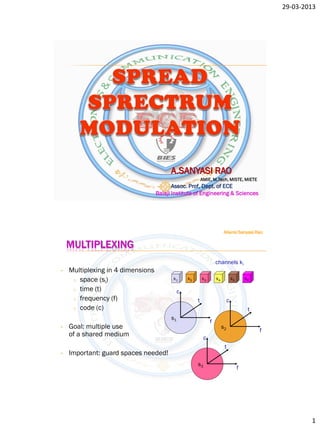

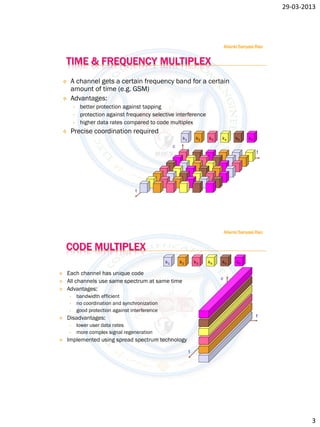
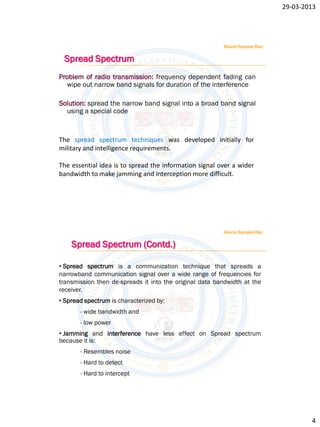


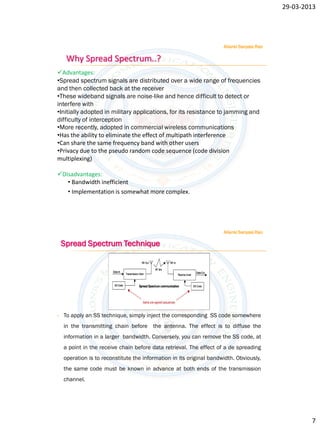







1. The document discusses various multiplexing techniques including frequency multiplexing, time multiplexing, time-frequency multiplexing, and code multiplexing. It explains the advantages and disadvantages of each technique. 2. It then discusses spread spectrum techniques, which were initially developed for military applications due to their resistance to jamming and difficulty of interception. Spread spectrum spreads a narrowband signal over a wide frequency range to resemble noise. 3. The key aspects of spread spectrum are that it uses wide bandwidth and low power. This makes jamming and interference less effective as the signals resemble noise and are hard to detect and intercept.


