1
Physical Education
Team Sport Project: Cricket
1922-1923
Name
Class:
School:
Roll No:
2
3
ACKNOWLEDGEMENT
During the process of preparation of this project, I have got
immense help from various people, without which it would not
have been possible to achieve the goal.
First of all I wish to express my deep gratitude and sincere thanks
to our principal Ms. , respected teachers and
staff members of Yak Public School, Khopoli, for their
encouragement and in providing us well-rounded guidance.
I extend my thanks to , who have
rendered all support and guidance which has sustained my
efforts at all stages of this project work.
I am equally thankful to my parents for giving us moral support
and ideas to carve out this project.
4
Introduction:
Being one of the most loved and rejoiced sports in the modern
world, this game, fondly known as the Gentleman’s Game has
rendered immense love and fan following in its recent history as
well as past endeavours.
Cricket is primarily a bat-and-ball game played between two
teams of eleven players on a field at the centre of which is a
22-yard (20-meter) pitch with a wicket at each end, each
comprising two bails balanced on three stumps.
To begin with, the batting side scores runs by striking
the ball bowled at one of the wickets with the bat and then
running between the wickets, while the bowling
and fielding side tries to prevent this (by preventing the ball
from leaving the field, and getting the ball to either wicket)
and dismiss each batter (so they are "out").
Means of dismissal include being bowled, when the ball hits the
stumps and dislodges the bails, and by the fielding side
either catching the ball after it is hit by the bat, but before it hits
the ground, or hitting a wicket with the ball before a batter can
cross the crease in front of the wicket.
When ten batters have been dismissed, the innings ends, and
the teams swap roles. The game is adjudicated by two umpires,
5
aided by a third umpire and match referee in international
matches. They communicate with two off-field scorers who
record the match's statistical information.
HISTORY OF CRICKET:
There is a consensus of expert opinion that cricket may have
been invented during Saxon or Norman times by children living
in the Weald, an area of dense woodlands and clearings in
southeast England.
The first reference to cricket being played as an adult sport
was in 1611, and the same year, a dictionary defined cricket as
a boys' game. There is also the thought that cricket may have
derived from bowls, by the intervention of a batsman trying to
stop the ball from reaching its target by hitting it away.
Village cricket had developed by the middle of the 17th century
and the first English “county teams” were formed in the second
half of the century, as “local experts” from village cricket were
employed as the earliest professionals.
The first known game in which the teams used county names
was in 1709.
In the first half of the 18th Century, cricket established itself as
a leading sport in London and the south-eastern counties of
England. Its spread was limited by the constraints of travel, but
6
it was slowly gaining popularity in other parts of England and
Women’s Cricket dates back to 1745, when the first known
match was played in Surrey.
In 1744, the first Laws of Cricket were written and subsequently
amended in 1774, when innovations such as lbw, a 3rd stump,
- the middle stump, and a maximum bat width were added. The
codes were drawn up by the “Star and Garter Club” whose
members ultimately founded the famous Marylebone Cricket
Club at Lord's in 1787. MCC immediately became the custodian
of the Laws and has made revisions ever since then to the
current day.
Rolling the ball along the ground was superseded sometime
after 1760 when bowlers began to pitch the ball and in
response to that innovation, the straight bat replaced the old
“hockey stick” style of bat.
The Hambleden Club in Hampshire was the focal point of the
game for about thirty years until the formation of MCC and the
opening of Lord's Cricket Ground in 1787.
Cricket was introduced to North America via the English
colonies as early as the 17th century, and in the 18th century, it
arrived in other parts of the globe. It was introduced to the West
Indies by colonists and to India by British East India Company
mariners.
It arrived in Australia almost as soon as colonization began in
1788 and the sport reached New Zealand and South Africa in
the early years of the 19th century.
7
GENERAL RULES OF CRICKET:
Cricket is played between two teams each made up of eleven
players. (Sometime in junior competitions you will find 8-player
teams).
Games comprise at least one inning where each team will take turns
in batting and fielding/bowling.
The fielding team will have a bowler bowl the ball to the batsman who
tries to hit the ball with their bat.
The fielding team tries to get the batsmen out by: -
Hitting the wickets with the ball when bowling
Catching a batsman’s shot on the full
Hitting the batsman’s leg in front of the wicket (LBW)
Hitting the wickets before the batsmen can run to the other end of the
pitch
The batsmen try to score as many runs as possible before getting out
by
Hitting the ball and running between the wickets and making it to the
other end before the fielders can hit the wickets with the ball. Each
time you run one full length of the pitch it equals 1 run.
Hitting the ball to the boundary along the ground is 4 runs.
Hitting the ball over the Shounakgayhai boundary on the full equals 6
runs.
The fielding team must get 10 batsmen out before they can change
over and start batting.
The game aims to score as many runs as possible before the fielding
team takes 10 wickets. The team with the most runs wins.
MODERN RULES OF CRICKET:
Each inning has to be of about 1 hour 20 minutes with 20 minutes
internal.
8
A batter is timed out if he doesn’t take guard in 90 seconds after the
fall of a wicket.
A result is possible only when both have battled at least for 5 overs
Umpires can recall a dismissed batter at any time before the ball
comes into play for the next delivery. Previously, a batsman couldn't
be recalled once he/she had left the field.
The ICC has allowed the use of bails tethered to the Stumps to
prevent injuries caused by bails flying at wicketkeepers and fielders
after the stumps have been broken. The mechanism used to tether
the bails must not interface with their ability to be dislodged.
Each team can name 6 substitutes in test cricket. Previously, it was 4.
Batters returning when caught: When a batter is out Caught, the new
batter will come in at the end the striker was, regardless of whether
the batters crossed before the catch being taken.
Use of saliva to polish the ball: This prohibition has been in place for
over two years in international cricket as a Covid-related temporary
measure and it is considered appropriate for the ban to be made
permanent.
Incoming batter ready to face the ball: An incoming batter will now be
required to be ready to take strike within two minutes in Tests and
ODIs, while the current threshold of ninety seconds in T20Is remains
unchanged.
Striker’s right to play the ball: This is restricted to require some part of
their bat or person to remain within the pitch. Should they venture
beyond that, the umpire will call and signal Dead ball. Any ball which
would force the batter to leave the pitch will also be called No ball
9
Terminology:
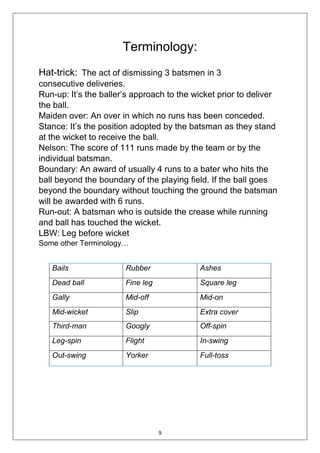
Hat-trick: The act of dismissing 3 batsmen in 3
consecutive deliveries.
Run-up: It’s the baller’s approach to the wicket prior to deliver
the ball.
Maiden over: An over in which no runs has been conceded.
Stance: It’s the position adopted by the batsman as they stand
at the wicket to receive the ball.
Nelson: The score of 111 runs made by the team or by the
individual batsman.
Boundary: An award of usually 4 runs to a bater who hits the
ball beyond the boundary of the playing field. If the ball goes
beyond the boundary without touching the ground the batsman
will be awarded with 6 runs.
Run-out: A batsman who is outside the crease while running
and ball has touched the wicket.
LBW: Leg before wicket
Some other Terminology…
Bails Rubber Ashes
Dead ball Fine leg Square leg
Gally Mid-off Mid-on
Mid-wicket Slip Extra cover
Third-man Googly Off-spin
Leg-spin Flight In-swing
Out-swing Yorker Full-toss
10
Fundamental Skills:
Basics of Batting:
GRIP
Left hand near to the top of the handle of the bat for a right-handed
batter.
Right hand near the top of the handle of the bat for a left-handed
batter.
The ‘V’ formed by the first finger and thumb of the right hand is
directly over the corresponding ‘V‘ of the right hand.
Both those V’s are almost in one line.
BACK LIFT
To pace the bat at a level and bring it from the back while hitting.
The bat should be lifted by the right hand and supported by the right
hand in the case of a right-handed batter.
The bat should be lifted by the right hand and supported by the left
hand in the case of a left-handed batter.
Basics of Balling:
Grip: The hand can maintain a hand over the grip and be able to
move or rotate as required.
Run-up: It’s the bowler's approach to the wicket for or to the deliver
the ball.
Delivery Stride: It’s the Stage when the bowler starts to propel (take
a position) to bowl.
Basics of fielding:
Defensive:
Fielder waits for the ball.
The aim is to save the boundary.
11
The fielder should come in line with the ball rather than attacking the
ball.
Offensive:
Fielder attacks the ball.
Aim is to save singles.
Fielders don't wait for the ball and pick up as early as possible.
Basics of Wicket-Keeping:
The player should feel comfortable with a balanced body position.
They must stand either right up to the stumps or right back.
They should move as little as possible and always keep their eyes on
the ball.
There should be no snatching of the ball with hands held in a relaxed
up like padded cushions.
12
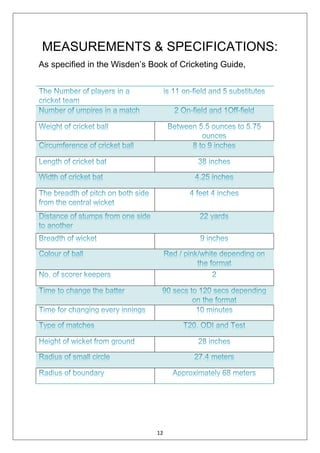
MEASUREMENTS & SPECIFICATIONS:
As specified in the Wisden’s Book of Cricketing Guide,
13
Tournaments:
ODI World Cup:
T20 World Cup:
World Test Championship:
ICC Champions Trophy:
Indian Premier League (T20 Format):
Deodhar Trophy
Syed Mushtaq Ali Trophy
Irani Cup
Ranji Trophy
14
Border Gavaskar Trophy (Held between India and
Australia)
The Ashes (Held between England and Australia)
Duleep Trophy
And numerous other Bilateral series trophies
15
Injuries And Precautions:
Rotator cuff injuries:
All of the aspects of cricket, including bowling, batting, and fielding
put your shoulders into overdrive.
The rotator cuff consists of 4 muscles (supraspinatus, infraspinatus,
subscapularis and teres minor) which help to stabilise the shoulder
joint. Injuries to the rotator cuff occur when any of the stabilizers are
strained or torn. This can result in symptoms such as pain, swelling,
and decreased range of motion.
The POLICE principle is recommended for initial treatment (see
below). Rotator cuff injuries range in severity but it is recommended
that you seek professional help from a physiotherapist.
Hamstring strains
Hamstring strains commonly occur in cricket during sudden sprints,
often when fielding or taking a quick single run. Hamstring strains
range in severity, from a minor strain which may feel like an ache in
your hamstring, through the major strains which are extremely
painful and can make it difficult to walk or stand at all. Initial
treatment should be the POLICE principle and following up with a
physiotherapist is highly recommended. Ensuring that you do an
adequate warm-up before taking to the field can reduce your risk of
hamstring strains.
Ankle sprains:
Ankle sprains are common in most sports, and cricket is no
different. Running at high speeds, as well as shifts in momentum
and sudden stopping can all cause ankle sprains. Initial treatment
should include the POLICE principle and following up with a
physiotherapist to ensure optimum recovery, as well as the
16
discussion of prevention measures.
We recommend seeing a physiotherapist if you are susceptible to
ankle sprains, as a tailored program can help increase your ankle
mobility and prevent sprains.
Abdominal side strain:
Most common in bowlers, a side strain occurs when the obliques
(the side of your abdomen) are strained or torn. This occurs on the
opposite side of the bowling arm and can range in severity.
Treatment requires adequate rest from bowling as well as
professional treatment.
Precautions:
Wear the right gear for playing cricket
Make sure you:
● Wear a mouthguard, preferably custom-fitted, at all times.
● Wear shoes designed for cricket.
● Wear protective gear at all times, including training.
● Wear body padding, including gloves, leg pads, boxes, and forearm guards
while batting.
● Wear a cricket helmet with a faceguard when wicketkeeping, batting, or
fielding in close.
● If you have a history of injury, speak to your doctor or physiotherapist about
appropriate bracing or protective gear.
Keep the cricket-playing environment safe
A safe ground is important, so remember to:
● Remove hazards, such as stones and water, from the playing surface.
● Make sure the pitch is smooth and clean.
● Make sure the netting in practice nets is adequate to stop cricket balls.
17
Major Venues Across the Globe:
⮚Eden Gardens (Kolkata)
⮚Wankhede Stadium (Mumbai)
⮚Firoz Shah Kotla (Delhi)
⮚Narendra Moti Stadium (Ahmedabad)
⮚Melbourne Cricket Stadium (Australia)
⮚Perth Stadium (Australia)
⮚Adelaide Oval (Australia)
⮚Lord’s Stadium (England)
⮚The Oval (England)
⮚Centurion Park (South Africa)
18
Famous Cricketing Personalities:
1. MS Dhoni:
Born on July 7, 1981, Mahendra Singh Dhoni, popularly referred to as “Mahi” or “Captain
Cool”, is a former Indian international cricket player who captained the Team India, India’s
national cricket team, from 2007 to 2017. Mahendra played as a right-handed middle-order
batsman and wicketkeeper. He is one of the highest run-scorers in One Day Internationals.
2. Chris Gayle:
Christopher Henry Gayle is a Jamaican international cricket player who plays for the West
Indies team. Born on Sept. 21, 1979, Gayle is a left-handed batting-all-rounder who
captained the West Indies Test side from 2007 to 2010.
3. Virat Kohli:
Virat Kohli is an Indian cricket player and presently the captain of Men in Blue. This right-
handed top-order batsman is considered one of the best in the world. Born on Nov. 5, 1988,
Virat rose to stardom when he led India’s under-19 team to victory at the Under-19 World
Cup in Malaysia in 2008.
Kohli won the Man of the Tournament award twice, at the ICC World Twenty20 in 2014 and
2016. He holds the second-highest number of centuries and highest number of centuries in
run chases. In addition to all these honours and awards, Kohli is also one of the highest-paid
cricketers in the world. He currently plays for Delhi in domestic cricket and Royal
Challengers Bangalore in the Indian Premier League.
4. Sachin Tendulkar:
Popularly known as “Master Blaster” or “Little Master”, Sachin Ramesh Tendulkar is an
Indian former international cricketer flatteringly described by BBC as “India’s god of cricket”.
Tendulkar served as the captain of the Indian national cricket team, and he is the all-time
highest run-scorer in international cricket. He’s the only player ever to have scored 100
international centuries. With a net worth of $120 million, Tendulkar is undoubtedly the richest
cricketer in the world.
5. “Sir” Donald Bradman
Sir Donald George Bradman, nicknamed “The Don”, was an Australian international
cricketer, born on Aug. 27, 1908. This iconic sportsman was regarded as the greatest
19
batsman of all time because of his unmatched batting average of 99.94, which has been
cited as the greatest achievement by any sportsperson in any major sport.
As a young boy, Bradman started as a bush cricket player, where he practiced alone with a
cricket stump and a golf ball. By the age of 22, Bradman had set several records, of which
some still stand. Unsurprisingly, Bradman became an Australian sporting idol.
Bibliography:
⮚www.youtube.com
⮚www.t20worldcup.com
⮚www.icc-cricket.com
⮚www.bcci.tv
⮚ www.cricbuzz.com
⮚ www.aljazeera.com
⮚ www.lords.org
⮚ www.espncricinfo.com
⮚ www.hindustantimes.com
⮚ www.cricket.com.au
⮚ https://cricket.co.za
⮚ www.windiescricket.com

PE PROJECT 12 CBSE

  • 1.
    1 Physical Education Team SportProject: Cricket 1922-1923 Name Class: School: Roll No:
  • 2.
  • 3.
    3 ACKNOWLEDGEMENT During the processof preparation of this project, I have got immense help from various people, without which it would not have been possible to achieve the goal. First of all I wish to express my deep gratitude and sincere thanks to our principal Ms. , respected teachers and staff members of Yak Public School, Khopoli, for their encouragement and in providing us well-rounded guidance. I extend my thanks to , who have rendered all support and guidance which has sustained my efforts at all stages of this project work. I am equally thankful to my parents for giving us moral support and ideas to carve out this project.
  • 4.
    4 Introduction: Being one ofthe most loved and rejoiced sports in the modern world, this game, fondly known as the Gentleman’s Game has rendered immense love and fan following in its recent history as well as past endeavours. Cricket is primarily a bat-and-ball game played between two teams of eleven players on a field at the centre of which is a 22-yard (20-meter) pitch with a wicket at each end, each comprising two bails balanced on three stumps. To begin with, the batting side scores runs by striking the ball bowled at one of the wickets with the bat and then running between the wickets, while the bowling and fielding side tries to prevent this (by preventing the ball from leaving the field, and getting the ball to either wicket) and dismiss each batter (so they are "out"). Means of dismissal include being bowled, when the ball hits the stumps and dislodges the bails, and by the fielding side either catching the ball after it is hit by the bat, but before it hits the ground, or hitting a wicket with the ball before a batter can cross the crease in front of the wicket. When ten batters have been dismissed, the innings ends, and the teams swap roles. The game is adjudicated by two umpires,
  • 5.
    5 aided by athird umpire and match referee in international matches. They communicate with two off-field scorers who record the match's statistical information. HISTORY OF CRICKET: There is a consensus of expert opinion that cricket may have been invented during Saxon or Norman times by children living in the Weald, an area of dense woodlands and clearings in southeast England. The first reference to cricket being played as an adult sport was in 1611, and the same year, a dictionary defined cricket as a boys' game. There is also the thought that cricket may have derived from bowls, by the intervention of a batsman trying to stop the ball from reaching its target by hitting it away. Village cricket had developed by the middle of the 17th century and the first English “county teams” were formed in the second half of the century, as “local experts” from village cricket were employed as the earliest professionals. The first known game in which the teams used county names was in 1709. In the first half of the 18th Century, cricket established itself as a leading sport in London and the south-eastern counties of England. Its spread was limited by the constraints of travel, but
  • 6.
    6 it was slowlygaining popularity in other parts of England and Women’s Cricket dates back to 1745, when the first known match was played in Surrey. In 1744, the first Laws of Cricket were written and subsequently amended in 1774, when innovations such as lbw, a 3rd stump, - the middle stump, and a maximum bat width were added. The codes were drawn up by the “Star and Garter Club” whose members ultimately founded the famous Marylebone Cricket Club at Lord's in 1787. MCC immediately became the custodian of the Laws and has made revisions ever since then to the current day. Rolling the ball along the ground was superseded sometime after 1760 when bowlers began to pitch the ball and in response to that innovation, the straight bat replaced the old “hockey stick” style of bat. The Hambleden Club in Hampshire was the focal point of the game for about thirty years until the formation of MCC and the opening of Lord's Cricket Ground in 1787. Cricket was introduced to North America via the English colonies as early as the 17th century, and in the 18th century, it arrived in other parts of the globe. It was introduced to the West Indies by colonists and to India by British East India Company mariners. It arrived in Australia almost as soon as colonization began in 1788 and the sport reached New Zealand and South Africa in the early years of the 19th century.
  • 7.
    7 GENERAL RULES OFCRICKET: Cricket is played between two teams each made up of eleven players. (Sometime in junior competitions you will find 8-player teams). Games comprise at least one inning where each team will take turns in batting and fielding/bowling. The fielding team will have a bowler bowl the ball to the batsman who tries to hit the ball with their bat. The fielding team tries to get the batsmen out by: - Hitting the wickets with the ball when bowling Catching a batsman’s shot on the full Hitting the batsman’s leg in front of the wicket (LBW) Hitting the wickets before the batsmen can run to the other end of the pitch The batsmen try to score as many runs as possible before getting out by Hitting the ball and running between the wickets and making it to the other end before the fielders can hit the wickets with the ball. Each time you run one full length of the pitch it equals 1 run. Hitting the ball to the boundary along the ground is 4 runs. Hitting the ball over the Shounakgayhai boundary on the full equals 6 runs. The fielding team must get 10 batsmen out before they can change over and start batting. The game aims to score as many runs as possible before the fielding team takes 10 wickets. The team with the most runs wins. MODERN RULES OF CRICKET: Each inning has to be of about 1 hour 20 minutes with 20 minutes internal.
  • 8.
    8 A batter istimed out if he doesn’t take guard in 90 seconds after the fall of a wicket. A result is possible only when both have battled at least for 5 overs Umpires can recall a dismissed batter at any time before the ball comes into play for the next delivery. Previously, a batsman couldn't be recalled once he/she had left the field. The ICC has allowed the use of bails tethered to the Stumps to prevent injuries caused by bails flying at wicketkeepers and fielders after the stumps have been broken. The mechanism used to tether the bails must not interface with their ability to be dislodged. Each team can name 6 substitutes in test cricket. Previously, it was 4. Batters returning when caught: When a batter is out Caught, the new batter will come in at the end the striker was, regardless of whether the batters crossed before the catch being taken. Use of saliva to polish the ball: This prohibition has been in place for over two years in international cricket as a Covid-related temporary measure and it is considered appropriate for the ban to be made permanent. Incoming batter ready to face the ball: An incoming batter will now be required to be ready to take strike within two minutes in Tests and ODIs, while the current threshold of ninety seconds in T20Is remains unchanged. Striker’s right to play the ball: This is restricted to require some part of their bat or person to remain within the pitch. Should they venture beyond that, the umpire will call and signal Dead ball. Any ball which would force the batter to leave the pitch will also be called No ball
  • 9.
    9 Terminology: Hat-trick: The actof dismissing 3 batsmen in 3 consecutive deliveries. Run-up: It’s the baller’s approach to the wicket prior to deliver the ball. Maiden over: An over in which no runs has been conceded. Stance: It’s the position adopted by the batsman as they stand at the wicket to receive the ball. Nelson: The score of 111 runs made by the team or by the individual batsman. Boundary: An award of usually 4 runs to a bater who hits the ball beyond the boundary of the playing field. If the ball goes beyond the boundary without touching the ground the batsman will be awarded with 6 runs. Run-out: A batsman who is outside the crease while running and ball has touched the wicket. LBW: Leg before wicket Some other Terminology… Bails Rubber Ashes Dead ball Fine leg Square leg Gally Mid-off Mid-on Mid-wicket Slip Extra cover Third-man Googly Off-spin Leg-spin Flight In-swing Out-swing Yorker Full-toss
  • 10.
    10 Fundamental Skills: Basics ofBatting: GRIP Left hand near to the top of the handle of the bat for a right-handed batter. Right hand near the top of the handle of the bat for a left-handed batter. The ‘V’ formed by the first finger and thumb of the right hand is directly over the corresponding ‘V‘ of the right hand. Both those V’s are almost in one line. BACK LIFT To pace the bat at a level and bring it from the back while hitting. The bat should be lifted by the right hand and supported by the right hand in the case of a right-handed batter. The bat should be lifted by the right hand and supported by the left hand in the case of a left-handed batter. Basics of Balling: Grip: The hand can maintain a hand over the grip and be able to move or rotate as required. Run-up: It’s the bowler's approach to the wicket for or to the deliver the ball. Delivery Stride: It’s the Stage when the bowler starts to propel (take a position) to bowl. Basics of fielding: Defensive: Fielder waits for the ball. The aim is to save the boundary.
  • 11.
    11 The fielder shouldcome in line with the ball rather than attacking the ball. Offensive: Fielder attacks the ball. Aim is to save singles. Fielders don't wait for the ball and pick up as early as possible. Basics of Wicket-Keeping: The player should feel comfortable with a balanced body position. They must stand either right up to the stumps or right back. They should move as little as possible and always keep their eyes on the ball. There should be no snatching of the ball with hands held in a relaxed up like padded cushions.
  • 12.
    12 MEASUREMENTS & SPECIFICATIONS: Asspecified in the Wisden’s Book of Cricketing Guide,
  • 13.
    13 Tournaments: ODI World Cup: T20World Cup: World Test Championship: ICC Champions Trophy: Indian Premier League (T20 Format): Deodhar Trophy Syed Mushtaq Ali Trophy Irani Cup Ranji Trophy
  • 14.
    14 Border Gavaskar Trophy(Held between India and Australia) The Ashes (Held between England and Australia) Duleep Trophy And numerous other Bilateral series trophies
  • 15.
    15 Injuries And Precautions: Rotatorcuff injuries: All of the aspects of cricket, including bowling, batting, and fielding put your shoulders into overdrive. The rotator cuff consists of 4 muscles (supraspinatus, infraspinatus, subscapularis and teres minor) which help to stabilise the shoulder joint. Injuries to the rotator cuff occur when any of the stabilizers are strained or torn. This can result in symptoms such as pain, swelling, and decreased range of motion. The POLICE principle is recommended for initial treatment (see below). Rotator cuff injuries range in severity but it is recommended that you seek professional help from a physiotherapist. Hamstring strains Hamstring strains commonly occur in cricket during sudden sprints, often when fielding or taking a quick single run. Hamstring strains range in severity, from a minor strain which may feel like an ache in your hamstring, through the major strains which are extremely painful and can make it difficult to walk or stand at all. Initial treatment should be the POLICE principle and following up with a physiotherapist is highly recommended. Ensuring that you do an adequate warm-up before taking to the field can reduce your risk of hamstring strains. Ankle sprains: Ankle sprains are common in most sports, and cricket is no different. Running at high speeds, as well as shifts in momentum and sudden stopping can all cause ankle sprains. Initial treatment should include the POLICE principle and following up with a physiotherapist to ensure optimum recovery, as well as the
  • 16.
    16 discussion of preventionmeasures. We recommend seeing a physiotherapist if you are susceptible to ankle sprains, as a tailored program can help increase your ankle mobility and prevent sprains. Abdominal side strain: Most common in bowlers, a side strain occurs when the obliques (the side of your abdomen) are strained or torn. This occurs on the opposite side of the bowling arm and can range in severity. Treatment requires adequate rest from bowling as well as professional treatment. Precautions: Wear the right gear for playing cricket Make sure you: ● Wear a mouthguard, preferably custom-fitted, at all times. ● Wear shoes designed for cricket. ● Wear protective gear at all times, including training. ● Wear body padding, including gloves, leg pads, boxes, and forearm guards while batting. ● Wear a cricket helmet with a faceguard when wicketkeeping, batting, or fielding in close. ● If you have a history of injury, speak to your doctor or physiotherapist about appropriate bracing or protective gear. Keep the cricket-playing environment safe A safe ground is important, so remember to: ● Remove hazards, such as stones and water, from the playing surface. ● Make sure the pitch is smooth and clean. ● Make sure the netting in practice nets is adequate to stop cricket balls.
  • 17.
    17 Major Venues Acrossthe Globe: ⮚Eden Gardens (Kolkata) ⮚Wankhede Stadium (Mumbai) ⮚Firoz Shah Kotla (Delhi) ⮚Narendra Moti Stadium (Ahmedabad) ⮚Melbourne Cricket Stadium (Australia) ⮚Perth Stadium (Australia) ⮚Adelaide Oval (Australia) ⮚Lord’s Stadium (England) ⮚The Oval (England) ⮚Centurion Park (South Africa)
  • 18.
    18 Famous Cricketing Personalities: 1.MS Dhoni: Born on July 7, 1981, Mahendra Singh Dhoni, popularly referred to as “Mahi” or “Captain Cool”, is a former Indian international cricket player who captained the Team India, India’s national cricket team, from 2007 to 2017. Mahendra played as a right-handed middle-order batsman and wicketkeeper. He is one of the highest run-scorers in One Day Internationals. 2. Chris Gayle: Christopher Henry Gayle is a Jamaican international cricket player who plays for the West Indies team. Born on Sept. 21, 1979, Gayle is a left-handed batting-all-rounder who captained the West Indies Test side from 2007 to 2010. 3. Virat Kohli: Virat Kohli is an Indian cricket player and presently the captain of Men in Blue. This right- handed top-order batsman is considered one of the best in the world. Born on Nov. 5, 1988, Virat rose to stardom when he led India’s under-19 team to victory at the Under-19 World Cup in Malaysia in 2008. Kohli won the Man of the Tournament award twice, at the ICC World Twenty20 in 2014 and 2016. He holds the second-highest number of centuries and highest number of centuries in run chases. In addition to all these honours and awards, Kohli is also one of the highest-paid cricketers in the world. He currently plays for Delhi in domestic cricket and Royal Challengers Bangalore in the Indian Premier League. 4. Sachin Tendulkar: Popularly known as “Master Blaster” or “Little Master”, Sachin Ramesh Tendulkar is an Indian former international cricketer flatteringly described by BBC as “India’s god of cricket”. Tendulkar served as the captain of the Indian national cricket team, and he is the all-time highest run-scorer in international cricket. He’s the only player ever to have scored 100 international centuries. With a net worth of $120 million, Tendulkar is undoubtedly the richest cricketer in the world. 5. “Sir” Donald Bradman Sir Donald George Bradman, nicknamed “The Don”, was an Australian international cricketer, born on Aug. 27, 1908. This iconic sportsman was regarded as the greatest
  • 19.
    19 batsman of alltime because of his unmatched batting average of 99.94, which has been cited as the greatest achievement by any sportsperson in any major sport. As a young boy, Bradman started as a bush cricket player, where he practiced alone with a cricket stump and a golf ball. By the age of 22, Bradman had set several records, of which some still stand. Unsurprisingly, Bradman became an Australian sporting idol. Bibliography: ⮚www.youtube.com ⮚www.t20worldcup.com ⮚www.icc-cricket.com ⮚www.bcci.tv ⮚ www.cricbuzz.com ⮚ www.aljazeera.com ⮚ www.lords.org ⮚ www.espncricinfo.com ⮚ www.hindustantimes.com ⮚ www.cricket.com.au ⮚ https://cricket.co.za ⮚ www.windiescricket.com