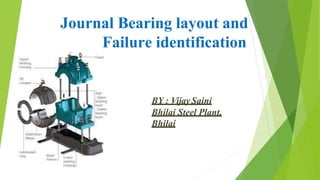
Journal Bearing layout and
Failure identification
BY : VijaySaini
Bhilai Steel Plant,
Bhilai
CONTENTS
• Introduction
• Types Of Journal Bearings
• Material Used For Journal Bearings
• Terms Used In Hydrodynamic Journal Bearings
• Types of failure in journal bearing
INTRODUCTION
In journal bearing sliding action is along the circumference of circle
or an arc of circle and carrying radial loads. [1]
TYPES OF JOURNALBEARINGS
• According to angle of contact of journal bearings [2]
CONTINUE …..
According to thickness of lubricating layer [3]
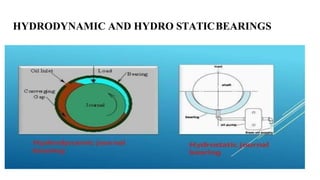
HYDRODYNAMIC AND HYDRO STATICBEARINGS
MATERIAL USED FOR JOURNALBEARINGS
1.Babbit metal
• Tin base (Tin 90 %, copper 4.5 %, lead 0.5 % ) and
• Lead base (Lead 84 % Tin 6 %,Antimony 9.5 %copper 0.5)
2. Bronze
3. Cast iron
4. Silver
5. Non metallic bearings
TERMS USED IN HYDRODYNAMIC JOURNAL
BEARINGS
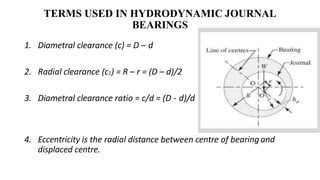
1. Diametral clearance (c) = D – d
2. Radial clearance (c1) = R – r = (D – d)/2
3. Diametral clearance ratio = c/d = (D - d)/d
4. Eccentricity is the radial distance between centre of bearingand
displaced centre.
CONTINUE
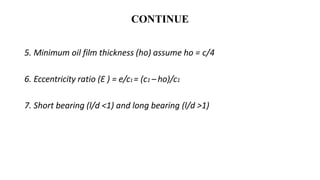
5. Minimum oil film thickness (ho) assume ho = c/4
6. Eccentricity ratio (Ɛ ) = e/c1 = (c1 – ho)/c1
7. Short bearing (l/d ˂1) and long bearing (l/d ˃1)
Failure Analysis for Plain Bearing
The textbook cases of distress modes are especially useful in diagnosing problems prior
to the damage that occurs when a bearing can no longer support an oil film. Through the
prudent use of temperature and vibration monitoring equipment, routine oil analysis,
lubrication system evaluations and machine operational performance reviews, bearing
distress may be identified and evaluated before catastrophic failure occurs.
Bearing health is commonly monitored through the use of temperature measurements.
Temperature sensors may be mounted in a wide variety of locations, with a corresponding
variation in temperature. The specific location and type of sensor must be known for the
measured temperature data to have any real value.
Being able to properly identify the damage resulting from pitting (from arcing),fatigue,
erosion and corrosion is key to diagnosing bearing problems.
Voids
Electrical Pitting
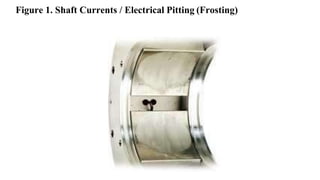
Electrical pitting appears as rounded pits in the bearing lining. The pits may appear frosted (Figure 1),or
they may be blackened due to oil deposits. It is not unusual for them to be small and difficult to observe
with the unaided eye.
A clearly defined boundary exists between the pitted and unpitted regions, with the pitting usuallyoccurring
where the oil film is thinnest.
As pitting progresses, the individual pits lose their characteristic appearance as they begin to overlap. Pits
located near the boundary should still be intact. The debris that enters the oil begins abrasion damage.Once
the bearing surface becomes incapable of supporting an oil film, the bearing willwipe.
The bearing may recover an oil film and continue to operate, and pitting will begin again. This processmay
occur several times before the inevitable catastrophic bearingfailure.
Electrical pitting damage is caused by intermittent arcing between the stationary and rotating machine
components. Because of the small film thicknesses relative to other machine clearances, the arcing
commonly occurs through the bearings. Although the rotating and other stationary members can alsobe
affected, the most severe pitting occurs in the softbabbitt.
Figure 1. Shaft Currents / Electrical Pitting (Frosting)
Rectification Action
Electromagnetic currents are best eliminated by demagnetizing the affected component.
Grounding brushes or straps may or may not be helpful. The bearings should also be
isolated.
The lubricating oil must be filtered or replaced. Pitting damage often blackens the oil and
fills it with debris. In addition to filtering or replacing the oil, the entire bearing assembly,
oil reservoir and piping should be flushed and cleaned.
The original bearing finish should also be restored. Journal shoes typically must be
replaced, but if the correction leaves the bearing within design tolerance, the bearingmay
be reused. The condition of the rotating journal, collar or runner surfaces must also be
evaluated. It must be restored to original condition, either by lapping, hand stoning or
replacement.
Fatigue
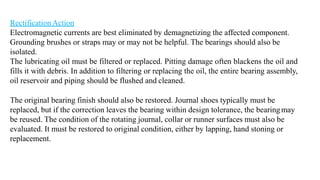
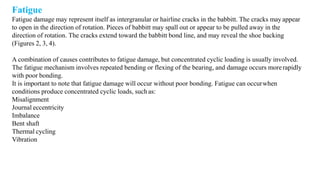
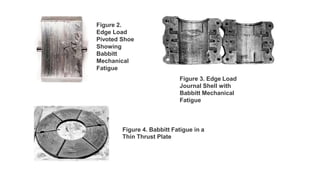
Fatigue damage may represent itself as intergranular or hairline cracks in the babbitt. The cracks may appear
to open in the direction of rotation. Pieces of babbitt may spall out or appear to be pulled away in the
direction of rotation. The cracks extend toward the babbitt bond line, and may reveal the shoe backing
(Figures 2, 3, 4).
A combination of causes contributes to fatigue damage, but concentrated cyclic loading is usually involved.
The fatigue mechanism involves repeated bending or flexing of the bearing, and damage occurs morerapidly
with poor bonding.
It is important to note that fatigue damage will occur without poor bonding. Fatigue can occurwhen
conditions produce concentrated cyclic loads, such as:
Misalignment
Journal eccentricity
Imbalance
Bent shaft
Thermal cycling
Vibration
Figure 2.
Edge Load
Pivoted Shoe
Showing
Babbitt
Mechanical
Fatigue
Figure 3. Edge Load
Journal Shell with
Babbitt Mechanical
Fatigue
Figure 4. Babbitt Fatigue in a
Thin Thrust Plate
Rectification Action
• Performance data should be reviewed to determine if a vibration increase occurred. The
leveling plate wings should be examined for signs of excessive wear, indicating the rotating
collar or runner is not perpendicular to the shaft axis.
• High bearing temperature may also be considered as a contributing factor to fatigue damage.
As temperatures increase, the fatigue strength of bearing materials decreases.
• The lubricating oil must be filtered or replaced. In addition to filtering or replacing the oil, the
entire bearing assembly, oil reservoir and piping should be flushed and cleaned. Depending
on the damage, voids in the babbitt can be puddle-repaired. The original bearing finish must
be restored. Journal shoes may also be puddle-repaired and refinished. If this cannot be
done, the shoes must be replaced.
• Although the babbitted surface is usually damaged more severely, the rotating collar or journal
surface must also be evaluated. This surface must be restored to original condition, either by
tapping or hand stoning.
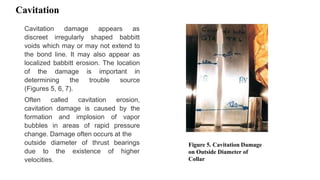
Cavitation
Cavitation
discreet
damage appears as
irregularly shaped babbitt
voids which may or may not extend to
the bond line. It may also appear as
localized babbitt erosion. The location
of the damage is important in
determining the trouble source
(Figures 5, 6, 7).
Often called cavitation erosion,
cavitation damage is caused by the
formation and implosion of vapor
bubbles in areas of rapid pressure
change. Damage often occurs at the
bearings
higher
outside diameter of thrust
due to the existence of
velocities.
Figure 5. Cavitation Damage
on Outside Diameter of
Collar
Rectification Action
This type of damage can also affect stationary machine components in close proximity to the
rotor. Based on its source, cavitation can be eliminated in a number of ways. These include
the following:
 Radius/chamfer sharp steps
 Modify bearing grooves
 Reduce bearing clearance
 Reduce bearing arc
 Eliminate flow restrictions (downstream)
 Increase lubricant flow
 Increase oil viscosity
 Lower the bearing temperature
 Change oil feed pressure
 Use harder bearing materials
The lubricating oil must be filtered or replaced. In
addition to filtering or replacing the oil, the entire
bearing assembly, oil reservoir and piping should be
flushed and cleaned.
Depending on the extent of damage, voids in the
babbitt can be puddle-repaired. The original bearing
finish must be restored. Journal shoes may also be
puddle-repaired and refinished. If this cannot be
done, the shoes must be replaced.
Although the babbitted surface is usually damaged
more severely, the rotating collar, runner or journal
surface must also be evaluated. This surface must
also be restored to original condition, either by
lapping or hand stoning
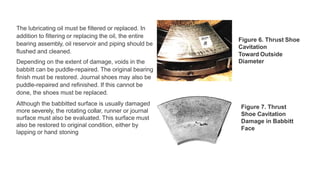
Figure 6. Thrust Shoe
Cavitation
Toward Outside
Diameter
Figure 7. Thrust
Shoe Cavitation
Damage in Babbitt
Face
Erosion
• Erosion damage may appear as localized babbitt voids with smooth
edges, particularly in the direction of rotation. Damage is more likely
to occur in stationary members.
• As a rule of thumb, if the babbitt has been affected, the cause was
cavitation damage, not erosion. Because erosion is caused by
sudden obstructions in oil flow, it is more likely to occur in other
areas, because the babbitt is under high pressure. Once damaged,
however, babbitt erosion may occur.
• Corrective action is similar to that employed in eliminating cavitation
damage, with the emphasis on streamlining oil flow through the
bearing.
Corrosion
Corrosion damage is characterized by the widespread removal of the
bearing lining by chemical attack. This attack produces a latticework
appearance. The damage may be uniform with the affected elementsbeing
washed away, leaving the corrosion-resistant elements behind.
Corrosion may also affect the rotating collar, runner or journal, appearing as
random, widespread rust or pitting. The pits are easily distinguished from
electrical pitting, because they are not as uniform or smooth-bottomed.
Corrosive materials may appear in the lubricating oil through:
 Decomposition of oil additives
 Acidic oxidation products formed in service
 Water or coolant in lube oil
 Direct corrosive contamination
Rectification Action
• Bearing housing seals, oil additive packages, and oil reservoir
operating temperatures should be evaluated as an initial step in
eliminating corrosion. The integrity of cooling coils should also be
examined.
• The cause of corrosion is best detected by knowledge of the
babbitt composition and an oil analysis. Corrosion can be
eliminated by replacing the lubricating oil. In addition, the entire
bearing assembly, oil reservoir and piping should be flushed and
cleaned. If the original bearing finish cannot be restored, the
bearing must be replaced.
• The rotating collar, runner or journal surface must also be
evaluated and restored to original condition, either by lapping or
hand stoning.
Collar/ Runner/ Journal
Surface
The most commonly overlooked bearing component is the
collar. It is the single most important part of the bearing.
Collar rotation draws oil into the region between the collar
and shoe surfaces. Oil adheres to the collar and is pulled
into pressurized oil wedges.
This occurs due to the collar surface finish. If the collar
finish is too smooth (better than 12 root mean square
(RMS)), it will not move an adequate supply of oil; too
rough, and the bearing shoes will be damaged. Ideally the
finish should be between 12 to 16 RMS.
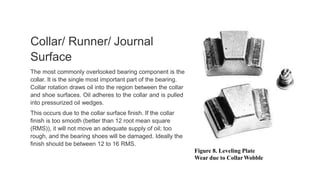
Figure 8. Leveling Plate
Wear due to CollarWobble
• Each time a bearing is inspected, the collar should be inspected and worked as
necessary. Glossy areas on the collar can easily be removed by hand-scrubbing
with a soft 600-grit oilstone.
• Collars with significant operating time may have lost their original surface flatness.
This flatness, as well as the surface finish, should be restored.
• If a split runner is used, it should be separated into halves and evaluated. Relative
motion between the halves will result in fretting damage to the runner, as well as
potential cavitation-like damage to the bearing surfaces.
• It is important that the collar faces be parallel, and perpendicular to the centerline
of the shaft. If the collar is not within tolerance, the resultant wobble will force the
shoes and leveling plates to constantly equalize, causing rapid leveling plate wear
(Figure 8).
Oil Analysis
A quick visual examination of the oil or oil filter may be all that is required to
determine that a problem exists and that further investigation is necessary. Cloudy or
discolored oil indicates a problem.
A thorough oil analysis can provide useful data to assist in diagnosing bearing or
machine distress. The usefulness of the analysis is directly related to the information
requested. As a minimum, the following should be supplied:
 Particulate density
 Particulate breakdown
 Viscosity
 Water contamination
 Chemical breakdown
• The amount of particulate, as well as its content, can
identify potential trouble spots. Oil viscosity will
decrease in time, and whether or not distress is
suspected, it should be periodically evaluated.
• Water contamination is extremely unwanted, because it
can cause rust and oil foaming, and if it is drawn into
the oil film, bearing failure. A chemical breakdown of
the oil will help to determine the integrity of the additive
packages and the presence of unwanted
contaminants.
THANK YOU

Journal Bearing layout and Failure Analysis

  • 1.
    Journal Bearing layoutand Failure identification BY : VijaySaini Bhilai Steel Plant, Bhilai
  • 2.
    CONTENTS • Introduction • TypesOf Journal Bearings • Material Used For Journal Bearings • Terms Used In Hydrodynamic Journal Bearings • Types of failure in journal bearing
  • 3.
    INTRODUCTION In journal bearingsliding action is along the circumference of circle or an arc of circle and carrying radial loads. [1]
  • 4.
    TYPES OF JOURNALBEARINGS •According to angle of contact of journal bearings [2]
  • 5.
    CONTINUE ….. According tothickness of lubricating layer [3]
  • 6.
    HYDRODYNAMIC AND HYDROSTATICBEARINGS
  • 7.
    MATERIAL USED FORJOURNALBEARINGS 1.Babbit metal • Tin base (Tin 90 %, copper 4.5 %, lead 0.5 % ) and • Lead base (Lead 84 % Tin 6 %,Antimony 9.5 %copper 0.5) 2. Bronze 3. Cast iron 4. Silver 5. Non metallic bearings
  • 8.
    TERMS USED INHYDRODYNAMIC JOURNAL BEARINGS 1. Diametral clearance (c) = D – d 2. Radial clearance (c1) = R – r = (D – d)/2 3. Diametral clearance ratio = c/d = (D - d)/d 4. Eccentricity is the radial distance between centre of bearingand displaced centre.
  • 9.
    CONTINUE 5. Minimum oilfilm thickness (ho) assume ho = c/4 6. Eccentricity ratio (Ɛ ) = e/c1 = (c1 – ho)/c1 7. Short bearing (l/d ˂1) and long bearing (l/d ˃1)
  • 10.
    Failure Analysis forPlain Bearing The textbook cases of distress modes are especially useful in diagnosing problems prior to the damage that occurs when a bearing can no longer support an oil film. Through the prudent use of temperature and vibration monitoring equipment, routine oil analysis, lubrication system evaluations and machine operational performance reviews, bearing distress may be identified and evaluated before catastrophic failure occurs. Bearing health is commonly monitored through the use of temperature measurements. Temperature sensors may be mounted in a wide variety of locations, with a corresponding variation in temperature. The specific location and type of sensor must be known for the measured temperature data to have any real value. Being able to properly identify the damage resulting from pitting (from arcing),fatigue, erosion and corrosion is key to diagnosing bearing problems.
  • 11.
    Voids Electrical Pitting Electrical pittingappears as rounded pits in the bearing lining. The pits may appear frosted (Figure 1),or they may be blackened due to oil deposits. It is not unusual for them to be small and difficult to observe with the unaided eye. A clearly defined boundary exists between the pitted and unpitted regions, with the pitting usuallyoccurring where the oil film is thinnest. As pitting progresses, the individual pits lose their characteristic appearance as they begin to overlap. Pits located near the boundary should still be intact. The debris that enters the oil begins abrasion damage.Once the bearing surface becomes incapable of supporting an oil film, the bearing willwipe. The bearing may recover an oil film and continue to operate, and pitting will begin again. This processmay occur several times before the inevitable catastrophic bearingfailure. Electrical pitting damage is caused by intermittent arcing between the stationary and rotating machine components. Because of the small film thicknesses relative to other machine clearances, the arcing commonly occurs through the bearings. Although the rotating and other stationary members can alsobe affected, the most severe pitting occurs in the softbabbitt.
  • 12.
    Figure 1. ShaftCurrents / Electrical Pitting (Frosting)
  • 13.
    Rectification Action Electromagnetic currentsare best eliminated by demagnetizing the affected component. Grounding brushes or straps may or may not be helpful. The bearings should also be isolated. The lubricating oil must be filtered or replaced. Pitting damage often blackens the oil and fills it with debris. In addition to filtering or replacing the oil, the entire bearing assembly, oil reservoir and piping should be flushed and cleaned. The original bearing finish should also be restored. Journal shoes typically must be replaced, but if the correction leaves the bearing within design tolerance, the bearingmay be reused. The condition of the rotating journal, collar or runner surfaces must also be evaluated. It must be restored to original condition, either by lapping, hand stoning or replacement.
  • 14.
    Fatigue Fatigue damage mayrepresent itself as intergranular or hairline cracks in the babbitt. The cracks may appear to open in the direction of rotation. Pieces of babbitt may spall out or appear to be pulled away in the direction of rotation. The cracks extend toward the babbitt bond line, and may reveal the shoe backing (Figures 2, 3, 4). A combination of causes contributes to fatigue damage, but concentrated cyclic loading is usually involved. The fatigue mechanism involves repeated bending or flexing of the bearing, and damage occurs morerapidly with poor bonding. It is important to note that fatigue damage will occur without poor bonding. Fatigue can occurwhen conditions produce concentrated cyclic loads, such as: Misalignment Journal eccentricity Imbalance Bent shaft Thermal cycling Vibration
  • 15.
    Figure 2. Edge Load PivotedShoe Showing Babbitt Mechanical Fatigue Figure 3. Edge Load Journal Shell with Babbitt Mechanical Fatigue Figure 4. Babbitt Fatigue in a Thin Thrust Plate
  • 16.
    Rectification Action • Performancedata should be reviewed to determine if a vibration increase occurred. The leveling plate wings should be examined for signs of excessive wear, indicating the rotating collar or runner is not perpendicular to the shaft axis. • High bearing temperature may also be considered as a contributing factor to fatigue damage. As temperatures increase, the fatigue strength of bearing materials decreases. • The lubricating oil must be filtered or replaced. In addition to filtering or replacing the oil, the entire bearing assembly, oil reservoir and piping should be flushed and cleaned. Depending on the damage, voids in the babbitt can be puddle-repaired. The original bearing finish must be restored. Journal shoes may also be puddle-repaired and refinished. If this cannot be done, the shoes must be replaced. • Although the babbitted surface is usually damaged more severely, the rotating collar or journal surface must also be evaluated. This surface must be restored to original condition, either by tapping or hand stoning.
  • 17.
    Cavitation Cavitation discreet damage appears as irregularlyshaped babbitt voids which may or may not extend to the bond line. It may also appear as localized babbitt erosion. The location of the damage is important in determining the trouble source (Figures 5, 6, 7). Often called cavitation erosion, cavitation damage is caused by the formation and implosion of vapor bubbles in areas of rapid pressure change. Damage often occurs at the bearings higher outside diameter of thrust due to the existence of velocities. Figure 5. Cavitation Damage on Outside Diameter of Collar
  • 18.
    Rectification Action This typeof damage can also affect stationary machine components in close proximity to the rotor. Based on its source, cavitation can be eliminated in a number of ways. These include the following:  Radius/chamfer sharp steps  Modify bearing grooves  Reduce bearing clearance  Reduce bearing arc  Eliminate flow restrictions (downstream)  Increase lubricant flow  Increase oil viscosity  Lower the bearing temperature  Change oil feed pressure  Use harder bearing materials
  • 19.
    The lubricating oilmust be filtered or replaced. In addition to filtering or replacing the oil, the entire bearing assembly, oil reservoir and piping should be flushed and cleaned. Depending on the extent of damage, voids in the babbitt can be puddle-repaired. The original bearing finish must be restored. Journal shoes may also be puddle-repaired and refinished. If this cannot be done, the shoes must be replaced. Although the babbitted surface is usually damaged more severely, the rotating collar, runner or journal surface must also be evaluated. This surface must also be restored to original condition, either by lapping or hand stoning Figure 6. Thrust Shoe Cavitation Toward Outside Diameter Figure 7. Thrust Shoe Cavitation Damage in Babbitt Face
  • 20.
    Erosion • Erosion damagemay appear as localized babbitt voids with smooth edges, particularly in the direction of rotation. Damage is more likely to occur in stationary members. • As a rule of thumb, if the babbitt has been affected, the cause was cavitation damage, not erosion. Because erosion is caused by sudden obstructions in oil flow, it is more likely to occur in other areas, because the babbitt is under high pressure. Once damaged, however, babbitt erosion may occur. • Corrective action is similar to that employed in eliminating cavitation damage, with the emphasis on streamlining oil flow through the bearing.
  • 21.
    Corrosion Corrosion damage ischaracterized by the widespread removal of the bearing lining by chemical attack. This attack produces a latticework appearance. The damage may be uniform with the affected elementsbeing washed away, leaving the corrosion-resistant elements behind. Corrosion may also affect the rotating collar, runner or journal, appearing as random, widespread rust or pitting. The pits are easily distinguished from electrical pitting, because they are not as uniform or smooth-bottomed. Corrosive materials may appear in the lubricating oil through:  Decomposition of oil additives  Acidic oxidation products formed in service  Water or coolant in lube oil  Direct corrosive contamination
  • 22.
    Rectification Action • Bearinghousing seals, oil additive packages, and oil reservoir operating temperatures should be evaluated as an initial step in eliminating corrosion. The integrity of cooling coils should also be examined. • The cause of corrosion is best detected by knowledge of the babbitt composition and an oil analysis. Corrosion can be eliminated by replacing the lubricating oil. In addition, the entire bearing assembly, oil reservoir and piping should be flushed and cleaned. If the original bearing finish cannot be restored, the bearing must be replaced. • The rotating collar, runner or journal surface must also be evaluated and restored to original condition, either by lapping or hand stoning.
  • 23.
    Collar/ Runner/ Journal Surface Themost commonly overlooked bearing component is the collar. It is the single most important part of the bearing. Collar rotation draws oil into the region between the collar and shoe surfaces. Oil adheres to the collar and is pulled into pressurized oil wedges. This occurs due to the collar surface finish. If the collar finish is too smooth (better than 12 root mean square (RMS)), it will not move an adequate supply of oil; too rough, and the bearing shoes will be damaged. Ideally the finish should be between 12 to 16 RMS. Figure 8. Leveling Plate Wear due to CollarWobble
  • 24.
    • Each timea bearing is inspected, the collar should be inspected and worked as necessary. Glossy areas on the collar can easily be removed by hand-scrubbing with a soft 600-grit oilstone. • Collars with significant operating time may have lost their original surface flatness. This flatness, as well as the surface finish, should be restored. • If a split runner is used, it should be separated into halves and evaluated. Relative motion between the halves will result in fretting damage to the runner, as well as potential cavitation-like damage to the bearing surfaces. • It is important that the collar faces be parallel, and perpendicular to the centerline of the shaft. If the collar is not within tolerance, the resultant wobble will force the shoes and leveling plates to constantly equalize, causing rapid leveling plate wear (Figure 8).
  • 25.
    Oil Analysis A quickvisual examination of the oil or oil filter may be all that is required to determine that a problem exists and that further investigation is necessary. Cloudy or discolored oil indicates a problem. A thorough oil analysis can provide useful data to assist in diagnosing bearing or machine distress. The usefulness of the analysis is directly related to the information requested. As a minimum, the following should be supplied:  Particulate density  Particulate breakdown  Viscosity  Water contamination  Chemical breakdown
  • 26.
    • The amountof particulate, as well as its content, can identify potential trouble spots. Oil viscosity will decrease in time, and whether or not distress is suspected, it should be periodically evaluated. • Water contamination is extremely unwanted, because it can cause rust and oil foaming, and if it is drawn into the oil film, bearing failure. A chemical breakdown of the oil will help to determine the integrity of the additive packages and the presence of unwanted contaminants.
  • 27.