1
Splay
Trees
CSE 326: Data StructuresCSE 326: Data Structures
Part 3: Splay TreePart 3: Splay Tree
2
Today: Splay Trees
• Fast both in worst-case amortized analysis
and in practice
• Are used in the kernel of NT for keep track of
process information!
• Invented by Sleator and Tarjan (1985)
• Details:
• Weiss 4.5 (basic splay trees)
• 11.5 (amortized analysis)
• 12.1 (better “top down” implementation)
3
Basic Idea
“Blind” rebalancing – no height info kept!
• Worst-case time per operation is O(n)
• Worst-case amortized time is O(log n)
• Insert/find always rotates node to the root!
• Good locality:
– Most commonly accessed keys move high in
tree – become easier and easier to find
4
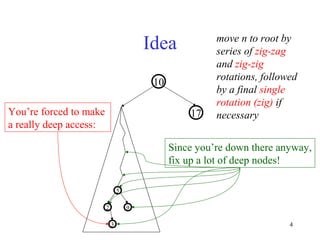
Idea
17
10
92
5
3
You’re forced to make
a really deep access:
Since you’re down there anyway,
fix up a lot of deep nodes!
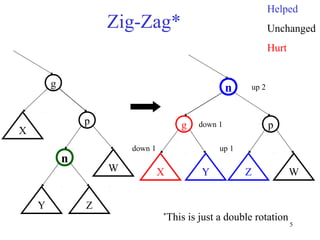
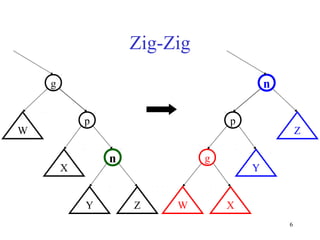
move n to root by
series of zig-zag
and zig-zig
rotations, followed
by a final single
rotation (zig) if
necessary
5
Zig-Zag*
g
X
p
Y
n
Z
W
*
This is just a double rotation
n
Y
g
W
p
ZX
Helped
Unchanged
Hurt
up 2
down 1
up 1down 1
6
Zig-Zig
n
Z
Y
p
X
g
W
g
W
X
p
Y
n
Z
7
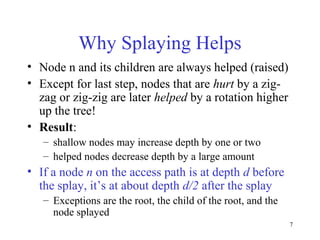
Why Splaying Helps
• Node n and its children are always helped (raised)
• Except for last step, nodes that are hurt by a zig-
zag or zig-zig are later helped by a rotation higher
up the tree!
• Result:
– shallow nodes may increase depth by one or two
– helped nodes decrease depth by a large amount
• If a node n on the access path is at depth d before
the splay, it’s at about depth d/2 after the splay
– Exceptions are the root, the child of the root, and the
node splayed
8
Splaying Example
2
1
3
4
5
6
Find(6)
2
1
3
6
5
4
zig-zig
9
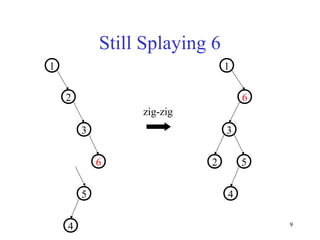
Still Splaying 6
zig-zig
2
1
3
6
5
4
1
6
3
2 5
4
10
Almost There, Stay on Target
zig
1
6
3
2 5
4
6
1
3
2 5
4
11
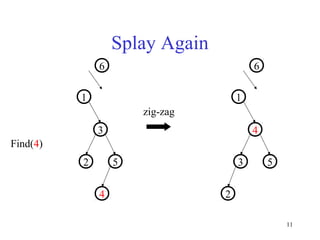
Splay Again
Find(4)
zig-zag
6
1
3
2 5
4
6
1
4
3 5
2
12
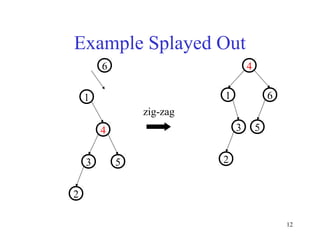
Example Splayed Out
zig-zag
6
1
4
3 5
2
61
4
3 5
2
13
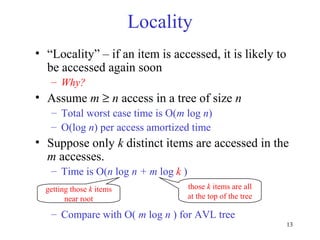
Locality
• “Locality” – if an item is accessed, it is likely to
be accessed again soon
– Why?
• Assume m ≥ n access in a tree of size n
– Total worst case time is O(m log n)
– O(log n) per access amortized time
• Suppose only k distinct items are accessed in the
m accesses.
– Time is O(n log n + m log k )
– Compare with O( m log n ) for AVL tree
getting those k items
near root
those k items are all
at the top of the tree
14
Splay Operations: Insert
• To insert, could do an ordinary BST insert
– but would not fix up tree
– A BST insert followed by a find (splay)?
• Better idea: do the splay before the insert!
• How?
15
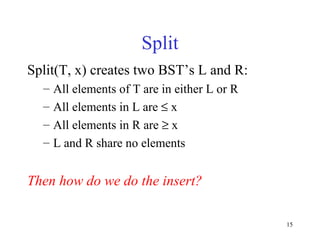
Split
Split(T, x) creates two BST’s L and R:
– All elements of T are in either L or R
– All elements in L are ≤ x
– All elements in R are ≥ x
– L and R share no elements
Then how do we do the insert?
16
Split
Split(T, x) creates two BST’s L and R:
– All elements of T are in either L or R
– All elements in L are ≤ x
– All elements in R are > x
– L and R share no elements
Then how do we do the insert?
Insert as root, with children L and R
17
Splitting in Splay Trees
• How can we split?
– We have the splay operation
– We can find x or the parent of where x would
be if we were to insert it as an ordinary BST
– We can splay x or the parent to the root
– Then break one of the links from the root to a
child
18
Split
split(x)
T L R
splay
OR
L R L R
≤ x > x> x < x
could be x, or
what would
have been the
parent of x
if root is ≤ x
if root is > x
19
Back to Insert
split(x)
L R
x
L R
> x≤ x
Insert(x):
Split on x
Join subtrees using x as root
20
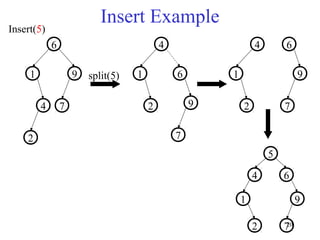
Insert Example
91
6
4 7
2
Insert(5)
split(5)
9
6
7
1
4
2
1
4
2
9
6
7
1
4
2
9
6
7
5
21
Splay Operations: Delete
find(x)
L R
x
L R
> x< x
delete x
Now what?
22
Join
• Join(L, R): given two trees such that L < R,
merge them
• Splay on the maximum element in L then
attach R
L R R
splay L
23
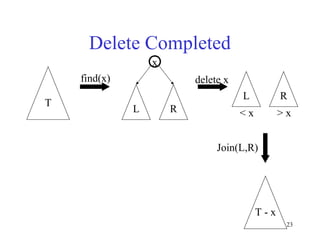
Delete Completed
T
find(x)
L R
x
L R
> x< x
delete x
T - x
Join(L,R)
24
Delete Example
91
6
4 7
2
Delete(4)
find(4)
9
6
7
1
4
2
1
2
9
6
7
Find max
2
1
9
6
7
2
1
9
6
7
25
Splay Trees, Summary
• Splay trees are arguably the most practical
kind of self-balancing trees
• If number of finds is much larger than n,
then locality is crucial!
– Example: word-counting
• Also supports efficient Split and Join
operations – useful for other tasks
– E.g., range queries

Splay tree

Editor's Notes

  • #2 Alright, today we’ll get a little Yin and Yang. We saw B-Trees, but they were just too hard to use! Let’s see something easier! (a bit)
  • #3 We’ll start by introducing AVL trees. Then, I’d like to spend some time talking about double-tailed distributions and means. Next, we’ll gind out what AVL stands for. Finally, you’ll receive a special bonus if we get to it! (Unfortunately, the bonus is AVL tree deletion)
  • #6 This is just a double rotation.
  • #7 Can anyone tell me how to implement this with two rotations? There are two possibilities: Start with rotate n or rotate p? Rotate p! Rotate n makes p n’s left child and then we’re hosed. Then, rotate n. This helps all the nodes in blue and hurts the ones in red. So, in some sense, it helps and hurts the same number of nodes on one rotation. Question: what if we keep rotating? What happens to this whole subtree? It gets helped!
  • #8 Alright, remember what we did on Monday. We learned how to splay a node to the root of a search tree. We decided it would help because we’d go a lot of fixing up if we had an expensive access. That means we have to fix up the tree on every expensive access.
  • #15 What about insert? Ideas? Can we just do BST insert? NO. Because then we could do an expensive operation without fixing up the tree.
  • #16 What about insert? Ideas? Can we just do BST insert? NO. Because then we could do an expensive operation without fixing up the tree.
  • #17 What about insert? Ideas? Can we just do BST insert? NO. Because then we could do an expensive operation without fixing up the tree.
  • #18 How can we implement this? We can splay. We can find x or where x ought to be. We can splay that spot to the root. Now, what do we have? The left subtree is all &amp;lt;= x The right is all &amp;gt;= x
  • #19 So, a split just splays x’s spot to the root then hacks off one subtree. This code is _very_ pseudo. You should only use it as a general guideline.
  • #20 Now, If we can split on x and produce one subtree smaller and one larger than x, insert is easy! Just split on x. Then, hang the left (smaller) subtree on the left of x. Hang the right (larger) subtree on the right of x. Pretty simple, huh? Are we fixing up deep paths?
  • #21 Let’s do some examples.
  • #22 OK, we’ll do something similar for delete. We know x is in the tree. Find it and bring it to the root. Remove it. Now, we have to split subtrees. How do we put them back together?
  • #23 The join operation puts two subtrees together as long as one has smaller keys to begin with. First, splay the max element of L to the root. Now, that’s gauranteed to have no right child, right? Just snap R onto that NULL right side of the max.
  • #24 So, we just join the two subtrees for delete.