TYPES OF FIBRE SPINNING
 Wet spinning
 Dry spinning
 Melt spinning
 Gel spinning or Dry – Wet spinning
WET SPINNING
Wet spinning
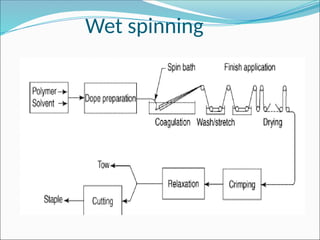
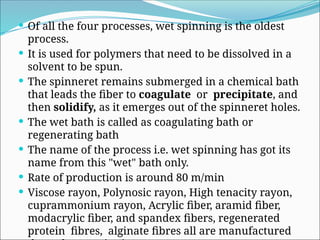
 Of all the four processes, wet spinning is the oldest
process.
 It is used for polymers that need to be dissolved in a
solvent to be spun.
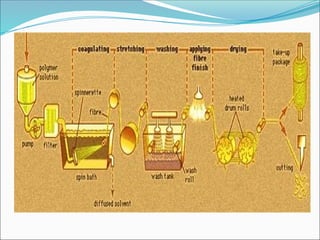
 The spinneret remains submerged in a chemical bath
that leads the fiber to coagulate or precipitate, and
then solidify, as it emerges out of the spinneret holes.
 The wet bath is called as coagulating bath or
regenerating bath
 The name of the process i.e. wet spinning has got its
name from this "wet" bath only.
 Rate of production is around 80 m/min
 Viscose rayon, Polynosic rayon, High tenacity rayon,
cuprammonium rayon, Acrylic fiber, aramid fiber,
modacrylic fiber, and spandex fibers, regenerated
protein fibres, alginate fibres all are manufactured
SPINNERRET
DRY SPINNING
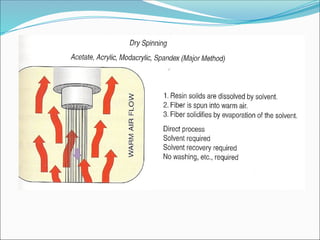
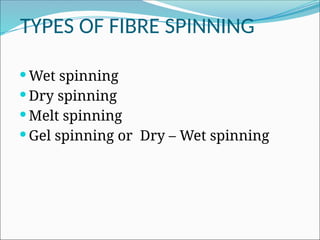
Dry spinning
 It is also used for polymers that have to be dissolved in a
solvent.
 However, solidification results from evaporation of the solvent.
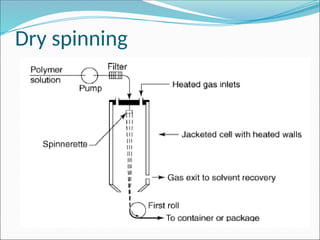
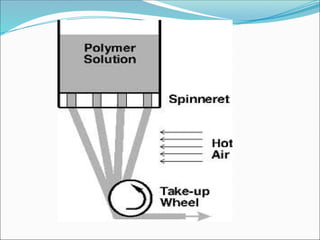
 After dissolving the polymer in a volatile solvent, the solution is
pumped through a spinneret.
 As the fibers emerge from the spinneret, air or inert gas is used
to evaporate the solvent which results in solidification of the
fibers that can be collected on a take-up wheel.
 Fibre formation in dry spinning is solidification by solvent
evaporation
 The fibers are stretched which provides for orientation of the
polymer chains along the fiber axis.
 This technique is used only for polymers which cannot be melt
spun because of the safety and environmental concerns
concerned with solvent handling.
 Dry spinning may be used for manufacturing acetate fiber,
triacetate fiber, acrylic fiber, modacrylic fiber, PBI, spandex
fiber, and vinyon
Wet spinning techniques for yarn manufacturing

  • 1.
    TYPES OF FIBRESPINNING  Wet spinning  Dry spinning  Melt spinning  Gel spinning or Dry – Wet spinning
  • 2.
  • 3.
  • 5.
     Of allthe four processes, wet spinning is the oldest process.  It is used for polymers that need to be dissolved in a solvent to be spun.  The spinneret remains submerged in a chemical bath that leads the fiber to coagulate or precipitate, and then solidify, as it emerges out of the spinneret holes.  The wet bath is called as coagulating bath or regenerating bath  The name of the process i.e. wet spinning has got its name from this "wet" bath only.  Rate of production is around 80 m/min  Viscose rayon, Polynosic rayon, High tenacity rayon, cuprammonium rayon, Acrylic fiber, aramid fiber, modacrylic fiber, and spandex fibers, regenerated protein fibres, alginate fibres all are manufactured
  • 6.
  • 7.
  • 8.
  • 11.
     It isalso used for polymers that have to be dissolved in a solvent.  However, solidification results from evaporation of the solvent.  After dissolving the polymer in a volatile solvent, the solution is pumped through a spinneret.  As the fibers emerge from the spinneret, air or inert gas is used to evaporate the solvent which results in solidification of the fibers that can be collected on a take-up wheel.  Fibre formation in dry spinning is solidification by solvent evaporation  The fibers are stretched which provides for orientation of the polymer chains along the fiber axis.  This technique is used only for polymers which cannot be melt spun because of the safety and environmental concerns concerned with solvent handling.  Dry spinning may be used for manufacturing acetate fiber, triacetate fiber, acrylic fiber, modacrylic fiber, PBI, spandex fiber, and vinyon