TRANSMISSION MODEL OF
   COMMUNICATION
What is communication?
“So what is communication? Have you ever listened to
a very polished, confident speaker and not understood a
word of what they were saying? A common mistake
people make is to focus on the delivery of information,
rather than how it is received. Communication has to be
two-way.
You only communicate when the message you send out
has been received and sent back to you, so you know
that it has been properly understood.
This applies whether you are at work, communicating
with employees, suppliers or customers, or at home,
communicating with your family and friends.”
Transmission Model of Interpersonal
               Communication
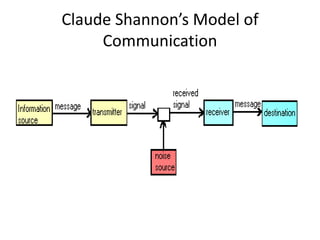
• The best known model of communication is the one
  devised by Shannon and Weaver (1949). It is a simple linear
  model which is easily understood. The model has five main
  parts:
• Information source - where the message is produced
• Transmitter - where the message is encoded
• Channel - where the signal is carried
• Receiver - where the message is decoded
• Destination - where the message ends up
• There is also a sixth part which is noise. Noise is
  interference in the channel, and causes a signal to be
  received that was not intended by the source.
Claude Shannon’s Model of
     Communication

Speech 103

  • 1.
  • 2.
    What is communication? “Sowhat is communication? Have you ever listened to a very polished, confident speaker and not understood a word of what they were saying? A common mistake people make is to focus on the delivery of information, rather than how it is received. Communication has to be two-way. You only communicate when the message you send out has been received and sent back to you, so you know that it has been properly understood. This applies whether you are at work, communicating with employees, suppliers or customers, or at home, communicating with your family and friends.”
  • 3.
    Transmission Model ofInterpersonal Communication • The best known model of communication is the one devised by Shannon and Weaver (1949). It is a simple linear model which is easily understood. The model has five main parts: • Information source - where the message is produced • Transmitter - where the message is encoded • Channel - where the signal is carried • Receiver - where the message is decoded • Destination - where the message ends up • There is also a sixth part which is noise. Noise is interference in the channel, and causes a signal to be received that was not intended by the source.
  • 4.
    Claude Shannon’s Modelof Communication