INTRODUCTION TO MEDIA
AND COMMUNICATION
TOPIC: MODEL OF COMMUNICATION
B.A (hons.) journalism and mass communication, 1st year
LECTURE:- 1
• TRANSMISSION MODEL OF COMMUNICATION
• EXPRESSIVE MODEL OF COMMUNICATION
INTRODUCTION: Transmission model of communication
• A model invented by Shannon and weaver
• Model that was invented in 1949
• It has been considered a mathematical interpretation of how
communication between different parties is ought to function
• The purpose of the model is to communicate to one another
• The transmission model of communication helps us assist
how communication works
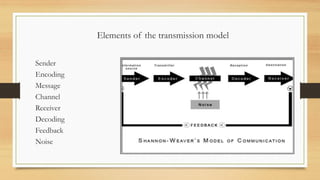
Elements of the transmission model
Sender
Encoding
Message
Channel
Receiver
Decoding
Feedback
Noise
• Sender :- In the communication process, the sender is the individual who initiates a message and is also called the
communication or source of communication.
• Encoding :- The encoding of a message is the production of the message. It is a system of coded meanings.
• Message :- It can be define as information conveyed by words, and other sign of symbols. A message is the
content of the communication process.
• Channel :- A communication channel refers to a physical transmission medium such as wind, wire or to a logical
connection over a multiplexed medium such as a radio channel.
• Receiver :- In the communication process, the receiver is the listener, reader, or observer that is the individual to
whom a message is directed.
• Decoding :- The decoding of a message is how an audience member is able to understand, and interpret the
message.
• Feedback :- It can be refers to the response or reaction of receiver to the sender’s message.
• Noise :- Noise is the any type of disruption that interferes with the transmission or interpretation of information from
the sender to the receiver.
Transmission Model in Critical Thinking
• The matter mathematically to be explained through the transmission model,
which should be followed by a qualified persuader
• Reasoning needed to be understood for all parties included
• Argumentative environment to be created by the speaker with the assistance
of the transmission model
• Inclusion of the audience by understanding its context, and accepting its
feedback should be incorporated in the critical thinking process
Introduction: Expressive Model of
Communication
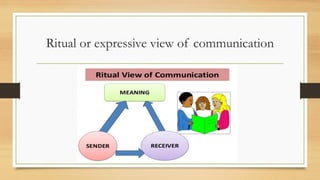
• The model was given by the JAMES W CAREY.
• This view sees communication in terms of the representation of shared beliefs.
• It define the communication as participation.
• Ritual view of communication does not confine communication to mechanistic
understanding of transmission of information from on geographical point to the other.
• Both sender and receiver has active role in the communication process as the culture is
important in the communication.
• All engaged in communication gains something more than information
Ritual or expressive view of communication
Approaches to expressive communication
• ‘Sharing’, ‘participation’, ‘association’, ‘fellowship’, and ‘the possession of a
common faith’
• ‘towards the maintenance of society in time’
• ‘the representation of shared beleifs’
Department of Journalism and mass communication
By: Vijaybhan pratap singh dhakad

INTRODUCTION TO MEDIA AND COMMUNICATION ppt.pdf

  • 1.
    INTRODUCTION TO MEDIA ANDCOMMUNICATION TOPIC: MODEL OF COMMUNICATION B.A (hons.) journalism and mass communication, 1st year
  • 2.
    LECTURE:- 1 • TRANSMISSIONMODEL OF COMMUNICATION • EXPRESSIVE MODEL OF COMMUNICATION
  • 3.
    INTRODUCTION: Transmission modelof communication • A model invented by Shannon and weaver • Model that was invented in 1949 • It has been considered a mathematical interpretation of how communication between different parties is ought to function • The purpose of the model is to communicate to one another • The transmission model of communication helps us assist how communication works
  • 4.
    Elements of thetransmission model Sender Encoding Message Channel Receiver Decoding Feedback Noise
  • 5.
    • Sender :-In the communication process, the sender is the individual who initiates a message and is also called the communication or source of communication. • Encoding :- The encoding of a message is the production of the message. It is a system of coded meanings. • Message :- It can be define as information conveyed by words, and other sign of symbols. A message is the content of the communication process. • Channel :- A communication channel refers to a physical transmission medium such as wind, wire or to a logical connection over a multiplexed medium such as a radio channel. • Receiver :- In the communication process, the receiver is the listener, reader, or observer that is the individual to whom a message is directed. • Decoding :- The decoding of a message is how an audience member is able to understand, and interpret the message. • Feedback :- It can be refers to the response or reaction of receiver to the sender’s message. • Noise :- Noise is the any type of disruption that interferes with the transmission or interpretation of information from the sender to the receiver.
  • 6.
    Transmission Model inCritical Thinking • The matter mathematically to be explained through the transmission model, which should be followed by a qualified persuader • Reasoning needed to be understood for all parties included • Argumentative environment to be created by the speaker with the assistance of the transmission model • Inclusion of the audience by understanding its context, and accepting its feedback should be incorporated in the critical thinking process
  • 7.
    Introduction: Expressive Modelof Communication • The model was given by the JAMES W CAREY. • This view sees communication in terms of the representation of shared beliefs. • It define the communication as participation. • Ritual view of communication does not confine communication to mechanistic understanding of transmission of information from on geographical point to the other. • Both sender and receiver has active role in the communication process as the culture is important in the communication. • All engaged in communication gains something more than information
  • 8.
    Ritual or expressiveview of communication
  • 9.
    Approaches to expressivecommunication • ‘Sharing’, ‘participation’, ‘association’, ‘fellowship’, and ‘the possession of a common faith’ • ‘towards the maintenance of society in time’ • ‘the representation of shared beleifs’
  • 10.
    Department of Journalismand mass communication By: Vijaybhan pratap singh dhakad