SPECIFICATION BASED OR BLACK
BOX TECHNIQUES
Muhammad HiDayat
Email : Hidayat1995.mh@gmail.com
Information System Department Faculty of
Science and Technology
State Islamic University of Sultan Syarif
Kasim Riau (UIN SUSKA RIAU)
https://sif.uin-suska.ac.id
http://uin-suska.ac.id
SPECIFICATION-BASED OR BLACK-BOX TECHNIQUES
In this section, look for the definitions of the glossary terms: boundary value a
nalysis, decision table testing, equivalence partitioning, state transition t
esting and use case testing.
The four specification-based techniques we will cover in detail are:
 equivalence partitioning.
 boundary value analysis.
 decision tables.
 state transition testing.
Equivalence partitioning and boundary value
analysis
Equivalence partitioning (EP) is a good all-round specification-based black-bo
x technique. It can be applied at any level of testing and is often a good techniq
ue to use first. It is a common sense approach to testing, so much so that most
testers practise it informally even though they may not realize it. However, while
it is better to use the technique informally than not at all, it is much better to use
the technique in a formal way to attain the full benefits that it can deliver. This te
chnique will be found in most testing books, including [Myers, 1979] and [Copel
and, 2003].
The idea behind the technique is to divide (i.e. to partition) a set of test conditio
ns into groups or sets that can be considered the same (i.e. the system should
handle them equivalently), hence 'equivalence partitioning'. Equivalence partiti
ons are also known as equivalence classes – the two terms mean exactly the s
ame thing.
Equivalence partitioning and boundary value
analysis
The equivalence-partitioning technique then requires that we need test only on
e condition from each partition. This is because we are assuming that all the co
nditions in one partition will be treated in the same way by the software. If one
condition in a partition works, we assume all of the conditions in that partition w
ill work, and so there is little point in testing any of these others.
Conversely, if one of the conditions in a partition does not work, then we assu
me that none of the conditions in that partition will work so again there is little p
oint in testing any more in that partition. Of course these are simplifying assum
ptions that may not always be right but if we write them down, at least it gives
other people the chance to challenge the assumptions we have made and hop
efully help to identify better partitions. If you have time, you may want to try mo
re than one value from a partition, especially if you want to confirm a selection
of typical user inputs.
Decision table testing
Why use decision tables?
The techniques of equivalence partitioning and boundary value analysis are often
applied to specific situations or inputs. However, if different combinations of inputs result in d
ifferent actions being taken, this can be more difficult to show using equivalence partitioning
and boundary value analysis, which tend to be more focused on the user interface. The othe
r two specification-based techniques, decision tables and state transition testing are more fo
cused on business logic or business rules.
A decision table is a good way to deal with combinations of things (e.g. inputs).
This technique is sometimes also referred to as a 'cause-effect' table. The reason for this is t
hat there is an associated logic diagramming technique called 'cause-effect graphing' which
was sometimes used to help derive the decision table (Myers describes this as a combinator
ial logic network [Myers, 1979]). However, most people find it more useful just to use the tabl
e described in [Copeland, 2003].
Decision table testing
If you begin using decision tables to explore what the business rules are that should be teste
d, you may find that the analysts and developers find the tables very helpful and want to begi
n using them too. Do encourage this, as it will make your job easier in the future. Decision ta
bles provide a systematic way of stating complex business rules, which is useful for develope
rs as well as for testers. Decision tables can be used in test design whether or not they are u
sed in specifications, as they help testers explore the effects of combinations of different inpu
ts and other software states that must correctly implement business rules. Helping the develo
pers do a better job can also lead to better relationships with them.
Testing combinations can be a challenge, as the number of combinations can ofte
n be huge. Testing all combinations may be impractical if not impossible. We have to be satis
fied with testing just a small subset of combinations but making the choice of which combinati
ons to test and which to leave out is not trivial. If you do not have a systematic way of selecti
ng combinations, an arbitrary subset will be used and this may well result in an ineffective tes
t effort.
Decision table testing
Decision tables aid the systematic selection of effective test cases and can hav
e the beneficial side-effect of finding problems and ambiguities in the specificat
ion. It is a technique that works well in conjunction with equivalence partitionin
g. The combination of conditions explored may be combinations of equivalenc
e partitions.
In addition to decision tables, there are other techniques that deal wit
h testing combinations of things: pairwise testing and orthogonal arrays. These
are described in [Copeland, 2003]. Another source of techniques is [Pol et al.,
2001]. Decision tables and cause-effect graphing are described in [BS7925-2],
including designing tests and measuring coverage.
State transition testing
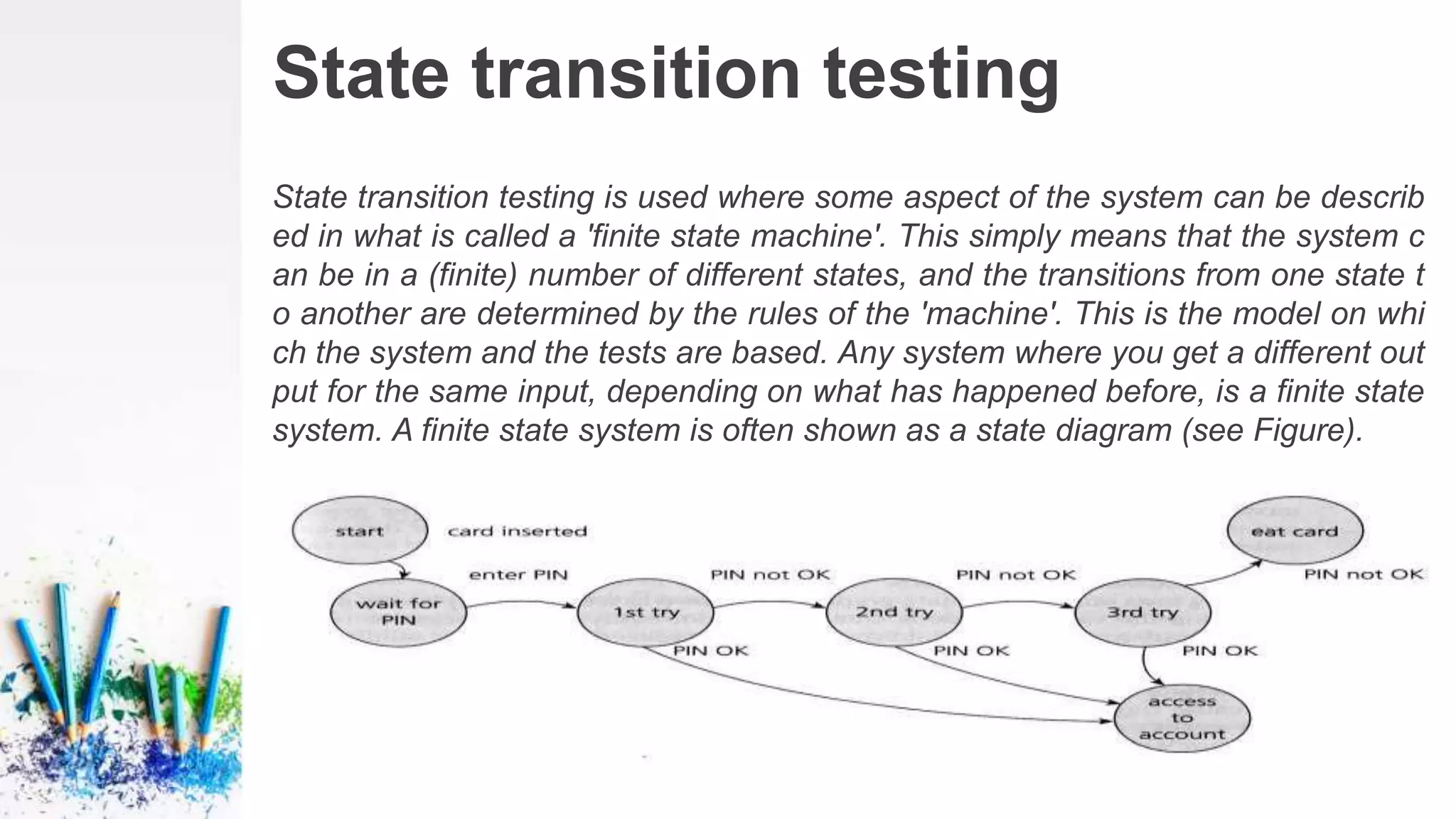
State transition testing is used where some aspect of the system can be describ
ed in what is called a 'finite state machine'. This simply means that the system c
an be in a (finite) number of different states, and the transitions from one state t
o another are determined by the rules of the 'machine'. This is the model on whi
ch the system and the tests are based. Any system where you get a different out
put for the same input, depending on what has happened before, is a finite state
system. A finite state system is often shown as a state diagram (see Figure).
State transition testing
Decision tables aid the systematic selection of effective test cases and can have
the beneficial side-effect of finding problems and ambiguities in the specification.
It is a technique that works well in conjunction with equivalence partitioning. The
combination of conditions explored may be combinations of equivalence partition
s.
In addition to decision tables, there are other techniques that deal with t
esting combinations of things: pairwise testing and orthogonal arrays. These are
described in [Copeland, 2003]. Another source of techniques is [Pol et al., 2001].
Decision tables and cause-effect graphing are described in [BS7925-2], including
designing tests and measuring coverage.
Use case testing
Use case testing is a technique that helps us identify test cases that exercise the whole s
ystem on a transaction by transaction basis from start to finish. They are described by Iva
r Jacobson in his book Object-Oriented Software Engineering: A Use Case Driven Approa
ch [Jacobson, 1992].
A use case is a description of a particular use of the system by an actor (a use
r of the system). Each use case describes the interactions the actor has with the system i
n order to achieve a specific task (or, at least, produce something of value to the user). A
ctors are generally people but they may also be other systems. Use cases are a sequenc
e of steps that describe the interactions between the actor and the system.
Use cases are defined in terms of the actor, not the system, describing what th
e actor does and what the actor sees rather than what inputs the system expects and wh
at the system'outputs. They often use the language and terms of the business rather than
technical terms, especially when the actor is a business user. They serve as the foundatio
n for developing test cases mostly at the system and acceptance testing levels.
Use case testing
Use cases can uncover integration defects, that is, defects caused by the incorrect interacti
on between different components. Used in this way, the actor may be something that the sy
stem interfaces to such as a communication link or sub-system.
Use cases describe the process flows through a system based on its most likely
use. This makes the test cases derived from use cases particularly good for finding defects
in the real-world use of the system (i.e. the defects that the users are most likely to come a
cross when first using the system). Each use case usually has a mainstream (or most likely
) scenario and sometimes additional alternative branches (covering, for example, special c
ases or exceptional conditions). Each use case must specify any preconditions that need to
be met for the use case to work. Use cases must also specify postconditions that are obser
vable results and a description of the final state of the system after the use case has been
executed successfully.
Reference
Graham, Dorothy, et al. “Test design techniques”. Chapter 4 .2011

Specification based or black box techniques

  • 1.
    SPECIFICATION BASED ORBLACK BOX TECHNIQUES Muhammad HiDayat Email : Hidayat1995.mh@gmail.com Information System Department Faculty of Science and Technology State Islamic University of Sultan Syarif Kasim Riau (UIN SUSKA RIAU) https://sif.uin-suska.ac.id http://uin-suska.ac.id
  • 2.
    SPECIFICATION-BASED OR BLACK-BOXTECHNIQUES In this section, look for the definitions of the glossary terms: boundary value a nalysis, decision table testing, equivalence partitioning, state transition t esting and use case testing. The four specification-based techniques we will cover in detail are:  equivalence partitioning.  boundary value analysis.  decision tables.  state transition testing.
  • 3.
    Equivalence partitioning andboundary value analysis Equivalence partitioning (EP) is a good all-round specification-based black-bo x technique. It can be applied at any level of testing and is often a good techniq ue to use first. It is a common sense approach to testing, so much so that most testers practise it informally even though they may not realize it. However, while it is better to use the technique informally than not at all, it is much better to use the technique in a formal way to attain the full benefits that it can deliver. This te chnique will be found in most testing books, including [Myers, 1979] and [Copel and, 2003]. The idea behind the technique is to divide (i.e. to partition) a set of test conditio ns into groups or sets that can be considered the same (i.e. the system should handle them equivalently), hence 'equivalence partitioning'. Equivalence partiti ons are also known as equivalence classes – the two terms mean exactly the s ame thing.
  • 4.
    Equivalence partitioning andboundary value analysis The equivalence-partitioning technique then requires that we need test only on e condition from each partition. This is because we are assuming that all the co nditions in one partition will be treated in the same way by the software. If one condition in a partition works, we assume all of the conditions in that partition w ill work, and so there is little point in testing any of these others. Conversely, if one of the conditions in a partition does not work, then we assu me that none of the conditions in that partition will work so again there is little p oint in testing any more in that partition. Of course these are simplifying assum ptions that may not always be right but if we write them down, at least it gives other people the chance to challenge the assumptions we have made and hop efully help to identify better partitions. If you have time, you may want to try mo re than one value from a partition, especially if you want to confirm a selection of typical user inputs.
  • 5.
    Decision table testing Whyuse decision tables? The techniques of equivalence partitioning and boundary value analysis are often applied to specific situations or inputs. However, if different combinations of inputs result in d ifferent actions being taken, this can be more difficult to show using equivalence partitioning and boundary value analysis, which tend to be more focused on the user interface. The othe r two specification-based techniques, decision tables and state transition testing are more fo cused on business logic or business rules. A decision table is a good way to deal with combinations of things (e.g. inputs). This technique is sometimes also referred to as a 'cause-effect' table. The reason for this is t hat there is an associated logic diagramming technique called 'cause-effect graphing' which was sometimes used to help derive the decision table (Myers describes this as a combinator ial logic network [Myers, 1979]). However, most people find it more useful just to use the tabl e described in [Copeland, 2003].
  • 6.
    Decision table testing Ifyou begin using decision tables to explore what the business rules are that should be teste d, you may find that the analysts and developers find the tables very helpful and want to begi n using them too. Do encourage this, as it will make your job easier in the future. Decision ta bles provide a systematic way of stating complex business rules, which is useful for develope rs as well as for testers. Decision tables can be used in test design whether or not they are u sed in specifications, as they help testers explore the effects of combinations of different inpu ts and other software states that must correctly implement business rules. Helping the develo pers do a better job can also lead to better relationships with them. Testing combinations can be a challenge, as the number of combinations can ofte n be huge. Testing all combinations may be impractical if not impossible. We have to be satis fied with testing just a small subset of combinations but making the choice of which combinati ons to test and which to leave out is not trivial. If you do not have a systematic way of selecti ng combinations, an arbitrary subset will be used and this may well result in an ineffective tes t effort.
  • 7.
    Decision table testing Decisiontables aid the systematic selection of effective test cases and can hav e the beneficial side-effect of finding problems and ambiguities in the specificat ion. It is a technique that works well in conjunction with equivalence partitionin g. The combination of conditions explored may be combinations of equivalenc e partitions. In addition to decision tables, there are other techniques that deal wit h testing combinations of things: pairwise testing and orthogonal arrays. These are described in [Copeland, 2003]. Another source of techniques is [Pol et al., 2001]. Decision tables and cause-effect graphing are described in [BS7925-2], including designing tests and measuring coverage.
  • 8.
    State transition testing Statetransition testing is used where some aspect of the system can be describ ed in what is called a 'finite state machine'. This simply means that the system c an be in a (finite) number of different states, and the transitions from one state t o another are determined by the rules of the 'machine'. This is the model on whi ch the system and the tests are based. Any system where you get a different out put for the same input, depending on what has happened before, is a finite state system. A finite state system is often shown as a state diagram (see Figure).
  • 9.
    State transition testing Decisiontables aid the systematic selection of effective test cases and can have the beneficial side-effect of finding problems and ambiguities in the specification. It is a technique that works well in conjunction with equivalence partitioning. The combination of conditions explored may be combinations of equivalence partition s. In addition to decision tables, there are other techniques that deal with t esting combinations of things: pairwise testing and orthogonal arrays. These are described in [Copeland, 2003]. Another source of techniques is [Pol et al., 2001]. Decision tables and cause-effect graphing are described in [BS7925-2], including designing tests and measuring coverage.
  • 10.
    Use case testing Usecase testing is a technique that helps us identify test cases that exercise the whole s ystem on a transaction by transaction basis from start to finish. They are described by Iva r Jacobson in his book Object-Oriented Software Engineering: A Use Case Driven Approa ch [Jacobson, 1992]. A use case is a description of a particular use of the system by an actor (a use r of the system). Each use case describes the interactions the actor has with the system i n order to achieve a specific task (or, at least, produce something of value to the user). A ctors are generally people but they may also be other systems. Use cases are a sequenc e of steps that describe the interactions between the actor and the system. Use cases are defined in terms of the actor, not the system, describing what th e actor does and what the actor sees rather than what inputs the system expects and wh at the system'outputs. They often use the language and terms of the business rather than technical terms, especially when the actor is a business user. They serve as the foundatio n for developing test cases mostly at the system and acceptance testing levels.
  • 11.
    Use case testing Usecases can uncover integration defects, that is, defects caused by the incorrect interacti on between different components. Used in this way, the actor may be something that the sy stem interfaces to such as a communication link or sub-system. Use cases describe the process flows through a system based on its most likely use. This makes the test cases derived from use cases particularly good for finding defects in the real-world use of the system (i.e. the defects that the users are most likely to come a cross when first using the system). Each use case usually has a mainstream (or most likely ) scenario and sometimes additional alternative branches (covering, for example, special c ases or exceptional conditions). Each use case must specify any preconditions that need to be met for the use case to work. Use cases must also specify postconditions that are obser vable results and a description of the final state of the system after the use case has been executed successfully.
  • 12.
    Reference Graham, Dorothy, etal. “Test design techniques”. Chapter 4 .2011