

SPEAKING TO INFORM
2013702085
MOHAMMAD SYAMIL BIN SELAMAT
2013380903
MOHAMAD ZULHIZAMI BIN MOHD ARIFFIN
INTRODUCTION
• For a person to convey information correctly and deliberately, a correct
form of speech must be used. That is where the principal of speaking to
inform comes in. For example, for a marketing director to know his
audience, he must first know what the people need. And before he can do
any persuasion to the public, he must then tell the crowd in question what
his product is all about. This is an example of speech to inform:

“Okay. Good morning all. My name is Andrew Johnson. Today, I want to
introduce our latest product range, the Beauty Queen skincare range. Our
estimated release date is around fall.
• Notice the wordings in red. It is an example of speaking to inform. There
he introduces his name and informing the crowd of his product, the
Beauty Queen skincare range.
CONT..
• In delivering a speech to inform, the deliverer
must be observing three main things in
his/her speech, mainly:
– Is the information communicated accurately?
– Is the information communicated clearly?
– Is the information made meaningful and
interesting to the audience?
SPEECHES ABOUT OBJECTS
• One of the easiest form of speech to inform, this type of speech is
on objects, as shown in the example earlier, where Andrew told the
crowd about his skincare product, which is an “object”.
• When delivering speech on objects, the speech must both be
concise and informative. For example, I want to inform the class on
books to buy. Meaning that I will only tell about the price and things
related to it. I don’t have to inform about the color or something
like that.
• But, I can’t just tell the title and not the price. It won’t be concise
and informative enough.
• Divided into three:
– Chronological
– Spatial
– Topical
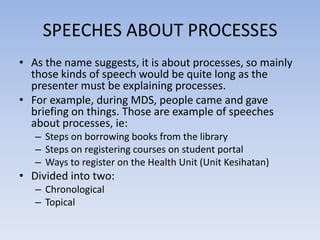
SPEECHES ABOUT PROCESSES
• As the name suggests, it is about processes, so mainly
those kinds of speech would be quite long as the
presenter must be explaining processes.
• For example, during MDS, people came and gave
briefing on things. Those are example of speeches
about processes, ie:
– Steps on borrowing books from the library
– Steps on registering courses on student portal
– Ways to register on the Health Unit (Unit Kesihatan)

• Divided into two:
– Chronological
– Topical
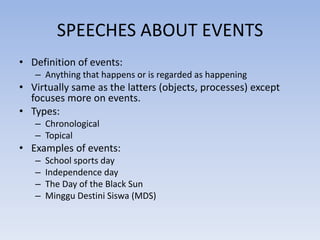
SPEECHES ABOUT EVENTS
• Definition of events:
– Anything that happens or is regarded as happening

• Virtually same as the latters (objects, processes) except
focuses more on events.
• Types:
– Chronological
– Topical

• Examples of events:
–
–
–
–

School sports day
Independence day
The Day of the Black Sun
Minggu Destini Siswa (MDS)
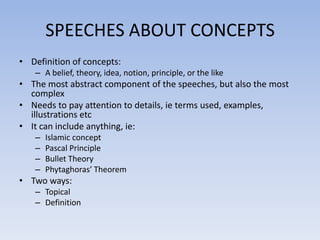
SPEECHES ABOUT CONCEPTS
• Definition of concepts:
– A belief, theory, idea, notion, principle, or the like

• The most abstract component of the speeches, but also the most
complex
• Needs to pay attention to details, ie terms used, examples,
illustrations etc
• It can include anything, ie:
–
–
–
–

Islamic concept
Pascal Principle
Bullet Theory
Phytaghoras’ Theorem

• Two ways:
– Topical
– Definition
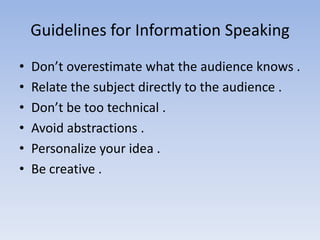
Guidelines for Information Speaking
•
•
•
•
•
•

Don’t overestimate what the audience knows .
Relate the subject directly to the audience .
Don’t be too technical .
Avoid abstractions .
Personalize your idea .
Be creative .
Don’t overtimate what the audience
knows .
• As many speakers have discovered, it is to everestimate
the audience’c stock of information. You must be sure to
explain everything so thoroughly that they cannot help
but understand.
• Example ; Bulletproof vest .
• They are pieces of personal body armor that protect
human beings from damage incurred by explosively
propelled projectiles. How ? Intricately woven synthetic
fibers suchh as Kevlar form a powerful mesh that literally
disperses a project’s kinetic energy while at the same
time deforming the projectile and stopping its
momentum.
Relate the subject directly to the
audience
• Must recognize that what is fascinating to them may
not be fascinating to everybody.
• Choose a topic that could possibly be interesting to
your listener , then relate it to them.
• Example ; Chili peppers.
• Imagine your mouth burning like wildfire, your eyes
squirting outcontrollable tears, and your face red and
sweating profusely. Are you sick? No. You just took a
bite of screaming hot chili pepper. Congratulation. You
‘re partaking in a worldwide tradition that has been
spicing up lives and diets for thousands of years.
Don’t be too technical
• Any subject can be popularized.
• Know what can be explained to an ordinary
audience and what cannot.
• Example ; Stem cell and the roles they can play in
the human body.
• Most multicellular organisms contain stem cells
that reinvigorates themselves through the
process of mitotic cellular division. Stem cells in
early embryos represent basic units of life in
higher organisms, while adult stem cell in somatic
tissues.
Avoid Abstraction
•
•
•
•

Through description.
; communicate internal feelings.
Example ; one student began his first sky diving.
As we wait for the plane to climb to the jump
altitude of 12,000 feet, my mind races with a
frienzied jumble of thoughts: “OK, this is the
moment you’ve been waiting for. It’s going to be
great. Am I really going to jump out of an airplane
from 12,000 feet? What if somethings goes
wrong? Can I still back out? Come on now, don’t
worry. It’ll be fine.
Personalize your ideas
• Listeners want to be entertained as they are being enlightened.
• Try to personalize your ideas and dramatize them in human
terms.
• Example ; one speaker began telling about her autistic nephew:
My nephew Sam was delight of our family when he was
born, the first grandchild of my parents. He cooed and
babbled, smiled at his mom and dad, grasped for the playthings
around his crib. He looks normal infant in a secure and loving
home.
Then shortly before his second birthday we began to notice
unusual behaviors. Sam avoided looking us in the eye, did not seem
interested in learning words, played endlessly with the same
toy, rocked back and forth in his chair for hours at the time, and
was easily frustrated. My sister took him to a speacialist, who gave
the dreaded diagnosis: Sam was autistic.
• End the speech with a hopeful conclusion.
We have seen that autism is a very serious
disorder whose causes are not well understood and
whose effects on famillies and the lives of the
children themselvescan be devastating. But we also
seen that early diagnosis and early intervention can
help to modify and even turn around the symptoms
of autism.
I am happy to say that Sam has benefited from
such intervention. From the time he was two, he
has been taught “normal” behavior patterns
throuogh aggressive theraphy. Now he is able to
participate in his class at school. He is also more
responsive and effectionate at home. Sam
continues to be our delight.
Be creative
• Any kind of speech, it requires a healthy dose
of creativity.
• If you think creatively when constructing your
informative speech, you are much more likely
to be successful.
QUESTIONS?

Speaking to inform

  • 1.
    SPEAKING TO INFORM 2013702085 MOHAMMADSYAMIL BIN SELAMAT 2013380903 MOHAMAD ZULHIZAMI BIN MOHD ARIFFIN
  • 2.
    INTRODUCTION • For aperson to convey information correctly and deliberately, a correct form of speech must be used. That is where the principal of speaking to inform comes in. For example, for a marketing director to know his audience, he must first know what the people need. And before he can do any persuasion to the public, he must then tell the crowd in question what his product is all about. This is an example of speech to inform: “Okay. Good morning all. My name is Andrew Johnson. Today, I want to introduce our latest product range, the Beauty Queen skincare range. Our estimated release date is around fall. • Notice the wordings in red. It is an example of speaking to inform. There he introduces his name and informing the crowd of his product, the Beauty Queen skincare range.
  • 3.
    CONT.. • In deliveringa speech to inform, the deliverer must be observing three main things in his/her speech, mainly: – Is the information communicated accurately? – Is the information communicated clearly? – Is the information made meaningful and interesting to the audience?
  • 4.
    SPEECHES ABOUT OBJECTS •One of the easiest form of speech to inform, this type of speech is on objects, as shown in the example earlier, where Andrew told the crowd about his skincare product, which is an “object”. • When delivering speech on objects, the speech must both be concise and informative. For example, I want to inform the class on books to buy. Meaning that I will only tell about the price and things related to it. I don’t have to inform about the color or something like that. • But, I can’t just tell the title and not the price. It won’t be concise and informative enough. • Divided into three: – Chronological – Spatial – Topical
  • 5.
    SPEECHES ABOUT PROCESSES •As the name suggests, it is about processes, so mainly those kinds of speech would be quite long as the presenter must be explaining processes. • For example, during MDS, people came and gave briefing on things. Those are example of speeches about processes, ie: – Steps on borrowing books from the library – Steps on registering courses on student portal – Ways to register on the Health Unit (Unit Kesihatan) • Divided into two: – Chronological – Topical
  • 6.
    SPEECHES ABOUT EVENTS •Definition of events: – Anything that happens or is regarded as happening • Virtually same as the latters (objects, processes) except focuses more on events. • Types: – Chronological – Topical • Examples of events: – – – – School sports day Independence day The Day of the Black Sun Minggu Destini Siswa (MDS)
  • 7.
    SPEECHES ABOUT CONCEPTS •Definition of concepts: – A belief, theory, idea, notion, principle, or the like • The most abstract component of the speeches, but also the most complex • Needs to pay attention to details, ie terms used, examples, illustrations etc • It can include anything, ie: – – – – Islamic concept Pascal Principle Bullet Theory Phytaghoras’ Theorem • Two ways: – Topical – Definition
  • 8.
    Guidelines for InformationSpeaking • • • • • • Don’t overestimate what the audience knows . Relate the subject directly to the audience . Don’t be too technical . Avoid abstractions . Personalize your idea . Be creative .
  • 9.
    Don’t overtimate whatthe audience knows . • As many speakers have discovered, it is to everestimate the audience’c stock of information. You must be sure to explain everything so thoroughly that they cannot help but understand. • Example ; Bulletproof vest . • They are pieces of personal body armor that protect human beings from damage incurred by explosively propelled projectiles. How ? Intricately woven synthetic fibers suchh as Kevlar form a powerful mesh that literally disperses a project’s kinetic energy while at the same time deforming the projectile and stopping its momentum.
  • 10.
    Relate the subjectdirectly to the audience • Must recognize that what is fascinating to them may not be fascinating to everybody. • Choose a topic that could possibly be interesting to your listener , then relate it to them. • Example ; Chili peppers. • Imagine your mouth burning like wildfire, your eyes squirting outcontrollable tears, and your face red and sweating profusely. Are you sick? No. You just took a bite of screaming hot chili pepper. Congratulation. You ‘re partaking in a worldwide tradition that has been spicing up lives and diets for thousands of years.
  • 11.
    Don’t be tootechnical • Any subject can be popularized. • Know what can be explained to an ordinary audience and what cannot. • Example ; Stem cell and the roles they can play in the human body. • Most multicellular organisms contain stem cells that reinvigorates themselves through the process of mitotic cellular division. Stem cells in early embryos represent basic units of life in higher organisms, while adult stem cell in somatic tissues.
  • 12.
    Avoid Abstraction • • • • Through description. ;communicate internal feelings. Example ; one student began his first sky diving. As we wait for the plane to climb to the jump altitude of 12,000 feet, my mind races with a frienzied jumble of thoughts: “OK, this is the moment you’ve been waiting for. It’s going to be great. Am I really going to jump out of an airplane from 12,000 feet? What if somethings goes wrong? Can I still back out? Come on now, don’t worry. It’ll be fine.
  • 13.
    Personalize your ideas •Listeners want to be entertained as they are being enlightened. • Try to personalize your ideas and dramatize them in human terms. • Example ; one speaker began telling about her autistic nephew: My nephew Sam was delight of our family when he was born, the first grandchild of my parents. He cooed and babbled, smiled at his mom and dad, grasped for the playthings around his crib. He looks normal infant in a secure and loving home. Then shortly before his second birthday we began to notice unusual behaviors. Sam avoided looking us in the eye, did not seem interested in learning words, played endlessly with the same toy, rocked back and forth in his chair for hours at the time, and was easily frustrated. My sister took him to a speacialist, who gave the dreaded diagnosis: Sam was autistic.
  • 14.
    • End thespeech with a hopeful conclusion. We have seen that autism is a very serious disorder whose causes are not well understood and whose effects on famillies and the lives of the children themselvescan be devastating. But we also seen that early diagnosis and early intervention can help to modify and even turn around the symptoms of autism. I am happy to say that Sam has benefited from such intervention. From the time he was two, he has been taught “normal” behavior patterns throuogh aggressive theraphy. Now he is able to participate in his class at school. He is also more responsive and effectionate at home. Sam continues to be our delight.
  • 15.
    Be creative • Anykind of speech, it requires a healthy dose of creativity. • If you think creatively when constructing your informative speech, you are much more likely to be successful.
  • 16.