SPAWN PRODUCTON FOR THE MUSHROOM INDUSTRY:
THE BASIC FACILITY FOR VALUE CHAIN
DEVELOPMENT OF MUSHROOMS
By:
Sara Mitiku
1.INTRODUCTION
 Mushrooms are fungal form of life.
 They are rich in protein compared with other vegetables.
 Its production is one of the most promising and highly desirable activities
in developing countries to reduce protein malnutrition.
 Mushroom cultivation has two main phases, spawn production and fruiting
body production.
 The mushroom seed is generally referred to as spawn.
 Spawn is the mycelium of the mushroom with its substrate, which is the
propagating material, used for initiating mushroom production.
Introduction cont…
 Its production is a precise laboratory procedure where maintaining
sanitation and purity of the spawn are critical.
 Cereal grains and sawdust are common materials used for spawn making.
 The most commonly utilized grain types are rye, wheat, sorghum and
millet.
 The choice of the grain is made after considering the prevailing price, easy
supply, grain size and the desired variety to be grown.
 Small sized grains like teff couldn't be used for spawn making b/c of
sticking nature of the grain during soaking and sterilization.
 Grain spawn is made of cooked or soaked grains with small amount of
gypsum.
2. METHOD OF SPAWN PREPARATION
 There are three steps involved in spawn production:
 Raising pure culture,
 Preparation of mother spawn and
 Multiplication of spawn.
 Preparation of agar media is basic for mushroom cultures.
 There are several types of agar media such as potatoes, malt extract and
corn meal.
 Potato dextrose agar and malt extract agar are available in market and
could be prepared according to instruction given by the manufacturer.
2.1. Media preparation
Potato Dextrose Agar
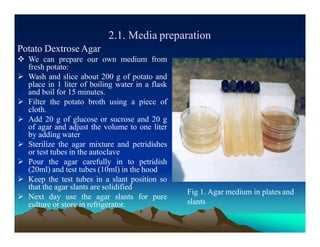
 We can prepare our own medium from
fresh potato:
 Wash and slice about 200 g of potato and
place in 1 liter of boiling water in a flask
and boil for 15 minutes.
 Filter the potato broth using a piece of
cloth.
 Add 20 g of glucose or sucrose and 20 g
of agar and adjust the volume to one liter
by adding water
 Sterilize the agar mixture and petridishes
or test tubes in the autoclave
 Pour the agar carefully in to petridish
(20ml) and test tubes (10ml) in the hood
 Keep the test tubes in a slant position so
that the agar slants are solidified
 Next day use the agar slants for pure
culture or store in refrigerator.
Fig 1. Agar medium in plates and
slants
2.2. Pure culture preparation
 There are two ways of raising pure culture
a. Tissue culture
b. Spore culture
a. Tissue Culture
 Well grown young mushroom is selected
 Clean the mushroom from any debris with
alcohol
 Split the mushroom lengthwise with knife and
avoid any contact of the knife with the area we
want to take tissue.
 Sterilize the scalpel on aflame and take a small
piece of mushroom tissue using forceps.
 Inoculate the mushroom tissue to PDA or MEA
media slants or plates aseptically
 In a few day hyphea will grow out from the
tissue and covers the entire surface and
 The culture becomes ready for further
multiplication.
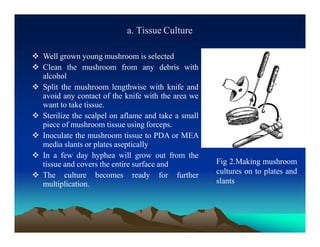
Fig 2.Making mushroom
cultures on to plates and
slants
b. Spore culture
 Well developed fruiting body are selected and cut the stalk of the
mushroom
 Laid the gills down on a clean typing paper, glass or similar surface
 After 12 hours most mushrooms have released thousands of spores.
 The spores are collected by spore map techniques.
 Pick up the spores by the inoculating loop
 Inoculate the spore to the PDA or MEA slants as in tissue culture under
aseptic condition and incubate at room temperature.
 The spores germinate and will form mycelium in a few days.
o The tissue culture method is the most reliable and recommended for the
mushroom culture to grow b/c
o In case spore culture method, more than one spore is required to get
cultures which could form the mushroom
o In the process of spore inoculation contaminant bacteria and molds may
grow together making it difficult to get pure culture of the mushroom.
2.3. Grain Spawn Preparation
 Select clean sorghum, wash the grains and soak overnight
 Next day remove the soaked grains and wash gently and drain the water on
a sieve
 Check the moisture content by hand; it should not be too dry or too wet
 Mix the grain with 10% wheat bran and 2% calcium sulfate and calcium
carbonate mixtures
 Fill the supplemented grain in sterilizable bottles or flasks and loosely
cover the mouth of bottles.
 Then sterilize the bottles in an autoclave at 121ºC for about 15-30 minutes
or for one hour in pressure cooker.
 Take out the bottles from the autoclave and let it to cool for a day.
2.4. Preparation of mother spawn
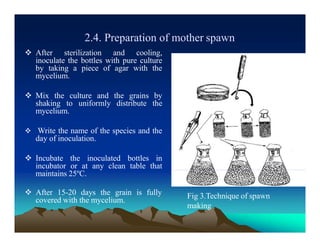
 After sterilization and cooling,
inoculate the bottles with pure culture
by taking a piece of agar with the
mycelium.
 Mix the culture and the grains by
shaking to uniformly distribute the
mycelium.
 Write the name of the species and the
day of inoculation.
 Incubate the inoculated bottles in
incubator or at any clean table that
maintains 25ºC.
 After 15-20 days the grain is fully
covered with the mycelium.
Fig 3.Technique of spawn
making
2.5. Multiplication of mother spawn
 Select well grown mother spawn
 Open the mother spawn bottles on a
flame and stir the spawn using sterilized
forceps to get the individual grains.
 Transfer few grains with the mycelium
in to sterilized substrate bottles under
aseptic conditions and cover the mouth.
 Mix the grains by shaking to uniformly
distribute the mycelium.
 Incubate the inoculated bottles at 25ºC
till all the grains is covered with the
mycelium.
 Inspect the bottles regularly and discard
contaminated ones.
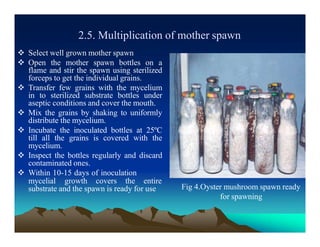
 Within 10-15 days of inoculation
mycelial growth covers the entire
substrate and the spawn is ready for use Fig 4.Oyster mushroom spawn ready
for spawning
3. Research findings
 In a study to evaluate grain substrates for spawn production, four grain (teff,
wheat, sorghum and maize) types were tested for
Moisture content
Volume per unit weight
Carbon and nitrogen content
Days to complete mycelium growth on grain substrate.
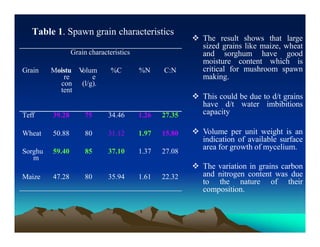
Table 1. Spawn grain characteristics
Grain characteristics
Grain %N C:N
 The result shows that large
sized grains like maize, wheat
and sorghum have good
moisture content which is
critical for mushroom spawn
making.
Moistu V
olum %C
re e
con (l/g).
tent
 This could be due to d/t grains
have d/t water imbibitions
capacity
 Volume per unit weight is an
indication of available surface
area for growth of mycelium.
m
 The variation in grains carbon
and nitrogen content was due
to the nature of their
composition.
Teff 39.28 75 34.46 1.26 27.35
Wheat 50.88 80 31.12 1.97 15.80
Sorghu 59.40 85 37.10 1.37 27.08
Maize 47.28 80 35.94 1.61 22.32
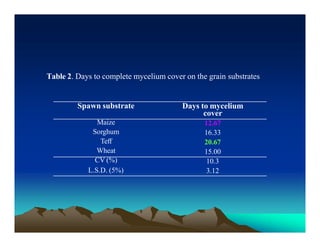
Table 2. Days to complete mycelium cover on the grain substrates
Spawn substrate
Maize
Sorghum
Teff
Wheat
CV (%)
L.S.D. (5%)
Days to mycelium
cover
12.67
16.33
20.67
15.00
10.3
3.12
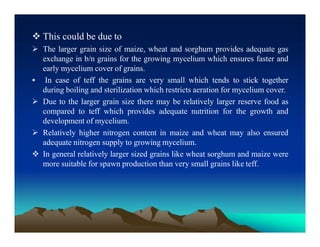
 This could be due to
 The larger grain size of maize, wheat and sorghum provides adequate gas
exchange in b/n grains for the growing mycelium which ensures faster and
early mycelium cover of grains.
 In case of teff the grains are very small which tends to stick together
during boiling and sterilization which restricts aeration for mycelium cover.
 Due to the larger grain size there may be relatively larger reserve food as
compared to teff which provides adequate nutrition for the growth and
development of mycelium.
 Relatively higher nitrogen content in maize and wheat may also ensured
adequate nitrogen supply to growing mycelium.
 In general relatively larger sized grains like wheat sorghum and maize were
more suitable for spawn production than very small grains like teff.
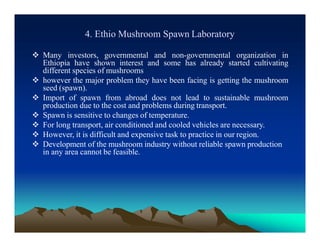
4. Ethio Mushroom Spawn Laboratory
 Many investors, governmental and non-governmental organization in
Ethiopia have shown interest and some has already started cultivating
different species of mushrooms
 however the major problem they have been facing is getting the mushroom
seed (spawn).
 Import of spawn from abroad does not lead to sustainable mushroom
production due to the cost and problems during transport.
 Spawn is sensitive to changes of temperature.
 For long transport, air conditioned and cooled vehicles are necessary.
 However, it is difficult and expensive task to practice in our region.
 Development of the mushroom industry without reliable spawn production
in any area cannot be feasible.
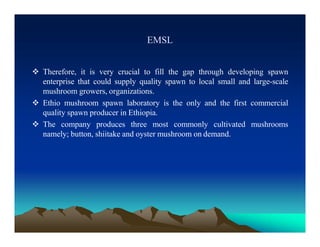
EMSL
 Therefore, it is very crucial to fill the gap through developing spawn
enterprise that could supply quality spawn to local small and large-scale
mushroom growers, organizations.
 Ethio mushroom spawn laboratory is the only and the first commercial
quality spawn producer in Ethiopia.
 The company produces three most commonly cultivated mushrooms
namely; button, shiitake and oyster mushroom on demand.
Objective of the company
 Produces quality spawn of the three species
 It gives training on mushroom spawn making and cultivation method for
interested organizations and individuals.
 Undertaking mini research on spawn making and alternate spawn substrates
and improving the method
 Increasing mushroom species of cultivation in the future
 In general the establishment of this company is basic for value chain
development for the mushroom industry to flourish in our country.
Conclusion
 The main problem that hinders the mushroom industry to flourish in the
country as well as in Africa is the unavailability of mushroom spawn.
 Among the many causes, one is the lack of technical knowledge on how to
prepare the mushroom spawn since it requires exacting laboratory
procedures
 As a result there should be a mushroom center could
undergo research,
giving training
arranging workshops and
giving technical supports for the growers.
 There should be diversified commercial spawn suppliers that could supply
quality spawn to the growers.
 Asa result the mushroom industry will bloom up inEthiopia.
Thank you

Spawn Production for the Mushroom Industry.pptx

  • 1.
    SPAWN PRODUCTON FORTHE MUSHROOM INDUSTRY: THE BASIC FACILITY FOR VALUE CHAIN DEVELOPMENT OF MUSHROOMS By: Sara Mitiku
  • 2.
    1.INTRODUCTION  Mushrooms arefungal form of life.  They are rich in protein compared with other vegetables.  Its production is one of the most promising and highly desirable activities in developing countries to reduce protein malnutrition.  Mushroom cultivation has two main phases, spawn production and fruiting body production.  The mushroom seed is generally referred to as spawn.  Spawn is the mycelium of the mushroom with its substrate, which is the propagating material, used for initiating mushroom production.
  • 3.
    Introduction cont…  Itsproduction is a precise laboratory procedure where maintaining sanitation and purity of the spawn are critical.  Cereal grains and sawdust are common materials used for spawn making.  The most commonly utilized grain types are rye, wheat, sorghum and millet.  The choice of the grain is made after considering the prevailing price, easy supply, grain size and the desired variety to be grown.  Small sized grains like teff couldn't be used for spawn making b/c of sticking nature of the grain during soaking and sterilization.  Grain spawn is made of cooked or soaked grains with small amount of gypsum.
  • 4.
    2. METHOD OFSPAWN PREPARATION  There are three steps involved in spawn production:  Raising pure culture,  Preparation of mother spawn and  Multiplication of spawn.  Preparation of agar media is basic for mushroom cultures.  There are several types of agar media such as potatoes, malt extract and corn meal.  Potato dextrose agar and malt extract agar are available in market and could be prepared according to instruction given by the manufacturer.
  • 5.
    2.1. Media preparation PotatoDextrose Agar  We can prepare our own medium from fresh potato:  Wash and slice about 200 g of potato and place in 1 liter of boiling water in a flask and boil for 15 minutes.  Filter the potato broth using a piece of cloth.  Add 20 g of glucose or sucrose and 20 g of agar and adjust the volume to one liter by adding water  Sterilize the agar mixture and petridishes or test tubes in the autoclave  Pour the agar carefully in to petridish (20ml) and test tubes (10ml) in the hood  Keep the test tubes in a slant position so that the agar slants are solidified  Next day use the agar slants for pure culture or store in refrigerator. Fig 1. Agar medium in plates and slants
  • 6.
    2.2. Pure culturepreparation  There are two ways of raising pure culture a. Tissue culture b. Spore culture
  • 7.
    a. Tissue Culture Well grown young mushroom is selected  Clean the mushroom from any debris with alcohol  Split the mushroom lengthwise with knife and avoid any contact of the knife with the area we want to take tissue.  Sterilize the scalpel on aflame and take a small piece of mushroom tissue using forceps.  Inoculate the mushroom tissue to PDA or MEA media slants or plates aseptically  In a few day hyphea will grow out from the tissue and covers the entire surface and  The culture becomes ready for further multiplication. Fig 2.Making mushroom cultures on to plates and slants
  • 8.
    b. Spore culture Well developed fruiting body are selected and cut the stalk of the mushroom  Laid the gills down on a clean typing paper, glass or similar surface  After 12 hours most mushrooms have released thousands of spores.  The spores are collected by spore map techniques.  Pick up the spores by the inoculating loop  Inoculate the spore to the PDA or MEA slants as in tissue culture under aseptic condition and incubate at room temperature.  The spores germinate and will form mycelium in a few days. o The tissue culture method is the most reliable and recommended for the mushroom culture to grow b/c o In case spore culture method, more than one spore is required to get cultures which could form the mushroom o In the process of spore inoculation contaminant bacteria and molds may grow together making it difficult to get pure culture of the mushroom.
  • 9.
    2.3. Grain SpawnPreparation  Select clean sorghum, wash the grains and soak overnight  Next day remove the soaked grains and wash gently and drain the water on a sieve  Check the moisture content by hand; it should not be too dry or too wet  Mix the grain with 10% wheat bran and 2% calcium sulfate and calcium carbonate mixtures  Fill the supplemented grain in sterilizable bottles or flasks and loosely cover the mouth of bottles.  Then sterilize the bottles in an autoclave at 121ºC for about 15-30 minutes or for one hour in pressure cooker.  Take out the bottles from the autoclave and let it to cool for a day.
  • 10.
    2.4. Preparation ofmother spawn  After sterilization and cooling, inoculate the bottles with pure culture by taking a piece of agar with the mycelium.  Mix the culture and the grains by shaking to uniformly distribute the mycelium.  Write the name of the species and the day of inoculation.  Incubate the inoculated bottles in incubator or at any clean table that maintains 25ºC.  After 15-20 days the grain is fully covered with the mycelium. Fig 3.Technique of spawn making
  • 11.
    2.5. Multiplication ofmother spawn  Select well grown mother spawn  Open the mother spawn bottles on a flame and stir the spawn using sterilized forceps to get the individual grains.  Transfer few grains with the mycelium in to sterilized substrate bottles under aseptic conditions and cover the mouth.  Mix the grains by shaking to uniformly distribute the mycelium.  Incubate the inoculated bottles at 25ºC till all the grains is covered with the mycelium.  Inspect the bottles regularly and discard contaminated ones.  Within 10-15 days of inoculation mycelial growth covers the entire substrate and the spawn is ready for use Fig 4.Oyster mushroom spawn ready for spawning
  • 12.
    3. Research findings In a study to evaluate grain substrates for spawn production, four grain (teff, wheat, sorghum and maize) types were tested for Moisture content Volume per unit weight Carbon and nitrogen content Days to complete mycelium growth on grain substrate.
  • 13.
    Table 1. Spawngrain characteristics Grain characteristics Grain %N C:N  The result shows that large sized grains like maize, wheat and sorghum have good moisture content which is critical for mushroom spawn making. Moistu V olum %C re e con (l/g). tent  This could be due to d/t grains have d/t water imbibitions capacity  Volume per unit weight is an indication of available surface area for growth of mycelium. m  The variation in grains carbon and nitrogen content was due to the nature of their composition. Teff 39.28 75 34.46 1.26 27.35 Wheat 50.88 80 31.12 1.97 15.80 Sorghu 59.40 85 37.10 1.37 27.08 Maize 47.28 80 35.94 1.61 22.32
  • 14.
    Table 2. Daysto complete mycelium cover on the grain substrates Spawn substrate Maize Sorghum Teff Wheat CV (%) L.S.D. (5%) Days to mycelium cover 12.67 16.33 20.67 15.00 10.3 3.12
  • 15.
     This couldbe due to  The larger grain size of maize, wheat and sorghum provides adequate gas exchange in b/n grains for the growing mycelium which ensures faster and early mycelium cover of grains.  In case of teff the grains are very small which tends to stick together during boiling and sterilization which restricts aeration for mycelium cover.  Due to the larger grain size there may be relatively larger reserve food as compared to teff which provides adequate nutrition for the growth and development of mycelium.  Relatively higher nitrogen content in maize and wheat may also ensured adequate nitrogen supply to growing mycelium.  In general relatively larger sized grains like wheat sorghum and maize were more suitable for spawn production than very small grains like teff.
  • 16.
    4. Ethio MushroomSpawn Laboratory  Many investors, governmental and non-governmental organization in Ethiopia have shown interest and some has already started cultivating different species of mushrooms  however the major problem they have been facing is getting the mushroom seed (spawn).  Import of spawn from abroad does not lead to sustainable mushroom production due to the cost and problems during transport.  Spawn is sensitive to changes of temperature.  For long transport, air conditioned and cooled vehicles are necessary.  However, it is difficult and expensive task to practice in our region.  Development of the mushroom industry without reliable spawn production in any area cannot be feasible.
  • 17.
    EMSL  Therefore, itis very crucial to fill the gap through developing spawn enterprise that could supply quality spawn to local small and large-scale mushroom growers, organizations.  Ethio mushroom spawn laboratory is the only and the first commercial quality spawn producer in Ethiopia.  The company produces three most commonly cultivated mushrooms namely; button, shiitake and oyster mushroom on demand.
  • 18.
    Objective of thecompany  Produces quality spawn of the three species  It gives training on mushroom spawn making and cultivation method for interested organizations and individuals.  Undertaking mini research on spawn making and alternate spawn substrates and improving the method  Increasing mushroom species of cultivation in the future  In general the establishment of this company is basic for value chain development for the mushroom industry to flourish in our country.
  • 19.
    Conclusion  The mainproblem that hinders the mushroom industry to flourish in the country as well as in Africa is the unavailability of mushroom spawn.  Among the many causes, one is the lack of technical knowledge on how to prepare the mushroom spawn since it requires exacting laboratory procedures  As a result there should be a mushroom center could undergo research, giving training arranging workshops and giving technical supports for the growers.  There should be diversified commercial spawn suppliers that could supply quality spawn to the growers.  Asa result the mushroom industry will bloom up inEthiopia.
  • 20.