GI2011-X-border-SDI/GDI-Symposium
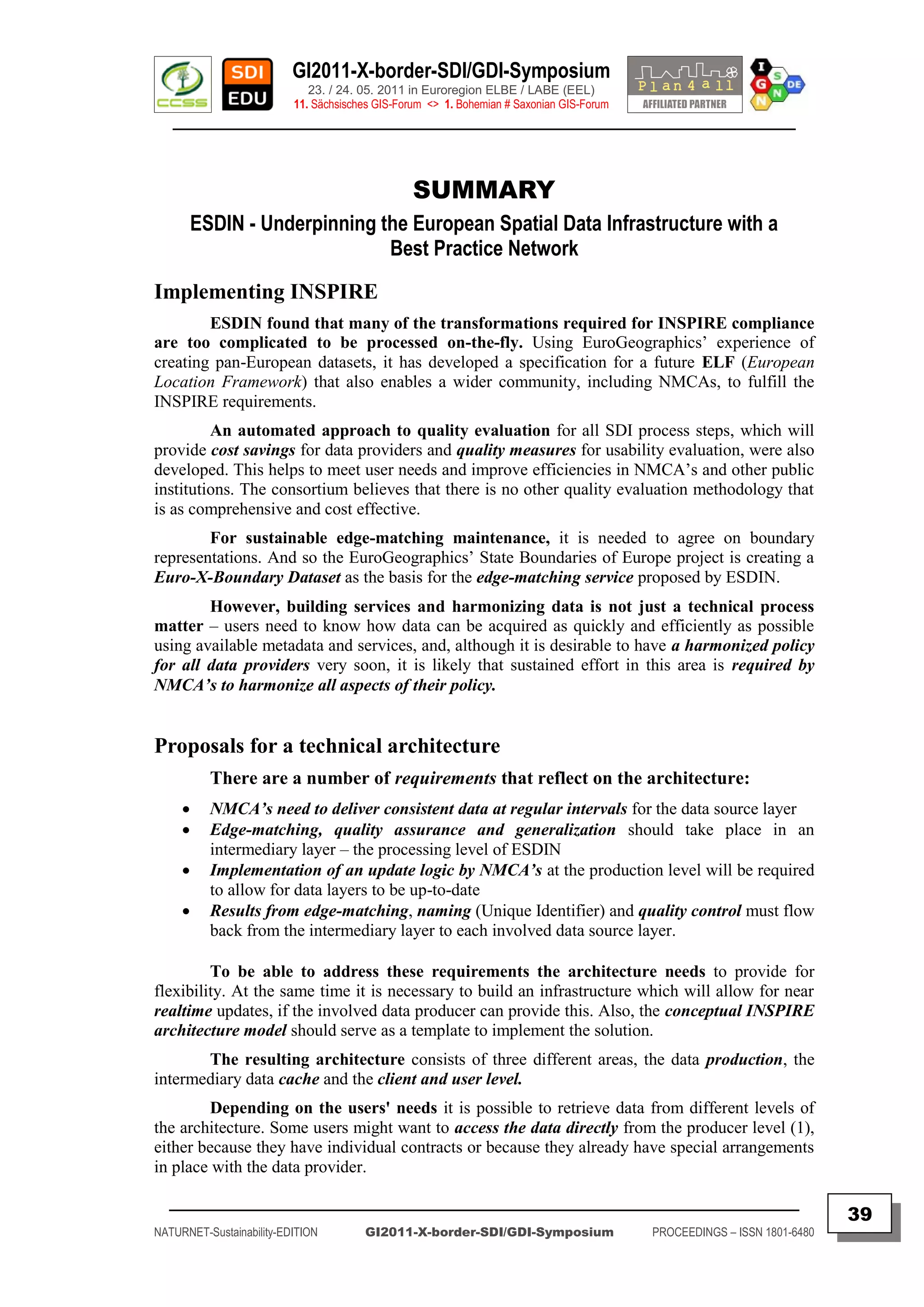
                             23. / 24. 05. 2011 in Euroregion ELBE / LABE (EEL)
                          11. Sächsisches GIS-Forum <> 1. Bohemian # Saxonian GIS-Forum
   ________________________________________________________________________________________


                                      Inter-Regional
          GI2011-X-BORDER-SDI / GDI

     SYMPOSIUM


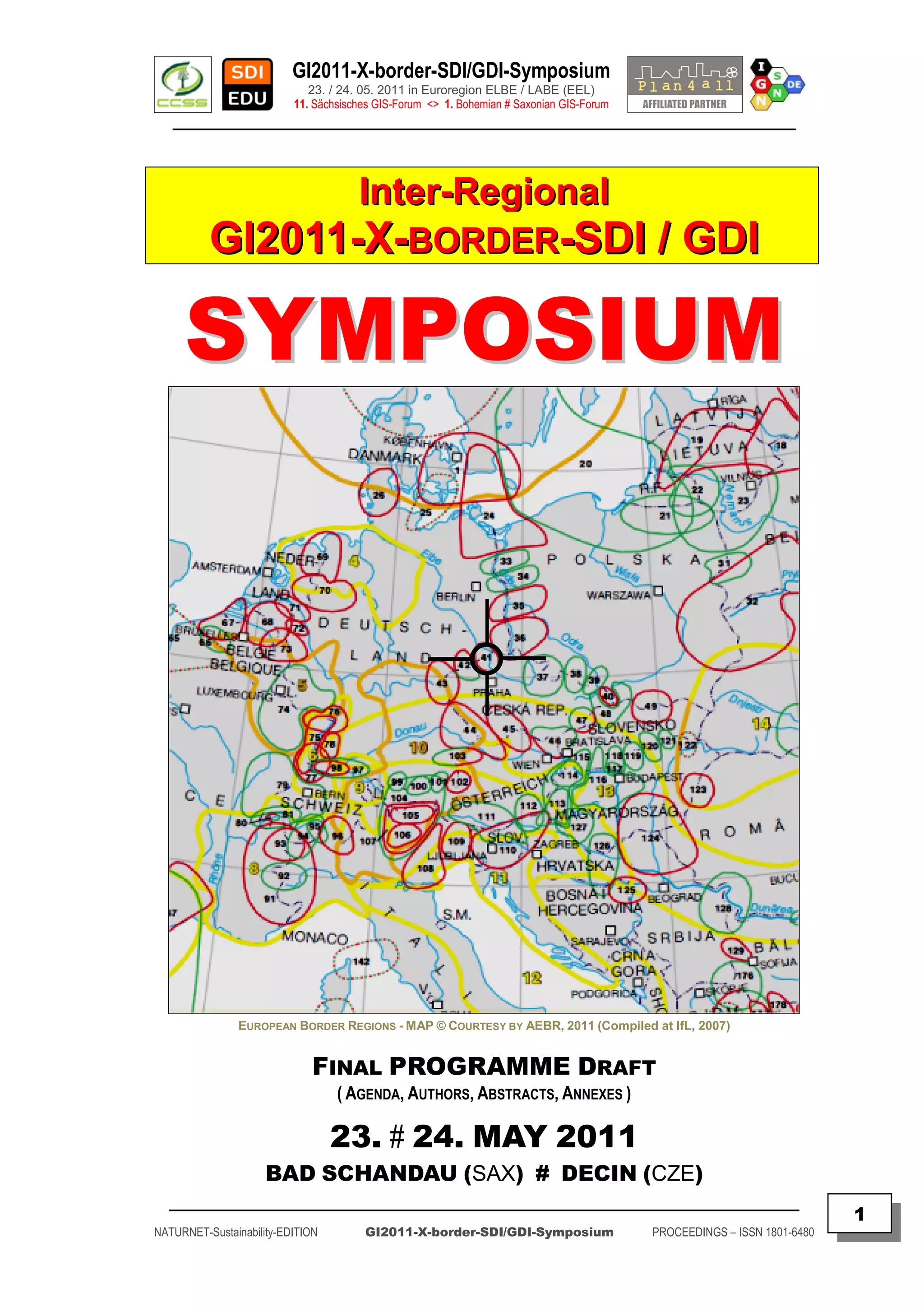
               EUROPEAN BORDER REGIONS - MAP © COURTESY BY AEBR, 2011 (Compiled at IfL, 2007)


                             FINAL PROGRAMME DRAFT
                                  ( AGENDA, AUTHORS, ABSTRACTS, ANNEXES )

                                  23. # 24. MAY 2011
                     BAD SCHANDAU (SAX) # DECIN (CZE)
  _________________________________________________________________________________________
                                                                                                                         1
NATURNET-Sustainability-EDITION        GI2011-X-border-SDI/GDI-Symposium                  PROCEEDINGS – ISSN 1801-6480
GI2011-X-border-SDI/GDI-Symposium
                                  23. / 24. 05. 2011 in Euroregion ELBE / LABE (EEL)
                               11. Sächsisches GIS-Forum <> 1. Bohemian # Saxonian GIS-Forum
    ________________________________________________________________________________________
                  This event has been supported by European Commission (EU-Programme “Inter-regional Collaboration”) in Free State of Saxony (2007-2013)


                                                    EUROPEAN BORDER REGIONS

      "GeoINSPIRE'd X-border-SDI/GDI for Digital Europe 2020"
                        SUSTAINABILITY OF INTER-REGIONAL COLLABORATION

                               The GeoINSPIRE'd Main FOCUS of GI2011
                   is about X-border-GI/GIS/GDI-Awareness, Innovation & Research on
                         X-PSI / X-INSPIRE – Data, Service and “Best Practices”
                                  of GEO-ENVIRO-SPATIO-Applications
                              towards INSPIRE'd Geoportals4Everybody !


PROGRAMME COMMITTEE:

     MEMBERS OF PROGRAMME & ORG COMMITTEE:
    Dr. J. BLACHOWSKI (PL), Dr. K. CHARVAT (CZ), C. CORBIN (UK), Dr. J. FURDIK (SK), Dr. K. JANECKA (CZ),
    Dr. P. KUBICEK (CZ), Dipl.Ing. W. MAYER (AT), Dipl.Ing.Tomas MILDORF(CZ), J.THURSTON (CA).
    Doz. Dr. F. HOFFMANN (DE), Prof. Dr. S. KLOSS (DE), Dr. K.-D. MICHAEL (DE), Prof. Dr. I.ROCH (DE).


     REFERENCE INFORMATION & INTERNET URL‟S:
    CCSS-Praha                        [ http://www.CCSS.cz ]
    IGN-Dresden                       [ http://GDI-SN.blogspot.com ]
    UWB-Plzen                         [ http://www.PLAN4ALL.eu ] + [ http://www.SDI-EDU.zcu.cz ]
    SOCIAL NETWORKS                   [ INSPIRE-FORUM ] + [ FACEBOOK ] + [ LINKEDIN ] + [ TWITTER ]


IMPRESSUM:
Herausgegeben von / Published by
     Founding Members of IGN e.V.:

     Doz. Dr. Frank HOFFMANN, CSc
     IGN – Vorstandsvorsitzender, Dresden
     INNOVATION. Grenzüberschreitendes Netzwerk e.V.

     Dr. Karel CHARVAT
     CCSS – President, Praha
     Czech Center for Science and Society

INNOVATION. Grenzüberschreitendes Netzwerk
( Gemeinnütziger e.V. / Non-profit Organization )
c/o IGN-Vorstand, Martin-Andersen-Nexö-Str. 4
D – 01217 DRESDEN / Saxony / Germany

    SKYPE:             [ fh_ign ]
    INTERNET:          [ http://www.IGN-SN.de ]
    WEBLOG:            [ http://www.GDI-SN.de ]
    EMAIL:             [ info@GDI-SN.de | Vorstand@IGN-SN.de ]
    TEL/FAX:           [ +49-351-403.2729 # FAX: +49-351-401.4260 ]

Copyright © 2011 – CCSS-Praha & IGN-Dresden & UWB-Plzen – All rights reserved.

    _________________________________________________________________________________________
                                                                                                                                                                  2
NATURNET-Sustainability-EDITION                    GI2011-X-border-SDI/GDI-Symposium                                               PROCEEDINGS – ISSN 1801-6480
GI2011-X-border-SDI/GDI-Symposium
                             23. / 24. 05. 2011 in Euroregion ELBE / LABE (EEL)
                          11. Sächsisches GIS-Forum <> 1. Bohemian # Saxonian GIS-Forum
   ________________________________________________________________________________________


      Willkommen in der grenzüberschreitenden Euroregion Elbe # Labe
          Welcome in the cross-border Euroregion Elbe # Labe (EEL)


                Inter-Regional
     GI2011-X-border-SDI/GDI-Symposium

                       PROGRAMME
                                                              &

                   PROCEEDINGS
                                   Bad Schandau
                                    23. Mai 2011


                                              Decin
                                           24. Mai 2011


                                            IMPRIMATUR TO PRINT
                                                       20. Mai 2011

                          Copyright © 2011 – CCSS-Praha & IGN-Dresden & UWB-Plzen – All rights reserved.


  _________________________________________________________________________________________
                                                                                                                                  3
NATURNET-Sustainability-EDITION         GI2011-X-border-SDI/GDI-Symposium                          PROCEEDINGS – ISSN 1801-6480
GI2011-X-border-SDI/GDI-Symposium
                             23. / 24. 05. 2011 in Euroregion ELBE / LABE (EEL)
                          11. Sächsisches GIS-Forum <> 1. Bohemian # Saxonian GIS-Forum
   ________________________________________________________________________________________

GI2011 – CROSS-BORDER – SDI/GDI – SYMPOSIUM FOR
  EUROPEAN BORDER REGIONS – 23./24. MAY 2011
  TOWARDS GEOINSPIRE'D X-BORDER-SDI/GDI FOR EUROPEAN BORDER REGIONS IN
                          DIGITAL EUROPE 2020 !

          IGN, CCSS and UniWB are organizing this professional event, following their long-time education and
research activities to achieve better SDI/GDI awareness and closer cooperation in EUROPEAN BORDER REGIONS to
adapt to the EU Strategy of “Europe 2020” and the Action Plan “Digital Europe 2020”. The EU Directives on re-using
of Public Sector Information (PSI) and development of Infrastructures for Spatial Information in Europe (INSPIRE)
are strategic opportunities and challenges for more than 200 EUROPEAN BORDER REGIONS.

           Therefore, you are welcome to participate at this GI2011-X-border-SDI/GDI Symposium to be held as
the “11th Sächsisches GIS-Forum” at May 23rd in BAD SCHANDAU (SAX) & “1st Bohemia # Saxonia GIS-Forum” at May
24th in DECIN (CZE). Both these GI2011 events should inform on the progress of EU-Directives PSI for re-using public
sector information, as well as on INSPIRE about interoperability of X-border Data, Services & Applications, especially
in EUROPEAN BORDER REGIONS.

         The GI2011-X-border-SDI/GDI Symposium is presenting existing and still yet developing cross-border
SDI/GDI Geoportal solutions to demonstrate the transformation, harmonization and integration processes of
independent WebGIS-Portals into more complex SDI/GDI Frameworks. The importance of the “borderless”
OpenStreetMap (OSM) will be highlighted too !

         Examples of the very few existing cross-border Geoportals should have been presented like DP-PLIS,
REGIOGDI-BE/BB, REGIOGDI-MRH, X-GDI-RONDUIT, REGIOGDI-RKN, GIS-GRANDEREGION, SIGRS/GISOR,
DACH+, CENTROPE-Map/Statistics, REGIOCxD, as well as the less known developing SDI„s from other EUROPEAN
BORDER REGIONS now focusing on INSPIRE principles, but unfortunately, not all of these border regions have used
the opportunity to present lessons learned and strategies developed. Nevertheless, the presentation of National
Czech INSPIRE Geoportal will be one of the highlights of the GI2011 Symposium !

          The Goal of GI2011 Symposium is to share information, knowledge, and expertise, to learn from SDI
and OSM „best practices“, as well as to exchange and discuss European awareness and research projects
(NATURNET, SDI-EDU, HUMBOLDT) and other European networks (GEOPORTAL4EVERYBODY, PLAN4ALL, etc.)
introducing innovative geomatics technologies, demonstrating cost-benefit approaches, as well as discussing the
frameworks for PSI, GI & SDI policy, organization and technologies behind the INSPIRE process.

          The GI2011-X-border-SDI/GDI-Symposium has its focus as well on actual EU research projects and “best
practice” networks like ESDIN (EuroGeographics et al.), GEOPORTAL4EVERYBODY (CCSS & UNSDI.cz), PLAN4ALL
(UWB & CCSS), and SDI-EDU (UWB) to share the experience and advanced knowledge directly with participants
registered from local and regional organizations in EUROPEAN BORDER REGIONS. The GI2011-Participants will
share a „Round Table Discussion Session“ on PSI & INSPIRE challenges important for border regions.

            The Locations of GI2011-Symposium are situated in the Center of the Euroregion „Elbe # Labe“ (EEL),
at the first day to be held in Bad Schandau (SAX), and at the second day in Decin (CZE), both located in the Cross-
border National Park Region of "Bohemia # Saxonia Switzerland". The first day ends with an INVITATION to a
SOCIAL EVENING taking place as “Get together @ Lounge Room” in Restaurant of “Hotel Posta” at Decin City Center.

         An Exhibition at Castle Decin is informing about [ Eger border treaty between Bohemia and Saxonia ]
more than 550 years ago signed in Eger (Cheb) between Bohemia and Saxonia in year 1459.

          The [ Interactive Historical Map ] was developed as a X-border-Exhibition-Project [ „GRENZRÄUME“ ]
in the Euroregion EEL which is open for visiting at both [ Castle Weesenstein (SAX) ] and [ Castle Decin (CZE) ].

                                  Dresden & Praha and Plzen: April 23rd , 2011
                              IGN e.V. (Dresden) # CCSS (Praha) & UniWB (Plzen)

  _________________________________________________________________________________________
                                                                                                                         4
NATURNET-Sustainability-EDITION        GI2011-X-border-SDI/GDI-Symposium                  PROCEEDINGS – ISSN 1801-6480
GI2011-X-border-SDI/GDI-Symposium
                                  23. / 24. 05. 2011 in Euroregion ELBE / LABE (EEL)
                               11. Sächsisches GIS-Forum <> 1. Bohemian # Saxonian GIS-Forum
   ________________________________________________________________________________________

                  GI2011 – RAHMENPROGRAMM - AGENDA
                  Interactive Agenda: Bad Schandau (23.05.2011) < ELBE x LABE > Decin (23./24.05.2011)
  ( By STRG+Clicking on Hypertext a new website can be opened from where to get more logistics, travel and additional touristics information )

  DATE              TIME              GI2011-X-border-Symposium-AGENDA                                                LOCATION
 17./18.05.        Private !        [ German INTERGRAPH-GEO-Forum ]                                            [ Dresden - ICC ]
 17.-22.05.        Private !        [ 41th International DIEXIELAND-JAZZ-Festival ]                            [ Dresden - City ]
                   19:00-           Arrival of Keynote Speakers & Accomodation /                               DDH-Hotel-Pension /
   22.05.
                     -22:00           Invitation by IGN & CCSS for Keynoters+Invited Guests                       BOW-Panorama-Center
                                    Arrival & Registration of Participants (for travel & logistic
   23.05.            09:00                                                                                     [ Bad Schandau ] (SN)
                                    info by car, train, ship see [ http://GDI-SN.blogspot.com ]
                     10:00          OPENING & [ Multivision Show in NPC ]                                      [ Bad Schandau - MAP ]
                     11:00          X-SDI/GDI-Session 1 (OPENING, MultivisionShow, X-Policy)                   [ Bad Schandau - NPZ ]
                     12:00          Lunch-Break                                                                [ Bad Schandau - Wetter ]
                                    X-SDI/GDI-Session 2 (PSI/INSPIRE & Awareness in EBR)
                     13:00                                                                                     [ Bad Schandau-Google ]
                                    Cross-border GEO+ENVIRO+SPATIO Data Sharing
                     14:30          Coffee break                                                               [ Bad Schandau-Webcam ]
                     15:00          X-SDI/GDI-Session 3 (Status of X-GI/GIS/GDI across EBR)                    [ Bad Schandau-NPark ]
                     16:00          X-SDI/GDI-RT-Session 4 (G4E - RoundTableDiscussion)                        [ Elbe/Labe-Staustufe ]
                     17:00          X-Relocating to Decin & Relaxing at Hotel accommodations                   [ Decin Hotels ] (CZ)
                   19:00-
                                    [ Social “Get together” Event Decin @Castle RoseGarden ]                   [ Decin-Castle|Burg] (EN|DE)
                     -22:00
   23.05.            22:00          End of Day 1                                                               [ Decin-Ubytovani ] (CZ)

   24.05.            08:00         Registration at Conference Location of Decin Castle                        DECIN (CZ)
                     09:00         OPENING & X-SDI/GDI Session 5 (X-GDI/SDI-Integration )                     [ DECIN-City ] (CZ)
                     10:30         Kaffeepause / Coffee-Break                                                 [ DECIN-Zamek ] (CZ)
                                   X-SDI/GDI-Session 6 (X-Mapping/ X-Statistics/ X-Planning)
                     11:00                                                                                    [ DECIN-Castle ] (EN)
                                   Cross-border Applications
                     12:00         Mittagspause / Lunch-Break                                                 [ DECIN-Burg ] (DE)
                                   X-SDI/GDI-Session 7 (Education, Innovation & Research)
                     13:00                                                                                    [ Travel-Tips ] (EN)
                                   GEOSS and GMES Applications
                     14:30         Kaffeepause / Coffee-Break                                                 [ DECIN-WebCAM ] (CZ)
                                   X-SDI/GDI-Session 8 (X-PSI/-INSPIRE-Challenges in EBR)
                     15:00                                                                                    [ DECIN-Video ] (EN)
                                   Brainstorming & Conclusions for EuropeanBorderRegions
                     16:00         Closing of the GI2011-X-border-Symposium                                   [ DECIN-Cruise-MAP ] (EN)

   24.05.            17:00         Post-Symposium Social Guided Tour for Invited Guests                       DECIN (CZ)

Important Deadlines for active Authors:
30.03.2011         Registration FORM for passive participants will be available for registration and social events !
31.03.2011         Information for Keynoters + Authors & preliminary GI2011-X-border-Symposium Agenda DRAFT
25.04.2011         Summary delivery by Authors ( Summary template.doc to be used/sent: [ Mailto:GI2011@CCSS.de ] )
15.05.2011         Präsentation delivery (PPT) by Authors ( to be sent: [ Mailto:GI2011@IGN-SN.de ] )
23.05.2011         Poster delivery by Authors at Registration DESK for Exhibition 24.05. at DECIN Conference Location
*) Präsentationen erfolgen sich ergänzend in Deutsch und Englisch – Example: Abstract (RU), Summary (EN), PPT (DE), Presentation (EN)
**) Sprache: Es erfolgt keine simultane Übersetzung der Vorträge / Language: There will be no simultanous translation of presentations
***) Keynotes: ca. 20-30 min (incl. 5 min Q & A) / Presentations: ca. 10-15 min (incl. 5 min Q & A) as fixed in the Final Programme
****) Internetzugang: vorhanden / WiFi Connectivity as well multimedia tools and devices will be provided

   _________________________________________________________________________________________
                                                                                                                                                 5
NATURNET-Sustainability-EDITION              GI2011-X-border-SDI/GDI-Symposium                               PROCEEDINGS – ISSN 1801-6480
GI2011-X-border-SDI/GDI-Symposium
                               23. / 24. 05. 2011 in Euroregion ELBE / LABE (EEL)
                            11. Sächsisches GIS-Forum <> 1. Bohemian # Saxonian GIS-Forum
   ________________________________________________________________________________________


               Final Programme 23. Mai 2011
                                       @ NPZ – Bad Schandau (SAX)
             LOCATION ADDRESS: National-Park-Zentrum, Dresdner Str. 2b, D – 01814 BAD SCHANDAU
                                   ( Use car parking lots at nearby Elbe river, 100 m from NPZ )
09:00
                    Anmeldung im Nationalparkzentrum Bad Schandau (SAX) /                                                Opening
        |
            10:00                / Registration in the National Park Center of Bad Schandau (SAX)                       Moderators
                    CHARVAT (CZ) / HOFFMANN (DE): Opening & Welcome Addresses by CCSS, IGN and by
10:00                                                                                                                    Dr. Michael
                    Local / Regional Authorities of Bad Schandau / Euroregion “Elbe#Labe”
                    NATIONALPARK-ZENTRUM-Multivision:
    10:15
                    Film: Natur protection in Cross-border “Bohemia # Saxonia Switzerland“ (15 min)
                    KEYNOTE by RAMIREZ / AEBR – Generalsekretär (ES):
    10:30
                    Grenzüberschreitende Regionen in Europa – Eine Bestandsaufnahme
                    KNIPPSCHILD (DE):
11:00                                                                                                                   Dr. Hoffmann
                    Nothing – But a waste of time and money ? – Specifics of cross-border cooperation in the …
                    KEYNOTE by THEVENET / EUROINSTITUT – Stellv. Direktorin (FR):
    11:20
                    Characteristics and Challenges for successful cross-border cooperation
                    BENDEL (DE):
    11:50
                    Grenzüberschreitende Verflechtungsräume und Analyse von Fachdaten zur Beschreibung …
12:00
        |                                            Mittagspause / Lunch break
            13:00
                    Einführung POSTER-Kurzporträts / Introduction to POSTER-Descriptions by MAYER – PROGIS (AT)
13:00               + BLACHOWSKI & WBU-Team + FURDIK & STUBA-Teams (SK) + GEDRANGE & IOER-Team (DE)
                                                                                                                          Posters
                    KEYNOTE by MAYER (AT):
    13:15                                                                                                                Dr. Charvat
                    GIS-Software across AGRI applications and integration of BING-Maps
                    RAITIS / DZERVE / ALBERTS (LV):                                                                       Webcast
    13:45
                    The “BIZBIZ”-Tool as an online platform for cross-border education in the SDI-EDU project
                    JANECKA (CZ) & SDI-EDU-Team:
    14:00
                    LEONARDO „SDI-EDU-Project“ as a framework for vocational education in EU BorderRegions
                    KLIMENT / OGGIONI (IT):
    14:15                                                                                                                 Webcast
                    Bringing Eco-Biological Metadata to the INSPIRE metainformation world
14:30
                                                     Kaffeepause / Coffee break
            15:00
                    KEYNOTE by CHARVAT (CZ):                                                                              Dipl.Ing.
    15:00                                                                                                                 MAYER
                    The pyramide or spider network – towards social geospatial space in European Border Regions
                    KAFKA / CHARVAT (CZ):
    15:25                                                                                                                 Webcast
                    Sharing metadata across Europe – Experiences from ONEgeology and PLAN4ALL research …
                    CHARVAT / VOHNOUT (CZ):
    15:35
                    ENVIROGRIDS towards “Black Sea” catchment regions – cross-border SDI for water and …
                    ALBERTS & ICMS-Team (LV):
    15:50                                                                                                                 Webcast
                    Economic activity in cross-border marine habitats
                    ROEHNERT / GEDRANGE / NEUBERT (DE):
16:00
                    Cross-border data harmonization in practice – examplified by German ATKIS & Czech ZABAGED
                    HOFFMANN (DE):
    16:20
                    Challenges and opportunities for EBR – Analysis of X-border-Geoportals and GeoINSPIRE‟d …
                    FINAL Day 1: “Round Table”                                                                          Dr. Hoffmann
    16:40                                                                                                               & Dr. Charvat
                    Discussion & Summarizing
                                     RE-Locating from Bad Schandau (SAX) across the border
17:00
                                                  via Hrensko (CZE) to DECIN (CZE)
17:30                                        Accomodation and Relax time etc. at Hotels
                                                                                                                        Accomodation
        19:30           Location of Hotel “Ceska Koruna” [ Masarykovo náměstí 60, CZ - 40501 Děčín ]
    19:30                   Abendveranstaltung im „Lounge Room“ des Restaurants „Hotel zur Post“
      |                     Location @ [ Masarykovo náměstí 9, CZ - 40501 Děčín | Lounge Room ]                         Get_together
      |                    Social Get together at “Lounge room” of Restaurant “Hotel Posta” in Decin
    22:00                                                    End of Day 1
                                  *) Hinweis: Änderungen vorbehalten! / Comment: Changes may apply!


  _________________________________________________________________________________________
                                                                                                                                        6
NATURNET-Sustainability-EDITION           GI2011-X-border-SDI/GDI-Symposium                           PROCEEDINGS – ISSN 1801-6480
GI2011-X-border-SDI/GDI-Symposium
                               23. / 24. 05. 2011 in Euroregion ELBE / LABE (EEL)
                            11. Sächsisches GIS-Forum <> 1. Bohemian # Saxonian GIS-Forum
   ________________________________________________________________________________________


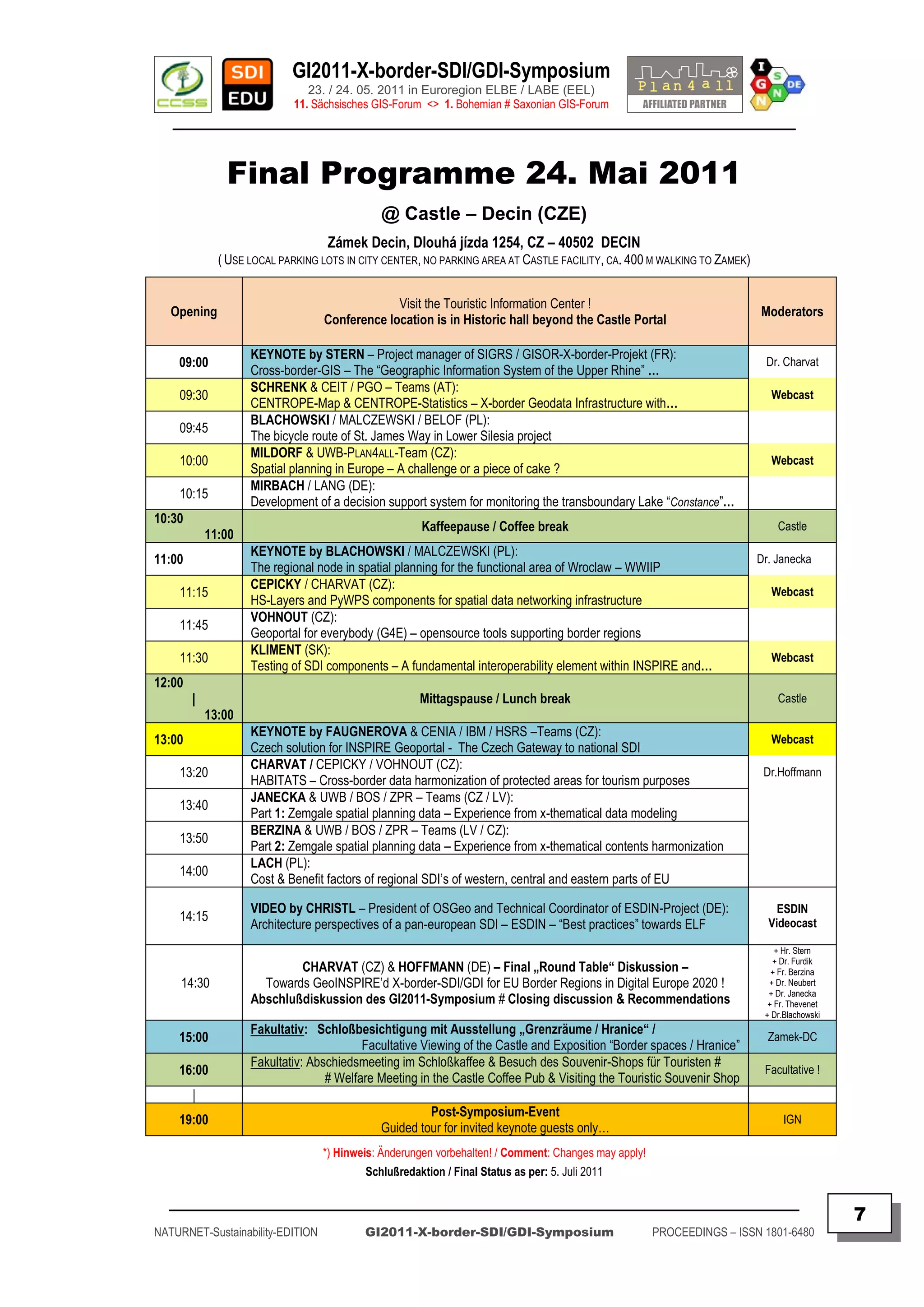
               Final Programme 24. Mai 2011
                                             @ Castle – Decin (CZE)
                                   Zámek Decin, Dlouhá jízda 1254, CZ – 40502 DECIN
              ( USE LOCAL PARKING LOTS IN CITY CENTER, NO PARKING AREA AT CASTLE FACILITY, CA. 400 M WALKING TO ZAMEK)


                                               Visit the Touristic Information Center !
   Opening                                                                                                               Moderators
                                  Conference location is in Historic hall beyond the Castle Portal

                    KEYNOTE by STERN – Project manager of SIGRS / GISOR-X-border-Projekt (FR):
    09:00                                                                                                                 Dr. Charvat
                    Cross-border-GIS – The “Geographic Information System of the Upper Rhine” …
                    SCHRENK & CEIT / PGO – Teams (AT):
    09:30                                                                                                                  Webcast
                    CENTROPE-Map & CENTROPE-Statistics – X-border Geodata Infrastructure with…
                    BLACHOWSKI / MALCZEWSKI / BELOF (PL):
    09:45
                    The bicycle route of St. James Way in Lower Silesia project
                    MILDORF & UWB-PLAN4ALL-Team (CZ):
    10:00                                                                                                                  Webcast
                    Spatial planning in Europe – A challenge or a piece of cake ?
                    MIRBACH / LANG (DE):
    10:15
                    Development of a decision support system for monitoring the transboundary Lake “Constance”…
10:30
                                                      Kaffeepause / Coffee break                                             Castle
            11:00
                    KEYNOTE by BLACHOWSKI / MALCZEWSKI (PL):
11:00                                                                                                                    Dr. Janecka
                    The regional node in spatial planning for the functional area of Wroclaw – WWIIP
                    CEPICKY / CHARVAT (CZ):
    11:15                                                                                                                  Webcast
                    HS-Layers and PyWPS components for spatial data networking infrastructure
                    VOHNOUT (CZ):
    11:45
                    Geoportal for everybody (G4E) – opensource tools supporting border regions
                    KLIMENT (SK):
    11:30                                                                                                                  Webcast
                    Testing of SDI components – A fundamental interoperability element within INSPIRE and…
12:00
        |                                            Mittagspause / Lunch break                                              Castle
            13:00
                    KEYNOTE by FAUGNEROVA & CENIA / IBM / HSRS –Teams (CZ):
13:00                                                                                                                      Webcast
                    Czech solution for INSPIRE Geoportal - The Czech Gateway to national SDI
                    CHARVAT / CEPICKY / VOHNOUT (CZ):
    13:20                                                                                                                 Dr.Hoffmann
                    HABITATS – Cross-border data harmonization of protected areas for tourism purposes
                    JANECKA & UWB / BOS / ZPR – Teams (CZ / LV):
    13:40
                    Part 1: Zemgale spatial planning data – Experience from x-thematical data modeling
                    BERZINA & UWB / BOS / ZPR – Teams (LV / CZ):
    13:50
                    Part 2: Zemgale spatial planning data – Experience from x-thematical contents harmonization
                    LACH (PL):
    14:00
                    Cost & Benefit factors of regional SDI‟s of western, central and eastern parts of EU

                    VIDEO by CHRISTL – President of OSGeo and Technical Coordinator of ESDIN-Project (DE):                   ESDIN
    14:15                                                                                                                  Videocast
                    Architecture perspectives of a pan-european SDI – ESDIN – “Best practices” towards ELF
                                                                                                                             + Hr. Stern
                                                                                                                            + Dr. Furdik
                            CHARVAT (CZ) & HOFFMANN (DE) – Final „Round Table“ Diskussion –                                 + Fr. Berzina
     14:30            Towards GeoINSPIRE‟d X-border-SDI/GDI for EU Border Regions in Digital Europe 2020 !                 + Dr. Neubert
                                                                                                                           + Dr. Janecka
                    Abschlußdiskussion des GI2011-Symposium # Closing discussion & Recommendations                         + Fr. Thevenet
                                                                                                                          + Dr.Blachowski
                    Fakultativ: Schloßbesichtigung mit Ausstellung „Grenzräume / Hranice“ /
    15:00                                                                                                                  Zamek-DC
                                          Facultative Viewing of the Castle and Exposition “Border spaces / Hranice”
                    Fakultativ: Abschiedsmeeting im Schloßkaffee & Besuch des Souvenir-Shops für Touristen #
    16:00                                                                                                                 Facultative !
                                   # Welfare Meeting in the Castle Coffee Pub & Visiting the Touristic Souvenir Shop
        |
                                                      Post-Symposium-Event
    19:00                                                                                                                      IGN
                                             Guided tour for invited keynote guests only…
                                  *) Hinweis: Änderungen vorbehalten! / Comment: Changes may apply!
                                          Schlußredaktion / Final Status as per: 5. Juli 2011

  _________________________________________________________________________________________
                                                                                                                                            7
NATURNET-Sustainability-EDITION           GI2011-X-border-SDI/GDI-Symposium                           PROCEEDINGS – ISSN 1801-6480
GI2011-X-border-SDI/GDI-Symposium
                               23. / 24. 05. 2011 in Euroregion ELBE / LABE (EEL)
                            11. Sächsisches GIS-Forum <> 1. Bohemian # Saxonian GIS-Forum
   ________________________________________________________________________________________


GI2011 – CROSS-BORDER – SDI/GDI – SYMPOSIUM FOR
  EUROPEAN BORDER REGIONS – 23./24. MAY 2011


  Nationalparkhaus Bad Schandau © NationalparkZentrum                 #       Decin - Děčínský (Castle) zámek nad Labem © Wikipedia.cz


     Castle Rose Garden / Zamek Rozárium Děčín – Copyright by Wikipedia (cc) [ http://creativecommons.org/licenses/by-sa/2.0/deed.cs ]


                        Castle / Zamek – Decin: Copyright by (cc) [ http://cs.wikipedia.org/wiki/Soubor:Decin001.jpg ]

  _________________________________________________________________________________________
                                                                                                                                           8
NATURNET-Sustainability-EDITION             GI2011-X-border-SDI/GDI-Symposium                               PROCEEDINGS – ISSN 1801-6480
GI2011-X-border-SDI/GDI-Symposium
                             23. / 24. 05. 2011 in Euroregion ELBE / LABE (EEL)
                          11. Sächsisches GIS-Forum <> 1. Bohemian # Saxonian GIS-Forum
   ________________________________________________________________________________________


                Inter-Regional
     GI2011-X-border-SDI/GDI-Symposium


  AUTORENLISTE
                                   Bad Schandau
                                    23. Mai 2011


                                              Decin
                                           24. Mai 2011


                                            IMPRIMATUR TO PRINT
                                                       20. Mai 2011


                          Copyright © 2011 – CCSS-Praha & IGN-Dresden & UWB-Plzen – All rights reserved.


  _________________________________________________________________________________________
                                                                                                                                  9
NATURNET-Sustainability-EDITION         GI2011-X-border-SDI/GDI-Symposium                          PROCEEDINGS – ISSN 1801-6480
GI2011-X-border-SDI/GDI-Symposium
                             23. / 24. 05. 2011 in Euroregion ELBE / LABE (EEL)
                          11. Sächsisches GIS-Forum <> 1. Bohemian # Saxonian GIS-Forum
   ________________________________________________________________________________________


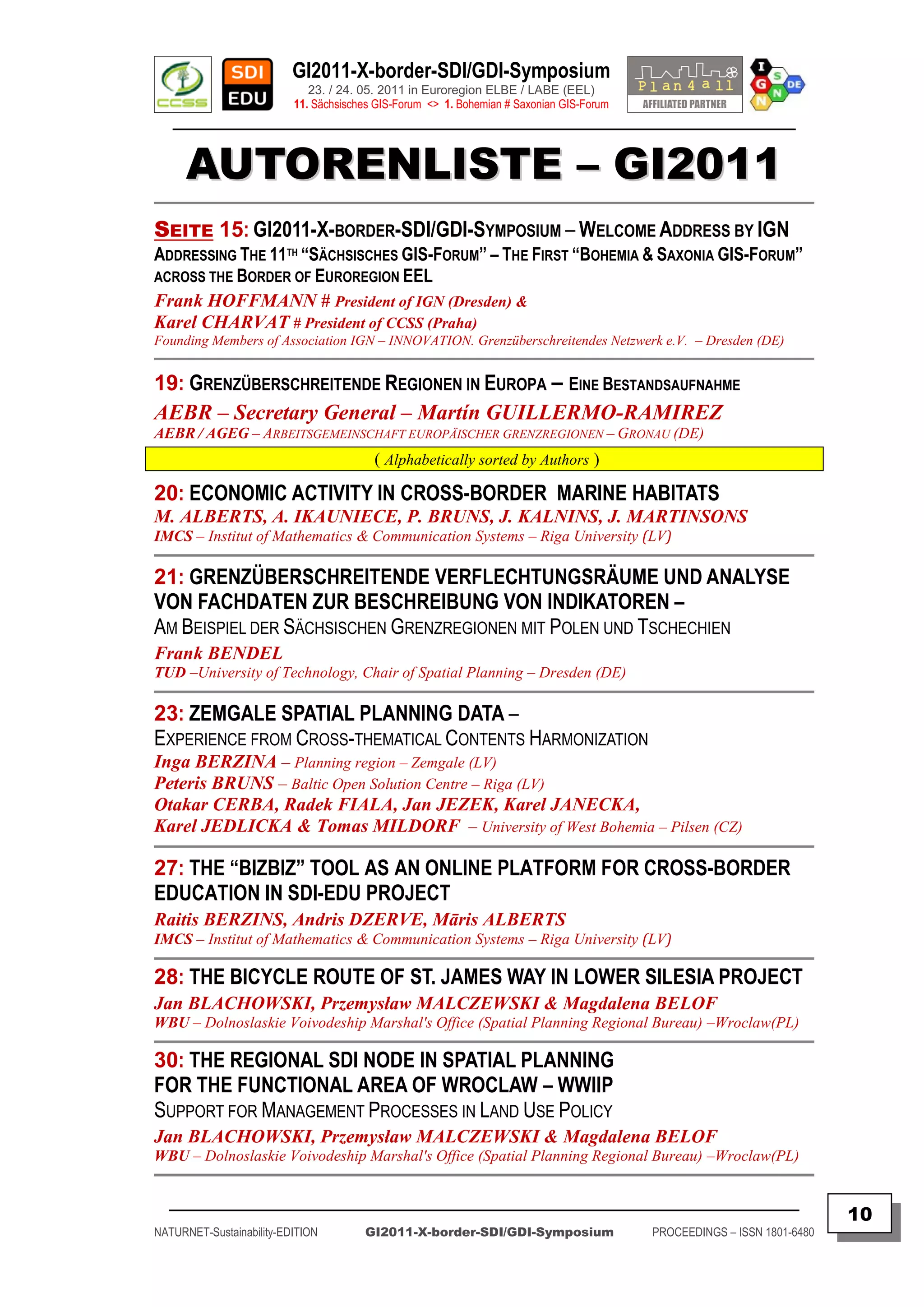
      AUTORENLISTE – GI2011
SEITE 15: GI2011-X-BORDER-SDI/GDI-SYMPOSIUM – WELCOME ADDRESS BY IGN
ADDRESSING THE 11TH “SÄCHSISCHES GIS-FORUM” – THE FIRST “BOHEMIA & SAXONIA GIS-FORUM”
ACROSS THE BORDER OF EUROREGION EEL
Frank HOFFMANN # President of IGN (Dresden) &
Karel CHARVAT # President of CCSS (Praha)
Founding Members of Association IGN – INNOVATION. Grenzüberschreitendes Netzwerk e.V. – Dresden (DE)


19: GRENZÜBERSCHREITENDE REGIONEN IN EUROPA – EINE BESTANDSAUFNAHME
AEBR – Secretary General – Martín GUILLERMO-RAMIREZ
AEBR / AGEG – ARBEITSGEMEINSCHAFT EUROPÄISCHER GRENZREGIONEN – GRONAU (DE)
                                         ( Alphabetically sorted by Authors )

20: ECONOMIC ACTIVITY IN CROSS-BORDER MARINE HABITATS
M. ALBERTS, A. IKAUNIECE, P. BRUNS, J. KALNINS, J. MARTINSONS
IMCS – Institut of Mathematics & Communication Systems – Riga University (LV)

21: GRENZÜBERSCHREITENDE VERFLECHTUNGSRÄUME UND ANALYSE
VON FACHDATEN ZUR BESCHREIBUNG VON INDIKATOREN –
AM BEISPIEL DER SÄCHSISCHEN GRENZREGIONEN MIT POLEN UND TSCHECHIEN
Frank BENDEL
TUD –University of Technology, Chair of Spatial Planning – Dresden (DE)

23: ZEMGALE SPATIAL PLANNING DATA –
EXPERIENCE FROM CROSS-THEMATICAL CONTENTS HARMONIZATION
Inga BERZINA – Planning region – Zemgale (LV)
Peteris BRUNS – Baltic Open Solution Centre – Riga (LV)
Otakar CERBA, Radek FIALA, Jan JEZEK, Karel JANECKA,
Karel JEDLICKA & Tomas MILDORF – University of West Bohemia – Pilsen (CZ)

27: THE “BIZBIZ” TOOL AS AN ONLINE PLATFORM FOR CROSS-BORDER
EDUCATION IN SDI-EDU PROJECT
Raitis BERZINS, Andris DZERVE, Māris ALBERTS
IMCS – Institut of Mathematics & Communication Systems – Riga University (LV)

28: THE BICYCLE ROUTE OF ST. JAMES WAY IN LOWER SILESIA PROJECT
Jan BLACHOWSKI, Przemysław MALCZEWSKI & Magdalena BELOF
WBU – Dolnoslaskie Voivodeship Marshal's Office (Spatial Planning Regional Bureau) –Wroclaw(PL)

30: THE REGIONAL SDI NODE IN SPATIAL PLANNING
FOR THE FUNCTIONAL AREA OF WROCLAW – WWIIP
SUPPORT FOR MANAGEMENT PROCESSES IN LAND USE POLICY
Jan BLACHOWSKI, Przemysław MALCZEWSKI & Magdalena BELOF
WBU – Dolnoslaskie Voivodeship Marshal's Office (Spatial Planning Regional Bureau) –Wroclaw(PL)


  _________________________________________________________________________________________
                                                                                                                         10
NATURNET-Sustainability-EDITION        GI2011-X-border-SDI/GDI-Symposium                  PROCEEDINGS – ISSN 1801-6480
GI2011-X-border-SDI/GDI-Symposium
                             23. / 24. 05. 2011 in Euroregion ELBE / LABE (EEL)
                          11. Sächsisches GIS-Forum <> 1. Bohemian # Saxonian GIS-Forum
   ________________________________________________________________________________________

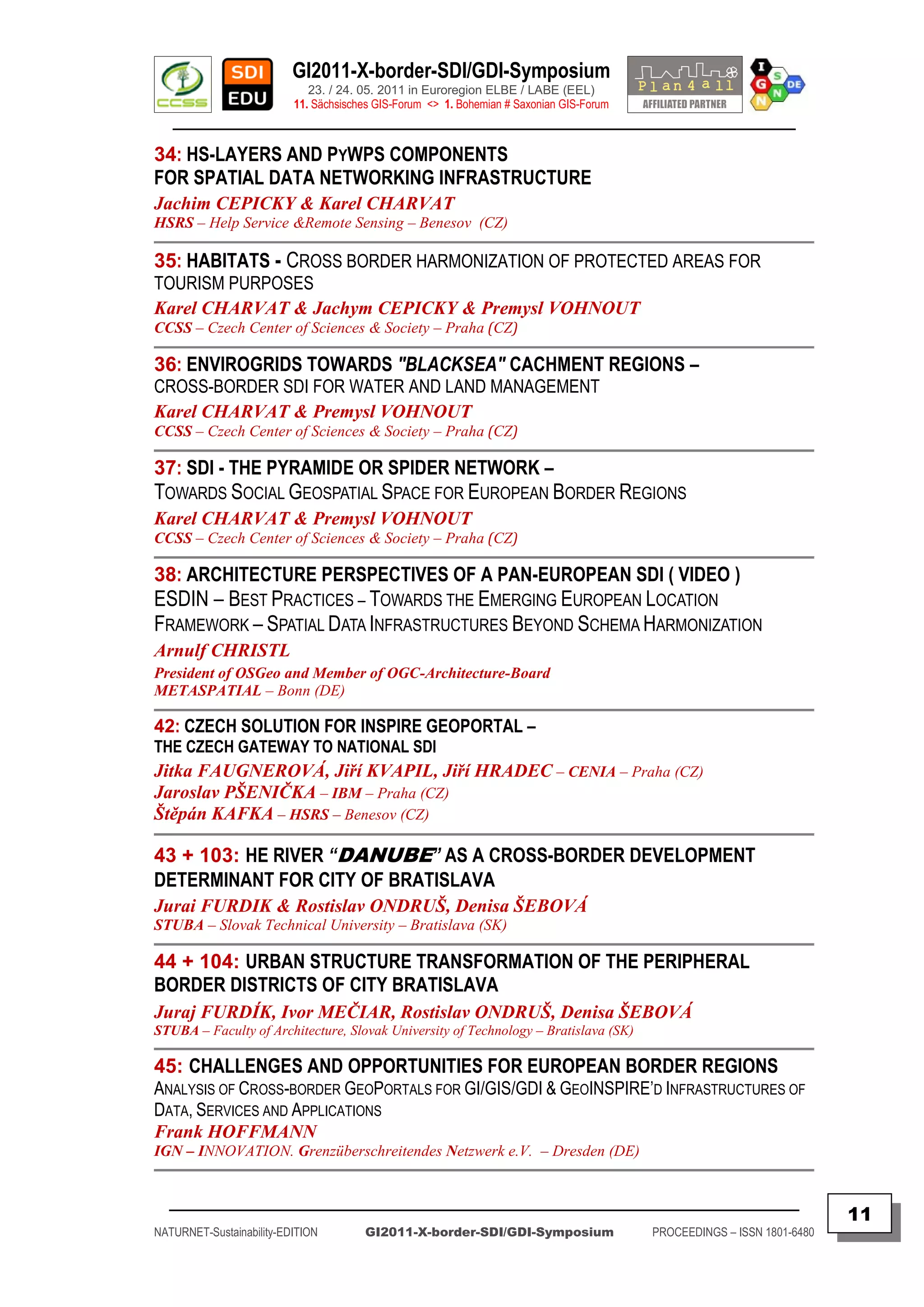
34: HS-LAYERS AND PYWPS COMPONENTS
FOR SPATIAL DATA NETWORKING INFRASTRUCTURE
Jachim CEPICKY & Karel CHARVAT
HSRS – Help Service &Remote Sensing – Benesov (CZ)

35: HABITATS - CROSS BORDER HARMONIZATION OF PROTECTED AREAS FOR
TOURISM PURPOSES
Karel CHARVAT & Jachym CEPICKY & Premysl VOHNOUT
CCSS – Czech Center of Sciences & Society – Praha (CZ)

36: ENVIROGRIDS TOWARDS "BLACKSEA" CACHMENT REGIONS –
CROSS-BORDER SDI FOR WATER AND LAND MANAGEMENT
Karel CHARVAT & Premysl VOHNOUT
CCSS – Czech Center of Sciences & Society – Praha (CZ)

37: SDI - THE PYRAMIDE OR SPIDER NETWORK –
TOWARDS SOCIAL GEOSPATIAL SPACE FOR EUROPEAN BORDER REGIONS
Karel CHARVAT & Premysl VOHNOUT
CCSS – Czech Center of Sciences & Society – Praha (CZ)

38: ARCHITECTURE PERSPECTIVES OF A PAN-EUROPEAN SDI ( VIDEO )
ESDIN – BEST PRACTICES – TOWARDS THE EMERGING EUROPEAN LOCATION
FRAMEWORK – SPATIAL DATA INFRASTRUCTURES BEYOND SCHEMA HARMONIZATION
Arnulf CHRISTL
President of OSGeo and Member of OGC-Architecture-Board
METASPATIAL – Bonn (DE)

42: CZECH SOLUTION FOR INSPIRE GEOPORTAL –
THE CZECH GATEWAY TO NATIONAL SDI
Jitka FAUGNEROVÁ, Jiří KVAPIL, Jiří HRADEC – CENIA – Praha (CZ)
Jaroslav PŠENIČKA – IBM – Praha (CZ)
Štěpán KAFKA – HSRS – Benesov (CZ)

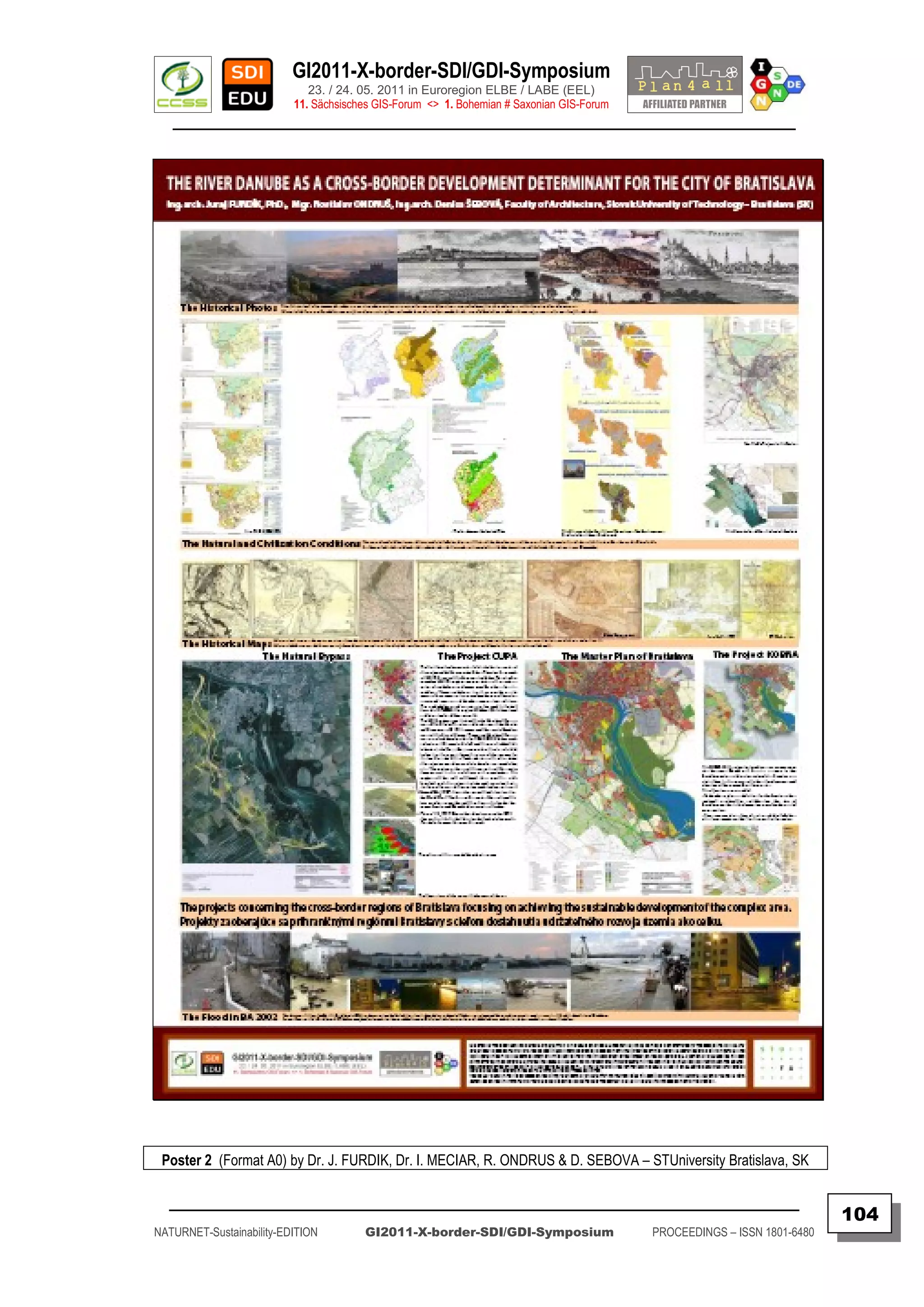
43 + 103: HE RIVER “DANUBE” AS A CROSS-BORDER DEVELOPMENT
DETERMINANT FOR CITY OF BRATISLAVA
Jurai FURDIK & Rostislav ONDRUŠ, Denisa ŠEBOVÁ
STUBA – Slovak Technical University – Bratislava (SK)

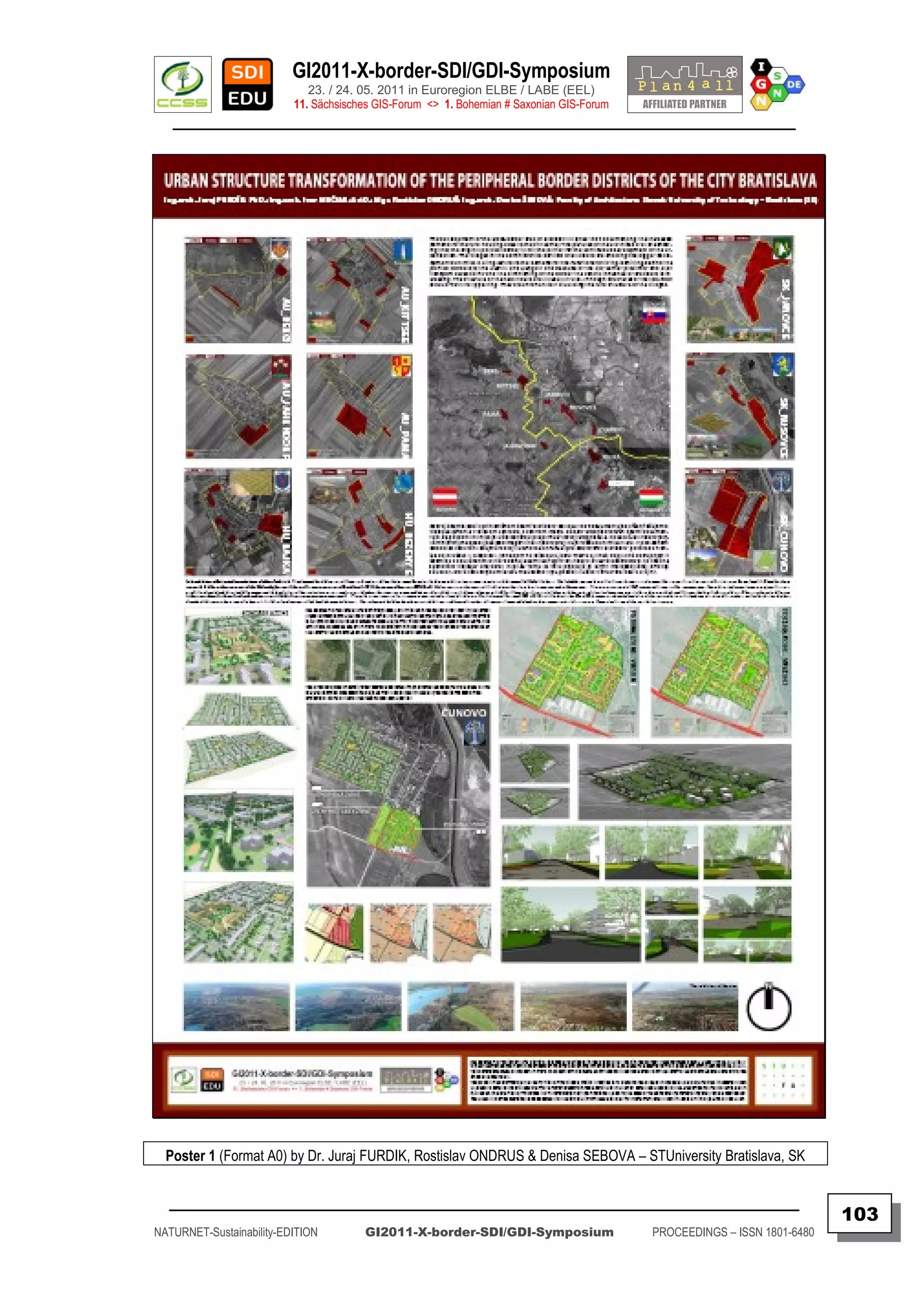
44 + 104: URBAN STRUCTURE TRANSFORMATION OF THE PERIPHERAL
BORDER DISTRICTS OF CITY BRATISLAVA
Juraj FURDÍK, Ivor MEČIAR, Rostislav ONDRUŠ, Denisa ŠEBOVÁ
STUBA – Faculty of Architecture, Slovak University of Technology – Bratislava (SK)

45: CHALLENGES AND OPPORTUNITIES FOR EUROPEAN BORDER REGIONS
ANALYSIS OF CROSS-BORDER GEOPORTALS FOR GI/GIS/GDI & GEOINSPIRE‟D INFRASTRUCTURES OF
DATA, SERVICES AND APPLICATIONS
Frank HOFFMANN
IGN – INNOVATION. Grenzüberschreitendes Netzwerk e.V. – Dresden (DE)


  _________________________________________________________________________________________
                                                                                                                         11
NATURNET-Sustainability-EDITION        GI2011-X-border-SDI/GDI-Symposium                  PROCEEDINGS – ISSN 1801-6480
GI2011-X-border-SDI/GDI-Symposium
                             23. / 24. 05. 2011 in Euroregion ELBE / LABE (EEL)
                          11. Sächsisches GIS-Forum <> 1. Bohemian # Saxonian GIS-Forum
   ________________________________________________________________________________________

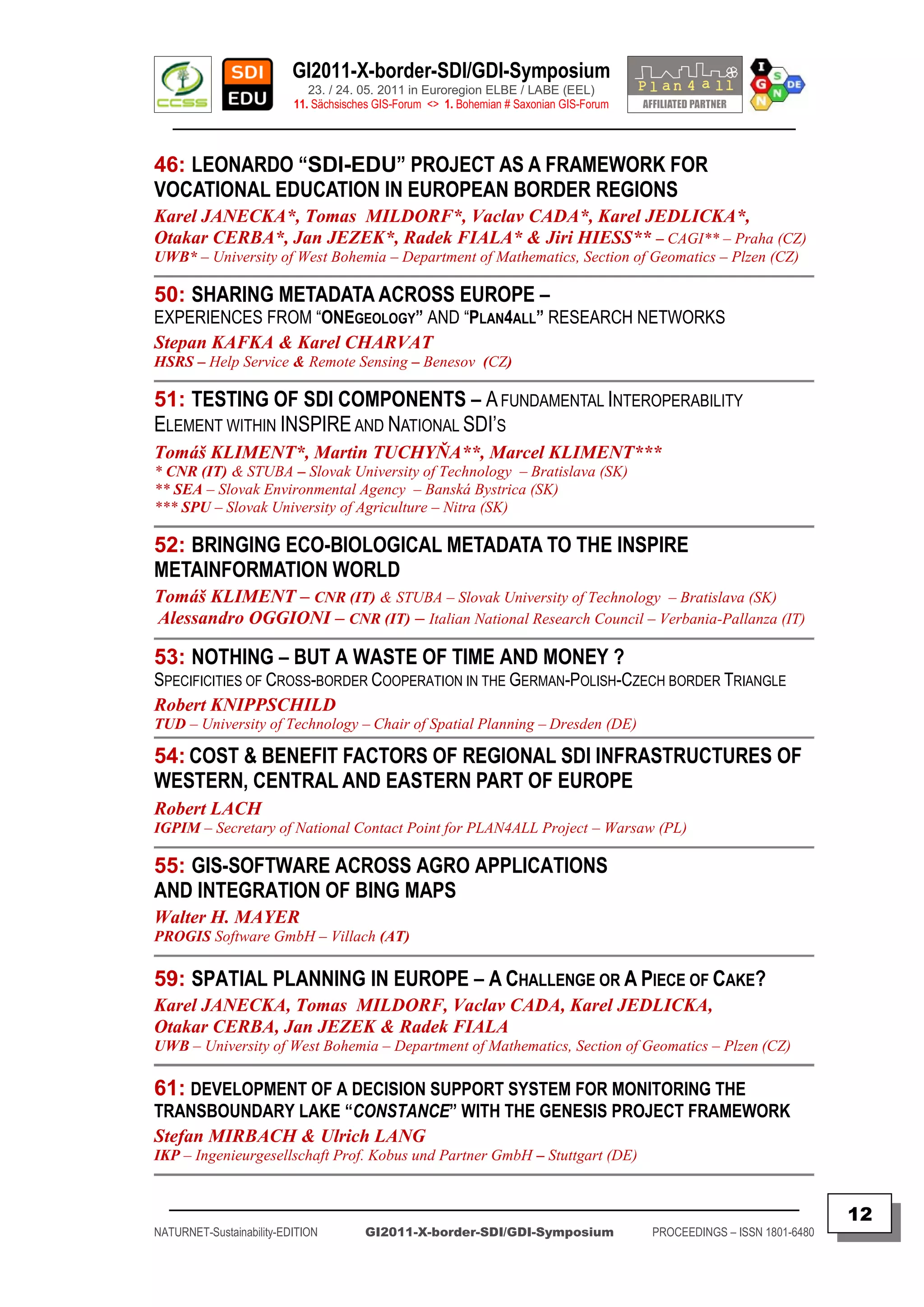
46: LEONARDO “SDI-EDU” PROJECT AS A FRAMEWORK FOR
VOCATIONAL EDUCATION IN EUROPEAN BORDER REGIONS
Karel JANECKA*, Tomas MILDORF*, Vaclav CADA*, Karel JEDLICKA*,
Otakar CERBA*, Jan JEZEK*, Radek FIALA* & Jiri HIESS** – CAGI** – Praha (CZ)
UWB* – University of West Bohemia – Department of Mathematics, Section of Geomatics – Plzen (CZ)

50: SHARING METADATA ACROSS EUROPE –
EXPERIENCES FROM “ONEGEOLOGY” AND “PLAN4ALL” RESEARCH NETWORKS
Stepan KAFKA & Karel CHARVAT
HSRS – Help Service & Remote Sensing – Benesov (CZ)

51: TESTING OF SDI COMPONENTS – A FUNDAMENTAL INTEROPERABILITY
ELEMENT WITHIN INSPIRE AND NATIONAL SDI‟S
Tomáš KLIMENT*, Martin TUCHYŇA**, Marcel KLIMENT***
* CNR (IT) & STUBA – Slovak University of Technology – Bratislava (SK)
** SEA – Slovak Environmental Agency – Banská Bystrica (SK)
*** SPU – Slovak University of Agriculture – Nitra (SK)

52: BRINGING ECO-BIOLOGICAL METADATA TO THE INSPIRE
METAINFORMATION WORLD
Tomáš KLIMENT – CNR (IT) & STUBA – Slovak University of Technology – Bratislava (SK)
Alessandro OGGIONI – CNR (IT) – Italian National Research Council – Verbania-Pallanza (IT)

53: NOTHING – BUT A WASTE OF TIME AND MONEY ?
SPECIFICITIES OF CROSS-BORDER COOPERATION IN THE GERMAN-POLISH-CZECH BORDER TRIANGLE
Robert KNIPPSCHILD
TUD – University of Technology – Chair of Spatial Planning – Dresden (DE)

54: COST & BENEFIT FACTORS OF REGIONAL SDI INFRASTRUCTURES OF
WESTERN, CENTRAL AND EASTERN PART OF EUROPE
Robert LACH
IGPIM – Secretary of National Contact Point for PLAN4ALL Project – Warsaw (PL)

55: GIS-SOFTWARE ACROSS AGRO APPLICATIONS
AND INTEGRATION OF BING MAPS
Walter H. MAYER
PROGIS Software GmbH – Villach (AT)

59: SPATIAL PLANNING IN EUROPE – A CHALLENGE OR A PIECE OF CAKE?
Karel JANECKA, Tomas MILDORF, Vaclav CADA, Karel JEDLICKA,
Otakar CERBA, Jan JEZEK & Radek FIALA
UWB – University of West Bohemia – Department of Mathematics, Section of Geomatics – Plzen (CZ)

61: DEVELOPMENT OF A DECISION SUPPORT SYSTEM FOR MONITORING THE
TRANSBOUNDARY LAKE “CONSTANCE” WITH THE GENESIS PROJECT FRAMEWORK
Stefan MIRBACH & Ulrich LANG
IKP – Ingenieurgesellschaft Prof. Kobus und Partner GmbH – Stuttgart (DE)


  _________________________________________________________________________________________
                                                                                                                         12
NATURNET-Sustainability-EDITION        GI2011-X-border-SDI/GDI-Symposium                  PROCEEDINGS – ISSN 1801-6480
GI2011-X-border-SDI/GDI-Symposium
                             23. / 24. 05. 2011 in Euroregion ELBE / LABE (EEL)
                          11. Sächsisches GIS-Forum <> 1. Bohemian # Saxonian GIS-Forum
   ________________________________________________________________________________________


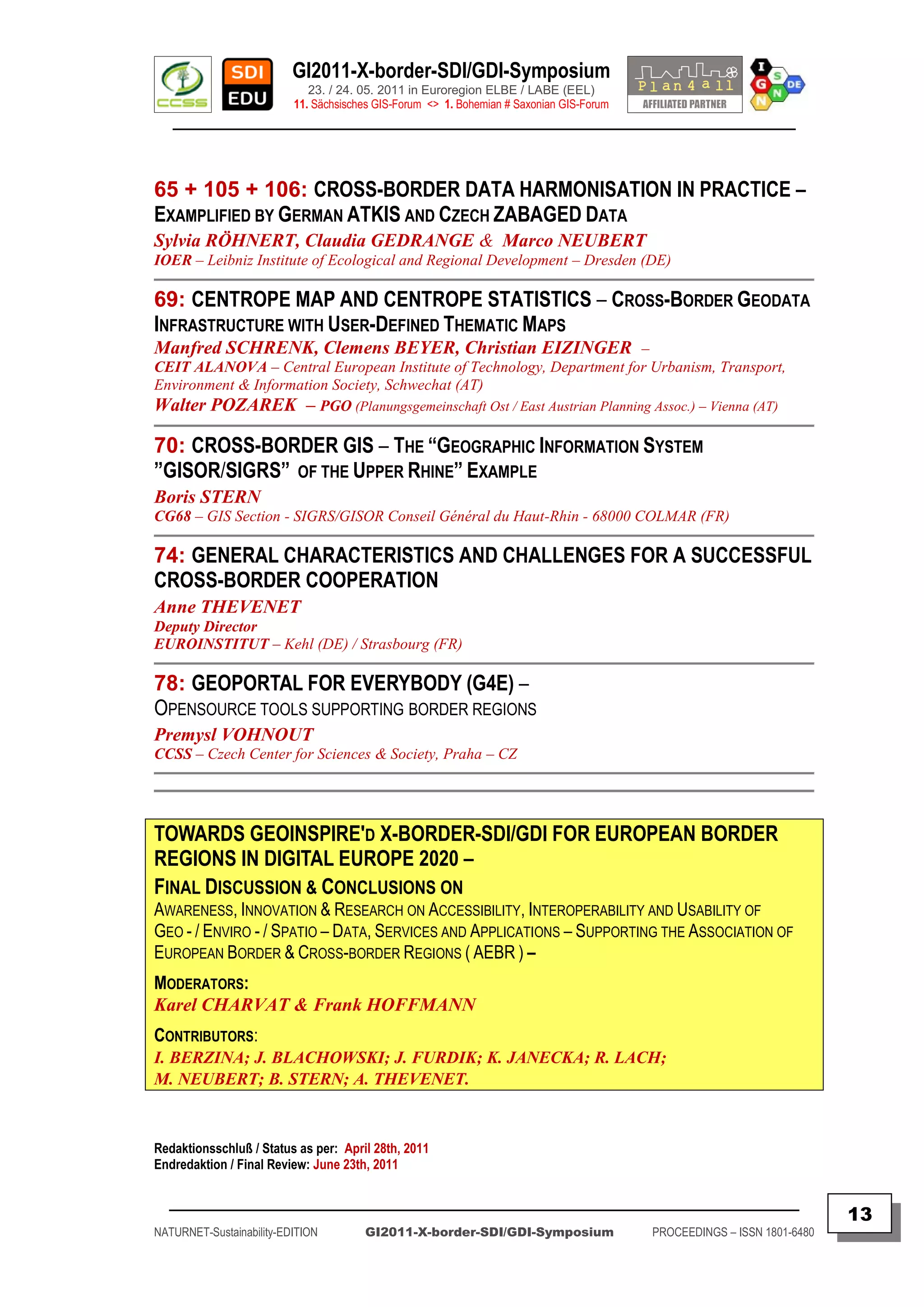
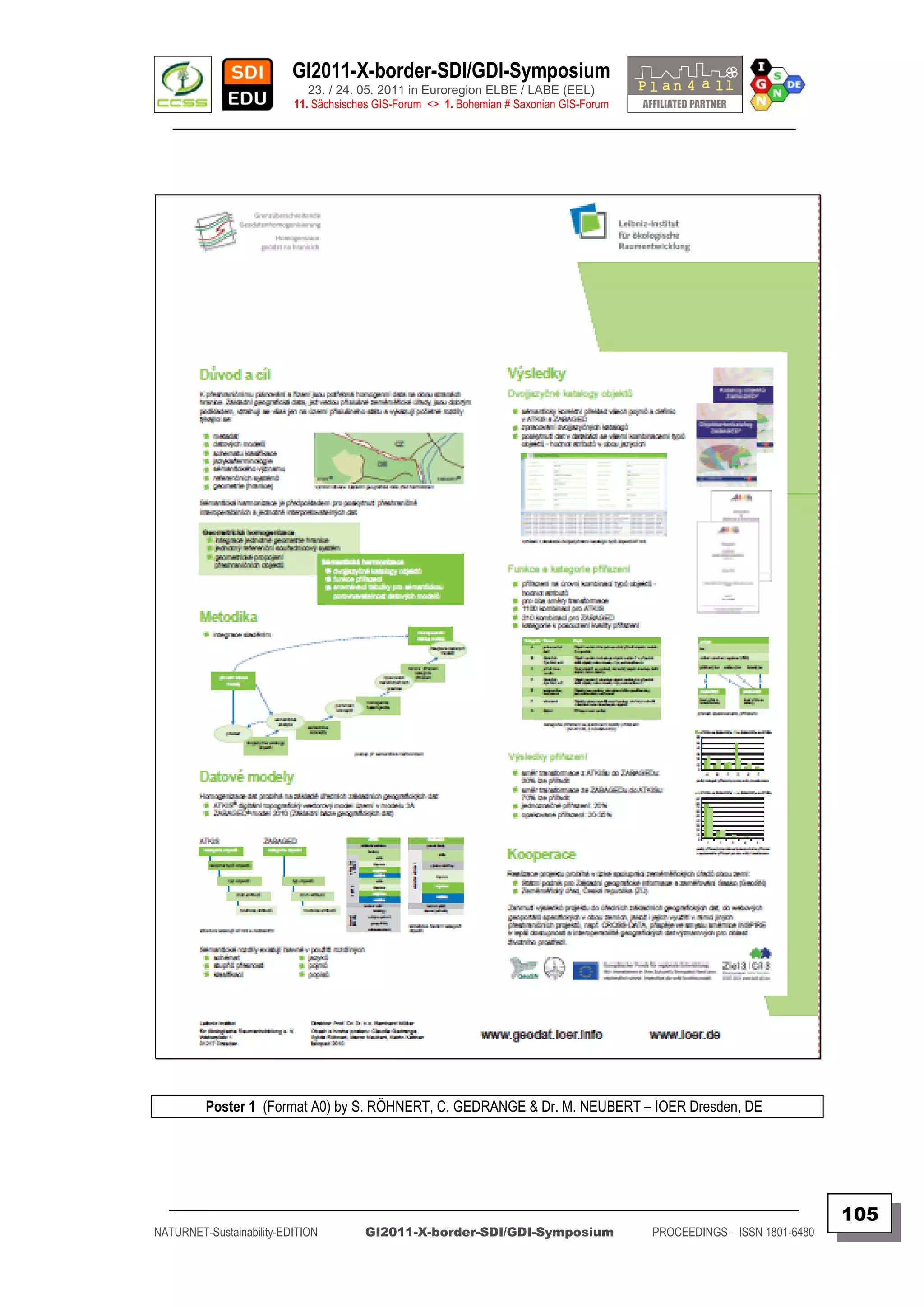
65 + 105 + 106: CROSS-BORDER DATA HARMONISATION IN PRACTICE –
EXAMPLIFIED BY GERMAN ATKIS AND CZECH ZABAGED DATA
Sylvia RÖHNERT, Claudia GEDRANGE & Marco NEUBERT
IOER – Leibniz Institute of Ecological and Regional Development – Dresden (DE)

69: CENTROPE MAP AND CENTROPE STATISTICS – CROSS-BORDER GEODATA
INFRASTRUCTURE WITH USER-DEFINED THEMATIC MAPS
Manfred SCHRENK, Clemens BEYER, Christian EIZINGER –
CEIT ALANOVA – Central European Institute of Technology, Department for Urbanism, Transport,
Environment & Information Society, Schwechat (AT)
Walter POZAREK – PGO (Planungsgemeinschaft Ost / East Austrian Planning Assoc.) – Vienna (AT)

70: CROSS-BORDER GIS – THE “GEOGRAPHIC INFORMATION SYSTEM
”GISOR/SIGRS” OF THE UPPER RHINE” EXAMPLE
Boris STERN
CG68 – GIS Section - SIGRS/GISOR Conseil Général du Haut-Rhin - 68000 COLMAR (FR)

74: GENERAL CHARACTERISTICS AND CHALLENGES FOR A SUCCESSFUL
CROSS-BORDER COOPERATION
Anne THEVENET
Deputy Director
EUROINSTITUT – Kehl (DE) / Strasbourg (FR)

78: GEOPORTAL FOR EVERYBODY (G4E) –
OPENSOURCE TOOLS SUPPORTING BORDER REGIONS
Premysl VOHNOUT
CCSS – Czech Center for Sciences & Society, Praha – CZ


TOWARDS GEOINSPIRE'D X-BORDER-SDI/GDI FOR EUROPEAN BORDER
REGIONS IN DIGITAL EUROPE 2020 –
FINAL DISCUSSION & CONCLUSIONS ON
AWARENESS, INNOVATION & RESEARCH ON ACCESSIBILITY, INTEROPERABILITY AND USABILITY OF
GEO - / ENVIRO - / SPATIO – DATA, SERVICES AND APPLICATIONS – SUPPORTING THE ASSOCIATION OF
EUROPEAN BORDER & CROSS-BORDER REGIONS ( AEBR ) –
MODERATORS:
Karel CHARVAT & Frank HOFFMANN
CONTRIBUTORS:
I. BERZINA; J. BLACHOWSKI; J. FURDIK; K. JANECKA; R. LACH;
M. NEUBERT; B. STERN; A. THEVENET.


Redaktionsschluß / Status as per: April 28th, 2011
Endredaktion / Final Review: June 23th, 2011

  _________________________________________________________________________________________
                                                                                                                         13
NATURNET-Sustainability-EDITION        GI2011-X-border-SDI/GDI-Symposium                  PROCEEDINGS – ISSN 1801-6480
GI2011-X-border-SDI/GDI-Symposium
                             23. / 24. 05. 2011 in Euroregion ELBE / LABE (EEL)
                          11. Sächsisches GIS-Forum <> 1. Bohemian # Saxonian GIS-Forum
   ________________________________________________________________________________________


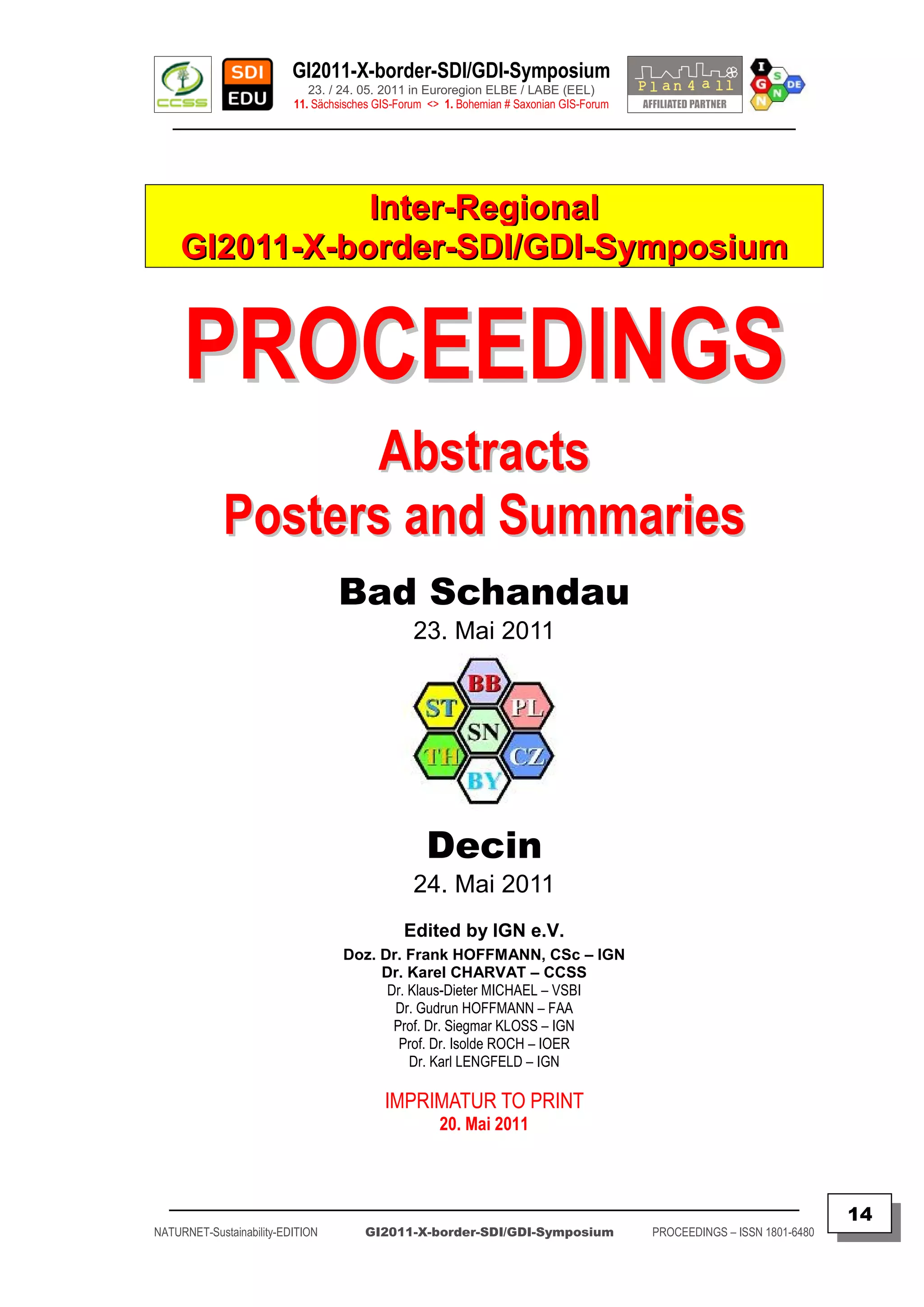
                Inter-Regional
     GI2011-X-border-SDI/GDI-Symposium


     PROCEEDINGS
                   Abstracts
             Posters and Summaries
                                  Bad Schandau
                                                 23. Mai 2011


                                                   Decin
                                                 24. Mai 2011
                                               Edited by IGN e.V.
                                   Doz. Dr. Frank HOFFMANN, CSc – IGN
                                        Dr. Karel CHARVAT – CCSS
                                         Dr. Klaus-Dieter MICHAEL – VSBI
                                          Dr. Gudrun HOFFMANN – FAA
                                          Prof. Dr. Siegmar KLOSS – IGN
                                           Prof. Dr. Isolde ROCH – IOER
                                             Dr. Karl LENGFELD – IGN

                                           IMPRIMATUR TO PRINT
                                                      20. Mai 2011


  _________________________________________________________________________________________
                                                                                                                         14
NATURNET-Sustainability-EDITION        GI2011-X-border-SDI/GDI-Symposium                  PROCEEDINGS – ISSN 1801-6480
GI2011-X-border-SDI/GDI-Symposium
                             23. / 24. 05. 2011 in Euroregion ELBE / LABE (EEL)
                          11. Sächsisches GIS-Forum <> 1. Bohemian # Saxonian GIS-Forum
    ________________________________________________________________________________________

          GI2011-X-BORDER-SDI/GDI-SYMPOSIUM
 ADDRESSING THE 11TH “SÄCHSISCHES GIS-FORUM” = THE FIRST “BOHEMIA & SAXONIA GIS-FORUM”
                         ACROSS THE BORDER OF EUROREGION EEL
                        23.5.2011: BAD SCHANDAU (SAX) # 24.5.2011: DECIN (CZE)


                           Frank HOFFMANN & Karel CHARVAT
                          Founding Members of the Non-profit charity Association IGN e.V.
                              “INNOVATION. GRENZÜBERSCHREITENDES NETZWERK“


              WELCOME ADDRESS TO THE “11. SÄCHSISCHES GIS-FORUM”
               THE “FIRST BOHEMIAN & SAXONIAN GIS-FORUM” 2011

Keywords: AEBR, Austria, Awareness, Bavaria, Bohemia, BOWGIS, CENTROP-MAP/STATISTICS,
Cross-border, DACH+, Data-Pool, Education, ESDI, ETC/4A, EU-Directives, Euregio, Europe, FP6/7,
GDI, Geodata, Geomatics, Geospatial, GI2000, GI2011, GIS-GrandeRegion, GSDI, INSPIRE,
Interoperability, INTERREG/4A, LifeLongLearning, NATURNET+, NSDI, OpenGIS, Pilot projects, PSI,
RAPIS, Regions, Saxonia, SDI, SIG-GR, SIG-RS, Spatial planning, Strategy seminars, Sustainability,
Usability, X-SDI, X-GDI.
Contents:
         The implementation of EU Directives on ACCESS (Public Access to Environmental
Information), PSI (Public Sector Information), and INSPIRE (Infrastructure for Spatial Information in
the European Community) and other is determined by
      the globalization processes of economy,
      the rapid high-tech development changes, as well as
      the way decision processes have to be improved after the global financial crisis
in order to monitor environment and natural resources, to prevent climate changes, and to overcome
the challenges of economic growth, energy and finance crisis over all Europe of ( Border ) Regions.
    The test results based on the EU-Project NATURNET+REDIME (NNR) and received until 2009
     have demonstrated the urgent needs for GeoINSPIRE’d action, as for syntactic interoperability, as
     for semantic and linguistic interoperability needs of applications based on harmonized and
     integrated Geo-/Enviro-Webservices, especially across EU borders.
    The “Status-quo” tested in NNR project has been challenging to solve existing problems in
     harmonizing scaleability and quality of x-border data, information, applications, as well as
     providing guidelines and learning resources for stakeholders and decision makers at administrative
     and institutional levels.
   Therefore, X-border-INSPIRE‟d approaches, technologies, models and application solutions need
    better awareness, education and training for integrated problem solving by administrations,
    business, companies, governments, decision makers and citizens at all levels across borders in
    EUROPE OF REGIONS.
         But, the main barriers and, as well as important technical challenges, are the geodetic
transformation, semantic harmonization and cartomatic generalization of GEO/ENVIRO/SPATIO
data and datasets and their integration based on interoperable webservices from local via regional into
national level to build an european homogenous

              Infrastructure of Spatial Information across European Border Regions ( INSPIRE-X-EBR ) !

         Research and development for comprehensive use and re-use of public sector (e.g. statistical,
sensoric, spatial and non-spatial) data, information, and applications, as well as web-based and mobile
communication technologies (ICT) can help to improve european strategies and to enable sustainable
decision making for regional development, but this needs:

    _________________________________________________________________________________________
                                                                                                                         15
NATURNET-Sustainability-EDITION        GI2011-X-border-SDI/GDI-Symposium                  PROCEEDINGS – ISSN 1801-6480
GI2011-X-border-SDI/GDI-Symposium
                             23. / 24. 05. 2011 in Euroregion ELBE / LABE (EEL)
                          11. Sächsisches GIS-Forum <> 1. Bohemian # Saxonian GIS-Forum
   ________________________________________________________________________________________

         accessibility to analytical, sensor & statistical data about the environment openly available to
          associations, citizens, communities (ACCESS Directive 2003/4/EC),
         availability of sectoral & thematical information from public administrations & agencies to be
          re-usable by private SME‟s & start-up firms (PSI Directive 2003/98/EC),
         interoperability of integrated, web-based geoscientific, environmental and spatial services
          (INSPIRE Directive 2007/2/EC),
in order to provide the knowledge basis for sharing of environmental information systems (SEIS),
integrating of geographical, environmental and topographical data, services & applications (SDI), and
developing a single information space in Europe (SISE) and improving awareness and learning support
for making sustainable decisions on local, regional and cross-border levels across Europe of Regions.

         IGN, CCSS and UniWB are organizing together this professional event, following their long-
time education and research activities to achieve better SDI/GDI awareness and closer cooperation in
EUROPEAN BORDER REGIONS to adapt to the EU Strategy of “Europe 2020” and the Action Plan
“Digital Agenda of Europe 2020”. The EU Directives on re-using of Public Sector Information (PSI)
and development of Infrastructures for Spatial Information in Europe (INSPIRE) can support and
improve strategic opportunities and challenges for more than 200 EUROPEAN BORDER REGIONS.

         Therefore, you are welcome to participate at this GI2011-X-border-SDI/GDI Symposium
this year to be held traditionally as the “11th Sächsisches GIS-Forum” in BAD SCHANDAU (SAX) and as
the very “1st Bohemia # Saxonia GIS-Forum” in DECIN (CZE). Both these GI2011 events should inform
on the progress of EU-Directives PSI for re-using public sector information and implementation of
INSPIRE process on interoperability of X-border Data & Services in EUROPEAN BORDER REGIONS.

        The Goal of GI2011 Symposium is to share information, knowledge, and expertise, to learn
from SDI and OSM „best practices“, as well as to exchange and discuss European awareness and
research projects (NATURNET, SDI-EDU, HUMBOLDT) and other European networks
(GEOPORTAL4EVERYBODY, PLAN4ALL, etc.) introducing innovative geomatics technologies,
demonstrating cost-benefit approaches, as well as discussing the frameworks for PSI, GI & SDI policy,
organization and technologies behind the INSPIRE process.

         The GI2011-X-border-SDI/GDI-Symposium has its focus as well on actual EU research
projects and “best practice” networks like ESDIN (EuroGeographics et al.), GEOPORTAL4EVERYBODY
(CCSS & UNSDI.cz), PLAN4ALL (UWB & CCSS), and SDI-EDU (UWB) to share the experience and
advanced knowledge directly with participants registered from local and regional organizations in
EUROPEAN BORDER REGIONS. The GI2011-Participants will share a „Round Table Discussion Session“
on PSI & INSPIRE challenges important for border regions.

          That‟s the way developing Sustainability of European cross-border, trans-national and inter-
regional collaboration and setting up innovative contents for a lifelong-learning process (LLP) in order
to realize step-by-step the INSPIRE strategy for Europe until 2019 and probably beyond 2020.

         The GI2011-Symposium should continue the usability road-map of the already finished EU-
FP6-Project NaturNet+Redime (NNR) lead by CCSS (Prague) which has been developed further the
NNR tools within the Framework of EU-FP7-Programme since its finalization at the end of 2007 and
transferred its deliverables now into several new EU-Projects like: NN+, METASCHOOL, HUMBOLDT,
PLAN4ALL, SDI-EDU, BRISEIDE etc. under the leadership of our Czech colleagues, e.g. all they are
members of an innovative NETWORK of High-tec-GeoInfo SME‟s and Universities lead by CCSS
(Czech Center for Science & Society) and nowadays to be transferred to other REGIONS of EUROPE.

         Therefore, we w‟d like transforming Quantity of 10 Years „Sächsisches GIS-Forum‟ and the
results of FP6/7 Research activities now into a new Quality supporting Sustainability of X-border &
Inter-regional Collaboration, especially for the tri-national areas across borders of CZ+PL+SN.de !


  _________________________________________________________________________________________
                                                                                                                         16
NATURNET-Sustainability-EDITION        GI2011-X-border-SDI/GDI-Symposium                  PROCEEDINGS – ISSN 1801-6480
GI2011-X-border-SDI/GDI-Symposium
                             23. / 24. 05. 2011 in Euroregion ELBE / LABE (EEL)
                          11. Sächsisches GIS-Forum <> 1. Bohemian # Saxonian GIS-Forum
   ________________________________________________________________________________________


      Finally, the Organizers, the non-profit Associations CCSS & IGN, as well
      as UniWB would like to say you:

               WELCOME to our inter-regional, trans-national & cross-border participants, guests and
                authors celebrating the traditional Anniversary of “11. Sächsisches GIS-Forum” as a
                                                                    1
                cross-border forum event, the “1. Bohemia # Saxonia GIS-Forum” by contributing,
                                                  1
                discussing and exchanging cross-border-awareness, information and experience;
              THANK YOU to the keynote experts, session speakers, poster contributors and tele-
               presenters finally from 10 Countries:
                 AT + CZ + DE ( BW +SN ) + EU ( AEBR +ESDIN +EUROINSTITUT ) + FR + IT + LV + PL + SK
               ready to share with local, regional and cross-border communities their vision, information,
               knowledge and expertise, the way forward for better citizens awareness, metadata and cross-
               border data interoperability and sustainability of x-border & inter-regional communication,
               coordination and collaboration.
              ACKOWLEDGEMENT is given to several organizations and companies providing
               conference materials like flyers, posters, fact sheets, demos, reports, and supporting us to
               organize this GI2011-Symposium, important especially for our colleagues from CEE
               countries, especially the following supporters have to be named (see p. ??? for details):
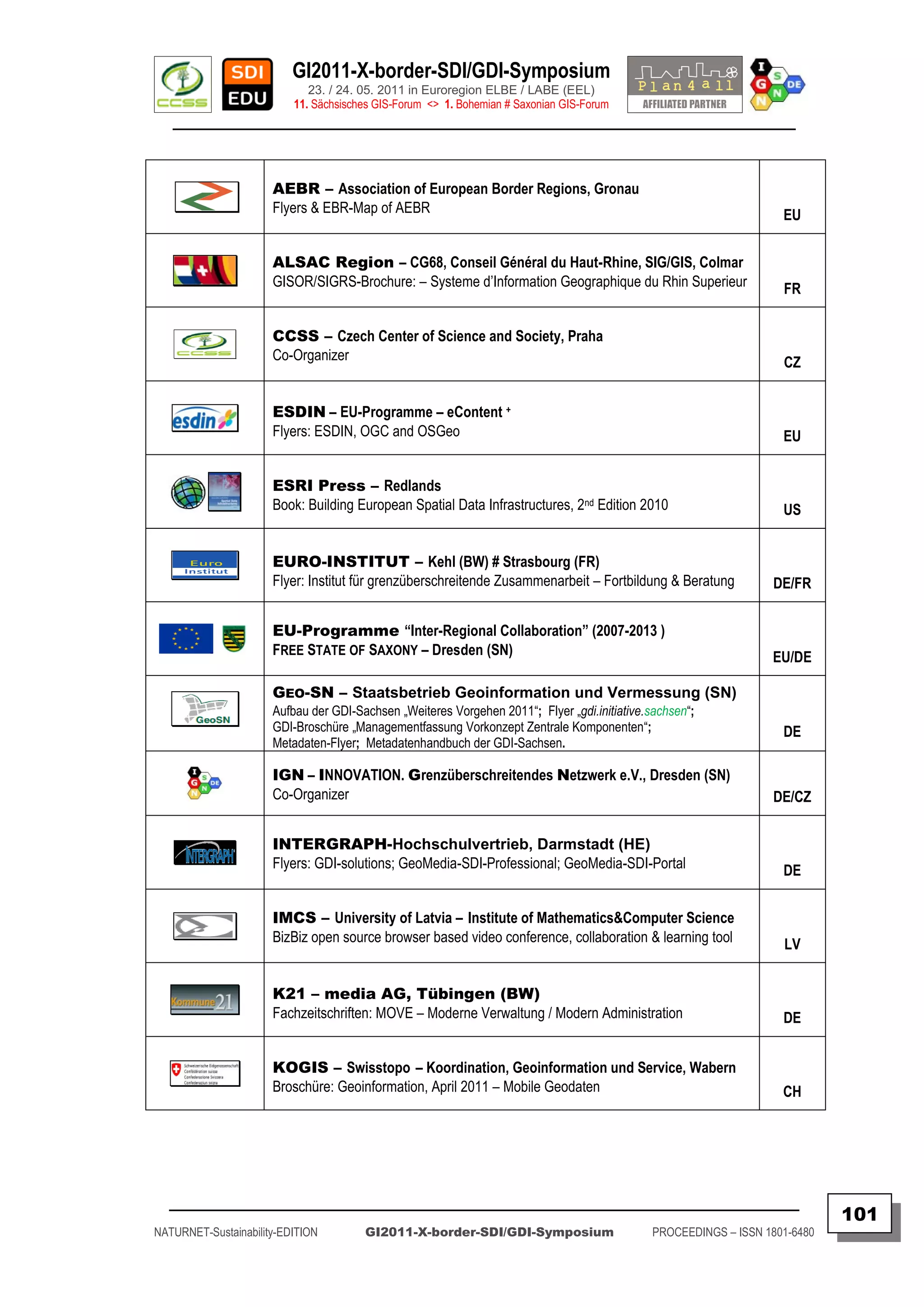
              AEBR, Alsac-Region-CG68, CCSS, ESDIN, ESRI-Press, EUROINSTITUTE,
               FREE STATE OF SAXONY, GeoSN, IGN-SN, K21 MEDIA AG, KOGIS/SWISS TOPO,
               KULK-CZ, MIR/GLPA-BERLIN/BRANDENBURG, MOT-FR, NATIONALPARKZENTRUM,
               PROGIS-AT, SENATSVERWALTUNG-Berlin, SIG Media GmbH&Co.KG/Köln,
               SIGRS/GISOR-FR, STUBA-SK, UniWB-CZ, WBU-PL, ZAMEK-DECIN-CZ.

      Dresden / Praha 23. Mai 2011


                                                      Authors
                          Doz. Dr. Frank HOFFMANN, CSc & Dr. Karel CHARVAT

                                                   References
                  ARCHIV: GI2010-Symposium - 10. Sächsisches GIS-Forum, Dresden 2010
         [ http://epsiplatform.eu/psi_library/reports/gi2010_dresden_symposium_may_2010 ]
                   ARCHIV: GI2009-Symposium - 9. Sächsisches GIS-Forum, Dresden 2009
             [ http://www.epsiplatform.eu/reports/gi2009_dresden_symposium_may_2009 ]
                   ARCHIV: GI2008-Symposium - 8. Sächsisches GIS-Forum, Dresden 2008
                [ http://www.epsiplus.net/reports/gi2008_dresden_symposium_may_2008 ]

                                            EU-FP6/7-Projects-NATURNET
                                          [ http://www.NATURNET.org ]

                                    GEOSPATIAL SAXONY – WEBLOG – GDI-SN
                                       [ http://GDI-SN.blogspot.com ]
                                      CZECH CENTER OF SCIENCE & SOCIETY
                                            [ http://www.CCSS.cz ]


                                                       Contact
                           IGN - INNOVATION. Grenzüberschreitendes Netzwerk e.V.
              c/o IGN-Vorstand, Martin-Andersen-Nexö-Str. 4, D-01217 DRESDEN / Saxony / Germany
                      Email [ Mailto:Vorstand@IGN-SN.de ] + [ Mailto:info@GDI-SN.de ]


  _________________________________________________________________________________________
                                                                                                                         17
NATURNET-Sustainability-EDITION        GI2011-X-border-SDI/GDI-Symposium                  PROCEEDINGS – ISSN 1801-6480
GI2011-X-border-SDI/GDI-Symposium
                             23. / 24. 05. 2011 in Euroregion ELBE / LABE (EEL)
                          11. Sächsisches GIS-Forum <> 1. Bohemian # Saxonian GIS-Forum
   ________________________________________________________________________________________


   distance in which individuals are clustered: Dot sizes:         = 1,000+       = 100 - 999   = 10 - 99 = 1 - 9 visits
                           th
               As per 14 May 2011 @ 07:58 GMT – Total access since 28 Dec 2007: 7.463.
                                                               th                     hrs
             3.800 visits shown above as from 30 Dec 2009 to 18 Apr 2011 - Previous 24 : 15
               CLUSTERMAPS © 2011 Access Statistics for IGN‟s Weblog URL [ http://GDI-SN.blogspot.com ]


IGN e.V. - INNOVATION.Grenzüberschreitendes Netzwerk (X-border Network) - is a non-profit
Association (gemeinnütziger Verein) for Education, Development and Knowledge Transfer - has been
founded first in 2002 as "GDI-Sachsen" (i.G.) - the final outcome of the "OpenGIS Strategy Seminar"
series in GI2000 & GI2002 at "Bildungswerk Ost-West" (BOW), but was re-founded later on as the
follow-up "IGN" (e.V.) at September 2nd, 2003, by Czechia and Saxonia experts of Cartomatics,
Cyberlaw, Cybernetics, Geomatics, Economics, Mediamatics, Pedagogics, Regional Development and
Spatial Sciences.
Its main goals: supporting GEO - ENVIRO - SPATIO - oriented Awareness, Business and Openness in
Training, Education and Research on GeoINSPIRE‟d Interoperability, Sustainability, and Usability of
spatial Data, Services and Applications for X-border-Infrastructures of Spatial Information (X-INSPIRE)
in EUROPE of REGIONS.
IGN has been registered by Dresden City Court officially as a Non-profit Association, October 16th, 2003
              [ http://www.IGN-SN.de/Registration.pdf ] - [ Mailto:Vorstand@IGN-SN.de ]
                         [ Copyright © 2011 by IGN e.V. - All rights reserved. ]

The CCSS – Czech Center for Science and Society – is an Association of high tech SMEs, the public
administration and research organizations. It is an independent, non-profit and non-governmental
organisation. It is a type of virtual centre of excellence with the focus on the implementation of new
communication and navigation technologies which have potential for sustainable development.
The CCSS co-operates with a wide range of institutions and individuals, home and foreign ones. It is
focused on research & development activities in the field of international research projects and
utilization of modern technologies. CCSS supports co-operation networks of the small and medium
business within the framework of regional economies and helds intensive contacts, particularly in Europe,
Asia, Africa and South America.
CCSS is focused on transfer, analyses and development of the most advanced GI & ICT technologies
which are contributing to the growth of productivity not only in industrial enterprises but in the branch of
small and medium business as well. CCSS is active in the agriculture, industry, trade and services,
predominantly in agricultural regions.
The priority of activities of CCSS is Environment protection and Crisis management. In this field CCSS
is active in European FP7 research and “best practice” excellence & social networks.
                       [ Copyright © 2011 by CCSS, Praha - All rights reserved. ]

  _________________________________________________________________________________________
                                                                                                                           18
NATURNET-Sustainability-EDITION        GI2011-X-border-SDI/GDI-Symposium                    PROCEEDINGS – ISSN 1801-6480
GI2011-X-border-SDI/GDI-Symposium
                             23. / 24. 05. 2011 in Euroregion ELBE / LABE (EEL)
                          11. Sächsisches GIS-Forum <> 1. Bohemian # Saxonian GIS-Forum
   ________________________________________________________________________________________


        GRENZÜBERSCHREITENDE REGIONEN IN
         EUROPA – EINE BESTANDSAUFNAHME
                                     Martín Guillermo-Ramírez
                ARBEITSGEMEINSCHAFT EUROPÄISCHER GRENZREGIONEN - AGEG
                           ABSTRACT – OPENING KEYNOTE
Keywords: AEBR, AGEG, ARFE, Border regions, Cooperation, Cross-border, Europa,
Euroregionen, EVTZ, EGTC, GECT, Europe, Grenzregionen, Integration
Contents:
       Grenzübergreifende Zusammenarbeit ist inzwischen eine der Hauptaufgaben
der Europäischen Union. In der Vergangenheit wurden viele Einrichtungen geschaffen,
mit denen die Grenzregionen vorangebracht werden sollen:
       Euroregionen, Arbeitsgemeinschaften, Netzwerke oder kürzlich die EVTZ„s
(Europäischer Verbund für territoriale Zusammenarbeit). All diese haben die
grenzübergreifenden Regionen in ein unersetzliches Werkzeug verwandelt, um Europa
den Menschen näher zu bringen.
       Grenzregionen sind häufig dünn besiedelt, leiden an mangelhafter Infrastruktur
sowie an der Abwanderung ihrer gut ausgebildeten Kräfte. Manche sind allerdings auch
urbaner Natur mit Millionen Einwohnern und auf diese Weise Beispiele für europäische
Metropolen.
      In diesen ganz unterschiedlichen Gebieten, in denen Europa jeden Tag gelebt
wird, gibt es beispielsweise Zentren alter Traditionen, ebenso aber auch
Zusammenschlüsse, in denen Stadt-Land-Partnerschaften entstehen.
       An unseren Binnengrenzen (aber auch an den Außengrenzen und darüber
hinaus) ist nahezu alles möglich: dort, auf den ehemaligen Schlachtfeldern, zeigt sich
heute Europa von seiner besten Seite. Auf den Narben der Vergangenheit entstanden die
Wirkungsstätten der europäischen Integration.

                                                        Author
                                           Martín Guillermo-Ramírez
                                               Secretary General
                              Association of European Border Regions (AEBR)
                                                    References
                                        [ http://www.AEBR.eu ]
                              [ Grenzüberschreitende Regionen in Europa ]
                                                       Contact
                                  Association of European Border Regions (AEBR)
                                       Enscheder Str. 362, D-48599 Gronau
                                             Tel.: +49 (0) 2562 - 702 19
                                            Fax: +49 (0) 2562 - 702 59
                     E-Mail: [ m.guillermo@aebr.eu ] | Web: [ www.aebr.eu ]

  _________________________________________________________________________________________
                                                                                                                         19
NATURNET-Sustainability-EDITION        GI2011-X-border-SDI/GDI-Symposium                  PROCEEDINGS – ISSN 1801-6480
GI2011-X-border-SDI/GDI-Symposium
                             23. / 24. 05. 2011 in Euroregion ELBE / LABE (EEL)
                          11. Sächsisches GIS-Forum <> 1. Bohemian # Saxonian GIS-Forum
   ________________________________________________________________________________________


         ECONOMIC ACTIVITY IN CROSS-BORDER
                 MARINE HABITATS
    M. ALBERTS, A. IKAUNIECE, P. BRUNS, J. KALNINS, J. MARTINSONS
                                                    IMCS, Riga - LV

                                                     ABSTRACT
Keywords: biotope, habitats, INSPIRE, meta-data, modelling SDI, species

Abstract:
          Latvian marine coastal habitats are currently represented by various datasets owned by
Latvian Institute of Aquatic Ecology (LIAE). As the coastal region encompasses also protected areas
(Natura 2000) with limited allowed actions the knowledge on location of habitats and their value is
essential for all types of economical activities.
          The cross-border nature of any marine data on habitat situation therefore is relevant also for
the other countries sharing the Baltic Sea area. The provision of information about possible economical
activities in marine areas is one of the pilot cases in INSPIRED HABITATS project. Its infrastructure
and platform implementation is planned as compliant to INSPIRE requirement. To be more closer to
citizens, stakeholders, science enthusiasts & businessmens the INSPIRED HABITATS project is trying to
use also social networks to attract all these user groups and experts to validate the pro‟s and con‟s for
INSPIRE data models and its usage to solve real world problems.
        This is the first INSPIRE compliant habitats and species distribution meta-data and data
model implementation trial in Latvia. Continuous data model evolution is being implemented due to
changing user requirements and development of INSPIRE Directive data model specifications.
         The Data model implementation is developed by Latvian Institute of Aquatic Ecology (LIAE)
in collaboration with Institute of Mathematics and Computer Science of the University of Latvia
(IMCS). The Database consists of monitoring and observation data about habitats, species and physical
characteristics collected during the last 35 years. Bottom type, physico-chemical features – temperature
and salinity regimes, content of oxygen and nutrients, density of benthic animals have been sampled and
measured for a few decades in the framework of national marine monitoring.
         SDI software implementation is based on open source components and follows ideas of
European project PLAN4ALL that allows adaptation of solution easily in future for other countries across
the Baltic Sea area.

                                                       Authors
             Dr. math. Māris ALBERTS, Dr. biol. Anda IKAUNIECE, Bc. Ing. Peteris BRUNS,
                      Dr.comp.sc. Janis KALNINS, Dr.comp.sc.Janis MARTINSONS

                                                    References
           INSPIRED HABITATS. 2010-2011. Internet [http://www.inspiredhabitats.eu/]
  Janecka K., Berzins R., Charvat K., Dzerve A.: The “GeoPortal4everybody & BizBiz” tools as a
modern technological framework for vocational e-learning. In: Proceedings of ELDE Conference, Sofia:
                                           2011, p. 215

                                                       Contact
            IMCS – Institute of Mathematics and Computer Science – University of Latvia (LV)
                                     Department of Real time systems
                                 Raina bulvaris 29, Riga, LV-1459 Latvia
                                 Tel: +371 67226997 Fax: +371 67820153
                                      Email: [ alberts@latnet.lv ]


  _________________________________________________________________________________________
                                                                                                                         20
NATURNET-Sustainability-EDITION        GI2011-X-border-SDI/GDI-Symposium                  PROCEEDINGS – ISSN 1801-6480
GI2011-X-border-SDI/GDI-Symposium
                             23. / 24. 05. 2011 in Euroregion ELBE / LABE (EEL)
                          11. Sächsisches GIS-Forum <> 1. Bohemian # Saxonian GIS-Forum
   ________________________________________________________________________________________


                CROSS-BORDER INTERWEAVEMENT
         AN ANALYSIS OF DATA AVAILABILITY DESCRIBING CROSS-BORDER
                INTERWEAVING OF SAXONY’S BORDER REGIONS
                                               Frank BENDEL
                    Dresden University of Technology, Institute of Geography (DE)

                                                   ABSTRACT

Keywords: data availability, cross-border interweavement, regionalization


Contents:
This presentation contains the following thesis of diploma research:

      Interconnected cross-border regions, a new shape for cross-border areas

      The regionalization and their possibilities for the delimitation of regions

      The procedure of data research for cross-border development

      Data availability in Saxony describing cross-border interweavement

      First steps to compare the data availability between Saxony and the so-called
       MORO-Regions

      Measures for a better data availability


                                                        Author
                                           Dipl.-Geogr. Frank Bendel


                                                     Reference
       Bendel, F. (2010). Grenzüberschreitende Verflechtungsräume – Eine Analyse
          grenzüberschreitender Verflechtungen an den Außengrenzen Sachsens,
                               Diplomarbeit: TU Dresden.
                                                       Contact
                                                 Frank Bendel
                                           phone: 0049 351 482 9364

                                  Email: [ bendel.frank@yahoo.de ]

  _________________________________________________________________________________________
                                                                                                                         21
NATURNET-Sustainability-EDITION        GI2011-X-border-SDI/GDI-Symposium                  PROCEEDINGS – ISSN 1801-6480
GI2011-X-border-SDI/GDI-Symposium
                             23. / 24. 05. 2011 in Euroregion ELBE / LABE (EEL)
                          11. Sächsisches GIS-Forum <> 1. Bohemian # Saxonian GIS-Forum
   ________________________________________________________________________________________


                                                 SUMMARY
The following lines are not forming a summary in the proper sense. The author rather wants to give more
detailed information for a better understanding.

Interconnected cross-border regions:

Within the context of the European integration border regions gain more and more importance. By now
above 30% of the EU-citizens live in border regions what makes up 40% of the EU-territory. Soon
Germany recognized that some of these areas are using important metropolitan services behind the
border. But up till now there are not any overall concepts for such interconnected cross-border regions.

Therefore, these geographical markets are currently examined in a research project of the Federal
Planning Agency.

Common characteristics of cross-border regions:

         strong intra-regional cross-border linkages
         Actors possess extensive experience in cross-border cooperation, which is also institutionalized.
         The regions are important in terms of growth and innovation as well as the European integration
          and cohesion.

Possibilities used for delimitation of regions:

The delimitation of regions depends on the intended purpose. Within the diploma-thesis ways of
delimitation of regions were utilized to find measurable indicators of cross-border linkages. Substantially
there are three basic sectors to delimitate regions, the social, the economic and the political sector.
Additionally measurable indicators were assigned to those sectors. To achieve comparability for the
research results an existing indicator-set was used.


Examples of the indicators:

         purchasing power                                               customer flow
         price level                                                    strenght of frontier traffic
         cross-border commuters                                         cross-border projects


Procedure of the data research:

         experimental design of the survey: research of documents

         survey method: telephone interview

         survey instrument: standardized interview guide

         sample structure:
          Number and composition of the survey population is unknown.
          Therefore a pyramid scheme was used.
          All in all 104 institution and 142 actors were polled.


  _________________________________________________________________________________________
                                                                                                                           22
NATURNET-Sustainability-EDITION        GI2011-X-border-SDI/GDI-Symposium                    PROCEEDINGS – ISSN 1801-6480
GI2011-X-border-SDI/GDI-Symposium
                             23. / 24. 05. 2011 in Euroregion ELBE / LABE (EEL)
                          11. Sächsisches GIS-Forum <> 1. Bohemian # Saxonian GIS-Forum
   ________________________________________________________________________________________


    ZEMGALE SPATIAL PLANNING DATA - EXPERIENCE FROM
       CROSS-THEMATICAL CONTENTS HARMONIZATION
                 Inga BERZINA – Zemgale Planning region (LV)
                Peteris BRUNS – Baltic Open Solution Centre (LV)
       Otakar CERBA, Radek FIALA, Jan JEZEK, Karel JANECKA, Karel
      JEDLICKA, Tomas MILDORF – University of West Bohemia in Pilsen (CZ)
                                                   ABSTRACT
Keywords: spatial planning, data, models, harmonization, region, land cover, Plan4all, SDI-EDU
Contents:
         Spatial planning could be defined as a set of policies (including planning and
controlling activities) on the distribution of resources and facilities across urbanized areas. One
of the conditions of successful spatial planning activities and decisions is an accessibility of
high-quality spatial data sets. Experts and institutes participating on spatial planning and similar
activities (like urban or regional planning) have two options:
         To buy or to collect spatial data – such data has to be managed and updated by using own resources or
          an outsourcing.
         To re-use existing shared spatial data sets.
         The main problem of the second solution is the incompatibility of spatial data
provided by different sources. The incompatibility (or heterogeneity) consists of different
scales, granularity, terminology, data models, data formats, portrayal rules etc. These categories
represent the aspects of spatial data harmonization – the process of elimination of
heterogeneities of two or more spatial data sets.
         As an illustration of pros and cons of spatial data harmonization there were selected
two spatial data sets – “land cover model of the Plan4all project” using the CORINE land cover
nomenclature (as an example of widely dispersed and used European land cover and land use
data) and spatial data provided and administered by Zemgale region (Latvia). Still in Latvia is
used non standardized data model for planning data but model definition is in process - each
spatial plan is with unique data structure, symbology and structural detail.
         Zemgale planning region (one of the 5 regions of Latvia) already started to harmonize
in region existing planning data to one common data model, currently is static and generalized
to be usable in rural and urban areas.
         The harmonization of Zemgale spatial data to the structure developed in the Plan4all
project according to INSPIRE principles will be explained using four different GIT tools:
         ESRI-ArcGIS, HALE (Humboldt Alignment Editor), Open Studio (including Spatial
Data Integrator), and PostgreSQL database solution (using SQL queries).
                                                       Authors
 Ing. et Mgr. Otakar Cerba; Ing. Radek Fiala; Ing. Jan Jezek, Ph.D.; Ing. Karel Janecka,
                 Ph.D.; Ing. Karel Jedlicka, Ph.D.; Ing. Tomas Mildorf;
                      Peteris Bruns & Mgr.oec. Phd Inga Berzina
                                                     Reference
                              eContentPlus project “Plan4all”
   [ http://www.plan4all.eu/simplecms/?menuID=32&action=article&presenter=Article ]
                                                       Contact
                                              Zemgale Planning region
                                       Katolu iela 2b, Jelgava, Latvia LV3001
                                  phone: +37-1-63027549 & fax : +37-1- 63084949
                                      [ Email: Inga.Berzina@zpr.gov.lv ]
  _________________________________________________________________________________________
                                                                                                                         23
NATURNET-Sustainability-EDITION        GI2011-X-border-SDI/GDI-Symposium                  PROCEEDINGS – ISSN 1801-6480
GI2011-X-border-SDI/GDI-Symposium
                             23. / 24. 05. 2011 in Euroregion ELBE / LABE (EEL)
                          11. Sächsisches GIS-Forum <> 1. Bohemian # Saxonian GIS-Forum
   ________________________________________________________________________________________


                                                 SUMMARY
              ZEMGALE SPATIAL PLANNING DATA MODELING
         Spatial planning could be defined as a set of policies (including planning and
controlling activities) on the distribution of resources and facilities across urbanized areas. One
of the conditions of successful spatial planning activities and decisions is the accessibility of
high-quality spatial data sets. Experts and institutes participating on spatial planning and
similar activities (like urban or regional planning) have two choices:
         To buy or collect spatial data – such data has to be managed, updated by using own resources or an
          outsourcing.
         To re-use existing shared spatial data sets.

        The main problem of the second solution is the incompatibility of spatial data
provided by different sources. The incompatibility (or heterogeneity) consists in different
scales, granularity, terminology, data models, data formats, portrayal rules etc. These
categories represent the aspects of spatial data harmonization – the process of elimination of
heterogeneities of two or more spatial data sets.
        As an illustration of “pros and cons” of spatial data harmonization there were
selected two spatial data sets – “land cover model of project PLAN4ALL” using the CORINE
land cover nomenclature (as an example of widely dispersed and used Europenan land cover
and land use data) and spatial data provided and administered by Zemgale region (Latvia).
         Latvia is still using non standardized data model for planning data but a new model
definition is in process - each spatial plan has its unique data structure, symbology and
structural details. Zemgale planning region already started to harmonize existing regional
planning data to one common data model, which is currently static and generalized to be
usable for rural and urban areas.
     The harmonization of Zemgale spatial data to the structure developed in the
PLAN4ALL project was composed of the following steps:
         Comparison of source and target data models – it will be explained in more detail during
          presentation
         Creation of concrete harmonization steps – transformation of reference systems and mapping of
          attributes (classes of land cover classification systems)
         Implementation of designed solution based on the geoinformation technologies (GIT).
        We tried to develope an open, universal and platform independent solution.
Therefore, the above mentioned procedure was successfully implemented based on four
different GIT tools:
         ESRI ArcGIS as an example of commercial GIS (Geographic Information System),
         HALE (HUMBOLDT Alignment Editor) – an open source application that allows to interactively
          design transformations on a conceptual schema level (developed in the HUMBOLDT project),
         Open Studio and Spatial Data Integrator – an open source solution for data integration with
          the extension for processing spatial data (developed by Talend),
         Solution based on PostgreSQL database and SQL queries (Structured Query Language).
The following list shows the purposes of development as examples:
         Education of spatial planners in the framework of SDI-EDU project
         Checking of correctness of the PLAN4ALL data models
         Testing of the HUMBOLDT project results (harmonization procedures,
          HUMBOLDT Scenario Urban Planning and HALE Editor)
         Comparison of harmonization software tools
         Optimization of harmonization procedures including particular steps


  _________________________________________________________________________________________
                                                                                                                         24
NATURNET-Sustainability-EDITION        GI2011-X-border-SDI/GDI-Symposium                  PROCEEDINGS – ISSN 1801-6480
GI2011-X-border-SDI/GDI-Symposium
                             23. / 24. 05. 2011 in Euroregion ELBE / LABE (EEL)
                          11. Sächsisches GIS-Forum <> 1. Bohemian # Saxonian GIS-Forum
   ________________________________________________________________________________________

        EXPERIENCE FROM CROSS-THEMATICAL CONTENTS
                      HARMONIZATION
                                                   ( INGA BERZINA )

         Zemgale is one of the five regions, situated in the Latvian central area to the south of Riga. The
region is located along the Latvian - Lithuanian border and adjacent to the Latgale, Vidzeme, Riga and
Kurzeme planning regions. Zemgale covers 16.6% of the total territory of Latvia with 12.5% of the total
population.
          Zemgale Planning Region (ZPR) is a public body / legal entity which role is to undertake
planning of the development of the region and to ensure a link between the region‟s development
priorities and industry development plans at the national level as well as promote cooperation and
coordination among the municipalities and other public bodies in the region. ZPR consists of 22 local
governments, the decision making body is Development Council and an executive body - Planning
Region Administration. According to the Development Planning law the planning regions’
competence is:
      to provide regional and local planning documents of mutual consistency and coherence with
          hierarchically higher development planning documents and planning documents regulating
          system of laws and regulations –
      to administer and supervise the planning of regional development planning documents and the
          elaboration and their implementation.
          The initial work on Zemgale geo-portal started with the Norway Grant Project “Capacity
Building of Zemgale Region for Strengthening the economical Activities and Cooperation with
Norwegian institutions”, whose aim was to enhance the balanced and sustainable socio-economical
development of Zemgale region while preserving its specific territorial characteristics. Within in the
project the innovative approach for previously not formulated issues – processes, classifications, data –
for the first time in Latvia there have been worked out methodological guidelines for the comprehensive
territorial development planning document format on regional and local governments‟ planning levels:
      defining the minimal (compulsory) and advisable requirements for the development planning
          documents
      monitoring their contents, drafting process, approval and implementation.
          Proposals for development of the database of territorial plans and the joint land use type
(zoning) classification have been worked out. Based on ESRI technologies the Zemgale Geoportal
[http://gisdb.zpr.gov.lv/gis] has been developed with a unified central database for industrial territories
enabling and providing decentralized data input at local level.
         Since 2009 the Zemgale Planning Region is one of the partners in the eContentPlus project
network PLAN4ALL, which is focused on the harmonization of spatial planning data based on the
existing “best practices” in other EU regions and municipalities and results of current research projects.
        The Zemgale Planning Region, in order to fulfil the project aims, has introduced the Geoportal
system solution for spatial data infrastructures developed by the Czech Centre for Science and Society
(CCSS). The ZPR Geoportal is enabling interoperability of the two CCSS & ZPR servers.
         The harmonization of Zemgale spatial data into the structure developed in the PLAN4ALL
project for Land Cover and Land Use has been composed of the following steps:
     Comparison of source and target data models
     Creation of concrete harmonization steps:
               transformation of reference systems and
               mapping of attributes (classes of land cover classification systems)
     Transformation of attributes and values:
               comparison of enumerations of the source and target data (for Land Use)
     Implementation of the designed solution to the geoinformation technologies (GIT).

      The project activities are based on data and metadata descriptions as well as on
implementation of Web Map Service (WMS) and Web Feature Service (WFS):


  _________________________________________________________________________________________
                                                                                                                         25
NATURNET-Sustainability-EDITION        GI2011-X-border-SDI/GDI-Symposium                  PROCEEDINGS – ISSN 1801-6480
GI2011-X-border-SDI/GDI-Symposium
                             23. / 24. 05. 2011 in Euroregion ELBE / LABE (EEL)
                          11. Sächsisches GIS-Forum <> 1. Bohemian # Saxonian GIS-Forum
   ________________________________________________________________________________________

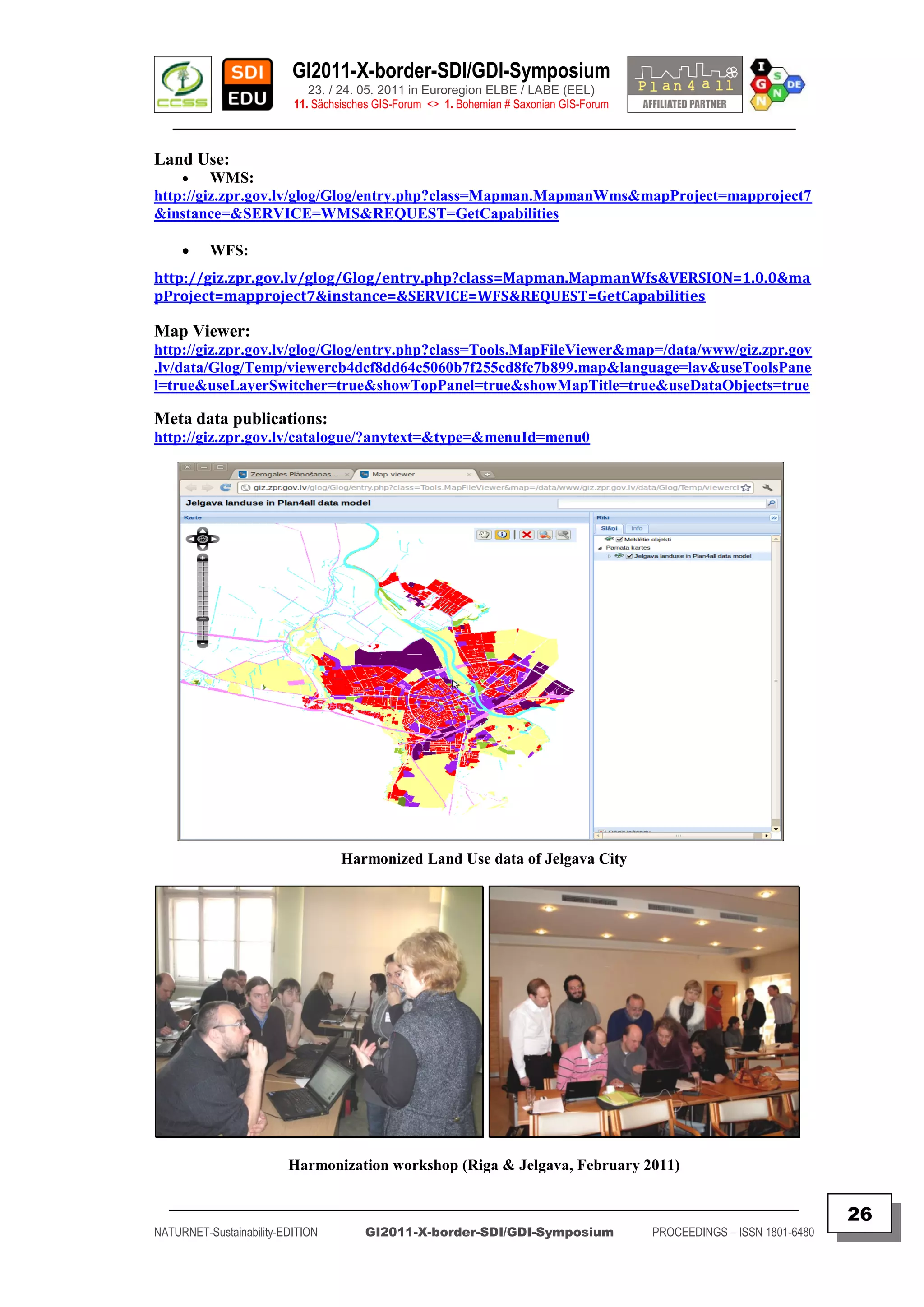
Land Use:
        WMS:
http://giz.zpr.gov.lv/glog/Glog/entry.php?class=Mapman.MapmanWms&mapProject=mapproject7
&instance=&SERVICE=WMS&REQUEST=GetCapabilities

         WFS:
http://giz.zpr.gov.lv/glog/Glog/entry.php?class=Mapman.MapmanWfs&VERSION=1.0.0&ma
pProject=mapproject7&instance=&SERVICE=WFS&REQUEST=GetCapabilities

Map Viewer:
http://giz.zpr.gov.lv/glog/Glog/entry.php?class=Tools.MapFileViewer&map=/data/www/giz.zpr.gov
.lv/data/Glog/Temp/viewercb4dcf8dd64c5060b7f255cd8fc7b899.map&language=lav&useToolsPane
l=true&useLayerSwitcher=true&showTopPanel=true&showMapTitle=true&useDataObjects=true

Meta data publications:
http://giz.zpr.gov.lv/catalogue/?anytext=&type=&menuId=menu0


                                   Harmonized Land Use data of Jelgava City


                         Harmonization workshop (Riga & Jelgava, February 2011)

  _________________________________________________________________________________________
                                                                                                                         26
NATURNET-Sustainability-EDITION        GI2011-X-border-SDI/GDI-Symposium                  PROCEEDINGS – ISSN 1801-6480
GI2011-X-border-SDI/GDI-Symposium
                             23. / 24. 05. 2011 in Euroregion ELBE / LABE (EEL)
                          11. Sächsisches GIS-Forum <> 1. Bohemian # Saxonian GIS-Forum
   ________________________________________________________________________________________


  THE “BIZBIZ” TOOL AS AN ONLINE PLATFORM
  FOR CROSS-BORDER EDUCATION IN SDI-EDU
                  PROJECT
                                   Raitis BERZINS & ICMS-Team
                                  University of Latvia – IMCS – Riga (LV)
                                                    ABSTRACT
Keywords: bizbiz, e-learning, inspire, meta-data, modelling, sdi-edu, video lectures
Contents:
         The “BizBiz” tool is an opensource web browser based e-conference, collaboration and
learning tool which supports slide shows, web page demonstration, synchronous pre-recorded video
display, chat and lecturers live narration using web camera provided video and audio.
         It is part of the SDI-EDU platform for vocational e-learning which is designed and
implemented as a virtual database based on social network principles of the GeoPortal4everybody and
principle of web services using Unified Resource Management (URM). The SDI-EDU project aims to
knowledge transfer of former experiences gained from different EU research projects like HUMBOLDT and
NATURNET+REDIME (NNR) dealing with education on SDI for spatial planning towards sustainable urban
& regional planners in European ( border ) Regions and Municipalities.
         In the second year of the project various improvements to “BizBiz” tool has been made
ranging from multilingual content support to integration with social networks and mapping services.
Modelling of the BizBiz” system in different usage scenarios and load conditions has been carried out
and predictions of its behavior has been made.
         The “BizBiz” learning database now consists of ~50 presentations about SDI related subjects
in 6 european languages to be usable with “BizBiz” tool support.
         The “BizBiz” tool has been developed in the Institute of Mathematics and Computer Science
(IMCS) and is used in EU projects like NaturNetplus and SDI-EDU to support learning processes about
the use of Geographic Information Systems and implementation of the INSPIRE-Directive.

                                                       Authors
      Mgr. comp. Raitis Bērziņš & MSc. Andris Dzerve & Dr. math. Māris Alberts
                                                    References
                                  IMCS: “BizBiz” online lecturing tool. Riga: 2010.
                                  Internet [ http://sdi-edu.zcu.cz/wiki/Main_Page ]
     Raitis Bērziņš: GIS education using online video lectures – The OpenSource “BizBiz”-Project.
                      In: Proceedings of GI2010-Symposium, Dresden: 2010, p. 26
     [ http://www.epsiplatform.eu/content/download/55172/760157/version/1/file/GI2010-Symposium-BERZINS+%28BizBiz%29.pdf ]

  Janecka K., Berzins R., Charvat K., Dzerve A.: The “GeoPortal4everybody & BizBiz” tools as a
modern technological framework for vocational e-learning. In: Proceedings of ELDE Conference, Sofia:
                                           2011, p. 215

                                                        Contact
                 Institute of Mathematics and Computer Science, University of Latvia
                                          Department of Realtime Systems
                                      Raina bulvaris 29, Riga, LV-1459 Latvia
                                    Tel: +371 67226997 & Fax: +371 67820153
                                      Email: [ alberts(at)latnet.lv ]

  _________________________________________________________________________________________
                                                                                                                               27
NATURNET-Sustainability-EDITION         GI2011-X-border-SDI/GDI-Symposium                       PROCEEDINGS – ISSN 1801-6480
GI2011-X-border-SDI/GDI-Symposium
                             23. / 24. 05. 2011 in Euroregion ELBE / LABE (EEL)
                          11. Sächsisches GIS-Forum <> 1. Bohemian # Saxonian GIS-Forum
   ________________________________________________________________________________________


   THE BICYCLE ROUTE OF “ST. JAMES” WAY IN
           LOWER SILESIA PROJECT
                      Jan BLACHOWSKI & Przemysław MALCZEWSKI
       Dolnoslaskie Voivodeship Marshal's Office, Spatial Planning Regional Bureau Wroclaw (PL)


                                                  ABSTRACT
Keywords: St. Jacob’s Way, Via Regia Plus, bicycle trails, GPS navigation
Contents:

        The Way of St. James (Camino de Santiago) is an European network of
pilgrimage routes leading to the shrine of Sanitago de Compostela in NW Spain, which
is the resting place of St. James the Apostle. A beacon for all travellers is a white or
yellow scallop shell a symbol of St. James.

        The Lower Silesian part of the network, in Poland, consists of four trails: the
Via Regia extending from Brzeg in the East, through Wroclaw, Legnica and Luban to
Zgorzelec in the West, the Lower Silesian Way extending NE from Luban on the Via
Regia towards Gdansk, Via Cervimontana running from Jelenia Gora in the Sudety
Mts. and joining Via Regia in Luban and Sleza Way extending from Mt. Sleza south of
Wroclaw and joining Via Regia in Sroda Slaska. Within the frames of the project Via
Regia Plus carried out under the Programme for Central Europe of the European
Territorial Cooperation (ETC) work has been done to analyse and propose the course of
St James Way for bicycle use.

       In the results of field work, which included cycling on over 550km of trails,
four bicycle routes accessible for a casual cyclist have been proposed.

       Results of this work have been presented during final conference in Wroclaw
in December 2010. Information on the project can be found at the internet link cited in
references.

                                                       Authors
     Dr. Magdalena BELOF, Dr. Jan BLACHOWSKI, Przemysław MALCZEWSKI
                                                     Reference
                   Outline of a cycle route “The Way of St. James, in Lower Silesia”
                             [ http://www.wbu.wroc.pl/3.3.1./?lang=en ]
                                                        Contact
         Regional Bureau of Spatial Planning, Dolnoslaskie Voivodeship Marshal's Office
                         ul. Swidnicka 12-16, 50-068 Wroclaw, Poland,
                                    phone: 0048 71 343 79 46
                                     fax : 0048 71 344 52 45

     Email: [jblachowski@poczta.wbu.wroc.pl ] + [pmalczewski@poczta.wbu.wroc.pl ]
  _________________________________________________________________________________________
                                                                                                                         28
NATURNET-Sustainability-EDITION        GI2011-X-border-SDI/GDI-Symposium                  PROCEEDINGS – ISSN 1801-6480
GI2011-X-border-SDI/GDI-Symposium
                             23. / 24. 05. 2011 in Euroregion ELBE / LABE (EEL)
                          11. Sächsisches GIS-Forum <> 1. Bohemian # Saxonian GIS-Forum
   ________________________________________________________________________________________


                                                 SUMMARY
        The Way of St. James (Camino de Santiago) is an European network of
pilgrimage routes leading to the shrine of Sanitago de Compostela in NW Spain, which
is the resting place of St. James the Apostle. A beacon for all travellers is a white or
yellow scallop shell a symbol of St. James.
        The Lower Silesian part of the network, in Poland, consists of four trails: the
Via Regia extending from Brzeg in the East, through Wroclaw, Legnica and Luban to
Zgorzelec in the West, the Lower Silesian Way extending NE from Luban on the Via
Regia towards Gdansk, Via Cervimontana running from Jelenia Gora in the Sudety
Mts. and joining Via Regia in Luban and Sleza Way extending from Mt. Sleza south of
Wroclaw and joining Via Regia in Sroda Slaska. Within the frames of the project Via
Regia Plus carried out under the Programme for Central Europe of the European
Territorial Cooperation (ETC) work has been done to analyse and propose the course of
St James Way for bicycle use.
          The following tasks have been carried out:
         The first one concerned development of GIS database and map of the existing
          pilgrimage routes based on available guides and descriptions of the trails.
         Then the project has been discussed during a workshop with public participation
          of NGO‟s, representatives of local administration, cycling associations, friends
          of the St Jacob Way and other.
         The next step concerned field inventorying of all the routes with the use of
          satellite GPS positioning and field GIS mapping using database structure
          designed to collect data on the course of the bicycle route, position of cultural
          and nature attractions along the way, type and state of the trail surface, difficulty
          of the trail and condition of trail marking.
         In addition an extensive photo data base has been created.
        In the results of field work, which included cycling on over 550km of trails,
four bicycle routes accessible for a casual cyclist have been proposed. These are
mostly consistent with the walking St Jacob‟s Way trails. Each route has been divided
into single day sections (approx. 50km in length) for which detailed descriptions have
been prepared.
        These include: technical specification, length, difficulty, climb/descent and
overall suitability. On this basis a mini-guide for each section has been produced, which
also contain description of the main attractions along the route and its graphical profile
showing elevation changes. All the routes are presented in the form of an interactive
map on a web page where the guides can be downloaded as PDF files and cyclists
equipped with GPS receivers are able to download files with route trails and waypoints
in GPS data exchange format (gpx). These can then be used, after importing into GPS
units, for satellite navigation.
       Results of this work have been presented during final conference in Wroclaw
in December 2010. Information on the project can be found at the internet link cited in
references.


  _________________________________________________________________________________________
                                                                                                                         29
NATURNET-Sustainability-EDITION        GI2011-X-border-SDI/GDI-Symposium                  PROCEEDINGS – ISSN 1801-6480
GI2011-X-border-SDI/GDI-Symposium
                             23. / 24. 05. 2011 in Euroregion ELBE / LABE (EEL)
                          11. Sächsisches GIS-Forum <> 1. Bohemian # Saxonian GIS-Forum
   ________________________________________________________________________________________


THE REGIONAL SDI NODE IN SPATIAL PLANNING FOR
  THE FUNCTIONAL AREA OF WROCLAW – WWIIP
          SUPPORT FOR MANAGEMENT PROCESSES IN LAND USE POLICY
                      Jan BLACHOWSKI & Przemysław MALCZEWSKI
         Dolnoslaskie Voivodeship Marshal's Office, Spatial Planning Regional Bureau Wroclaw (PL)

                                       ABSTRACT + POSTER
Keywords: Regional SDI Node, Via Regia Plus, Inspire, Spatial planning
Contents:
                            PROJECT “VIA REGIA PLUS” INFO
           The Project VIA REGIA PLUS (Sustainable Mobility and Regional
Cooperation along the Pan-European Transport Corridor III) carried out under the
Programme for Central Europe of the European Territorial Cooperation (ETC) covers
the area along the Pan-European Transport Corridor III (Berlin / Dresden - Wroclaw -
Lviv - Kiev).


           Wroclaw City - as a leading partner along with 14 partners from Poland,
Germany, Slovakia and Ukraine, have focused on issues in the following areas:
          transport accessibility - railway and road systems,
          development in metropolitan areas and urban regions,
          tourism.


           The Regional Bureau of Spatial Planning in Wroclaw has implemented the
following tasks:
          Outline of a cycle route "The Way of St. James, in Lower Silesia" (work
           package WP5 - 5.3.3.).
          Analysis regarding the outline of a road route integrating the southern areas of
           Lower Silesia with the North – South nodes (work package WP3 - 3.3.1.).
          Works on Integrated Area Allocations System for for the Metropolitan Area
           (WP4 work package - 4.2.4.).
           More information about the project can be found at:
           [ http://www.viaregiaplus.eu ] and [ http://www.wbu.wroc.pl ]

  _________________________________________________________________________________________
                                                                                                                         30
NATURNET-Sustainability-EDITION        GI2011-X-border-SDI/GDI-Symposium                  PROCEEDINGS – ISSN 1801-6480
GI2011-X-border-SDI/GDI-Symposium
                             23. / 24. 05. 2011 in Euroregion ELBE / LABE (EEL)
                          11. Sächsisches GIS-Forum <> 1. Bohemian # Saxonian GIS-Forum
   ________________________________________________________________________________________


  _________________________________________________________________________________________
                                                                                                                         31
NATURNET-Sustainability-EDITION        GI2011-X-border-SDI/GDI-Symposium                  PROCEEDINGS – ISSN 1801-6480
GI2011-X-border-SDI/GDI-Symposium
                             23. / 24. 05. 2011 in Euroregion ELBE / LABE (EEL)
                          11. Sächsisches GIS-Forum <> 1. Bohemian # Saxonian GIS-Forum
   ________________________________________________________________________________________


                                                        SUMMARY

WWIIP – WHAT FOR?


          The Regional Bureau of Spatial Planning in Wroclaw, by pursuing the
objectives of the Via Regia Plus project, coordinates the creation and development of
the regional node of spatial data infrastructure in the field of spatial planning, which
links local and regional levels of administration - WWIIP.


OBJECTIVES:
         Spatial Monitoring,
         Integration / Interoperability,
         Harmonization / spatial planning standards Evaluation of Spatial Policy,
         Standardization of the planning documents publication.


ACCESS POINT:
          General access to the integrated planning information is addressed to the
decision makers and the space‟ consumers.


WWIIP – ARCHITECTURE AND FUNCTIONALITY


WWIIP - OPEN IDEA
          The entire system, based exclusively on free software solutions. It ensures
compliance with ISO and OGC standards and fulfils requirements of the INSPIRE
directive and IIP Act.


FUNCTIONALITY
          WWIIP, due to its functionality, is focused on the integration of multiple
sources of spatial data utilized in planning, by services (WMS, WFS)


  _________________________________________________________________________________________
                                                                                                                         32
NATURNET-Sustainability-EDITION        GI2011-X-border-SDI/GDI-Symposium                  PROCEEDINGS – ISSN 1801-6480
GI2011-X-border-SDI/GDI-Symposium
                             23. / 24. 05. 2011 in Euroregion ELBE / LABE (EEL)
                          11. Sächsisches GIS-Forum <> 1. Bohemian # Saxonian GIS-Forum
   ________________________________________________________________________________________

DATA CIRCULATION SCHEME


WWIIP - GIS TOOLS DEVELOPMENT
       The idea of the project is to strengthen cooperation between public
administration and universities in the area of as well as offer the final product of the
project to the wider public on the principles of open source licenses. All project
products has GNU GPL v3 license.
DEVELOPING SCHEME


                                                       Authors
                          Magdalena Belof, Jan Blachowski, Przemysław Malczewski

                                                     Reference
                   Outline of a cycle route “The Way of St. James, in Lower Silesia”
                                     http://www.wbu.wroc.pl/4.2.4/
                                                        Contact
              Regional Bureau of Spatial Planning, Dolnoslaskie Voivodeship Marshal's Office
                              ul. Swidnicka 12-16, 50-068 Wroclaw, Poland,
                                         phone: 0048 71 343 79 46
                                          fax : 0048 71 344 52 45
                                                  Email:
              [ jblachowski@poczta.wbu.wroc.pl ] + [ pmalczewski@poczta.wbu.wroc.pl ]

  _________________________________________________________________________________________
                                                                                                                         33
NATURNET-Sustainability-EDITION        GI2011-X-border-SDI/GDI-Symposium                  PROCEEDINGS – ISSN 1801-6480
GI2011-X-border-SDI/GDI-Symposium
                             23. / 24. 05. 2011 in Euroregion ELBE / LABE (EEL)
                          11. Sächsisches GIS-Forum <> 1. Bohemian # Saxonian GIS-Forum
   ________________________________________________________________________________________


HS-LAYERS AND PYWPS COMPONENTS FOR SPATIAL
      DATA NETWORKING INFRASTRUCTURE
                              Jachym CEPICKY & Karel CHARVAT
                             Help Service Remote Sensing – Benesov (CZ)
                                                  ABSTRACT
Keywords: INSPIRE, Geoportal, View Services, Processing Services
Contents:
         HSLayers combines capabilities of ExtJS and OpenLayers and several helping scripts to
establish truly Web GIS applications. The development started in 2007. In 2009, after 2 years of
development, it was released under conditions of GNU General Public License 3. HSLayers features are
coming up from OpenLayers.

         HSLayers additional functions: Dynamic adding of OGC (Open Geospatial Consortium)
services into map - clients for WMS and WFS, Portrayal of independent data sources on the client side.
Map composition is composed on the basis of requests to various servers.
        It is thus not necessary to install a map server, saving of map composition according
to WMC (Web Map Context) OGC specification on user computer for repeated future use or for
sharing between users, Extension of compute functions based on WPS (Web Processing
Service) OGC service according to user needs, Multilingual environment, Map requests to
various types of data stored on various servers, with automatic processing of results, Work with
micro-formats, Search on the map, Connection of the application with catalogue client (OGC
CSW) in the geoportal, which enables display of the searched service from catalogue directly on
the map, Edit function by snapping to chosen layers, Possibilities for advanced configuration of
user requests, Advanced measuring of length and surfaces, Print of map compositions with
possible of large print outs (up to A0 format), and finally, user configuration of print settings
         The important new issue is support for Web Map Context (WMC). Web Map Context (WMC)
describes how to save a map view comprised of many different layers from different Web Map Servers.
This mechanism is valuable for efficiently communicating across shift transitions.
         PyWPSW is an implementation of the Web Processing Service of the Open Geospatial
Consortium in Python. With PyWPS, it is possible to provide functionalities of geographic information
systems and other space-related software via Internet.
         The main advantage of PyWPS is, that it has been written with native support for GRASS-
GIS. Access to GRASS modules via web interface should be as easy as possible. Currently PyWPS is
used also with other platforms.

                                                       Authors
                                  JACHYM CEPICKY & KAREL CHARVAT,
                                       HSRS (Help Service Remote Sensing)

                                                    References
                                     [ http://www.bnhelp.cz]
           [ http://dev.bnhelp.cz/trac/hslayers ] + [ http://pywps.wald.intevation.org ]
                                                       Contact
                                         Help Service Remote Sensing
                            Vnoučkova 614, 25601 Benešov, +420 317 724 620
                             tel. +420 604 617 327 | mob. +420 317 724 620

                                     Email: [ bnhelp@bnhelp.cz ]

  _________________________________________________________________________________________
                                                                                                                         34
NATURNET-Sustainability-EDITION        GI2011-X-border-SDI/GDI-Symposium                  PROCEEDINGS – ISSN 1801-6480
GI2011-X-border-SDI/GDI-Symposium
                             23. / 24. 05. 2011 in Euroregion ELBE / LABE (EEL)
                          11. Sächsisches GIS-Forum <> 1. Bohemian # Saxonian GIS-Forum
   ________________________________________________________________________________________


           HABITATS - CROSS BORDER DATA
        HARMONIZATION OF PROTECTED AREAS FOR
                 TOURISM PURPOSES
  Karel CHARVAT & Jachym CEPICKY – Help Service Remote Sensing – Benesov (CZ)
        Premysl VOHNOUT – Czech Centre for Science and Society – Praha (CZ)

                                                  ABSTRACT
Keywords: Habitats, Biotops, Sea regions, Data Harmonisation INSPIRE, Geoportal,
Tourism, Social Validation, Social Networks.
Abstract:
          The HABITATS extends user-centric, co-design approaches into the arena of standards
design and adoption processes, considering standards initiatives such as INSPIRE, OGC, UNSDI to be
significant social, economic and institutional innovations. The elements of approach are maintained,
applying the model at all levels from the global scale of the to the local and regional policies that frame
many HABITATS validation pilots. Community building activities follow a Web 2.0 approach to
capture the knowledge in active user communities with a strong interest in contributing to the standards
development process.
          The main paradigm for HABITATS is not “What we would like to build” or “How we would
like to build”, but it is “Why?” (we need to build INSPIRE architecture, we need to harmonise data).
Only answering on such question could help and really attract local stakeholders to the implementation of
INSPIRE. Only, if we are able answer on such questions, we can see real profit from INSPIRE for local
and regional players. One application from economical segment, which was recognised by HABITATS
and which can profit from environmental data harmonization could be tourism.
          Harmonized data could make easier sharing local environmental data in tourist systems. There
exists set of tasks recognised by HABITATS like choice of most promising tourism routes – including
water sports and diving, according to the season and habitat diversity of the area, users – tourism
agencies, holders of local guest houses and hotels, local municipalities.
          As the coastal region encompasses also protected areas (Natura 2000) with limited allowed
actions the knowledge on location of habitats and their value is essential for all types of economical
activities. Any stakeholder involved in mentioned processes should be aware of the habitats‟ status in the
respective area. Besides, the same knowledge is necessary for the authorities as ministries, environmental
boards and coastal municipalities as the economical activities should be overseen and regulated to ensure
sustainable management of the natural resources. So the first group of target communities, although
diverse, is strongly nationally based.
          Taking into account the cross-border nature of any marine processes the data on habitat
situation is relevant also for the countries sharing the Baltic Sea area. This could also bring direct profit
to ICT application developers. Having standardised services could extended applications among regions.

                                                       Authors
         Karel CHARVAT & Jachym CEPICKY – HSRS (Help Service Remote Sensing)
               Premysl VOHNOUT – CCSS (Czech Centre for Science and Society)
                                                    References
      [ http://www.habitats.cz ] + [ http://www.inspiredhabitats.eu ] + [ http://inspiredhabitats.ning.com ]

                                                       Contact
                                           Help Service Remote Sensing
                                  Vnoučkova 614, 25601 Benešov, +420 317 724 620
                                   tel. +420 604 617 327 | mob. +420 317 724 620

                                      Email: [ bnhelp@bnhelp.cz ]
  _________________________________________________________________________________________
                                                                                                                         35
NATURNET-Sustainability-EDITION         GI2011-X-border-SDI/GDI-Symposium                 PROCEEDINGS – ISSN 1801-6480
GI2011-X-border-SDI/GDI-Symposium
                             23. / 24. 05. 2011 in Euroregion ELBE / LABE (EEL)
                          11. Sächsisches GIS-Forum <> 1. Bohemian # Saxonian GIS-Forum
   ________________________________________________________________________________________


  ENVIROGRIDS TOWARDS "BLACKSEA" CACHMENT REGIONS –
   CROSS-BORDER SDI FOR WATER AND LAND MANAGEMENT
                            Karel CHARVAT & Premysl VOHNOUT
                          Czech Centre for Science and Society – Praha (CZ)
                                                  ABSTRACT
Keywords: GEOSS, INSPIRE, Black See, Catchment, Uniform Resource
Management, Metadata, OGC, Catalogue, Web Map Setrvices, Web Map Context, Web
Feature Servicies, GRID Computing, Content Management System.
Abstract:
          The enviroGRIDS project is contributing to the Global Earth Observation System of Systems
(GEOSS) by promoting the use of web-based services to share and process large amounts of key
environmental information in the Black Sea catchment. The main aim of the project is to assess water
resources in the past, the present and the future, according to different development scenarios.
          The objective is also to develop datasets that are compatible with the European INSPIRE
Directive on spatial data sharing across Europe. The data and metadata gathered and produced on the
Black Sea catchment are distributed through the enviroGRIDS geoportal. The challenge is to convince
and help regional data holders to make their data and metadata available to a larger audience in order to
improve our capacity to assess the sustainability and vulnerability of the environment.
          EnviroGrids focuses on building the capacity of scientific community to assemble such a
system in the Black Sea Catchment and one of the goals of this project is the development of a web
platform for knowledge dissemination that will also enable citizens‟ active and collaborative participation
in environmental resources management, with emphasis on fresh-water resources through integrated
River Basin Management.
          The EnviroGrids portal was initially presented as Uniform Resource Management (URM),
Current concept include not only basic URM tools, but also interaction with Social Media. The current
Geoportal has to offer services supporting the creation of a spatial data sharing system with possibility
to publish data for any user having access to Web. The system is based on open formats and is open for
interaction with other SDI platforms. It could be used in education, but also could be a solution for
researchers, voluntary initiatives and data providers, and supports also GEOSS principles.
          The EnviroGrids portal is a new integrated solution being designed as a combination of
previous technologies – Uniform Resource Management, Geohosting and new technological development
of a visualization client based on HSLayers - OpenLayers+ExtJS mapping framework.
          The URM Geoportal is not the one integrated solution, but a set of modules and services,
which are able to communicate through interoperable services (OGC, W3C). The solution is modular and
could be easily modified for different purposes The URM models currently integrate different tools,
which support sharing of knowledge. The Geoportal contains common metadata and catalogue, data
sharing and visualization functionalities.

                                                       Authors
                                  Karel CHARVAT & Premysl VOHNOUT
                           CCSS (Czech Centre for Science and Society) – Praha (CZ)

                                                    References
                        [ http://www.envirogrids.cz ] + [ http://www.envirogrids.net ]

                                                        Contact
                                    Czech Centre for Science and Society
                                             Radlicka 28; 150 00 Praha 5
                                   tel. +420 604 617 327 | mob. +420 604 617 327

                                          Email: [ ccss@ccss.cz ]
  _________________________________________________________________________________________
                                                                                                                         36
NATURNET-Sustainability-EDITION        GI2011-X-border-SDI/GDI-Symposium                  PROCEEDINGS – ISSN 1801-6480
GI2011-X-border-SDI/GDI-Symposium
                             23. / 24. 05. 2011 in Euroregion ELBE / LABE (EEL)
                          11. Sächsisches GIS-Forum <> 1. Bohemian # Saxonian GIS-Forum
   ________________________________________________________________________________________

        SDI - THE PYRAMID OR SPIDER NETWORK
                            Karel CHARVAT & Premysl VOHNOUT
                          Czech Centre for Science and Society – Praha (CZ)

                                                  ABSTRACT
Keywords: GEOSS, INSPIRE, GMESS, SDI, Social Media, Voluntary initiatives,
Cross-border applications.
Abstract:
          Global SDI building is usually described like the pyramid building. Current experiences
demonstrate, that for practical usage is more efficient the “spider net infrastructure”, where different
local or global levels are able to share data directly. As examples could be mentioned cross border
systems, systems of different communities across Europe or World, etc.
          A 4th way to SDI is the way to shift from the pyramid paradigm, to paradigm of spider net.
Connected with our concept is the system of distributed data sources, where every provider could decide
about accessibility of his data against concept of cloud computing, where one organisation is managing
all information.
          The principle of “Geoportal4everybody” (G4E) allows to build a "spidernet" infrastructure
supporting interconnection of any two portals and effective exchange of information. This concept is also
more related to GEOSS principles.
          Our Geoportal solutions support two approaches. It offer possibility of publishing user
derived data on community portal, but also sharing information using metadata catalogues with other
portals. It also offers connection with public portal and re-use of information on public portals. It
supports also easy integration of such information sources like OpenStreetMap. With the development of
new desktop solutions, it is possible also connecting the whole infrastructure from desktop solutions.
This depends on the ability of desktop systems to implement OGC standards and also eventual catalogue
functionality.
          The new functionality of G4E also includes aspects of social network. A social network
consists of a finite set or sets of actors and the relation or relations defined on them. The presence of
relational information is a critical and defining feature of a social network. The focus of the URM
Geoportal project is on social network sites (e.g LinkedIn, Facebook, Twitter) as one of the main
dissemination and communication tool. The Geoportal is in principle also a social network offering
sharing of information (including spatial) among its own community and offers support for information
exchange as well among thematical communities.
          The Geoportal is an entry point for any news (new developments, problematic topics,
progress in the project, etc.). News are posted by the project partners and will be automatically
distributed to a number of selected communities – social network sites.
          This approach will allow involving of other communities from one place without having to
enter each other community. Users of various social network sites can read entries and comment through
their respective communities and don‟t have to register elsewhere.
          GeoPortal4everybody also supports utilization of information from other social networks like
SlideShare or YouTube.

                                                       Authors
                                  Karel CHARVAT & Premysl VOHNOUT
                           CCSS (Czech Centre for Science and Society) – Praha (CZ)

                                                     Reference
                                     [ http://www.egeoportal4everybody.cz ]

                                                        Contact
                                    Czech Centre for Science and Society
                                             Radlicka 28; 150 00 Praha 5
                                   tel. +420 604 617 327 | mob. +420 604 617 327
                                          Email: [ ccss@ccss.cz ]
  _________________________________________________________________________________________
                                                                                                                         37
NATURNET-Sustainability-EDITION        GI2011-X-border-SDI/GDI-Symposium                  PROCEEDINGS – ISSN 1801-6480
GI2011-X-border-SDI/GDI-Symposium
                             23. / 24. 05. 2011 in Euroregion ELBE / LABE (EEL)
                          11. Sächsisches GIS-Forum <> 1. Bohemian # Saxonian GIS-Forum
   ________________________________________________________________________________________


         ARCHITECTURE PERSPECTIVES OF A
                PAN-EUROPEAN SDI
                              ESDIN – BEST PRACTICES –
        TOWARDS THE EMERGING EUROPEAN LOCATION FRAMEWORK:
     SPATIAL DATA INFRASTRUCTURES BEYOND SCHEMA HARMONIZATION

                                                 Arnulf CHRISTL
                                                    METASPATIAL

Keywords: architecture, best practice, ESDIN, european, framework, harmonization,
location, INSPIRE
Abstract:
        The ESDIN consortium has successfully shown how data from European
NATIONAL MAPPING AND CADASTRAL AGENCIES (NMCA‟s) can be harmonized to
meet INSPIRE obligations whilst also addressing issues such as generalization, quality
evaluation, edge-matching and spatial data infrastructure (SDI) access control. In
doing so, it has laid the foundations for a European Location Framework (ELF) which
will enable cross-border information to be geographically-referenced and allow citizens,
businesses and governments to gain maximum benefit from the re-use of existing
national datasets.
        All software created is available under BSD licenses, making it open in the
most permissive way. The recommendations and guidelines are scale and theme
independent and, although they focus on aggregation and the update of data for
INSPIRE Themes in Annex I, they will also be applicable to other themes.

     Dieser Beitrag basiert auf den Ergebnissen des EU-Projektes
ESDIN. In Form einer Video-Demonstration werden
         Erfahrungen aus dem EU-CONTENTplusProjekt ESDIN vermittelt
         Verbindungen zwischen Interessengruppen gefördert
         Arbeiten zur Umsetzung von INSPIRE verdeutlicht bzw. für die eigenen
          Bedürfnisse in Wert gesetzt und
         ESDIN-Projektergebnisse mit einem Online Viewer vorgestellt.

                                                        Author
                                                  Arnulf CHRISTL
                                                                               +
                          Technical Coordinator of European Content Project ESDIN

                                References
           [ http://www.metaspatial.net ] + [ http://www.ESDIN.eu ]
                          [ http://www.esdin.eu/search/node/arnulf%20christl ]
               [ http://www.esdin.eu/project/summary-esdin-project-public-deliverables ]
                                                       Contact
                             [ http://www.metaspatial.net/contact.html ]
                             Email: [ arnulf.christl (at) metaspatial.net ]

  _________________________________________________________________________________________
                                                                                                                         38
NATURNET-Sustainability-EDITION        GI2011-X-border-SDI/GDI-Symposium                  PROCEEDINGS – ISSN 1801-6480
GI2011-X-border-SDI/GDI-Symposium
                             23. / 24. 05. 2011 in Euroregion ELBE / LABE (EEL)
                          11. Sächsisches GIS-Forum <> 1. Bohemian # Saxonian GIS-Forum
   ________________________________________________________________________________________


                                                 SUMMARY
         ESDIN - Underpinning the European Spatial Data Infrastructure with a
                               Best Practice Network
Implementing INSPIRE
        ESDIN found that many of the transformations required for INSPIRE compliance
are too complicated to be processed on-the-fly. Using EuroGeographics‟ experience of
creating pan-European datasets, it has developed a specification for a future ELF (European
Location Framework) that also enables a wider community, including NMCAs, to fulfill the
INSPIRE requirements.
         An automated approach to quality evaluation for all SDI process steps, which will
provide cost savings for data providers and quality measures for usability evaluation, were also
developed. This helps to meet user needs and improve efficiencies in NMCA‟s and other public
institutions. The consortium believes that there is no other quality evaluation methodology that
is as comprehensive and cost effective.
        For sustainable edge-matching maintenance, it is needed to agree on boundary
representations. And so the EuroGeographics‟ State Boundaries of Europe project is creating a
Euro-X-Boundary Dataset as the basis for the edge-matching service proposed by ESDIN.
        However, building services and harmonizing data is not just a technical process
matter – users need to know how data can be acquired as quickly and efficiently as possible
using available metadata and services, and, although it is desirable to have a harmonized policy
for all data providers very soon, it is likely that sustained effort in this area is required by
NMCA‟s to harmonize all aspects of their policy.


Proposals for a technical architecture
           There are a number of requirements that reflect on the architecture:
          NMCA‟s need to deliver consistent data at regular intervals for the data source layer
          Edge-matching, quality assurance and generalization should take place in an
           intermediary layer – the processing level of ESDIN
          Implementation of an update logic by NMCA‟s at the production level will be required
           to allow for data layers to be up-to-date
          Results from edge-matching, naming (Unique Identifier) and quality control must flow
           back from the intermediary layer to each involved data source layer.

         To be able to address these requirements the architecture needs to provide for
flexibility. At the same time it is necessary to build an infrastructure which will allow for near
realtime updates, if the involved data producer can provide this. Also, the conceptual INSPIRE
architecture model should serve as a template to implement the solution.
       The resulting architecture consists of three different areas, the data production, the
intermediary data cache and the client and user level.
        Depending on the users' needs it is possible to retrieve data from different levels of
the architecture. Some users might want to access the data directly from the producer level (1),
either because they have individual contracts or because they already have special arrangements
in place with the data provider.

  _________________________________________________________________________________________
                                                                                                                         39
NATURNET-Sustainability-EDITION        GI2011-X-border-SDI/GDI-Symposium                  PROCEEDINGS – ISSN 1801-6480
GI2011-X-border-SDI/GDI-Symposium
                             23. / 24. 05. 2011 in Euroregion ELBE / LABE (EEL)
                          11. Sächsisches GIS-Forum <> 1. Bohemian # Saxonian GIS-Forum
   ________________________________________________________________________________________


             Figure 1: Two levels of data provision and access in an INSPIRE architecture

         Other users may need to access pan-European maps and underlying data, they will
instead access the intermediary data cache (2). It contains data which has gone through all the
extra processing steps involved in creating a high quality, harmonized homogeneous geographic
content.
        The data cache allows for another important advantage that also goes beyond the
needs of INSPIRE. It will be easy to add new data formats and interfaces. Besides the regular
INSPIRE View (OCG WMS) and Download Services (OGC WFS) ESDIN has opted for tile
caching as another way to access ready to use maps. In many contexts this way of delivering
maps is much more responsive and will satisfy the needs of a majority of users while at the
same time offering much better scalability.
       It will also be possible to implement an API on this central cache and create an Open
Linked Data store. This allows to link non-spatial resources, again without the need to set up
new components at every data provider site.
      The new Open Linked Data approach and the yet unknown effects of the Digital
Agenda on Public Sector Information will require heavy lifting of the involved data.
         Addressing new needs will be much more economic, consistent and also faster if done
at the central data cache level. The update mechanisms between the central data cache and the
data producers can be left untouched when adding new formats or even API‟s to the data at the
cache level.


  _________________________________________________________________________________________
                                                                                                                         40
NATURNET-Sustainability-EDITION        GI2011-X-border-SDI/GDI-Symposium                  PROCEEDINGS – ISSN 1801-6480
GI2011-X-border-SDI/GDI-Symposium
                             23. / 24. 05. 2011 in Euroregion ELBE / LABE (EEL)
                          11. Sächsisches GIS-Forum <> 1. Bohemian # Saxonian GIS-Forum
   ________________________________________________________________________________________


Technology and Software
        ESDIN was implemented to satisfy the needs and requirements of the participating
NMCA‟s. In order to minimize disruption of existing work flows and to best leverage existing
skills NMCA‟s were free to choose whichever software they wanted. The market for INSPIRE
ready software is still fairly small, both on the serving and the consuming side.
        More than ¾ of all participating NMCA’s chose to implement the publication
components of the architecture using Open Source technology. The others either used
proprietary software with special compatibility extensions, or implemented the required
components themselves.
         The Open Source stack used includes the “deegree” server components in versions 2
and 3, GeoServer and MapServer. Especially the “deegree” project has gone to quite some
effort to optimize their “deegree” version 3 of the software to deliver INSPIRE download
services out of the box.
        The client framework was implemented using OpenLayers with additional
extensions implemented during the project, especially to be able to use the Shibboleth
authentication federation which was set up to provide controlled access to the SDI. During the
project a lack of ready-to-use software capable of visualizing GML 3.2.1 was observed. The
obvious reason is the lack of availability of data in that format. Hopefully this will change in
future. As an alternative the ESDIN architecture is ready to accommodate extension for other
formats which can be easily hooked into the central data cache.
        The tiling service delivering the EuroGeographics products EuroRegionalMap (ERM)
EuroGlobalMap (EGM) and EuroBoundaryMap (EBM) is implemented using
“GeoWebcCache”, monitoring, service tracking and metadata management during the project
was performed with “Mapbender”.
        The full list of all software used during the project can be found in the Technical
Architecture document deliverable 5.2.

The way forward
        Feedback from the pricing and licensing workshops, and the user insight work,
demonstrated that on-going efforts to advance “best practice” in harmonizing, accessing and
processing geographic information are needed and will be well appreciated.
        It is now up to individual NMCAs, EuroGeographics and other Stakeholders to
progress and fund the creation of data and services to these specifications and therefore
complement INSPIRE with ELF.
       Names and addresses are at the root of most geographical searches so these INSPIRE
themes must be the cornerstone of any proposed ELF.
        The experience gained during the ESDIN project will be a helpful asset for building
and improving the architecture of the ELF. The ESDIN Consortium encourages European actors
to employ the methods outlined here in their own “best practice” towards INSPIRE compliance
and pan-European harmonization. Use the tools that have been created, experience the
demonstrations and engage with the emergent network of people and organizations that can be
used for building the ELF.

  The [ VIDEO ] presentation will give some more insights to the work which has
          been done in this EUROPEAN SDI NETWORK Project ( ESDIN ) !


  _________________________________________________________________________________________
                                                                                                                         41
NATURNET-Sustainability-EDITION        GI2011-X-border-SDI/GDI-Symposium                  PROCEEDINGS – ISSN 1801-6480
GI2011-X-border-SDI/GDI-Symposium
                             23. / 24. 05. 2011 in Euroregion ELBE / LABE (EEL)
                          11. Sächsisches GIS-Forum <> 1. Bohemian # Saxonian GIS-Forum
   ________________________________________________________________________________________


  CZECH SOLUTION FOR INSPIRE GEOPORTAL –
       THE GATEWAY TO NATIONAL SDI
      Jitka FAUGNEROVÁ, Jiří KVAPIL, Jiří HRADEC – CENIA – Praha (CZ)
                  Jaroslav PŠENIČKA – IBM – Praha (CZ)
                   Štěpán KAFKA – HSRS – Benesov (CZ)

                                                  ABSTRACT
Keywords: Catalogue, Czech Republic, Dataset, Decision making, Directive, editing,
Geoportal, INSPIRE, Map viewer, Metadata, Network, monitoring, OGC, Registry,
Services, spatial validating, WMS.
Abstract:
         There are two main activities supporting the implementation of the INSPIRE Directive in the
Czech Republic. These are coordinating structures forming and National INSPIRE Geoportal building.
Both are placing the cornerstone for a successful implementation: coordinating structures from the
organizational point of view, and the Geoportal from the technical one to be described.
         The development of the Czech National INSPIRE Geoportal has started apart from all the
organizational issues. The main driving forces for the Geoportal are of course the requirements of the
INSPIRE directive (to make data and metadata available, to run network services, etc.), but from the
beginning its creators decided to do more, than only provide an access to data guaranteed by the state
administration.
         The Geoportal is available at [ http://geoportal.gov.cz ] providing discovery and view
services. So far only following portal components are fully functional: metadata searching, metadata
editing, metadata validator, user registry, map window and monitoring. The others are being developed
according to the plan. Monitoring indicators can be easily inserted by each data provider without using
the complicated Excel template. Map viewer user interface supports OGC WMC. Each user is able to
combine services into map compositions, modify predefined ones, store the results on the Geoportal and
share them with others.
         The National INSPIRE Geoportal of the Czech Republic was launched in January 2011.
The number of registered users is increasing day by day, but the overall figures are still not high enough.
Data providers are mostly aware of INSPIRE Directive and know what they are expected to provide,
however they are sometimes hesitating to make their data or services available. The GIS community is
already familiar with map services provided by many providers, they are accessing it directly using GIS
software. So the most important is to inform the public, that there some INSPIRE Directive exists and
explain what profit they can have from it. This is the biggest challenge.

                                                       Authors
                         Jitka FAUGNEROVÁ, Jiří KVAPIL, Jiří HRADEC
                     CENIA (Czech Environmental Information Agency) – Praha (CZ)
                           Jaroslav PŠENIČKA – IBM.cz – Praha (CZ)
                 Štěpán KAFKA – HSRS (Help Service Remote Sensing) – Benesov (CZ)
                                                    References
               [ http://www.cenia.cz ] + [ http://inspire.gov.cz [ + [ http://geoportal.gov.cz ]

                                                       Contact
                              CENIA, česká informační agentura životního prostředí
                                       Litevská 1174/8; 100 05 Praha 10
                                tel. +420 267 225 294 | mob. +420 724 549 970

                                  Email: [ geoportal@CENIA.cz ]

  _________________________________________________________________________________________
                                                                                                                         42
NATURNET-Sustainability-EDITION        GI2011-X-border-SDI/GDI-Symposium                  PROCEEDINGS – ISSN 1801-6480
GI2011-X-border-SDI/GDI-Symposium
                             23. / 24. 05. 2011 in Euroregion ELBE / LABE (EEL)
                          11. Sächsisches GIS-Forum <> 1. Bohemian # Saxonian GIS-Forum
   ________________________________________________________________________________________

    THE RIVER DANUBE AS A CROSS-BORDER
   DEVELOPMENT DETERMINANT FOR THE CITY
               OF BRATISLAVA
                   Juraj FURDÍK, Rostislav ONDRUŠ, Denisa ŠEBOVÁ
             Faculty of Architecture, Slovak University of Technology – Bratislava (SK)

                                       ABSTRACT – POSTER
Keywords: Austria, Hungary, Cross-border, The River Danube, Bratislava, Landuse
Planning, Water Flow, Region, Slovakia
Contents:
        Historically, the River Danube protected the territory of Slovakia, and this
fact has naturally and politically demonstrated to the possibilities of the City of
Bratislava development and to the possibilities of the whole region development.

       The intention of this poster presentation is to point out natural and social
determinants of the development of Bratislava territory and in the context of the impact
on the border Slovak, Austrian and Hungarian villages (city districts).

        The poster presents the influence of the Danube water flow and its water
system in the evolutional (historical) context, when the voluminous system of the
starting point of the Central Europe delta – Danube mouth in the territories of Slovakia,
Hungaria and Austria presented autonomical natural and social system in the contact
with the capitals of these countries.

        The poster presentation is focused on the City of Bratislava and the territory of
surrounding villages in contact with the water system of Danube river, with emphasis
on the improvement of natural and civilization conditions in the context of sustainable
territory development of this border region.

                                                       Authors
      Ing. arch. Juraj FURDÍK, PhD., Mgr. Rostislav ONDRUŠ, Ing. arch. Denisa ŠEBOVÁ

                                                     Reference
                     [ http://www.fa.stuba.sk/generate_page.php?page_id=2358 ]

                                                       Contact
              Department of Computer and Multimedia Design, Faculty of Architecture,
                           Slovak University of Technology – Bratislava
                         Námestie slobody 19, 812 45 Bratislava, Slovakia
                                    phone: 00421 918 665 034

                                    Email: [ furdik@fa.stuba.sk ]


  _________________________________________________________________________________________
                                                                                                                         43
NATURNET-Sustainability-EDITION        GI2011-X-border-SDI/GDI-Symposium                  PROCEEDINGS – ISSN 1801-6480
GI2011-X-border-SDI/GDI-Symposium
                             23. / 24. 05. 2011 in Euroregion ELBE / LABE (EEL)
                          11. Sächsisches GIS-Forum <> 1. Bohemian # Saxonian GIS-Forum
   ________________________________________________________________________________________

URBAN STRUCTURE TRANSFORMATION OF THE
  PERIPHERAL BORDER DISTRICTS OF CITY
              BRATISLAVA
       Juraj FURDÍK, Ivor MEČIAR, Rostislav ONDRUŠ, Denisa ŠEBOVÁ
             Faculty of Architecture, Slovak University of Technology – Bratislava (SK)

                                       ABSTRACT – POSTER
Keywords:            Cross-border, Bratislava – Čunovo, Land-Use Planning

Contents:
        Development of peripheral city districts (villages) of Bratislava in the period after
1989 attained the strong dynamism at the border areas between Slovak, Hungary and Austria.
One of these city districts is Čunovo, which is unique, because its cadastral territory is
bordering directly with Hungary and Austria.

       This dynamism, caused by several factors, was dominantly influenced by the opening
of borders and by the admittance of Slovakia and Hungary as Member states to the single
European Union.

        The intentions and possibilities of structural transformation of the village, located
at the borders with Austria and Hungary is to preserve the suburban character, and as been
documented in several urban studies and zonal plans of Čunovo border territory.

          The Poster presents in more detail urban study of zone land-use plan of the
          “Area of the Former Collective Farm in Čunovo″ located in a border area.

        The intention of this study is a transformation of the functional usage to the zone of
housing and manufacturing and non-productive services. Therefore, the main objective of this
study was keeping of the sustainable development of the city district by searching for its new
architectural and urban image.

                                                       Authors
                Ing. arch. Juraj FURDÍK, PhD., Ing. arch. Ivor MEČIAR, ArtD.,
                     Mgr. Rostislav ONDRUŠ, Ing. arch. Denisa ŠEBOVÁ
                                                     Reference
                     [ http://www.fa.stuba.sk/generate_page.php?page_id=2358 ]

                                                       Contact
                  Department of Computer and Multimedia Design, Faculty of Architecture,
                               Slovak University of Technology – Bratislava
                             Námestie slobody 19, 812 45 Bratislava, Slovakia
                                        phone: 00421 918 665 034

                                    Email: [ furdik@fa.stuba.sk ]


  _________________________________________________________________________________________
                                                                                                                         44
NATURNET-Sustainability-EDITION        GI2011-X-border-SDI/GDI-Symposium                  PROCEEDINGS – ISSN 1801-6480
GI2011-X-border-SDI/GDI-Symposium
                              23. / 24. 05. 2011 in Euroregion ELBE / LABE (EEL)
                           11. Sächsisches GIS-Forum <> 1. Bohemian # Saxonian GIS-Forum
   ________________________________________________________________________________________

           CHALLENGES AND OPPORTUNITIES FOR
                EUROPEAN BORDER REGIONS
Analysis of Cross-border GeoPortals for GI/GIS/GDI & GeoINSPIRE’d Infrastructures of Data, Services and Applications

                                                 Frank HOFFMANN
            IGN-Vorstandsvorsitzender – (INNOVATION. Grenzüberschreitendes Netzwerk e.V.) – DRESDEN (DE)

                                                    ABSTRACT
Keywords:
    AEBR, Awareness, Border regions, BOWGIS, Education, ESDI, ETC/4A, EU-Directives, Europe, FP6/7, GDI,
Geodata, Geomatics, Geospatial, GI2000, GI2011, GSDI, INSPIRE, Interoperability, INTERREG/4A, NSDI,
OpenGIS, Pilot projects, PSI, Regions, SDI, Spatial planning, Strategy seminars, Sustainability, Usability, X-SDI.

Contents:
           The GI2000 Initiative, already created and discussed intensively between 1995 and 1999 as a vision,
mission and conception for an integrated European Spatial Data Infrastructure (ESDI) process, defacto was
ready for submission just after the 5th EC GI&GIS Workshop in Stresa/Italy in summer 1999. But, unfortunately, in
December 1999 in spite of the urged demission of the European Commission the GI2000 concept was cancelled.
           But, the GI2000 concept then was “re-invented” again in 2001 and promoted at EC GI&GIS workshop
2002 in Dublin as the “new”, but now as the well known INSPIRE process, officially proposed in 2004, and adopted
later on as the INSPIRE Directive 2007/2/EC.
           Finally, the INSPIRE Data and Service Sharing Guidelines of the European Commission, e.g. the legal
REGULATION No 268/2010 as of 29 March 2010 have been published at April 28th 2010.
           This Regulation is aiming to introduce OPEN GEODATA ACCESS conditions to spatial datasets,
information services and thematical applications (e.g. for georesource exploring, environmental monitoring and
spatial planning) not only inside of the EC institutions and agencies, but as well for regional/cross-border
organizations and local/cross-border communities in order to give them the opportunity to harmonize and integrate
geodatasets and public sector information (PSI-Directive 2003/98/EC) supplied from all Member states in an
interoperable and syntactically and semantically standardized way for environmental and spatial planning processes.
           Nevertheless, the geopolitical and technical decision process to implement INSPIRE until year 2019 is
moving very slowly not only in the European Member states, but as a follow-up also in Germany, as well in Saxony.
           But, the main barriers and, as well as important, challenges are the geodetic transformation, semantic
harmonization and cartomatic generalization of GEO/ENVIRO/SPATIO data and datasets and their integration
based on interoperable webservices from local via regional into national level to build a homogenous…

         Infrastructure of Spatial Information across European Border Regions ( INSPIRE-X-EBR ) !
         Therefore, this presentation gives an overview on the very few selected SDI, e.g. only 6-8 still existing
X-border-Geoportal initiatives, as well as X-SDI/GDI Pilot projects dealing with topometric, topological &
thematical interoperability, usability and sustainability of public & private sector geodata, webservices and
special PLAN4ALL applications across local, regional and state borders. The symposium will inform and make
aware the AEBR community of nearly 200 European Border Regions about the potential, chances and challenges
ahead when implementing the PSI & INSPIRE Directives in cross-border regions of Europe.

                                                           Author
                                           Doz. Dr. Frank HOFFMANN, CSc
                                                       References
  [ http://www.AEBR.eu/files/filemanager_files//dummy/AEBR_seminars/Vigo_2011/Presentations/Hoffmann_2011-AEBR-X-SDI-INSPIRE.pdf ]
                               ARCHIV: GI2010-Symposium - 10. Sächsisches GIS-Forum, Dresden 2010
                                 [ http://epsiplatform.eu/psi_library/reports/gi2010_dresden_symposium_may_2010 ]
                                ARCHIV: GI2009-Symposium - 9. Sächsisches GIS-Forum, Dresden 2009
                                    [ http://www.epsiplatform.eu/reports/gi2009_dresden_symposium_may_2009 ]
                                ARCHIV: GI2008-Symposium - 8. Sächsisches GIS-Forum, Dresden 2008
                                       [ http://www.epsiplus.net/reports/gi2008_dresden_symposium_may_2008 ]
                                              EU-FP6-Project-NATURNET [ http://www.NATURNET.org ]
        GEOSPATIAL SAXONY – WEBLOG GDI-SN [ http://GDI-SN.blogspot.com ] – IGN e.V. © 2002-2011, IGN. All rights reserved.
                                                          Contact
                              IGN - INNOVATION. Grenzüberschreitendes Netzwerk e.V.
                   c/o IGN-Vorstand, Martin-Andersen-Nexö-Str. 4, D-01217 DRESDEN / Saxony / Germany
                             [ http://www.FACEBOOK.com/event.php?eid=163068260403141 ]
                        Email [ Mailto:Vorstand@IGN-SN.de ] + [ Mailto:info@GDI-SN.de ]

  _________________________________________________________________________________________
                                                                                                                                     45
NATURNET-Sustainability-EDITION          GI2011-X-border-SDI/GDI-Symposium                         PROCEEDINGS – ISSN 1801-6480
GI2011-X-border-SDI/GDI-Symposium
                             23. / 24. 05. 2011 in Euroregion ELBE / LABE (EEL)
                          11. Sächsisches GIS-Forum <> 1. Bohemian # Saxonian GIS-Forum
   ________________________________________________________________________________________


    LEONARDO “SDI-EDU” PROJECT AS A FRAMEWORK
          FOR VOCATIONAL EDUCATION IN
            EUROPEAN BORDER REGIONS
        Karel JANECKA*, Jiri HIESS**, Vaclav CADA*, Radek FIALA*,
      Karel JEDLICKA*, Otakar CERBA*, Jan JEZEK*, Tomas MILDORF*
                *University of West Bohemia – Pilsen (CZ) & **CAGI – Prague (CZ)

                                                   ABSTRACT
Keywords: Awareness, BizBiz, contents, Directive, Geoportal, INSPIRE, learning
PSI, SDI-EDU, spatial planning, tools, vocational education,
Contents:
          The paper describes the proposed version of teaching content, the universal syllabus focused
on planners around all Europe. As this came from only several countries in a limited group of experts
during the first year of SDI-EDU project, therefore, the feedback and comments from different regions,
countries, from practitioners working in spatial planning, active in regional and urban planning, from
officials, and decision makers are welcomed.

          The drafted syllabuses will be in next step transformed and developed into practically useable
teaching lessons using all the SDI-EDU set of instruments and the teaching contents will be proved and
trained in partner countries for ordinary audience in the next part of project.

         Getting feedbacks the syllabus could be improved and modified to maximise the synergic
effects and get the most efficient learning.


                                                       Authors
                                                 Karel JANECKA1,
                         Jiri HIESS2, Vaclav CADA1, Otakar CERBA1, Radek FIALA1,
                               Karel JEDLICKA1, Jan JEZEK1, Tomas MILDORF1

                                                     Reference
              [ SDI-EDU – Deliverable “Training content selection and adoption” ]
                                         [ http://portal.sdi-edu.zcu.cz/ ]

                                                       Contact
                                          1
                                              University of West Bohemia
                                      Univerzitni 22, 30614 Pilsen, Czech Republic
                                               phone: 00420 377 632 673
                                                fax : 00420 377 632 602
  Email: [ { kjanecka | cada | cerba | fialar | smrcek | jezekjan | mildorf | } ]@kma.zcu.cz
                                  2
                                  Czech Association for Geoinformation – CAGI
                                              Novotneho lavka 5,
                                       116 68 Prague 1 – Czech Republic
                                               Email: [ hiess2@cagi.cz ]

  _________________________________________________________________________________________
                                                                                                                         46
NATURNET-Sustainability-EDITION          GI2011-X-border-SDI/GDI-Symposium                PROCEEDINGS – ISSN 1801-6480
GI2011-X-border-SDI/GDI-Symposium
                             23. / 24. 05. 2011 in Euroregion ELBE / LABE (EEL)
                          11. Sächsisches GIS-Forum <> 1. Bohemian # Saxonian GIS-Forum
   ________________________________________________________________________________________


                                                   SUMMARY
         In our focus are both the national level stakeholders (ministries, planning institutes, leading
planning ateliers), and the regional administrations and urban planners. To describe the whole portfolio
SDI-EDU uses illustrative use cases from European, national, regional, and even local scales.
         The targeted end users – specialized, but ordinary public active in planning processes – have
to fully understand the meaning and consequences of INSPIRE, of complex and harmonised spatial
information.
         The lectures are based on existing situation and open questions; therefore, learning by doing is
one of key teaching methods.


                    Fig. 1: The training material will be available from the SDI-EDU portal

         The contents will be developed even during the rest of project, as this has to be both universal in
any country or region, and reflect the hot-topic specifics. Due to the necessary ability to understand the
contents should be translated directly into partner languages. It contains also partial chapters unique in
given country.

          These specifics could be seen as marginal in the European context, but we consider it
important for the final success of educational process: the more will the contents reflect local situation,
the more will the audience understand the higher level scale planning problems. Interiorization of this
specific learning contents will cause improving the flexibility and competitiveness at the end.

         SDI-EDU team will carefully evaluate the feedback from upcoming teaching. The syllabus
cannot be fixed forever of course, this deliverable doesn´t solve teaching the planning disciplines, it adds
a value to new structural and working principles invoked by the INSPIRE and PSI re-use directives, and
allowed by modern advanced web geoinformation technologies.

         Additional analysis after WP1 (Analysis of User Requirements) conclusions was made as
preparatory and feedback process of WP3 (Curriculum Preparing). To be short and not to repeat, these
aspects were considered to prepare the learning context specifically for the planning sector:

  _________________________________________________________________________________________
                                                                                                                         47
NATURNET-Sustainability-EDITION        GI2011-X-border-SDI/GDI-Symposium                  PROCEEDINGS – ISSN 1801-6480
GI2011-X-border-SDI/GDI-Symposium
                             23. / 24. 05. 2011 in Euroregion ELBE / LABE (EEL)
                          11. Sächsisches GIS-Forum <> 1. Bohemian # Saxonian GIS-Forum
   ________________________________________________________________________________________

          • Technological challenges and operational techniques appropriate to planning
          • Recommended illustrative cases for implementation into teaching content and lessons
          • Feedback mechanism to indicate, mine and prove the expectations of planners
          • Exploring and measuring the knowledge (and its weakness) during the learning process
          • National and regional specifics
          • Review of relations and inputs to/from other projects, test beds, sources, events
          • Basic starting core themes of SDI-EDU curriculum
          • INSPIRE principles, challenges and advantages for planning tasks
          • Good practice illustrative cases
          • Networking architecture and services for planning
          • IPR in complex planning SDI
          • Necessary technological conditions to implement INSPIRE into planning
          • Practical typology of exercises:
          • Discovery, search – first quick orientation, overview
          • View, show, get geoinformation – user of planning information
          • Get geodata, download, pre-defined analyses – producer of planning information
          • Geodata provider – geopublishing, geoportals
          • Creative stand-alone analyst, decision maker, evaluator, examiner
          • Requests on teaching tools and environment, the teaching experience
          • Improving recommendations from feedback reactions of testers and practitioners

         For designing these learning contents we used several progressive concepts. INSPIRE
principles as one of the best developing and sustainable system of rules and techniques, with one big
advantage: This EU Directive was already transposed into legal systems of EU members, and must be
implemented. Annexes II and III of INSPIRE Directive include groups of geoinformation solved in
planning, many geodatasets are already prepared, done, exist, but not always accessible to routine
planners, in some and not for them appropriate form.

        Finally, we established the educational curriculum logically divided into 17 particular
learning contents topics:

SDI-EDU Learning topics:
1) Spatial Data Infrastructure (SDI) – the importance, awareness, its role in planning processes
2) INSPIRE directive and implementing mechanisms (IR ...)
3) National INSPIRE transposition
4) INSPIRE development and innovations in European projects (Plan4All, SDI-EDU) – what exactly:
tools, techniques, special applicative user and administrative GI knowledge, user skills
5) INSPIRE impacts in national context generally, in given country
6) INSPIRE implementation into the national environment (larger than SDI with respect to planning
practice and rules)
7) Legal rules, acts, normative, methodological institutes and processes in given country
8) Metainformation catalogues in / for spatial planning – generally, illustrative learning cases
9) Spatial data – INSPIRE approach for spatial planning – generally, with respect to learning cases base
on good practice understandable to the audience
10) Software tools directly useable for spatial planners – SDI-EDU teaching environment in accord to
existing LMSs
11) What to do with the existing spatial data in planning to be INSPIRE compliant? And what to do to be
useable for upcoming tasks and SP objectives in EU in given country?
12) How to find, evaluate, select, and use the existing heterogeneous spatial data and metadata? (First
orientation for users)
13) How to create new spatial planning metainformation to be INSPIRE compliant?
14) How to manage and improve the already existing metadata to be INSPIRE compliant?
15) How to create new spatial planning data to be INSPIRE compliant?
16) What does a geodata harmonisation mean? How to realise it in Spatial Planning?
17) Special case based on hot-topics in given country – to get the interests of our key target groups
(designing, planning, negotiation, and construction of e.g. new highways, supermarkets, solar or wind
power stations)

  _________________________________________________________________________________________
                                                                                                                         48
NATURNET-Sustainability-EDITION        GI2011-X-border-SDI/GDI-Symposium                  PROCEEDINGS – ISSN 1801-6480
GI2011-X-border-SDI/GDI-Symposium
                             23. / 24. 05. 2011 in Euroregion ELBE / LABE (EEL)
                          11. Sächsisches GIS-Forum <> 1. Bohemian # Saxonian GIS-Forum
   ________________________________________________________________________________________


     Fig. 1: All courses will be available on “BizBiz” as an external component of the SDI-EDU portal


         The key SDI-EDU value consists in flexible and quick complex teaching methodology and
information technology allowing authors to create and modify the teaching context. The end users can
access the lessons planned remotely, with no special technical equipment.

              The project team is working on learning material nowadays.
              The tools have been already developed.

         The GI2011-X-border-SDI/GDI-Symposium in Bad Schandau (SAX) # Decin (CZE) will be
used not only for presentation the SDI-EDU, for promoting its goals and ideas, but also for live expert
discussion. The participants of GI2011 are welcomed to visit the project webpage, to comment and prove
the SDI-EDU solution.


  _________________________________________________________________________________________
                                                                                                                         49
NATURNET-Sustainability-EDITION        GI2011-X-border-SDI/GDI-Symposium                  PROCEEDINGS – ISSN 1801-6480
GI2011-X-border-SDI/GDI-Symposium
                             23. / 24. 05. 2011 in Euroregion ELBE / LABE (EEL)
                          11. Sächsisches GIS-Forum <> 1. Bohemian # Saxonian GIS-Forum
   ________________________________________________________________________________________


           SHARING METADATA ACROSS EUROPE
   EXPERIENCES FROM “ONEGEOLOGY”, “HABITATS” AND “PLAN4ALL”
                 EUROPEAN RESEARCH NETWORKS
             Stepan KAFKA – Help Service Remote Sensing – Benesov (CZ)
           Karel CHARVAT – Czech Centre for Science and Society– Praha (CZ)

                                                  ABSTRACT
Keywords: Metadata, Catalogues, Metadata profiles, User communities
Abstract:
         MICKA is a complex system for metadata management used for building Spatial Data
Infrastructure (SDI) and geoportal solutions. It contains tools for editing and management of metadata
for spatial information, web services and other sources (documents, web sites, etc.). It includes online
metadata search engine , portrayal of spatial information and download of spatial data to local computer.
         MICKA is compatible with obligatory standards for European SDI building (INSPIRE).
Therefore it is ready to be connected with other nodes of prepared network of metadata catalogues (its
compatibility with pilot European geoportal is continuously tested). Initially, MICKA was developed as
monolithic system, but currently MICKA is a modular system divided into simple components, which
could be used independently.
         Currently exist the following independent MICKA components:
         INSPIRE metadata profile client for editing and validation of INSPIRE metadata
         Import module for importing metadata from existing services like WMS, WCS and their editing and
          validation against INSPIRE profile
         Editing module for existing metadata
         Light discovery catalogue client, which could be parameterized and included into different applications
         Full discovery catalogue, supporting multi catalogue search
         Full MICKA for Metadata administration, used only by the administrator
         Harvesting of metadata

          MICKA is a multilingual solution, currently translated into eighteen European languages and
it is used not only on local, regional and national level, but very often is used as well by different
European communities like geologist, spatial planners and others. These communities usually define
their own metadata profiles. As good example could be mentioned projects ONEGEOLOGY, PLAN4ALL
and HABITATS.
          In ONEGEOLOGY MICKA is the central metadata catalogue describing geological data assets
held by national Geological surveys in Europe. Through the catalogue geological data and services are
discoverable across Europe. One from main objective of PLAN4ALL project was to define an overall
spatial planning metadata profile applicable for spatial plan as a whole. The PLAN4ALL metadata profile
includes not only spatial data, but also non-spatial data, relations among data sets and also time
dimension. Also the HABITATS project defines an own metadata profile as extension to the INSPIRE
profile. The HABITATS profile could be tested and validated on the HABITATS reference laboratory.

                                                       Authors
                                   Dr. Stepan KAFKA & Dr. Karel CHARVAT
                              HSRS (Help Service Remote Sensing) – Benesov (CZ)
                                                     References
            [ http://one.geology.cz ] + [ http://www.plan4all.eu ] + [ http://www.habitats.cz ]
                                                        Contact
                                           Help Service Remote Sensing
                                  Vnoučkova 614, 25601 Benešov, +420 317 724 620
                                   tel. +420 604 617 327 | mob. +420 317 724 620
                                      Email: [ bnhelp@bnhelp.cz ]

  _________________________________________________________________________________________
                                                                                                                         50
NATURNET-Sustainability-EDITION         GI2011-X-border-SDI/GDI-Symposium                 PROCEEDINGS – ISSN 1801-6480
GI2011-X-border-SDI/GDI-Symposium
                             23. / 24. 05. 2011 in Euroregion ELBE / LABE (EEL)
                          11. Sächsisches GIS-Forum <> 1. Bohemian # Saxonian GIS-Forum
   ________________________________________________________________________________________


      TESTING OF SDI COMPONENTS – A
  FUNDAMENTAL INTEROPERABILITY ELEMENT
     WITHIN INSPIRE AND NATIONAL SDI’s
              Tomáš KLIMENT*, Martin TUCHYŇA**, Marcel KLIMENT***
              * Italian National Research Council, the Institute of Ecosystem Study (IT)
                    **Slovak Environmental Agency – SEA, Banská Bystrica (SK)
                        ***Slovak University of Agriculture – SPU, Nitra (SK)
                                                   ABSTRACT
Keywords: geospatial metadata, geospatial services, INSPIRE regulations, testing
methodology, testing tools, testing reporting
Contents:
        Before any Spatial Data Infrastructure (SDI) is implemented, relevant
testing procedures should take place to ensure full compliancy of all SDI components
against the standards setting up the SDI framework being deployed. Testing procedures
executed across various domains on national level can be the challenge and this
contribution comes with one example.
        The INSPIRE framework defines five components: metadata, network
services, spatial data, data sharing and monitoring and reporting.
        Metadata provides descriptive information about all existing resources within
SDI for the purpose of their discovery, evaluation and consumption. Metadata is served
by discovery service to the end user.
        Spatial data, metadata and related network services for their discovery,
portrayal, acquisition, transformation and processing are fundamental components of
any SDI in general. Spatial data is being used for further processing within an
individual business process related to the user needs. Spatial data is visualized by view
service, accessible by download service, processed by transformation and other
processing services.
        This contribution stresses the necessity of testing the above mentioned
components and provides user scenarios of cooperation between the public and
academic sector organisations. Current status and “best practices” within legally
mandated organizations (LMO) show that such cooperation is more then necessary in
order to gain required interoperability level on national and European level as well.
                                                       Authors
                                Dipl.-Ing. Tomáš KLIMENT &
              Dipl.-Ing. Martin Tuchyňa, PhD & Dipl.-Ing. Marcel Kliment, PhD
                                                    References
                        [ http://www.svf.stuba.sk/docs/sjce/2010/2010_2/file2.pdf ]
      [ http://gis.vsb.cz/GIS_Ostrava/GIS_Ova_2011/sbornik/papers/Kliment_theoretical.pdf ]
                                   [ http://geo.enviroportal.sk/nipi ]
                                                       Contact
                      Italian National Research Council, the Institute of Ecosystem Study
                               Largo Tonolli 50, 28922 Verbania Pallanza, Italy,
                                        cell phone: 0039 389 4955 954
                              Email: [ tomas.kliment@gmail.com ]
  _________________________________________________________________________________________
                                                                                                                         51
NATURNET-Sustainability-EDITION        GI2011-X-border-SDI/GDI-Symposium                  PROCEEDINGS – ISSN 1801-6480
GI2011-X-border-SDI/GDI-Symposium
                             23. / 24. 05. 2011 in Euroregion ELBE / LABE (EEL)
                          11. Sächsisches GIS-Forum <> 1. Bohemian # Saxonian GIS-Forum
   ________________________________________________________________________________________


BRINGING ECO-BIOLOGICAL METADATA TO THE
    INSPIRE META INFORMATION WORLD
                            Tomáš KLIMENT & Alessandro OGGIONI
                                  Italian National Research Council – CNR (IT)

Keywords: EnvEurope project, EML- Ecological Metadata Language, INSPIRE
metadata profile, Metadata crosswalk between EML and INSPIRE,
Abstract:
        The EnvEurope project proposes a design for environmental high quality
monitoring and long-term research sites and the exemplary establishment of common
parameter sets to be collected across the largest site-based network of Long-Term
Ecosystem Research (LTER) in Europe, in 3 different types of environment
(Lacustrine, Marin and Terrestrial).
        The aim of EnvEurope data management working group is to provide a
framework which allows to share the data within the project and to provide a use case
for INSPIRE/SEIS. Important part of data sharing is data discovery and evaluation by
its description. Hence, EnvEurope community metadata profile on the dataset level
using EML (Ecological Metadata Language) specification is being developed.
        EML is based on prior work done by Ecological society in United States (US)
and has been developed by ecologists for ecologic discipline. It is mainly used in the US
LTER sites, and many other sites in the world (Japan, Israel, etc.). As the project
community is geographically connected with Europe an INSPIRE form of this
community metadata profile has to be taken into account to promote interoperability for
any other community in Europe.
        This paper describes basic information about the construction of cross-walk
between EML metadata specification and INSPIRE metadata profile. Furthermore
provide pilot implementation of such cross-walk using XSLT technology. Moreover,
open questions and issues related mainly to the EML metadata collection using
available tools are defined for the future research work
        The EnvEurope metadata profile for dataset level implementation aims on the
one hand to support a framework, where interoperable way of long term ecological and
biological data exchange across Europe and even outside of EU should be achieved.
On the other hand the activity related to dataset level metadata within the INSPIRE
Thematic Working Group for Biogeographical regions, Habitats and Biotopes and
Species Distribution (TWG HB-BR-SD) is directly supported as well.
                                                       Authors
                      Dipl.-Ing. Tomáš Kliment & Alessandro Oggioni, Ph.D.
                                                     Reference
                                          [http://www.enveurope.eu/]
                   [ http://inspire.jrc.ec.europa.eu/index.cfm/pageid/42/list/7/id/76156 ]
                                                       Contact
                      Italian National Research Council, the Institute of Ecosystem Study
                               Largo Tonolli 50, 28922 Verbania Pallanza, Italy,
                                        cell phone: 0039 389 4955 954
                              Email: [ tomas.kliment@gmail.com ]
  _________________________________________________________________________________________
                                                                                                                         52
NATURNET-Sustainability-EDITION        GI2011-X-border-SDI/GDI-Symposium                  PROCEEDINGS – ISSN 1801-6480
GI2011-X-border-SDI/GDI-Symposium
                             23. / 24. 05. 2011 in Euroregion ELBE / LABE (EEL)
                          11. Sächsisches GIS-Forum <> 1. Bohemian # Saxonian GIS-Forum
   ________________________________________________________________________________________


      NOTHING – BUT A WASTE OF TIME AND MONEY?
                 SPECIFICITIES OF CROSS-BORDER COOPERATION
                IN THE GERMAN-POLISH-CZECH BORDER TRIANGLE

                                          Robert KNIPPSCHILD
               Dresden University of Technology, Chair of Spatial Planning (DE)

                                                   ABSTRACT
Keywords: Cross-border cooperation, German-Polish-Czech border triangle,
regional development.
Contents:
        Preconditions for cross-border cooperation are better than ever before. The
German-Polish-Border region has faced a rapid process of integration over the last
twenty years.
        Anyhow cross-border cooperation in the field of regional development and
planning in this region is stagnating.
            Why is that?
        Cross-border cooperation here is characterised by specificities that require
attention within the different phases of cooperation: political legitimation, funding,
process management, evaluation.
        The paper will highlight evidence from an evaluation of cross-border
cooperation in the German-Polish-Czech border triangle and will draw conclusions on
future cooperation in this region, and on requirements on future cohesion policy.

                                                        Author
                                          Dr. Robert KNIPPSCHILD
                                                    References
  Knippschild: Cross-border Spatial Planning: Understanding, Designing and Managing Cooperation
      Processes in the German-Polish-Czech Borderland. In: European Planning Studies 4/2011.

   Knippschild: Außer Spesen nichts gewesen? Nutzen und Erfolgsfaktoren grenzüberschreitender
 Kooperation in der Stadt- und Regionalentwicklung im deutsch-polnisch-tschechischen Dreiländereck.
                   In: Raumforschung und Raumordnung 3 / 2009. Seiten 228-238.

        Knippschild: Erklärungsansätze für erfolgreiche Kooperationsprozesse in der Stadt- und
      Regionalentwicklung im grenzüberschreitenden Kontext. In: Lehrstuhl für Planungstheorie und
            Stadtentwicklung RWTH Aachen: Planung neu denken online - Ausgabe I/2009.
                        [ http://www.planung-neu-denken.de/content/view/133/41 ]


                                                       Contact
               Dresden University of Technology, Chair of Spatial Planning (DE)
                                   phone: 0049 463335143
                                     fax : 0049 46337745
                      Email: [ Robert.Knippschild@mailbox.tu-dresden.de


  _________________________________________________________________________________________
                                                                                                                         53
NATURNET-Sustainability-EDITION        GI2011-X-border-SDI/GDI-Symposium                  PROCEEDINGS – ISSN 1801-6480
GI2011-X-border-SDI/GDI-Symposium
                             23. / 24. 05. 2011 in Euroregion ELBE / LABE (EEL)
                          11. Sächsisches GIS-Forum <> 1. Bohemian # Saxonian GIS-Forum
   ________________________________________________________________________________________

         COST & BENEFIT FACTORS OF REGIONAL SDI
                   INFRASTRUCTURES
           OF WESTERN, CENTRAL AND EASTERN PART OF EUROPE

                                  *Robert Lach & **Slawomir Anusz
       *Secretary of National Contact Point of PLAN4ALL Project, IGPIM – Warsaw (PL)
       ** Vice-director of Institute of Spatial Economy & Housing, IGPIM – Warsaw (PL)

                                                   ABSTRACT
Keywords:         Cross-border, Co-operation, Cost & Benefit Analysis of SDIs, interoperability of spatial
planning documents, state and regional/local levels cooperation, standardization of spatial planning
documetns, co-operative agreements between local and regional governments, National Spatial Planning
Concept 2030, National Strategy of Regional Development, Regional Operational Programmes, digital
spatial content, European Urban Atlas, GMES Pre-operational and (2011-13) and operational (2014-
2020) periods.

Contents:
         Achievements of Advanced Regions of Europe in building and operating their SDI‟s have
been described in two technical reports of SDI Unit of DG JRC, entitled : Socio-Economic Impact of
Spatial Data Infrastructure of Catalonia (Craglia, Almirall, 2008) and Advanced Regional Spatial Data
Infrastructures in Europe (Craglia, Campagna, 2009).

         Since the Government of Ukraine asked for some comparative data on impact of National and
Regional SDI’s across European Union, while preparing to approve its Law on National Geospatial Data
Infrastructure and preparing National Program of NGDI Implementation, data from 27 EU Member
States were assembled and compared, while talking on
          level of development of Information Society in Europe (i2010 report),
          digital cadastres implementation,
          mortgage markets description (European Mortgage Federation)
          and influence of cadastre, mortgage and SDIs on the development of economies of the
              countries of Europe.

         Comparison and dependance, by prof. Hernando DeSoto was found between development of
cadastral, mortgage systems, intellectual property and real estate rights protection – and the overall
GDP/capita of particular countries.

         Having some basic data on national levels (data from National Mapping Agencies, ARSDI
Report, regional governments and central governments) a study of several regions in Poland was made,
including basic statistical, financial, organizational and legal information. Some comparative tables
were fulfilled for Western, Central and Eastern Regions of Europe. Conclusions were drawn on the basis
of external data on eventuality of coming of second wave of the World Financial Crisis.

                                                        Author
                                         Robert LACH & Slawomir ANUSZ

                                                     Reference
                    Reflection on cross border cooperation in Lower Silesia, Poland
                  [ http://ec.europa.eu/regional_policy/opendays/CD/doc/c02.doc ]
                                                       Contact
                   NCP of PLAN4ALL, Institute of Spatial Economy and Housing (IGPIM)
                              ul. Targowa 45 03-728 Warszawa, Poland,
                                       phone: 0048 509 791 682
                                      Email: [ robertlach@igpim.pl ]
  _________________________________________________________________________________________
                                                                                                                         54
NATURNET-Sustainability-EDITION        GI2011-X-border-SDI/GDI-Symposium                  PROCEEDINGS – ISSN 1801-6480
GI2011-X-border-SDI/GDI-Symposium
                             23. / 24. 05. 2011 in Euroregion ELBE / LABE (EEL)
                          11. Sächsisches GIS-Forum <> 1. Bohemian # Saxonian GIS-Forum
   ________________________________________________________________________________________


   GIS-SOFTWARE ACROSS AGRI APPLICATIONS AND
            INTEGRATION OF BING MAPS
                                                Walter H. MAYER
                                  PROGIS Software GmbH, Villach / Austria

                                                   ABSTRACT
Keywords: Geographic Information Systems, GIS-Developer component, GIS based integrated
rural area management applications, AGRI-ICT, cross-border cooperation, data visualisation
Contents:
          PROGIS is an Austria based GIS-Software developer and specialist for applications for rural
area management – agriculture, forestry, environment and risk-management.
          PROGIS in 2010 closed a worldwide cooperation with Microsoft BING. Since then, Bing Maps
are embedded into the complete range of PROGIS technologies and can be used at click bases (for sure
also other images can be processed by PROGIS systems). In 2010 MS started to fly on new, Europe and
US to generate ortho-images with 30 cm resolution. The Western EU region is supposed to be finished in
June 2012.
          For rural-area management tasks, PROGIS agreed with Microsoft the following special deal:
Bing Maps in 30 cm resolution embedded into PROGIS technology can be used by all rural-area players
for a special flat rate price for the next 4 years and may be shared amongst them.
          A triple advantage – an extremely cheap flat rate for Bing Maps - divided with different users
gives a negligible price for images - embedded into an easy to use, easy to learn, powerful and cost
efficient GIS software WinGIS® and the complete range of applications across agri- and other thematical
sectors.
     Why are Maps important?
         Current, accurate and complete maps and geodata are quintessential for most, if not all, agro-forest-
          environment-risk projects.
         Public and Private Organizations (GO/NGO) need geodata for project definition, problem and risk
          assessment, project approval,
         Farmers and farmers organizations need geodata for project planning and project execution,
         Chain partners need geodata for status and progress tracking, project monitoring and supervision (incl.
          fraud detection)
         Application and database developers need geodata for visualizing their data.
     Why is PROGIS-ICT-technology important?
         GIS WinGIS® – AXWinGIS® for processing BING maps - to build up base maps of farms and regions -
          to develop own applications with the development component – to visualize data.
         AGRO-applications “AGROffice-DokuPlant and FORESTOffice” for planning, processing, documentation
          and control of all activities within agriculture & forestry and advisory services support.
         Rural-Logistics “mobGIS” for organizing and optimizing logistic processes of large farms - and small
          holder cooperatives (group needs - advisors)
         Precision farming “GIS-ISO-module, ISOBUS-communication” to benefit from sensor networks, to
          optimize machine usage, to manage the environment and risks – also cross-border!

                                                        Author
                                              Dipl.-Ing. Walter H. Mayer

                                                     Reference
                                   [ http://www.progis.com/de/ ]
                      [ http://www.progis.com/de/?id=gisMS_Bing_Maps.html ]

                                                       Contact
                             PROGIS Software GmbH, Postgasse 6, A-9500 Villach
                               phone: +43 4242 26332, fax : +43 4242 26332 7
                                        Email: [ mayer@progis.com ]
  _________________________________________________________________________________________
                                                                                                                         55
NATURNET-Sustainability-EDITION        GI2011-X-border-SDI/GDI-Symposium                  PROCEEDINGS – ISSN 1801-6480
GI2011-X-border-SDI/GDI-Symposium
                             23. / 24. 05. 2011 in Euroregion ELBE / LABE (EEL)
                          11. Sächsisches GIS-Forum <> 1. Bohemian # Saxonian GIS-Forum
   ________________________________________________________________________________________

                                               SUMMARY
    GIS-Software Across Agro Applications and Integration of Bing Maps
         ( How to strengthen farmer businesses or agriculture and forestry in general )


Benefits for farmers supported by technologies and accompanying measures:
          It is often mentioned that technology can support large farms or even smallholder farmers. Yes,
it can, but we have to accept that technology alone is not able to do the support. Technology needs
accompanying measures. We also have to understand that technology suddenly allows to plan, measure,
verify etc. precisely what we do in the nature – with positive and negative results.
          Farmers are producing in general food for 10 billion people in the near future, have in parallel
to provide biomass for energy production without competing with the food production and we have to
understand that –particular in times of climate change and increasing natural risks - farming is in
parallel reducing natural risks if land is managed correctly. All these facts have to be taken into
consideration - and managed.
          Further we understand more and more the integrated system of our nature that has no borders,
which means that mismanagement in one region or country can influence the situation in other
regions/countries. That further means that all nations have to cooperate better in managing their land –
and the main managers of the land are and will be the farmers.
          Smallholders are responsible for the environmental caretaking even at a higher percentage and
have thus to be compensated for their work. Managing farmers or smallholders was and will stay a deep
political process, but there is an urgent need for much deeper integration and cooperation that goes far
beyond state borders.

BING plus PROGIS ICT and weather-data, the AGRO-ICT backbone
       Public AND private stakeholders will be users and both will benefit from it.
Only with the setup of integrative AND cooperative models, the benefits for private
stakeholders (smallholders, large farms and forests), for public stakeholders
(government, extension services, etc.) and for ppp structures will be optimized. More,
suddenly we will be able to manage our nature for the benefits of private stakeholders as
well as for the needed social services coming from the nature, not automatically – they
must be planned, they must be controlled and we have to pay for them, and it must be
worked hard to reach the targets.
       Smallholder management supported by technology needs accompanying
measures like
         the enabling of the setup of smallholder cooperatives,
         a public or even better private, but public supported farm advisory system,
         an insurance system that backs up smallholders for worst case scenarios,
         a banking system that is able to support also smallholders.
         landowner titles, easy registered, for single smallholders or for groups (coop owners).

        Taking into consideration the need for all these measures for farmers or
smallholders, the base of all will be to have an ortho-image with, depending on region,
30-50cm resolution for agriculture or 50cm to 1(2) m resolution for forestry. The
orthoimage must be available for ALL chain partners. In detail we can plan, measure,
verify, document and control:

         WinGIS® and Bing Maps give precise ownership info.
         WinGIS® and Bing Maps allow easy/fast cadastre setu
         WinGIS® and Bing Maps give precise size of fields/forests
         WinGIS® and Bing Maps give the exact location of fields and forests for logistics use

  _________________________________________________________________________________________
                                                                                                                         56
NATURNET-Sustainability-EDITION        GI2011-X-border-SDI/GDI-Symposium                  PROCEEDINGS – ISSN 1801-6480
GI2011-X-border-SDI/GDI-Symposium
                             23. / 24. 05. 2011 in Euroregion ELBE / LABE (EEL)
                          11. Sächsisches GIS-Forum <> 1. Bohemian # Saxonian GIS-Forum
   ________________________________________________________________________________________
     DokuPlant® and Bing Maps allow precise farm-management (+advise) incl. local expert data
        integration for planning & documentation
     DokuPlant® and Bing Maps allow nutrient- and carbon-balancing (regions & countries)
     DokuPlant® and Bing Maps allow the use as subsidy tool
     DokuPlant® + FORESTOffice and Bing Maps allow all necessary calculations
     DokuPlant® + FORESTOffice and Bing Maps allow traceability and sustainability (§§)
     DokuPlant® + ForestOffice and Bing Maps allow providing business-plans for banks
     DokuPlant® + ForestOffice and Bing Maps give information for insurance companies
     DokuPlant® + FORESTOffice and Bing Maps for advisors are tools for regional analysis
     FORESTOffice and Bing Maps can calculate forest inventories
     Logistic, mobGIS and Bing Maps allow detailed logistic planning for complete regions
     Logistic, mobGIS & Bing Maps serve farmers-foresters AND partners with mobCOM
     WinGIS® integrates meteorological data for Precise Farming (PF)
     Meteodata allow pesticide optimization - PF in the best method, but needs data
     Machine interfaces (IsoBUS) allow Precise Farming
     FOMUMIIS, is an upgraded WinGIS® for environmental caretaking - risk management
     FOMUMIIS will generate hundred-thousands of new jobs and new values for farmers
     Trust Centres (cloud) allow the integration of countrywide agriculture - forestry –
        environmental – information, will enable the buildup of risk systems for food security
     Z-GIS and Bing Maps give a tool for land consolidation


All the above mentioned is possible only in combination with accompanying measures.
It will support smallholders and their families will in parallel fight against poverty and
malnutrition, will support rural development, and reduce risks for rural areas & for
smallholders.


Accompanying measures
supporting smallholders sustainably are listed up once more:

         Initiatives for local farmer cooperatives and the setup of
         Advisory services (public and private)
         Bank and insurance services for smallholder-farmers
         Regional smallholder support offices: Recommendations acc. practical experience are:
                o 1 expert for 300-500 farms ~ one expert for 3.000 - 5.000 people
                o 1 office keeps (10)25 experts and 1 general manager for 7.500 - 12.500 farms = 75.000
                    - 125.000 people
                o 1 expert team supporting advisors and allowing fast know how transfer to smallholders
                    in cooperation with national and international science.

Such models as mentioned above will be able:
       to increase the output of a 1 ha field due to optimized pest control, fertilization, logistics etc.
        from at least 10,-- €/ha and year to € 35,-- or more per ha and year; on the forest side it will
        at least 5,-- to 15,-- €/ha and per year
       due to better cooperation, better calculation and closer links to markets, better prices will be
        realized: We can calculate 20,-- /ha/a
       For Austria (1,4 Mio ha arable land, 2 Mio ha pastures, 3,9 Mio ha forests), I calculated 200
        Mio€ per year = 27,--€/y/ha. A 4%-rate is equal to a perpetual value of 675,-- €/ha.
       Beside this monetary, min. the same in ecological values is given, a total of 1.350,-- €/ha.
       Sub-Saharan Africa has 141 Mio ha arable land, 725 Mio pastures and permanent crops and
        559 Mio of forest area, in total agro-forest area of 1425 Mio ha! I do not calculate!
       Altogether such systems will document the work of smallholder farmers for the society!


  _________________________________________________________________________________________
                                                                                                                         57
NATURNET-Sustainability-EDITION        GI2011-X-border-SDI/GDI-Symposium                  PROCEEDINGS – ISSN 1801-6480
GI2011-X-border-SDI/GDI-Symposium
                             23. / 24. 05. 2011 in Euroregion ELBE / LABE (EEL)
                          11. Sächsisches GIS-Forum <> 1. Bohemian # Saxonian GIS-Forum
   ________________________________________________________________________________________

All will become possible when:
       orthoimages are available, are updated in a frequency of around 5 years;
       a backbone solution is installed to give public AND private users access to data (orthoimages,
        vector-information (like cadaster, soil maps, geological maps etc.)
       AND agriculture and forest and environment base-data (like machines and their costs, fertilizers,
        pesticides + chemical contents, carbon models, cultivation methods etc.) are embedded to be able
        to run on top the mentioned applications
       A fast ROI of such applications incl. base data is guaranteed but needs the fast setup throughout
        complete countries to ensure low prices as well as the implementation of mentioned
        accompanying measures (cooperatives, advisory services, agro-banks and agro-insurance
        companies, smallholder support offices).
        o     If we want to serve smallholders and our nature we have to act fast!
        o     We work for food for 10 billion people + sustainable bioenergy + environmental caretaking
              – with the help of 2,5 bio farmers, mainly smallholders - worldwide!


                    PROGIS Software
                    GmbH, Postgasse 6, 9500 Villach,
                    Tel. +43 (0) 4242-26332, Fax +43-(0)4242-263327,
                    email: office@progis.com Internet: http://www.progis.com


  _________________________________________________________________________________________
                                                                                                                         58
NATURNET-Sustainability-EDITION        GI2011-X-border-SDI/GDI-Symposium                  PROCEEDINGS – ISSN 1801-6480
GI2011-X-border-SDI/GDI-Symposium
                             23. / 24. 05. 2011 in Euroregion ELBE / LABE (EEL)
                          11. Sächsisches GIS-Forum <> 1. Bohemian # Saxonian GIS-Forum
   ________________________________________________________________________________________


SPATIAL PLANNING IN EUROPE – A CHALLENGE OR A
               PIECE OF CAKE?
      Karel JANECKA, Tomas MILDORF, Vaclav CADA, Karel JEDLICKA,
                 Otakar CERBA, Jan JEZEK, Radek FIALA
           University of West Bohemia – Department of Mathematics, Section of Geomatics (CZ)

                                                   ABSTRACT
Keywords:            SDI, best practices, harmonisation, interoperability, INSPIRE, spatial planning

Contents:
         The European project Plan4all is co-funded by the Community programme
eContentplus. The main aim of the project is to harmonise spatial planning data and related
metadata according to the INSPIRE principles.
         The Plan4all project should contribute to the standardisation in the field of spatial data
from a spatial planning point of view. Its activities and results are becoming a reference
material for the INSPIRE initiative; especially for data specifications.
         Plan4all is focused on the following 7 spatial data themes as outlined in Annex II and
III of the INSPIRE Directive:
          Land cover
          Land use
          Utility and Government services
          Production and industrial facilities
          Agricultural and aquaculture facilities
          Area management/restriction/regulation zones and reporting units
          Natural risk zones
         The Plan4all project has finalised standards that are in line with the INSPIRE
Directive. These standards include European spatial planning metadata profile, data models
for the above mentioned spatial data themes and networking architecture.
          This contribution should provide a general overview of these components.
         We can consider that solving partial problems of spatial planning data harmonisation
can be a piece of cake. When you try to connect these pieces together, it becomes a real
challenge.
         Please, visit the Plan4all geoportal to get more information about the implementation of
the Plan4all solution in pilot regions.

                                                       Authors
                                                Tomas MILDORF,
    Karel JANECKA, Vaclav CADA, Karel JEDLICKA, Otakar CERBA, Jan JEZEK, Radek FIALA

                                                     Reference
                                            [ http://www.plan4all.eu ]
                                                       Contact
                                           University of West Bohemia
                                   Univerzitni 22, 30614 Pilsen, Czech Republic
                                            phone: 00420 377 632 673
                                             fax : 00420 377 632 602
  Email: [ { kjanecka | mildorf | cada | smrcek | cerba | jezekjan | fialar }@kma.zcu.cz ]
  _________________________________________________________________________________________
                                                                                                                         59
NATURNET-Sustainability-EDITION        GI2011-X-border-SDI/GDI-Symposium                  PROCEEDINGS – ISSN 1801-6480
GI2011-X-border-SDI/GDI-Symposium
                             23. / 24. 05. 2011 in Euroregion ELBE / LABE (EEL)
                          11. Sächsisches GIS-Forum <> 1. Bohemian # Saxonian GIS-Forum
   ________________________________________________________________________________________

                                                  SUMMARY
         Human activity is a term that is very often declined in conjunction with social,
political, economic and environmental issues. Spatial planning is one of the most important
areas that strongly influence these issues on all levels. Sustainable planning addresses the
environment where people live and work, the location of social and economic activities, the way
in which the resources we possess are exploited, etc. Spatial planning acts in bottom-up and top-
down directions between all levels of government. National, regional and local authorities face
important challenges in the development of territorial frameworks and concepts every day.
         Spatial planning refers to the methods used by the public sector to influence the
distribution of people and activities in spaces of various scales. There are several definitions of
spatial planning. One of them is mentioned in the European Regional/Spatial Planning
Charter (1983) that was adopted by the European Conference of Ministers responsible for
Regional Planning (CEMAT): Regional/spatial planning gives geographical expression to the
economic, social, cultural and ecological policies of society. It is at the same time a scientific
discipline, an administrative technique and a policy developed as an interdisciplinary and
comprehensive approach directed towards a balanced regional development and the physical
organisation of space according to an overall strategy.
         There are many challenges for spatial planning in Europe - from heterogeneity of
data to differences of planning legislations in the European countries. Infrastructure for Spatial
Information in the European Community (INSPIRE) can significantly contribute to support
spatial planning processes, especially in transboundary contexts. It should help to enhance
exchange of strategic data, to improve the use of impact assessment and evaluation of plans and
provisions in spatial planning with transparency and shared methodology.
         Interoperability and harmonisation - two terms that are essential for the integration
of spatial planning information:
         Interoperability means the possibility for spatial datasets to be combined, and for
services to interact, without repetitive manual intervention, in such a way that the result is
coherent and the added value of the datasets and services is enhanced. [1]
         Data harmonisation - providing access to spatial data through network services in a
representation that allows for combining it with other harmonised data in a coherent way by
using a common set of data product specifications. [2]
         In other words, interoperability means that each country maintains their own
infrastructure but adopts a framework that enables existing datasets to be linked up from one
country to another. Interoperability may be achieved by either changing (harmonizing) and
storing existing datasets or transforming them via services for publication in the INSPIRE
infrastructure.
         The results of the PLAN4ALL project show the heterogeneity, fragmentation and
complexity of spatial planning in Europe. The Plan4all project is in the last phase of its lifetime
and using the draft INSPIRE data models will show the feasibility of data harmonisation.
PLAN4ALL project will take part in the INSPIRE testing of several spatial data themes from
Annex II and III of the INSPIRE Directive.

                                                    References
[1] Directive 2007/2/EC of the European Parliament and of the Council of 14 March 2007 establishing an
Infrastructure for Spatial Information in the European Community (INSPIRE). [Online].
Available: [ http://eurlex.europa.eu/JOHtml.do?uri=OJ:L:2007:108:SOM:EN:HTML.
[2] D2.5 Generic Conceptual model, INSPIRE Drafting Team “Data Specifications”. [Online].
Available: [ http://inspire.jrc.ec.europa.eu/reports/ImplementingRules/inspireDataspecD2_5v2.0.pdf ]


  _________________________________________________________________________________________
                                                                                                                         60
NATURNET-Sustainability-EDITION        GI2011-X-border-SDI/GDI-Symposium                  PROCEEDINGS – ISSN 1801-6480
GI2011-X-border-SDI/GDI-Symposium
                             23. / 24. 05. 2011 in Euroregion ELBE / LABE (EEL)
                          11. Sächsisches GIS-Forum <> 1. Bohemian # Saxonian GIS-Forum
   ________________________________________________________________________________________


   DEVELOPMENT OF A DECISION SUPPORT SYSTEM FOR
 TRANSBOUNDARY LAKE “CONSTANCE” WITH THE GENESIS
               PROJECT FRAMEWORK
                                   Stefan MIRBACH & Ulrich LANG
                 Ingenieurgesellschaft Prof. Kobus und Partner GmbH, Stuttgart (DE)

                                                   ABSTRACT
Keywords:            Cross-border, Lake Constance, Decision support system, FP7, GENESIS Project

Contents:
        Lake Constance is a transboundary lake shared between Germany, Switzerland and
Austria and the important drinking water reservoir. More than 4 Mio inhabitants are supplied
by the clean lake water without considerable treatment. In recent years a comprehensive
information system called BodenseeOnline was developed in a cooperative research project.
BodenseeOnline provides a wide range of historical as well as up-to-date data, which can be
accessed via a web interface:
     daily updated measurement data on meteorological and hydrological parameters all
        around the lake,
     data from weather forecasts for the next 78 hours,
     three dimensional distribution of hydrophysical and biogeochemical parameters
        simulated by numerical models.
     The models are updated daily and driven with actual data as well as data from
        weather forecasts, which allow a prognosis for the next 78 hours.
         To enhance the ability of BodenseeOnline to serve as a decision support system, the
GENESIS Project framework is used. Relying on standards and in strong synergy with the
major European or global harmonization initiatives (e.g. INSPIRE), this framework is based
on a thematic-neutral collaborative framework, made of web services, portal components and
toolkits, which can be customized and deployed for two thematic fields of water and air
quality.
            This paper presents the integration of the data from BodenseeOnline to GENESIS
    and the set-up of a decision support service using GENESIS. In case of an accident with
    hazardous substances in Lake Constance, this decision support service can be used by
    local authorities like water suppliers for obtaining a comprehensive evaluation and
    analysis of the current and predicted meteorological, hydrological and hydrodynamic
    conditions.
                                                       Authors
                                  Stefan MIRBACH & Dr. Ulrich LANG
                                                    References
          FP7-Project GENeric European Sustainable Information Space for environment
                                [ http://www.genesis-fp7.eu/ ]
                        Cooperative Research Project BodenseeOnline
                              [ http://www.bodenseeonline.de ]
                                                       Contact
  Ingenieurgesellschaft Prof. Kobus und Partner GmbH                                 Christian Alegre
                    Wilhelmstraße 11,                                         GENESIS project coordinator :
                 70182 Stuttgart, Germany                             THALES Aleniaspace, 100 Boulevard du Midi,
              phone: 0049 711 237 1936 00                                  FR-06156 CANNES La Bocca Cedex
               fax : 0049 711 237 1936 01                                        Phone: 0033 492 923 202
         Email: [ mirbach@kobus-partner.com ]                        Email: [christian.alegre@thalesaleniaspace.com]

  _________________________________________________________________________________________
                                                                                                                            61
NATURNET-Sustainability-EDITION        GI2011-X-border-SDI/GDI-Symposium                     PROCEEDINGS – ISSN 1801-6480
GI2011-X-border-SDI/GDI-Symposium
                             23. / 24. 05. 2011 in Euroregion ELBE / LABE (EEL)
                          11. Sächsisches GIS-Forum <> 1. Bohemian # Saxonian GIS-Forum
   ________________________________________________________________________________________


                                                 SUMMARY

        The Lake “Constance” is a transboundary lake shared between Germany,
Switzerland and Austria and an important drinking water reservoir as well. More than 4
Mio inhabitants are supplied by the clean lake water without considerable treatment.
Therefore there is a serious interest in preserving the lake‟s current status of high water
quality. At the same time the lake is under substantial pressure by a multitude of
potential contamination sources including:

         quite industrialized areas and intensive use of agriculture around the lake,
         industrial use of lake water (heating and cooling)
         traffic routes including air traffic.

       To handle the potential risks a comprehensive information system called
“BodenseeOnline” was developed in recent years in a cooperative research project. The
aim of this project was to install a decision support system for the assessment of
hydrodynamics and water quality in Lake “Constance”. BodenseeOnline provides a
wide range of historical, as well as up-to-date data, which is stored in a database and can
be accessed and visualized via a web interface:

         daily updated measurement data on meteorological and hydrological parameters all
          around the lake from different national data owners,
         data from weather forecasts for the next 78 hours,
         three dimensional distribution of hydrophysical and biogeochemical parameters
          simulated by numerical models.
         The models are updated daily and driven with actual data as well as data from weather
          forecasts, which allow a prognosis for the next 78 hours.

       While “BodenseeOnline” collects measurement data and runs lake models
to simulate hydrodynamic and water quality processes, no interpretation of the data is
undertaken. Furthermore “BodenseeOnline” provides only general information, a
compilation and visualization of data regarding case specific requirements is not yet
performed.

        To enhance the ability of “BodenseeOnline” to serve as a decision support
system, the framework provided by the GENESIS Project is used. This project has been
launched in September 2008 with 29 partners involved and a duration of three years.
The core of the solution provided by GENESIS is a "thematic-neutral information
system set-up framework". It can be easily customized for various thematic fields and
deployed in many contexts (Regional, European). In fact the GENESIS solution is
validated by six pilots, including the herein presented, addressing a wide range of
thematic blocks like air quality, water quality or environmental impacts on health.

         The solution relies on public open standards ( W3C, CEN, ISO, OGC, OASIS
) and is developed in strong synergy with the major European or global harmonization
initiatives like GEOSS and INSPIRE.


  _________________________________________________________________________________________
                                                                                                                         62
NATURNET-Sustainability-EDITION        GI2011-X-border-SDI/GDI-Symposium                  PROCEEDINGS – ISSN 1801-6480
GI2011-X-border-SDI/GDI-Symposium
                             23. / 24. 05. 2011 in Euroregion ELBE / LABE (EEL)
                          11. Sächsisches GIS-Forum <> 1. Bohemian # Saxonian GIS-Forum
   ________________________________________________________________________________________

          It includes:
         A generic portal plus a "portal factory", allowing to customize the portal to address
          new complex applications,
         A set of generic services covering most recurrent parts of an environment monitoring
          and management process. Typical generic services include:
                       Data access services,
                       Catalogue services,
                       Viewing (or portrayal services),
                       Geo-information Processing services

         A workflow management component allowing to chain services and to automate
          recurrent (e.g daily) complex tasks,
         A Toolbox facilitating the connection of legacy systems and a development
          environment for custom Web Processing Services (WPS).

        The GENESIS framework is used to set up a decision support service in
case of an accident with hazardous substances in Lake “Constance”. The aim is to
provide new tools for decision support to local authorities like water suppliers and
disaster management authorities. Besides, the service is used to evaluate the IT tools of
GENESIS.

       In case of an accident with hazardous substances in Lake “Constance”, the
decision support service delivers up-to-date data and an analysis of the current situation
including:

         Measured wind conditions from wind measurement stations around the lake
         Forecasted wind conditions,
         Vertical temperature profiles from numerical models and an index
          characterizing the stratification of the water column,
         Flow path computations using spill models to simulate the movement of a spill
          (forecast and hindcast).

       The main task is the connection of the data from the legacy system
“BodenseeOnline” to the GENESIS framework. This is done by using the catalogue
services provided by GENESIS:

         ebRIM catalogue, CIM profile for storing metadata of water velocity field data
          and
         temperature profile data,
         Sensor Observation Service (SOS) for storing data from wind measurement
          stations around the lake and pre-processed data like stratification indices.

        The data from “BodenseeOnline” database is daily harvested into these
catalogue services automatically as a rolling archive, i.e. data older than two weeks will
be deleted automatically.

        The decision support service can be invoked using the portal, which provides
an ordering page for the end user for entering spill accident information and accessing
current lake data using the Geodata Visualization Service (GVS).
  _________________________________________________________________________________________
                                                                                                                         63
NATURNET-Sustainability-EDITION        GI2011-X-border-SDI/GDI-Symposium                  PROCEEDINGS – ISSN 1801-6480
GI2011-X-border-SDI/GDI-Symposium
                             23. / 24. 05. 2011 in Euroregion ELBE / LABE (EEL)
                          11. Sächsisches GIS-Forum <> 1. Bohemian # Saxonian GIS-Forum
   ________________________________________________________________________________________

       The GVS is the cartographic map interface within the portal. It enables the
end user to select points or areas of interest and display layers from remote services like
Web Map Services (WMS), Web Feature Services (WFS), Web Coverage Services
(WCS) and the SOS. For the implementation of the WMS, WFS and WCS a customized
version of the open-source software GeoServer with extended functionalities like
netCDF support and management of time dimension requests is used. A screenshot of
the ordering page is displayed in
       Fig. 1.


              Fig. 1: User ordering page of the decision support service on the GENESIS portal
         When the user invokes the service, in a first step a catalogue search is executed to
check if the data for the user given timeframe is available. If yes, a custom Web Processing
Service (WPS) is executed, performing the actual processing of data and computations of the
spill‟s flow path. This WPS is built by using the GENESIS toolbox, which provides a
development environment for creating custom WPS using shell scripts, etc.
         The results of the WPS are again displayed using the GVS. Additionally, based on
the results a recommended decision for further proceedings is presented. The end user enters
accepts the decision or chooses another decision, which determines the dissemination of the
results, which are summarized in a report, to local authorities.
        The capability of the developed services will be tested by a hindcast of an oil accident
in March 2009 with international oil alarm around the entire lake due to an oil spill of 8 km
length and several 10 m width in the eastern part of Lake Constance.
        The presented application of the GENESIS framework extends the already existing
information system “BodenseeOnline” in offering a comprehensive analysis and processing of
available data with a case specific background in mind. This comprehensive and timesaving
approach can be a valuable component of a crisis management for end users like water suppliers
and disaster management authorities from all three countries around the lake.
        The presented decision support service is just one example for an application using
the GENESIS framework. As mentioned above, the framework is thematic-neutral and can be
used for wide range of fields. This is demonstrated by the six pilots, which have a high variety
of environmental contexts involving several geographical scales, several kinds of actors and
very different organizational models.
  _________________________________________________________________________________________
                                                                                                                         64
NATURNET-Sustainability-EDITION        GI2011-X-border-SDI/GDI-Symposium                  PROCEEDINGS – ISSN 1801-6480
GI2011-X-border-SDI/GDI-Symposium
                             23. / 24. 05. 2011 in Euroregion ELBE / LABE (EEL)
                          11. Sächsisches GIS-Forum <> 1. Bohemian # Saxonian GIS-Forum
   ________________________________________________________________________________________


CROSS-BORDER DATA HARMONISATION IN PRACTICE
– EXEMPLIFIED BY SAXON ATKIS AND CZECH ZABAGED DATA
            Sylvia ROEHNERT, Claudia GEDRANGE & Marco NEUBERT
                   Leibniz Institute of Ecological and Regional Development, Dresden (DE)

                                                   ABSTRACT
Keywords: ATKIS, cross-border, data harmonization, spatial base data, ZABAGED

Contents:
        Cross-border planning and information need homogeneous cross-border data bases.
Spatial base data as collected and provided by the respective land surveying offices offer a good
basis but refer only to the related national territory. Furthermore, they feature different
geographic projections, data formats and models, geometry (e.g. of the national boundary),
languages, and meanings of the contents.

         The objective of this project is to develop methods which allow the land surveying
offices to adapt their data to be seamlessly compatible along the national boundary (geometric
homogenization) and comparable regarding their contents (semantic harmonization).

        As a result methods will be developed which allow the cross-border harmonization
of spatial base data within a Geographical Information System (GIS). The implementation is
realized exemplary using vector data of the German ATKIS Basis DLM (Authoritative
Topographic Cartographic Information System, Digital Basis Landscape Model) and the Czech
ZABAGED data (Fundamental Base of Geographic Data/Základní báze geografických dat).
Both serve as the mostly used spatial base data on either side of the border.

        The project is realized in cooperation with the land surveying offices of Saxony
(Staatsbetrieb Geobasisinformation und Vermessung Sachsen, GeoSN) and the Czech Republic
(Land Surveying Office/Zeměměřický úřad, ZÚ). It is funded by the European Union (Ziel 3/Cil
3 programme to support the cross-border co-operation between the Free State of Saxony and
the Czech Republic 2007-2013) and the Free State of Saxony.

         The presentation will introduce the project and show the current state including first
results as well as practical outcomes regarding cross-border data harmonization.

                                                       Authors
       Dipl.-Geogr. Sylvia Röhnert & Dipl.-Geogr. Claudia Gedrange & Dr. Marco Neubert
                                                     Reference
                                   Project Website [ http://geodat.ioer.info/ ]
                                                       Contact
                       Leibniz Institute of Ecological and Regional Development (IOER)
                                     Weberplatz 1, 01217 Dresden, Germany
                                          phone: +49 (0) 351 4679-274
                                            fax: +49 (0) 351 4679-212

                                                         Email
                 [ s.roehnert[at]ioer.de | c.gedrange[at]ioer.de | m.neubert[at]ioer.de ]

  _________________________________________________________________________________________
                                                                                                                         65
NATURNET-Sustainability-EDITION        GI2011-X-border-SDI/GDI-Symposium                  PROCEEDINGS – ISSN 1801-6480
GI2011-X-border-SDI/GDI-Symposium
                             23. / 24. 05. 2011 in Euroregion ELBE / LABE (EEL)
                          11. Sächsisches GIS-Forum <> 1. Bohemian # Saxonian GIS-Forum
   ________________________________________________________________________________________


                                                 SUMMARY
         In a Europe of disappearing borders and especially in border regions itself a
growing demand on harmonized cross-border geodata is denoted. Harmonized geodata
facilitates cross-border spatial planning and information exchange. It enables to take
into account the situation on both sides of a border in equal measure. In addition the
needs for such data are stimulated by the INSPIRE directive of the European Union to
establish an Infrastructure for Spatial Information in European Community.
        The presented project „Cross-border harmonisation of spatial base data
between the Free State of Saxony and the Czech Republic“ aims to integrate data
across the border. It is funded by the Ziel3/Cíl3-progamme of the EU which intends to
develop cross-border cooperations in the saxon-bohemian border region and the Free
State of Saxony as well.
        The project is realised by three cooperation partners. The Leibniz Institute of
Ecological and Regional Development (IÖR) as Lead Partner is responsible for
scientific research and organisational steering. The cooperation with the land surveying
offices of Saxony (Staatsbetrieb Geobasisinformation und Vermessung Sachsen,
GeoSN) and the Czech Republic (Land Surveying Office/Zeměměřický úřad, ZÚ)
enables easy access and adjustments to the required data, as well as expert knowledge
about data models.
        The harmonization is realised for the official spatial base data in Germany
and the Czech Republic. These data is applicable for a wide range of possible usage
options. On the one hand it is vector data of the German ATKIS Basis DLM
(Authoritative Topographic Cartographic Information System, Digital Basis Landscape
Model) in the new AAA model. On the other hand it is the Czech ZABAGED data
(Fundamental Base of Geographic Data/Základní báze geografických dat). Both data
sets are provided and actualized by the responsible land surveying offices.
        Due to some similarities, concerning e.g. the acquisition scale and purpose, this
spatial base data sets offer a good basis for cross-border usage.
        In contrast, differences existing in geometry (see Fig. 1), projection, language,
denotation and data model require data harmonization. Thus, the objective of this
project is the geometric and semantic harmonization.


       Fig. 1 – Initial situation in the Saxon-Bohemian border region, [ http://geodat.ioer.info ]


  _________________________________________________________________________________________
                                                                                                                         66
NATURNET-Sustainability-EDITION        GI2011-X-border-SDI/GDI-Symposium                  PROCEEDINGS – ISSN 1801-6480
GI2011-X-border-SDI/GDI-Symposium
                             23. / 24. 05. 2011 in Euroregion ELBE / LABE (EEL)
                          11. Sächsisches GIS-Forum <> 1. Bohemian # Saxonian GIS-Forum
   ________________________________________________________________________________________

          The geometric homogenisation presupposes:
                    the use of a consistent coordinate reference system,
                    the integration of a common border geometry and
                    the edge matching of cross-border objects.
          The semantic harmonisation implies:
                    the creation of bi-lingual object type catalogues, as well as
                    the definition of matching functions and categories for comparing
                       data models.
       As a first step on the way to geometrically homogeneous data an agreement
about a consistent coordinate reference system was nessesary. Orignially saxon
ATKIS data is available in RD83 with Gauss-Krüger coordinates. ZABAGED data is
projected in S-JTSK with Krovak coordinates, which is especially adapted to czech
needs [Projektbericht AP 2.1].
        Both land surveying offices agreed to use ETRS89 with UTM coordinates. It
is the common reference system for Europe, defined by the INSPIRE directive
specification. Furthermore the transformation rules were adapted.
       Both geodata sets currently use an inaccurate border geometry. Thus, the
surveying offices came to the agreement to use the actual valid level of common border
geometry (resulting from common border measurements).
        In addition to that a set of relevant cross-border objects and especially
connecting points for edge matching were defined. Currently the edge matching is in
process. As a result the integration of a common border geometry and the connected
cross-border objects in the respective base data will be accomplished within the
project.
        The semantic harmonisation approach consists of various steps. At first both
object type catalogues were translated resulting in bi-lingual object type catalogues. The
translated catalogues allowed the conceptual analysis of the data models. This analysis
revealed complex differences regarding classification and detailedness. Due to the fact
that the data is official, the data models are not changed. Thus, for harmonization the
models are integrated by alignment [ Kavouras et al. 2008 ].
         To do so, all relevant combinations of object types and attribute values were
derived (ATKIS: ca. 1100, ZABAGED: ca. 310). The number of combinations is
restricted e.g. by conditions of consistency. For ATKIS only objects were used which
are maintained within Saxony (‚Bestandsdaten„).
     Subsequently, matching functions for both matching directions (ATKIS to
ZABAGED and ZABAGED to ATKIS) were adjusted in a process:
      At first, the cooperation partners prepared proposals.
      In a second step expert meetings supported by a competent interpreter helped
        to verify matching functions.
      Third, matching categories were discussed and established.
          The quality of matching functions is evaluated by seven categories
          [ Gedrange 2011 ]:

  _________________________________________________________________________________________
                                                                                                                         67
NATURNET-Sustainability-EDITION        GI2011-X-border-SDI/GDI-Symposium                  PROCEEDINGS – ISSN 1801-6480
GI2011-X-border-SDI/GDI-Symposium
                             23. / 24. 05. 2011 in Euroregion ELBE / LABE (EEL)
                          11. Sächsisches GIS-Forum <> 1. Bohemian # Saxonian GIS-Forum
   ________________________________________________________________________________________

                                 A – bi-unique
                                 B – superset
                                 C – overlap
                                 D – subset
                                 E – mapping to a superior object
                                 F – derivation
                                 G – no mapping

The frequency of the used matching categories is illustrated in Fig. 2. It applies to all
relevant combinations of object types and attribute values of both catalogues. In
addition to this fuzzy matching multiple mappings are often possible (for ATKIS to
ZABAGED 20% and for ZABAGED to ATKIS 35% of all combinations). In contrast,
to detect the matching quality in data sets itself, further analyses are nessesary.


                      Fig. 2 – Matching functions and categories for both directions,
                               including multiple mappings [ Gedrange 2011 ].

        For actual results, please, visit the bi-lingual project homepage at IOER
website [ www.geodat.ioer.info ]. Further information about the harmonized base data
is provided by the geoportals of the respective land surveying offices.


                                                 References
[ Projektbericht AP 2.1 ] Gedrange, C. (2009): Bericht zum Arbeitspaket 2.1
“Festlegung eines einheitlichen Bezugssystems”, available: [ http://geodat.ioer.info ].
[ Gedrange 2011 ] Gedrange, C., Neubert, M., Röhnert, S. (2011): Cross-Border
Harmonisation of Spatial Base Data between Germany and the Czech Republic.
International Journal of Spatial Data Infrastructures Research, Vol 6.
[ Kavouras et al. 2008 ] Kavouras, M. and M. Kokla (2008). Theories of Geographic
Concepts:Ontological Approaches to Semantic Integration. CRC Press, Taylor &
Francis Group, Boca Raton, FL, USA.


  _________________________________________________________________________________________
                                                                                                                         68
NATURNET-Sustainability-EDITION        GI2011-X-border-SDI/GDI-Symposium                  PROCEEDINGS – ISSN 1801-6480
GI2011-X-border-SDI/GDI-Symposium
                             23. / 24. 05. 2011 in Euroregion ELBE / LABE (EEL)
                          11. Sächsisches GIS-Forum <> 1. Bohemian # Saxonian GIS-Forum
   ________________________________________________________________________________________


   CENTROPE MAP AND CENTROPE STATISTICS – CROSS-
 BORDER GEODATA INFRASTRUCTURE WITH USER-DEFINED
                  THEMATIC MAPS

            Manfred SCHRENK*, Clemens BEYER*, Christian EIZINGER*
  * CEIT ALANOVA – Central European Institute of Technology, Dept. for Urbanism, Transport, Environment &
                                 Information Society, Schwechat (AT)
                                              Walter POZAREK**,
               ** PGO - Planungsgemeinschaft Ost (East Austrian Planning Association), Vienna (AT)

                                                   ABSTRACT
Keywords:            Cross-border, Web Mapping, Data Harmonisation, INSPIRE, Centrope Region

Contents:
                    Not long ago the only way to obtain digital geodata from different sources was to
    collect offline media like CD-ROMs and then match the datasets together on your own PC like a
    jigsaw puzzle. Nowadays, the situation has significantly improved. Almost each data processing
    institution is providing selected data via internet services which makes it easier for the users to
    retrieve the information wanted. However, these services are still mostly isolated without connections
    to neighbouring countries, sometimes even lacking content from neighbouring regions within the own
    country. Data beyond the administrative border is often not compatible, accessible and understandable
    making cross-border activities difficult.
             CentropeMAP is a cross-border geodata viewer based on the INTERREG project
    Centrope and was initiated by the East Austrian Planning Organisation together with the adjacent
    border regions in the Czech Republic, Slovakia, and Hungary. The main focus is on geodata relevant
    for regional and cross-border spatial planning on a scale level of about 1:50,000 to 1:200,000.
    Geodata is queried from individual servers within the Centrope region and collected with cascading
    web map services so that the user can view the result upon a single request. CentropeMAP is an open
    system able to integrate digital information from different scale levels and different sources.
    CentropeMAP data itself can also be integrated in external applications via OGC WMS.
              CentropeSTATISTICS extends the map portal by a large cross-border statistics database
    which is also connected to the map server so that not only numbers can be seen, queried and exported,
    but statistic data can also be visualised as chlorophlethic maps from NUTS 3 down to municipality
    level (LAU 2). Thus, thematic maps can be generated on the fly through a user-friendly interface with
    a few clicks only.
            CentropeMAP and CentropeSTATISTICS follow the INSPIRE standards for the
    harmonisation of spatial information in the European Community.


                                                       Authors
       Dipl.-Ing. Manfred SCHRENK, Dipl.-Ing. Clemens BEYER, Dipl.-Ing. Christian EIZINGER,
                                   Dipl.-Ing. Walter POZAREK

                                                     Reference
                           CentropeMAP and CentropeSTATISTICS web portal
                                   [ http://www.centropemap.org ]
                                                       Contact
                                  CEIT ALANOVA gemeinnützige GmbH
                            Concorde Business Park 2/F, A-2320 Schwechat, Austria
                                         phone: 0043 664 854 43 90
                                          fax: 0043 1 90360-1299
                                         Email: [ m.schrenk@ceit.at ]
  _________________________________________________________________________________________
                                                                                                                         69
NATURNET-Sustainability-EDITION        GI2011-X-border-SDI/GDI-Symposium                  PROCEEDINGS – ISSN 1801-6480
GI2011-X-border-SDI/GDI-Symposium
                             23. / 24. 05. 2011 in Euroregion ELBE / LABE (EEL)
                          11. Sächsisches GIS-Forum <> 1. Bohemian # Saxonian GIS-Forum
   ________________________________________________________________________________________


   CROSS-BORDER GIS – THE “GEOGRAPHIC
 INFORMATION SYSTEM OF THE UPPER RHINE”
                EXAMPLE
                                                     B. STERN
       GIS Section - SIGRS/GISOR Conseil Général du Haut-Rhin - 68000 COLMAR (FR)

                                                   ABSTRACT
Keywords:
Cross-border GIS, Spatial Planning, Thematic Databases, Upper-Rhine-Valley

Contents:
         The Geographic Information System of the Upper Rhine (SIGRS) aims at getting a
uniform and coherent representation of the territory of the Upper-Rhine. Within its technical
part, it produces mappings which deal with many topics (environment, land-use, statistics,
transports, energy, wealth and forecasting) from a very rich geographic French, German and
Swiss database, updated as often as possible.

         At the same time, it leads many cross-border networks through the organization of
meetings, workshops and presentations. It also aims at collaborating with other European
structures that are developing similar projects and keeps up with issues raised by the European
legislation about geoinformatics (in particular the European Directive INSPIRE).

         Some topics developed by the SIGRS between 2008 and 2011:
Upper-Rhine demographical evolution, transports, business parks, socio-economical indicators,
rail activity…

          This paper/poster will present some thematic data workflow examples, as well as
    some mapping results and the SIGRS prospect for better cross-border cooperation.

                                                       Authors
                                           B. STERN – Y.SOULAIMANI


                                                     Reference
                                              [ http://sigrs-gisor.org ]

                                                        Contact
                                                    Boris STERN
                                    Cellule SIG/GIS Abteilung - SIGRS/GISOR
                                           Conseil Général du Haut-Rhin
                                           Adresse : 100 avenue d'Alsace
                                      BP 20351 - 68006 COLMAR CEDEX
                                             Tel: ++33 / 3 / 89 30 63 91
                                             Fax: ++33 / 3 / 89 21 98 52
                                            Email: [ stern@cg68.FR

  _________________________________________________________________________________________
                                                                                                                         70
NATURNET-Sustainability-EDITION        GI2011-X-border-SDI/GDI-Symposium                  PROCEEDINGS – ISSN 1801-6480
GI2011-X-border-SDI/GDI-Symposium
                             23. / 24. 05. 2011 in Euroregion ELBE / LABE (EEL)
                          11. Sächsisches GIS-Forum <> 1. Bohemian # Saxonian GIS-Forum
   ________________________________________________________________________________________


                                                 SUMMARY
       Das Geografische Informationssystem des Oberrheins (GISOR) beruht auf einer
gemeinsamen Arbeit von Geomatik-und Kartographie-Experten aus Baden-Württemberg,
Rheinland-Pfalz, dem Elsass und der Nordwestschweiz zu so unterschiedlichen Themen wie
Raumplanung, Verkehr, Wirtschaft, Forschung und Innovation oder Energie.
        Dieses besondere Werkzeug zur Raumbeobachtung wird mittlerweile einstimmig für
seinen operativen Charakter wie auch für die Qualität und Vielfalt seiner Arbeiten geschätzt.
Daher trägt es zu einer besseren Kenntnis über den Oberrheinraum, zur Erschließung von
Potenzialen und demzufolge zur Erhöhung des lokalen, nationalen und europäischen
Bekanntheitsgrades des Oberrheins bei.
        Die große Anzahl an Arbeiten, die vom GISOR seit 2004 verfolgt wurden, belegen
seine Einsatzbereitschaft und das Fachwissen seiner Experten. Denn GISOR will nicht nur
geographische Daten gemeinsam nutzen und verarbeiten, um die Raumbeobachtung und eine
grenzüberschreitende Raumplanung zu ermöglichen, sondern auch eine «gemeinsame
Sprache» sowie «gemeinsame Definitionen» entwickeln, welche die Vergleichbarkeit der
verschiedenen nationalen Daten gewährleisten.
        Mit seinen Aktivitäten wirkt GISOR aktiv an der Raumplanung im Oberrhein-Raum
mit. Seine Arbeiten liefern eine aussagekräftige kartographische Basis für die politische und
administrative Entscheidungsfindung in diesem grenzüberschreitenden Gebiet.
        Da GISOR unzählige unterschiedliche und teilweise sehr fachliche Themen bearbeitet,
beruht die Erarbeitung der Datenbanken und Karten auf einer Zusammenführung der
Kenntnisse und Erfahrungen der verschiedenen Arbeits- und Expertengruppen der
Oberrheinkonferenz (ORK) und des Geomatik- und Kartographie-Wissens der Mitglieder
des Expertenausschusses GISOR. Diese Arbeitsmethode, die auf einer umfassenden
Vernetzung der Partner beruht und heute sehr gut funktioniert, gewährleistet die Qualität, den
umfassenden Charakter und die Aktualität der verteilt vorliegenden Informationen und illustriert
dabei die guten Koordinationsbeziehungen zwischen dem Expertenausschuss GISOR und ihren
unzähligen tri-nationalen Partnern.


                                  Seminar über GeoDatenInfrastrukturen (Mai 2009)

Als Beispiele:

         die Karte über die Planungsdokumente (ein jährlich zu aktualisierendes Dokument)
          in Zusammenarbeit mit der Arbeitsgruppe «Raumordnung»,
         die Karte mit den Übernachtungszahlen von Touristen in Zusammenarbeit mit der
          Expertengruppe «Tourismus»,
         die Karte mit der Bevölkerungsdichte als Ergebnis einer Zusammenarbeit mit der
          Arbeitsgruppe «Raumplanung» und der Expertengruppe «Statistik» genannt werden.
  _________________________________________________________________________________________
                                                                                                                         71
NATURNET-Sustainability-EDITION        GI2011-X-border-SDI/GDI-Symposium                  PROCEEDINGS – ISSN 1801-6480
GI2011-X-border-SDI/GDI-Symposium
                             23. / 24. 05. 2011 in Euroregion ELBE / LABE (EEL)
                          11. Sächsisches GIS-Forum <> 1. Bohemian # Saxonian GIS-Forum
   ________________________________________________________________________________________


                   Stand der übergeordneten Planungen im Oberrheingebiet am 01/08/2010

        Mit der Zeit, haben sich die Ziele nach und nach vervielfältigt. Heute will GISOR
nicht nur im Dienste der Raumbeobachtung und Raumordnung des Oberrheingebietes handeln
sondern ein gemeinsames Bild dessen bei der Rheinbevölkerung und den nationalen und
europäischen Institutionen aufwerten. Somit möchte es zur Schaffung einer oberrheinischen
Identität beitragen und aktiv an der Dynamik der Trinationalen Metropolregion Oberrhein
teilnehmen.
     Um die diese neuen Zielsetzungen zu erreichen, plant GISOR:
     1.         Eine bessere Berücksichtigung der europäischen Vorschriften, inbesondere der
          INSPIRE-Richtlinie, durch die Entwicklung geomatischer und kartographischer Instrumente,
          die sich an die europäische Richtlinie INSPIRE halten. Das impliziert eine verbesserte
          Interoperabilität und Kompatibilität der GISOR-Daten sowie gemeinsam unter den Partnern
          entwickelte Methodologien.

     2.         Die Verstärkung der Positionierung von GISOR auf lokaler, nationaler und
          europäischer Ebene durch die Einrichtung eines umfangreichen Akteure-Netzwerkes. GISOR
          wird gemeinsame Veranstaltungen organisieren und Werkzeuge zur Weiterentwicklung des
          Netzwerkes erstellen (wie zum Beispiel thematische Handbücher zu effektiven Methoden und ein
          zweisprachiges technisches Glossar).

     3.      Eine Förderung der GISOR-Aneignung von den Bürgern durch die Veröffentlichung
      lizenzfreier Kartographien, die von jedem Bürger benutzt werden könnten. GISOR wird auch eine
      auf die oberrheinische Bevölkerung abzielende Öffentlichkeitsarbeit leisten, um so bei der
      Bevölkerung bekannter zu werden.
  _________________________________________________________________________________________
                                                                                                                         72
NATURNET-Sustainability-EDITION        GI2011-X-border-SDI/GDI-Symposium                  PROCEEDINGS – ISSN 1801-6480
GI2011-X-border-SDI/GDI-Symposium
                             23. / 24. 05. 2011 in Euroregion ELBE / LABE (EEL)
                          11. Sächsisches GIS-Forum <> 1. Bohemian # Saxonian GIS-Forum
   ________________________________________________________________________________________


                                  GISOR-Vorstellung in Brüssel (Oktober 2010).


        GISOR hat zwischenzeitlich auch seinen Nutzen bei Zukunftsanalysen bewiesen und
gehört mittlerweile zum Kern der Strategie der Trinationalen Metropolregion des
Oberrheins, die die Kenntnis unseres Grenzgebietes verbessern soll, damit es sowohl auf
nationaler als auch auf europäischer Ebene besser beworben werden kann.

       Anfangs war GISOR ein technisches Instrument für die Arbeitsgruppen und
Expertenausschüsse der Oberrheinkonferenz.

        Heute soll es der breiten Öffentlichkeit zugänglich gemacht werden und auf
unterschiedlichen Ebenen zum Einsatz kommen (Veröffentlichungen, internationales
Marketing, Schul- und Universitätsbereich, Vereinsleben …).

     Zudem soll das derzeitige Partnernetz auf europäische Beteiligte
und Kooperationen ausgeweitet werden.

              Mehr Informationen unter: [ http://ww.sigrs-gisor.org ]


  _________________________________________________________________________________________
                                                                                                                         73
NATURNET-Sustainability-EDITION        GI2011-X-border-SDI/GDI-Symposium                  PROCEEDINGS – ISSN 1801-6480
GI2011-X-border-SDI/GDI-Symposium
                             23. / 24. 05. 2011 in Euroregion ELBE / LABE (EEL)
                          11. Sächsisches GIS-Forum <> 1. Bohemian # Saxonian GIS-Forum
   ________________________________________________________________________________________


     GENERAL CHARACTERISTICS AND CHALLENGES FOR A
        SUCCESSFUL CROSS-BORDER COOPERATION

                                                Anne THEVENET
                           Deputy Director of the Euro-Institut (Kehl/Strasbourg)

                                                   ABSTRACT
Keywords:            Cross-border, cooperation, intercultural, training, territorial cohesion

Contents:
        Cross-Border cooperation should be simple…The European Union - with the internal
market, the free movement of persons, goods, services and capital -, the Schengen Agreement,
the knowledge of the English language make it easier to exchange and to cooperate with
neighbour States.

         The border does not exist anymore… but it is only the buildings at the borders and
the systematic controls that disappeared. The differences between the systems stayed. And
people who want to or have to cooperate with their neighbours must work with Others and this
is not always as easy as ones may think.

        This presentation will therefore first of all focus on the different dimensions of the
border. On this basis I‟ll underline what happens when two “systems” try to work together. It
will then be interesting to draw attention to the typical cultural differences for individuals.

        When we are able to identify all these potential differences, we can better understand
what the reality of cross-border cooperation is. The presentation will highlight some situations
we can come across in the cross-border cooperation. Those examples will be related with my
experiences at the French-German border.

        The last part of the presentation will emphasize what we try to do in order to simplify
cross-border cooperation and what can be done to help the project coordinators and partners to
better work together. Thus, the importance of continuing education, of counselling, of a neutral
platform for exchange will be stressed.

       The presentation will conclude with some recommendations for successful cross-
border cooperation.

                                                        Author
                                                   Anne THEVENET

                                                    References
                                          [ http://www.euroinstitut.org ]
                                                       Contact
                                                    Euro-Institut
                                   Rehfusplatz 11, Postfach 1945, D-77694 Kehl
                                            phone: 0049 7851 7407 28
                                             fax : 0049 7851 7407 33
                              Email: [ thevenet@euroinstitut.org ]
  _________________________________________________________________________________________
                                                                                                                         74
NATURNET-Sustainability-EDITION        GI2011-X-border-SDI/GDI-Symposium                  PROCEEDINGS – ISSN 1801-6480
GI2011-X-border-SDI/GDI-Symposium
                             23. / 24. 05. 2011 in Euroregion ELBE / LABE (EEL)
                          11. Sächsisches GIS-Forum <> 1. Bohemian # Saxonian GIS-Forum
   ________________________________________________________________________________________


                                                 SUMMARY
         Cross-Border cooperation should be simple… The European Union - with the internal market,
the free movement of persons, goods, services and capital - the Schengen Agreement, and the knowledge
of the English language make it easier to exchange and to cooperate with neighbouring States.

         The border does not exist anymore… but it is only the buildings at the borders and the
systematic controls that disappeared. The differences between the systems stayed. And people who want
to or have to cooperate with their neighbours must work with Others and this is not always as easy as
ones may think.

        This presentation will therefore first of all focus on the different dimensions of the border.
Indeed we can differentiate:
    - political borders (a State is ending at the border, after the border, there his “nothing”),
    - economic borders (GDP difference, economic fabric, concurrence, etc.),
    - legal borders (the applicable law is completely different -sometimes incompatible- on each side
        of the border)
    - administrative borders (the administrative levels, the competence distribution are not the same),
    - language borders (in most cases the language is not the same on the different sides of the
        border, English is often a 3rd language and is not always the better way to overcome the
        difficulties),
    - natural borders (mountains, rivers, etc.),
    - cultural borders (way of thinking and working can be completely different),
    - mental borders (personal history, prejudices),
    - etc.

         On this basis the presentation will underline what happens when two “systems” try to work
together and mostly the appearance of a sub-system “cross-border cooperation” with its own rules of
functioning.

        It will then be interesting to draw attention to the typical cultural differences for individuals,
for example:
     - time management (polychromatic/monochromatic),
     - hierarchical distance (long/short),
     - discussion culture (disagreement/consensus),
     - stile of communication (implicit/explicit),
     - etc.

          When we are able to identify all these potential differences, we can better understand what
the reality of cross-border cooperation is. The presentation will highlight some situations we can come
across in the cross-border cooperation. Those examples will be related with my experiences at the French-
German border:
     - Communication: What does “concept” mean?
     - The exact counterpart: Meeting between a French and a German Town Mayor
     - The importance of being open-minded and flexible: The right partner for the right project
     - Time management and cultural aspect: Story of a first Project Meeting

          The last part of the presentation will emphasize what we try to do in order to simplify cross-
border cooperation and what can be done to help the project coordinators and partners to better work
together.

         In this respect the different cross-border structures in the Upper Rhine Region will be
presented and more concretely:
    - The Infobest Network (information and counselling for citizens, mainly commuters)
    - Euro-Info-Consumers (information, counselling and mediation for consumers – EU wide)
    - The Upper Rhine Conference (institutional cooperation instrument)
    - The Euro-Institut (training, consulting and support in cross-border cooperation) - the
         importance of continuing education, of counselling, of a neutral platform for exchange will be
         stressed. (Fig.1 and 2)
  _________________________________________________________________________________________
                                                                                                                         75
NATURNET-Sustainability-EDITION        GI2011-X-border-SDI/GDI-Symposium                  PROCEEDINGS – ISSN 1801-6480
GI2011-X-border-SDI/GDI-Symposium
                             23. / 24. 05. 2011 in Euroregion ELBE / LABE (EEL)
                          11. Sächsisches GIS-Forum <> 1. Bohemian # Saxonian GIS-Forum
    ________________________________________________________________________________________

    Finally, the governance model of the Trinational Metropolitain Upper-Rhine, which has been
     officially approved by the State level in December 2010, will be described with the help of fig. 3 and
     4.

    The presentation will conclude with some recommendations for successful cross-border
     cooperation.


Fig.1: A training session at the Euro-Institut


                                                                                                   Fig.2:
                                                                                                   The training
                                                                                                   offers of the
                                                                                                   Euro-Institut


    _________________________________________________________________________________________
                                                                                                                         76
NATURNET-Sustainability-EDITION        GI2011-X-border-SDI/GDI-Symposium                  PROCEEDINGS – ISSN 1801-6480
GI2011-X-border-SDI/GDI-Symposium
                             23. / 24. 05. 2011 in Euroregion ELBE / LABE (EEL)
                          11. Sächsisches GIS-Forum <> 1. Bohemian # Saxonian GIS-Forum
   ________________________________________________________________________________________


                                                                                          Fig. 3:
                                                                                          The Upper Rhine region
                                                                                          and its cooperation areas


                                                                                          Fig. 4:
                                                                                          The governance model
                                                                                          of the Trinational
                                                                                          Metropolitain
                                                                                          Region


  _________________________________________________________________________________________
                                                                                                                           77
NATURNET-Sustainability-EDITION        GI2011-X-border-SDI/GDI-Symposium                    PROCEEDINGS – ISSN 1801-6480
GI2011-X-border-SDI/GDI-Symposium
                             23. / 24. 05. 2011 in Euroregion ELBE / LABE (EEL)
                          11. Sächsisches GIS-Forum <> 1. Bohemian # Saxonian GIS-Forum
   ________________________________________________________________________________________


         GEOPORTAL FOR EVERYBODY (G4E)
                OPENSOURCE TOOLS SUPPORTING BORDER REGIONS
                                              Premysl VOHNOUT
                        Czech Center for Sciences & Society (CCSS, Praha – CZ)

Keywords: INSPIRE, geoportal, OGC standards, metadata
Abstract:
       Geoportal is always an application which is developed for one scenario using
mostly proprietary, but closed source technology. These technologies are always very
expensive because of licensing and lot of implementation work needed to be done.
       Geoportal4everybody conception is trying to solve the problems using mainly
open source technology and providing a package of connected applications. These
applications provides all requirements defined by INSPIRE.
       Geoportal4everybody is an open and standardized interface that enables
search, portrayal, evaluation, sharing, analyse and reuse of spatial and non-spatial
data. G4E-Portal is a solution based on interoperable standards (OGC, W3C, OASIS,
and ISO). G4E is interconnected to other resources through the Internet.
Features:
         Independent components
         Composition according to user requirements
         Based on SOA
         Possibility to integrate with other resources
         Maximum emphasis on
         Open Source
         Open Standards
         Extension to non-GIS community
         Open Search
         Administration of other (non-spatial) data sources
Components:
   MicKA
   Catalogue client (CSW 2.0.2)
   Map Viewer
   SimpleCMS
   Spatial and non-spatial data management

                                                        Author
                                           Dipl.Ing. Premysl Vohnout
                                                       Contact
                                        Czech centre for Science and Society
                                               Radlicka 28, Prague

                                      Email: [ vohnout@ccss.cz ]
  _________________________________________________________________________________________
                                                                                                                         78
NATURNET-Sustainability-EDITION        GI2011-X-border-SDI/GDI-Symposium                  PROCEEDINGS – ISSN 1801-6480
GI2011-X-border-SDI/GDI-Symposium
                             23. / 24. 05. 2011 in Euroregion ELBE / LABE (EEL)
                          11. Sächsisches GIS-Forum <> 1. Bohemian # Saxonian GIS-Forum
   ________________________________________________________________________________________


                Inter-Regional
     GI2011-X-border-SDI/GDI-Symposium


     ACTUAL
PRESS INFORMATION
                                  ( ATTACHMENTS )

                                   Bad Schandau
                                    23. Mai 2011


                                              Decin
                                           24. Mai 2011


                                            IMPRIMATUR TO PRINT
                                                       20. Mai 2011

                          Copyright © 2011 – CCSS-Praha & IGN-Dresden & UWB-Plzen – All rights reserved.


  _________________________________________________________________________________________
                                                                                                                                  79
NATURNET-Sustainability-EDITION         GI2011-X-border-SDI/GDI-Symposium                          PROCEEDINGS – ISSN 1801-6480
GI2011-X-border-SDI/GDI-Symposium
                             23. / 24. 05. 2011 in Euroregion ELBE / LABE (EEL)
                          11. Sächsisches GIS-Forum <> 1. Bohemian # Saxonian GIS-Forum
   ________________________________________________________________________________________


POSITION PAPER ON THE DIGITAL AGENDA FOR EUROPE
                                     PRESS INFORMATION
      EUROPEAN UMBRELLA ORGANISATION FOR GEOGRAPHIC INFORMATION

EUROGI has submitted its contribution and POSITION PAPER to the EC on-line Public Consultation on electronic
           identification, authentication and signatures - ICT for Government and Public Services.


Leuven, 15th April 2011

EUROGI is the umbrella organisation for the European geographic information (GI)
community. Among its member organisations are the GI organisations representing the
majority of the EU member states, as well as national GI organisations from non-EU
member European countries and major companies in the GI sector. EUROGI thus
represents a community of some 6500 institutional, organisational and individual
stakeholders in this field.

As the EUROGI President I would like to use the Commission‟s call for a public
consultation on electronic identification, authentication and signatures, to put forward a
brief position paper on the Digital Agenda for Europe in general.

The Agenda states [COM(2010)245] that the ICT sector is responsible for 5% of
European GDP, corresponding to a market value of about €660b annually. This market
is nurtured by the electronic information content, of which more than half is GI. This
proportion is confirmed by many national studies in European countries. On the
European level, the latest study, dating unfortunately from the year 2000, provides
indicative support for this by stating that out of public sector information worth €68b,
about €36b is geographical in nature [Pira intl. ltd.: “Commercial exploitation of
Europe’s public sector information”, study for the European Commission, 2000].

The high proportion of digital content in the public sector which is GI will almost
certainly reflect the high proportion of GI more generally in digital content. Not only is
GI already firmly established in areas like satellite navigation, emergency response,
environmental policy making, climate change monitoring and many others, but
increasingly it is becoming embedded in social media (eg Twitter), a rapidly growing
field. In the future the amount and proportion of GI will no doubt sore to new levels as
the number of instruments which record and transmit location information increases
rapidly, possibly entering into the billions (RFIDs, mobile phones etc). In fact a veritable
explosion of digital content which has a GI component is taking place and will continue
to take place.

It is therefore incomprehensible that a Digital Agenda for Europe has been
written with no single mention of one of the most ubiquitous and important
current and future forms of digital content, namely GI. The more so since the
overall context of its emergence is geographic.
Council Conclusions of the 2999th Competitiveness Council of 1 March 2010, that
commission the Digital Agenda, list one line below in the same article 9
“transforming Europe into an eco-efficient economy while baring in mind both
the benefits and the costs of this transition” as another priority. It is clear that for
most decisions in this process GI is indispensible.
  _________________________________________________________________________________________
                                                                                                                         80
NATURNET-Sustainability-EDITION        GI2011-X-border-SDI/GDI-Symposium                  PROCEEDINGS – ISSN 1801-6480
GI2011-X-border-SDI/GDI-Symposium
                             23. / 24. 05. 2011 in Euroregion ELBE / LABE (EEL)
                          11. Sächsisches GIS-Forum <> 1. Bohemian # Saxonian GIS-Forum
   ________________________________________________________________________________________

Furthermore, the Europe 2020 strategy, which is behind the Council conclusion, has
sustainable growth as one of three priorities. Together with the Digital Agenda is
GMES, having a true geo-information remit, part of another of the seven flagship
initiatives of Europe 2020. The Digital Agenda makes however no cross-reference
to it either.

The absence of any mention of the spatially-referenced part of ICT impairs the
consistency of the Agenda because application fields that it alludes to (climate change,
cultural heritage, eGovernment and eEnvironment, including cross-border services,
efficient transport and mobility) offer suitable contexts where references to GI could
well have been placed. Even the actions of the present consultation (identification and
authentication) which at face value would seem to have little GI content, have an
intrinsic spatial reference because every individual has a physical home or work
address.

We believe that without adequate reference to GI in the Digital Agenda there will
be significant missed opportunities to grow the European GI business sector and
create high value adding jobs. The benefits of full recognition and inclusion of GI
into a Digital Agenda will not be confined to the economic sphere but will have
benefits in such diverse areas as promotion of democracy, improvement of everyday
convenience and welfare of our citizens, efficient and effective governance, and for the
protection and enhancement of the environment.

Thus I would like to urge the European Commission in the interests of sustainable
economic, social, governance and environmental development, to give due
consideration to GI and the important role it can play, in every revision of the text as
well as in related and subordinate documents.

Should there be a need to discuss the issues raised in this letter I and certain of our
members would be most willing to meet with Commission staff directly.


Bruce McCormack
EUROGI President


SOURCE: EUROGI (re-formatted by IGN / FH)
[ http://www.eurogi.org/POOLED/articles/bf_newsart/view.asp?Q=bf_newsart_322849 ]
References
[ http://www.eurogi.org/default.asp ]
EUROGI - European Umbrella Organisation for Geographic Information
p/a GEO-Instituut Campus Arenberg, Celestijnenlaan 200 E, bus 2411,
3001 Leuven, BELGIUM
Contact
EUROGI office: Catharina Bamps
Email: [ catharina.bamps@eurogi.org ]
Office: +32-16-322.946


  _________________________________________________________________________________________
                                                                                                                         81
NATURNET-Sustainability-EDITION        GI2011-X-border-SDI/GDI-Symposium                  PROCEEDINGS – ISSN 1801-6480
GI2011-X-border-SDI/GDI-Symposium
                             23. / 24. 05. 2011 in Euroregion ELBE / LABE (EEL)
                          11. Sächsisches GIS-Forum <> 1. Bohemian # Saxonian GIS-Forum
   ________________________________________________________________________________________


    NIEDERLANDE UND NRW WOLLEN KOOPERATION
        BEIM KATASTROPHENSCHUTZ AUSBAUEN
        BESSERE HILFE FÜR DIE MENSCHEN ÜBER DIE LANDESGRENZEN HINWEG
                  ( BETTER HELP FOR PEOPLE ACROSS THE STATE BORDER )

                                             PRESSEMITTEILUNG
                           MINISTERIUM FÜR INNERES UND KOMMUNALES
                         Presseerklärung der Minister Opstelten (NL) und Jäger (NRW)

                                                   ABSTRACT
Keywords:         Civil protection, Crisis prevention, Cross-border, Emergency, Euroregion, Ministry of
Interior, Netherland, Nord-Rhine-Westfalia, Risk protection, Security.

Contents:
          Nordrhein-Westfalen und die Niederlande wollen bei der Bewältigung von Katastrophen
verstärkt zusammenarbeiten. Grenzüberschreitende regionale Kooperationen sowie kurze
Kommunikations- und Anforderungswege für den Krisenfall sollen verbindlich festgelegt werden.
"Unglücksfälle machen vor Landesgrenzen nicht Halt. Deshalb müssen wir uns gegenseitig effizient und
effektiv helfen, wenn der andere einen braucht", sagte Innenminister Ralf Jäger heute (23.03.) auf
einem Fachkongress in Aachen an dem der niederländischen Minister für Sicherheit und Justiz, Ivo
Opstelten, teilnahm.

        Nach Ansicht der beiden Minister muss der Katastrophenschutz über die Landesgrenzen
hinweg funktionieren und zielgerichtet vernetzt werden. "Wenn unsere eigenen Ressourcen nicht reichen,
wird uns der Nachbar unterstützen - und umgekehrt", erklärte Jäger. "Das ist ein Garant für mehr
Sicherheit der Menschen über die Grenzen hinweg", betonte Minister Opstelten.

        Auch die gemeinsame Vorbeugungsarbeit soll intensiviert werden. "Je mehr wir über
drohende Gefahren wissen, desto zielgerichteter können wir uns auf sie vorbereiten. Dazu gehört, dass
wir uns gegenseitig über die bestehenden Risiken und Gefahrenquellen informieren, diese Daten
bewerten und gemeinsame Abwehrstrategien entwickeln", erläuterte Jäger.

         Der Kongress zum Thema grenzüberschreitender Katastrophenschutz bildet den
Schlussstein einer Veranstaltungsreihe, die im vergangenen Jahr begonnen hat. Bereits die
Feuerwerkskatastrophe in Enschede hatte deutlich gemacht, wie wichtig die grenzüberschreitende
Gefahrenabwehr ist. Damals waren Großeinheiten aus Deutschland spontan zur Hilfe geeilt.

          Die Zusammenarbeit auf regionaler Ebene ist seitdem erweitert und intensiviert worden. Die
gegenseitige Unterstützung der Feuerwehren und Rettungsdienste auf örtlicher Ebene über die
gemeinsame Grenze hinweg gehört zum gelebten Alltag. Jäger: "Wer am schnellsten am Einsatzort ist,
hilft. Die Grenze spielt dabei schon heute keine Rolle. Und das hat sich bewährt."

                                                     Reference
                                            Date: Wed, 23 Mar 2011 12:48:37 +0100
                                             To: 320052219146-0001@t-online.de
                                     Ministerium für Inneres und Kommunales
                                         des Landes Nordrhein-Westfalen
                                         Presse- und Öffentlichkeitsarbeit
                                                 40190 Düsseldorf

                                                       Contact
                                           Email: [ abo@im.nrw.de ]
                                     [   http://www.im.nrw.de/hom/15.htm              ]
  _________________________________________________________________________________________
                                                                                                                         82
NATURNET-Sustainability-EDITION          GI2011-X-border-SDI/GDI-Symposium                PROCEEDINGS – ISSN 1801-6480
GI2011-X-border-SDI/GDI-Symposium
                             23. / 24. 05. 2011 in Euroregion ELBE / LABE (EEL)
                          11. Sächsisches GIS-Forum <> 1. Bohemian # Saxonian GIS-Forum
   ________________________________________________________________________________________

           POLAND IMPLEMENTS ESRI-BASED INSPIRE
                        SOLUTION
                                                 27 April 2011, 3:23pm

                                     PRESS INFORMATION
         Redlands, California - April 27, 2011 - The Head Office of Geodesy and Cartography
in Poland (GUGiK) is implementing an Esri-based solution to support compliance with the
European Union's Infrastructure for Spatial Information in Europe (INSPIRE) Directive. The
directive sets out a framework and timetable for implementing a pan-European spatial data
infrastructure (SDI) to address multinational and multi-agency issues. GUGiK is the central state
administration unit responsible for national policy related to geodesy and cartography.
         ESRI's ArcGIS technology will be used to create GUGiK's GeoPortal2, a project
designed to improve access to government datasets and provide mapping and survey services
to other government agencies, citizens, and businesses.
        GeoPortal2 includes ESRI's ArcGIS for INSPIRE product as well as software from Esri
business partner con terra GmbH. The project is being implemented by ESRI distributor ESRI
Polska sp. z o.o.; ESRI partner GISPartner; and the largest IT company in the country, Asseco
Poland SA.
          GeoPortal2 is scheduled to be completed in November 2012 and will include:
                    Geographic names and addresses throughout Poland
                    Integrated and unified distribution of spatial data services defined by the INSPIRE Directive
                    Streamlined and improved data maintenance
                    Digital archive of spatial data for the central registry of data
                    Uniform maintenance on all orders of data products and services
                    More accurate monitoring of distributed resources
        “ESRI Polska is excited by this opportunity and fully committed to working with GUGiK
to implement this strategic project successfully," says Lech Nowogrodzki, president, ESRI
Polska. "We look forward to making a real difference to the development of Poland's, and
Europe's, SDI."
        Passed by the member states of the European Union and the European Parliament,
INSPIRE's goal is to tie European geospatial information producers and users together into a
single community to improve decision making and operations for a productive and sustainable
Europe.

For more information about ArcGIS for INSPIRE, visit the link below


SOURCE: Geo: International
[ http://www.geoconnexion.com/geo_news_article/Poland-Implements-Esri-Based-INSPIRE-Solution/10689 ]


References
[ http://media.netpr.pl/PressOffice/PressRelease.184361.po?print_version=true ]
[ http://www.directionsmag.com/pressreleases/poland-implements-esri-based-inspire-solution/176270 ]
[ http://www.wallstreet-online.de/nachricht/3141273-poland-implements-esri-based-inspire-solution ]


Contact
Email: [ mailto:inspire@esri.com ]
[ http://www.esri.com/software/arcgis/arcgis-for-inspire/index.html ]


  _________________________________________________________________________________________
                                                                                                                          83
NATURNET-Sustainability-EDITION        GI2011-X-border-SDI/GDI-Symposium                   PROCEEDINGS – ISSN 1801-6480
GI2011-X-border-SDI/GDI-Symposium
                              23. / 24. 05. 2011 in Euroregion ELBE / LABE (EEL)
                           11. Sächsisches GIS-Forum <> 1. Bohemian # Saxonian GIS-Forum
   ________________________________________________________________________________________

   ePRACTICE.eu-WORKSHOP: ADDRESSING EVOLVING NEEDS
       FOR CROSS-BORDER eGOVERNMENT SERVICES


           Posting Date: 28 April 2011/ Last Edited Date: 3 May 2011 / Country Belgium
        Submitted By [ ePractice Editorial Team ] (EUROPEAN DYNAMICS SA) | Belgium

                                  PRESS INFORMATION

Category: eGovernment
Keywords: Efficiency & Effectiveness, Benchmarking | Services for Businesses |
Services for Citizens | Infrastructure | Interoperability | Legal Aspects | Policy |
Regional and Local
Tags: cross-border | egovernment | local national government | services
Submitted by: Eleni Galyfianaki (European Dynamics)
Location: Brussels (Belgium)
Date: 25 May 2011

Basic info
                      eGovernment (High Impact Services with Pan-European Scope; Interoperability;
Domain and topic:
                      Policy; Regional and Local; Other)
                      European Dynamics (Private (Contractor on behalf of Public Organisation)
Organiser:
                      Organisation)
Languages:            English
Scope:                Pan-European
Expected
                      70
participants:
Contact email:        Eleni.Galyfianaki@eurodyn.com

Description
        Cross-border access to public services of other European administrations by
citizens and businesses is one important step closer to a truly united Europe with
strengthened eGovernment services between public administrations in different
Member States.
       This workshop is proposed to focus on the evolving needs of the European
Union towards a more efficient delivery of ICT-facilitated public services for citizens
and businesses across the EU. The target is to widen the scope of use of the electronic
means that public administrations have at their disposal outside the local, regional or
national level. A further aim is to facilitate mobility of businesses and citizens i.e. for
entrepreneurs to set up and run a business anywhere in Europe and allowing
individuals to study, work, reside, receive health care and retire anywhere in the
European Union.


  _________________________________________________________________________________________
                                                                                                                          84
NATURNET-Sustainability-EDITION         GI2011-X-border-SDI/GDI-Symposium                  PROCEEDINGS – ISSN 1801-6480
GI2011-X-border-SDI/GDI-Symposium
                             23. / 24. 05. 2011 in Euroregion ELBE / LABE (EEL)
                          11. Sächsisches GIS-Forum <> 1. Bohemian # Saxonian GIS-Forum
   ________________________________________________________________________________________
Workshop topics:
          This workshop aims to discuss the following key questions:
         Which cross-border services are already in place and which ones are still
          missing?
         Which of these can be considered as key supporting the eGovernment Action
          Plan 2010-2015?
         Is there a need for cross-border services and why?
         When and by whom should these services be used?

Existing and future cross-border services:
   • Large scale pilots that will present the services they are providing on the basis of
       the “demand” side and the actual “offer”;
   • European, national or local pilots, initiatives and ePractice case studies that
       target the deployment of cross-border public services in eGovernment, eHealth,
       eEnvironment, eJustice, employment, crime, education or other focus.

User experience:
   • Experience of administrations, citizens and businesses with cross-border
       services;
   • Views on the demand for cross-border services and perceived benefits.

Barriers and enablers:
   • Current barriers and challenges that do not support a seamless integration and
       deployment of cross-border services;
   • The key enablers and core conditions for the implementation of cross-border
       services and what is actually needed to be done including interoperability,
       eSignatures and eIdentification;
   • Procedures and legislations in exchange of data and information across Member
       States.
       Additional subjects falling within the umbrella of the workshop‟s theme in
general are also welcome based on potential speaker proposals.

Important deadlines to remember:
   • Submission of summaries / presentations:12 May 2011
   • Speaker participation confirmation: 19 May 2011
   • Submission of final presentations: 20 May 2011

Registration:
        To register for this workshop, please create an ePractice account at
http://www.epractice.eu/en/user/register if you are not a current member.
        Subsequently, kindly login and once you are in this page click the yellow button
that reads "Participate in this event" to activate your registration. ePractice members can
simply login and click on the same page as described above.


  _________________________________________________________________________________________
                                                                                                                         85
NATURNET-Sustainability-EDITION        GI2011-X-border-SDI/GDI-Symposium                  PROCEEDINGS – ISSN 1801-6480
GI2011-X-border-SDI/GDI-Symposium
                             23. / 24. 05. 2011 in Euroregion ELBE / LABE (EEL)
                          11. Sächsisches GIS-Forum <> 1. Bohemian # Saxonian GIS-Forum
   ________________________________________________________________________________________
Submission of summaries/presentation slides:
       To be considered for a speaker placement kindly submit a summary of one
page and four presentation slides of your intended presentation to events@eurodyn.com.
Regarding your summary, please download and complete the "Workshop form for
speakers" that may be found in the „Presentation and documents‟ section below.
        Final presentations should not exceed 7 presentation slides and should be
concise and factual. The main point of your presentation is to briefly inform about the
project/initiative and encourage participation, questions and overall discussion.
Networking:
       This workshop is all about networking. A few selected speakers will set the
scene with a 15 minute presentation and the rest of the programme will be dedicated to
roundtable discussions and networking purposes.
Contact:
       Please, direct all queries to the above events@eurodyn.com. The event
coordinator will assist you promptly.

Agenda: TBA
Venue: How to get there

       The workshop will take place in European Commission premises, BU25 / S1, in
Brussels, Belgium.
Address:Avenue de Beaulieu 25, Brussels, Belgium


SOURCE:
   [ http://www.epractice.eu/files/Call for Participation cross-border SC11_v8 _FINAL.doc ]


References
         [ http://www.epractice.eu/en/events/epractice-workshop-cross-border-services ]
         [ Original news article - Digital Planning Application (in Dutch) ]
         [ Digital Planning Application Leaflet (in Dutch) ]

Contact
     •    Email: [ mailto:inspire@esri.com ]
     •    [ http://www.esri.com/software/arcgis/arcgis-for-inspire/index.html ]

About epractice.eu
The European ePractice Newsletter is published under a contract with the European Commission. The
views expressed may not in any circumstances be regarded as stating an official position. Neither the
European Commission nor any person actingon its behalf is responsible for the use that might be made of
the information provided.

© European Union, 2011.
Reproduction is authorised, except for commercial purposes, provided the source is acknowledged


  _________________________________________________________________________________________
                                                                                                                         86
NATURNET-Sustainability-EDITION        GI2011-X-border-SDI/GDI-Symposium                  PROCEEDINGS – ISSN 1801-6480
GI2011-X-border-SDI/GDI-Symposium
                             23. / 24. 05. 2011 in Euroregion ELBE / LABE (EEL)
                          11. Sächsisches GIS-Forum <> 1. Bohemian # Saxonian GIS-Forum
   ________________________________________________________________________________________


          DER LÄRM IN SACHSEN BEKOMMT EINE
                      LANDKARTE

                                      PRESSEMITTEILUNG
                                  SÄCHSISCHE ZEITUNG – ONLINE (DPA)
                                        [ WWW.SZ-ONLINE.DE ]

Keywords: 2012, Cross-border, Directive, Emergency, EU, Kartierung, kommunaler
Lärmschutz, LfULG, Noise check, Noise mapping, Noise protection, Noise prevention, Saxony,
Schallschutz, Urban planning.


Contents:
          Dresden (Donnerstag, 5. Mai 2011):

        Der Lärm bekommt im Freistaat eine eigene Landkarte. Hupende Autos, holprige Straßen
und undichte Fenster fließen ebenso in die Berechnungen ein wie Schallschutzwände und die Zahl der
Nachbarn. Um den Lärm-Check drücken kann sich niemand:

         Nach EU-Vorgaben müssen neben Dresden, Leipzig und Chemnitz 245 Gemeinden ihre
Geräuschkulisse bis 2012 in Karten darstellen. „Der Sinn dieser EU-Richtlinie ist es, sich einen
Überblick über die Belastung nach einheitlichen Kriterien zu verschaffen“, sagte Johannes Herhold
vom Landesamt für Umwelt, Landwirtschaft und Geologie. „Es gibt einen Farbschlüssel. Je blauer der
Fleck, desto größer der Lärm.“

         Die Karten werden EU-weit nach denselben Kriterien erstellt. Im Freistaat übernimmt das
zuständige Landesamt den Großteil der Gemeinden. Lärmexperte Herhold rechnet für die Gemeinden mit
Kosten von bis zu 500 Euro pro angefangenem Kilometer.

        Insgesamt werden rund 1650 Kilometer Strecke auf Lärm untersucht. Dresden, Leipzig und
Chemnitz noch nicht mitgezählt - die drei größten Städte im Freistaat untersuchen ihren Krach auf eigene
Faust. Den ersten Lärm-Check gab es bereits 2007. Mit einem Messgerät an der Autobahn stehe dabei
jedoch niemand, sagte Herhold. „Es wird ein Mittelwert über das ganze Jahr berechnet.“ Die Daten
kämen unter anderem von den Gemeinden, der Straßenbauverwaltung und von Vermessungsämtern.

         Wer in einem besonders blauen Fleck wohnt, muss sich aber nicht mit einer Riesenpackung
Ohrstöpseln zufriedengeben. „Es dreht sich alles um die Bevölkerung“, sagte Herhold. Betroffene
Gemeinden sollen einen Plan erstellen, um künftig wieder mehr Ruhe zu haben. „Es gibt natürlich kein
Mittel, mit dem man das Problem auf einen Schlag loswird“, sagte der Lärmexperte.

        Bessere Straßenbeläge, Geschwindigkeitsgrenzen oder Schallschutzfenster könnten jedoch
ein Anfang sein. Ob die Sachsen danach ruhiger schlafen, stellt sich spätestens in fünf Jahren heraus:
Dann wird neu berechnet. (dpa)

QUELLE: DPA (re-formatted by IGN/FH)


                                                     References
                                            [ http://www.sz-online.de ]
                   [ http://www.sz-online.de/nachrichten/artikel.asp?id=2756338 ]

  _________________________________________________________________________________________
                                                                                                                         87
NATURNET-Sustainability-EDITION        GI2011-X-border-SDI/GDI-Symposium                  PROCEEDINGS – ISSN 1801-6480
GI2011-X-border-SDI/GDI-Symposium
                             23. / 24. 05. 2011 in Euroregion ELBE / LABE (EEL)
                          11. Sächsisches GIS-Forum <> 1. Bohemian # Saxonian GIS-Forum
   ________________________________________________________________________________________


             IS OPEN LOCATION THE NEXT OPEN?

                                     PRESS INFORMATION
                     V1 Magazine – Promoting Spatial Design for a Sustainable Tomorrow
                                     Written by Matt Ball Friday, 06 May 2011 00:00
                                         [ http://www.vector1media.com ]


          There are a growing number of open movements that include open access, open
source software, open government, open standards, open data, open courseware, open
science, etc.
          The Internet is the catalyst for these movements, with its ability to offer
transparency, a repository, and a means to create community connections. With all the
pushback on how both Apple and Google have stored personal location data, will open location
be the next movement ?

          There are existing standards for interoperable linkages between location-based
service providers, but what we‟re talking about here is more of a user-centric movement as
backlash to how Apple and Google have treated user locations. Researchers at the New York
Times just launched [ Openpaths ] that is specifically aimed at sharing archived locations
from Apple devices for research purposes. This commendable effort goes a good way toward
gleaning insight on aggregated location data without exposing identity, but it‟s aimed
specifically at sharing of Apple‟s data before a patch is released to fix the problem. What
Openpaths has started might provide a jumping off point for a means to consistently archive
and analyze location outside of, and independent from, your cell phone carrier or smart phone
environment.

User Control
          Along the lines of other open efforts, the open location movement should be less
about the commercial potential and more about possibility. At present we give away our location
very freely, seldom realizing its value or the repercussions on how we are profiled. Our locations
say a lot about us, and are being mined for all sorts of insight, but the catch at present is that we
have little control. The idea of pervasive and consistent personal tracking, but with full
control on when and how we share that information, has some interesting possibilities.

          There is value to the insight into human behavior derived from our location. The
promise of location-based services have been around for more than ten years now, and an
interesting evolution in that span is that we used to fear the cell phone carriers, but it‟s now the
operating system providers and device manufacturers that are feared.

  _________________________________________________________________________________________
                                                                                                                         88
NATURNET-Sustainability-EDITION        GI2011-X-border-SDI/GDI-Symposium                  PROCEEDINGS – ISSN 1801-6480
GI2011-X-border-SDI/GDI-Symposium
                             23. / 24. 05. 2011 in Euroregion ELBE / LABE (EEL)
                          11. Sächsisches GIS-Forum <> 1. Bohemian # Saxonian GIS-Forum
   ________________________________________________________________________________________

          Regardless of the power shift, there have always been issues of privacy concern
about who knows where I am and what I‟m doing, particularly when there is a recording of my
movements. Putting more transparency on who knows this information, and providing ironclad
opt-out capabilities should now be demanded.

Restrictive but Not Restricting
          Setting restrictions on location information is a tough road now that we‟ve come to
expect development platforms with open sharing of location. While the days of unregulated
access to location may be over, the curtailing of „clandestine‟ tracking is perhaps as simple as
providing reports of what is known about movements, and providing a means for users to
explore their records. The element of transparency provides the needed trust that has been
lost, and the many benefits of enhanced social interaction and improved navigation are
likely all the payment that is needed.
          There is a growing realization that we are our best sensors, and the use of people
for gathering metrics on a wide number of things via location-enabled handheld devices is
gaining ground. The recent [ Leafsnap ] application that provides a means to determine tree
type in exchange for the location where the tree was found is one example of simple
permission-based use of location that is point specific and that opens up a whole channel of
citizen science. Similar commercial exchanges of information regarding your interest in
particular goods and services along with your location provide a more transparent and equitable
exchange than a service provider who knows your profile and is tracking your whereabouts. A
move toward transaction-based location would provide a good degree of insight into location
interactions with a more manageable data stream, and a feeling that trust has been restored.
Owning the Insight
          A good deal of the outrage about „locationgate‟ has to do with insight that people
have about us that we might not realize ourselves. Unleashing control of our interactions,
without having access to this information, feels that we‟re giving control of our lives to outside
entities that may even be unknown to us. We should be the owners of this insight or at least
privy to the details that others know as well as the repercussions.
          Parallels on control of outcome can be drawn to our personal credit score. We‟re
aware on a transaction or monthly basis of how and where we spend our money and extend our
credit, even if we might lose sight of the big picture of our debt. Similarly, if we‟re to be tracked
and profiled based on our interactions, we should at a minimum know what conclusions
others are drawing from this information. Ideally, we‟ll also be able to close off and erase those
records against those we don‟t trust.
          The issue of transparent location and tracking is one of fundamental freedom that is
fraught with past transgressions of power and control. An open location exchange, with a
focus on insight rather than monetary gains, would provide a focus on the promise of technology
rather than the leverage of closed devices. If we’re to make the most of this technology,
then the control of location must rest solely in the hands of the individual if society and
commerce are to benefit.
SOURCE (format edited by IGN / FH):
[ http://www.vector1media.com/dialog/perspectives/20122-is-open-location-sharing-the-next-open.html ]
  _________________________________________________________________________________________
                                                                                                                         89
NATURNET-Sustainability-EDITION        GI2011-X-border-SDI/GDI-Symposium                  PROCEEDINGS – ISSN 1801-6480
GI2011-X-border-SDI/GDI-Symposium
                             23. / 24. 05. 2011 in Euroregion ELBE / LABE (EEL)
                          11. Sächsisches GIS-Forum <> 1. Bohemian # Saxonian GIS-Forum
   ________________________________________________________________________________________


   eSax – E-GOVERNMENT – AKTUELL
           INTERNETDIENSTE ZUR BEREITSTELLUNG
                 SÄCHSISCHER GEODATEN

                                  PRESS INFORMATION
   Subject:           [ eSax ] Newsletter des sächsischen E-Government
      Date:           Tue, 10 May 2011 10:37:34 +0200
     From:            eSax - E-Government Aktuell [ esax@newsletter.sachsen.de ]
  Reply-To:           [ esax-admin@newsletter.sachsen.de ] ; [ esax@newsletter.sachsen.de ]
        To:           [ esax@newsletter.sachsen.de ]


09.05.2011 - Erster sächsischer Geodienst für INSPIRE bereitgestellt
          INSPIRE (Infrastructure for Spatial Information in the European Community) ist eine
Initiative der Europäischen Kommission zum Aufbau der europäischen Geodateninfrastruktur. Im
Rahmen dieser Initiative sind alle EU-Mitgliedstaaten verpflichtet, für verschiedene Themen
digitale Daten mit geografischem Bezug (Geodaten) über das Internet bereitzustellen.
          Der nächste Meilenstein beim Aufbau von INSPIRE ist der 9. Mai 2011. Ab diesem
Zeitpunkt müssen die ersten Geodaten über so genannte Darstellungsdienste in einer
Anfangsbetriebsfähigkeit im Internet verfügbar sein.
          Von dieser Verpflichtung sind neben Behörden des Freistaates Sachsen auch die
Landkreise und Kreisfreien Städte sowie teilweise auch weitere Gemeinden im Freistaat Sachsen
betroffen. Näheres kann im Internet unter:
          [ http://www.gdi.sachsen.de ] oder [ http://inspire.jrc.ec.europa.eu ] in
Erfahrung gebracht werden.

Ansprechpartner für die Umsetzung von INSPIRE im Freistaat Sachsen:
     •    Staatsbetrieb Geobasisinformation und Vermessung Sachsen
     •    Referat Koordinierung Geodateninfrastruktur
     •    Tel. : +49-351 8283 4520
     •    Mailto: [ Koordinierungsstelle.GDI@geosn.sachsen.de ]
       Aufgrund der europarechtlichen Verpflichtung hat der Staatsbetrieb
Geobasisinformation und Vermessung Sachsen ab dem 9. Mai 2011 die Anfangs-
Betriebsfähigkeit von Darstellungsdiensten zu folgenden INSPIRE-Datenthemen hergestellt:
     •    Flurstücke (Katasterparzellen)
     •    Adressen
          Für Interessierte sind beide Internetdienste im Geoportal « Sachsenatlas » unter
          [ http://www.atlas.sachsen.de ] abrufbar.

         QUELLE : [ eSax ] Newsletter des sächsischen E-Government © Sächsische Staatskanzlei

  _________________________________________________________________________________________
                                                                                                                         90
NATURNET-Sustainability-EDITION        GI2011-X-border-SDI/GDI-Symposium                  PROCEEDINGS – ISSN 1801-6480
GI2011-X-border-SDI/GDI-Symposium
                             23. / 24. 05. 2011 in Euroregion ELBE / LABE (EEL)
                          11. Sächsisches GIS-Forum <> 1. Bohemian # Saxonian GIS-Forum
   ________________________________________________________________________________________


            REPORT – WEGE IN DIE CLOUD
                                   K21 – ONLINE – NEWSLETTER
                                      Ausgabe vom Donnerstag, 12. Mai 2011

                                  Subject:   Newsletter Kommune21 - Ausgabe 2011-05-12
                                    Date:    Thu, 12 May 2011 13:04:57 +0200
                                    From:    "news@kommune21.de" news@kommune21.de
                                      To:    320052219146-0001 @ t-online.de


         Liebe Abonnentinnen und Abonnenten, der Frage, ob Cloud Computing ein
attraktives IT-Dienstleistungsmodell fuer die oeffentliche Verwaltung ist oder ein
Sicherheitsrisiko darstellt, ist das Kommune21-Forum vergangene Woche auf der Messe
DiKOM Süd nachgegangen.

       Welche Mindestanforderungen an die Informationssicherheit beim Cloud
Computing bestehen, ist in dem Eckpunktepapier des Bundesamtes fuer Sicherheit in der
Informationstechnik (BSI) nachzulesen, das jetzt in finaler Fassung veroeffentlicht wurde.
Mehr erfahren Sie in unserem aktuellen Newsletter.
                                     Mit freundlichen Gruessen aus Tuebingen
                                       Ihre news@kommune21-Redaktion

Keywords: Bundesamtes fuer Sicherheit in der Informationstechnik (BSI), Cloud
Computing, Datenschutz, E-Government, Informationstechnik, Internet, kommunal,
Kommune21, Kommunikation, Newsletter, Online-Services, Strategie.


Contents:
REPORT: Wege in die Cloud
       1. E-Government-Strategie: Plan zur Umsetzung
       2. NRW: Datenschutzmaengel beim RIS-Einsatz
       3. Cloud Computing: BSI-Empfehlungen in finaler Version
       4. Bayern: Breitband braucht das Land
       5. Muenster: Umfrage zu Online-Services
       6. KDRS: Kommunikation per E-Postbrief
       7. Augsburg: Terminvereinbarungen online
       8. KDVZ Rhein-Erft-Rur: Doppik-Umstieg Teil 2
       9. Bayern: E-Government-Loewe gefunden
____________________________________________________________

REPORT: Wege in die Cloud
        Ist Cloud Computing ein attraktives IT-Dienstleistungsmodell fuer die
oeffentliche Verwaltung oder ein Sicherheitsrisiko? Auf dem Forum Kommune21
der Messe DiKOM Sued beantworteten die Referenten diese Frage aus
verschiedenen Blickwinkeln.
http://www.kommune21.de/meldung_11976

  _________________________________________________________________________________________
                                                                                                                         91
NATURNET-Sustainability-EDITION          GI2011-X-border-SDI/GDI-Symposium                PROCEEDINGS – ISSN 1801-6480
GI2011-X-border-SDI/GDI-Symposium
                             23. / 24. 05. 2011 in Euroregion ELBE / LABE (EEL)
                          11. Sächsisches GIS-Forum <> 1. Bohemian # Saxonian GIS-Forum
   ________________________________________________________________________________________

Meldungen / News
1. E-Government-Strategie: Plan zur Umsetzung
        Mitte Oktober will der IT-Planungsrat die Umsetzungsplanung fuer die Nationale E-
Government-Strategie beschliessen.
http://www.kommune21.de/meldung_12013

2. NRW: Datenschutzmaengel beim RIS-Einsatz
        Kommunen in Nordrhein-Westfalen halten beim Einsatz von Ratsinformationssystemen
(RIS) nicht immer alle datenschutzrechtlichen Vorgaben ein. Dies geht aus dem aktuellen
Datenschutz- und Informationsfreiheitsbericht des Landesdatenschutzbeauftragten Ulrich
Lepper hervor.
http://www.kommune21.de/meldung_12009

3. Cloud Computing: BSI-Empfehlungen in finaler Version
        Das Bundesamt fuer Sicherheit in der Informationstechnik (BSI) hat die finale Fassung
des Eckpunktepapiers zu Mindestanforderungen an die Informationssicherheit beim Cloud
Computing veroeffentlicht.
http://www.kommune21.de/meldung_11999

4. Bayern: Breitband braucht das Land
        Zur Bedeutung des Breitband-Ausbaus fuer den laendlichen Raum hat sich Bayern-CIO
Franz Josef Pschierer auf einer Veranstaltung geaeussert. Er verwies auf beispielgebende
Projekte und kuendigte eine Online-Beteiligung der Traeger oeffentlicher Belange bei
Bebauungsplanverfahren an.
http://www.kommune21.de/meldung_11996

5. Muenster: Umfrage zu Online-Services
         Die Muensteraner Buerger wollen kuenftig verstaerkt elektronisch mit der Stadt
kommunizieren. Dies ist das Ergebnis einer Umfrage zu staedtischen Dienstleistungen im
Internet.
http://www.kommune21.de/meldung_11992

6. KDRS: Kommunikation per E-Postbrief
        Die Kommunale Datenverarbeitung Region Stuttgart (KDRS) setzt ab sofort den E-
Postbrief ein und bietet Kommunalverwaltungen somit die Moeglichkeit ihre Kommunikation
elektronisch abzuwickeln und dennoch alle Kunden zu erreichen.
http://www.kommune21.de/meldung_11993

7. Augsburg: Terminvereinbarungen online
        Die Stadt Augsburg bietet einen neuen Service an: Termine fuer die Buergerbueros
koennen jetzt online reserviert werden. Dabei werden die Buerger auch informiert, welche
Unterlagen fuer den Besuch im Rathaus mitzubringen sind.
http://www.kommune21.de/meldung_11983

8. KDVZ Rhein-Erft-Rur: Doppik-Umstieg Teil 2
        Das Unternehmen Infoma und die Kommunale Datenverarbeitungszentrale (KDVZ)
Rhein-Erft-Rur haben nach den Staedten Bergheim und Dueren im vergangenen Jahr nun die
Doppik-zu-Doppik-Umstellung fuer neun weitere Mitgliedskommunen realisiert.
http://www.kommune21.de/meldung_11975


  _________________________________________________________________________________________
                                                                                                                         92
NATURNET-Sustainability-EDITION        GI2011-X-border-SDI/GDI-Symposium                  PROCEEDINGS – ISSN 1801-6480
GI2011-X-border-SDI/GDI-Symposium
                             23. / 24. 05. 2011 in Euroregion ELBE / LABE (EEL)
                          11. Sächsisches GIS-Forum <> 1. Bohemian # Saxonian GIS-Forum
   ________________________________________________________________________________________

9. Bayern: E-Government-Loewe gefunden
Die Preise im Rahmen des Wettbewerbs Bayerischer E-Government-Loewe gehen in diesem
Jahr an die Oberste Baubehoerde fuer ihre Vergabeplattform, das Landratsamt Muehldorf fuer
die Loesung Fuehrerschein Online sowie das Umweltministerium fuer den Energie-Atlas
Bayern. http://www.kommune21.de/meldung_11973


Termine mit ausfuehrlichen Informationen finden Sie unter http://www.kommune21.de/termine

11.-25. Mai 2011, verschiedene Orte: Hausmesse „Forum 2011“
12. Mai 2011, Osnabrueck: Integriertes E-Government in Niedersachsen
17.-18. Mai 2011, Dresden: Intergraph-Forum
18. Mai 2011, Darmstadt: GDI im kommunalen Umfeld. Welchen Nutzen kann ich daraus
ziehen?
23.-24. Mai 2011, Bad Schandau / Decin: 11. Sächsisches GIS-Forum
24.-26. Mai 2011, Unterschleissheim: ESRI. Die deutschsprachige GIS-Konferenz
25.-26. Mai 2011, Nuernberg: e_procure & supply
26. Mai 2011, Koblenz: 5. egovday
27.-28. Mai 2011, Muelheim an der Ruhr: Kommune gemeinsam gestalten. Beteiligungs- und
Kooperationsprozesse zwischen Buergern, Wirtschaft und Kommune initiieren und realisieren
6.-7. Juni 2011, Berlin: DuD 2011. 13. Konferenz zu Datenschutz und Datensicherheit

                                                    References
                       „news@kommune21.de“ ist ein kostenloser Newsletter
          Copyright: Alle Beitraege im Newsletter news@kommune21.de sind urheberrechtlich geschuetzt. Sie
wurden mit Sorgfalt recherchiert und zusammengestellt. Eine Haftung fuer fehlerhafte oder unrichtige Informationen
wird ausgeschlossen.
          Abonnement: Schreiben Sie uns einfach eine e-Mail an mailto: mit Ihrer e-Mail-Adresse und dem Betreff
'subscribe' (abonnieren) bzw. 'unsubscribe' (abbestellen).

                                                        Contact
                                       Email: [ news@kommune21.de ]
                                                   K21 media AG
                                                    Olgastrasse 8
                                                  72074 Tübingen
                                                 Tel. 07071.56513-0
                                                Fax. 07071.56513-29
                                  Internet: [          http://www.kommune21.de            ]


                                           ACKNOWLEDGEMENT
    THE ORGANIZERS OF GI2011-X-BORDER-SDI/GDI-SYMPOSIUM ARE ACKNOWLEDGING THE SUPPORT GIVEN
                                  BY PUBLISHING HOUSE OF K21 MEDIA AG - TÜBINGEN

       PRESENTING TWO ISSUES OF JOURNAL MOVE – MODERNE VERWALTUNG / MODERN ADMINISTRATION

                                  TO THE PARTICIPANTS OF THE GI2011-SYMPOSIUM             !
                                                         IGN E.V.


  _________________________________________________________________________________________
                                                                                                                             93
NATURNET-Sustainability-EDITION        GI2011-X-border-SDI/GDI-Symposium                      PROCEEDINGS – ISSN 1801-6480
GI2011-X-border-SDI/GDI-Symposium
                             23. / 24. 05. 2011 in Euroregion ELBE / LABE (EEL)
                          11. Sächsisches GIS-Forum <> 1. Bohemian # Saxonian GIS-Forum
   ________________________________________________________________________________________


 SÉMINAIRE DE CLÔTURE DE LA
CONVENTION 2008-2011 DU SIGRS
                                               INVITATION
             RÉGION MÉTROPOLITAINE TRINATIONALE (RMT) DU RHIN SUPÉRIEUR

Keywords: Base de données, Communes, Conférence du Rhin Supérieur, Conseil
Général du Haut-Rhin, Cross-border, Directive, Europe, Information, INSPIRE, Région
Métropolitaine Trinationale (RMT), Systeme, SIGRS, trinationale.
Contents:
       Le groupe d'experts SIGRS organise le 26 mai 2011 un séminaire de clôture de la
convention 2008-2011 du "Système d'Information Géographique du Rhin Supérieur" (SIGRS).
Ce séminaire prendra place en salle Europe au Conseil Général du Haut-Rhin à Colmar
(France).
         La convention d‟objectifs et de moyens actuelle du SIGRS, dont le Conseil Général
du Haut-Rhin est le chef de file, prendra fin le 30 juin 2011. A cette occasion, le groupe
d‟experts SIGRS souhaite consacrer une journée aux nombreux travaux menés par cet outil,
dédié à l‟observation du territoire transfrontalier, depuis sa création par la Conférence du Rhin
Supérieur en 1998. Ce faisant, il propose d‟aborder ensemble les grandes orientations de
travail qu‟il s‟est fixées pour sa prochaine période de financement.
          A cet égard, le SIGRS présente aujourd‟hui un bilan très positif :
         107 cartes transfrontalières accessibles via son site Internet,
         une base de données trinationale régulièrement actualisée,
         un réseau d‟acteurs trinationaux entretenant des échanges techniques réguliers dans le
          cadre de réunions, workshops thématiques ou séminaires organisés par le SIGRS,
         une charte pour l‟achat, l‟actualisation et la création de données transfrontalières,
         des publications (une brochure, un rapport d‟étape, des Newsletters…), etc.
          Chacune de ces réalisations ont contribué à faire du SIGRS un outil performant,
reconnu et valorisé pour la qualité de ses travaux. Toutefois, les obstacles techniques
(difficultés dans l’interopérabilité des données issues de trois pays), juridiques (trois législations
différentes), linguistiques (nécessité de développer un langage technique commun) inhérents
à cet outil transfrontalier persistent et les défis futurs sont encore nombreux.

         Face à ces enjeux, comment permettre au SIGRS de capitaliser l‟existant tout en
répondant de manière innovante et prospective aux nouvelles exigences européennes en
particulier celle d‟Inspire ? Comment mieux positionner le SIGRS au niveau local, national et
européen ? Comment rapprocher cet outil cartographique des citoyens du Rhin Supérieur ?

        Tour à tour, lors de ce séminaire, les experts et les cofinanceurs du SIGRS, les
représentants politiques et administratifs des trois pays, les Eurodistricts, les communes et
intercommunalités de la bande rhénane, des experts de la Commission européenne et des
représentants de délégations régionales seront invités à débattre et à échanger autour de ces
questions.


         Voilà le challenge lancé par les experts du SIGRS le 26 mai 2011 !

  _________________________________________________________________________________________
                                                                                                                         94
NATURNET-Sustainability-EDITION        GI2011-X-border-SDI/GDI-Symposium                  PROCEEDINGS – ISSN 1801-6480
GI2011-X-border-SDI/GDI-Symposium
                             23. / 24. 05. 2011 in Euroregion ELBE / LABE (EEL)
                          11. Sächsisches GIS-Forum <> 1. Bohemian # Saxonian GIS-Forum
   ________________________________________________________________________________________

Programme:
(La traduction simultanée de l'intégralité du séminaire est assurée par deux traducteurs professionnels)

         Ouverture du séminaire par M. Pierre-Etienne BISCH, Préfet de Région et Président de
          la CRS, et M. Charles BUTTNER, Président du Conseil Général du Haut-Rhin
         Le rôle des SIG et les enjeux de la directive Inspire en Europe :
          Intervention d'un représentant de la Commission Européenne
         Echange avec la salle
         Présentation du SIGRS: concepts, enjeux et exemples concrets:
          Intervention des cellules SIG et coordination du SIGRS
         Echange avec la salle – Conférence de Presse pour les représentants politiques
         Retours d‟expériences par trois utilisateurs du SIGRS:
          Discussion entre experts allemand, français et suisse
         Déjeuner – Buffet (offert par le SIGRS)
         La contribution du SIGRS au développement du Rhin Supérieur:
          Présentations du Président du groupe de travail Aménagement de la Conférence du
          Rhin Supérieur et d‟un représentant du 12ème Congrès Tripartite
         Echange avec la salle
         Perspectives futures du SIGRS dans le contexte de la Région Métropolitaine
          Trinationale (RMT) du Rhin Supérieur:
          Intervention d‟un représentant de la RMT

         Synthese - Clôture - Verre de l‟amitié


                                               Flyer d'invitation:

                                                [ http://sigrs-
           gisor.org/Extranet/FileDownload.php?fichier=Invit_Einlad_05_2011.pdf ]
                      [ http://sigrs-gisor.org/CDIS2009/Presentations/P1_DE.pdf ]


                                                     Reference
                                                     Date: 13.05.2011
                                              [   http://sigrs-gisor.org     ]

                                                       Contact
Groupe d'Experts SIGRS                    Cellule Coordination                        Cellule SIG
Conseil Général du Haut-Rhin              Conseil Général du Haut-Rhin                Conseil Général du Haut-Rhin
100, avenue d'Alsace                      100, avenue d'Alsace                        100, avenue d'Alsace
BP 20351 - 68006 COLMAR                   BP 20351 - 68006 COLMAR                     BP 20351 - 68006 COLMAR
Cedex                                     Cedex                                       Cedex
Tel : 03.89.30.64.28                      Tel : 03.89.30.64.28                        Tel : 03.89.30.63.91
Fax: 03.89.21.64.53                       Fax: 03.89.21.64.53                         Fax: 03.89.21.64.53
Email: soulaimani(at)cg68.fr              Email: soulaimani(at)cg68.fr                Email: stern(at)cg68.fr


  _________________________________________________________________________________________
                                                                                                                           95
NATURNET-Sustainability-EDITION        GI2011-X-border-SDI/GDI-Symposium                    PROCEEDINGS – ISSN 1801-6480
GI2011-X-border-SDI/GDI-Symposium
                             23. / 24. 05. 2011 in Euroregion ELBE / LABE (EEL)
                          11. Sächsisches GIS-Forum <> 1. Bohemian # Saxonian GIS-Forum
   ________________________________________________________________________________________


           INSPIRE-UMSETZUNG IN SACHSEN
                            POST – WORKSHOP – INFORMATION
                                           der „gdi.initiative.sachsen“
                                              vom 16.05.2011 zum
                                           „1.Workshop der GDI Sachsen“
                                              am 10. Mai 2011 im
                                       Staatsministerium des Innern


       Am 10. Mai 2011 trafen sich auf Einladung des Staatsministeriums des Innern
70 Teilnehmer zum 1. Workshop der GDI Sachsen in Dresden.

          Schwerpunkte waren:
         die Vorstellung des Entwurfes des Betriebsmodells der GDI Sachsen
          und des Betriebskonzepts Geothemenmanagement,
         Informationen zum Stand der INSPIRE-Umsetzung sowie die
         Präsentation von Lösungsansätzen für die Aufbereitung von Geodaten.

       Die Vertreter von staatlichen und kommunalen geodatenhaltenden Stellen
sowie wissenschaftlichen Einrichtungen wurden über die zum 9. Mai 2011
termingerecht hergestellte Anfangsbetriebsfähigkeit von INSPIRE-Darstellungsdiensten
für die Themen Flurstücke und Adressen informiert. Die in einer Livevorführung
gezeigte Einbindung dieser Dienste in Geoanwendungen nahmen die Teilnehmer mit
großem Interesse zur Kenntnis.

        Ein aktueller Aufgabenschwerpunkt bei der Umsetzung der INSPIRE-
Richtlinie ist die Ermittlung der Geodaten der GDI Sachsen und der für deren
Bereitstellung verantwortlichen geodatenhaltenden Stellen. Auf Basis des in der
Veranstaltung vorgestellten Betriebskonzepts Geothemenmanagement ist bei dieser
Ermittlung ein weiteres zielgerichtetes Vorgehen mit den betroffenen
geodatenhaltenden Stellen erforderlich.

      Die Ergebnisse des INSPIE-Monitorings 2010 veranschaulichen die
zunehmende Wahrnehmung der Aufgaben einer Vielzahl geodatenhaltender Stellen bei
der Erfassung und Bereitstellung von Metadaten entsprechend der INSPIRE-
Durchführungsbestimmung.

       Die Veranstaltung zeigte, dass der Freistaat Sachsen für die Umsetzung der
INSPIRE-Richtlinie konzeptionell gut aufgestellt ist und konkrete Lösungsansätze zur
Erfüllung der Anforderungen der INSPIRE-Richtlinie erarbeitet wurden.


QUELLE © GeoSN – Staatsbetrieb Geobasisinformation und Vermessung Sachsen,
Referat 42 - Koordinierung Geodateninfrastruktur ( format-edited by IGN / FH ):
[ http://www.gdi.sachsen.de/inhalt/info/bericht/110516/110516.html ]


  _________________________________________________________________________________________
                                                                                                                         96
NATURNET-Sustainability-EDITION        GI2011-X-border-SDI/GDI-Symposium                  PROCEEDINGS – ISSN 1801-6480
GI2011-X-border-SDI/GDI-Symposium
                             23. / 24. 05. 2011 in Euroregion ELBE / LABE (EEL)
                          11. Sächsisches GIS-Forum <> 1. Bohemian # Saxonian GIS-Forum
   ________________________________________________________________________________________


  INTERGRAPH – HOCHSCHULVERTRIEB – IKGIS
            FÖRDERPROGRAMME FÜR LEHRE UND FORSCHUNG
                       Intergraph U – Global Education Program

Keywords: Dresden (17.-18. Mai 2011), Education Grant, Hochschulvertrieb, IKGIS,
INTERGRAPH-Forum-2011, RRL-Program, Student lizense program,
Contents:


Intergraph Hochschulvertrieb für Deutschland, Österreich & die Schweiz
Möchten auch Sie die Möglichkeit nutzen, kostengünstig oder sogar kostenfrei mit unseren leistungsstarken GIS-
Lösungen zu arbeiten? Dann gehen Sie denselben Weg, wie zahlreiche Hochschulen und Bildungseinrichtungen in
Deutschland, Österreich und der Schweiz, die bereits Produkte der GeoMedia- Familie in Forschung und Lehre
einsetzen.
Als Weltmarktführer für Geoinformationssysteme möchte Intergraph einen Beitrag zur Qualifizierung des GIS-
Nachwuchses leisten und unterstützt Sie deshalb in Forschung und Ausbildung. Zudem erhalten auch Studenten die
Möglichkeit kostenfreie 1-Jahres Lizenzen GeoMedia Professional zu erhalten.
Die Folgenden Seiten informieren Sie über das Angebot des Intergraph Hochschulvertriebs.

Förderprogramme für Lehre und Forschung
Studentenförderung (Student License Program)
Universitäten und Forschungsinstitute erhalten kostenfreihe Einjahreslizensen für ihre Studierenden in gewünschter
Stückzahl.
  SLP - Student License Programm
Forschungsförderung (RRL-Program)
Universitäten/Forschungsinstitute erhalten kostenfrei ein umfangreiches Softwarepaket und zwei Jahre Wartung, wenn
die GeoMedia-Technologie in der Forschung eingesetzt wird.
   RRL-Programm
Ausbildungsförderung (Education Grant)
Wird die GeoMedia-Technologie in der Lehre eingesetzt, erhalten Universitäten/ Forschungsinstitute kostenfrei ein
Campus-Bundle und zwei Jahre Wartung.
  Education-Grant

GIS für hydrologische Fragestellungen
"GIS für hydrologische Fragestellungen" ist ein komplett ausgearbeiteter Hochschulkurs (rund 28 Unterrichtsstunden),
der interessierten Hochschulen kostenfrei zur Verfügung gestellt wird -
inklusive des Lehrkonzepts, der erforderlichen Daten und eines Education Grants.
GIS für hydrologische Fragestellungen
  Ausführliches Informationsmaterial (englisch) zum Intergraph Education Angebot
  Weiteres Infomaterial als PDF


                                                                             (c) 2011 IKGIS e.V. - Hochschulvertrieb


  _________________________________________________________________________________________
                                                                                                                          97
NATURNET-Sustainability-EDITION        GI2011-X-border-SDI/GDI-Symposium                   PROCEEDINGS – ISSN 1801-6480
GI2011-X-border-SDI/GDI-Symposium
                             23. / 24. 05. 2011 in Euroregion ELBE / LABE (EEL)
                          11. Sächsisches GIS-Forum <> 1. Bohemian # Saxonian GIS-Forum
   ________________________________________________________________________________________


AUFBAU DER GEODATENINFRASTRUKTUR
       IM FREISTAAT SACHSEN
 Staatsregierung verabschiedet den Bericht zum Aufbau der Geodateninfrastruktur
                     im Freistaat Sachsen für das Jahr 2010
                                           PRESSEINFORMATION
         SMI – Sächsisches Staatsministerium des Innern – Landesentwicklung | Infrastruktur – 17.05.2011
                                  Von: medienservice@egov.sachsen.de / Datum: 17.05.2011 / 14:15
                                   Betreff: [SMI] Aufbau der Geodateninfrastruktur im Freistaat Sachsen

Die Staatsregierung verabschiedete am 17. Mai 2011 den Bericht zum Aufbau der Geodateninfrastruktur im
Freistaat Sachsen (GDI Sachsen) für den Zeitraum 1. Januar 2010 bis 31. März 2011.

Die GDI Sachsen schafft die technischen und organisatorischen Voraussetzungen für eine kostensparende
und anforderungsgerechte Erschließung und Bereitstellung digitaler Geodaten unterschiedlicher Quellen und dient
damit der Befriedigung eines stark wachsenden Bedarfs an solchen Daten. Nicht zuletzt der große Erfolg von
kommerziellen Internetdiensten, die in Sekundenschnelle Karten mit Informationen für einen konkreten,
anlassbezogenen Bedarf (z. B. Sehenswürdigkeiten, Einkaufs- oder Übernachtungsmöglichkeiten) anzeigen,
verdeutlicht, dass Geodaten aus einer modernen Gesellschaft nicht mehr wegzudenken sind. Mit der GDI Sachsen
werden Strukturen aufgebaut, die – vergleichbar mit kommerziellen Internetdiensten – stets aktuelle amtliche
Geodaten von Behörden und Kommunen am Bildschirm anzeigen und für eine Weiterverarbeitung bereitstellen. Der
Freistaat Sachsen verknüpft dabei seine Verpflichtung zur Beteiligung am Aufbau einer Geodateninfrastruktur in der
Europäischen Gemeinschaft ( INSPIRE ) mit dem landespolitischen Ziel einer modernen, bürgernahen und
effizienten Verwaltung.

Der Bericht stellt den Stand der Umsetzung der Richtlinie 2007/2/EG des Europäischen Parlaments und des Rates
zur Schaffung einer Geodateninfrastruktur in der Europäischen Gemeinschaft (INSPIRE) im Freistaat Sachsen
dar. Er gibt Auskunft darüber, dass der Freistaat Sachsen mit dem am 5. Juni 2010 in Kraft getretenen Sächsischen
Geodateninfrastrukturgesetz seiner Verpflichtung zur Umsetzung der Richtlinie in Landesrecht nachgekommen ist.
Zur europäischen Geodateninfrastruktur trägt der Freistaat Sachsen aktuell bereits mit 191 amtlichen
Geodatensätzen und 57 Internetdiensten bei. Für Zwecke der Verwaltung und der Wirtschaft stehen insgesamt
jedoch schon ca. 4.000 Geodatensätze aus den verschiedensten Themengebieten in der GDI Sachsen bereit.

Der Bericht erläutert das Vorgehen zur gemeinsamen Bereitstellung von digitalen Geodaten über das
Internet durch die staatlichen und kommunalen Stellen sowie durch sächsische Wirtschaftsunternehmen. In diesem
Zusammenhang wird der Freistaat Sachsen das im Rahmen des E-Government betriebene Geoportal
„Sachsenatlas“ zu einer leistungsfähigen IT-Plattform weiterentwickeln, die voraussichtlich ab 2012 alle
Geodaten des Freistaates Sachsen mit höchster Qualität über moderne Internetdienste anbietet. Das Konzept für
den Aufbau dieser IT-Plattform wurde 2010 von staatlichen und kommunalen Experten mit Unterstützung der TU
Dresden und der HTW Dresden, entwickelt.

Mit dem Aufbau der IT-Plattform wollen der Freistaat Sachsen und die sächsischen Kommunen Folgendes
erreichen:
      sächsische Daten für die Geodateninfrastruktur Deutschland und die Geodateninfrastruktur der
          Europäischen Gemeinschaft effizient und wirtschaftlich bereitstellen,
      die umfassende Bereitstellung und Nutzung von raumbezogenen Daten durch Verwaltung, Wirtschaft
          und Bürger gewährleisten und
      die Zahl der bei staatlichen und kommunalen Behörden eingesetzten IT-Verfahren durch die Nutzung
          der zentralen IT-Plattform reduzieren.

Rückfragen an Pressesprecher Frank Wend: [ mailto:frank.wend@smi.sachsen.de ]
            [ http://www.medienservice.sachsen.de ]
QUELLE © Medienservice Sachsen ( format-edited by IGN e.V. / FH )
  _________________________________________________________________________________________
                                                                                                                                         98
NATURNET-Sustainability-EDITION            GI2011-X-border-SDI/GDI-Symposium                              PROCEEDINGS – ISSN 1801-6480
GI2011-X-border-SDI/GDI-Symposium
                             23. / 24. 05. 2011 in Euroregion ELBE / LABE (EEL)
                          11. Sächsisches GIS-Forum <> 1. Bohemian # Saxonian GIS-Forum
   ________________________________________________________________________________________


                                     DER WIRTSCHAFTSRAUM
       SACHSEN – BÖHMEN – NIEDERSCHLESIEN
         POTENZIALE UND HERAUSFORDERUNGEN EINER
              MAKROREGION IN MITTELEUROPA
                       POST-Event-PRESSEINFORMATION
                                          MEDIENSERVICE SACHSEN

                                              19.05.2011, 12:31 Uhr
       70 Fachleute aus Sachsen, Polen und Tschechien befassten sich am gestrigen
Tag im Innenministerium mit dem Thema „Der Wirtschaftsraum Sachsen – Böhmen –
Niederschlesien: Potenziale und Herausforderungen einer Makroregion in
Mitteleuropa“.
       Anlass dieser Veranstaltung war die seit dem 1. Mai 2011 eingesetzte
Arbeitnehmerfreizügigkeit, wodurch sich neue Herausforderungen für die Regionen
Sachsen. Böhmen und Niederschlesien ergeben. Alle Teilnehmer waren sich einig, dass
die Schaffung einer leistungsfähigen grenzüberschreitenden Wirtschaftskooperation in
einem gemeinsamen Wirtschaftsraum notwendig ist und letztlich allen drei Regionen
zugute kommen würde.
       Unter anderem ging es darum, auf welche Weise grenzüberschreitende und
transnationale Projekte diesbezüglich wirksame Beiträge zur Fachkräftesicherung und
Qualifizierung leisten können. Einzelne positive Ansätze und Projekte zur Stärkung der
Innovationsleistung von Unternehmen, zur Vernetzung von Kernbranchen der Regionen
und zur Verknüpfung von Bildung und Ausbildung wurden im Rahmen dieser
Veranstaltung vorgestellt.
        Die sächsische Landesplanung und Landesentwicklung hat dies früh
erkannt und in den letzten Jahren vielfältige Anstrengungen unternommen, die
transnationale und grenzüberschreitende Zusammenarbeit zu intensivieren und die
planerischen Voraussetzungen und Grundlagen hierfür zu verbessern.
        Die     verbesserte    Anbindungsqualität     und     Erreichbarkeit    von
Metropolräumen, Stadtregionen und Städten ist als wichtige Grundlage gerade auch für
die wirtschaftliche Entwicklung zu sehen. Insofern ist die Projektarbeit und enge
Zusammenarbeit über Grenzen hinweg ein wichtiger Baustein für die gesamte Region
und alternativlos im weltweiten Wettbewerb der Regionen.
         Die Ergebnisse der verschiedenen EU-Projekte haben schließlich gezeigt,
dass die Potenziale, was die Einwohnerzahl, das hohe Bildungsniveau der Bevölkerung
und die Vielzahl der gut ausgebildeten Arbeitskräfte anbetrifft, für eine positive
Entwicklung des Wirtschaftsraumes Sachsen – Böhmen – Niederschlesien vorhanden
sind.
QUELLE © Medienservice Sachsen (format-edited by IGN e.V. / FH)
[ http://www.medienservice.sachsen.de/medien/news/159936 ]
[ http://www.medienservice.sachsen.de/medien/news/159936?page=2 ]

  _________________________________________________________________________________________
                                                                                                                         99
NATURNET-Sustainability-EDITION        GI2011-X-border-SDI/GDI-Symposium                  PROCEEDINGS – ISSN 1801-6480
GI2011-X-border-SDI/GDI-Symposium
                             23. / 24. 05. 2011 in Euroregion ELBE / LABE (EEL)
                          11. Sächsisches GIS-Forum <> 1. Bohemian # Saxonian GIS-Forum
   ________________________________________________________________________________________


                Inter-Regional
     GI2011-X-border-SDI/GDI-Symposium

               ACKNOWLEDGEMENT
                 TO SUPPORTING ORGANIZATIONS


                                   Bad Schandau
                                    23. Mai 2011


                                              Decin
                                           24. Mai 2011


                                            IMPRIMATUR TO PRINT
                                                       20. Mai 2011


                          Copyright © 2011 – CCSS-Praha & IGN-Dresden & UWB-Plzen – All rights reserved.


  _________________________________________________________________________________________
                                                                                                                                  100
NATURNET-Sustainability-EDITION         GI2011-X-border-SDI/GDI-Symposium                          PROCEEDINGS – ISSN 1801-6480
GI2011-X-border-SDI/GDI-Symposium
                             23. / 24. 05. 2011 in Euroregion ELBE / LABE (EEL)
                          11. Sächsisches GIS-Forum <> 1. Bohemian # Saxonian GIS-Forum
   ________________________________________________________________________________________


                      AEBR – Association of European Border Regions, Gronau
                      Flyers & EBR-Map of AEBR                                                                      EU


                      ALSAC Region – CG68, Conseil Général du Haut-Rhine, SIG/GIS, Colmar
                      GISOR/SIGRS-Brochure: – Systeme d‟Information Geographique du Rhin Superieur                  FR


                      CCSS – Czech Center of Science and Society, Praha
                      Co-Organizer                                                                                  CZ


                      ESDIN – EU-Programme – eContent +
                      Flyers: ESDIN, OGC and OSGeo                                                                  EU


                      ESRI Press – Redlands
                      Book: Building European Spatial Data Infrastructures, 2nd Edition 2010                        US


                      EURO-INSTITUT – Kehl (BW) # Strasbourg (FR)
                      Flyer: Institut für grenzüberschreitende Zusammenarbeit – Fortbildung & Beratung            DE/FR


                      EU-Programme “Inter-Regional Collaboration” (2007-2013 )
                      FREE STATE OF SAXONY – Dresden (SN)                                                         EU/DE

                      GEO-SN – Staatsbetrieb Geoinformation und Vermessung (SN)
                      Aufbau der GDI-Sachsen „Weiteres Vorgehen 2011“; Flyer „gdi.initiative.sachsen“;
                      GDI-Broschüre „Managementfassung Vorkonzept Zentrale Komponenten“;                            DE
                      Metadaten-Flyer; Metadatenhandbuch der GDI-Sachsen.

                      IGN – INNOVATION. Grenzüberschreitendes Netzwerk e.V., Dresden (SN)
                      Co-Organizer                                                                                DE/CZ


                      INTERGRAPH-Hochschulvertrieb, Darmstadt (HE)
                      Flyers: GDI-solutions; GeoMedia-SDI-Professional; GeoMedia-SDI-Portal                         DE


                      IMCS – University of Latvia – Institute of Mathematics&Computer Science
                      BizBiz open source browser based video conference, collaboration & learning tool              LV


                      K21 – media AG, Tübingen (BW)
                      Fachzeitschriften: MOVE – Moderne Verwaltung / Modern Administration                          DE


                      KOGIS – Swisstopo – Koordination, Geoinformation und Service, Wabern
                      Broschüre: Geoinformation, April 2011 – Mobile Geodaten                                       CH


  _________________________________________________________________________________________
                                                                                                                             101
NATURNET-Sustainability-EDITION        GI2011-X-border-SDI/GDI-Symposium                      PROCEEDINGS – ISSN 1801-6480
GI2011-X-border-SDI/GDI-Symposium
                               23. / 24. 05. 2011 in Euroregion ELBE / LABE (EEL)
                            11. Sächsisches GIS-Forum <> 1. Bohemian # Saxonian GIS-Forum
   ________________________________________________________________________________________


                        KULK – Regional Government Liberec, ENVIRO-Department
                        ATLAS ZIVOTNÍHO ROSTREDÍ LIBERECKÉHO KRAJE, Liberec 2008 – ISBN 978-80-254-2872-6
                                                                                                                     CZ


                        MIR-GLA – Ministerium für Infrastruktur und Raumordnung, Potsdam (BB)
                        Wyniki wspolpracy transgranicznej 2008 – DPERON / DP-PLIS                                    DE


                        MOT – Mission Opérationnelle Transfrontalière, Paris
                        The MOT-Guide 8/2011 – “ Civil society and cross-border cooperation”                         FR


                        NationalparkZentrum “Sächsische Schweiz“, Bad Schandau (SN)
                        Nationalparkhaus – Tagungsstätte – Sächsische Landesstiftung „Natur und Umwelt“              DE


                        PROGIS SOFTWARE GMBH, Villach
                        Flyer Farm- & Landmanagement                                                                 AT


                        Senatsverwaltung Stadtentwicklung – Broschürenstelle, Berlin (BE)
                        Geoinformation 2010 in Berlin – Veränderungen und Herausforderungen                          DE


                        SIG – Media GmbH & Co. KG, Köln (NRW)
                        Business Geomatics – Wirtschaftszeitung, Ausgaben April/Mai 2011                             DE


                        UWB – University of West Bohemia, Section Geomatics, Plzen
                        Co-organizer                                                                                 CZ


                        WFS – Wirtschaftsförderung Sachsen (SN)
                        Flyers & Booklets                                                                            DE


                        ZAMEK – DECIN
                        Tagungsstätte “Schloß/Castle Decin”                                                          CZ


Status as per: 23.05.2011                                                                             Printed : 05.07.2011


   The Organizers – CCSS (Praha) & IGN (Dresden) & UniWB (Plzen) – are acknowledging
   the support of the EU Programme for “Inter-regional Collaboration” in Saxony (2007-2013)
             the authors contributing keynotes, presentations, posters, webcasts
                                                               and
                  the organizations supplying complimentary documents to participants
                                                               and
    the institutions hosting GI2011 in BAD SCHANDAU (NationalParkCenter) & DECIN (Castle)
                     st
      to make this 1 Bohemian # Saxonian Cross-border GIS-Forum 2011 a success !


   _________________________________________________________________________________________
                                                                                                                             102
NATURNET-Sustainability-EDITION          GI2011-X-border-SDI/GDI-Symposium                  PROCEEDINGS – ISSN 1801-6480
GI2011-X-border-SDI/GDI-Symposium
                             23. / 24. 05. 2011 in Euroregion ELBE / LABE (EEL)
                          11. Sächsisches GIS-Forum <> 1. Bohemian # Saxonian GIS-Forum
   ________________________________________________________________________________________


  Poster 1 (Format A0) by Dr. Juraj FURDIK, Rostislav ONDRUS & Denisa SEBOVA – STUniversity Bratislava, SK


  _________________________________________________________________________________________
                                                                                                                         103
NATURNET-Sustainability-EDITION        GI2011-X-border-SDI/GDI-Symposium                  PROCEEDINGS – ISSN 1801-6480
GI2011-X-border-SDI/GDI-Symposium
                             23. / 24. 05. 2011 in Euroregion ELBE / LABE (EEL)
                          11. Sächsisches GIS-Forum <> 1. Bohemian # Saxonian GIS-Forum
   ________________________________________________________________________________________


 Poster 2 (Format A0) by Dr. J. FURDIK, Dr. I. MECIAR, R. ONDRUS & D. SEBOVA – STUniversity Bratislava, SK

  _________________________________________________________________________________________
                                                                                                                         104
NATURNET-Sustainability-EDITION        GI2011-X-border-SDI/GDI-Symposium                  PROCEEDINGS – ISSN 1801-6480
GI2011-X-border-SDI/GDI-Symposium
                             23. / 24. 05. 2011 in Euroregion ELBE / LABE (EEL)
                          11. Sächsisches GIS-Forum <> 1. Bohemian # Saxonian GIS-Forum
   ________________________________________________________________________________________


         Poster 1 (Format A0) by S. RÖHNERT, C. GEDRANGE & Dr. M. NEUBERT – IOER Dresden, DE


  _________________________________________________________________________________________
                                                                                                                         105
NATURNET-Sustainability-EDITION        GI2011-X-border-SDI/GDI-Symposium                  PROCEEDINGS – ISSN 1801-6480
GI2011-X-border-SDI/GDI-Symposium
                             23. / 24. 05. 2011 in Euroregion ELBE / LABE (EEL)
                          11. Sächsisches GIS-Forum <> 1. Bohemian # Saxonian GIS-Forum
   ________________________________________________________________________________________


          Poster 2 (Format A0) by S. RÖHNERT, C. GEDRANGE & Dr. M. NEUBERT – IOER Dresden, DE


  _________________________________________________________________________________________
                                                                                                                         106
NATURNET-Sustainability-EDITION        GI2011-X-border-SDI/GDI-Symposium                  PROCEEDINGS – ISSN 1801-6480
GI2011-X-border-SDI/GDI-Symposium
                             23. / 24. 05. 2011 in Euroregion ELBE / LABE (EEL)
                          11. Sächsisches GIS-Forum <> 1. Bohemian # Saxonian GIS-Forum
   ________________________________________________________________________________________


                Inter-Regional
     GI2011-X-border-SDI/GDI-Symposium


     TABLE OF CONTENTS
                           ( INHALTSVERZEICHNIS )

                   TABLE OF CONTENTS                                                                      PAGE
                                  ( INHALTSVERZEICHNIS )                                                  (SEITE )

IMPRESSUM                                                                                                        2
PROGRAMME                                                                                                        3
WE L C O M E A D D R E S S E S                                                                                   4
TOC 23.5.                                                                                                        6
TOC 24.5.                                                                                                        7
SYMPOSIUM LOCATIONS                                                                                              8
KEYNOTES & AUTHORS LIST                                                                                          9
PROCEEDINGS                                                                                                    14
OPENING ADDRESS BY CCSS & IGN E.V.                                                                              15
KEYNOTE BY SECRETARY GENERAL OF AEBR                                                                            19
ABSTRACTS & SUMMARIES ( ALPHABETICAL ORDER )                                                                    20
ACTUAL PRESS INFORMATION                                                                                       79
ACKNOWLEDGEMENTS                                                                                              100
POSTERS OF STU BRATISLAVA ( FACULTY OF ARCHITECTURE )                                                          103
POSTERS OF IOER DRESDEN ( GEODATA HARMONIZATION )                                                              105
TABLE OF CONTENTS (TOC)                                                                                       107

                   IMPRIMATUR OF FINAL EDITED VERSION FOR WEB PUBLICATION
                                                   23. Juni 2011
  _________________________________________________________________________________________
                                                                                                                         107
NATURNET-Sustainability-EDITION        GI2011-X-border-SDI/GDI-Symposium                  PROCEEDINGS – ISSN 1801-6480

GI2011+proceedings v5 final

  • 1.
    GI2011-X-border-SDI/GDI-Symposium 23. / 24. 05. 2011 in Euroregion ELBE / LABE (EEL) 11. Sächsisches GIS-Forum <> 1. Bohemian # Saxonian GIS-Forum ________________________________________________________________________________________ Inter-Regional GI2011-X-BORDER-SDI / GDI SYMPOSIUM EUROPEAN BORDER REGIONS - MAP © COURTESY BY AEBR, 2011 (Compiled at IfL, 2007) FINAL PROGRAMME DRAFT ( AGENDA, AUTHORS, ABSTRACTS, ANNEXES ) 23. # 24. MAY 2011 BAD SCHANDAU (SAX) # DECIN (CZE) _________________________________________________________________________________________ 1 NATURNET-Sustainability-EDITION GI2011-X-border-SDI/GDI-Symposium PROCEEDINGS – ISSN 1801-6480
  • 2.
    GI2011-X-border-SDI/GDI-Symposium 23. / 24. 05. 2011 in Euroregion ELBE / LABE (EEL) 11. Sächsisches GIS-Forum <> 1. Bohemian # Saxonian GIS-Forum ________________________________________________________________________________________ This event has been supported by European Commission (EU-Programme “Inter-regional Collaboration”) in Free State of Saxony (2007-2013) EUROPEAN BORDER REGIONS "GeoINSPIRE'd X-border-SDI/GDI for Digital Europe 2020" SUSTAINABILITY OF INTER-REGIONAL COLLABORATION The GeoINSPIRE'd Main FOCUS of GI2011 is about X-border-GI/GIS/GDI-Awareness, Innovation & Research on X-PSI / X-INSPIRE – Data, Service and “Best Practices” of GEO-ENVIRO-SPATIO-Applications towards INSPIRE'd Geoportals4Everybody ! PROGRAMME COMMITTEE: MEMBERS OF PROGRAMME & ORG COMMITTEE:  Dr. J. BLACHOWSKI (PL), Dr. K. CHARVAT (CZ), C. CORBIN (UK), Dr. J. FURDIK (SK), Dr. K. JANECKA (CZ),  Dr. P. KUBICEK (CZ), Dipl.Ing. W. MAYER (AT), Dipl.Ing.Tomas MILDORF(CZ), J.THURSTON (CA).  Doz. Dr. F. HOFFMANN (DE), Prof. Dr. S. KLOSS (DE), Dr. K.-D. MICHAEL (DE), Prof. Dr. I.ROCH (DE). REFERENCE INFORMATION & INTERNET URL‟S:  CCSS-Praha [ http://www.CCSS.cz ]  IGN-Dresden [ http://GDI-SN.blogspot.com ]  UWB-Plzen [ http://www.PLAN4ALL.eu ] + [ http://www.SDI-EDU.zcu.cz ]  SOCIAL NETWORKS [ INSPIRE-FORUM ] + [ FACEBOOK ] + [ LINKEDIN ] + [ TWITTER ] IMPRESSUM: Herausgegeben von / Published by Founding Members of IGN e.V.: Doz. Dr. Frank HOFFMANN, CSc IGN – Vorstandsvorsitzender, Dresden INNOVATION. Grenzüberschreitendes Netzwerk e.V. Dr. Karel CHARVAT CCSS – President, Praha Czech Center for Science and Society INNOVATION. Grenzüberschreitendes Netzwerk ( Gemeinnütziger e.V. / Non-profit Organization ) c/o IGN-Vorstand, Martin-Andersen-Nexö-Str. 4 D – 01217 DRESDEN / Saxony / Germany  SKYPE: [ fh_ign ]  INTERNET: [ http://www.IGN-SN.de ]  WEBLOG: [ http://www.GDI-SN.de ]  EMAIL: [ info@GDI-SN.de | Vorstand@IGN-SN.de ]  TEL/FAX: [ +49-351-403.2729 # FAX: +49-351-401.4260 ] Copyright © 2011 – CCSS-Praha & IGN-Dresden & UWB-Plzen – All rights reserved. _________________________________________________________________________________________ 2 NATURNET-Sustainability-EDITION GI2011-X-border-SDI/GDI-Symposium PROCEEDINGS – ISSN 1801-6480
  • 3.
    GI2011-X-border-SDI/GDI-Symposium 23. / 24. 05. 2011 in Euroregion ELBE / LABE (EEL) 11. Sächsisches GIS-Forum <> 1. Bohemian # Saxonian GIS-Forum ________________________________________________________________________________________ Willkommen in der grenzüberschreitenden Euroregion Elbe # Labe Welcome in the cross-border Euroregion Elbe # Labe (EEL) Inter-Regional GI2011-X-border-SDI/GDI-Symposium PROGRAMME & PROCEEDINGS Bad Schandau 23. Mai 2011 Decin 24. Mai 2011 IMPRIMATUR TO PRINT 20. Mai 2011 Copyright © 2011 – CCSS-Praha & IGN-Dresden & UWB-Plzen – All rights reserved. _________________________________________________________________________________________ 3 NATURNET-Sustainability-EDITION GI2011-X-border-SDI/GDI-Symposium PROCEEDINGS – ISSN 1801-6480
  • 4.
    GI2011-X-border-SDI/GDI-Symposium 23. / 24. 05. 2011 in Euroregion ELBE / LABE (EEL) 11. Sächsisches GIS-Forum <> 1. Bohemian # Saxonian GIS-Forum ________________________________________________________________________________________ GI2011 – CROSS-BORDER – SDI/GDI – SYMPOSIUM FOR EUROPEAN BORDER REGIONS – 23./24. MAY 2011 TOWARDS GEOINSPIRE'D X-BORDER-SDI/GDI FOR EUROPEAN BORDER REGIONS IN DIGITAL EUROPE 2020 ! IGN, CCSS and UniWB are organizing this professional event, following their long-time education and research activities to achieve better SDI/GDI awareness and closer cooperation in EUROPEAN BORDER REGIONS to adapt to the EU Strategy of “Europe 2020” and the Action Plan “Digital Europe 2020”. The EU Directives on re-using of Public Sector Information (PSI) and development of Infrastructures for Spatial Information in Europe (INSPIRE) are strategic opportunities and challenges for more than 200 EUROPEAN BORDER REGIONS. Therefore, you are welcome to participate at this GI2011-X-border-SDI/GDI Symposium to be held as the “11th Sächsisches GIS-Forum” at May 23rd in BAD SCHANDAU (SAX) & “1st Bohemia # Saxonia GIS-Forum” at May 24th in DECIN (CZE). Both these GI2011 events should inform on the progress of EU-Directives PSI for re-using public sector information, as well as on INSPIRE about interoperability of X-border Data, Services & Applications, especially in EUROPEAN BORDER REGIONS. The GI2011-X-border-SDI/GDI Symposium is presenting existing and still yet developing cross-border SDI/GDI Geoportal solutions to demonstrate the transformation, harmonization and integration processes of independent WebGIS-Portals into more complex SDI/GDI Frameworks. The importance of the “borderless” OpenStreetMap (OSM) will be highlighted too ! Examples of the very few existing cross-border Geoportals should have been presented like DP-PLIS, REGIOGDI-BE/BB, REGIOGDI-MRH, X-GDI-RONDUIT, REGIOGDI-RKN, GIS-GRANDEREGION, SIGRS/GISOR, DACH+, CENTROPE-Map/Statistics, REGIOCxD, as well as the less known developing SDI„s from other EUROPEAN BORDER REGIONS now focusing on INSPIRE principles, but unfortunately, not all of these border regions have used the opportunity to present lessons learned and strategies developed. Nevertheless, the presentation of National Czech INSPIRE Geoportal will be one of the highlights of the GI2011 Symposium ! The Goal of GI2011 Symposium is to share information, knowledge, and expertise, to learn from SDI and OSM „best practices“, as well as to exchange and discuss European awareness and research projects (NATURNET, SDI-EDU, HUMBOLDT) and other European networks (GEOPORTAL4EVERYBODY, PLAN4ALL, etc.) introducing innovative geomatics technologies, demonstrating cost-benefit approaches, as well as discussing the frameworks for PSI, GI & SDI policy, organization and technologies behind the INSPIRE process. The GI2011-X-border-SDI/GDI-Symposium has its focus as well on actual EU research projects and “best practice” networks like ESDIN (EuroGeographics et al.), GEOPORTAL4EVERYBODY (CCSS & UNSDI.cz), PLAN4ALL (UWB & CCSS), and SDI-EDU (UWB) to share the experience and advanced knowledge directly with participants registered from local and regional organizations in EUROPEAN BORDER REGIONS. The GI2011-Participants will share a „Round Table Discussion Session“ on PSI & INSPIRE challenges important for border regions. The Locations of GI2011-Symposium are situated in the Center of the Euroregion „Elbe # Labe“ (EEL), at the first day to be held in Bad Schandau (SAX), and at the second day in Decin (CZE), both located in the Cross- border National Park Region of "Bohemia # Saxonia Switzerland". The first day ends with an INVITATION to a SOCIAL EVENING taking place as “Get together @ Lounge Room” in Restaurant of “Hotel Posta” at Decin City Center. An Exhibition at Castle Decin is informing about [ Eger border treaty between Bohemia and Saxonia ] more than 550 years ago signed in Eger (Cheb) between Bohemia and Saxonia in year 1459. The [ Interactive Historical Map ] was developed as a X-border-Exhibition-Project [ „GRENZRÄUME“ ] in the Euroregion EEL which is open for visiting at both [ Castle Weesenstein (SAX) ] and [ Castle Decin (CZE) ]. Dresden & Praha and Plzen: April 23rd , 2011 IGN e.V. (Dresden) # CCSS (Praha) & UniWB (Plzen) _________________________________________________________________________________________ 4 NATURNET-Sustainability-EDITION GI2011-X-border-SDI/GDI-Symposium PROCEEDINGS – ISSN 1801-6480
  • 5.
    GI2011-X-border-SDI/GDI-Symposium 23. / 24. 05. 2011 in Euroregion ELBE / LABE (EEL) 11. Sächsisches GIS-Forum <> 1. Bohemian # Saxonian GIS-Forum ________________________________________________________________________________________ GI2011 – RAHMENPROGRAMM - AGENDA Interactive Agenda: Bad Schandau (23.05.2011) < ELBE x LABE > Decin (23./24.05.2011) ( By STRG+Clicking on Hypertext a new website can be opened from where to get more logistics, travel and additional touristics information ) DATE TIME GI2011-X-border-Symposium-AGENDA LOCATION 17./18.05. Private ! [ German INTERGRAPH-GEO-Forum ] [ Dresden - ICC ] 17.-22.05. Private ! [ 41th International DIEXIELAND-JAZZ-Festival ] [ Dresden - City ] 19:00- Arrival of Keynote Speakers & Accomodation / DDH-Hotel-Pension / 22.05. -22:00 Invitation by IGN & CCSS for Keynoters+Invited Guests BOW-Panorama-Center Arrival & Registration of Participants (for travel & logistic 23.05. 09:00 [ Bad Schandau ] (SN) info by car, train, ship see [ http://GDI-SN.blogspot.com ] 10:00 OPENING & [ Multivision Show in NPC ] [ Bad Schandau - MAP ] 11:00 X-SDI/GDI-Session 1 (OPENING, MultivisionShow, X-Policy) [ Bad Schandau - NPZ ] 12:00 Lunch-Break [ Bad Schandau - Wetter ] X-SDI/GDI-Session 2 (PSI/INSPIRE & Awareness in EBR) 13:00 [ Bad Schandau-Google ] Cross-border GEO+ENVIRO+SPATIO Data Sharing 14:30 Coffee break [ Bad Schandau-Webcam ] 15:00 X-SDI/GDI-Session 3 (Status of X-GI/GIS/GDI across EBR) [ Bad Schandau-NPark ] 16:00 X-SDI/GDI-RT-Session 4 (G4E - RoundTableDiscussion) [ Elbe/Labe-Staustufe ] 17:00 X-Relocating to Decin & Relaxing at Hotel accommodations [ Decin Hotels ] (CZ) 19:00- [ Social “Get together” Event Decin @Castle RoseGarden ] [ Decin-Castle|Burg] (EN|DE) -22:00 23.05. 22:00 End of Day 1 [ Decin-Ubytovani ] (CZ) 24.05. 08:00 Registration at Conference Location of Decin Castle DECIN (CZ) 09:00 OPENING & X-SDI/GDI Session 5 (X-GDI/SDI-Integration ) [ DECIN-City ] (CZ) 10:30 Kaffeepause / Coffee-Break [ DECIN-Zamek ] (CZ) X-SDI/GDI-Session 6 (X-Mapping/ X-Statistics/ X-Planning) 11:00 [ DECIN-Castle ] (EN) Cross-border Applications 12:00 Mittagspause / Lunch-Break [ DECIN-Burg ] (DE) X-SDI/GDI-Session 7 (Education, Innovation & Research) 13:00 [ Travel-Tips ] (EN) GEOSS and GMES Applications 14:30 Kaffeepause / Coffee-Break [ DECIN-WebCAM ] (CZ) X-SDI/GDI-Session 8 (X-PSI/-INSPIRE-Challenges in EBR) 15:00 [ DECIN-Video ] (EN) Brainstorming & Conclusions for EuropeanBorderRegions 16:00 Closing of the GI2011-X-border-Symposium [ DECIN-Cruise-MAP ] (EN) 24.05. 17:00 Post-Symposium Social Guided Tour for Invited Guests DECIN (CZ) Important Deadlines for active Authors: 30.03.2011 Registration FORM for passive participants will be available for registration and social events ! 31.03.2011 Information for Keynoters + Authors & preliminary GI2011-X-border-Symposium Agenda DRAFT 25.04.2011 Summary delivery by Authors ( Summary template.doc to be used/sent: [ Mailto:GI2011@CCSS.de ] ) 15.05.2011 Präsentation delivery (PPT) by Authors ( to be sent: [ Mailto:GI2011@IGN-SN.de ] ) 23.05.2011 Poster delivery by Authors at Registration DESK for Exhibition 24.05. at DECIN Conference Location *) Präsentationen erfolgen sich ergänzend in Deutsch und Englisch – Example: Abstract (RU), Summary (EN), PPT (DE), Presentation (EN) **) Sprache: Es erfolgt keine simultane Übersetzung der Vorträge / Language: There will be no simultanous translation of presentations ***) Keynotes: ca. 20-30 min (incl. 5 min Q & A) / Presentations: ca. 10-15 min (incl. 5 min Q & A) as fixed in the Final Programme ****) Internetzugang: vorhanden / WiFi Connectivity as well multimedia tools and devices will be provided _________________________________________________________________________________________ 5 NATURNET-Sustainability-EDITION GI2011-X-border-SDI/GDI-Symposium PROCEEDINGS – ISSN 1801-6480
  • 6.
    GI2011-X-border-SDI/GDI-Symposium 23. / 24. 05. 2011 in Euroregion ELBE / LABE (EEL) 11. Sächsisches GIS-Forum <> 1. Bohemian # Saxonian GIS-Forum ________________________________________________________________________________________ Final Programme 23. Mai 2011 @ NPZ – Bad Schandau (SAX) LOCATION ADDRESS: National-Park-Zentrum, Dresdner Str. 2b, D – 01814 BAD SCHANDAU ( Use car parking lots at nearby Elbe river, 100 m from NPZ ) 09:00 Anmeldung im Nationalparkzentrum Bad Schandau (SAX) / Opening | 10:00 / Registration in the National Park Center of Bad Schandau (SAX) Moderators CHARVAT (CZ) / HOFFMANN (DE): Opening & Welcome Addresses by CCSS, IGN and by 10:00 Dr. Michael Local / Regional Authorities of Bad Schandau / Euroregion “Elbe#Labe” NATIONALPARK-ZENTRUM-Multivision: 10:15 Film: Natur protection in Cross-border “Bohemia # Saxonia Switzerland“ (15 min) KEYNOTE by RAMIREZ / AEBR – Generalsekretär (ES): 10:30 Grenzüberschreitende Regionen in Europa – Eine Bestandsaufnahme KNIPPSCHILD (DE): 11:00 Dr. Hoffmann Nothing – But a waste of time and money ? – Specifics of cross-border cooperation in the … KEYNOTE by THEVENET / EUROINSTITUT – Stellv. Direktorin (FR): 11:20 Characteristics and Challenges for successful cross-border cooperation BENDEL (DE): 11:50 Grenzüberschreitende Verflechtungsräume und Analyse von Fachdaten zur Beschreibung … 12:00 | Mittagspause / Lunch break 13:00 Einführung POSTER-Kurzporträts / Introduction to POSTER-Descriptions by MAYER – PROGIS (AT) 13:00 + BLACHOWSKI & WBU-Team + FURDIK & STUBA-Teams (SK) + GEDRANGE & IOER-Team (DE) Posters KEYNOTE by MAYER (AT): 13:15 Dr. Charvat GIS-Software across AGRI applications and integration of BING-Maps RAITIS / DZERVE / ALBERTS (LV): Webcast 13:45 The “BIZBIZ”-Tool as an online platform for cross-border education in the SDI-EDU project JANECKA (CZ) & SDI-EDU-Team: 14:00 LEONARDO „SDI-EDU-Project“ as a framework for vocational education in EU BorderRegions KLIMENT / OGGIONI (IT): 14:15 Webcast Bringing Eco-Biological Metadata to the INSPIRE metainformation world 14:30 Kaffeepause / Coffee break 15:00 KEYNOTE by CHARVAT (CZ): Dipl.Ing. 15:00 MAYER The pyramide or spider network – towards social geospatial space in European Border Regions KAFKA / CHARVAT (CZ): 15:25 Webcast Sharing metadata across Europe – Experiences from ONEgeology and PLAN4ALL research … CHARVAT / VOHNOUT (CZ): 15:35 ENVIROGRIDS towards “Black Sea” catchment regions – cross-border SDI for water and … ALBERTS & ICMS-Team (LV): 15:50 Webcast Economic activity in cross-border marine habitats ROEHNERT / GEDRANGE / NEUBERT (DE): 16:00 Cross-border data harmonization in practice – examplified by German ATKIS & Czech ZABAGED HOFFMANN (DE): 16:20 Challenges and opportunities for EBR – Analysis of X-border-Geoportals and GeoINSPIRE‟d … FINAL Day 1: “Round Table” Dr. Hoffmann 16:40 & Dr. Charvat Discussion & Summarizing RE-Locating from Bad Schandau (SAX) across the border 17:00 via Hrensko (CZE) to DECIN (CZE) 17:30 Accomodation and Relax time etc. at Hotels Accomodation 19:30 Location of Hotel “Ceska Koruna” [ Masarykovo náměstí 60, CZ - 40501 Děčín ] 19:30 Abendveranstaltung im „Lounge Room“ des Restaurants „Hotel zur Post“ | Location @ [ Masarykovo náměstí 9, CZ - 40501 Děčín | Lounge Room ] Get_together | Social Get together at “Lounge room” of Restaurant “Hotel Posta” in Decin 22:00 End of Day 1 *) Hinweis: Änderungen vorbehalten! / Comment: Changes may apply! _________________________________________________________________________________________ 6 NATURNET-Sustainability-EDITION GI2011-X-border-SDI/GDI-Symposium PROCEEDINGS – ISSN 1801-6480
  • 7.
    GI2011-X-border-SDI/GDI-Symposium 23. / 24. 05. 2011 in Euroregion ELBE / LABE (EEL) 11. Sächsisches GIS-Forum <> 1. Bohemian # Saxonian GIS-Forum ________________________________________________________________________________________ Final Programme 24. Mai 2011 @ Castle – Decin (CZE) Zámek Decin, Dlouhá jízda 1254, CZ – 40502 DECIN ( USE LOCAL PARKING LOTS IN CITY CENTER, NO PARKING AREA AT CASTLE FACILITY, CA. 400 M WALKING TO ZAMEK) Visit the Touristic Information Center ! Opening Moderators Conference location is in Historic hall beyond the Castle Portal KEYNOTE by STERN – Project manager of SIGRS / GISOR-X-border-Projekt (FR): 09:00 Dr. Charvat Cross-border-GIS – The “Geographic Information System of the Upper Rhine” … SCHRENK & CEIT / PGO – Teams (AT): 09:30 Webcast CENTROPE-Map & CENTROPE-Statistics – X-border Geodata Infrastructure with… BLACHOWSKI / MALCZEWSKI / BELOF (PL): 09:45 The bicycle route of St. James Way in Lower Silesia project MILDORF & UWB-PLAN4ALL-Team (CZ): 10:00 Webcast Spatial planning in Europe – A challenge or a piece of cake ? MIRBACH / LANG (DE): 10:15 Development of a decision support system for monitoring the transboundary Lake “Constance”… 10:30 Kaffeepause / Coffee break Castle 11:00 KEYNOTE by BLACHOWSKI / MALCZEWSKI (PL): 11:00 Dr. Janecka The regional node in spatial planning for the functional area of Wroclaw – WWIIP CEPICKY / CHARVAT (CZ): 11:15 Webcast HS-Layers and PyWPS components for spatial data networking infrastructure VOHNOUT (CZ): 11:45 Geoportal for everybody (G4E) – opensource tools supporting border regions KLIMENT (SK): 11:30 Webcast Testing of SDI components – A fundamental interoperability element within INSPIRE and… 12:00 | Mittagspause / Lunch break Castle 13:00 KEYNOTE by FAUGNEROVA & CENIA / IBM / HSRS –Teams (CZ): 13:00 Webcast Czech solution for INSPIRE Geoportal - The Czech Gateway to national SDI CHARVAT / CEPICKY / VOHNOUT (CZ): 13:20 Dr.Hoffmann HABITATS – Cross-border data harmonization of protected areas for tourism purposes JANECKA & UWB / BOS / ZPR – Teams (CZ / LV): 13:40 Part 1: Zemgale spatial planning data – Experience from x-thematical data modeling BERZINA & UWB / BOS / ZPR – Teams (LV / CZ): 13:50 Part 2: Zemgale spatial planning data – Experience from x-thematical contents harmonization LACH (PL): 14:00 Cost & Benefit factors of regional SDI‟s of western, central and eastern parts of EU VIDEO by CHRISTL – President of OSGeo and Technical Coordinator of ESDIN-Project (DE): ESDIN 14:15 Videocast Architecture perspectives of a pan-european SDI – ESDIN – “Best practices” towards ELF + Hr. Stern + Dr. Furdik CHARVAT (CZ) & HOFFMANN (DE) – Final „Round Table“ Diskussion – + Fr. Berzina 14:30 Towards GeoINSPIRE‟d X-border-SDI/GDI for EU Border Regions in Digital Europe 2020 ! + Dr. Neubert + Dr. Janecka Abschlußdiskussion des GI2011-Symposium # Closing discussion & Recommendations + Fr. Thevenet + Dr.Blachowski Fakultativ: Schloßbesichtigung mit Ausstellung „Grenzräume / Hranice“ / 15:00 Zamek-DC Facultative Viewing of the Castle and Exposition “Border spaces / Hranice” Fakultativ: Abschiedsmeeting im Schloßkaffee & Besuch des Souvenir-Shops für Touristen # 16:00 Facultative ! # Welfare Meeting in the Castle Coffee Pub & Visiting the Touristic Souvenir Shop | Post-Symposium-Event 19:00 IGN Guided tour for invited keynote guests only… *) Hinweis: Änderungen vorbehalten! / Comment: Changes may apply! Schlußredaktion / Final Status as per: 5. Juli 2011 _________________________________________________________________________________________ 7 NATURNET-Sustainability-EDITION GI2011-X-border-SDI/GDI-Symposium PROCEEDINGS – ISSN 1801-6480
  • 8.
    GI2011-X-border-SDI/GDI-Symposium 23. / 24. 05. 2011 in Euroregion ELBE / LABE (EEL) 11. Sächsisches GIS-Forum <> 1. Bohemian # Saxonian GIS-Forum ________________________________________________________________________________________ GI2011 – CROSS-BORDER – SDI/GDI – SYMPOSIUM FOR EUROPEAN BORDER REGIONS – 23./24. MAY 2011 Nationalparkhaus Bad Schandau © NationalparkZentrum # Decin - Děčínský (Castle) zámek nad Labem © Wikipedia.cz Castle Rose Garden / Zamek Rozárium Děčín – Copyright by Wikipedia (cc) [ http://creativecommons.org/licenses/by-sa/2.0/deed.cs ] Castle / Zamek – Decin: Copyright by (cc) [ http://cs.wikipedia.org/wiki/Soubor:Decin001.jpg ] _________________________________________________________________________________________ 8 NATURNET-Sustainability-EDITION GI2011-X-border-SDI/GDI-Symposium PROCEEDINGS – ISSN 1801-6480
  • 9.
    GI2011-X-border-SDI/GDI-Symposium 23. / 24. 05. 2011 in Euroregion ELBE / LABE (EEL) 11. Sächsisches GIS-Forum <> 1. Bohemian # Saxonian GIS-Forum ________________________________________________________________________________________ Inter-Regional GI2011-X-border-SDI/GDI-Symposium AUTORENLISTE Bad Schandau 23. Mai 2011 Decin 24. Mai 2011 IMPRIMATUR TO PRINT 20. Mai 2011 Copyright © 2011 – CCSS-Praha & IGN-Dresden & UWB-Plzen – All rights reserved. _________________________________________________________________________________________ 9 NATURNET-Sustainability-EDITION GI2011-X-border-SDI/GDI-Symposium PROCEEDINGS – ISSN 1801-6480
  • 10.
    GI2011-X-border-SDI/GDI-Symposium 23. / 24. 05. 2011 in Euroregion ELBE / LABE (EEL) 11. Sächsisches GIS-Forum <> 1. Bohemian # Saxonian GIS-Forum ________________________________________________________________________________________ AUTORENLISTE – GI2011 SEITE 15: GI2011-X-BORDER-SDI/GDI-SYMPOSIUM – WELCOME ADDRESS BY IGN ADDRESSING THE 11TH “SÄCHSISCHES GIS-FORUM” – THE FIRST “BOHEMIA & SAXONIA GIS-FORUM” ACROSS THE BORDER OF EUROREGION EEL Frank HOFFMANN # President of IGN (Dresden) & Karel CHARVAT # President of CCSS (Praha) Founding Members of Association IGN – INNOVATION. Grenzüberschreitendes Netzwerk e.V. – Dresden (DE) 19: GRENZÜBERSCHREITENDE REGIONEN IN EUROPA – EINE BESTANDSAUFNAHME AEBR – Secretary General – Martín GUILLERMO-RAMIREZ AEBR / AGEG – ARBEITSGEMEINSCHAFT EUROPÄISCHER GRENZREGIONEN – GRONAU (DE) ( Alphabetically sorted by Authors ) 20: ECONOMIC ACTIVITY IN CROSS-BORDER MARINE HABITATS M. ALBERTS, A. IKAUNIECE, P. BRUNS, J. KALNINS, J. MARTINSONS IMCS – Institut of Mathematics & Communication Systems – Riga University (LV) 21: GRENZÜBERSCHREITENDE VERFLECHTUNGSRÄUME UND ANALYSE VON FACHDATEN ZUR BESCHREIBUNG VON INDIKATOREN – AM BEISPIEL DER SÄCHSISCHEN GRENZREGIONEN MIT POLEN UND TSCHECHIEN Frank BENDEL TUD –University of Technology, Chair of Spatial Planning – Dresden (DE) 23: ZEMGALE SPATIAL PLANNING DATA – EXPERIENCE FROM CROSS-THEMATICAL CONTENTS HARMONIZATION Inga BERZINA – Planning region – Zemgale (LV) Peteris BRUNS – Baltic Open Solution Centre – Riga (LV) Otakar CERBA, Radek FIALA, Jan JEZEK, Karel JANECKA, Karel JEDLICKA & Tomas MILDORF – University of West Bohemia – Pilsen (CZ) 27: THE “BIZBIZ” TOOL AS AN ONLINE PLATFORM FOR CROSS-BORDER EDUCATION IN SDI-EDU PROJECT Raitis BERZINS, Andris DZERVE, Māris ALBERTS IMCS – Institut of Mathematics & Communication Systems – Riga University (LV) 28: THE BICYCLE ROUTE OF ST. JAMES WAY IN LOWER SILESIA PROJECT Jan BLACHOWSKI, Przemysław MALCZEWSKI & Magdalena BELOF WBU – Dolnoslaskie Voivodeship Marshal's Office (Spatial Planning Regional Bureau) –Wroclaw(PL) 30: THE REGIONAL SDI NODE IN SPATIAL PLANNING FOR THE FUNCTIONAL AREA OF WROCLAW – WWIIP SUPPORT FOR MANAGEMENT PROCESSES IN LAND USE POLICY Jan BLACHOWSKI, Przemysław MALCZEWSKI & Magdalena BELOF WBU – Dolnoslaskie Voivodeship Marshal's Office (Spatial Planning Regional Bureau) –Wroclaw(PL) _________________________________________________________________________________________ 10 NATURNET-Sustainability-EDITION GI2011-X-border-SDI/GDI-Symposium PROCEEDINGS – ISSN 1801-6480
  • 11.
    GI2011-X-border-SDI/GDI-Symposium 23. / 24. 05. 2011 in Euroregion ELBE / LABE (EEL) 11. Sächsisches GIS-Forum <> 1. Bohemian # Saxonian GIS-Forum ________________________________________________________________________________________ 34: HS-LAYERS AND PYWPS COMPONENTS FOR SPATIAL DATA NETWORKING INFRASTRUCTURE Jachim CEPICKY & Karel CHARVAT HSRS – Help Service &Remote Sensing – Benesov (CZ) 35: HABITATS - CROSS BORDER HARMONIZATION OF PROTECTED AREAS FOR TOURISM PURPOSES Karel CHARVAT & Jachym CEPICKY & Premysl VOHNOUT CCSS – Czech Center of Sciences & Society – Praha (CZ) 36: ENVIROGRIDS TOWARDS "BLACKSEA" CACHMENT REGIONS – CROSS-BORDER SDI FOR WATER AND LAND MANAGEMENT Karel CHARVAT & Premysl VOHNOUT CCSS – Czech Center of Sciences & Society – Praha (CZ) 37: SDI - THE PYRAMIDE OR SPIDER NETWORK – TOWARDS SOCIAL GEOSPATIAL SPACE FOR EUROPEAN BORDER REGIONS Karel CHARVAT & Premysl VOHNOUT CCSS – Czech Center of Sciences & Society – Praha (CZ) 38: ARCHITECTURE PERSPECTIVES OF A PAN-EUROPEAN SDI ( VIDEO ) ESDIN – BEST PRACTICES – TOWARDS THE EMERGING EUROPEAN LOCATION FRAMEWORK – SPATIAL DATA INFRASTRUCTURES BEYOND SCHEMA HARMONIZATION Arnulf CHRISTL President of OSGeo and Member of OGC-Architecture-Board METASPATIAL – Bonn (DE) 42: CZECH SOLUTION FOR INSPIRE GEOPORTAL – THE CZECH GATEWAY TO NATIONAL SDI Jitka FAUGNEROVÁ, Jiří KVAPIL, Jiří HRADEC – CENIA – Praha (CZ) Jaroslav PŠENIČKA – IBM – Praha (CZ) Štěpán KAFKA – HSRS – Benesov (CZ) 43 + 103: HE RIVER “DANUBE” AS A CROSS-BORDER DEVELOPMENT DETERMINANT FOR CITY OF BRATISLAVA Jurai FURDIK & Rostislav ONDRUŠ, Denisa ŠEBOVÁ STUBA – Slovak Technical University – Bratislava (SK) 44 + 104: URBAN STRUCTURE TRANSFORMATION OF THE PERIPHERAL BORDER DISTRICTS OF CITY BRATISLAVA Juraj FURDÍK, Ivor MEČIAR, Rostislav ONDRUŠ, Denisa ŠEBOVÁ STUBA – Faculty of Architecture, Slovak University of Technology – Bratislava (SK) 45: CHALLENGES AND OPPORTUNITIES FOR EUROPEAN BORDER REGIONS ANALYSIS OF CROSS-BORDER GEOPORTALS FOR GI/GIS/GDI & GEOINSPIRE‟D INFRASTRUCTURES OF DATA, SERVICES AND APPLICATIONS Frank HOFFMANN IGN – INNOVATION. Grenzüberschreitendes Netzwerk e.V. – Dresden (DE) _________________________________________________________________________________________ 11 NATURNET-Sustainability-EDITION GI2011-X-border-SDI/GDI-Symposium PROCEEDINGS – ISSN 1801-6480
  • 12.
    GI2011-X-border-SDI/GDI-Symposium 23. / 24. 05. 2011 in Euroregion ELBE / LABE (EEL) 11. Sächsisches GIS-Forum <> 1. Bohemian # Saxonian GIS-Forum ________________________________________________________________________________________ 46: LEONARDO “SDI-EDU” PROJECT AS A FRAMEWORK FOR VOCATIONAL EDUCATION IN EUROPEAN BORDER REGIONS Karel JANECKA*, Tomas MILDORF*, Vaclav CADA*, Karel JEDLICKA*, Otakar CERBA*, Jan JEZEK*, Radek FIALA* & Jiri HIESS** – CAGI** – Praha (CZ) UWB* – University of West Bohemia – Department of Mathematics, Section of Geomatics – Plzen (CZ) 50: SHARING METADATA ACROSS EUROPE – EXPERIENCES FROM “ONEGEOLOGY” AND “PLAN4ALL” RESEARCH NETWORKS Stepan KAFKA & Karel CHARVAT HSRS – Help Service & Remote Sensing – Benesov (CZ) 51: TESTING OF SDI COMPONENTS – A FUNDAMENTAL INTEROPERABILITY ELEMENT WITHIN INSPIRE AND NATIONAL SDI‟S Tomáš KLIMENT*, Martin TUCHYŇA**, Marcel KLIMENT*** * CNR (IT) & STUBA – Slovak University of Technology – Bratislava (SK) ** SEA – Slovak Environmental Agency – Banská Bystrica (SK) *** SPU – Slovak University of Agriculture – Nitra (SK) 52: BRINGING ECO-BIOLOGICAL METADATA TO THE INSPIRE METAINFORMATION WORLD Tomáš KLIMENT – CNR (IT) & STUBA – Slovak University of Technology – Bratislava (SK) Alessandro OGGIONI – CNR (IT) – Italian National Research Council – Verbania-Pallanza (IT) 53: NOTHING – BUT A WASTE OF TIME AND MONEY ? SPECIFICITIES OF CROSS-BORDER COOPERATION IN THE GERMAN-POLISH-CZECH BORDER TRIANGLE Robert KNIPPSCHILD TUD – University of Technology – Chair of Spatial Planning – Dresden (DE) 54: COST & BENEFIT FACTORS OF REGIONAL SDI INFRASTRUCTURES OF WESTERN, CENTRAL AND EASTERN PART OF EUROPE Robert LACH IGPIM – Secretary of National Contact Point for PLAN4ALL Project – Warsaw (PL) 55: GIS-SOFTWARE ACROSS AGRO APPLICATIONS AND INTEGRATION OF BING MAPS Walter H. MAYER PROGIS Software GmbH – Villach (AT) 59: SPATIAL PLANNING IN EUROPE – A CHALLENGE OR A PIECE OF CAKE? Karel JANECKA, Tomas MILDORF, Vaclav CADA, Karel JEDLICKA, Otakar CERBA, Jan JEZEK & Radek FIALA UWB – University of West Bohemia – Department of Mathematics, Section of Geomatics – Plzen (CZ) 61: DEVELOPMENT OF A DECISION SUPPORT SYSTEM FOR MONITORING THE TRANSBOUNDARY LAKE “CONSTANCE” WITH THE GENESIS PROJECT FRAMEWORK Stefan MIRBACH & Ulrich LANG IKP – Ingenieurgesellschaft Prof. Kobus und Partner GmbH – Stuttgart (DE) _________________________________________________________________________________________ 12 NATURNET-Sustainability-EDITION GI2011-X-border-SDI/GDI-Symposium PROCEEDINGS – ISSN 1801-6480
  • 13.
    GI2011-X-border-SDI/GDI-Symposium 23. / 24. 05. 2011 in Euroregion ELBE / LABE (EEL) 11. Sächsisches GIS-Forum <> 1. Bohemian # Saxonian GIS-Forum ________________________________________________________________________________________ 65 + 105 + 106: CROSS-BORDER DATA HARMONISATION IN PRACTICE – EXAMPLIFIED BY GERMAN ATKIS AND CZECH ZABAGED DATA Sylvia RÖHNERT, Claudia GEDRANGE & Marco NEUBERT IOER – Leibniz Institute of Ecological and Regional Development – Dresden (DE) 69: CENTROPE MAP AND CENTROPE STATISTICS – CROSS-BORDER GEODATA INFRASTRUCTURE WITH USER-DEFINED THEMATIC MAPS Manfred SCHRENK, Clemens BEYER, Christian EIZINGER – CEIT ALANOVA – Central European Institute of Technology, Department for Urbanism, Transport, Environment & Information Society, Schwechat (AT) Walter POZAREK – PGO (Planungsgemeinschaft Ost / East Austrian Planning Assoc.) – Vienna (AT) 70: CROSS-BORDER GIS – THE “GEOGRAPHIC INFORMATION SYSTEM ”GISOR/SIGRS” OF THE UPPER RHINE” EXAMPLE Boris STERN CG68 – GIS Section - SIGRS/GISOR Conseil Général du Haut-Rhin - 68000 COLMAR (FR) 74: GENERAL CHARACTERISTICS AND CHALLENGES FOR A SUCCESSFUL CROSS-BORDER COOPERATION Anne THEVENET Deputy Director EUROINSTITUT – Kehl (DE) / Strasbourg (FR) 78: GEOPORTAL FOR EVERYBODY (G4E) – OPENSOURCE TOOLS SUPPORTING BORDER REGIONS Premysl VOHNOUT CCSS – Czech Center for Sciences & Society, Praha – CZ TOWARDS GEOINSPIRE'D X-BORDER-SDI/GDI FOR EUROPEAN BORDER REGIONS IN DIGITAL EUROPE 2020 – FINAL DISCUSSION & CONCLUSIONS ON AWARENESS, INNOVATION & RESEARCH ON ACCESSIBILITY, INTEROPERABILITY AND USABILITY OF GEO - / ENVIRO - / SPATIO – DATA, SERVICES AND APPLICATIONS – SUPPORTING THE ASSOCIATION OF EUROPEAN BORDER & CROSS-BORDER REGIONS ( AEBR ) – MODERATORS: Karel CHARVAT & Frank HOFFMANN CONTRIBUTORS: I. BERZINA; J. BLACHOWSKI; J. FURDIK; K. JANECKA; R. LACH; M. NEUBERT; B. STERN; A. THEVENET. Redaktionsschluß / Status as per: April 28th, 2011 Endredaktion / Final Review: June 23th, 2011 _________________________________________________________________________________________ 13 NATURNET-Sustainability-EDITION GI2011-X-border-SDI/GDI-Symposium PROCEEDINGS – ISSN 1801-6480
  • 14.
    GI2011-X-border-SDI/GDI-Symposium 23. / 24. 05. 2011 in Euroregion ELBE / LABE (EEL) 11. Sächsisches GIS-Forum <> 1. Bohemian # Saxonian GIS-Forum ________________________________________________________________________________________ Inter-Regional GI2011-X-border-SDI/GDI-Symposium PROCEEDINGS Abstracts Posters and Summaries Bad Schandau 23. Mai 2011 Decin 24. Mai 2011 Edited by IGN e.V. Doz. Dr. Frank HOFFMANN, CSc – IGN Dr. Karel CHARVAT – CCSS Dr. Klaus-Dieter MICHAEL – VSBI Dr. Gudrun HOFFMANN – FAA Prof. Dr. Siegmar KLOSS – IGN Prof. Dr. Isolde ROCH – IOER Dr. Karl LENGFELD – IGN IMPRIMATUR TO PRINT 20. Mai 2011 _________________________________________________________________________________________ 14 NATURNET-Sustainability-EDITION GI2011-X-border-SDI/GDI-Symposium PROCEEDINGS – ISSN 1801-6480
  • 15.
    GI2011-X-border-SDI/GDI-Symposium 23. / 24. 05. 2011 in Euroregion ELBE / LABE (EEL) 11. Sächsisches GIS-Forum <> 1. Bohemian # Saxonian GIS-Forum ________________________________________________________________________________________ GI2011-X-BORDER-SDI/GDI-SYMPOSIUM ADDRESSING THE 11TH “SÄCHSISCHES GIS-FORUM” = THE FIRST “BOHEMIA & SAXONIA GIS-FORUM” ACROSS THE BORDER OF EUROREGION EEL 23.5.2011: BAD SCHANDAU (SAX) # 24.5.2011: DECIN (CZE) Frank HOFFMANN & Karel CHARVAT Founding Members of the Non-profit charity Association IGN e.V. “INNOVATION. GRENZÜBERSCHREITENDES NETZWERK“ WELCOME ADDRESS TO THE “11. SÄCHSISCHES GIS-FORUM” THE “FIRST BOHEMIAN & SAXONIAN GIS-FORUM” 2011 Keywords: AEBR, Austria, Awareness, Bavaria, Bohemia, BOWGIS, CENTROP-MAP/STATISTICS, Cross-border, DACH+, Data-Pool, Education, ESDI, ETC/4A, EU-Directives, Euregio, Europe, FP6/7, GDI, Geodata, Geomatics, Geospatial, GI2000, GI2011, GIS-GrandeRegion, GSDI, INSPIRE, Interoperability, INTERREG/4A, LifeLongLearning, NATURNET+, NSDI, OpenGIS, Pilot projects, PSI, RAPIS, Regions, Saxonia, SDI, SIG-GR, SIG-RS, Spatial planning, Strategy seminars, Sustainability, Usability, X-SDI, X-GDI. Contents: The implementation of EU Directives on ACCESS (Public Access to Environmental Information), PSI (Public Sector Information), and INSPIRE (Infrastructure for Spatial Information in the European Community) and other is determined by  the globalization processes of economy,  the rapid high-tech development changes, as well as  the way decision processes have to be improved after the global financial crisis in order to monitor environment and natural resources, to prevent climate changes, and to overcome the challenges of economic growth, energy and finance crisis over all Europe of ( Border ) Regions.  The test results based on the EU-Project NATURNET+REDIME (NNR) and received until 2009 have demonstrated the urgent needs for GeoINSPIRE’d action, as for syntactic interoperability, as for semantic and linguistic interoperability needs of applications based on harmonized and integrated Geo-/Enviro-Webservices, especially across EU borders.  The “Status-quo” tested in NNR project has been challenging to solve existing problems in harmonizing scaleability and quality of x-border data, information, applications, as well as providing guidelines and learning resources for stakeholders and decision makers at administrative and institutional levels.  Therefore, X-border-INSPIRE‟d approaches, technologies, models and application solutions need better awareness, education and training for integrated problem solving by administrations, business, companies, governments, decision makers and citizens at all levels across borders in EUROPE OF REGIONS. But, the main barriers and, as well as important technical challenges, are the geodetic transformation, semantic harmonization and cartomatic generalization of GEO/ENVIRO/SPATIO data and datasets and their integration based on interoperable webservices from local via regional into national level to build an european homogenous  Infrastructure of Spatial Information across European Border Regions ( INSPIRE-X-EBR ) ! Research and development for comprehensive use and re-use of public sector (e.g. statistical, sensoric, spatial and non-spatial) data, information, and applications, as well as web-based and mobile communication technologies (ICT) can help to improve european strategies and to enable sustainable decision making for regional development, but this needs: _________________________________________________________________________________________ 15 NATURNET-Sustainability-EDITION GI2011-X-border-SDI/GDI-Symposium PROCEEDINGS – ISSN 1801-6480
  • 16.
    GI2011-X-border-SDI/GDI-Symposium 23. / 24. 05. 2011 in Euroregion ELBE / LABE (EEL) 11. Sächsisches GIS-Forum <> 1. Bohemian # Saxonian GIS-Forum ________________________________________________________________________________________  accessibility to analytical, sensor & statistical data about the environment openly available to associations, citizens, communities (ACCESS Directive 2003/4/EC),  availability of sectoral & thematical information from public administrations & agencies to be re-usable by private SME‟s & start-up firms (PSI Directive 2003/98/EC),  interoperability of integrated, web-based geoscientific, environmental and spatial services (INSPIRE Directive 2007/2/EC), in order to provide the knowledge basis for sharing of environmental information systems (SEIS), integrating of geographical, environmental and topographical data, services & applications (SDI), and developing a single information space in Europe (SISE) and improving awareness and learning support for making sustainable decisions on local, regional and cross-border levels across Europe of Regions. IGN, CCSS and UniWB are organizing together this professional event, following their long- time education and research activities to achieve better SDI/GDI awareness and closer cooperation in EUROPEAN BORDER REGIONS to adapt to the EU Strategy of “Europe 2020” and the Action Plan “Digital Agenda of Europe 2020”. The EU Directives on re-using of Public Sector Information (PSI) and development of Infrastructures for Spatial Information in Europe (INSPIRE) can support and improve strategic opportunities and challenges for more than 200 EUROPEAN BORDER REGIONS. Therefore, you are welcome to participate at this GI2011-X-border-SDI/GDI Symposium this year to be held traditionally as the “11th Sächsisches GIS-Forum” in BAD SCHANDAU (SAX) and as the very “1st Bohemia # Saxonia GIS-Forum” in DECIN (CZE). Both these GI2011 events should inform on the progress of EU-Directives PSI for re-using public sector information and implementation of INSPIRE process on interoperability of X-border Data & Services in EUROPEAN BORDER REGIONS. The Goal of GI2011 Symposium is to share information, knowledge, and expertise, to learn from SDI and OSM „best practices“, as well as to exchange and discuss European awareness and research projects (NATURNET, SDI-EDU, HUMBOLDT) and other European networks (GEOPORTAL4EVERYBODY, PLAN4ALL, etc.) introducing innovative geomatics technologies, demonstrating cost-benefit approaches, as well as discussing the frameworks for PSI, GI & SDI policy, organization and technologies behind the INSPIRE process. The GI2011-X-border-SDI/GDI-Symposium has its focus as well on actual EU research projects and “best practice” networks like ESDIN (EuroGeographics et al.), GEOPORTAL4EVERYBODY (CCSS & UNSDI.cz), PLAN4ALL (UWB & CCSS), and SDI-EDU (UWB) to share the experience and advanced knowledge directly with participants registered from local and regional organizations in EUROPEAN BORDER REGIONS. The GI2011-Participants will share a „Round Table Discussion Session“ on PSI & INSPIRE challenges important for border regions. That‟s the way developing Sustainability of European cross-border, trans-national and inter- regional collaboration and setting up innovative contents for a lifelong-learning process (LLP) in order to realize step-by-step the INSPIRE strategy for Europe until 2019 and probably beyond 2020. The GI2011-Symposium should continue the usability road-map of the already finished EU- FP6-Project NaturNet+Redime (NNR) lead by CCSS (Prague) which has been developed further the NNR tools within the Framework of EU-FP7-Programme since its finalization at the end of 2007 and transferred its deliverables now into several new EU-Projects like: NN+, METASCHOOL, HUMBOLDT, PLAN4ALL, SDI-EDU, BRISEIDE etc. under the leadership of our Czech colleagues, e.g. all they are members of an innovative NETWORK of High-tec-GeoInfo SME‟s and Universities lead by CCSS (Czech Center for Science & Society) and nowadays to be transferred to other REGIONS of EUROPE. Therefore, we w‟d like transforming Quantity of 10 Years „Sächsisches GIS-Forum‟ and the results of FP6/7 Research activities now into a new Quality supporting Sustainability of X-border & Inter-regional Collaboration, especially for the tri-national areas across borders of CZ+PL+SN.de ! _________________________________________________________________________________________ 16 NATURNET-Sustainability-EDITION GI2011-X-border-SDI/GDI-Symposium PROCEEDINGS – ISSN 1801-6480
  • 17.
    GI2011-X-border-SDI/GDI-Symposium 23. / 24. 05. 2011 in Euroregion ELBE / LABE (EEL) 11. Sächsisches GIS-Forum <> 1. Bohemian # Saxonian GIS-Forum ________________________________________________________________________________________ Finally, the Organizers, the non-profit Associations CCSS & IGN, as well as UniWB would like to say you:  WELCOME to our inter-regional, trans-national & cross-border participants, guests and authors celebrating the traditional Anniversary of “11. Sächsisches GIS-Forum” as a 1 cross-border forum event, the “1. Bohemia # Saxonia GIS-Forum” by contributing, 1 discussing and exchanging cross-border-awareness, information and experience;  THANK YOU to the keynote experts, session speakers, poster contributors and tele- presenters finally from 10 Countries:  AT + CZ + DE ( BW +SN ) + EU ( AEBR +ESDIN +EUROINSTITUT ) + FR + IT + LV + PL + SK ready to share with local, regional and cross-border communities their vision, information, knowledge and expertise, the way forward for better citizens awareness, metadata and cross- border data interoperability and sustainability of x-border & inter-regional communication, coordination and collaboration.  ACKOWLEDGEMENT is given to several organizations and companies providing conference materials like flyers, posters, fact sheets, demos, reports, and supporting us to organize this GI2011-Symposium, important especially for our colleagues from CEE countries, especially the following supporters have to be named (see p. ??? for details):  AEBR, Alsac-Region-CG68, CCSS, ESDIN, ESRI-Press, EUROINSTITUTE, FREE STATE OF SAXONY, GeoSN, IGN-SN, K21 MEDIA AG, KOGIS/SWISS TOPO, KULK-CZ, MIR/GLPA-BERLIN/BRANDENBURG, MOT-FR, NATIONALPARKZENTRUM, PROGIS-AT, SENATSVERWALTUNG-Berlin, SIG Media GmbH&Co.KG/Köln, SIGRS/GISOR-FR, STUBA-SK, UniWB-CZ, WBU-PL, ZAMEK-DECIN-CZ. Dresden / Praha 23. Mai 2011 Authors Doz. Dr. Frank HOFFMANN, CSc & Dr. Karel CHARVAT References ARCHIV: GI2010-Symposium - 10. Sächsisches GIS-Forum, Dresden 2010 [ http://epsiplatform.eu/psi_library/reports/gi2010_dresden_symposium_may_2010 ] ARCHIV: GI2009-Symposium - 9. Sächsisches GIS-Forum, Dresden 2009 [ http://www.epsiplatform.eu/reports/gi2009_dresden_symposium_may_2009 ] ARCHIV: GI2008-Symposium - 8. Sächsisches GIS-Forum, Dresden 2008 [ http://www.epsiplus.net/reports/gi2008_dresden_symposium_may_2008 ] EU-FP6/7-Projects-NATURNET [ http://www.NATURNET.org ] GEOSPATIAL SAXONY – WEBLOG – GDI-SN [ http://GDI-SN.blogspot.com ] CZECH CENTER OF SCIENCE & SOCIETY [ http://www.CCSS.cz ] Contact IGN - INNOVATION. Grenzüberschreitendes Netzwerk e.V. c/o IGN-Vorstand, Martin-Andersen-Nexö-Str. 4, D-01217 DRESDEN / Saxony / Germany Email [ Mailto:Vorstand@IGN-SN.de ] + [ Mailto:info@GDI-SN.de ] _________________________________________________________________________________________ 17 NATURNET-Sustainability-EDITION GI2011-X-border-SDI/GDI-Symposium PROCEEDINGS – ISSN 1801-6480
  • 18.
    GI2011-X-border-SDI/GDI-Symposium 23. / 24. 05. 2011 in Euroregion ELBE / LABE (EEL) 11. Sächsisches GIS-Forum <> 1. Bohemian # Saxonian GIS-Forum ________________________________________________________________________________________ distance in which individuals are clustered: Dot sizes: = 1,000+ = 100 - 999 = 10 - 99 = 1 - 9 visits th As per 14 May 2011 @ 07:58 GMT – Total access since 28 Dec 2007: 7.463. th hrs 3.800 visits shown above as from 30 Dec 2009 to 18 Apr 2011 - Previous 24 : 15 CLUSTERMAPS © 2011 Access Statistics for IGN‟s Weblog URL [ http://GDI-SN.blogspot.com ] IGN e.V. - INNOVATION.Grenzüberschreitendes Netzwerk (X-border Network) - is a non-profit Association (gemeinnütziger Verein) for Education, Development and Knowledge Transfer - has been founded first in 2002 as "GDI-Sachsen" (i.G.) - the final outcome of the "OpenGIS Strategy Seminar" series in GI2000 & GI2002 at "Bildungswerk Ost-West" (BOW), but was re-founded later on as the follow-up "IGN" (e.V.) at September 2nd, 2003, by Czechia and Saxonia experts of Cartomatics, Cyberlaw, Cybernetics, Geomatics, Economics, Mediamatics, Pedagogics, Regional Development and Spatial Sciences. Its main goals: supporting GEO - ENVIRO - SPATIO - oriented Awareness, Business and Openness in Training, Education and Research on GeoINSPIRE‟d Interoperability, Sustainability, and Usability of spatial Data, Services and Applications for X-border-Infrastructures of Spatial Information (X-INSPIRE) in EUROPE of REGIONS. IGN has been registered by Dresden City Court officially as a Non-profit Association, October 16th, 2003 [ http://www.IGN-SN.de/Registration.pdf ] - [ Mailto:Vorstand@IGN-SN.de ] [ Copyright © 2011 by IGN e.V. - All rights reserved. ] The CCSS – Czech Center for Science and Society – is an Association of high tech SMEs, the public administration and research organizations. It is an independent, non-profit and non-governmental organisation. It is a type of virtual centre of excellence with the focus on the implementation of new communication and navigation technologies which have potential for sustainable development. The CCSS co-operates with a wide range of institutions and individuals, home and foreign ones. It is focused on research & development activities in the field of international research projects and utilization of modern technologies. CCSS supports co-operation networks of the small and medium business within the framework of regional economies and helds intensive contacts, particularly in Europe, Asia, Africa and South America. CCSS is focused on transfer, analyses and development of the most advanced GI & ICT technologies which are contributing to the growth of productivity not only in industrial enterprises but in the branch of small and medium business as well. CCSS is active in the agriculture, industry, trade and services, predominantly in agricultural regions. The priority of activities of CCSS is Environment protection and Crisis management. In this field CCSS is active in European FP7 research and “best practice” excellence & social networks. [ Copyright © 2011 by CCSS, Praha - All rights reserved. ] _________________________________________________________________________________________ 18 NATURNET-Sustainability-EDITION GI2011-X-border-SDI/GDI-Symposium PROCEEDINGS – ISSN 1801-6480
  • 19.
    GI2011-X-border-SDI/GDI-Symposium 23. / 24. 05. 2011 in Euroregion ELBE / LABE (EEL) 11. Sächsisches GIS-Forum <> 1. Bohemian # Saxonian GIS-Forum ________________________________________________________________________________________ GRENZÜBERSCHREITENDE REGIONEN IN EUROPA – EINE BESTANDSAUFNAHME Martín Guillermo-Ramírez ARBEITSGEMEINSCHAFT EUROPÄISCHER GRENZREGIONEN - AGEG ABSTRACT – OPENING KEYNOTE Keywords: AEBR, AGEG, ARFE, Border regions, Cooperation, Cross-border, Europa, Euroregionen, EVTZ, EGTC, GECT, Europe, Grenzregionen, Integration Contents: Grenzübergreifende Zusammenarbeit ist inzwischen eine der Hauptaufgaben der Europäischen Union. In der Vergangenheit wurden viele Einrichtungen geschaffen, mit denen die Grenzregionen vorangebracht werden sollen: Euroregionen, Arbeitsgemeinschaften, Netzwerke oder kürzlich die EVTZ„s (Europäischer Verbund für territoriale Zusammenarbeit). All diese haben die grenzübergreifenden Regionen in ein unersetzliches Werkzeug verwandelt, um Europa den Menschen näher zu bringen. Grenzregionen sind häufig dünn besiedelt, leiden an mangelhafter Infrastruktur sowie an der Abwanderung ihrer gut ausgebildeten Kräfte. Manche sind allerdings auch urbaner Natur mit Millionen Einwohnern und auf diese Weise Beispiele für europäische Metropolen. In diesen ganz unterschiedlichen Gebieten, in denen Europa jeden Tag gelebt wird, gibt es beispielsweise Zentren alter Traditionen, ebenso aber auch Zusammenschlüsse, in denen Stadt-Land-Partnerschaften entstehen. An unseren Binnengrenzen (aber auch an den Außengrenzen und darüber hinaus) ist nahezu alles möglich: dort, auf den ehemaligen Schlachtfeldern, zeigt sich heute Europa von seiner besten Seite. Auf den Narben der Vergangenheit entstanden die Wirkungsstätten der europäischen Integration. Author Martín Guillermo-Ramírez Secretary General Association of European Border Regions (AEBR) References [ http://www.AEBR.eu ] [ Grenzüberschreitende Regionen in Europa ] Contact Association of European Border Regions (AEBR) Enscheder Str. 362, D-48599 Gronau Tel.: +49 (0) 2562 - 702 19 Fax: +49 (0) 2562 - 702 59 E-Mail: [ m.guillermo@aebr.eu ] | Web: [ www.aebr.eu ] _________________________________________________________________________________________ 19 NATURNET-Sustainability-EDITION GI2011-X-border-SDI/GDI-Symposium PROCEEDINGS – ISSN 1801-6480
  • 20.
    GI2011-X-border-SDI/GDI-Symposium 23. / 24. 05. 2011 in Euroregion ELBE / LABE (EEL) 11. Sächsisches GIS-Forum <> 1. Bohemian # Saxonian GIS-Forum ________________________________________________________________________________________ ECONOMIC ACTIVITY IN CROSS-BORDER MARINE HABITATS M. ALBERTS, A. IKAUNIECE, P. BRUNS, J. KALNINS, J. MARTINSONS IMCS, Riga - LV ABSTRACT Keywords: biotope, habitats, INSPIRE, meta-data, modelling SDI, species Abstract: Latvian marine coastal habitats are currently represented by various datasets owned by Latvian Institute of Aquatic Ecology (LIAE). As the coastal region encompasses also protected areas (Natura 2000) with limited allowed actions the knowledge on location of habitats and their value is essential for all types of economical activities. The cross-border nature of any marine data on habitat situation therefore is relevant also for the other countries sharing the Baltic Sea area. The provision of information about possible economical activities in marine areas is one of the pilot cases in INSPIRED HABITATS project. Its infrastructure and platform implementation is planned as compliant to INSPIRE requirement. To be more closer to citizens, stakeholders, science enthusiasts & businessmens the INSPIRED HABITATS project is trying to use also social networks to attract all these user groups and experts to validate the pro‟s and con‟s for INSPIRE data models and its usage to solve real world problems. This is the first INSPIRE compliant habitats and species distribution meta-data and data model implementation trial in Latvia. Continuous data model evolution is being implemented due to changing user requirements and development of INSPIRE Directive data model specifications. The Data model implementation is developed by Latvian Institute of Aquatic Ecology (LIAE) in collaboration with Institute of Mathematics and Computer Science of the University of Latvia (IMCS). The Database consists of monitoring and observation data about habitats, species and physical characteristics collected during the last 35 years. Bottom type, physico-chemical features – temperature and salinity regimes, content of oxygen and nutrients, density of benthic animals have been sampled and measured for a few decades in the framework of national marine monitoring. SDI software implementation is based on open source components and follows ideas of European project PLAN4ALL that allows adaptation of solution easily in future for other countries across the Baltic Sea area. Authors Dr. math. Māris ALBERTS, Dr. biol. Anda IKAUNIECE, Bc. Ing. Peteris BRUNS, Dr.comp.sc. Janis KALNINS, Dr.comp.sc.Janis MARTINSONS References INSPIRED HABITATS. 2010-2011. Internet [http://www.inspiredhabitats.eu/] Janecka K., Berzins R., Charvat K., Dzerve A.: The “GeoPortal4everybody & BizBiz” tools as a modern technological framework for vocational e-learning. In: Proceedings of ELDE Conference, Sofia: 2011, p. 215 Contact IMCS – Institute of Mathematics and Computer Science – University of Latvia (LV) Department of Real time systems Raina bulvaris 29, Riga, LV-1459 Latvia Tel: +371 67226997 Fax: +371 67820153 Email: [ alberts@latnet.lv ] _________________________________________________________________________________________ 20 NATURNET-Sustainability-EDITION GI2011-X-border-SDI/GDI-Symposium PROCEEDINGS – ISSN 1801-6480
  • 21.
    GI2011-X-border-SDI/GDI-Symposium 23. / 24. 05. 2011 in Euroregion ELBE / LABE (EEL) 11. Sächsisches GIS-Forum <> 1. Bohemian # Saxonian GIS-Forum ________________________________________________________________________________________ CROSS-BORDER INTERWEAVEMENT AN ANALYSIS OF DATA AVAILABILITY DESCRIBING CROSS-BORDER INTERWEAVING OF SAXONY’S BORDER REGIONS Frank BENDEL Dresden University of Technology, Institute of Geography (DE) ABSTRACT Keywords: data availability, cross-border interweavement, regionalization Contents: This presentation contains the following thesis of diploma research:  Interconnected cross-border regions, a new shape for cross-border areas  The regionalization and their possibilities for the delimitation of regions  The procedure of data research for cross-border development  Data availability in Saxony describing cross-border interweavement  First steps to compare the data availability between Saxony and the so-called MORO-Regions  Measures for a better data availability Author Dipl.-Geogr. Frank Bendel Reference Bendel, F. (2010). Grenzüberschreitende Verflechtungsräume – Eine Analyse grenzüberschreitender Verflechtungen an den Außengrenzen Sachsens, Diplomarbeit: TU Dresden. Contact Frank Bendel phone: 0049 351 482 9364 Email: [ bendel.frank@yahoo.de ] _________________________________________________________________________________________ 21 NATURNET-Sustainability-EDITION GI2011-X-border-SDI/GDI-Symposium PROCEEDINGS – ISSN 1801-6480
  • 22.
    GI2011-X-border-SDI/GDI-Symposium 23. / 24. 05. 2011 in Euroregion ELBE / LABE (EEL) 11. Sächsisches GIS-Forum <> 1. Bohemian # Saxonian GIS-Forum ________________________________________________________________________________________ SUMMARY The following lines are not forming a summary in the proper sense. The author rather wants to give more detailed information for a better understanding. Interconnected cross-border regions: Within the context of the European integration border regions gain more and more importance. By now above 30% of the EU-citizens live in border regions what makes up 40% of the EU-territory. Soon Germany recognized that some of these areas are using important metropolitan services behind the border. But up till now there are not any overall concepts for such interconnected cross-border regions. Therefore, these geographical markets are currently examined in a research project of the Federal Planning Agency. Common characteristics of cross-border regions:  strong intra-regional cross-border linkages  Actors possess extensive experience in cross-border cooperation, which is also institutionalized.  The regions are important in terms of growth and innovation as well as the European integration and cohesion. Possibilities used for delimitation of regions: The delimitation of regions depends on the intended purpose. Within the diploma-thesis ways of delimitation of regions were utilized to find measurable indicators of cross-border linkages. Substantially there are three basic sectors to delimitate regions, the social, the economic and the political sector. Additionally measurable indicators were assigned to those sectors. To achieve comparability for the research results an existing indicator-set was used. Examples of the indicators:  purchasing power  customer flow  price level  strenght of frontier traffic  cross-border commuters  cross-border projects Procedure of the data research:  experimental design of the survey: research of documents  survey method: telephone interview  survey instrument: standardized interview guide  sample structure: Number and composition of the survey population is unknown. Therefore a pyramid scheme was used. All in all 104 institution and 142 actors were polled. _________________________________________________________________________________________ 22 NATURNET-Sustainability-EDITION GI2011-X-border-SDI/GDI-Symposium PROCEEDINGS – ISSN 1801-6480
  • 23.
    GI2011-X-border-SDI/GDI-Symposium 23. / 24. 05. 2011 in Euroregion ELBE / LABE (EEL) 11. Sächsisches GIS-Forum <> 1. Bohemian # Saxonian GIS-Forum ________________________________________________________________________________________ ZEMGALE SPATIAL PLANNING DATA - EXPERIENCE FROM CROSS-THEMATICAL CONTENTS HARMONIZATION Inga BERZINA – Zemgale Planning region (LV) Peteris BRUNS – Baltic Open Solution Centre (LV) Otakar CERBA, Radek FIALA, Jan JEZEK, Karel JANECKA, Karel JEDLICKA, Tomas MILDORF – University of West Bohemia in Pilsen (CZ) ABSTRACT Keywords: spatial planning, data, models, harmonization, region, land cover, Plan4all, SDI-EDU Contents: Spatial planning could be defined as a set of policies (including planning and controlling activities) on the distribution of resources and facilities across urbanized areas. One of the conditions of successful spatial planning activities and decisions is an accessibility of high-quality spatial data sets. Experts and institutes participating on spatial planning and similar activities (like urban or regional planning) have two options:  To buy or to collect spatial data – such data has to be managed and updated by using own resources or an outsourcing.  To re-use existing shared spatial data sets. The main problem of the second solution is the incompatibility of spatial data provided by different sources. The incompatibility (or heterogeneity) consists of different scales, granularity, terminology, data models, data formats, portrayal rules etc. These categories represent the aspects of spatial data harmonization – the process of elimination of heterogeneities of two or more spatial data sets. As an illustration of pros and cons of spatial data harmonization there were selected two spatial data sets – “land cover model of the Plan4all project” using the CORINE land cover nomenclature (as an example of widely dispersed and used European land cover and land use data) and spatial data provided and administered by Zemgale region (Latvia). Still in Latvia is used non standardized data model for planning data but model definition is in process - each spatial plan is with unique data structure, symbology and structural detail. Zemgale planning region (one of the 5 regions of Latvia) already started to harmonize in region existing planning data to one common data model, currently is static and generalized to be usable in rural and urban areas. The harmonization of Zemgale spatial data to the structure developed in the Plan4all project according to INSPIRE principles will be explained using four different GIT tools: ESRI-ArcGIS, HALE (Humboldt Alignment Editor), Open Studio (including Spatial Data Integrator), and PostgreSQL database solution (using SQL queries). Authors Ing. et Mgr. Otakar Cerba; Ing. Radek Fiala; Ing. Jan Jezek, Ph.D.; Ing. Karel Janecka, Ph.D.; Ing. Karel Jedlicka, Ph.D.; Ing. Tomas Mildorf; Peteris Bruns & Mgr.oec. Phd Inga Berzina Reference eContentPlus project “Plan4all” [ http://www.plan4all.eu/simplecms/?menuID=32&action=article&presenter=Article ] Contact Zemgale Planning region Katolu iela 2b, Jelgava, Latvia LV3001 phone: +37-1-63027549 & fax : +37-1- 63084949 [ Email: Inga.Berzina@zpr.gov.lv ] _________________________________________________________________________________________ 23 NATURNET-Sustainability-EDITION GI2011-X-border-SDI/GDI-Symposium PROCEEDINGS – ISSN 1801-6480
  • 24.
    GI2011-X-border-SDI/GDI-Symposium 23. / 24. 05. 2011 in Euroregion ELBE / LABE (EEL) 11. Sächsisches GIS-Forum <> 1. Bohemian # Saxonian GIS-Forum ________________________________________________________________________________________ SUMMARY ZEMGALE SPATIAL PLANNING DATA MODELING Spatial planning could be defined as a set of policies (including planning and controlling activities) on the distribution of resources and facilities across urbanized areas. One of the conditions of successful spatial planning activities and decisions is the accessibility of high-quality spatial data sets. Experts and institutes participating on spatial planning and similar activities (like urban or regional planning) have two choices:  To buy or collect spatial data – such data has to be managed, updated by using own resources or an outsourcing.  To re-use existing shared spatial data sets. The main problem of the second solution is the incompatibility of spatial data provided by different sources. The incompatibility (or heterogeneity) consists in different scales, granularity, terminology, data models, data formats, portrayal rules etc. These categories represent the aspects of spatial data harmonization – the process of elimination of heterogeneities of two or more spatial data sets. As an illustration of “pros and cons” of spatial data harmonization there were selected two spatial data sets – “land cover model of project PLAN4ALL” using the CORINE land cover nomenclature (as an example of widely dispersed and used Europenan land cover and land use data) and spatial data provided and administered by Zemgale region (Latvia). Latvia is still using non standardized data model for planning data but a new model definition is in process - each spatial plan has its unique data structure, symbology and structural details. Zemgale planning region already started to harmonize existing regional planning data to one common data model, which is currently static and generalized to be usable for rural and urban areas. The harmonization of Zemgale spatial data to the structure developed in the PLAN4ALL project was composed of the following steps:  Comparison of source and target data models – it will be explained in more detail during presentation  Creation of concrete harmonization steps – transformation of reference systems and mapping of attributes (classes of land cover classification systems)  Implementation of designed solution based on the geoinformation technologies (GIT). We tried to develope an open, universal and platform independent solution. Therefore, the above mentioned procedure was successfully implemented based on four different GIT tools:  ESRI ArcGIS as an example of commercial GIS (Geographic Information System),  HALE (HUMBOLDT Alignment Editor) – an open source application that allows to interactively design transformations on a conceptual schema level (developed in the HUMBOLDT project),  Open Studio and Spatial Data Integrator – an open source solution for data integration with the extension for processing spatial data (developed by Talend),  Solution based on PostgreSQL database and SQL queries (Structured Query Language). The following list shows the purposes of development as examples:  Education of spatial planners in the framework of SDI-EDU project  Checking of correctness of the PLAN4ALL data models  Testing of the HUMBOLDT project results (harmonization procedures, HUMBOLDT Scenario Urban Planning and HALE Editor)  Comparison of harmonization software tools  Optimization of harmonization procedures including particular steps _________________________________________________________________________________________ 24 NATURNET-Sustainability-EDITION GI2011-X-border-SDI/GDI-Symposium PROCEEDINGS – ISSN 1801-6480
  • 25.
    GI2011-X-border-SDI/GDI-Symposium 23. / 24. 05. 2011 in Euroregion ELBE / LABE (EEL) 11. Sächsisches GIS-Forum <> 1. Bohemian # Saxonian GIS-Forum ________________________________________________________________________________________ EXPERIENCE FROM CROSS-THEMATICAL CONTENTS HARMONIZATION ( INGA BERZINA ) Zemgale is one of the five regions, situated in the Latvian central area to the south of Riga. The region is located along the Latvian - Lithuanian border and adjacent to the Latgale, Vidzeme, Riga and Kurzeme planning regions. Zemgale covers 16.6% of the total territory of Latvia with 12.5% of the total population. Zemgale Planning Region (ZPR) is a public body / legal entity which role is to undertake planning of the development of the region and to ensure a link between the region‟s development priorities and industry development plans at the national level as well as promote cooperation and coordination among the municipalities and other public bodies in the region. ZPR consists of 22 local governments, the decision making body is Development Council and an executive body - Planning Region Administration. According to the Development Planning law the planning regions’ competence is:  to provide regional and local planning documents of mutual consistency and coherence with hierarchically higher development planning documents and planning documents regulating system of laws and regulations –  to administer and supervise the planning of regional development planning documents and the elaboration and their implementation. The initial work on Zemgale geo-portal started with the Norway Grant Project “Capacity Building of Zemgale Region for Strengthening the economical Activities and Cooperation with Norwegian institutions”, whose aim was to enhance the balanced and sustainable socio-economical development of Zemgale region while preserving its specific territorial characteristics. Within in the project the innovative approach for previously not formulated issues – processes, classifications, data – for the first time in Latvia there have been worked out methodological guidelines for the comprehensive territorial development planning document format on regional and local governments‟ planning levels:  defining the minimal (compulsory) and advisable requirements for the development planning documents  monitoring their contents, drafting process, approval and implementation. Proposals for development of the database of territorial plans and the joint land use type (zoning) classification have been worked out. Based on ESRI technologies the Zemgale Geoportal [http://gisdb.zpr.gov.lv/gis] has been developed with a unified central database for industrial territories enabling and providing decentralized data input at local level. Since 2009 the Zemgale Planning Region is one of the partners in the eContentPlus project network PLAN4ALL, which is focused on the harmonization of spatial planning data based on the existing “best practices” in other EU regions and municipalities and results of current research projects. The Zemgale Planning Region, in order to fulfil the project aims, has introduced the Geoportal system solution for spatial data infrastructures developed by the Czech Centre for Science and Society (CCSS). The ZPR Geoportal is enabling interoperability of the two CCSS & ZPR servers. The harmonization of Zemgale spatial data into the structure developed in the PLAN4ALL project for Land Cover and Land Use has been composed of the following steps:  Comparison of source and target data models  Creation of concrete harmonization steps:  transformation of reference systems and  mapping of attributes (classes of land cover classification systems)  Transformation of attributes and values:  comparison of enumerations of the source and target data (for Land Use)  Implementation of the designed solution to the geoinformation technologies (GIT). The project activities are based on data and metadata descriptions as well as on implementation of Web Map Service (WMS) and Web Feature Service (WFS): _________________________________________________________________________________________ 25 NATURNET-Sustainability-EDITION GI2011-X-border-SDI/GDI-Symposium PROCEEDINGS – ISSN 1801-6480
  • 26.
    GI2011-X-border-SDI/GDI-Symposium 23. / 24. 05. 2011 in Euroregion ELBE / LABE (EEL) 11. Sächsisches GIS-Forum <> 1. Bohemian # Saxonian GIS-Forum ________________________________________________________________________________________ Land Use:  WMS: http://giz.zpr.gov.lv/glog/Glog/entry.php?class=Mapman.MapmanWms&mapProject=mapproject7 &instance=&SERVICE=WMS&REQUEST=GetCapabilities  WFS: http://giz.zpr.gov.lv/glog/Glog/entry.php?class=Mapman.MapmanWfs&VERSION=1.0.0&ma pProject=mapproject7&instance=&SERVICE=WFS&REQUEST=GetCapabilities Map Viewer: http://giz.zpr.gov.lv/glog/Glog/entry.php?class=Tools.MapFileViewer&map=/data/www/giz.zpr.gov .lv/data/Glog/Temp/viewercb4dcf8dd64c5060b7f255cd8fc7b899.map&language=lav&useToolsPane l=true&useLayerSwitcher=true&showTopPanel=true&showMapTitle=true&useDataObjects=true Meta data publications: http://giz.zpr.gov.lv/catalogue/?anytext=&type=&menuId=menu0 Harmonized Land Use data of Jelgava City Harmonization workshop (Riga & Jelgava, February 2011) _________________________________________________________________________________________ 26 NATURNET-Sustainability-EDITION GI2011-X-border-SDI/GDI-Symposium PROCEEDINGS – ISSN 1801-6480
  • 27.
    GI2011-X-border-SDI/GDI-Symposium 23. / 24. 05. 2011 in Euroregion ELBE / LABE (EEL) 11. Sächsisches GIS-Forum <> 1. Bohemian # Saxonian GIS-Forum ________________________________________________________________________________________ THE “BIZBIZ” TOOL AS AN ONLINE PLATFORM FOR CROSS-BORDER EDUCATION IN SDI-EDU PROJECT Raitis BERZINS & ICMS-Team University of Latvia – IMCS – Riga (LV) ABSTRACT Keywords: bizbiz, e-learning, inspire, meta-data, modelling, sdi-edu, video lectures Contents: The “BizBiz” tool is an opensource web browser based e-conference, collaboration and learning tool which supports slide shows, web page demonstration, synchronous pre-recorded video display, chat and lecturers live narration using web camera provided video and audio. It is part of the SDI-EDU platform for vocational e-learning which is designed and implemented as a virtual database based on social network principles of the GeoPortal4everybody and principle of web services using Unified Resource Management (URM). The SDI-EDU project aims to knowledge transfer of former experiences gained from different EU research projects like HUMBOLDT and NATURNET+REDIME (NNR) dealing with education on SDI for spatial planning towards sustainable urban & regional planners in European ( border ) Regions and Municipalities. In the second year of the project various improvements to “BizBiz” tool has been made ranging from multilingual content support to integration with social networks and mapping services. Modelling of the BizBiz” system in different usage scenarios and load conditions has been carried out and predictions of its behavior has been made. The “BizBiz” learning database now consists of ~50 presentations about SDI related subjects in 6 european languages to be usable with “BizBiz” tool support. The “BizBiz” tool has been developed in the Institute of Mathematics and Computer Science (IMCS) and is used in EU projects like NaturNetplus and SDI-EDU to support learning processes about the use of Geographic Information Systems and implementation of the INSPIRE-Directive. Authors Mgr. comp. Raitis Bērziņš & MSc. Andris Dzerve & Dr. math. Māris Alberts References IMCS: “BizBiz” online lecturing tool. Riga: 2010. Internet [ http://sdi-edu.zcu.cz/wiki/Main_Page ] Raitis Bērziņš: GIS education using online video lectures – The OpenSource “BizBiz”-Project. In: Proceedings of GI2010-Symposium, Dresden: 2010, p. 26 [ http://www.epsiplatform.eu/content/download/55172/760157/version/1/file/GI2010-Symposium-BERZINS+%28BizBiz%29.pdf ] Janecka K., Berzins R., Charvat K., Dzerve A.: The “GeoPortal4everybody & BizBiz” tools as a modern technological framework for vocational e-learning. In: Proceedings of ELDE Conference, Sofia: 2011, p. 215 Contact Institute of Mathematics and Computer Science, University of Latvia Department of Realtime Systems Raina bulvaris 29, Riga, LV-1459 Latvia Tel: +371 67226997 & Fax: +371 67820153 Email: [ alberts(at)latnet.lv ] _________________________________________________________________________________________ 27 NATURNET-Sustainability-EDITION GI2011-X-border-SDI/GDI-Symposium PROCEEDINGS – ISSN 1801-6480
  • 28.
    GI2011-X-border-SDI/GDI-Symposium 23. / 24. 05. 2011 in Euroregion ELBE / LABE (EEL) 11. Sächsisches GIS-Forum <> 1. Bohemian # Saxonian GIS-Forum ________________________________________________________________________________________ THE BICYCLE ROUTE OF “ST. JAMES” WAY IN LOWER SILESIA PROJECT Jan BLACHOWSKI & Przemysław MALCZEWSKI Dolnoslaskie Voivodeship Marshal's Office, Spatial Planning Regional Bureau Wroclaw (PL) ABSTRACT Keywords: St. Jacob’s Way, Via Regia Plus, bicycle trails, GPS navigation Contents: The Way of St. James (Camino de Santiago) is an European network of pilgrimage routes leading to the shrine of Sanitago de Compostela in NW Spain, which is the resting place of St. James the Apostle. A beacon for all travellers is a white or yellow scallop shell a symbol of St. James. The Lower Silesian part of the network, in Poland, consists of four trails: the Via Regia extending from Brzeg in the East, through Wroclaw, Legnica and Luban to Zgorzelec in the West, the Lower Silesian Way extending NE from Luban on the Via Regia towards Gdansk, Via Cervimontana running from Jelenia Gora in the Sudety Mts. and joining Via Regia in Luban and Sleza Way extending from Mt. Sleza south of Wroclaw and joining Via Regia in Sroda Slaska. Within the frames of the project Via Regia Plus carried out under the Programme for Central Europe of the European Territorial Cooperation (ETC) work has been done to analyse and propose the course of St James Way for bicycle use. In the results of field work, which included cycling on over 550km of trails, four bicycle routes accessible for a casual cyclist have been proposed. Results of this work have been presented during final conference in Wroclaw in December 2010. Information on the project can be found at the internet link cited in references. Authors Dr. Magdalena BELOF, Dr. Jan BLACHOWSKI, Przemysław MALCZEWSKI Reference Outline of a cycle route “The Way of St. James, in Lower Silesia” [ http://www.wbu.wroc.pl/3.3.1./?lang=en ] Contact Regional Bureau of Spatial Planning, Dolnoslaskie Voivodeship Marshal's Office ul. Swidnicka 12-16, 50-068 Wroclaw, Poland, phone: 0048 71 343 79 46 fax : 0048 71 344 52 45 Email: [jblachowski@poczta.wbu.wroc.pl ] + [pmalczewski@poczta.wbu.wroc.pl ] _________________________________________________________________________________________ 28 NATURNET-Sustainability-EDITION GI2011-X-border-SDI/GDI-Symposium PROCEEDINGS – ISSN 1801-6480
  • 29.
    GI2011-X-border-SDI/GDI-Symposium 23. / 24. 05. 2011 in Euroregion ELBE / LABE (EEL) 11. Sächsisches GIS-Forum <> 1. Bohemian # Saxonian GIS-Forum ________________________________________________________________________________________ SUMMARY The Way of St. James (Camino de Santiago) is an European network of pilgrimage routes leading to the shrine of Sanitago de Compostela in NW Spain, which is the resting place of St. James the Apostle. A beacon for all travellers is a white or yellow scallop shell a symbol of St. James. The Lower Silesian part of the network, in Poland, consists of four trails: the Via Regia extending from Brzeg in the East, through Wroclaw, Legnica and Luban to Zgorzelec in the West, the Lower Silesian Way extending NE from Luban on the Via Regia towards Gdansk, Via Cervimontana running from Jelenia Gora in the Sudety Mts. and joining Via Regia in Luban and Sleza Way extending from Mt. Sleza south of Wroclaw and joining Via Regia in Sroda Slaska. Within the frames of the project Via Regia Plus carried out under the Programme for Central Europe of the European Territorial Cooperation (ETC) work has been done to analyse and propose the course of St James Way for bicycle use. The following tasks have been carried out:  The first one concerned development of GIS database and map of the existing pilgrimage routes based on available guides and descriptions of the trails.  Then the project has been discussed during a workshop with public participation of NGO‟s, representatives of local administration, cycling associations, friends of the St Jacob Way and other.  The next step concerned field inventorying of all the routes with the use of satellite GPS positioning and field GIS mapping using database structure designed to collect data on the course of the bicycle route, position of cultural and nature attractions along the way, type and state of the trail surface, difficulty of the trail and condition of trail marking.  In addition an extensive photo data base has been created. In the results of field work, which included cycling on over 550km of trails, four bicycle routes accessible for a casual cyclist have been proposed. These are mostly consistent with the walking St Jacob‟s Way trails. Each route has been divided into single day sections (approx. 50km in length) for which detailed descriptions have been prepared. These include: technical specification, length, difficulty, climb/descent and overall suitability. On this basis a mini-guide for each section has been produced, which also contain description of the main attractions along the route and its graphical profile showing elevation changes. All the routes are presented in the form of an interactive map on a web page where the guides can be downloaded as PDF files and cyclists equipped with GPS receivers are able to download files with route trails and waypoints in GPS data exchange format (gpx). These can then be used, after importing into GPS units, for satellite navigation. Results of this work have been presented during final conference in Wroclaw in December 2010. Information on the project can be found at the internet link cited in references. _________________________________________________________________________________________ 29 NATURNET-Sustainability-EDITION GI2011-X-border-SDI/GDI-Symposium PROCEEDINGS – ISSN 1801-6480
  • 30.
    GI2011-X-border-SDI/GDI-Symposium 23. / 24. 05. 2011 in Euroregion ELBE / LABE (EEL) 11. Sächsisches GIS-Forum <> 1. Bohemian # Saxonian GIS-Forum ________________________________________________________________________________________ THE REGIONAL SDI NODE IN SPATIAL PLANNING FOR THE FUNCTIONAL AREA OF WROCLAW – WWIIP SUPPORT FOR MANAGEMENT PROCESSES IN LAND USE POLICY Jan BLACHOWSKI & Przemysław MALCZEWSKI Dolnoslaskie Voivodeship Marshal's Office, Spatial Planning Regional Bureau Wroclaw (PL) ABSTRACT + POSTER Keywords: Regional SDI Node, Via Regia Plus, Inspire, Spatial planning Contents: PROJECT “VIA REGIA PLUS” INFO The Project VIA REGIA PLUS (Sustainable Mobility and Regional Cooperation along the Pan-European Transport Corridor III) carried out under the Programme for Central Europe of the European Territorial Cooperation (ETC) covers the area along the Pan-European Transport Corridor III (Berlin / Dresden - Wroclaw - Lviv - Kiev). Wroclaw City - as a leading partner along with 14 partners from Poland, Germany, Slovakia and Ukraine, have focused on issues in the following areas:  transport accessibility - railway and road systems,  development in metropolitan areas and urban regions,  tourism. The Regional Bureau of Spatial Planning in Wroclaw has implemented the following tasks:  Outline of a cycle route "The Way of St. James, in Lower Silesia" (work package WP5 - 5.3.3.).  Analysis regarding the outline of a road route integrating the southern areas of Lower Silesia with the North – South nodes (work package WP3 - 3.3.1.).  Works on Integrated Area Allocations System for for the Metropolitan Area (WP4 work package - 4.2.4.). More information about the project can be found at: [ http://www.viaregiaplus.eu ] and [ http://www.wbu.wroc.pl ] _________________________________________________________________________________________ 30 NATURNET-Sustainability-EDITION GI2011-X-border-SDI/GDI-Symposium PROCEEDINGS – ISSN 1801-6480
  • 31.
    GI2011-X-border-SDI/GDI-Symposium 23. / 24. 05. 2011 in Euroregion ELBE / LABE (EEL) 11. Sächsisches GIS-Forum <> 1. Bohemian # Saxonian GIS-Forum ________________________________________________________________________________________ _________________________________________________________________________________________ 31 NATURNET-Sustainability-EDITION GI2011-X-border-SDI/GDI-Symposium PROCEEDINGS – ISSN 1801-6480
  • 32.
    GI2011-X-border-SDI/GDI-Symposium 23. / 24. 05. 2011 in Euroregion ELBE / LABE (EEL) 11. Sächsisches GIS-Forum <> 1. Bohemian # Saxonian GIS-Forum ________________________________________________________________________________________ SUMMARY WWIIP – WHAT FOR? The Regional Bureau of Spatial Planning in Wroclaw, by pursuing the objectives of the Via Regia Plus project, coordinates the creation and development of the regional node of spatial data infrastructure in the field of spatial planning, which links local and regional levels of administration - WWIIP. OBJECTIVES:  Spatial Monitoring,  Integration / Interoperability,  Harmonization / spatial planning standards Evaluation of Spatial Policy,  Standardization of the planning documents publication. ACCESS POINT: General access to the integrated planning information is addressed to the decision makers and the space‟ consumers. WWIIP – ARCHITECTURE AND FUNCTIONALITY WWIIP - OPEN IDEA The entire system, based exclusively on free software solutions. It ensures compliance with ISO and OGC standards and fulfils requirements of the INSPIRE directive and IIP Act. FUNCTIONALITY WWIIP, due to its functionality, is focused on the integration of multiple sources of spatial data utilized in planning, by services (WMS, WFS) _________________________________________________________________________________________ 32 NATURNET-Sustainability-EDITION GI2011-X-border-SDI/GDI-Symposium PROCEEDINGS – ISSN 1801-6480
  • 33.
    GI2011-X-border-SDI/GDI-Symposium 23. / 24. 05. 2011 in Euroregion ELBE / LABE (EEL) 11. Sächsisches GIS-Forum <> 1. Bohemian # Saxonian GIS-Forum ________________________________________________________________________________________ DATA CIRCULATION SCHEME WWIIP - GIS TOOLS DEVELOPMENT The idea of the project is to strengthen cooperation between public administration and universities in the area of as well as offer the final product of the project to the wider public on the principles of open source licenses. All project products has GNU GPL v3 license. DEVELOPING SCHEME Authors Magdalena Belof, Jan Blachowski, Przemysław Malczewski Reference Outline of a cycle route “The Way of St. James, in Lower Silesia” http://www.wbu.wroc.pl/4.2.4/ Contact Regional Bureau of Spatial Planning, Dolnoslaskie Voivodeship Marshal's Office ul. Swidnicka 12-16, 50-068 Wroclaw, Poland, phone: 0048 71 343 79 46 fax : 0048 71 344 52 45 Email: [ jblachowski@poczta.wbu.wroc.pl ] + [ pmalczewski@poczta.wbu.wroc.pl ] _________________________________________________________________________________________ 33 NATURNET-Sustainability-EDITION GI2011-X-border-SDI/GDI-Symposium PROCEEDINGS – ISSN 1801-6480
  • 34.
    GI2011-X-border-SDI/GDI-Symposium 23. / 24. 05. 2011 in Euroregion ELBE / LABE (EEL) 11. Sächsisches GIS-Forum <> 1. Bohemian # Saxonian GIS-Forum ________________________________________________________________________________________ HS-LAYERS AND PYWPS COMPONENTS FOR SPATIAL DATA NETWORKING INFRASTRUCTURE Jachym CEPICKY & Karel CHARVAT Help Service Remote Sensing – Benesov (CZ) ABSTRACT Keywords: INSPIRE, Geoportal, View Services, Processing Services Contents: HSLayers combines capabilities of ExtJS and OpenLayers and several helping scripts to establish truly Web GIS applications. The development started in 2007. In 2009, after 2 years of development, it was released under conditions of GNU General Public License 3. HSLayers features are coming up from OpenLayers. HSLayers additional functions: Dynamic adding of OGC (Open Geospatial Consortium) services into map - clients for WMS and WFS, Portrayal of independent data sources on the client side. Map composition is composed on the basis of requests to various servers. It is thus not necessary to install a map server, saving of map composition according to WMC (Web Map Context) OGC specification on user computer for repeated future use or for sharing between users, Extension of compute functions based on WPS (Web Processing Service) OGC service according to user needs, Multilingual environment, Map requests to various types of data stored on various servers, with automatic processing of results, Work with micro-formats, Search on the map, Connection of the application with catalogue client (OGC CSW) in the geoportal, which enables display of the searched service from catalogue directly on the map, Edit function by snapping to chosen layers, Possibilities for advanced configuration of user requests, Advanced measuring of length and surfaces, Print of map compositions with possible of large print outs (up to A0 format), and finally, user configuration of print settings The important new issue is support for Web Map Context (WMC). Web Map Context (WMC) describes how to save a map view comprised of many different layers from different Web Map Servers. This mechanism is valuable for efficiently communicating across shift transitions. PyWPSW is an implementation of the Web Processing Service of the Open Geospatial Consortium in Python. With PyWPS, it is possible to provide functionalities of geographic information systems and other space-related software via Internet. The main advantage of PyWPS is, that it has been written with native support for GRASS- GIS. Access to GRASS modules via web interface should be as easy as possible. Currently PyWPS is used also with other platforms. Authors JACHYM CEPICKY & KAREL CHARVAT, HSRS (Help Service Remote Sensing) References [ http://www.bnhelp.cz] [ http://dev.bnhelp.cz/trac/hslayers ] + [ http://pywps.wald.intevation.org ] Contact Help Service Remote Sensing Vnoučkova 614, 25601 Benešov, +420 317 724 620 tel. +420 604 617 327 | mob. +420 317 724 620 Email: [ bnhelp@bnhelp.cz ] _________________________________________________________________________________________ 34 NATURNET-Sustainability-EDITION GI2011-X-border-SDI/GDI-Symposium PROCEEDINGS – ISSN 1801-6480
  • 35.
    GI2011-X-border-SDI/GDI-Symposium 23. / 24. 05. 2011 in Euroregion ELBE / LABE (EEL) 11. Sächsisches GIS-Forum <> 1. Bohemian # Saxonian GIS-Forum ________________________________________________________________________________________ HABITATS - CROSS BORDER DATA HARMONIZATION OF PROTECTED AREAS FOR TOURISM PURPOSES Karel CHARVAT & Jachym CEPICKY – Help Service Remote Sensing – Benesov (CZ) Premysl VOHNOUT – Czech Centre for Science and Society – Praha (CZ) ABSTRACT Keywords: Habitats, Biotops, Sea regions, Data Harmonisation INSPIRE, Geoportal, Tourism, Social Validation, Social Networks. Abstract: The HABITATS extends user-centric, co-design approaches into the arena of standards design and adoption processes, considering standards initiatives such as INSPIRE, OGC, UNSDI to be significant social, economic and institutional innovations. The elements of approach are maintained, applying the model at all levels from the global scale of the to the local and regional policies that frame many HABITATS validation pilots. Community building activities follow a Web 2.0 approach to capture the knowledge in active user communities with a strong interest in contributing to the standards development process. The main paradigm for HABITATS is not “What we would like to build” or “How we would like to build”, but it is “Why?” (we need to build INSPIRE architecture, we need to harmonise data). Only answering on such question could help and really attract local stakeholders to the implementation of INSPIRE. Only, if we are able answer on such questions, we can see real profit from INSPIRE for local and regional players. One application from economical segment, which was recognised by HABITATS and which can profit from environmental data harmonization could be tourism. Harmonized data could make easier sharing local environmental data in tourist systems. There exists set of tasks recognised by HABITATS like choice of most promising tourism routes – including water sports and diving, according to the season and habitat diversity of the area, users – tourism agencies, holders of local guest houses and hotels, local municipalities. As the coastal region encompasses also protected areas (Natura 2000) with limited allowed actions the knowledge on location of habitats and their value is essential for all types of economical activities. Any stakeholder involved in mentioned processes should be aware of the habitats‟ status in the respective area. Besides, the same knowledge is necessary for the authorities as ministries, environmental boards and coastal municipalities as the economical activities should be overseen and regulated to ensure sustainable management of the natural resources. So the first group of target communities, although diverse, is strongly nationally based. Taking into account the cross-border nature of any marine processes the data on habitat situation is relevant also for the countries sharing the Baltic Sea area. This could also bring direct profit to ICT application developers. Having standardised services could extended applications among regions. Authors Karel CHARVAT & Jachym CEPICKY – HSRS (Help Service Remote Sensing) Premysl VOHNOUT – CCSS (Czech Centre for Science and Society) References [ http://www.habitats.cz ] + [ http://www.inspiredhabitats.eu ] + [ http://inspiredhabitats.ning.com ] Contact Help Service Remote Sensing Vnoučkova 614, 25601 Benešov, +420 317 724 620 tel. +420 604 617 327 | mob. +420 317 724 620 Email: [ bnhelp@bnhelp.cz ] _________________________________________________________________________________________ 35 NATURNET-Sustainability-EDITION GI2011-X-border-SDI/GDI-Symposium PROCEEDINGS – ISSN 1801-6480
  • 36.
    GI2011-X-border-SDI/GDI-Symposium 23. / 24. 05. 2011 in Euroregion ELBE / LABE (EEL) 11. Sächsisches GIS-Forum <> 1. Bohemian # Saxonian GIS-Forum ________________________________________________________________________________________ ENVIROGRIDS TOWARDS "BLACKSEA" CACHMENT REGIONS – CROSS-BORDER SDI FOR WATER AND LAND MANAGEMENT Karel CHARVAT & Premysl VOHNOUT Czech Centre for Science and Society – Praha (CZ) ABSTRACT Keywords: GEOSS, INSPIRE, Black See, Catchment, Uniform Resource Management, Metadata, OGC, Catalogue, Web Map Setrvices, Web Map Context, Web Feature Servicies, GRID Computing, Content Management System. Abstract: The enviroGRIDS project is contributing to the Global Earth Observation System of Systems (GEOSS) by promoting the use of web-based services to share and process large amounts of key environmental information in the Black Sea catchment. The main aim of the project is to assess water resources in the past, the present and the future, according to different development scenarios. The objective is also to develop datasets that are compatible with the European INSPIRE Directive on spatial data sharing across Europe. The data and metadata gathered and produced on the Black Sea catchment are distributed through the enviroGRIDS geoportal. The challenge is to convince and help regional data holders to make their data and metadata available to a larger audience in order to improve our capacity to assess the sustainability and vulnerability of the environment. EnviroGrids focuses on building the capacity of scientific community to assemble such a system in the Black Sea Catchment and one of the goals of this project is the development of a web platform for knowledge dissemination that will also enable citizens‟ active and collaborative participation in environmental resources management, with emphasis on fresh-water resources through integrated River Basin Management. The EnviroGrids portal was initially presented as Uniform Resource Management (URM), Current concept include not only basic URM tools, but also interaction with Social Media. The current Geoportal has to offer services supporting the creation of a spatial data sharing system with possibility to publish data for any user having access to Web. The system is based on open formats and is open for interaction with other SDI platforms. It could be used in education, but also could be a solution for researchers, voluntary initiatives and data providers, and supports also GEOSS principles. The EnviroGrids portal is a new integrated solution being designed as a combination of previous technologies – Uniform Resource Management, Geohosting and new technological development of a visualization client based on HSLayers - OpenLayers+ExtJS mapping framework. The URM Geoportal is not the one integrated solution, but a set of modules and services, which are able to communicate through interoperable services (OGC, W3C). The solution is modular and could be easily modified for different purposes The URM models currently integrate different tools, which support sharing of knowledge. The Geoportal contains common metadata and catalogue, data sharing and visualization functionalities. Authors Karel CHARVAT & Premysl VOHNOUT CCSS (Czech Centre for Science and Society) – Praha (CZ) References [ http://www.envirogrids.cz ] + [ http://www.envirogrids.net ] Contact Czech Centre for Science and Society Radlicka 28; 150 00 Praha 5 tel. +420 604 617 327 | mob. +420 604 617 327 Email: [ ccss@ccss.cz ] _________________________________________________________________________________________ 36 NATURNET-Sustainability-EDITION GI2011-X-border-SDI/GDI-Symposium PROCEEDINGS – ISSN 1801-6480
  • 37.
    GI2011-X-border-SDI/GDI-Symposium 23. / 24. 05. 2011 in Euroregion ELBE / LABE (EEL) 11. Sächsisches GIS-Forum <> 1. Bohemian # Saxonian GIS-Forum ________________________________________________________________________________________ SDI - THE PYRAMID OR SPIDER NETWORK Karel CHARVAT & Premysl VOHNOUT Czech Centre for Science and Society – Praha (CZ) ABSTRACT Keywords: GEOSS, INSPIRE, GMESS, SDI, Social Media, Voluntary initiatives, Cross-border applications. Abstract: Global SDI building is usually described like the pyramid building. Current experiences demonstrate, that for practical usage is more efficient the “spider net infrastructure”, where different local or global levels are able to share data directly. As examples could be mentioned cross border systems, systems of different communities across Europe or World, etc. A 4th way to SDI is the way to shift from the pyramid paradigm, to paradigm of spider net. Connected with our concept is the system of distributed data sources, where every provider could decide about accessibility of his data against concept of cloud computing, where one organisation is managing all information. The principle of “Geoportal4everybody” (G4E) allows to build a "spidernet" infrastructure supporting interconnection of any two portals and effective exchange of information. This concept is also more related to GEOSS principles. Our Geoportal solutions support two approaches. It offer possibility of publishing user derived data on community portal, but also sharing information using metadata catalogues with other portals. It also offers connection with public portal and re-use of information on public portals. It supports also easy integration of such information sources like OpenStreetMap. With the development of new desktop solutions, it is possible also connecting the whole infrastructure from desktop solutions. This depends on the ability of desktop systems to implement OGC standards and also eventual catalogue functionality. The new functionality of G4E also includes aspects of social network. A social network consists of a finite set or sets of actors and the relation or relations defined on them. The presence of relational information is a critical and defining feature of a social network. The focus of the URM Geoportal project is on social network sites (e.g LinkedIn, Facebook, Twitter) as one of the main dissemination and communication tool. The Geoportal is in principle also a social network offering sharing of information (including spatial) among its own community and offers support for information exchange as well among thematical communities. The Geoportal is an entry point for any news (new developments, problematic topics, progress in the project, etc.). News are posted by the project partners and will be automatically distributed to a number of selected communities – social network sites. This approach will allow involving of other communities from one place without having to enter each other community. Users of various social network sites can read entries and comment through their respective communities and don‟t have to register elsewhere. GeoPortal4everybody also supports utilization of information from other social networks like SlideShare or YouTube. Authors Karel CHARVAT & Premysl VOHNOUT CCSS (Czech Centre for Science and Society) – Praha (CZ) Reference [ http://www.egeoportal4everybody.cz ] Contact Czech Centre for Science and Society Radlicka 28; 150 00 Praha 5 tel. +420 604 617 327 | mob. +420 604 617 327 Email: [ ccss@ccss.cz ] _________________________________________________________________________________________ 37 NATURNET-Sustainability-EDITION GI2011-X-border-SDI/GDI-Symposium PROCEEDINGS – ISSN 1801-6480
  • 38.
    GI2011-X-border-SDI/GDI-Symposium 23. / 24. 05. 2011 in Euroregion ELBE / LABE (EEL) 11. Sächsisches GIS-Forum <> 1. Bohemian # Saxonian GIS-Forum ________________________________________________________________________________________ ARCHITECTURE PERSPECTIVES OF A PAN-EUROPEAN SDI ESDIN – BEST PRACTICES – TOWARDS THE EMERGING EUROPEAN LOCATION FRAMEWORK: SPATIAL DATA INFRASTRUCTURES BEYOND SCHEMA HARMONIZATION Arnulf CHRISTL METASPATIAL Keywords: architecture, best practice, ESDIN, european, framework, harmonization, location, INSPIRE Abstract: The ESDIN consortium has successfully shown how data from European NATIONAL MAPPING AND CADASTRAL AGENCIES (NMCA‟s) can be harmonized to meet INSPIRE obligations whilst also addressing issues such as generalization, quality evaluation, edge-matching and spatial data infrastructure (SDI) access control. In doing so, it has laid the foundations for a European Location Framework (ELF) which will enable cross-border information to be geographically-referenced and allow citizens, businesses and governments to gain maximum benefit from the re-use of existing national datasets. All software created is available under BSD licenses, making it open in the most permissive way. The recommendations and guidelines are scale and theme independent and, although they focus on aggregation and the update of data for INSPIRE Themes in Annex I, they will also be applicable to other themes. Dieser Beitrag basiert auf den Ergebnissen des EU-Projektes ESDIN. In Form einer Video-Demonstration werden  Erfahrungen aus dem EU-CONTENTplusProjekt ESDIN vermittelt  Verbindungen zwischen Interessengruppen gefördert  Arbeiten zur Umsetzung von INSPIRE verdeutlicht bzw. für die eigenen Bedürfnisse in Wert gesetzt und  ESDIN-Projektergebnisse mit einem Online Viewer vorgestellt. Author Arnulf CHRISTL + Technical Coordinator of European Content Project ESDIN References [ http://www.metaspatial.net ] + [ http://www.ESDIN.eu ] [ http://www.esdin.eu/search/node/arnulf%20christl ] [ http://www.esdin.eu/project/summary-esdin-project-public-deliverables ] Contact [ http://www.metaspatial.net/contact.html ] Email: [ arnulf.christl (at) metaspatial.net ] _________________________________________________________________________________________ 38 NATURNET-Sustainability-EDITION GI2011-X-border-SDI/GDI-Symposium PROCEEDINGS – ISSN 1801-6480
  • 39.
    GI2011-X-border-SDI/GDI-Symposium 23. / 24. 05. 2011 in Euroregion ELBE / LABE (EEL) 11. Sächsisches GIS-Forum <> 1. Bohemian # Saxonian GIS-Forum ________________________________________________________________________________________ SUMMARY ESDIN - Underpinning the European Spatial Data Infrastructure with a Best Practice Network Implementing INSPIRE ESDIN found that many of the transformations required for INSPIRE compliance are too complicated to be processed on-the-fly. Using EuroGeographics‟ experience of creating pan-European datasets, it has developed a specification for a future ELF (European Location Framework) that also enables a wider community, including NMCAs, to fulfill the INSPIRE requirements. An automated approach to quality evaluation for all SDI process steps, which will provide cost savings for data providers and quality measures for usability evaluation, were also developed. This helps to meet user needs and improve efficiencies in NMCA‟s and other public institutions. The consortium believes that there is no other quality evaluation methodology that is as comprehensive and cost effective. For sustainable edge-matching maintenance, it is needed to agree on boundary representations. And so the EuroGeographics‟ State Boundaries of Europe project is creating a Euro-X-Boundary Dataset as the basis for the edge-matching service proposed by ESDIN. However, building services and harmonizing data is not just a technical process matter – users need to know how data can be acquired as quickly and efficiently as possible using available metadata and services, and, although it is desirable to have a harmonized policy for all data providers very soon, it is likely that sustained effort in this area is required by NMCA‟s to harmonize all aspects of their policy. Proposals for a technical architecture There are a number of requirements that reflect on the architecture:  NMCA‟s need to deliver consistent data at regular intervals for the data source layer  Edge-matching, quality assurance and generalization should take place in an intermediary layer – the processing level of ESDIN  Implementation of an update logic by NMCA‟s at the production level will be required to allow for data layers to be up-to-date  Results from edge-matching, naming (Unique Identifier) and quality control must flow back from the intermediary layer to each involved data source layer. To be able to address these requirements the architecture needs to provide for flexibility. At the same time it is necessary to build an infrastructure which will allow for near realtime updates, if the involved data producer can provide this. Also, the conceptual INSPIRE architecture model should serve as a template to implement the solution. The resulting architecture consists of three different areas, the data production, the intermediary data cache and the client and user level. Depending on the users' needs it is possible to retrieve data from different levels of the architecture. Some users might want to access the data directly from the producer level (1), either because they have individual contracts or because they already have special arrangements in place with the data provider. _________________________________________________________________________________________ 39 NATURNET-Sustainability-EDITION GI2011-X-border-SDI/GDI-Symposium PROCEEDINGS – ISSN 1801-6480
  • 40.
    GI2011-X-border-SDI/GDI-Symposium 23. / 24. 05. 2011 in Euroregion ELBE / LABE (EEL) 11. Sächsisches GIS-Forum <> 1. Bohemian # Saxonian GIS-Forum ________________________________________________________________________________________ Figure 1: Two levels of data provision and access in an INSPIRE architecture Other users may need to access pan-European maps and underlying data, they will instead access the intermediary data cache (2). It contains data which has gone through all the extra processing steps involved in creating a high quality, harmonized homogeneous geographic content. The data cache allows for another important advantage that also goes beyond the needs of INSPIRE. It will be easy to add new data formats and interfaces. Besides the regular INSPIRE View (OCG WMS) and Download Services (OGC WFS) ESDIN has opted for tile caching as another way to access ready to use maps. In many contexts this way of delivering maps is much more responsive and will satisfy the needs of a majority of users while at the same time offering much better scalability. It will also be possible to implement an API on this central cache and create an Open Linked Data store. This allows to link non-spatial resources, again without the need to set up new components at every data provider site. The new Open Linked Data approach and the yet unknown effects of the Digital Agenda on Public Sector Information will require heavy lifting of the involved data. Addressing new needs will be much more economic, consistent and also faster if done at the central data cache level. The update mechanisms between the central data cache and the data producers can be left untouched when adding new formats or even API‟s to the data at the cache level. _________________________________________________________________________________________ 40 NATURNET-Sustainability-EDITION GI2011-X-border-SDI/GDI-Symposium PROCEEDINGS – ISSN 1801-6480
  • 41.
    GI2011-X-border-SDI/GDI-Symposium 23. / 24. 05. 2011 in Euroregion ELBE / LABE (EEL) 11. Sächsisches GIS-Forum <> 1. Bohemian # Saxonian GIS-Forum ________________________________________________________________________________________ Technology and Software ESDIN was implemented to satisfy the needs and requirements of the participating NMCA‟s. In order to minimize disruption of existing work flows and to best leverage existing skills NMCA‟s were free to choose whichever software they wanted. The market for INSPIRE ready software is still fairly small, both on the serving and the consuming side. More than ¾ of all participating NMCA’s chose to implement the publication components of the architecture using Open Source technology. The others either used proprietary software with special compatibility extensions, or implemented the required components themselves. The Open Source stack used includes the “deegree” server components in versions 2 and 3, GeoServer and MapServer. Especially the “deegree” project has gone to quite some effort to optimize their “deegree” version 3 of the software to deliver INSPIRE download services out of the box. The client framework was implemented using OpenLayers with additional extensions implemented during the project, especially to be able to use the Shibboleth authentication federation which was set up to provide controlled access to the SDI. During the project a lack of ready-to-use software capable of visualizing GML 3.2.1 was observed. The obvious reason is the lack of availability of data in that format. Hopefully this will change in future. As an alternative the ESDIN architecture is ready to accommodate extension for other formats which can be easily hooked into the central data cache. The tiling service delivering the EuroGeographics products EuroRegionalMap (ERM) EuroGlobalMap (EGM) and EuroBoundaryMap (EBM) is implemented using “GeoWebcCache”, monitoring, service tracking and metadata management during the project was performed with “Mapbender”. The full list of all software used during the project can be found in the Technical Architecture document deliverable 5.2. The way forward Feedback from the pricing and licensing workshops, and the user insight work, demonstrated that on-going efforts to advance “best practice” in harmonizing, accessing and processing geographic information are needed and will be well appreciated. It is now up to individual NMCAs, EuroGeographics and other Stakeholders to progress and fund the creation of data and services to these specifications and therefore complement INSPIRE with ELF. Names and addresses are at the root of most geographical searches so these INSPIRE themes must be the cornerstone of any proposed ELF. The experience gained during the ESDIN project will be a helpful asset for building and improving the architecture of the ELF. The ESDIN Consortium encourages European actors to employ the methods outlined here in their own “best practice” towards INSPIRE compliance and pan-European harmonization. Use the tools that have been created, experience the demonstrations and engage with the emergent network of people and organizations that can be used for building the ELF. The [ VIDEO ] presentation will give some more insights to the work which has been done in this EUROPEAN SDI NETWORK Project ( ESDIN ) ! _________________________________________________________________________________________ 41 NATURNET-Sustainability-EDITION GI2011-X-border-SDI/GDI-Symposium PROCEEDINGS – ISSN 1801-6480
  • 42.
    GI2011-X-border-SDI/GDI-Symposium 23. / 24. 05. 2011 in Euroregion ELBE / LABE (EEL) 11. Sächsisches GIS-Forum <> 1. Bohemian # Saxonian GIS-Forum ________________________________________________________________________________________ CZECH SOLUTION FOR INSPIRE GEOPORTAL – THE GATEWAY TO NATIONAL SDI Jitka FAUGNEROVÁ, Jiří KVAPIL, Jiří HRADEC – CENIA – Praha (CZ) Jaroslav PŠENIČKA – IBM – Praha (CZ) Štěpán KAFKA – HSRS – Benesov (CZ) ABSTRACT Keywords: Catalogue, Czech Republic, Dataset, Decision making, Directive, editing, Geoportal, INSPIRE, Map viewer, Metadata, Network, monitoring, OGC, Registry, Services, spatial validating, WMS. Abstract: There are two main activities supporting the implementation of the INSPIRE Directive in the Czech Republic. These are coordinating structures forming and National INSPIRE Geoportal building. Both are placing the cornerstone for a successful implementation: coordinating structures from the organizational point of view, and the Geoportal from the technical one to be described. The development of the Czech National INSPIRE Geoportal has started apart from all the organizational issues. The main driving forces for the Geoportal are of course the requirements of the INSPIRE directive (to make data and metadata available, to run network services, etc.), but from the beginning its creators decided to do more, than only provide an access to data guaranteed by the state administration. The Geoportal is available at [ http://geoportal.gov.cz ] providing discovery and view services. So far only following portal components are fully functional: metadata searching, metadata editing, metadata validator, user registry, map window and monitoring. The others are being developed according to the plan. Monitoring indicators can be easily inserted by each data provider without using the complicated Excel template. Map viewer user interface supports OGC WMC. Each user is able to combine services into map compositions, modify predefined ones, store the results on the Geoportal and share them with others. The National INSPIRE Geoportal of the Czech Republic was launched in January 2011. The number of registered users is increasing day by day, but the overall figures are still not high enough. Data providers are mostly aware of INSPIRE Directive and know what they are expected to provide, however they are sometimes hesitating to make their data or services available. The GIS community is already familiar with map services provided by many providers, they are accessing it directly using GIS software. So the most important is to inform the public, that there some INSPIRE Directive exists and explain what profit they can have from it. This is the biggest challenge. Authors Jitka FAUGNEROVÁ, Jiří KVAPIL, Jiří HRADEC CENIA (Czech Environmental Information Agency) – Praha (CZ) Jaroslav PŠENIČKA – IBM.cz – Praha (CZ) Štěpán KAFKA – HSRS (Help Service Remote Sensing) – Benesov (CZ) References [ http://www.cenia.cz ] + [ http://inspire.gov.cz [ + [ http://geoportal.gov.cz ] Contact CENIA, česká informační agentura životního prostředí Litevská 1174/8; 100 05 Praha 10 tel. +420 267 225 294 | mob. +420 724 549 970 Email: [ geoportal@CENIA.cz ] _________________________________________________________________________________________ 42 NATURNET-Sustainability-EDITION GI2011-X-border-SDI/GDI-Symposium PROCEEDINGS – ISSN 1801-6480
  • 43.
    GI2011-X-border-SDI/GDI-Symposium 23. / 24. 05. 2011 in Euroregion ELBE / LABE (EEL) 11. Sächsisches GIS-Forum <> 1. Bohemian # Saxonian GIS-Forum ________________________________________________________________________________________ THE RIVER DANUBE AS A CROSS-BORDER DEVELOPMENT DETERMINANT FOR THE CITY OF BRATISLAVA Juraj FURDÍK, Rostislav ONDRUŠ, Denisa ŠEBOVÁ Faculty of Architecture, Slovak University of Technology – Bratislava (SK) ABSTRACT – POSTER Keywords: Austria, Hungary, Cross-border, The River Danube, Bratislava, Landuse Planning, Water Flow, Region, Slovakia Contents: Historically, the River Danube protected the territory of Slovakia, and this fact has naturally and politically demonstrated to the possibilities of the City of Bratislava development and to the possibilities of the whole region development. The intention of this poster presentation is to point out natural and social determinants of the development of Bratislava territory and in the context of the impact on the border Slovak, Austrian and Hungarian villages (city districts). The poster presents the influence of the Danube water flow and its water system in the evolutional (historical) context, when the voluminous system of the starting point of the Central Europe delta – Danube mouth in the territories of Slovakia, Hungaria and Austria presented autonomical natural and social system in the contact with the capitals of these countries. The poster presentation is focused on the City of Bratislava and the territory of surrounding villages in contact with the water system of Danube river, with emphasis on the improvement of natural and civilization conditions in the context of sustainable territory development of this border region. Authors Ing. arch. Juraj FURDÍK, PhD., Mgr. Rostislav ONDRUŠ, Ing. arch. Denisa ŠEBOVÁ Reference [ http://www.fa.stuba.sk/generate_page.php?page_id=2358 ] Contact Department of Computer and Multimedia Design, Faculty of Architecture, Slovak University of Technology – Bratislava Námestie slobody 19, 812 45 Bratislava, Slovakia phone: 00421 918 665 034 Email: [ furdik@fa.stuba.sk ] _________________________________________________________________________________________ 43 NATURNET-Sustainability-EDITION GI2011-X-border-SDI/GDI-Symposium PROCEEDINGS – ISSN 1801-6480
  • 44.
    GI2011-X-border-SDI/GDI-Symposium 23. / 24. 05. 2011 in Euroregion ELBE / LABE (EEL) 11. Sächsisches GIS-Forum <> 1. Bohemian # Saxonian GIS-Forum ________________________________________________________________________________________ URBAN STRUCTURE TRANSFORMATION OF THE PERIPHERAL BORDER DISTRICTS OF CITY BRATISLAVA Juraj FURDÍK, Ivor MEČIAR, Rostislav ONDRUŠ, Denisa ŠEBOVÁ Faculty of Architecture, Slovak University of Technology – Bratislava (SK) ABSTRACT – POSTER Keywords: Cross-border, Bratislava – Čunovo, Land-Use Planning Contents: Development of peripheral city districts (villages) of Bratislava in the period after 1989 attained the strong dynamism at the border areas between Slovak, Hungary and Austria. One of these city districts is Čunovo, which is unique, because its cadastral territory is bordering directly with Hungary and Austria. This dynamism, caused by several factors, was dominantly influenced by the opening of borders and by the admittance of Slovakia and Hungary as Member states to the single European Union. The intentions and possibilities of structural transformation of the village, located at the borders with Austria and Hungary is to preserve the suburban character, and as been documented in several urban studies and zonal plans of Čunovo border territory. The Poster presents in more detail urban study of zone land-use plan of the “Area of the Former Collective Farm in Čunovo″ located in a border area. The intention of this study is a transformation of the functional usage to the zone of housing and manufacturing and non-productive services. Therefore, the main objective of this study was keeping of the sustainable development of the city district by searching for its new architectural and urban image. Authors Ing. arch. Juraj FURDÍK, PhD., Ing. arch. Ivor MEČIAR, ArtD., Mgr. Rostislav ONDRUŠ, Ing. arch. Denisa ŠEBOVÁ Reference [ http://www.fa.stuba.sk/generate_page.php?page_id=2358 ] Contact Department of Computer and Multimedia Design, Faculty of Architecture, Slovak University of Technology – Bratislava Námestie slobody 19, 812 45 Bratislava, Slovakia phone: 00421 918 665 034 Email: [ furdik@fa.stuba.sk ] _________________________________________________________________________________________ 44 NATURNET-Sustainability-EDITION GI2011-X-border-SDI/GDI-Symposium PROCEEDINGS – ISSN 1801-6480
  • 45.
    GI2011-X-border-SDI/GDI-Symposium 23. / 24. 05. 2011 in Euroregion ELBE / LABE (EEL) 11. Sächsisches GIS-Forum <> 1. Bohemian # Saxonian GIS-Forum ________________________________________________________________________________________ CHALLENGES AND OPPORTUNITIES FOR EUROPEAN BORDER REGIONS Analysis of Cross-border GeoPortals for GI/GIS/GDI & GeoINSPIRE’d Infrastructures of Data, Services and Applications Frank HOFFMANN IGN-Vorstandsvorsitzender – (INNOVATION. Grenzüberschreitendes Netzwerk e.V.) – DRESDEN (DE) ABSTRACT Keywords: AEBR, Awareness, Border regions, BOWGIS, Education, ESDI, ETC/4A, EU-Directives, Europe, FP6/7, GDI, Geodata, Geomatics, Geospatial, GI2000, GI2011, GSDI, INSPIRE, Interoperability, INTERREG/4A, NSDI, OpenGIS, Pilot projects, PSI, Regions, SDI, Spatial planning, Strategy seminars, Sustainability, Usability, X-SDI. Contents: The GI2000 Initiative, already created and discussed intensively between 1995 and 1999 as a vision, mission and conception for an integrated European Spatial Data Infrastructure (ESDI) process, defacto was ready for submission just after the 5th EC GI&GIS Workshop in Stresa/Italy in summer 1999. But, unfortunately, in December 1999 in spite of the urged demission of the European Commission the GI2000 concept was cancelled. But, the GI2000 concept then was “re-invented” again in 2001 and promoted at EC GI&GIS workshop 2002 in Dublin as the “new”, but now as the well known INSPIRE process, officially proposed in 2004, and adopted later on as the INSPIRE Directive 2007/2/EC. Finally, the INSPIRE Data and Service Sharing Guidelines of the European Commission, e.g. the legal REGULATION No 268/2010 as of 29 March 2010 have been published at April 28th 2010. This Regulation is aiming to introduce OPEN GEODATA ACCESS conditions to spatial datasets, information services and thematical applications (e.g. for georesource exploring, environmental monitoring and spatial planning) not only inside of the EC institutions and agencies, but as well for regional/cross-border organizations and local/cross-border communities in order to give them the opportunity to harmonize and integrate geodatasets and public sector information (PSI-Directive 2003/98/EC) supplied from all Member states in an interoperable and syntactically and semantically standardized way for environmental and spatial planning processes. Nevertheless, the geopolitical and technical decision process to implement INSPIRE until year 2019 is moving very slowly not only in the European Member states, but as a follow-up also in Germany, as well in Saxony. But, the main barriers and, as well as important, challenges are the geodetic transformation, semantic harmonization and cartomatic generalization of GEO/ENVIRO/SPATIO data and datasets and their integration based on interoperable webservices from local via regional into national level to build a homogenous…  Infrastructure of Spatial Information across European Border Regions ( INSPIRE-X-EBR ) ! Therefore, this presentation gives an overview on the very few selected SDI, e.g. only 6-8 still existing X-border-Geoportal initiatives, as well as X-SDI/GDI Pilot projects dealing with topometric, topological & thematical interoperability, usability and sustainability of public & private sector geodata, webservices and special PLAN4ALL applications across local, regional and state borders. The symposium will inform and make aware the AEBR community of nearly 200 European Border Regions about the potential, chances and challenges ahead when implementing the PSI & INSPIRE Directives in cross-border regions of Europe. Author Doz. Dr. Frank HOFFMANN, CSc References [ http://www.AEBR.eu/files/filemanager_files//dummy/AEBR_seminars/Vigo_2011/Presentations/Hoffmann_2011-AEBR-X-SDI-INSPIRE.pdf ] ARCHIV: GI2010-Symposium - 10. Sächsisches GIS-Forum, Dresden 2010 [ http://epsiplatform.eu/psi_library/reports/gi2010_dresden_symposium_may_2010 ] ARCHIV: GI2009-Symposium - 9. Sächsisches GIS-Forum, Dresden 2009 [ http://www.epsiplatform.eu/reports/gi2009_dresden_symposium_may_2009 ] ARCHIV: GI2008-Symposium - 8. Sächsisches GIS-Forum, Dresden 2008 [ http://www.epsiplus.net/reports/gi2008_dresden_symposium_may_2008 ] EU-FP6-Project-NATURNET [ http://www.NATURNET.org ] GEOSPATIAL SAXONY – WEBLOG GDI-SN [ http://GDI-SN.blogspot.com ] – IGN e.V. © 2002-2011, IGN. All rights reserved. Contact IGN - INNOVATION. Grenzüberschreitendes Netzwerk e.V. c/o IGN-Vorstand, Martin-Andersen-Nexö-Str. 4, D-01217 DRESDEN / Saxony / Germany [ http://www.FACEBOOK.com/event.php?eid=163068260403141 ] Email [ Mailto:Vorstand@IGN-SN.de ] + [ Mailto:info@GDI-SN.de ] _________________________________________________________________________________________ 45 NATURNET-Sustainability-EDITION GI2011-X-border-SDI/GDI-Symposium PROCEEDINGS – ISSN 1801-6480
  • 46.
    GI2011-X-border-SDI/GDI-Symposium 23. / 24. 05. 2011 in Euroregion ELBE / LABE (EEL) 11. Sächsisches GIS-Forum <> 1. Bohemian # Saxonian GIS-Forum ________________________________________________________________________________________ LEONARDO “SDI-EDU” PROJECT AS A FRAMEWORK FOR VOCATIONAL EDUCATION IN EUROPEAN BORDER REGIONS Karel JANECKA*, Jiri HIESS**, Vaclav CADA*, Radek FIALA*, Karel JEDLICKA*, Otakar CERBA*, Jan JEZEK*, Tomas MILDORF* *University of West Bohemia – Pilsen (CZ) & **CAGI – Prague (CZ) ABSTRACT Keywords: Awareness, BizBiz, contents, Directive, Geoportal, INSPIRE, learning PSI, SDI-EDU, spatial planning, tools, vocational education, Contents: The paper describes the proposed version of teaching content, the universal syllabus focused on planners around all Europe. As this came from only several countries in a limited group of experts during the first year of SDI-EDU project, therefore, the feedback and comments from different regions, countries, from practitioners working in spatial planning, active in regional and urban planning, from officials, and decision makers are welcomed. The drafted syllabuses will be in next step transformed and developed into practically useable teaching lessons using all the SDI-EDU set of instruments and the teaching contents will be proved and trained in partner countries for ordinary audience in the next part of project. Getting feedbacks the syllabus could be improved and modified to maximise the synergic effects and get the most efficient learning. Authors Karel JANECKA1, Jiri HIESS2, Vaclav CADA1, Otakar CERBA1, Radek FIALA1, Karel JEDLICKA1, Jan JEZEK1, Tomas MILDORF1 Reference [ SDI-EDU – Deliverable “Training content selection and adoption” ] [ http://portal.sdi-edu.zcu.cz/ ] Contact 1 University of West Bohemia Univerzitni 22, 30614 Pilsen, Czech Republic phone: 00420 377 632 673 fax : 00420 377 632 602 Email: [ { kjanecka | cada | cerba | fialar | smrcek | jezekjan | mildorf | } ]@kma.zcu.cz 2 Czech Association for Geoinformation – CAGI Novotneho lavka 5, 116 68 Prague 1 – Czech Republic Email: [ hiess2@cagi.cz ] _________________________________________________________________________________________ 46 NATURNET-Sustainability-EDITION GI2011-X-border-SDI/GDI-Symposium PROCEEDINGS – ISSN 1801-6480
  • 47.
    GI2011-X-border-SDI/GDI-Symposium 23. / 24. 05. 2011 in Euroregion ELBE / LABE (EEL) 11. Sächsisches GIS-Forum <> 1. Bohemian # Saxonian GIS-Forum ________________________________________________________________________________________ SUMMARY In our focus are both the national level stakeholders (ministries, planning institutes, leading planning ateliers), and the regional administrations and urban planners. To describe the whole portfolio SDI-EDU uses illustrative use cases from European, national, regional, and even local scales. The targeted end users – specialized, but ordinary public active in planning processes – have to fully understand the meaning and consequences of INSPIRE, of complex and harmonised spatial information. The lectures are based on existing situation and open questions; therefore, learning by doing is one of key teaching methods. Fig. 1: The training material will be available from the SDI-EDU portal The contents will be developed even during the rest of project, as this has to be both universal in any country or region, and reflect the hot-topic specifics. Due to the necessary ability to understand the contents should be translated directly into partner languages. It contains also partial chapters unique in given country. These specifics could be seen as marginal in the European context, but we consider it important for the final success of educational process: the more will the contents reflect local situation, the more will the audience understand the higher level scale planning problems. Interiorization of this specific learning contents will cause improving the flexibility and competitiveness at the end. SDI-EDU team will carefully evaluate the feedback from upcoming teaching. The syllabus cannot be fixed forever of course, this deliverable doesn´t solve teaching the planning disciplines, it adds a value to new structural and working principles invoked by the INSPIRE and PSI re-use directives, and allowed by modern advanced web geoinformation technologies. Additional analysis after WP1 (Analysis of User Requirements) conclusions was made as preparatory and feedback process of WP3 (Curriculum Preparing). To be short and not to repeat, these aspects were considered to prepare the learning context specifically for the planning sector: _________________________________________________________________________________________ 47 NATURNET-Sustainability-EDITION GI2011-X-border-SDI/GDI-Symposium PROCEEDINGS – ISSN 1801-6480
  • 48.
    GI2011-X-border-SDI/GDI-Symposium 23. / 24. 05. 2011 in Euroregion ELBE / LABE (EEL) 11. Sächsisches GIS-Forum <> 1. Bohemian # Saxonian GIS-Forum ________________________________________________________________________________________ • Technological challenges and operational techniques appropriate to planning • Recommended illustrative cases for implementation into teaching content and lessons • Feedback mechanism to indicate, mine and prove the expectations of planners • Exploring and measuring the knowledge (and its weakness) during the learning process • National and regional specifics • Review of relations and inputs to/from other projects, test beds, sources, events • Basic starting core themes of SDI-EDU curriculum • INSPIRE principles, challenges and advantages for planning tasks • Good practice illustrative cases • Networking architecture and services for planning • IPR in complex planning SDI • Necessary technological conditions to implement INSPIRE into planning • Practical typology of exercises: • Discovery, search – first quick orientation, overview • View, show, get geoinformation – user of planning information • Get geodata, download, pre-defined analyses – producer of planning information • Geodata provider – geopublishing, geoportals • Creative stand-alone analyst, decision maker, evaluator, examiner • Requests on teaching tools and environment, the teaching experience • Improving recommendations from feedback reactions of testers and practitioners For designing these learning contents we used several progressive concepts. INSPIRE principles as one of the best developing and sustainable system of rules and techniques, with one big advantage: This EU Directive was already transposed into legal systems of EU members, and must be implemented. Annexes II and III of INSPIRE Directive include groups of geoinformation solved in planning, many geodatasets are already prepared, done, exist, but not always accessible to routine planners, in some and not for them appropriate form. Finally, we established the educational curriculum logically divided into 17 particular learning contents topics: SDI-EDU Learning topics: 1) Spatial Data Infrastructure (SDI) – the importance, awareness, its role in planning processes 2) INSPIRE directive and implementing mechanisms (IR ...) 3) National INSPIRE transposition 4) INSPIRE development and innovations in European projects (Plan4All, SDI-EDU) – what exactly: tools, techniques, special applicative user and administrative GI knowledge, user skills 5) INSPIRE impacts in national context generally, in given country 6) INSPIRE implementation into the national environment (larger than SDI with respect to planning practice and rules) 7) Legal rules, acts, normative, methodological institutes and processes in given country 8) Metainformation catalogues in / for spatial planning – generally, illustrative learning cases 9) Spatial data – INSPIRE approach for spatial planning – generally, with respect to learning cases base on good practice understandable to the audience 10) Software tools directly useable for spatial planners – SDI-EDU teaching environment in accord to existing LMSs 11) What to do with the existing spatial data in planning to be INSPIRE compliant? And what to do to be useable for upcoming tasks and SP objectives in EU in given country? 12) How to find, evaluate, select, and use the existing heterogeneous spatial data and metadata? (First orientation for users) 13) How to create new spatial planning metainformation to be INSPIRE compliant? 14) How to manage and improve the already existing metadata to be INSPIRE compliant? 15) How to create new spatial planning data to be INSPIRE compliant? 16) What does a geodata harmonisation mean? How to realise it in Spatial Planning? 17) Special case based on hot-topics in given country – to get the interests of our key target groups (designing, planning, negotiation, and construction of e.g. new highways, supermarkets, solar or wind power stations) _________________________________________________________________________________________ 48 NATURNET-Sustainability-EDITION GI2011-X-border-SDI/GDI-Symposium PROCEEDINGS – ISSN 1801-6480
  • 49.
    GI2011-X-border-SDI/GDI-Symposium 23. / 24. 05. 2011 in Euroregion ELBE / LABE (EEL) 11. Sächsisches GIS-Forum <> 1. Bohemian # Saxonian GIS-Forum ________________________________________________________________________________________ Fig. 1: All courses will be available on “BizBiz” as an external component of the SDI-EDU portal The key SDI-EDU value consists in flexible and quick complex teaching methodology and information technology allowing authors to create and modify the teaching context. The end users can access the lessons planned remotely, with no special technical equipment.  The project team is working on learning material nowadays.  The tools have been already developed. The GI2011-X-border-SDI/GDI-Symposium in Bad Schandau (SAX) # Decin (CZE) will be used not only for presentation the SDI-EDU, for promoting its goals and ideas, but also for live expert discussion. The participants of GI2011 are welcomed to visit the project webpage, to comment and prove the SDI-EDU solution. _________________________________________________________________________________________ 49 NATURNET-Sustainability-EDITION GI2011-X-border-SDI/GDI-Symposium PROCEEDINGS – ISSN 1801-6480
  • 50.
    GI2011-X-border-SDI/GDI-Symposium 23. / 24. 05. 2011 in Euroregion ELBE / LABE (EEL) 11. Sächsisches GIS-Forum <> 1. Bohemian # Saxonian GIS-Forum ________________________________________________________________________________________ SHARING METADATA ACROSS EUROPE EXPERIENCES FROM “ONEGEOLOGY”, “HABITATS” AND “PLAN4ALL” EUROPEAN RESEARCH NETWORKS Stepan KAFKA – Help Service Remote Sensing – Benesov (CZ) Karel CHARVAT – Czech Centre for Science and Society– Praha (CZ) ABSTRACT Keywords: Metadata, Catalogues, Metadata profiles, User communities Abstract: MICKA is a complex system for metadata management used for building Spatial Data Infrastructure (SDI) and geoportal solutions. It contains tools for editing and management of metadata for spatial information, web services and other sources (documents, web sites, etc.). It includes online metadata search engine , portrayal of spatial information and download of spatial data to local computer. MICKA is compatible with obligatory standards for European SDI building (INSPIRE). Therefore it is ready to be connected with other nodes of prepared network of metadata catalogues (its compatibility with pilot European geoportal is continuously tested). Initially, MICKA was developed as monolithic system, but currently MICKA is a modular system divided into simple components, which could be used independently. Currently exist the following independent MICKA components:  INSPIRE metadata profile client for editing and validation of INSPIRE metadata  Import module for importing metadata from existing services like WMS, WCS and their editing and validation against INSPIRE profile  Editing module for existing metadata  Light discovery catalogue client, which could be parameterized and included into different applications  Full discovery catalogue, supporting multi catalogue search  Full MICKA for Metadata administration, used only by the administrator  Harvesting of metadata MICKA is a multilingual solution, currently translated into eighteen European languages and it is used not only on local, regional and national level, but very often is used as well by different European communities like geologist, spatial planners and others. These communities usually define their own metadata profiles. As good example could be mentioned projects ONEGEOLOGY, PLAN4ALL and HABITATS. In ONEGEOLOGY MICKA is the central metadata catalogue describing geological data assets held by national Geological surveys in Europe. Through the catalogue geological data and services are discoverable across Europe. One from main objective of PLAN4ALL project was to define an overall spatial planning metadata profile applicable for spatial plan as a whole. The PLAN4ALL metadata profile includes not only spatial data, but also non-spatial data, relations among data sets and also time dimension. Also the HABITATS project defines an own metadata profile as extension to the INSPIRE profile. The HABITATS profile could be tested and validated on the HABITATS reference laboratory. Authors Dr. Stepan KAFKA & Dr. Karel CHARVAT HSRS (Help Service Remote Sensing) – Benesov (CZ) References [ http://one.geology.cz ] + [ http://www.plan4all.eu ] + [ http://www.habitats.cz ] Contact Help Service Remote Sensing Vnoučkova 614, 25601 Benešov, +420 317 724 620 tel. +420 604 617 327 | mob. +420 317 724 620 Email: [ bnhelp@bnhelp.cz ] _________________________________________________________________________________________ 50 NATURNET-Sustainability-EDITION GI2011-X-border-SDI/GDI-Symposium PROCEEDINGS – ISSN 1801-6480
  • 51.
    GI2011-X-border-SDI/GDI-Symposium 23. / 24. 05. 2011 in Euroregion ELBE / LABE (EEL) 11. Sächsisches GIS-Forum <> 1. Bohemian # Saxonian GIS-Forum ________________________________________________________________________________________ TESTING OF SDI COMPONENTS – A FUNDAMENTAL INTEROPERABILITY ELEMENT WITHIN INSPIRE AND NATIONAL SDI’s Tomáš KLIMENT*, Martin TUCHYŇA**, Marcel KLIMENT*** * Italian National Research Council, the Institute of Ecosystem Study (IT) **Slovak Environmental Agency – SEA, Banská Bystrica (SK) ***Slovak University of Agriculture – SPU, Nitra (SK) ABSTRACT Keywords: geospatial metadata, geospatial services, INSPIRE regulations, testing methodology, testing tools, testing reporting Contents: Before any Spatial Data Infrastructure (SDI) is implemented, relevant testing procedures should take place to ensure full compliancy of all SDI components against the standards setting up the SDI framework being deployed. Testing procedures executed across various domains on national level can be the challenge and this contribution comes with one example. The INSPIRE framework defines five components: metadata, network services, spatial data, data sharing and monitoring and reporting. Metadata provides descriptive information about all existing resources within SDI for the purpose of their discovery, evaluation and consumption. Metadata is served by discovery service to the end user. Spatial data, metadata and related network services for their discovery, portrayal, acquisition, transformation and processing are fundamental components of any SDI in general. Spatial data is being used for further processing within an individual business process related to the user needs. Spatial data is visualized by view service, accessible by download service, processed by transformation and other processing services. This contribution stresses the necessity of testing the above mentioned components and provides user scenarios of cooperation between the public and academic sector organisations. Current status and “best practices” within legally mandated organizations (LMO) show that such cooperation is more then necessary in order to gain required interoperability level on national and European level as well. Authors Dipl.-Ing. Tomáš KLIMENT & Dipl.-Ing. Martin Tuchyňa, PhD & Dipl.-Ing. Marcel Kliment, PhD References [ http://www.svf.stuba.sk/docs/sjce/2010/2010_2/file2.pdf ] [ http://gis.vsb.cz/GIS_Ostrava/GIS_Ova_2011/sbornik/papers/Kliment_theoretical.pdf ] [ http://geo.enviroportal.sk/nipi ] Contact Italian National Research Council, the Institute of Ecosystem Study Largo Tonolli 50, 28922 Verbania Pallanza, Italy, cell phone: 0039 389 4955 954 Email: [ tomas.kliment@gmail.com ] _________________________________________________________________________________________ 51 NATURNET-Sustainability-EDITION GI2011-X-border-SDI/GDI-Symposium PROCEEDINGS – ISSN 1801-6480
  • 52.
    GI2011-X-border-SDI/GDI-Symposium 23. / 24. 05. 2011 in Euroregion ELBE / LABE (EEL) 11. Sächsisches GIS-Forum <> 1. Bohemian # Saxonian GIS-Forum ________________________________________________________________________________________ BRINGING ECO-BIOLOGICAL METADATA TO THE INSPIRE META INFORMATION WORLD Tomáš KLIMENT & Alessandro OGGIONI Italian National Research Council – CNR (IT) Keywords: EnvEurope project, EML- Ecological Metadata Language, INSPIRE metadata profile, Metadata crosswalk between EML and INSPIRE, Abstract: The EnvEurope project proposes a design for environmental high quality monitoring and long-term research sites and the exemplary establishment of common parameter sets to be collected across the largest site-based network of Long-Term Ecosystem Research (LTER) in Europe, in 3 different types of environment (Lacustrine, Marin and Terrestrial). The aim of EnvEurope data management working group is to provide a framework which allows to share the data within the project and to provide a use case for INSPIRE/SEIS. Important part of data sharing is data discovery and evaluation by its description. Hence, EnvEurope community metadata profile on the dataset level using EML (Ecological Metadata Language) specification is being developed. EML is based on prior work done by Ecological society in United States (US) and has been developed by ecologists for ecologic discipline. It is mainly used in the US LTER sites, and many other sites in the world (Japan, Israel, etc.). As the project community is geographically connected with Europe an INSPIRE form of this community metadata profile has to be taken into account to promote interoperability for any other community in Europe. This paper describes basic information about the construction of cross-walk between EML metadata specification and INSPIRE metadata profile. Furthermore provide pilot implementation of such cross-walk using XSLT technology. Moreover, open questions and issues related mainly to the EML metadata collection using available tools are defined for the future research work The EnvEurope metadata profile for dataset level implementation aims on the one hand to support a framework, where interoperable way of long term ecological and biological data exchange across Europe and even outside of EU should be achieved. On the other hand the activity related to dataset level metadata within the INSPIRE Thematic Working Group for Biogeographical regions, Habitats and Biotopes and Species Distribution (TWG HB-BR-SD) is directly supported as well. Authors Dipl.-Ing. Tomáš Kliment & Alessandro Oggioni, Ph.D. Reference [http://www.enveurope.eu/] [ http://inspire.jrc.ec.europa.eu/index.cfm/pageid/42/list/7/id/76156 ] Contact Italian National Research Council, the Institute of Ecosystem Study Largo Tonolli 50, 28922 Verbania Pallanza, Italy, cell phone: 0039 389 4955 954 Email: [ tomas.kliment@gmail.com ] _________________________________________________________________________________________ 52 NATURNET-Sustainability-EDITION GI2011-X-border-SDI/GDI-Symposium PROCEEDINGS – ISSN 1801-6480
  • 53.
    GI2011-X-border-SDI/GDI-Symposium 23. / 24. 05. 2011 in Euroregion ELBE / LABE (EEL) 11. Sächsisches GIS-Forum <> 1. Bohemian # Saxonian GIS-Forum ________________________________________________________________________________________ NOTHING – BUT A WASTE OF TIME AND MONEY? SPECIFICITIES OF CROSS-BORDER COOPERATION IN THE GERMAN-POLISH-CZECH BORDER TRIANGLE Robert KNIPPSCHILD Dresden University of Technology, Chair of Spatial Planning (DE) ABSTRACT Keywords: Cross-border cooperation, German-Polish-Czech border triangle, regional development. Contents: Preconditions for cross-border cooperation are better than ever before. The German-Polish-Border region has faced a rapid process of integration over the last twenty years. Anyhow cross-border cooperation in the field of regional development and planning in this region is stagnating.  Why is that? Cross-border cooperation here is characterised by specificities that require attention within the different phases of cooperation: political legitimation, funding, process management, evaluation. The paper will highlight evidence from an evaluation of cross-border cooperation in the German-Polish-Czech border triangle and will draw conclusions on future cooperation in this region, and on requirements on future cohesion policy. Author Dr. Robert KNIPPSCHILD References Knippschild: Cross-border Spatial Planning: Understanding, Designing and Managing Cooperation Processes in the German-Polish-Czech Borderland. In: European Planning Studies 4/2011. Knippschild: Außer Spesen nichts gewesen? Nutzen und Erfolgsfaktoren grenzüberschreitender Kooperation in der Stadt- und Regionalentwicklung im deutsch-polnisch-tschechischen Dreiländereck. In: Raumforschung und Raumordnung 3 / 2009. Seiten 228-238. Knippschild: Erklärungsansätze für erfolgreiche Kooperationsprozesse in der Stadt- und Regionalentwicklung im grenzüberschreitenden Kontext. In: Lehrstuhl für Planungstheorie und Stadtentwicklung RWTH Aachen: Planung neu denken online - Ausgabe I/2009. [ http://www.planung-neu-denken.de/content/view/133/41 ] Contact Dresden University of Technology, Chair of Spatial Planning (DE) phone: 0049 463335143 fax : 0049 46337745 Email: [ Robert.Knippschild@mailbox.tu-dresden.de _________________________________________________________________________________________ 53 NATURNET-Sustainability-EDITION GI2011-X-border-SDI/GDI-Symposium PROCEEDINGS – ISSN 1801-6480
  • 54.
    GI2011-X-border-SDI/GDI-Symposium 23. / 24. 05. 2011 in Euroregion ELBE / LABE (EEL) 11. Sächsisches GIS-Forum <> 1. Bohemian # Saxonian GIS-Forum ________________________________________________________________________________________ COST & BENEFIT FACTORS OF REGIONAL SDI INFRASTRUCTURES OF WESTERN, CENTRAL AND EASTERN PART OF EUROPE *Robert Lach & **Slawomir Anusz *Secretary of National Contact Point of PLAN4ALL Project, IGPIM – Warsaw (PL) ** Vice-director of Institute of Spatial Economy & Housing, IGPIM – Warsaw (PL) ABSTRACT Keywords: Cross-border, Co-operation, Cost & Benefit Analysis of SDIs, interoperability of spatial planning documents, state and regional/local levels cooperation, standardization of spatial planning documetns, co-operative agreements between local and regional governments, National Spatial Planning Concept 2030, National Strategy of Regional Development, Regional Operational Programmes, digital spatial content, European Urban Atlas, GMES Pre-operational and (2011-13) and operational (2014- 2020) periods. Contents: Achievements of Advanced Regions of Europe in building and operating their SDI‟s have been described in two technical reports of SDI Unit of DG JRC, entitled : Socio-Economic Impact of Spatial Data Infrastructure of Catalonia (Craglia, Almirall, 2008) and Advanced Regional Spatial Data Infrastructures in Europe (Craglia, Campagna, 2009). Since the Government of Ukraine asked for some comparative data on impact of National and Regional SDI’s across European Union, while preparing to approve its Law on National Geospatial Data Infrastructure and preparing National Program of NGDI Implementation, data from 27 EU Member States were assembled and compared, while talking on  level of development of Information Society in Europe (i2010 report),  digital cadastres implementation,  mortgage markets description (European Mortgage Federation)  and influence of cadastre, mortgage and SDIs on the development of economies of the countries of Europe. Comparison and dependance, by prof. Hernando DeSoto was found between development of cadastral, mortgage systems, intellectual property and real estate rights protection – and the overall GDP/capita of particular countries. Having some basic data on national levels (data from National Mapping Agencies, ARSDI Report, regional governments and central governments) a study of several regions in Poland was made, including basic statistical, financial, organizational and legal information. Some comparative tables were fulfilled for Western, Central and Eastern Regions of Europe. Conclusions were drawn on the basis of external data on eventuality of coming of second wave of the World Financial Crisis. Author Robert LACH & Slawomir ANUSZ Reference Reflection on cross border cooperation in Lower Silesia, Poland [ http://ec.europa.eu/regional_policy/opendays/CD/doc/c02.doc ] Contact NCP of PLAN4ALL, Institute of Spatial Economy and Housing (IGPIM) ul. Targowa 45 03-728 Warszawa, Poland, phone: 0048 509 791 682 Email: [ robertlach@igpim.pl ] _________________________________________________________________________________________ 54 NATURNET-Sustainability-EDITION GI2011-X-border-SDI/GDI-Symposium PROCEEDINGS – ISSN 1801-6480
  • 55.
    GI2011-X-border-SDI/GDI-Symposium 23. / 24. 05. 2011 in Euroregion ELBE / LABE (EEL) 11. Sächsisches GIS-Forum <> 1. Bohemian # Saxonian GIS-Forum ________________________________________________________________________________________ GIS-SOFTWARE ACROSS AGRI APPLICATIONS AND INTEGRATION OF BING MAPS Walter H. MAYER PROGIS Software GmbH, Villach / Austria ABSTRACT Keywords: Geographic Information Systems, GIS-Developer component, GIS based integrated rural area management applications, AGRI-ICT, cross-border cooperation, data visualisation Contents: PROGIS is an Austria based GIS-Software developer and specialist for applications for rural area management – agriculture, forestry, environment and risk-management. PROGIS in 2010 closed a worldwide cooperation with Microsoft BING. Since then, Bing Maps are embedded into the complete range of PROGIS technologies and can be used at click bases (for sure also other images can be processed by PROGIS systems). In 2010 MS started to fly on new, Europe and US to generate ortho-images with 30 cm resolution. The Western EU region is supposed to be finished in June 2012. For rural-area management tasks, PROGIS agreed with Microsoft the following special deal: Bing Maps in 30 cm resolution embedded into PROGIS technology can be used by all rural-area players for a special flat rate price for the next 4 years and may be shared amongst them. A triple advantage – an extremely cheap flat rate for Bing Maps - divided with different users gives a negligible price for images - embedded into an easy to use, easy to learn, powerful and cost efficient GIS software WinGIS® and the complete range of applications across agri- and other thematical sectors. Why are Maps important?  Current, accurate and complete maps and geodata are quintessential for most, if not all, agro-forest- environment-risk projects.  Public and Private Organizations (GO/NGO) need geodata for project definition, problem and risk assessment, project approval,  Farmers and farmers organizations need geodata for project planning and project execution,  Chain partners need geodata for status and progress tracking, project monitoring and supervision (incl. fraud detection)  Application and database developers need geodata for visualizing their data. Why is PROGIS-ICT-technology important?  GIS WinGIS® – AXWinGIS® for processing BING maps - to build up base maps of farms and regions - to develop own applications with the development component – to visualize data.  AGRO-applications “AGROffice-DokuPlant and FORESTOffice” for planning, processing, documentation and control of all activities within agriculture & forestry and advisory services support.  Rural-Logistics “mobGIS” for organizing and optimizing logistic processes of large farms - and small holder cooperatives (group needs - advisors)  Precision farming “GIS-ISO-module, ISOBUS-communication” to benefit from sensor networks, to optimize machine usage, to manage the environment and risks – also cross-border! Author Dipl.-Ing. Walter H. Mayer Reference [ http://www.progis.com/de/ ] [ http://www.progis.com/de/?id=gisMS_Bing_Maps.html ] Contact PROGIS Software GmbH, Postgasse 6, A-9500 Villach phone: +43 4242 26332, fax : +43 4242 26332 7 Email: [ mayer@progis.com ] _________________________________________________________________________________________ 55 NATURNET-Sustainability-EDITION GI2011-X-border-SDI/GDI-Symposium PROCEEDINGS – ISSN 1801-6480
  • 56.
    GI2011-X-border-SDI/GDI-Symposium 23. / 24. 05. 2011 in Euroregion ELBE / LABE (EEL) 11. Sächsisches GIS-Forum <> 1. Bohemian # Saxonian GIS-Forum ________________________________________________________________________________________ SUMMARY GIS-Software Across Agro Applications and Integration of Bing Maps ( How to strengthen farmer businesses or agriculture and forestry in general ) Benefits for farmers supported by technologies and accompanying measures: It is often mentioned that technology can support large farms or even smallholder farmers. Yes, it can, but we have to accept that technology alone is not able to do the support. Technology needs accompanying measures. We also have to understand that technology suddenly allows to plan, measure, verify etc. precisely what we do in the nature – with positive and negative results. Farmers are producing in general food for 10 billion people in the near future, have in parallel to provide biomass for energy production without competing with the food production and we have to understand that –particular in times of climate change and increasing natural risks - farming is in parallel reducing natural risks if land is managed correctly. All these facts have to be taken into consideration - and managed. Further we understand more and more the integrated system of our nature that has no borders, which means that mismanagement in one region or country can influence the situation in other regions/countries. That further means that all nations have to cooperate better in managing their land – and the main managers of the land are and will be the farmers. Smallholders are responsible for the environmental caretaking even at a higher percentage and have thus to be compensated for their work. Managing farmers or smallholders was and will stay a deep political process, but there is an urgent need for much deeper integration and cooperation that goes far beyond state borders. BING plus PROGIS ICT and weather-data, the AGRO-ICT backbone Public AND private stakeholders will be users and both will benefit from it. Only with the setup of integrative AND cooperative models, the benefits for private stakeholders (smallholders, large farms and forests), for public stakeholders (government, extension services, etc.) and for ppp structures will be optimized. More, suddenly we will be able to manage our nature for the benefits of private stakeholders as well as for the needed social services coming from the nature, not automatically – they must be planned, they must be controlled and we have to pay for them, and it must be worked hard to reach the targets. Smallholder management supported by technology needs accompanying measures like  the enabling of the setup of smallholder cooperatives,  a public or even better private, but public supported farm advisory system,  an insurance system that backs up smallholders for worst case scenarios,  a banking system that is able to support also smallholders.  landowner titles, easy registered, for single smallholders or for groups (coop owners). Taking into consideration the need for all these measures for farmers or smallholders, the base of all will be to have an ortho-image with, depending on region, 30-50cm resolution for agriculture or 50cm to 1(2) m resolution for forestry. The orthoimage must be available for ALL chain partners. In detail we can plan, measure, verify, document and control:  WinGIS® and Bing Maps give precise ownership info.  WinGIS® and Bing Maps allow easy/fast cadastre setu  WinGIS® and Bing Maps give precise size of fields/forests  WinGIS® and Bing Maps give the exact location of fields and forests for logistics use _________________________________________________________________________________________ 56 NATURNET-Sustainability-EDITION GI2011-X-border-SDI/GDI-Symposium PROCEEDINGS – ISSN 1801-6480
  • 57.
    GI2011-X-border-SDI/GDI-Symposium 23. / 24. 05. 2011 in Euroregion ELBE / LABE (EEL) 11. Sächsisches GIS-Forum <> 1. Bohemian # Saxonian GIS-Forum ________________________________________________________________________________________  DokuPlant® and Bing Maps allow precise farm-management (+advise) incl. local expert data integration for planning & documentation  DokuPlant® and Bing Maps allow nutrient- and carbon-balancing (regions & countries)  DokuPlant® and Bing Maps allow the use as subsidy tool  DokuPlant® + FORESTOffice and Bing Maps allow all necessary calculations  DokuPlant® + FORESTOffice and Bing Maps allow traceability and sustainability (§§)  DokuPlant® + ForestOffice and Bing Maps allow providing business-plans for banks  DokuPlant® + ForestOffice and Bing Maps give information for insurance companies  DokuPlant® + FORESTOffice and Bing Maps for advisors are tools for regional analysis  FORESTOffice and Bing Maps can calculate forest inventories  Logistic, mobGIS and Bing Maps allow detailed logistic planning for complete regions  Logistic, mobGIS & Bing Maps serve farmers-foresters AND partners with mobCOM  WinGIS® integrates meteorological data for Precise Farming (PF)  Meteodata allow pesticide optimization - PF in the best method, but needs data  Machine interfaces (IsoBUS) allow Precise Farming  FOMUMIIS, is an upgraded WinGIS® for environmental caretaking - risk management  FOMUMIIS will generate hundred-thousands of new jobs and new values for farmers  Trust Centres (cloud) allow the integration of countrywide agriculture - forestry – environmental – information, will enable the buildup of risk systems for food security  Z-GIS and Bing Maps give a tool for land consolidation All the above mentioned is possible only in combination with accompanying measures. It will support smallholders and their families will in parallel fight against poverty and malnutrition, will support rural development, and reduce risks for rural areas & for smallholders. Accompanying measures supporting smallholders sustainably are listed up once more:  Initiatives for local farmer cooperatives and the setup of  Advisory services (public and private)  Bank and insurance services for smallholder-farmers  Regional smallholder support offices: Recommendations acc. practical experience are: o 1 expert for 300-500 farms ~ one expert for 3.000 - 5.000 people o 1 office keeps (10)25 experts and 1 general manager for 7.500 - 12.500 farms = 75.000 - 125.000 people o 1 expert team supporting advisors and allowing fast know how transfer to smallholders in cooperation with national and international science. Such models as mentioned above will be able:  to increase the output of a 1 ha field due to optimized pest control, fertilization, logistics etc. from at least 10,-- €/ha and year to € 35,-- or more per ha and year; on the forest side it will at least 5,-- to 15,-- €/ha and per year  due to better cooperation, better calculation and closer links to markets, better prices will be realized: We can calculate 20,-- /ha/a  For Austria (1,4 Mio ha arable land, 2 Mio ha pastures, 3,9 Mio ha forests), I calculated 200 Mio€ per year = 27,--€/y/ha. A 4%-rate is equal to a perpetual value of 675,-- €/ha.  Beside this monetary, min. the same in ecological values is given, a total of 1.350,-- €/ha.  Sub-Saharan Africa has 141 Mio ha arable land, 725 Mio pastures and permanent crops and 559 Mio of forest area, in total agro-forest area of 1425 Mio ha! I do not calculate!  Altogether such systems will document the work of smallholder farmers for the society! _________________________________________________________________________________________ 57 NATURNET-Sustainability-EDITION GI2011-X-border-SDI/GDI-Symposium PROCEEDINGS – ISSN 1801-6480
  • 58.
    GI2011-X-border-SDI/GDI-Symposium 23. / 24. 05. 2011 in Euroregion ELBE / LABE (EEL) 11. Sächsisches GIS-Forum <> 1. Bohemian # Saxonian GIS-Forum ________________________________________________________________________________________ All will become possible when:  orthoimages are available, are updated in a frequency of around 5 years;  a backbone solution is installed to give public AND private users access to data (orthoimages, vector-information (like cadaster, soil maps, geological maps etc.)  AND agriculture and forest and environment base-data (like machines and their costs, fertilizers, pesticides + chemical contents, carbon models, cultivation methods etc.) are embedded to be able to run on top the mentioned applications  A fast ROI of such applications incl. base data is guaranteed but needs the fast setup throughout complete countries to ensure low prices as well as the implementation of mentioned accompanying measures (cooperatives, advisory services, agro-banks and agro-insurance companies, smallholder support offices). o If we want to serve smallholders and our nature we have to act fast! o We work for food for 10 billion people + sustainable bioenergy + environmental caretaking – with the help of 2,5 bio farmers, mainly smallholders - worldwide! PROGIS Software GmbH, Postgasse 6, 9500 Villach, Tel. +43 (0) 4242-26332, Fax +43-(0)4242-263327, email: office@progis.com Internet: http://www.progis.com _________________________________________________________________________________________ 58 NATURNET-Sustainability-EDITION GI2011-X-border-SDI/GDI-Symposium PROCEEDINGS – ISSN 1801-6480
  • 59.
    GI2011-X-border-SDI/GDI-Symposium 23. / 24. 05. 2011 in Euroregion ELBE / LABE (EEL) 11. Sächsisches GIS-Forum <> 1. Bohemian # Saxonian GIS-Forum ________________________________________________________________________________________ SPATIAL PLANNING IN EUROPE – A CHALLENGE OR A PIECE OF CAKE? Karel JANECKA, Tomas MILDORF, Vaclav CADA, Karel JEDLICKA, Otakar CERBA, Jan JEZEK, Radek FIALA University of West Bohemia – Department of Mathematics, Section of Geomatics (CZ) ABSTRACT Keywords: SDI, best practices, harmonisation, interoperability, INSPIRE, spatial planning Contents: The European project Plan4all is co-funded by the Community programme eContentplus. The main aim of the project is to harmonise spatial planning data and related metadata according to the INSPIRE principles. The Plan4all project should contribute to the standardisation in the field of spatial data from a spatial planning point of view. Its activities and results are becoming a reference material for the INSPIRE initiative; especially for data specifications. Plan4all is focused on the following 7 spatial data themes as outlined in Annex II and III of the INSPIRE Directive:  Land cover  Land use  Utility and Government services  Production and industrial facilities  Agricultural and aquaculture facilities  Area management/restriction/regulation zones and reporting units  Natural risk zones The Plan4all project has finalised standards that are in line with the INSPIRE Directive. These standards include European spatial planning metadata profile, data models for the above mentioned spatial data themes and networking architecture.  This contribution should provide a general overview of these components. We can consider that solving partial problems of spatial planning data harmonisation can be a piece of cake. When you try to connect these pieces together, it becomes a real challenge. Please, visit the Plan4all geoportal to get more information about the implementation of the Plan4all solution in pilot regions. Authors Tomas MILDORF, Karel JANECKA, Vaclav CADA, Karel JEDLICKA, Otakar CERBA, Jan JEZEK, Radek FIALA Reference [ http://www.plan4all.eu ] Contact University of West Bohemia Univerzitni 22, 30614 Pilsen, Czech Republic phone: 00420 377 632 673 fax : 00420 377 632 602 Email: [ { kjanecka | mildorf | cada | smrcek | cerba | jezekjan | fialar }@kma.zcu.cz ] _________________________________________________________________________________________ 59 NATURNET-Sustainability-EDITION GI2011-X-border-SDI/GDI-Symposium PROCEEDINGS – ISSN 1801-6480
  • 60.
    GI2011-X-border-SDI/GDI-Symposium 23. / 24. 05. 2011 in Euroregion ELBE / LABE (EEL) 11. Sächsisches GIS-Forum <> 1. Bohemian # Saxonian GIS-Forum ________________________________________________________________________________________ SUMMARY Human activity is a term that is very often declined in conjunction with social, political, economic and environmental issues. Spatial planning is one of the most important areas that strongly influence these issues on all levels. Sustainable planning addresses the environment where people live and work, the location of social and economic activities, the way in which the resources we possess are exploited, etc. Spatial planning acts in bottom-up and top- down directions between all levels of government. National, regional and local authorities face important challenges in the development of territorial frameworks and concepts every day. Spatial planning refers to the methods used by the public sector to influence the distribution of people and activities in spaces of various scales. There are several definitions of spatial planning. One of them is mentioned in the European Regional/Spatial Planning Charter (1983) that was adopted by the European Conference of Ministers responsible for Regional Planning (CEMAT): Regional/spatial planning gives geographical expression to the economic, social, cultural and ecological policies of society. It is at the same time a scientific discipline, an administrative technique and a policy developed as an interdisciplinary and comprehensive approach directed towards a balanced regional development and the physical organisation of space according to an overall strategy. There are many challenges for spatial planning in Europe - from heterogeneity of data to differences of planning legislations in the European countries. Infrastructure for Spatial Information in the European Community (INSPIRE) can significantly contribute to support spatial planning processes, especially in transboundary contexts. It should help to enhance exchange of strategic data, to improve the use of impact assessment and evaluation of plans and provisions in spatial planning with transparency and shared methodology. Interoperability and harmonisation - two terms that are essential for the integration of spatial planning information: Interoperability means the possibility for spatial datasets to be combined, and for services to interact, without repetitive manual intervention, in such a way that the result is coherent and the added value of the datasets and services is enhanced. [1] Data harmonisation - providing access to spatial data through network services in a representation that allows for combining it with other harmonised data in a coherent way by using a common set of data product specifications. [2] In other words, interoperability means that each country maintains their own infrastructure but adopts a framework that enables existing datasets to be linked up from one country to another. Interoperability may be achieved by either changing (harmonizing) and storing existing datasets or transforming them via services for publication in the INSPIRE infrastructure. The results of the PLAN4ALL project show the heterogeneity, fragmentation and complexity of spatial planning in Europe. The Plan4all project is in the last phase of its lifetime and using the draft INSPIRE data models will show the feasibility of data harmonisation. PLAN4ALL project will take part in the INSPIRE testing of several spatial data themes from Annex II and III of the INSPIRE Directive. References [1] Directive 2007/2/EC of the European Parliament and of the Council of 14 March 2007 establishing an Infrastructure for Spatial Information in the European Community (INSPIRE). [Online]. Available: [ http://eurlex.europa.eu/JOHtml.do?uri=OJ:L:2007:108:SOM:EN:HTML. [2] D2.5 Generic Conceptual model, INSPIRE Drafting Team “Data Specifications”. [Online]. Available: [ http://inspire.jrc.ec.europa.eu/reports/ImplementingRules/inspireDataspecD2_5v2.0.pdf ] _________________________________________________________________________________________ 60 NATURNET-Sustainability-EDITION GI2011-X-border-SDI/GDI-Symposium PROCEEDINGS – ISSN 1801-6480
  • 61.
    GI2011-X-border-SDI/GDI-Symposium 23. / 24. 05. 2011 in Euroregion ELBE / LABE (EEL) 11. Sächsisches GIS-Forum <> 1. Bohemian # Saxonian GIS-Forum ________________________________________________________________________________________ DEVELOPMENT OF A DECISION SUPPORT SYSTEM FOR TRANSBOUNDARY LAKE “CONSTANCE” WITH THE GENESIS PROJECT FRAMEWORK Stefan MIRBACH & Ulrich LANG Ingenieurgesellschaft Prof. Kobus und Partner GmbH, Stuttgart (DE) ABSTRACT Keywords: Cross-border, Lake Constance, Decision support system, FP7, GENESIS Project Contents: Lake Constance is a transboundary lake shared between Germany, Switzerland and Austria and the important drinking water reservoir. More than 4 Mio inhabitants are supplied by the clean lake water without considerable treatment. In recent years a comprehensive information system called BodenseeOnline was developed in a cooperative research project. BodenseeOnline provides a wide range of historical as well as up-to-date data, which can be accessed via a web interface:  daily updated measurement data on meteorological and hydrological parameters all around the lake,  data from weather forecasts for the next 78 hours,  three dimensional distribution of hydrophysical and biogeochemical parameters simulated by numerical models.  The models are updated daily and driven with actual data as well as data from weather forecasts, which allow a prognosis for the next 78 hours. To enhance the ability of BodenseeOnline to serve as a decision support system, the GENESIS Project framework is used. Relying on standards and in strong synergy with the major European or global harmonization initiatives (e.g. INSPIRE), this framework is based on a thematic-neutral collaborative framework, made of web services, portal components and toolkits, which can be customized and deployed for two thematic fields of water and air quality. This paper presents the integration of the data from BodenseeOnline to GENESIS and the set-up of a decision support service using GENESIS. In case of an accident with hazardous substances in Lake Constance, this decision support service can be used by local authorities like water suppliers for obtaining a comprehensive evaluation and analysis of the current and predicted meteorological, hydrological and hydrodynamic conditions. Authors Stefan MIRBACH & Dr. Ulrich LANG References FP7-Project GENeric European Sustainable Information Space for environment [ http://www.genesis-fp7.eu/ ] Cooperative Research Project BodenseeOnline [ http://www.bodenseeonline.de ] Contact Ingenieurgesellschaft Prof. Kobus und Partner GmbH Christian Alegre Wilhelmstraße 11, GENESIS project coordinator : 70182 Stuttgart, Germany THALES Aleniaspace, 100 Boulevard du Midi, phone: 0049 711 237 1936 00 FR-06156 CANNES La Bocca Cedex fax : 0049 711 237 1936 01 Phone: 0033 492 923 202 Email: [ mirbach@kobus-partner.com ] Email: [christian.alegre@thalesaleniaspace.com] _________________________________________________________________________________________ 61 NATURNET-Sustainability-EDITION GI2011-X-border-SDI/GDI-Symposium PROCEEDINGS – ISSN 1801-6480
  • 62.
    GI2011-X-border-SDI/GDI-Symposium 23. / 24. 05. 2011 in Euroregion ELBE / LABE (EEL) 11. Sächsisches GIS-Forum <> 1. Bohemian # Saxonian GIS-Forum ________________________________________________________________________________________ SUMMARY The Lake “Constance” is a transboundary lake shared between Germany, Switzerland and Austria and an important drinking water reservoir as well. More than 4 Mio inhabitants are supplied by the clean lake water without considerable treatment. Therefore there is a serious interest in preserving the lake‟s current status of high water quality. At the same time the lake is under substantial pressure by a multitude of potential contamination sources including:  quite industrialized areas and intensive use of agriculture around the lake,  industrial use of lake water (heating and cooling)  traffic routes including air traffic. To handle the potential risks a comprehensive information system called “BodenseeOnline” was developed in recent years in a cooperative research project. The aim of this project was to install a decision support system for the assessment of hydrodynamics and water quality in Lake “Constance”. BodenseeOnline provides a wide range of historical, as well as up-to-date data, which is stored in a database and can be accessed and visualized via a web interface:  daily updated measurement data on meteorological and hydrological parameters all around the lake from different national data owners,  data from weather forecasts for the next 78 hours,  three dimensional distribution of hydrophysical and biogeochemical parameters simulated by numerical models.  The models are updated daily and driven with actual data as well as data from weather forecasts, which allow a prognosis for the next 78 hours. While “BodenseeOnline” collects measurement data and runs lake models to simulate hydrodynamic and water quality processes, no interpretation of the data is undertaken. Furthermore “BodenseeOnline” provides only general information, a compilation and visualization of data regarding case specific requirements is not yet performed. To enhance the ability of “BodenseeOnline” to serve as a decision support system, the framework provided by the GENESIS Project is used. This project has been launched in September 2008 with 29 partners involved and a duration of three years. The core of the solution provided by GENESIS is a "thematic-neutral information system set-up framework". It can be easily customized for various thematic fields and deployed in many contexts (Regional, European). In fact the GENESIS solution is validated by six pilots, including the herein presented, addressing a wide range of thematic blocks like air quality, water quality or environmental impacts on health. The solution relies on public open standards ( W3C, CEN, ISO, OGC, OASIS ) and is developed in strong synergy with the major European or global harmonization initiatives like GEOSS and INSPIRE. _________________________________________________________________________________________ 62 NATURNET-Sustainability-EDITION GI2011-X-border-SDI/GDI-Symposium PROCEEDINGS – ISSN 1801-6480
  • 63.
    GI2011-X-border-SDI/GDI-Symposium 23. / 24. 05. 2011 in Euroregion ELBE / LABE (EEL) 11. Sächsisches GIS-Forum <> 1. Bohemian # Saxonian GIS-Forum ________________________________________________________________________________________ It includes:  A generic portal plus a "portal factory", allowing to customize the portal to address new complex applications,  A set of generic services covering most recurrent parts of an environment monitoring and management process. Typical generic services include:  Data access services,  Catalogue services,  Viewing (or portrayal services),  Geo-information Processing services  A workflow management component allowing to chain services and to automate recurrent (e.g daily) complex tasks,  A Toolbox facilitating the connection of legacy systems and a development environment for custom Web Processing Services (WPS). The GENESIS framework is used to set up a decision support service in case of an accident with hazardous substances in Lake “Constance”. The aim is to provide new tools for decision support to local authorities like water suppliers and disaster management authorities. Besides, the service is used to evaluate the IT tools of GENESIS. In case of an accident with hazardous substances in Lake “Constance”, the decision support service delivers up-to-date data and an analysis of the current situation including:  Measured wind conditions from wind measurement stations around the lake  Forecasted wind conditions,  Vertical temperature profiles from numerical models and an index characterizing the stratification of the water column,  Flow path computations using spill models to simulate the movement of a spill (forecast and hindcast). The main task is the connection of the data from the legacy system “BodenseeOnline” to the GENESIS framework. This is done by using the catalogue services provided by GENESIS:  ebRIM catalogue, CIM profile for storing metadata of water velocity field data and  temperature profile data,  Sensor Observation Service (SOS) for storing data from wind measurement stations around the lake and pre-processed data like stratification indices. The data from “BodenseeOnline” database is daily harvested into these catalogue services automatically as a rolling archive, i.e. data older than two weeks will be deleted automatically. The decision support service can be invoked using the portal, which provides an ordering page for the end user for entering spill accident information and accessing current lake data using the Geodata Visualization Service (GVS). _________________________________________________________________________________________ 63 NATURNET-Sustainability-EDITION GI2011-X-border-SDI/GDI-Symposium PROCEEDINGS – ISSN 1801-6480
  • 64.
    GI2011-X-border-SDI/GDI-Symposium 23. / 24. 05. 2011 in Euroregion ELBE / LABE (EEL) 11. Sächsisches GIS-Forum <> 1. Bohemian # Saxonian GIS-Forum ________________________________________________________________________________________ The GVS is the cartographic map interface within the portal. It enables the end user to select points or areas of interest and display layers from remote services like Web Map Services (WMS), Web Feature Services (WFS), Web Coverage Services (WCS) and the SOS. For the implementation of the WMS, WFS and WCS a customized version of the open-source software GeoServer with extended functionalities like netCDF support and management of time dimension requests is used. A screenshot of the ordering page is displayed in Fig. 1. Fig. 1: User ordering page of the decision support service on the GENESIS portal When the user invokes the service, in a first step a catalogue search is executed to check if the data for the user given timeframe is available. If yes, a custom Web Processing Service (WPS) is executed, performing the actual processing of data and computations of the spill‟s flow path. This WPS is built by using the GENESIS toolbox, which provides a development environment for creating custom WPS using shell scripts, etc. The results of the WPS are again displayed using the GVS. Additionally, based on the results a recommended decision for further proceedings is presented. The end user enters accepts the decision or chooses another decision, which determines the dissemination of the results, which are summarized in a report, to local authorities. The capability of the developed services will be tested by a hindcast of an oil accident in March 2009 with international oil alarm around the entire lake due to an oil spill of 8 km length and several 10 m width in the eastern part of Lake Constance. The presented application of the GENESIS framework extends the already existing information system “BodenseeOnline” in offering a comprehensive analysis and processing of available data with a case specific background in mind. This comprehensive and timesaving approach can be a valuable component of a crisis management for end users like water suppliers and disaster management authorities from all three countries around the lake. The presented decision support service is just one example for an application using the GENESIS framework. As mentioned above, the framework is thematic-neutral and can be used for wide range of fields. This is demonstrated by the six pilots, which have a high variety of environmental contexts involving several geographical scales, several kinds of actors and very different organizational models. _________________________________________________________________________________________ 64 NATURNET-Sustainability-EDITION GI2011-X-border-SDI/GDI-Symposium PROCEEDINGS – ISSN 1801-6480
  • 65.
    GI2011-X-border-SDI/GDI-Symposium 23. / 24. 05. 2011 in Euroregion ELBE / LABE (EEL) 11. Sächsisches GIS-Forum <> 1. Bohemian # Saxonian GIS-Forum ________________________________________________________________________________________ CROSS-BORDER DATA HARMONISATION IN PRACTICE – EXEMPLIFIED BY SAXON ATKIS AND CZECH ZABAGED DATA Sylvia ROEHNERT, Claudia GEDRANGE & Marco NEUBERT Leibniz Institute of Ecological and Regional Development, Dresden (DE) ABSTRACT Keywords: ATKIS, cross-border, data harmonization, spatial base data, ZABAGED Contents: Cross-border planning and information need homogeneous cross-border data bases. Spatial base data as collected and provided by the respective land surveying offices offer a good basis but refer only to the related national territory. Furthermore, they feature different geographic projections, data formats and models, geometry (e.g. of the national boundary), languages, and meanings of the contents. The objective of this project is to develop methods which allow the land surveying offices to adapt their data to be seamlessly compatible along the national boundary (geometric homogenization) and comparable regarding their contents (semantic harmonization). As a result methods will be developed which allow the cross-border harmonization of spatial base data within a Geographical Information System (GIS). The implementation is realized exemplary using vector data of the German ATKIS Basis DLM (Authoritative Topographic Cartographic Information System, Digital Basis Landscape Model) and the Czech ZABAGED data (Fundamental Base of Geographic Data/Základní báze geografických dat). Both serve as the mostly used spatial base data on either side of the border. The project is realized in cooperation with the land surveying offices of Saxony (Staatsbetrieb Geobasisinformation und Vermessung Sachsen, GeoSN) and the Czech Republic (Land Surveying Office/Zeměměřický úřad, ZÚ). It is funded by the European Union (Ziel 3/Cil 3 programme to support the cross-border co-operation between the Free State of Saxony and the Czech Republic 2007-2013) and the Free State of Saxony. The presentation will introduce the project and show the current state including first results as well as practical outcomes regarding cross-border data harmonization. Authors Dipl.-Geogr. Sylvia Röhnert & Dipl.-Geogr. Claudia Gedrange & Dr. Marco Neubert Reference Project Website [ http://geodat.ioer.info/ ] Contact Leibniz Institute of Ecological and Regional Development (IOER) Weberplatz 1, 01217 Dresden, Germany phone: +49 (0) 351 4679-274 fax: +49 (0) 351 4679-212 Email [ s.roehnert[at]ioer.de | c.gedrange[at]ioer.de | m.neubert[at]ioer.de ] _________________________________________________________________________________________ 65 NATURNET-Sustainability-EDITION GI2011-X-border-SDI/GDI-Symposium PROCEEDINGS – ISSN 1801-6480
  • 66.
    GI2011-X-border-SDI/GDI-Symposium 23. / 24. 05. 2011 in Euroregion ELBE / LABE (EEL) 11. Sächsisches GIS-Forum <> 1. Bohemian # Saxonian GIS-Forum ________________________________________________________________________________________ SUMMARY In a Europe of disappearing borders and especially in border regions itself a growing demand on harmonized cross-border geodata is denoted. Harmonized geodata facilitates cross-border spatial planning and information exchange. It enables to take into account the situation on both sides of a border in equal measure. In addition the needs for such data are stimulated by the INSPIRE directive of the European Union to establish an Infrastructure for Spatial Information in European Community. The presented project „Cross-border harmonisation of spatial base data between the Free State of Saxony and the Czech Republic“ aims to integrate data across the border. It is funded by the Ziel3/Cíl3-progamme of the EU which intends to develop cross-border cooperations in the saxon-bohemian border region and the Free State of Saxony as well. The project is realised by three cooperation partners. The Leibniz Institute of Ecological and Regional Development (IÖR) as Lead Partner is responsible for scientific research and organisational steering. The cooperation with the land surveying offices of Saxony (Staatsbetrieb Geobasisinformation und Vermessung Sachsen, GeoSN) and the Czech Republic (Land Surveying Office/Zeměměřický úřad, ZÚ) enables easy access and adjustments to the required data, as well as expert knowledge about data models. The harmonization is realised for the official spatial base data in Germany and the Czech Republic. These data is applicable for a wide range of possible usage options. On the one hand it is vector data of the German ATKIS Basis DLM (Authoritative Topographic Cartographic Information System, Digital Basis Landscape Model) in the new AAA model. On the other hand it is the Czech ZABAGED data (Fundamental Base of Geographic Data/Základní báze geografických dat). Both data sets are provided and actualized by the responsible land surveying offices. Due to some similarities, concerning e.g. the acquisition scale and purpose, this spatial base data sets offer a good basis for cross-border usage. In contrast, differences existing in geometry (see Fig. 1), projection, language, denotation and data model require data harmonization. Thus, the objective of this project is the geometric and semantic harmonization. Fig. 1 – Initial situation in the Saxon-Bohemian border region, [ http://geodat.ioer.info ] _________________________________________________________________________________________ 66 NATURNET-Sustainability-EDITION GI2011-X-border-SDI/GDI-Symposium PROCEEDINGS – ISSN 1801-6480
  • 67.
    GI2011-X-border-SDI/GDI-Symposium 23. / 24. 05. 2011 in Euroregion ELBE / LABE (EEL) 11. Sächsisches GIS-Forum <> 1. Bohemian # Saxonian GIS-Forum ________________________________________________________________________________________ The geometric homogenisation presupposes:  the use of a consistent coordinate reference system,  the integration of a common border geometry and  the edge matching of cross-border objects. The semantic harmonisation implies:  the creation of bi-lingual object type catalogues, as well as  the definition of matching functions and categories for comparing data models. As a first step on the way to geometrically homogeneous data an agreement about a consistent coordinate reference system was nessesary. Orignially saxon ATKIS data is available in RD83 with Gauss-Krüger coordinates. ZABAGED data is projected in S-JTSK with Krovak coordinates, which is especially adapted to czech needs [Projektbericht AP 2.1]. Both land surveying offices agreed to use ETRS89 with UTM coordinates. It is the common reference system for Europe, defined by the INSPIRE directive specification. Furthermore the transformation rules were adapted. Both geodata sets currently use an inaccurate border geometry. Thus, the surveying offices came to the agreement to use the actual valid level of common border geometry (resulting from common border measurements). In addition to that a set of relevant cross-border objects and especially connecting points for edge matching were defined. Currently the edge matching is in process. As a result the integration of a common border geometry and the connected cross-border objects in the respective base data will be accomplished within the project. The semantic harmonisation approach consists of various steps. At first both object type catalogues were translated resulting in bi-lingual object type catalogues. The translated catalogues allowed the conceptual analysis of the data models. This analysis revealed complex differences regarding classification and detailedness. Due to the fact that the data is official, the data models are not changed. Thus, for harmonization the models are integrated by alignment [ Kavouras et al. 2008 ]. To do so, all relevant combinations of object types and attribute values were derived (ATKIS: ca. 1100, ZABAGED: ca. 310). The number of combinations is restricted e.g. by conditions of consistency. For ATKIS only objects were used which are maintained within Saxony (‚Bestandsdaten„). Subsequently, matching functions for both matching directions (ATKIS to ZABAGED and ZABAGED to ATKIS) were adjusted in a process:  At first, the cooperation partners prepared proposals.  In a second step expert meetings supported by a competent interpreter helped to verify matching functions.  Third, matching categories were discussed and established. The quality of matching functions is evaluated by seven categories [ Gedrange 2011 ]: _________________________________________________________________________________________ 67 NATURNET-Sustainability-EDITION GI2011-X-border-SDI/GDI-Symposium PROCEEDINGS – ISSN 1801-6480
  • 68.
    GI2011-X-border-SDI/GDI-Symposium 23. / 24. 05. 2011 in Euroregion ELBE / LABE (EEL) 11. Sächsisches GIS-Forum <> 1. Bohemian # Saxonian GIS-Forum ________________________________________________________________________________________  A – bi-unique  B – superset  C – overlap  D – subset  E – mapping to a superior object  F – derivation  G – no mapping The frequency of the used matching categories is illustrated in Fig. 2. It applies to all relevant combinations of object types and attribute values of both catalogues. In addition to this fuzzy matching multiple mappings are often possible (for ATKIS to ZABAGED 20% and for ZABAGED to ATKIS 35% of all combinations). In contrast, to detect the matching quality in data sets itself, further analyses are nessesary. Fig. 2 – Matching functions and categories for both directions, including multiple mappings [ Gedrange 2011 ]. For actual results, please, visit the bi-lingual project homepage at IOER website [ www.geodat.ioer.info ]. Further information about the harmonized base data is provided by the geoportals of the respective land surveying offices. References [ Projektbericht AP 2.1 ] Gedrange, C. (2009): Bericht zum Arbeitspaket 2.1 “Festlegung eines einheitlichen Bezugssystems”, available: [ http://geodat.ioer.info ]. [ Gedrange 2011 ] Gedrange, C., Neubert, M., Röhnert, S. (2011): Cross-Border Harmonisation of Spatial Base Data between Germany and the Czech Republic. International Journal of Spatial Data Infrastructures Research, Vol 6. [ Kavouras et al. 2008 ] Kavouras, M. and M. Kokla (2008). Theories of Geographic Concepts:Ontological Approaches to Semantic Integration. CRC Press, Taylor & Francis Group, Boca Raton, FL, USA. _________________________________________________________________________________________ 68 NATURNET-Sustainability-EDITION GI2011-X-border-SDI/GDI-Symposium PROCEEDINGS – ISSN 1801-6480
  • 69.
    GI2011-X-border-SDI/GDI-Symposium 23. / 24. 05. 2011 in Euroregion ELBE / LABE (EEL) 11. Sächsisches GIS-Forum <> 1. Bohemian # Saxonian GIS-Forum ________________________________________________________________________________________ CENTROPE MAP AND CENTROPE STATISTICS – CROSS- BORDER GEODATA INFRASTRUCTURE WITH USER-DEFINED THEMATIC MAPS Manfred SCHRENK*, Clemens BEYER*, Christian EIZINGER* * CEIT ALANOVA – Central European Institute of Technology, Dept. for Urbanism, Transport, Environment & Information Society, Schwechat (AT) Walter POZAREK**, ** PGO - Planungsgemeinschaft Ost (East Austrian Planning Association), Vienna (AT) ABSTRACT Keywords: Cross-border, Web Mapping, Data Harmonisation, INSPIRE, Centrope Region Contents: Not long ago the only way to obtain digital geodata from different sources was to collect offline media like CD-ROMs and then match the datasets together on your own PC like a jigsaw puzzle. Nowadays, the situation has significantly improved. Almost each data processing institution is providing selected data via internet services which makes it easier for the users to retrieve the information wanted. However, these services are still mostly isolated without connections to neighbouring countries, sometimes even lacking content from neighbouring regions within the own country. Data beyond the administrative border is often not compatible, accessible and understandable making cross-border activities difficult. CentropeMAP is a cross-border geodata viewer based on the INTERREG project Centrope and was initiated by the East Austrian Planning Organisation together with the adjacent border regions in the Czech Republic, Slovakia, and Hungary. The main focus is on geodata relevant for regional and cross-border spatial planning on a scale level of about 1:50,000 to 1:200,000. Geodata is queried from individual servers within the Centrope region and collected with cascading web map services so that the user can view the result upon a single request. CentropeMAP is an open system able to integrate digital information from different scale levels and different sources. CentropeMAP data itself can also be integrated in external applications via OGC WMS. CentropeSTATISTICS extends the map portal by a large cross-border statistics database which is also connected to the map server so that not only numbers can be seen, queried and exported, but statistic data can also be visualised as chlorophlethic maps from NUTS 3 down to municipality level (LAU 2). Thus, thematic maps can be generated on the fly through a user-friendly interface with a few clicks only. CentropeMAP and CentropeSTATISTICS follow the INSPIRE standards for the harmonisation of spatial information in the European Community. Authors Dipl.-Ing. Manfred SCHRENK, Dipl.-Ing. Clemens BEYER, Dipl.-Ing. Christian EIZINGER, Dipl.-Ing. Walter POZAREK Reference CentropeMAP and CentropeSTATISTICS web portal [ http://www.centropemap.org ] Contact CEIT ALANOVA gemeinnützige GmbH Concorde Business Park 2/F, A-2320 Schwechat, Austria phone: 0043 664 854 43 90 fax: 0043 1 90360-1299 Email: [ m.schrenk@ceit.at ] _________________________________________________________________________________________ 69 NATURNET-Sustainability-EDITION GI2011-X-border-SDI/GDI-Symposium PROCEEDINGS – ISSN 1801-6480
  • 70.
    GI2011-X-border-SDI/GDI-Symposium 23. / 24. 05. 2011 in Euroregion ELBE / LABE (EEL) 11. Sächsisches GIS-Forum <> 1. Bohemian # Saxonian GIS-Forum ________________________________________________________________________________________ CROSS-BORDER GIS – THE “GEOGRAPHIC INFORMATION SYSTEM OF THE UPPER RHINE” EXAMPLE B. STERN GIS Section - SIGRS/GISOR Conseil Général du Haut-Rhin - 68000 COLMAR (FR) ABSTRACT Keywords: Cross-border GIS, Spatial Planning, Thematic Databases, Upper-Rhine-Valley Contents: The Geographic Information System of the Upper Rhine (SIGRS) aims at getting a uniform and coherent representation of the territory of the Upper-Rhine. Within its technical part, it produces mappings which deal with many topics (environment, land-use, statistics, transports, energy, wealth and forecasting) from a very rich geographic French, German and Swiss database, updated as often as possible. At the same time, it leads many cross-border networks through the organization of meetings, workshops and presentations. It also aims at collaborating with other European structures that are developing similar projects and keeps up with issues raised by the European legislation about geoinformatics (in particular the European Directive INSPIRE). Some topics developed by the SIGRS between 2008 and 2011: Upper-Rhine demographical evolution, transports, business parks, socio-economical indicators, rail activity… This paper/poster will present some thematic data workflow examples, as well as some mapping results and the SIGRS prospect for better cross-border cooperation. Authors B. STERN – Y.SOULAIMANI Reference [ http://sigrs-gisor.org ] Contact Boris STERN Cellule SIG/GIS Abteilung - SIGRS/GISOR Conseil Général du Haut-Rhin Adresse : 100 avenue d'Alsace BP 20351 - 68006 COLMAR CEDEX Tel: ++33 / 3 / 89 30 63 91 Fax: ++33 / 3 / 89 21 98 52 Email: [ stern@cg68.FR _________________________________________________________________________________________ 70 NATURNET-Sustainability-EDITION GI2011-X-border-SDI/GDI-Symposium PROCEEDINGS – ISSN 1801-6480
  • 71.
    GI2011-X-border-SDI/GDI-Symposium 23. / 24. 05. 2011 in Euroregion ELBE / LABE (EEL) 11. Sächsisches GIS-Forum <> 1. Bohemian # Saxonian GIS-Forum ________________________________________________________________________________________ SUMMARY Das Geografische Informationssystem des Oberrheins (GISOR) beruht auf einer gemeinsamen Arbeit von Geomatik-und Kartographie-Experten aus Baden-Württemberg, Rheinland-Pfalz, dem Elsass und der Nordwestschweiz zu so unterschiedlichen Themen wie Raumplanung, Verkehr, Wirtschaft, Forschung und Innovation oder Energie. Dieses besondere Werkzeug zur Raumbeobachtung wird mittlerweile einstimmig für seinen operativen Charakter wie auch für die Qualität und Vielfalt seiner Arbeiten geschätzt. Daher trägt es zu einer besseren Kenntnis über den Oberrheinraum, zur Erschließung von Potenzialen und demzufolge zur Erhöhung des lokalen, nationalen und europäischen Bekanntheitsgrades des Oberrheins bei. Die große Anzahl an Arbeiten, die vom GISOR seit 2004 verfolgt wurden, belegen seine Einsatzbereitschaft und das Fachwissen seiner Experten. Denn GISOR will nicht nur geographische Daten gemeinsam nutzen und verarbeiten, um die Raumbeobachtung und eine grenzüberschreitende Raumplanung zu ermöglichen, sondern auch eine «gemeinsame Sprache» sowie «gemeinsame Definitionen» entwickeln, welche die Vergleichbarkeit der verschiedenen nationalen Daten gewährleisten. Mit seinen Aktivitäten wirkt GISOR aktiv an der Raumplanung im Oberrhein-Raum mit. Seine Arbeiten liefern eine aussagekräftige kartographische Basis für die politische und administrative Entscheidungsfindung in diesem grenzüberschreitenden Gebiet. Da GISOR unzählige unterschiedliche und teilweise sehr fachliche Themen bearbeitet, beruht die Erarbeitung der Datenbanken und Karten auf einer Zusammenführung der Kenntnisse und Erfahrungen der verschiedenen Arbeits- und Expertengruppen der Oberrheinkonferenz (ORK) und des Geomatik- und Kartographie-Wissens der Mitglieder des Expertenausschusses GISOR. Diese Arbeitsmethode, die auf einer umfassenden Vernetzung der Partner beruht und heute sehr gut funktioniert, gewährleistet die Qualität, den umfassenden Charakter und die Aktualität der verteilt vorliegenden Informationen und illustriert dabei die guten Koordinationsbeziehungen zwischen dem Expertenausschuss GISOR und ihren unzähligen tri-nationalen Partnern. Seminar über GeoDatenInfrastrukturen (Mai 2009) Als Beispiele:  die Karte über die Planungsdokumente (ein jährlich zu aktualisierendes Dokument) in Zusammenarbeit mit der Arbeitsgruppe «Raumordnung»,  die Karte mit den Übernachtungszahlen von Touristen in Zusammenarbeit mit der Expertengruppe «Tourismus»,  die Karte mit der Bevölkerungsdichte als Ergebnis einer Zusammenarbeit mit der Arbeitsgruppe «Raumplanung» und der Expertengruppe «Statistik» genannt werden. _________________________________________________________________________________________ 71 NATURNET-Sustainability-EDITION GI2011-X-border-SDI/GDI-Symposium PROCEEDINGS – ISSN 1801-6480
  • 72.
    GI2011-X-border-SDI/GDI-Symposium 23. / 24. 05. 2011 in Euroregion ELBE / LABE (EEL) 11. Sächsisches GIS-Forum <> 1. Bohemian # Saxonian GIS-Forum ________________________________________________________________________________________ Stand der übergeordneten Planungen im Oberrheingebiet am 01/08/2010 Mit der Zeit, haben sich die Ziele nach und nach vervielfältigt. Heute will GISOR nicht nur im Dienste der Raumbeobachtung und Raumordnung des Oberrheingebietes handeln sondern ein gemeinsames Bild dessen bei der Rheinbevölkerung und den nationalen und europäischen Institutionen aufwerten. Somit möchte es zur Schaffung einer oberrheinischen Identität beitragen und aktiv an der Dynamik der Trinationalen Metropolregion Oberrhein teilnehmen. Um die diese neuen Zielsetzungen zu erreichen, plant GISOR: 1. Eine bessere Berücksichtigung der europäischen Vorschriften, inbesondere der INSPIRE-Richtlinie, durch die Entwicklung geomatischer und kartographischer Instrumente, die sich an die europäische Richtlinie INSPIRE halten. Das impliziert eine verbesserte Interoperabilität und Kompatibilität der GISOR-Daten sowie gemeinsam unter den Partnern entwickelte Methodologien. 2. Die Verstärkung der Positionierung von GISOR auf lokaler, nationaler und europäischer Ebene durch die Einrichtung eines umfangreichen Akteure-Netzwerkes. GISOR wird gemeinsame Veranstaltungen organisieren und Werkzeuge zur Weiterentwicklung des Netzwerkes erstellen (wie zum Beispiel thematische Handbücher zu effektiven Methoden und ein zweisprachiges technisches Glossar). 3. Eine Förderung der GISOR-Aneignung von den Bürgern durch die Veröffentlichung lizenzfreier Kartographien, die von jedem Bürger benutzt werden könnten. GISOR wird auch eine auf die oberrheinische Bevölkerung abzielende Öffentlichkeitsarbeit leisten, um so bei der Bevölkerung bekannter zu werden. _________________________________________________________________________________________ 72 NATURNET-Sustainability-EDITION GI2011-X-border-SDI/GDI-Symposium PROCEEDINGS – ISSN 1801-6480
  • 73.
    GI2011-X-border-SDI/GDI-Symposium 23. / 24. 05. 2011 in Euroregion ELBE / LABE (EEL) 11. Sächsisches GIS-Forum <> 1. Bohemian # Saxonian GIS-Forum ________________________________________________________________________________________ GISOR-Vorstellung in Brüssel (Oktober 2010). GISOR hat zwischenzeitlich auch seinen Nutzen bei Zukunftsanalysen bewiesen und gehört mittlerweile zum Kern der Strategie der Trinationalen Metropolregion des Oberrheins, die die Kenntnis unseres Grenzgebietes verbessern soll, damit es sowohl auf nationaler als auch auf europäischer Ebene besser beworben werden kann. Anfangs war GISOR ein technisches Instrument für die Arbeitsgruppen und Expertenausschüsse der Oberrheinkonferenz. Heute soll es der breiten Öffentlichkeit zugänglich gemacht werden und auf unterschiedlichen Ebenen zum Einsatz kommen (Veröffentlichungen, internationales Marketing, Schul- und Universitätsbereich, Vereinsleben …). Zudem soll das derzeitige Partnernetz auf europäische Beteiligte und Kooperationen ausgeweitet werden. Mehr Informationen unter: [ http://ww.sigrs-gisor.org ] _________________________________________________________________________________________ 73 NATURNET-Sustainability-EDITION GI2011-X-border-SDI/GDI-Symposium PROCEEDINGS – ISSN 1801-6480
  • 74.
    GI2011-X-border-SDI/GDI-Symposium 23. / 24. 05. 2011 in Euroregion ELBE / LABE (EEL) 11. Sächsisches GIS-Forum <> 1. Bohemian # Saxonian GIS-Forum ________________________________________________________________________________________ GENERAL CHARACTERISTICS AND CHALLENGES FOR A SUCCESSFUL CROSS-BORDER COOPERATION Anne THEVENET Deputy Director of the Euro-Institut (Kehl/Strasbourg) ABSTRACT Keywords: Cross-border, cooperation, intercultural, training, territorial cohesion Contents: Cross-Border cooperation should be simple…The European Union - with the internal market, the free movement of persons, goods, services and capital -, the Schengen Agreement, the knowledge of the English language make it easier to exchange and to cooperate with neighbour States. The border does not exist anymore… but it is only the buildings at the borders and the systematic controls that disappeared. The differences between the systems stayed. And people who want to or have to cooperate with their neighbours must work with Others and this is not always as easy as ones may think. This presentation will therefore first of all focus on the different dimensions of the border. On this basis I‟ll underline what happens when two “systems” try to work together. It will then be interesting to draw attention to the typical cultural differences for individuals. When we are able to identify all these potential differences, we can better understand what the reality of cross-border cooperation is. The presentation will highlight some situations we can come across in the cross-border cooperation. Those examples will be related with my experiences at the French-German border. The last part of the presentation will emphasize what we try to do in order to simplify cross-border cooperation and what can be done to help the project coordinators and partners to better work together. Thus, the importance of continuing education, of counselling, of a neutral platform for exchange will be stressed. The presentation will conclude with some recommendations for successful cross- border cooperation. Author Anne THEVENET References [ http://www.euroinstitut.org ] Contact Euro-Institut Rehfusplatz 11, Postfach 1945, D-77694 Kehl phone: 0049 7851 7407 28 fax : 0049 7851 7407 33 Email: [ thevenet@euroinstitut.org ] _________________________________________________________________________________________ 74 NATURNET-Sustainability-EDITION GI2011-X-border-SDI/GDI-Symposium PROCEEDINGS – ISSN 1801-6480
  • 75.
    GI2011-X-border-SDI/GDI-Symposium 23. / 24. 05. 2011 in Euroregion ELBE / LABE (EEL) 11. Sächsisches GIS-Forum <> 1. Bohemian # Saxonian GIS-Forum ________________________________________________________________________________________ SUMMARY Cross-Border cooperation should be simple… The European Union - with the internal market, the free movement of persons, goods, services and capital - the Schengen Agreement, and the knowledge of the English language make it easier to exchange and to cooperate with neighbouring States. The border does not exist anymore… but it is only the buildings at the borders and the systematic controls that disappeared. The differences between the systems stayed. And people who want to or have to cooperate with their neighbours must work with Others and this is not always as easy as ones may think. This presentation will therefore first of all focus on the different dimensions of the border. Indeed we can differentiate: - political borders (a State is ending at the border, after the border, there his “nothing”), - economic borders (GDP difference, economic fabric, concurrence, etc.), - legal borders (the applicable law is completely different -sometimes incompatible- on each side of the border) - administrative borders (the administrative levels, the competence distribution are not the same), - language borders (in most cases the language is not the same on the different sides of the border, English is often a 3rd language and is not always the better way to overcome the difficulties), - natural borders (mountains, rivers, etc.), - cultural borders (way of thinking and working can be completely different), - mental borders (personal history, prejudices), - etc. On this basis the presentation will underline what happens when two “systems” try to work together and mostly the appearance of a sub-system “cross-border cooperation” with its own rules of functioning. It will then be interesting to draw attention to the typical cultural differences for individuals, for example: - time management (polychromatic/monochromatic), - hierarchical distance (long/short), - discussion culture (disagreement/consensus), - stile of communication (implicit/explicit), - etc. When we are able to identify all these potential differences, we can better understand what the reality of cross-border cooperation is. The presentation will highlight some situations we can come across in the cross-border cooperation. Those examples will be related with my experiences at the French- German border: - Communication: What does “concept” mean? - The exact counterpart: Meeting between a French and a German Town Mayor - The importance of being open-minded and flexible: The right partner for the right project - Time management and cultural aspect: Story of a first Project Meeting The last part of the presentation will emphasize what we try to do in order to simplify cross- border cooperation and what can be done to help the project coordinators and partners to better work together. In this respect the different cross-border structures in the Upper Rhine Region will be presented and more concretely: - The Infobest Network (information and counselling for citizens, mainly commuters) - Euro-Info-Consumers (information, counselling and mediation for consumers – EU wide) - The Upper Rhine Conference (institutional cooperation instrument) - The Euro-Institut (training, consulting and support in cross-border cooperation) - the importance of continuing education, of counselling, of a neutral platform for exchange will be stressed. (Fig.1 and 2) _________________________________________________________________________________________ 75 NATURNET-Sustainability-EDITION GI2011-X-border-SDI/GDI-Symposium PROCEEDINGS – ISSN 1801-6480
  • 76.
    GI2011-X-border-SDI/GDI-Symposium 23. / 24. 05. 2011 in Euroregion ELBE / LABE (EEL) 11. Sächsisches GIS-Forum <> 1. Bohemian # Saxonian GIS-Forum ________________________________________________________________________________________  Finally, the governance model of the Trinational Metropolitain Upper-Rhine, which has been officially approved by the State level in December 2010, will be described with the help of fig. 3 and 4.  The presentation will conclude with some recommendations for successful cross-border cooperation. Fig.1: A training session at the Euro-Institut Fig.2: The training offers of the Euro-Institut _________________________________________________________________________________________ 76 NATURNET-Sustainability-EDITION GI2011-X-border-SDI/GDI-Symposium PROCEEDINGS – ISSN 1801-6480
  • 77.
    GI2011-X-border-SDI/GDI-Symposium 23. / 24. 05. 2011 in Euroregion ELBE / LABE (EEL) 11. Sächsisches GIS-Forum <> 1. Bohemian # Saxonian GIS-Forum ________________________________________________________________________________________ Fig. 3: The Upper Rhine region and its cooperation areas Fig. 4: The governance model of the Trinational Metropolitain Region _________________________________________________________________________________________ 77 NATURNET-Sustainability-EDITION GI2011-X-border-SDI/GDI-Symposium PROCEEDINGS – ISSN 1801-6480
  • 78.
    GI2011-X-border-SDI/GDI-Symposium 23. / 24. 05. 2011 in Euroregion ELBE / LABE (EEL) 11. Sächsisches GIS-Forum <> 1. Bohemian # Saxonian GIS-Forum ________________________________________________________________________________________ GEOPORTAL FOR EVERYBODY (G4E) OPENSOURCE TOOLS SUPPORTING BORDER REGIONS Premysl VOHNOUT Czech Center for Sciences & Society (CCSS, Praha – CZ) Keywords: INSPIRE, geoportal, OGC standards, metadata Abstract: Geoportal is always an application which is developed for one scenario using mostly proprietary, but closed source technology. These technologies are always very expensive because of licensing and lot of implementation work needed to be done. Geoportal4everybody conception is trying to solve the problems using mainly open source technology and providing a package of connected applications. These applications provides all requirements defined by INSPIRE. Geoportal4everybody is an open and standardized interface that enables search, portrayal, evaluation, sharing, analyse and reuse of spatial and non-spatial data. G4E-Portal is a solution based on interoperable standards (OGC, W3C, OASIS, and ISO). G4E is interconnected to other resources through the Internet. Features:  Independent components  Composition according to user requirements  Based on SOA  Possibility to integrate with other resources  Maximum emphasis on  Open Source  Open Standards  Extension to non-GIS community  Open Search  Administration of other (non-spatial) data sources Components:  MicKA  Catalogue client (CSW 2.0.2)  Map Viewer  SimpleCMS  Spatial and non-spatial data management Author Dipl.Ing. Premysl Vohnout Contact Czech centre for Science and Society Radlicka 28, Prague Email: [ vohnout@ccss.cz ] _________________________________________________________________________________________ 78 NATURNET-Sustainability-EDITION GI2011-X-border-SDI/GDI-Symposium PROCEEDINGS – ISSN 1801-6480
  • 79.
    GI2011-X-border-SDI/GDI-Symposium 23. / 24. 05. 2011 in Euroregion ELBE / LABE (EEL) 11. Sächsisches GIS-Forum <> 1. Bohemian # Saxonian GIS-Forum ________________________________________________________________________________________ Inter-Regional GI2011-X-border-SDI/GDI-Symposium ACTUAL PRESS INFORMATION ( ATTACHMENTS ) Bad Schandau 23. Mai 2011 Decin 24. Mai 2011 IMPRIMATUR TO PRINT 20. Mai 2011 Copyright © 2011 – CCSS-Praha & IGN-Dresden & UWB-Plzen – All rights reserved. _________________________________________________________________________________________ 79 NATURNET-Sustainability-EDITION GI2011-X-border-SDI/GDI-Symposium PROCEEDINGS – ISSN 1801-6480
  • 80.
    GI2011-X-border-SDI/GDI-Symposium 23. / 24. 05. 2011 in Euroregion ELBE / LABE (EEL) 11. Sächsisches GIS-Forum <> 1. Bohemian # Saxonian GIS-Forum ________________________________________________________________________________________ POSITION PAPER ON THE DIGITAL AGENDA FOR EUROPE PRESS INFORMATION EUROPEAN UMBRELLA ORGANISATION FOR GEOGRAPHIC INFORMATION EUROGI has submitted its contribution and POSITION PAPER to the EC on-line Public Consultation on electronic identification, authentication and signatures - ICT for Government and Public Services. Leuven, 15th April 2011 EUROGI is the umbrella organisation for the European geographic information (GI) community. Among its member organisations are the GI organisations representing the majority of the EU member states, as well as national GI organisations from non-EU member European countries and major companies in the GI sector. EUROGI thus represents a community of some 6500 institutional, organisational and individual stakeholders in this field. As the EUROGI President I would like to use the Commission‟s call for a public consultation on electronic identification, authentication and signatures, to put forward a brief position paper on the Digital Agenda for Europe in general. The Agenda states [COM(2010)245] that the ICT sector is responsible for 5% of European GDP, corresponding to a market value of about €660b annually. This market is nurtured by the electronic information content, of which more than half is GI. This proportion is confirmed by many national studies in European countries. On the European level, the latest study, dating unfortunately from the year 2000, provides indicative support for this by stating that out of public sector information worth €68b, about €36b is geographical in nature [Pira intl. ltd.: “Commercial exploitation of Europe’s public sector information”, study for the European Commission, 2000]. The high proportion of digital content in the public sector which is GI will almost certainly reflect the high proportion of GI more generally in digital content. Not only is GI already firmly established in areas like satellite navigation, emergency response, environmental policy making, climate change monitoring and many others, but increasingly it is becoming embedded in social media (eg Twitter), a rapidly growing field. In the future the amount and proportion of GI will no doubt sore to new levels as the number of instruments which record and transmit location information increases rapidly, possibly entering into the billions (RFIDs, mobile phones etc). In fact a veritable explosion of digital content which has a GI component is taking place and will continue to take place. It is therefore incomprehensible that a Digital Agenda for Europe has been written with no single mention of one of the most ubiquitous and important current and future forms of digital content, namely GI. The more so since the overall context of its emergence is geographic. Council Conclusions of the 2999th Competitiveness Council of 1 March 2010, that commission the Digital Agenda, list one line below in the same article 9 “transforming Europe into an eco-efficient economy while baring in mind both the benefits and the costs of this transition” as another priority. It is clear that for most decisions in this process GI is indispensible. _________________________________________________________________________________________ 80 NATURNET-Sustainability-EDITION GI2011-X-border-SDI/GDI-Symposium PROCEEDINGS – ISSN 1801-6480
  • 81.
    GI2011-X-border-SDI/GDI-Symposium 23. / 24. 05. 2011 in Euroregion ELBE / LABE (EEL) 11. Sächsisches GIS-Forum <> 1. Bohemian # Saxonian GIS-Forum ________________________________________________________________________________________ Furthermore, the Europe 2020 strategy, which is behind the Council conclusion, has sustainable growth as one of three priorities. Together with the Digital Agenda is GMES, having a true geo-information remit, part of another of the seven flagship initiatives of Europe 2020. The Digital Agenda makes however no cross-reference to it either. The absence of any mention of the spatially-referenced part of ICT impairs the consistency of the Agenda because application fields that it alludes to (climate change, cultural heritage, eGovernment and eEnvironment, including cross-border services, efficient transport and mobility) offer suitable contexts where references to GI could well have been placed. Even the actions of the present consultation (identification and authentication) which at face value would seem to have little GI content, have an intrinsic spatial reference because every individual has a physical home or work address. We believe that without adequate reference to GI in the Digital Agenda there will be significant missed opportunities to grow the European GI business sector and create high value adding jobs. The benefits of full recognition and inclusion of GI into a Digital Agenda will not be confined to the economic sphere but will have benefits in such diverse areas as promotion of democracy, improvement of everyday convenience and welfare of our citizens, efficient and effective governance, and for the protection and enhancement of the environment. Thus I would like to urge the European Commission in the interests of sustainable economic, social, governance and environmental development, to give due consideration to GI and the important role it can play, in every revision of the text as well as in related and subordinate documents. Should there be a need to discuss the issues raised in this letter I and certain of our members would be most willing to meet with Commission staff directly. Bruce McCormack EUROGI President SOURCE: EUROGI (re-formatted by IGN / FH) [ http://www.eurogi.org/POOLED/articles/bf_newsart/view.asp?Q=bf_newsart_322849 ] References [ http://www.eurogi.org/default.asp ] EUROGI - European Umbrella Organisation for Geographic Information p/a GEO-Instituut Campus Arenberg, Celestijnenlaan 200 E, bus 2411, 3001 Leuven, BELGIUM Contact EUROGI office: Catharina Bamps Email: [ catharina.bamps@eurogi.org ] Office: +32-16-322.946 _________________________________________________________________________________________ 81 NATURNET-Sustainability-EDITION GI2011-X-border-SDI/GDI-Symposium PROCEEDINGS – ISSN 1801-6480
  • 82.
    GI2011-X-border-SDI/GDI-Symposium 23. / 24. 05. 2011 in Euroregion ELBE / LABE (EEL) 11. Sächsisches GIS-Forum <> 1. Bohemian # Saxonian GIS-Forum ________________________________________________________________________________________ NIEDERLANDE UND NRW WOLLEN KOOPERATION BEIM KATASTROPHENSCHUTZ AUSBAUEN BESSERE HILFE FÜR DIE MENSCHEN ÜBER DIE LANDESGRENZEN HINWEG ( BETTER HELP FOR PEOPLE ACROSS THE STATE BORDER ) PRESSEMITTEILUNG MINISTERIUM FÜR INNERES UND KOMMUNALES Presseerklärung der Minister Opstelten (NL) und Jäger (NRW) ABSTRACT Keywords: Civil protection, Crisis prevention, Cross-border, Emergency, Euroregion, Ministry of Interior, Netherland, Nord-Rhine-Westfalia, Risk protection, Security. Contents: Nordrhein-Westfalen und die Niederlande wollen bei der Bewältigung von Katastrophen verstärkt zusammenarbeiten. Grenzüberschreitende regionale Kooperationen sowie kurze Kommunikations- und Anforderungswege für den Krisenfall sollen verbindlich festgelegt werden. "Unglücksfälle machen vor Landesgrenzen nicht Halt. Deshalb müssen wir uns gegenseitig effizient und effektiv helfen, wenn der andere einen braucht", sagte Innenminister Ralf Jäger heute (23.03.) auf einem Fachkongress in Aachen an dem der niederländischen Minister für Sicherheit und Justiz, Ivo Opstelten, teilnahm. Nach Ansicht der beiden Minister muss der Katastrophenschutz über die Landesgrenzen hinweg funktionieren und zielgerichtet vernetzt werden. "Wenn unsere eigenen Ressourcen nicht reichen, wird uns der Nachbar unterstützen - und umgekehrt", erklärte Jäger. "Das ist ein Garant für mehr Sicherheit der Menschen über die Grenzen hinweg", betonte Minister Opstelten. Auch die gemeinsame Vorbeugungsarbeit soll intensiviert werden. "Je mehr wir über drohende Gefahren wissen, desto zielgerichteter können wir uns auf sie vorbereiten. Dazu gehört, dass wir uns gegenseitig über die bestehenden Risiken und Gefahrenquellen informieren, diese Daten bewerten und gemeinsame Abwehrstrategien entwickeln", erläuterte Jäger. Der Kongress zum Thema grenzüberschreitender Katastrophenschutz bildet den Schlussstein einer Veranstaltungsreihe, die im vergangenen Jahr begonnen hat. Bereits die Feuerwerkskatastrophe in Enschede hatte deutlich gemacht, wie wichtig die grenzüberschreitende Gefahrenabwehr ist. Damals waren Großeinheiten aus Deutschland spontan zur Hilfe geeilt. Die Zusammenarbeit auf regionaler Ebene ist seitdem erweitert und intensiviert worden. Die gegenseitige Unterstützung der Feuerwehren und Rettungsdienste auf örtlicher Ebene über die gemeinsame Grenze hinweg gehört zum gelebten Alltag. Jäger: "Wer am schnellsten am Einsatzort ist, hilft. Die Grenze spielt dabei schon heute keine Rolle. Und das hat sich bewährt." Reference Date: Wed, 23 Mar 2011 12:48:37 +0100 To: 320052219146-0001@t-online.de Ministerium für Inneres und Kommunales des Landes Nordrhein-Westfalen Presse- und Öffentlichkeitsarbeit 40190 Düsseldorf Contact Email: [ abo@im.nrw.de ] [ http://www.im.nrw.de/hom/15.htm ] _________________________________________________________________________________________ 82 NATURNET-Sustainability-EDITION GI2011-X-border-SDI/GDI-Symposium PROCEEDINGS – ISSN 1801-6480
  • 83.
    GI2011-X-border-SDI/GDI-Symposium 23. / 24. 05. 2011 in Euroregion ELBE / LABE (EEL) 11. Sächsisches GIS-Forum <> 1. Bohemian # Saxonian GIS-Forum ________________________________________________________________________________________ POLAND IMPLEMENTS ESRI-BASED INSPIRE SOLUTION 27 April 2011, 3:23pm PRESS INFORMATION Redlands, California - April 27, 2011 - The Head Office of Geodesy and Cartography in Poland (GUGiK) is implementing an Esri-based solution to support compliance with the European Union's Infrastructure for Spatial Information in Europe (INSPIRE) Directive. The directive sets out a framework and timetable for implementing a pan-European spatial data infrastructure (SDI) to address multinational and multi-agency issues. GUGiK is the central state administration unit responsible for national policy related to geodesy and cartography. ESRI's ArcGIS technology will be used to create GUGiK's GeoPortal2, a project designed to improve access to government datasets and provide mapping and survey services to other government agencies, citizens, and businesses. GeoPortal2 includes ESRI's ArcGIS for INSPIRE product as well as software from Esri business partner con terra GmbH. The project is being implemented by ESRI distributor ESRI Polska sp. z o.o.; ESRI partner GISPartner; and the largest IT company in the country, Asseco Poland SA. GeoPortal2 is scheduled to be completed in November 2012 and will include:  Geographic names and addresses throughout Poland  Integrated and unified distribution of spatial data services defined by the INSPIRE Directive  Streamlined and improved data maintenance  Digital archive of spatial data for the central registry of data  Uniform maintenance on all orders of data products and services  More accurate monitoring of distributed resources “ESRI Polska is excited by this opportunity and fully committed to working with GUGiK to implement this strategic project successfully," says Lech Nowogrodzki, president, ESRI Polska. "We look forward to making a real difference to the development of Poland's, and Europe's, SDI." Passed by the member states of the European Union and the European Parliament, INSPIRE's goal is to tie European geospatial information producers and users together into a single community to improve decision making and operations for a productive and sustainable Europe. For more information about ArcGIS for INSPIRE, visit the link below SOURCE: Geo: International [ http://www.geoconnexion.com/geo_news_article/Poland-Implements-Esri-Based-INSPIRE-Solution/10689 ] References [ http://media.netpr.pl/PressOffice/PressRelease.184361.po?print_version=true ] [ http://www.directionsmag.com/pressreleases/poland-implements-esri-based-inspire-solution/176270 ] [ http://www.wallstreet-online.de/nachricht/3141273-poland-implements-esri-based-inspire-solution ] Contact Email: [ mailto:inspire@esri.com ] [ http://www.esri.com/software/arcgis/arcgis-for-inspire/index.html ] _________________________________________________________________________________________ 83 NATURNET-Sustainability-EDITION GI2011-X-border-SDI/GDI-Symposium PROCEEDINGS – ISSN 1801-6480
  • 84.
    GI2011-X-border-SDI/GDI-Symposium 23. / 24. 05. 2011 in Euroregion ELBE / LABE (EEL) 11. Sächsisches GIS-Forum <> 1. Bohemian # Saxonian GIS-Forum ________________________________________________________________________________________ ePRACTICE.eu-WORKSHOP: ADDRESSING EVOLVING NEEDS FOR CROSS-BORDER eGOVERNMENT SERVICES Posting Date: 28 April 2011/ Last Edited Date: 3 May 2011 / Country Belgium Submitted By [ ePractice Editorial Team ] (EUROPEAN DYNAMICS SA) | Belgium PRESS INFORMATION Category: eGovernment Keywords: Efficiency & Effectiveness, Benchmarking | Services for Businesses | Services for Citizens | Infrastructure | Interoperability | Legal Aspects | Policy | Regional and Local Tags: cross-border | egovernment | local national government | services Submitted by: Eleni Galyfianaki (European Dynamics) Location: Brussels (Belgium) Date: 25 May 2011 Basic info eGovernment (High Impact Services with Pan-European Scope; Interoperability; Domain and topic: Policy; Regional and Local; Other) European Dynamics (Private (Contractor on behalf of Public Organisation) Organiser: Organisation) Languages: English Scope: Pan-European Expected 70 participants: Contact email: Eleni.Galyfianaki@eurodyn.com Description Cross-border access to public services of other European administrations by citizens and businesses is one important step closer to a truly united Europe with strengthened eGovernment services between public administrations in different Member States. This workshop is proposed to focus on the evolving needs of the European Union towards a more efficient delivery of ICT-facilitated public services for citizens and businesses across the EU. The target is to widen the scope of use of the electronic means that public administrations have at their disposal outside the local, regional or national level. A further aim is to facilitate mobility of businesses and citizens i.e. for entrepreneurs to set up and run a business anywhere in Europe and allowing individuals to study, work, reside, receive health care and retire anywhere in the European Union. _________________________________________________________________________________________ 84 NATURNET-Sustainability-EDITION GI2011-X-border-SDI/GDI-Symposium PROCEEDINGS – ISSN 1801-6480
  • 85.
    GI2011-X-border-SDI/GDI-Symposium 23. / 24. 05. 2011 in Euroregion ELBE / LABE (EEL) 11. Sächsisches GIS-Forum <> 1. Bohemian # Saxonian GIS-Forum ________________________________________________________________________________________ Workshop topics: This workshop aims to discuss the following key questions:  Which cross-border services are already in place and which ones are still missing?  Which of these can be considered as key supporting the eGovernment Action Plan 2010-2015?  Is there a need for cross-border services and why?  When and by whom should these services be used? Existing and future cross-border services: • Large scale pilots that will present the services they are providing on the basis of the “demand” side and the actual “offer”; • European, national or local pilots, initiatives and ePractice case studies that target the deployment of cross-border public services in eGovernment, eHealth, eEnvironment, eJustice, employment, crime, education or other focus. User experience: • Experience of administrations, citizens and businesses with cross-border services; • Views on the demand for cross-border services and perceived benefits. Barriers and enablers: • Current barriers and challenges that do not support a seamless integration and deployment of cross-border services; • The key enablers and core conditions for the implementation of cross-border services and what is actually needed to be done including interoperability, eSignatures and eIdentification; • Procedures and legislations in exchange of data and information across Member States. Additional subjects falling within the umbrella of the workshop‟s theme in general are also welcome based on potential speaker proposals. Important deadlines to remember: • Submission of summaries / presentations:12 May 2011 • Speaker participation confirmation: 19 May 2011 • Submission of final presentations: 20 May 2011 Registration: To register for this workshop, please create an ePractice account at http://www.epractice.eu/en/user/register if you are not a current member. Subsequently, kindly login and once you are in this page click the yellow button that reads "Participate in this event" to activate your registration. ePractice members can simply login and click on the same page as described above. _________________________________________________________________________________________ 85 NATURNET-Sustainability-EDITION GI2011-X-border-SDI/GDI-Symposium PROCEEDINGS – ISSN 1801-6480
  • 86.
    GI2011-X-border-SDI/GDI-Symposium 23. / 24. 05. 2011 in Euroregion ELBE / LABE (EEL) 11. Sächsisches GIS-Forum <> 1. Bohemian # Saxonian GIS-Forum ________________________________________________________________________________________ Submission of summaries/presentation slides: To be considered for a speaker placement kindly submit a summary of one page and four presentation slides of your intended presentation to events@eurodyn.com. Regarding your summary, please download and complete the "Workshop form for speakers" that may be found in the „Presentation and documents‟ section below. Final presentations should not exceed 7 presentation slides and should be concise and factual. The main point of your presentation is to briefly inform about the project/initiative and encourage participation, questions and overall discussion. Networking: This workshop is all about networking. A few selected speakers will set the scene with a 15 minute presentation and the rest of the programme will be dedicated to roundtable discussions and networking purposes. Contact: Please, direct all queries to the above events@eurodyn.com. The event coordinator will assist you promptly. Agenda: TBA Venue: How to get there The workshop will take place in European Commission premises, BU25 / S1, in Brussels, Belgium. Address:Avenue de Beaulieu 25, Brussels, Belgium SOURCE:  [ http://www.epractice.eu/files/Call for Participation cross-border SC11_v8 _FINAL.doc ] References  [ http://www.epractice.eu/en/events/epractice-workshop-cross-border-services ]  [ Original news article - Digital Planning Application (in Dutch) ]  [ Digital Planning Application Leaflet (in Dutch) ] Contact • Email: [ mailto:inspire@esri.com ] • [ http://www.esri.com/software/arcgis/arcgis-for-inspire/index.html ] About epractice.eu The European ePractice Newsletter is published under a contract with the European Commission. The views expressed may not in any circumstances be regarded as stating an official position. Neither the European Commission nor any person actingon its behalf is responsible for the use that might be made of the information provided. © European Union, 2011. Reproduction is authorised, except for commercial purposes, provided the source is acknowledged _________________________________________________________________________________________ 86 NATURNET-Sustainability-EDITION GI2011-X-border-SDI/GDI-Symposium PROCEEDINGS – ISSN 1801-6480
  • 87.
    GI2011-X-border-SDI/GDI-Symposium 23. / 24. 05. 2011 in Euroregion ELBE / LABE (EEL) 11. Sächsisches GIS-Forum <> 1. Bohemian # Saxonian GIS-Forum ________________________________________________________________________________________ DER LÄRM IN SACHSEN BEKOMMT EINE LANDKARTE PRESSEMITTEILUNG SÄCHSISCHE ZEITUNG – ONLINE (DPA) [ WWW.SZ-ONLINE.DE ] Keywords: 2012, Cross-border, Directive, Emergency, EU, Kartierung, kommunaler Lärmschutz, LfULG, Noise check, Noise mapping, Noise protection, Noise prevention, Saxony, Schallschutz, Urban planning. Contents: Dresden (Donnerstag, 5. Mai 2011): Der Lärm bekommt im Freistaat eine eigene Landkarte. Hupende Autos, holprige Straßen und undichte Fenster fließen ebenso in die Berechnungen ein wie Schallschutzwände und die Zahl der Nachbarn. Um den Lärm-Check drücken kann sich niemand: Nach EU-Vorgaben müssen neben Dresden, Leipzig und Chemnitz 245 Gemeinden ihre Geräuschkulisse bis 2012 in Karten darstellen. „Der Sinn dieser EU-Richtlinie ist es, sich einen Überblick über die Belastung nach einheitlichen Kriterien zu verschaffen“, sagte Johannes Herhold vom Landesamt für Umwelt, Landwirtschaft und Geologie. „Es gibt einen Farbschlüssel. Je blauer der Fleck, desto größer der Lärm.“ Die Karten werden EU-weit nach denselben Kriterien erstellt. Im Freistaat übernimmt das zuständige Landesamt den Großteil der Gemeinden. Lärmexperte Herhold rechnet für die Gemeinden mit Kosten von bis zu 500 Euro pro angefangenem Kilometer. Insgesamt werden rund 1650 Kilometer Strecke auf Lärm untersucht. Dresden, Leipzig und Chemnitz noch nicht mitgezählt - die drei größten Städte im Freistaat untersuchen ihren Krach auf eigene Faust. Den ersten Lärm-Check gab es bereits 2007. Mit einem Messgerät an der Autobahn stehe dabei jedoch niemand, sagte Herhold. „Es wird ein Mittelwert über das ganze Jahr berechnet.“ Die Daten kämen unter anderem von den Gemeinden, der Straßenbauverwaltung und von Vermessungsämtern. Wer in einem besonders blauen Fleck wohnt, muss sich aber nicht mit einer Riesenpackung Ohrstöpseln zufriedengeben. „Es dreht sich alles um die Bevölkerung“, sagte Herhold. Betroffene Gemeinden sollen einen Plan erstellen, um künftig wieder mehr Ruhe zu haben. „Es gibt natürlich kein Mittel, mit dem man das Problem auf einen Schlag loswird“, sagte der Lärmexperte. Bessere Straßenbeläge, Geschwindigkeitsgrenzen oder Schallschutzfenster könnten jedoch ein Anfang sein. Ob die Sachsen danach ruhiger schlafen, stellt sich spätestens in fünf Jahren heraus: Dann wird neu berechnet. (dpa) QUELLE: DPA (re-formatted by IGN/FH) References [ http://www.sz-online.de ] [ http://www.sz-online.de/nachrichten/artikel.asp?id=2756338 ] _________________________________________________________________________________________ 87 NATURNET-Sustainability-EDITION GI2011-X-border-SDI/GDI-Symposium PROCEEDINGS – ISSN 1801-6480
  • 88.
    GI2011-X-border-SDI/GDI-Symposium 23. / 24. 05. 2011 in Euroregion ELBE / LABE (EEL) 11. Sächsisches GIS-Forum <> 1. Bohemian # Saxonian GIS-Forum ________________________________________________________________________________________ IS OPEN LOCATION THE NEXT OPEN? PRESS INFORMATION V1 Magazine – Promoting Spatial Design for a Sustainable Tomorrow Written by Matt Ball Friday, 06 May 2011 00:00 [ http://www.vector1media.com ] There are a growing number of open movements that include open access, open source software, open government, open standards, open data, open courseware, open science, etc. The Internet is the catalyst for these movements, with its ability to offer transparency, a repository, and a means to create community connections. With all the pushback on how both Apple and Google have stored personal location data, will open location be the next movement ? There are existing standards for interoperable linkages between location-based service providers, but what we‟re talking about here is more of a user-centric movement as backlash to how Apple and Google have treated user locations. Researchers at the New York Times just launched [ Openpaths ] that is specifically aimed at sharing archived locations from Apple devices for research purposes. This commendable effort goes a good way toward gleaning insight on aggregated location data without exposing identity, but it‟s aimed specifically at sharing of Apple‟s data before a patch is released to fix the problem. What Openpaths has started might provide a jumping off point for a means to consistently archive and analyze location outside of, and independent from, your cell phone carrier or smart phone environment. User Control Along the lines of other open efforts, the open location movement should be less about the commercial potential and more about possibility. At present we give away our location very freely, seldom realizing its value or the repercussions on how we are profiled. Our locations say a lot about us, and are being mined for all sorts of insight, but the catch at present is that we have little control. The idea of pervasive and consistent personal tracking, but with full control on when and how we share that information, has some interesting possibilities. There is value to the insight into human behavior derived from our location. The promise of location-based services have been around for more than ten years now, and an interesting evolution in that span is that we used to fear the cell phone carriers, but it‟s now the operating system providers and device manufacturers that are feared. _________________________________________________________________________________________ 88 NATURNET-Sustainability-EDITION GI2011-X-border-SDI/GDI-Symposium PROCEEDINGS – ISSN 1801-6480
  • 89.
    GI2011-X-border-SDI/GDI-Symposium 23. / 24. 05. 2011 in Euroregion ELBE / LABE (EEL) 11. Sächsisches GIS-Forum <> 1. Bohemian # Saxonian GIS-Forum ________________________________________________________________________________________ Regardless of the power shift, there have always been issues of privacy concern about who knows where I am and what I‟m doing, particularly when there is a recording of my movements. Putting more transparency on who knows this information, and providing ironclad opt-out capabilities should now be demanded. Restrictive but Not Restricting Setting restrictions on location information is a tough road now that we‟ve come to expect development platforms with open sharing of location. While the days of unregulated access to location may be over, the curtailing of „clandestine‟ tracking is perhaps as simple as providing reports of what is known about movements, and providing a means for users to explore their records. The element of transparency provides the needed trust that has been lost, and the many benefits of enhanced social interaction and improved navigation are likely all the payment that is needed. There is a growing realization that we are our best sensors, and the use of people for gathering metrics on a wide number of things via location-enabled handheld devices is gaining ground. The recent [ Leafsnap ] application that provides a means to determine tree type in exchange for the location where the tree was found is one example of simple permission-based use of location that is point specific and that opens up a whole channel of citizen science. Similar commercial exchanges of information regarding your interest in particular goods and services along with your location provide a more transparent and equitable exchange than a service provider who knows your profile and is tracking your whereabouts. A move toward transaction-based location would provide a good degree of insight into location interactions with a more manageable data stream, and a feeling that trust has been restored. Owning the Insight A good deal of the outrage about „locationgate‟ has to do with insight that people have about us that we might not realize ourselves. Unleashing control of our interactions, without having access to this information, feels that we‟re giving control of our lives to outside entities that may even be unknown to us. We should be the owners of this insight or at least privy to the details that others know as well as the repercussions. Parallels on control of outcome can be drawn to our personal credit score. We‟re aware on a transaction or monthly basis of how and where we spend our money and extend our credit, even if we might lose sight of the big picture of our debt. Similarly, if we‟re to be tracked and profiled based on our interactions, we should at a minimum know what conclusions others are drawing from this information. Ideally, we‟ll also be able to close off and erase those records against those we don‟t trust. The issue of transparent location and tracking is one of fundamental freedom that is fraught with past transgressions of power and control. An open location exchange, with a focus on insight rather than monetary gains, would provide a focus on the promise of technology rather than the leverage of closed devices. If we’re to make the most of this technology, then the control of location must rest solely in the hands of the individual if society and commerce are to benefit. SOURCE (format edited by IGN / FH): [ http://www.vector1media.com/dialog/perspectives/20122-is-open-location-sharing-the-next-open.html ] _________________________________________________________________________________________ 89 NATURNET-Sustainability-EDITION GI2011-X-border-SDI/GDI-Symposium PROCEEDINGS – ISSN 1801-6480
  • 90.
    GI2011-X-border-SDI/GDI-Symposium 23. / 24. 05. 2011 in Euroregion ELBE / LABE (EEL) 11. Sächsisches GIS-Forum <> 1. Bohemian # Saxonian GIS-Forum ________________________________________________________________________________________ eSax – E-GOVERNMENT – AKTUELL INTERNETDIENSTE ZUR BEREITSTELLUNG SÄCHSISCHER GEODATEN PRESS INFORMATION Subject: [ eSax ] Newsletter des sächsischen E-Government Date: Tue, 10 May 2011 10:37:34 +0200 From: eSax - E-Government Aktuell [ esax@newsletter.sachsen.de ] Reply-To: [ esax-admin@newsletter.sachsen.de ] ; [ esax@newsletter.sachsen.de ] To: [ esax@newsletter.sachsen.de ] 09.05.2011 - Erster sächsischer Geodienst für INSPIRE bereitgestellt INSPIRE (Infrastructure for Spatial Information in the European Community) ist eine Initiative der Europäischen Kommission zum Aufbau der europäischen Geodateninfrastruktur. Im Rahmen dieser Initiative sind alle EU-Mitgliedstaaten verpflichtet, für verschiedene Themen digitale Daten mit geografischem Bezug (Geodaten) über das Internet bereitzustellen. Der nächste Meilenstein beim Aufbau von INSPIRE ist der 9. Mai 2011. Ab diesem Zeitpunkt müssen die ersten Geodaten über so genannte Darstellungsdienste in einer Anfangsbetriebsfähigkeit im Internet verfügbar sein. Von dieser Verpflichtung sind neben Behörden des Freistaates Sachsen auch die Landkreise und Kreisfreien Städte sowie teilweise auch weitere Gemeinden im Freistaat Sachsen betroffen. Näheres kann im Internet unter: [ http://www.gdi.sachsen.de ] oder [ http://inspire.jrc.ec.europa.eu ] in Erfahrung gebracht werden. Ansprechpartner für die Umsetzung von INSPIRE im Freistaat Sachsen: • Staatsbetrieb Geobasisinformation und Vermessung Sachsen • Referat Koordinierung Geodateninfrastruktur • Tel. : +49-351 8283 4520 • Mailto: [ Koordinierungsstelle.GDI@geosn.sachsen.de ] Aufgrund der europarechtlichen Verpflichtung hat der Staatsbetrieb Geobasisinformation und Vermessung Sachsen ab dem 9. Mai 2011 die Anfangs- Betriebsfähigkeit von Darstellungsdiensten zu folgenden INSPIRE-Datenthemen hergestellt: • Flurstücke (Katasterparzellen) • Adressen Für Interessierte sind beide Internetdienste im Geoportal « Sachsenatlas » unter [ http://www.atlas.sachsen.de ] abrufbar. QUELLE : [ eSax ] Newsletter des sächsischen E-Government © Sächsische Staatskanzlei _________________________________________________________________________________________ 90 NATURNET-Sustainability-EDITION GI2011-X-border-SDI/GDI-Symposium PROCEEDINGS – ISSN 1801-6480
  • 91.
    GI2011-X-border-SDI/GDI-Symposium 23. / 24. 05. 2011 in Euroregion ELBE / LABE (EEL) 11. Sächsisches GIS-Forum <> 1. Bohemian # Saxonian GIS-Forum ________________________________________________________________________________________ REPORT – WEGE IN DIE CLOUD K21 – ONLINE – NEWSLETTER Ausgabe vom Donnerstag, 12. Mai 2011 Subject: Newsletter Kommune21 - Ausgabe 2011-05-12 Date: Thu, 12 May 2011 13:04:57 +0200 From: "news@kommune21.de" news@kommune21.de To: 320052219146-0001 @ t-online.de Liebe Abonnentinnen und Abonnenten, der Frage, ob Cloud Computing ein attraktives IT-Dienstleistungsmodell fuer die oeffentliche Verwaltung ist oder ein Sicherheitsrisiko darstellt, ist das Kommune21-Forum vergangene Woche auf der Messe DiKOM Süd nachgegangen. Welche Mindestanforderungen an die Informationssicherheit beim Cloud Computing bestehen, ist in dem Eckpunktepapier des Bundesamtes fuer Sicherheit in der Informationstechnik (BSI) nachzulesen, das jetzt in finaler Fassung veroeffentlicht wurde. Mehr erfahren Sie in unserem aktuellen Newsletter. Mit freundlichen Gruessen aus Tuebingen Ihre news@kommune21-Redaktion Keywords: Bundesamtes fuer Sicherheit in der Informationstechnik (BSI), Cloud Computing, Datenschutz, E-Government, Informationstechnik, Internet, kommunal, Kommune21, Kommunikation, Newsletter, Online-Services, Strategie. Contents: REPORT: Wege in die Cloud 1. E-Government-Strategie: Plan zur Umsetzung 2. NRW: Datenschutzmaengel beim RIS-Einsatz 3. Cloud Computing: BSI-Empfehlungen in finaler Version 4. Bayern: Breitband braucht das Land 5. Muenster: Umfrage zu Online-Services 6. KDRS: Kommunikation per E-Postbrief 7. Augsburg: Terminvereinbarungen online 8. KDVZ Rhein-Erft-Rur: Doppik-Umstieg Teil 2 9. Bayern: E-Government-Loewe gefunden ____________________________________________________________ REPORT: Wege in die Cloud Ist Cloud Computing ein attraktives IT-Dienstleistungsmodell fuer die oeffentliche Verwaltung oder ein Sicherheitsrisiko? Auf dem Forum Kommune21 der Messe DiKOM Sued beantworteten die Referenten diese Frage aus verschiedenen Blickwinkeln. http://www.kommune21.de/meldung_11976 _________________________________________________________________________________________ 91 NATURNET-Sustainability-EDITION GI2011-X-border-SDI/GDI-Symposium PROCEEDINGS – ISSN 1801-6480
  • 92.
    GI2011-X-border-SDI/GDI-Symposium 23. / 24. 05. 2011 in Euroregion ELBE / LABE (EEL) 11. Sächsisches GIS-Forum <> 1. Bohemian # Saxonian GIS-Forum ________________________________________________________________________________________ Meldungen / News 1. E-Government-Strategie: Plan zur Umsetzung Mitte Oktober will der IT-Planungsrat die Umsetzungsplanung fuer die Nationale E- Government-Strategie beschliessen. http://www.kommune21.de/meldung_12013 2. NRW: Datenschutzmaengel beim RIS-Einsatz Kommunen in Nordrhein-Westfalen halten beim Einsatz von Ratsinformationssystemen (RIS) nicht immer alle datenschutzrechtlichen Vorgaben ein. Dies geht aus dem aktuellen Datenschutz- und Informationsfreiheitsbericht des Landesdatenschutzbeauftragten Ulrich Lepper hervor. http://www.kommune21.de/meldung_12009 3. Cloud Computing: BSI-Empfehlungen in finaler Version Das Bundesamt fuer Sicherheit in der Informationstechnik (BSI) hat die finale Fassung des Eckpunktepapiers zu Mindestanforderungen an die Informationssicherheit beim Cloud Computing veroeffentlicht. http://www.kommune21.de/meldung_11999 4. Bayern: Breitband braucht das Land Zur Bedeutung des Breitband-Ausbaus fuer den laendlichen Raum hat sich Bayern-CIO Franz Josef Pschierer auf einer Veranstaltung geaeussert. Er verwies auf beispielgebende Projekte und kuendigte eine Online-Beteiligung der Traeger oeffentlicher Belange bei Bebauungsplanverfahren an. http://www.kommune21.de/meldung_11996 5. Muenster: Umfrage zu Online-Services Die Muensteraner Buerger wollen kuenftig verstaerkt elektronisch mit der Stadt kommunizieren. Dies ist das Ergebnis einer Umfrage zu staedtischen Dienstleistungen im Internet. http://www.kommune21.de/meldung_11992 6. KDRS: Kommunikation per E-Postbrief Die Kommunale Datenverarbeitung Region Stuttgart (KDRS) setzt ab sofort den E- Postbrief ein und bietet Kommunalverwaltungen somit die Moeglichkeit ihre Kommunikation elektronisch abzuwickeln und dennoch alle Kunden zu erreichen. http://www.kommune21.de/meldung_11993 7. Augsburg: Terminvereinbarungen online Die Stadt Augsburg bietet einen neuen Service an: Termine fuer die Buergerbueros koennen jetzt online reserviert werden. Dabei werden die Buerger auch informiert, welche Unterlagen fuer den Besuch im Rathaus mitzubringen sind. http://www.kommune21.de/meldung_11983 8. KDVZ Rhein-Erft-Rur: Doppik-Umstieg Teil 2 Das Unternehmen Infoma und die Kommunale Datenverarbeitungszentrale (KDVZ) Rhein-Erft-Rur haben nach den Staedten Bergheim und Dueren im vergangenen Jahr nun die Doppik-zu-Doppik-Umstellung fuer neun weitere Mitgliedskommunen realisiert. http://www.kommune21.de/meldung_11975 _________________________________________________________________________________________ 92 NATURNET-Sustainability-EDITION GI2011-X-border-SDI/GDI-Symposium PROCEEDINGS – ISSN 1801-6480
  • 93.
    GI2011-X-border-SDI/GDI-Symposium 23. / 24. 05. 2011 in Euroregion ELBE / LABE (EEL) 11. Sächsisches GIS-Forum <> 1. Bohemian # Saxonian GIS-Forum ________________________________________________________________________________________ 9. Bayern: E-Government-Loewe gefunden Die Preise im Rahmen des Wettbewerbs Bayerischer E-Government-Loewe gehen in diesem Jahr an die Oberste Baubehoerde fuer ihre Vergabeplattform, das Landratsamt Muehldorf fuer die Loesung Fuehrerschein Online sowie das Umweltministerium fuer den Energie-Atlas Bayern. http://www.kommune21.de/meldung_11973 Termine mit ausfuehrlichen Informationen finden Sie unter http://www.kommune21.de/termine 11.-25. Mai 2011, verschiedene Orte: Hausmesse „Forum 2011“ 12. Mai 2011, Osnabrueck: Integriertes E-Government in Niedersachsen 17.-18. Mai 2011, Dresden: Intergraph-Forum 18. Mai 2011, Darmstadt: GDI im kommunalen Umfeld. Welchen Nutzen kann ich daraus ziehen? 23.-24. Mai 2011, Bad Schandau / Decin: 11. Sächsisches GIS-Forum 24.-26. Mai 2011, Unterschleissheim: ESRI. Die deutschsprachige GIS-Konferenz 25.-26. Mai 2011, Nuernberg: e_procure & supply 26. Mai 2011, Koblenz: 5. egovday 27.-28. Mai 2011, Muelheim an der Ruhr: Kommune gemeinsam gestalten. Beteiligungs- und Kooperationsprozesse zwischen Buergern, Wirtschaft und Kommune initiieren und realisieren 6.-7. Juni 2011, Berlin: DuD 2011. 13. Konferenz zu Datenschutz und Datensicherheit References „news@kommune21.de“ ist ein kostenloser Newsletter Copyright: Alle Beitraege im Newsletter news@kommune21.de sind urheberrechtlich geschuetzt. Sie wurden mit Sorgfalt recherchiert und zusammengestellt. Eine Haftung fuer fehlerhafte oder unrichtige Informationen wird ausgeschlossen. Abonnement: Schreiben Sie uns einfach eine e-Mail an mailto: mit Ihrer e-Mail-Adresse und dem Betreff 'subscribe' (abonnieren) bzw. 'unsubscribe' (abbestellen). Contact Email: [ news@kommune21.de ] K21 media AG Olgastrasse 8 72074 Tübingen Tel. 07071.56513-0 Fax. 07071.56513-29 Internet: [ http://www.kommune21.de ] ACKNOWLEDGEMENT THE ORGANIZERS OF GI2011-X-BORDER-SDI/GDI-SYMPOSIUM ARE ACKNOWLEDGING THE SUPPORT GIVEN BY PUBLISHING HOUSE OF K21 MEDIA AG - TÜBINGEN PRESENTING TWO ISSUES OF JOURNAL MOVE – MODERNE VERWALTUNG / MODERN ADMINISTRATION TO THE PARTICIPANTS OF THE GI2011-SYMPOSIUM ! IGN E.V. _________________________________________________________________________________________ 93 NATURNET-Sustainability-EDITION GI2011-X-border-SDI/GDI-Symposium PROCEEDINGS – ISSN 1801-6480
  • 94.
    GI2011-X-border-SDI/GDI-Symposium 23. / 24. 05. 2011 in Euroregion ELBE / LABE (EEL) 11. Sächsisches GIS-Forum <> 1. Bohemian # Saxonian GIS-Forum ________________________________________________________________________________________ SÉMINAIRE DE CLÔTURE DE LA CONVENTION 2008-2011 DU SIGRS INVITATION RÉGION MÉTROPOLITAINE TRINATIONALE (RMT) DU RHIN SUPÉRIEUR Keywords: Base de données, Communes, Conférence du Rhin Supérieur, Conseil Général du Haut-Rhin, Cross-border, Directive, Europe, Information, INSPIRE, Région Métropolitaine Trinationale (RMT), Systeme, SIGRS, trinationale. Contents: Le groupe d'experts SIGRS organise le 26 mai 2011 un séminaire de clôture de la convention 2008-2011 du "Système d'Information Géographique du Rhin Supérieur" (SIGRS). Ce séminaire prendra place en salle Europe au Conseil Général du Haut-Rhin à Colmar (France). La convention d‟objectifs et de moyens actuelle du SIGRS, dont le Conseil Général du Haut-Rhin est le chef de file, prendra fin le 30 juin 2011. A cette occasion, le groupe d‟experts SIGRS souhaite consacrer une journée aux nombreux travaux menés par cet outil, dédié à l‟observation du territoire transfrontalier, depuis sa création par la Conférence du Rhin Supérieur en 1998. Ce faisant, il propose d‟aborder ensemble les grandes orientations de travail qu‟il s‟est fixées pour sa prochaine période de financement. A cet égard, le SIGRS présente aujourd‟hui un bilan très positif :  107 cartes transfrontalières accessibles via son site Internet,  une base de données trinationale régulièrement actualisée,  un réseau d‟acteurs trinationaux entretenant des échanges techniques réguliers dans le cadre de réunions, workshops thématiques ou séminaires organisés par le SIGRS,  une charte pour l‟achat, l‟actualisation et la création de données transfrontalières,  des publications (une brochure, un rapport d‟étape, des Newsletters…), etc. Chacune de ces réalisations ont contribué à faire du SIGRS un outil performant, reconnu et valorisé pour la qualité de ses travaux. Toutefois, les obstacles techniques (difficultés dans l’interopérabilité des données issues de trois pays), juridiques (trois législations différentes), linguistiques (nécessité de développer un langage technique commun) inhérents à cet outil transfrontalier persistent et les défis futurs sont encore nombreux. Face à ces enjeux, comment permettre au SIGRS de capitaliser l‟existant tout en répondant de manière innovante et prospective aux nouvelles exigences européennes en particulier celle d‟Inspire ? Comment mieux positionner le SIGRS au niveau local, national et européen ? Comment rapprocher cet outil cartographique des citoyens du Rhin Supérieur ? Tour à tour, lors de ce séminaire, les experts et les cofinanceurs du SIGRS, les représentants politiques et administratifs des trois pays, les Eurodistricts, les communes et intercommunalités de la bande rhénane, des experts de la Commission européenne et des représentants de délégations régionales seront invités à débattre et à échanger autour de ces questions.  Voilà le challenge lancé par les experts du SIGRS le 26 mai 2011 ! _________________________________________________________________________________________ 94 NATURNET-Sustainability-EDITION GI2011-X-border-SDI/GDI-Symposium PROCEEDINGS – ISSN 1801-6480
  • 95.
    GI2011-X-border-SDI/GDI-Symposium 23. / 24. 05. 2011 in Euroregion ELBE / LABE (EEL) 11. Sächsisches GIS-Forum <> 1. Bohemian # Saxonian GIS-Forum ________________________________________________________________________________________ Programme: (La traduction simultanée de l'intégralité du séminaire est assurée par deux traducteurs professionnels)  Ouverture du séminaire par M. Pierre-Etienne BISCH, Préfet de Région et Président de la CRS, et M. Charles BUTTNER, Président du Conseil Général du Haut-Rhin  Le rôle des SIG et les enjeux de la directive Inspire en Europe : Intervention d'un représentant de la Commission Européenne  Echange avec la salle  Présentation du SIGRS: concepts, enjeux et exemples concrets: Intervention des cellules SIG et coordination du SIGRS  Echange avec la salle – Conférence de Presse pour les représentants politiques  Retours d‟expériences par trois utilisateurs du SIGRS: Discussion entre experts allemand, français et suisse  Déjeuner – Buffet (offert par le SIGRS)  La contribution du SIGRS au développement du Rhin Supérieur: Présentations du Président du groupe de travail Aménagement de la Conférence du Rhin Supérieur et d‟un représentant du 12ème Congrès Tripartite  Echange avec la salle  Perspectives futures du SIGRS dans le contexte de la Région Métropolitaine Trinationale (RMT) du Rhin Supérieur: Intervention d‟un représentant de la RMT  Synthese - Clôture - Verre de l‟amitié Flyer d'invitation: [ http://sigrs- gisor.org/Extranet/FileDownload.php?fichier=Invit_Einlad_05_2011.pdf ] [ http://sigrs-gisor.org/CDIS2009/Presentations/P1_DE.pdf ] Reference Date: 13.05.2011 [ http://sigrs-gisor.org ] Contact Groupe d'Experts SIGRS Cellule Coordination Cellule SIG Conseil Général du Haut-Rhin Conseil Général du Haut-Rhin Conseil Général du Haut-Rhin 100, avenue d'Alsace 100, avenue d'Alsace 100, avenue d'Alsace BP 20351 - 68006 COLMAR BP 20351 - 68006 COLMAR BP 20351 - 68006 COLMAR Cedex Cedex Cedex Tel : 03.89.30.64.28 Tel : 03.89.30.64.28 Tel : 03.89.30.63.91 Fax: 03.89.21.64.53 Fax: 03.89.21.64.53 Fax: 03.89.21.64.53 Email: soulaimani(at)cg68.fr Email: soulaimani(at)cg68.fr Email: stern(at)cg68.fr _________________________________________________________________________________________ 95 NATURNET-Sustainability-EDITION GI2011-X-border-SDI/GDI-Symposium PROCEEDINGS – ISSN 1801-6480
  • 96.
    GI2011-X-border-SDI/GDI-Symposium 23. / 24. 05. 2011 in Euroregion ELBE / LABE (EEL) 11. Sächsisches GIS-Forum <> 1. Bohemian # Saxonian GIS-Forum ________________________________________________________________________________________ INSPIRE-UMSETZUNG IN SACHSEN POST – WORKSHOP – INFORMATION der „gdi.initiative.sachsen“ vom 16.05.2011 zum „1.Workshop der GDI Sachsen“ am 10. Mai 2011 im Staatsministerium des Innern Am 10. Mai 2011 trafen sich auf Einladung des Staatsministeriums des Innern 70 Teilnehmer zum 1. Workshop der GDI Sachsen in Dresden. Schwerpunkte waren:  die Vorstellung des Entwurfes des Betriebsmodells der GDI Sachsen und des Betriebskonzepts Geothemenmanagement,  Informationen zum Stand der INSPIRE-Umsetzung sowie die  Präsentation von Lösungsansätzen für die Aufbereitung von Geodaten. Die Vertreter von staatlichen und kommunalen geodatenhaltenden Stellen sowie wissenschaftlichen Einrichtungen wurden über die zum 9. Mai 2011 termingerecht hergestellte Anfangsbetriebsfähigkeit von INSPIRE-Darstellungsdiensten für die Themen Flurstücke und Adressen informiert. Die in einer Livevorführung gezeigte Einbindung dieser Dienste in Geoanwendungen nahmen die Teilnehmer mit großem Interesse zur Kenntnis. Ein aktueller Aufgabenschwerpunkt bei der Umsetzung der INSPIRE- Richtlinie ist die Ermittlung der Geodaten der GDI Sachsen und der für deren Bereitstellung verantwortlichen geodatenhaltenden Stellen. Auf Basis des in der Veranstaltung vorgestellten Betriebskonzepts Geothemenmanagement ist bei dieser Ermittlung ein weiteres zielgerichtetes Vorgehen mit den betroffenen geodatenhaltenden Stellen erforderlich. Die Ergebnisse des INSPIE-Monitorings 2010 veranschaulichen die zunehmende Wahrnehmung der Aufgaben einer Vielzahl geodatenhaltender Stellen bei der Erfassung und Bereitstellung von Metadaten entsprechend der INSPIRE- Durchführungsbestimmung. Die Veranstaltung zeigte, dass der Freistaat Sachsen für die Umsetzung der INSPIRE-Richtlinie konzeptionell gut aufgestellt ist und konkrete Lösungsansätze zur Erfüllung der Anforderungen der INSPIRE-Richtlinie erarbeitet wurden. QUELLE © GeoSN – Staatsbetrieb Geobasisinformation und Vermessung Sachsen, Referat 42 - Koordinierung Geodateninfrastruktur ( format-edited by IGN / FH ): [ http://www.gdi.sachsen.de/inhalt/info/bericht/110516/110516.html ] _________________________________________________________________________________________ 96 NATURNET-Sustainability-EDITION GI2011-X-border-SDI/GDI-Symposium PROCEEDINGS – ISSN 1801-6480
  • 97.
    GI2011-X-border-SDI/GDI-Symposium 23. / 24. 05. 2011 in Euroregion ELBE / LABE (EEL) 11. Sächsisches GIS-Forum <> 1. Bohemian # Saxonian GIS-Forum ________________________________________________________________________________________ INTERGRAPH – HOCHSCHULVERTRIEB – IKGIS FÖRDERPROGRAMME FÜR LEHRE UND FORSCHUNG Intergraph U – Global Education Program Keywords: Dresden (17.-18. Mai 2011), Education Grant, Hochschulvertrieb, IKGIS, INTERGRAPH-Forum-2011, RRL-Program, Student lizense program, Contents: Intergraph Hochschulvertrieb für Deutschland, Österreich & die Schweiz Möchten auch Sie die Möglichkeit nutzen, kostengünstig oder sogar kostenfrei mit unseren leistungsstarken GIS- Lösungen zu arbeiten? Dann gehen Sie denselben Weg, wie zahlreiche Hochschulen und Bildungseinrichtungen in Deutschland, Österreich und der Schweiz, die bereits Produkte der GeoMedia- Familie in Forschung und Lehre einsetzen. Als Weltmarktführer für Geoinformationssysteme möchte Intergraph einen Beitrag zur Qualifizierung des GIS- Nachwuchses leisten und unterstützt Sie deshalb in Forschung und Ausbildung. Zudem erhalten auch Studenten die Möglichkeit kostenfreie 1-Jahres Lizenzen GeoMedia Professional zu erhalten. Die Folgenden Seiten informieren Sie über das Angebot des Intergraph Hochschulvertriebs. Förderprogramme für Lehre und Forschung Studentenförderung (Student License Program) Universitäten und Forschungsinstitute erhalten kostenfreihe Einjahreslizensen für ihre Studierenden in gewünschter Stückzahl. SLP - Student License Programm Forschungsförderung (RRL-Program) Universitäten/Forschungsinstitute erhalten kostenfrei ein umfangreiches Softwarepaket und zwei Jahre Wartung, wenn die GeoMedia-Technologie in der Forschung eingesetzt wird. RRL-Programm Ausbildungsförderung (Education Grant) Wird die GeoMedia-Technologie in der Lehre eingesetzt, erhalten Universitäten/ Forschungsinstitute kostenfrei ein Campus-Bundle und zwei Jahre Wartung. Education-Grant GIS für hydrologische Fragestellungen "GIS für hydrologische Fragestellungen" ist ein komplett ausgearbeiteter Hochschulkurs (rund 28 Unterrichtsstunden), der interessierten Hochschulen kostenfrei zur Verfügung gestellt wird - inklusive des Lehrkonzepts, der erforderlichen Daten und eines Education Grants. GIS für hydrologische Fragestellungen Ausführliches Informationsmaterial (englisch) zum Intergraph Education Angebot Weiteres Infomaterial als PDF (c) 2011 IKGIS e.V. - Hochschulvertrieb _________________________________________________________________________________________ 97 NATURNET-Sustainability-EDITION GI2011-X-border-SDI/GDI-Symposium PROCEEDINGS – ISSN 1801-6480
  • 98.
    GI2011-X-border-SDI/GDI-Symposium 23. / 24. 05. 2011 in Euroregion ELBE / LABE (EEL) 11. Sächsisches GIS-Forum <> 1. Bohemian # Saxonian GIS-Forum ________________________________________________________________________________________ AUFBAU DER GEODATENINFRASTRUKTUR IM FREISTAAT SACHSEN Staatsregierung verabschiedet den Bericht zum Aufbau der Geodateninfrastruktur im Freistaat Sachsen für das Jahr 2010 PRESSEINFORMATION SMI – Sächsisches Staatsministerium des Innern – Landesentwicklung | Infrastruktur – 17.05.2011 Von: medienservice@egov.sachsen.de / Datum: 17.05.2011 / 14:15 Betreff: [SMI] Aufbau der Geodateninfrastruktur im Freistaat Sachsen Die Staatsregierung verabschiedete am 17. Mai 2011 den Bericht zum Aufbau der Geodateninfrastruktur im Freistaat Sachsen (GDI Sachsen) für den Zeitraum 1. Januar 2010 bis 31. März 2011. Die GDI Sachsen schafft die technischen und organisatorischen Voraussetzungen für eine kostensparende und anforderungsgerechte Erschließung und Bereitstellung digitaler Geodaten unterschiedlicher Quellen und dient damit der Befriedigung eines stark wachsenden Bedarfs an solchen Daten. Nicht zuletzt der große Erfolg von kommerziellen Internetdiensten, die in Sekundenschnelle Karten mit Informationen für einen konkreten, anlassbezogenen Bedarf (z. B. Sehenswürdigkeiten, Einkaufs- oder Übernachtungsmöglichkeiten) anzeigen, verdeutlicht, dass Geodaten aus einer modernen Gesellschaft nicht mehr wegzudenken sind. Mit der GDI Sachsen werden Strukturen aufgebaut, die – vergleichbar mit kommerziellen Internetdiensten – stets aktuelle amtliche Geodaten von Behörden und Kommunen am Bildschirm anzeigen und für eine Weiterverarbeitung bereitstellen. Der Freistaat Sachsen verknüpft dabei seine Verpflichtung zur Beteiligung am Aufbau einer Geodateninfrastruktur in der Europäischen Gemeinschaft ( INSPIRE ) mit dem landespolitischen Ziel einer modernen, bürgernahen und effizienten Verwaltung. Der Bericht stellt den Stand der Umsetzung der Richtlinie 2007/2/EG des Europäischen Parlaments und des Rates zur Schaffung einer Geodateninfrastruktur in der Europäischen Gemeinschaft (INSPIRE) im Freistaat Sachsen dar. Er gibt Auskunft darüber, dass der Freistaat Sachsen mit dem am 5. Juni 2010 in Kraft getretenen Sächsischen Geodateninfrastrukturgesetz seiner Verpflichtung zur Umsetzung der Richtlinie in Landesrecht nachgekommen ist. Zur europäischen Geodateninfrastruktur trägt der Freistaat Sachsen aktuell bereits mit 191 amtlichen Geodatensätzen und 57 Internetdiensten bei. Für Zwecke der Verwaltung und der Wirtschaft stehen insgesamt jedoch schon ca. 4.000 Geodatensätze aus den verschiedensten Themengebieten in der GDI Sachsen bereit. Der Bericht erläutert das Vorgehen zur gemeinsamen Bereitstellung von digitalen Geodaten über das Internet durch die staatlichen und kommunalen Stellen sowie durch sächsische Wirtschaftsunternehmen. In diesem Zusammenhang wird der Freistaat Sachsen das im Rahmen des E-Government betriebene Geoportal „Sachsenatlas“ zu einer leistungsfähigen IT-Plattform weiterentwickeln, die voraussichtlich ab 2012 alle Geodaten des Freistaates Sachsen mit höchster Qualität über moderne Internetdienste anbietet. Das Konzept für den Aufbau dieser IT-Plattform wurde 2010 von staatlichen und kommunalen Experten mit Unterstützung der TU Dresden und der HTW Dresden, entwickelt. Mit dem Aufbau der IT-Plattform wollen der Freistaat Sachsen und die sächsischen Kommunen Folgendes erreichen:  sächsische Daten für die Geodateninfrastruktur Deutschland und die Geodateninfrastruktur der Europäischen Gemeinschaft effizient und wirtschaftlich bereitstellen,  die umfassende Bereitstellung und Nutzung von raumbezogenen Daten durch Verwaltung, Wirtschaft und Bürger gewährleisten und  die Zahl der bei staatlichen und kommunalen Behörden eingesetzten IT-Verfahren durch die Nutzung der zentralen IT-Plattform reduzieren. Rückfragen an Pressesprecher Frank Wend: [ mailto:frank.wend@smi.sachsen.de ] [ http://www.medienservice.sachsen.de ] QUELLE © Medienservice Sachsen ( format-edited by IGN e.V. / FH ) _________________________________________________________________________________________ 98 NATURNET-Sustainability-EDITION GI2011-X-border-SDI/GDI-Symposium PROCEEDINGS – ISSN 1801-6480
  • 99.
    GI2011-X-border-SDI/GDI-Symposium 23. / 24. 05. 2011 in Euroregion ELBE / LABE (EEL) 11. Sächsisches GIS-Forum <> 1. Bohemian # Saxonian GIS-Forum ________________________________________________________________________________________ DER WIRTSCHAFTSRAUM SACHSEN – BÖHMEN – NIEDERSCHLESIEN POTENZIALE UND HERAUSFORDERUNGEN EINER MAKROREGION IN MITTELEUROPA POST-Event-PRESSEINFORMATION MEDIENSERVICE SACHSEN 19.05.2011, 12:31 Uhr 70 Fachleute aus Sachsen, Polen und Tschechien befassten sich am gestrigen Tag im Innenministerium mit dem Thema „Der Wirtschaftsraum Sachsen – Böhmen – Niederschlesien: Potenziale und Herausforderungen einer Makroregion in Mitteleuropa“. Anlass dieser Veranstaltung war die seit dem 1. Mai 2011 eingesetzte Arbeitnehmerfreizügigkeit, wodurch sich neue Herausforderungen für die Regionen Sachsen. Böhmen und Niederschlesien ergeben. Alle Teilnehmer waren sich einig, dass die Schaffung einer leistungsfähigen grenzüberschreitenden Wirtschaftskooperation in einem gemeinsamen Wirtschaftsraum notwendig ist und letztlich allen drei Regionen zugute kommen würde. Unter anderem ging es darum, auf welche Weise grenzüberschreitende und transnationale Projekte diesbezüglich wirksame Beiträge zur Fachkräftesicherung und Qualifizierung leisten können. Einzelne positive Ansätze und Projekte zur Stärkung der Innovationsleistung von Unternehmen, zur Vernetzung von Kernbranchen der Regionen und zur Verknüpfung von Bildung und Ausbildung wurden im Rahmen dieser Veranstaltung vorgestellt. Die sächsische Landesplanung und Landesentwicklung hat dies früh erkannt und in den letzten Jahren vielfältige Anstrengungen unternommen, die transnationale und grenzüberschreitende Zusammenarbeit zu intensivieren und die planerischen Voraussetzungen und Grundlagen hierfür zu verbessern. Die verbesserte Anbindungsqualität und Erreichbarkeit von Metropolräumen, Stadtregionen und Städten ist als wichtige Grundlage gerade auch für die wirtschaftliche Entwicklung zu sehen. Insofern ist die Projektarbeit und enge Zusammenarbeit über Grenzen hinweg ein wichtiger Baustein für die gesamte Region und alternativlos im weltweiten Wettbewerb der Regionen. Die Ergebnisse der verschiedenen EU-Projekte haben schließlich gezeigt, dass die Potenziale, was die Einwohnerzahl, das hohe Bildungsniveau der Bevölkerung und die Vielzahl der gut ausgebildeten Arbeitskräfte anbetrifft, für eine positive Entwicklung des Wirtschaftsraumes Sachsen – Böhmen – Niederschlesien vorhanden sind. QUELLE © Medienservice Sachsen (format-edited by IGN e.V. / FH) [ http://www.medienservice.sachsen.de/medien/news/159936 ] [ http://www.medienservice.sachsen.de/medien/news/159936?page=2 ] _________________________________________________________________________________________ 99 NATURNET-Sustainability-EDITION GI2011-X-border-SDI/GDI-Symposium PROCEEDINGS – ISSN 1801-6480
  • 100.
    GI2011-X-border-SDI/GDI-Symposium 23. / 24. 05. 2011 in Euroregion ELBE / LABE (EEL) 11. Sächsisches GIS-Forum <> 1. Bohemian # Saxonian GIS-Forum ________________________________________________________________________________________ Inter-Regional GI2011-X-border-SDI/GDI-Symposium ACKNOWLEDGEMENT TO SUPPORTING ORGANIZATIONS Bad Schandau 23. Mai 2011 Decin 24. Mai 2011 IMPRIMATUR TO PRINT 20. Mai 2011 Copyright © 2011 – CCSS-Praha & IGN-Dresden & UWB-Plzen – All rights reserved. _________________________________________________________________________________________ 100 NATURNET-Sustainability-EDITION GI2011-X-border-SDI/GDI-Symposium PROCEEDINGS – ISSN 1801-6480
  • 101.
    GI2011-X-border-SDI/GDI-Symposium 23. / 24. 05. 2011 in Euroregion ELBE / LABE (EEL) 11. Sächsisches GIS-Forum <> 1. Bohemian # Saxonian GIS-Forum ________________________________________________________________________________________ AEBR – Association of European Border Regions, Gronau Flyers & EBR-Map of AEBR EU ALSAC Region – CG68, Conseil Général du Haut-Rhine, SIG/GIS, Colmar GISOR/SIGRS-Brochure: – Systeme d‟Information Geographique du Rhin Superieur FR CCSS – Czech Center of Science and Society, Praha Co-Organizer CZ ESDIN – EU-Programme – eContent + Flyers: ESDIN, OGC and OSGeo EU ESRI Press – Redlands Book: Building European Spatial Data Infrastructures, 2nd Edition 2010 US EURO-INSTITUT – Kehl (BW) # Strasbourg (FR) Flyer: Institut für grenzüberschreitende Zusammenarbeit – Fortbildung & Beratung DE/FR EU-Programme “Inter-Regional Collaboration” (2007-2013 ) FREE STATE OF SAXONY – Dresden (SN) EU/DE GEO-SN – Staatsbetrieb Geoinformation und Vermessung (SN) Aufbau der GDI-Sachsen „Weiteres Vorgehen 2011“; Flyer „gdi.initiative.sachsen“; GDI-Broschüre „Managementfassung Vorkonzept Zentrale Komponenten“; DE Metadaten-Flyer; Metadatenhandbuch der GDI-Sachsen. IGN – INNOVATION. Grenzüberschreitendes Netzwerk e.V., Dresden (SN) Co-Organizer DE/CZ INTERGRAPH-Hochschulvertrieb, Darmstadt (HE) Flyers: GDI-solutions; GeoMedia-SDI-Professional; GeoMedia-SDI-Portal DE IMCS – University of Latvia – Institute of Mathematics&Computer Science BizBiz open source browser based video conference, collaboration & learning tool LV K21 – media AG, Tübingen (BW) Fachzeitschriften: MOVE – Moderne Verwaltung / Modern Administration DE KOGIS – Swisstopo – Koordination, Geoinformation und Service, Wabern Broschüre: Geoinformation, April 2011 – Mobile Geodaten CH _________________________________________________________________________________________ 101 NATURNET-Sustainability-EDITION GI2011-X-border-SDI/GDI-Symposium PROCEEDINGS – ISSN 1801-6480
  • 102.
    GI2011-X-border-SDI/GDI-Symposium 23. / 24. 05. 2011 in Euroregion ELBE / LABE (EEL) 11. Sächsisches GIS-Forum <> 1. Bohemian # Saxonian GIS-Forum ________________________________________________________________________________________ KULK – Regional Government Liberec, ENVIRO-Department ATLAS ZIVOTNÍHO ROSTREDÍ LIBERECKÉHO KRAJE, Liberec 2008 – ISBN 978-80-254-2872-6 CZ MIR-GLA – Ministerium für Infrastruktur und Raumordnung, Potsdam (BB) Wyniki wspolpracy transgranicznej 2008 – DPERON / DP-PLIS DE MOT – Mission Opérationnelle Transfrontalière, Paris The MOT-Guide 8/2011 – “ Civil society and cross-border cooperation” FR NationalparkZentrum “Sächsische Schweiz“, Bad Schandau (SN) Nationalparkhaus – Tagungsstätte – Sächsische Landesstiftung „Natur und Umwelt“ DE PROGIS SOFTWARE GMBH, Villach Flyer Farm- & Landmanagement AT Senatsverwaltung Stadtentwicklung – Broschürenstelle, Berlin (BE) Geoinformation 2010 in Berlin – Veränderungen und Herausforderungen DE SIG – Media GmbH & Co. KG, Köln (NRW) Business Geomatics – Wirtschaftszeitung, Ausgaben April/Mai 2011 DE UWB – University of West Bohemia, Section Geomatics, Plzen Co-organizer CZ WFS – Wirtschaftsförderung Sachsen (SN) Flyers & Booklets DE ZAMEK – DECIN Tagungsstätte “Schloß/Castle Decin” CZ Status as per: 23.05.2011 Printed : 05.07.2011 The Organizers – CCSS (Praha) & IGN (Dresden) & UniWB (Plzen) – are acknowledging the support of the EU Programme for “Inter-regional Collaboration” in Saxony (2007-2013) the authors contributing keynotes, presentations, posters, webcasts and the organizations supplying complimentary documents to participants and the institutions hosting GI2011 in BAD SCHANDAU (NationalParkCenter) & DECIN (Castle) st to make this 1 Bohemian # Saxonian Cross-border GIS-Forum 2011 a success ! _________________________________________________________________________________________ 102 NATURNET-Sustainability-EDITION GI2011-X-border-SDI/GDI-Symposium PROCEEDINGS – ISSN 1801-6480
  • 103.
    GI2011-X-border-SDI/GDI-Symposium 23. / 24. 05. 2011 in Euroregion ELBE / LABE (EEL) 11. Sächsisches GIS-Forum <> 1. Bohemian # Saxonian GIS-Forum ________________________________________________________________________________________ Poster 1 (Format A0) by Dr. Juraj FURDIK, Rostislav ONDRUS & Denisa SEBOVA – STUniversity Bratislava, SK _________________________________________________________________________________________ 103 NATURNET-Sustainability-EDITION GI2011-X-border-SDI/GDI-Symposium PROCEEDINGS – ISSN 1801-6480
  • 104.
    GI2011-X-border-SDI/GDI-Symposium 23. / 24. 05. 2011 in Euroregion ELBE / LABE (EEL) 11. Sächsisches GIS-Forum <> 1. Bohemian # Saxonian GIS-Forum ________________________________________________________________________________________ Poster 2 (Format A0) by Dr. J. FURDIK, Dr. I. MECIAR, R. ONDRUS & D. SEBOVA – STUniversity Bratislava, SK _________________________________________________________________________________________ 104 NATURNET-Sustainability-EDITION GI2011-X-border-SDI/GDI-Symposium PROCEEDINGS – ISSN 1801-6480
  • 105.
    GI2011-X-border-SDI/GDI-Symposium 23. / 24. 05. 2011 in Euroregion ELBE / LABE (EEL) 11. Sächsisches GIS-Forum <> 1. Bohemian # Saxonian GIS-Forum ________________________________________________________________________________________ Poster 1 (Format A0) by S. RÖHNERT, C. GEDRANGE & Dr. M. NEUBERT – IOER Dresden, DE _________________________________________________________________________________________ 105 NATURNET-Sustainability-EDITION GI2011-X-border-SDI/GDI-Symposium PROCEEDINGS – ISSN 1801-6480
  • 106.
    GI2011-X-border-SDI/GDI-Symposium 23. / 24. 05. 2011 in Euroregion ELBE / LABE (EEL) 11. Sächsisches GIS-Forum <> 1. Bohemian # Saxonian GIS-Forum ________________________________________________________________________________________ Poster 2 (Format A0) by S. RÖHNERT, C. GEDRANGE & Dr. M. NEUBERT – IOER Dresden, DE _________________________________________________________________________________________ 106 NATURNET-Sustainability-EDITION GI2011-X-border-SDI/GDI-Symposium PROCEEDINGS – ISSN 1801-6480
  • 107.
    GI2011-X-border-SDI/GDI-Symposium 23. / 24. 05. 2011 in Euroregion ELBE / LABE (EEL) 11. Sächsisches GIS-Forum <> 1. Bohemian # Saxonian GIS-Forum ________________________________________________________________________________________ Inter-Regional GI2011-X-border-SDI/GDI-Symposium TABLE OF CONTENTS ( INHALTSVERZEICHNIS ) TABLE OF CONTENTS PAGE ( INHALTSVERZEICHNIS ) (SEITE ) IMPRESSUM 2 PROGRAMME 3 WE L C O M E A D D R E S S E S 4 TOC 23.5. 6 TOC 24.5. 7 SYMPOSIUM LOCATIONS 8 KEYNOTES & AUTHORS LIST 9 PROCEEDINGS 14 OPENING ADDRESS BY CCSS & IGN E.V. 15 KEYNOTE BY SECRETARY GENERAL OF AEBR 19 ABSTRACTS & SUMMARIES ( ALPHABETICAL ORDER ) 20 ACTUAL PRESS INFORMATION 79 ACKNOWLEDGEMENTS 100 POSTERS OF STU BRATISLAVA ( FACULTY OF ARCHITECTURE ) 103 POSTERS OF IOER DRESDEN ( GEODATA HARMONIZATION ) 105 TABLE OF CONTENTS (TOC) 107 IMPRIMATUR OF FINAL EDITED VERSION FOR WEB PUBLICATION 23. Juni 2011 _________________________________________________________________________________________ 107 NATURNET-Sustainability-EDITION GI2011-X-border-SDI/GDI-Symposium PROCEEDINGS – ISSN 1801-6480