Preoperative metabolic conditioning   J.-Philipp Breuer Departments of Anaesthesiology and Intensive Care Medicine   Campus Charité Mitte und Campus Virchow-Klinikum CHARITÉ – Universitätsmedizin  Berlin
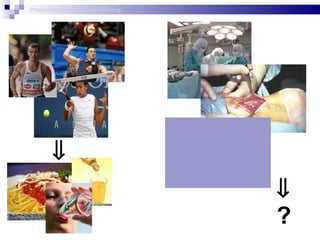
 ?  Preoperative metabolic conditioning
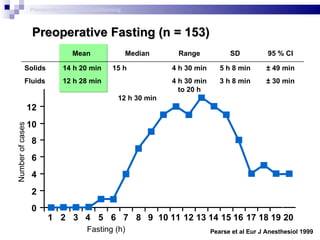
± 49 min ± 30 min 5 h 8 min 3 h 8 min 4 h 30 min 4 h 30 min to 20 h 15 h  12 h 30 min 14 h 20 min 12 h 28 min Solids Fluids 95 % CI SD Range Median Mean 2 Number of cases 6 4 2 0 8 10 12 1 3 4 5 6 7 8 9 10 11 12 13 14 15 16 17 18 19 20 Fasting (h) Preoperative Fasting (n = 153) Pearse et al Eur J Anesthesiol 1999 Preoperative metabolic conditioning
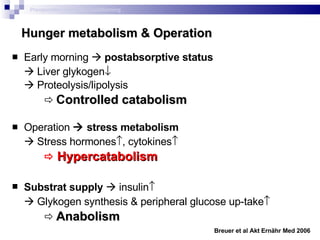
Early morning    postabsorptive status    Liver glykogen     Proteolysis/lipolysis    C ontrolled catabolism Operation     stress metabolism    Stress hormones  , cytokines       Hypercatabolism Substrat supply     insulin     Glykogen synthesis & peripheral glucose up-take     Anabolism Hunger metabolism & Operation  Breuer et al Akt Ernähr Med 2006 Preoperative metabolic conditioning
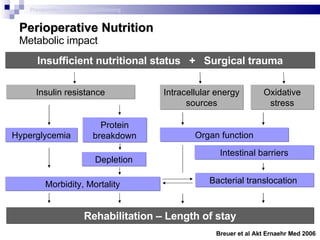
Perioperative Nutrition Metabolic impact Hyperglycemia Morbidity, Mortality Protein breakdown Depletion Rehabilitation – Length of stay Insulin resistance Intracellular energy sources Oxidative stress Organ function Intestinal barriers Bacterial translocation  Insufficient nutritional status  +  Surgical trauma Breuer et al Akt Ernaehr Med 2006 Preoperative metabolic conditioning
Cochrane-Analysis 38 randomized controlled comparisons (22 trials) Objects: perioperative complications & comfort “ […]  no evidence  to suggest a  shortened fluid fast  results in an  increased risk  of aspiration or related morbidity […].” Level of Evidence  = 1a “ […] appraise this evidence for themselves and […]  adjust any remaining standard  fasting policies for patients that are not considered `at risk´ during anaesthesia.” Grade of Recommendation =  A Brady et al  The Cochrane Collaboration  2003 Preoperative metabolic conditioning
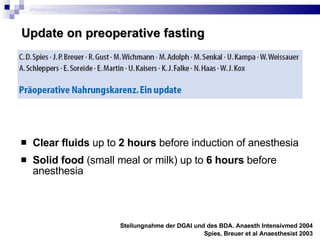
Clear fluids  up to  2 hours  before induction of anesthesia  Solid food  (small meal or milk) up to  6 hours  before anesthesia Stellungnahme der DGAI und des BDA.  Anaesth Intensivmed  2004 Spies, Breuer et al Anaesthesist 2003 Preoperative metabolic conditioning Update on preoperative fasting
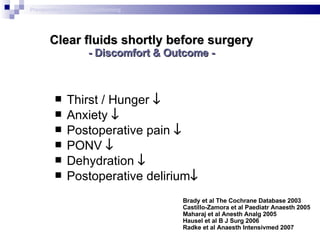
Clear fluids shortly before surgery - Discomfort & Outcome - Thirst / Hunger   Anxiety   Postoperative pain   PONV   Dehydration   Postoperative delirium  Brady et al The Cochrane Database 2003  Castillo-Zamora et al Paediatr Anaesth 2005 Maharaj et al Anesth Analg 2005 Hausel et al B J Surg 2006 Radke et al Anaesth Intensivmed 2007 Preoperative metabolic conditioning
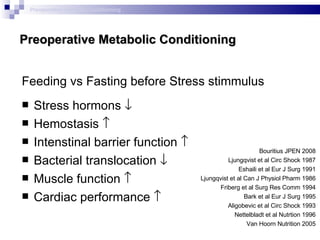
Preoperative Metabolic Conditioning Feeding vs Fasting before Stress stimmulus Stress hormons   Hemostasis   Intenstinal barrier function   Bacterial translocation   M uscle function   Cardiac performance   Bouritius JPEN 2008 Ljungqvist et al Circ Shock 1987 Eshaili et al Eur J Surg 1991 Ljungqvist et al Can J Physiol Pharm 1986 Friberg et al Surg Res Comm 1994 Bark et al Eur J Surg 1995 Aligobevic et al Circ Shock 1993 Nettelbladt et al Nutrtion 1996 Van Hoorn Nutrition 2005 Preoperative metabolic conditioning
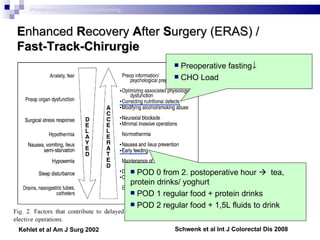
E nhanced  R ecovery  A fter  S urgery (ERAS) /  Fast-Track-Chirurgie Kehlet et al Am J Surg 2002 Preoperative metabolic conditioning Schwenk et al Int J Colorectal Dis 2008 Preoperative fasting  CHO Load POD 0 from 2. postoperative hour     tea, protein drinks/ yoghurt POD 1 regular food + protein drinks POD 2 regular food + 1,5L fluids to drink
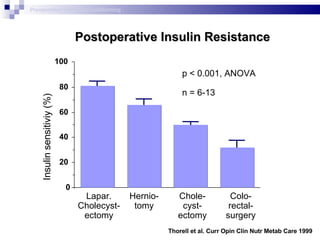
Postoperative Insulin Resistance Thorell et al. Curr Opin Clin Nutr Metab Care 1999 p < 0.001, ANOVA n = 6-13 Insulin sensitiviy (%) Lapar. Cholecyst- ectomy Hernio- tomy Chole- cyst- ectomy Colo- rectal- surgery Preoperative metabolic conditioning 0 20 40 60 80 100
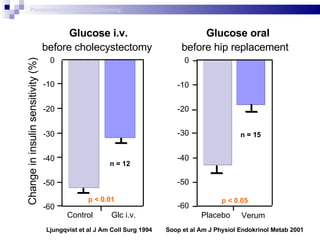
Change in insulin sensitivity  (%) 0 -10 -20 -30 -40 -50 -60 Glc i.v. Control p < 0.01 0 -10 -20 -30 -40 -50 -60 Placebo p < 0.05 Verum Ljungqvist et al J Am Coll Surg 1994 Soop et al Am J Physiol Endokrinol Metab 2001 Glucose i.v. before cholecystectomy Glucose oral before hip replacement n = 15 n = 12 Preoperative metabolic conditioning
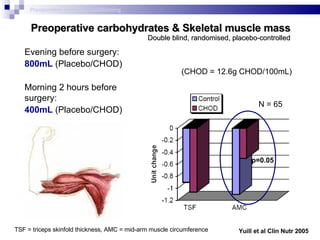
Preoperative carbohydrates & Skeletal muscle mass Double blind, randomised, placebo-controlled Yuill et al Clin Nutr 2005 TSF = triceps skinfold thickness, AMC = mid-arm muscle circumference  (CHOD = 12.6g CHOD/100mL) Evening before surgery: 800mL  (Placebo/CHOD) Morning 2 hours before surgery: 400mL  (Placebo/CHOD) N = 65 Preoperative metabolic conditioning p=0.05
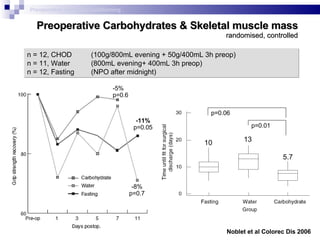
Preoperative Carbohydrates & Skeletal muscle mass randomised, controlled Noblet et al Colorec Dis 2006 n = 12, CHOD (100g/800mL evening + 50g/400mL 3h preop) n = 11, Water (800mL evening+ 400mL 3h preop) n = 12, Fasting (NPO after midnight) Preoperative metabolic conditioning 10 5.7 13 p=0.01 p=0.06 -11% p=0.05 -8% p=0.7 -5% p=0.6
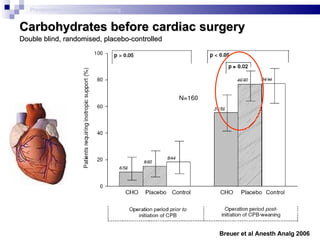
Carbohydrates before cardiac surgery Double blind, randomised, placebo-controlled Breuer et al Anesth Analg 2006   Preoperative metabolic conditioning
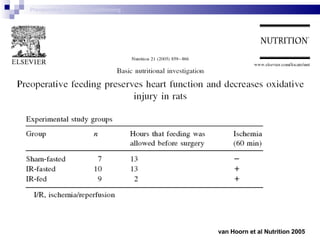
van Hoorn et al Nutrition 2005  Preoperative metabolic conditioning
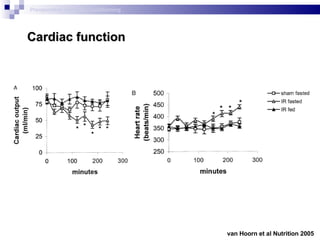
Cardiac function van Hoorn et al Nutrition 2005  Preoperative metabolic conditioning
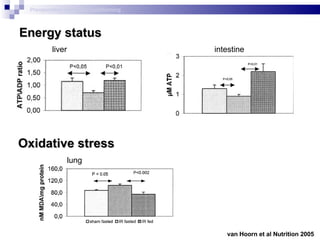
Energy status lung van Hoorn et al Nutrition 2005  liver     intestine Preoperative metabolic conditioning Oxidative stress
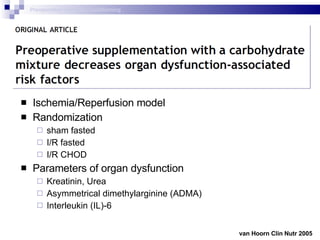
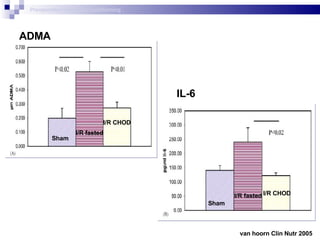
Ischemia/Reperfusion model Randomization sham fasted I/R fasted I/R CHOD Parameters of organ dysfunction Kreatinin, Urea Asymmetrical dimethylarginine (ADMA) Interleukin (IL)-6 van Hoorn Clin Nutr 2005  Preoperative metabolic conditioning
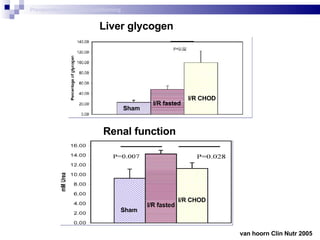
Renal function van hoorn Clin Nutr 2005  Liver glycogen Sham I/R CHOD I/R fasted Sham I/R CHOD I/R fasted Preoperative metabolic conditioning
van hoorn Clin Nutr 2005  ADMA IL-6 Sham I/R CHOD I/R fasted Sham I/R CHOD I/R fasted Preoperative metabolic conditioning
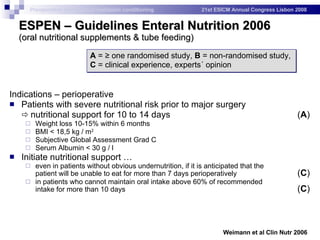
„ From the metabolic and nutritional point of view, the key aspects of perioperative care include: avoidance of long periods of pre-operative fasting; re-establishment of oral feeding as early as possible after surgery; integration of nutrition into the overall management of the patient; […]“ Weimann et al Clin Nutr 2006
ESPEN – Guidelines Enteral Nutrition 2006 ( oral nutritional supplements & tube feeding) A  =  ≥ one  randomised study,  B  = non-randomised study, C  = clinical experience, experts´ opinion Weimann et al Clin Nutr 2006 Indications – perioperative Patients with severe nutritional risk prior to major surgery    nutritional support for 10 to 14 days ( A ) Weight loss 10-15% within 6 months BMI < 18,5 kg / m 2 Subjective Global Assessment Grad C Serum Albumin < 30 g / l Initiate nutritional support … even in patients without obvious undernutrition, if it is anticipated that the patient will be unable to eat for more than 7 days perioperatively ( C ) in patients who cannot maintain oral intake above 60% of recommended intake for more than 10 days ( C ) Preoperative physical and metabolic conditioning   21st ESICM Annual Congress Lisbon 2008
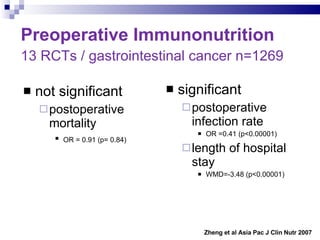
Preoperative Immunonutrition  13 RCTs / gastrointestinal cancer n=1269   not significant postoperative mortality  OR = 0.91 (p= 0.84)   significant postoperative infection rate  OR =0.41 (p<0.00001) length of hospital stay  WMD=-3.48 (p<0.00001)                                                                                                                                                          Zheng et al Asia Pac J Clin Nutr 2007
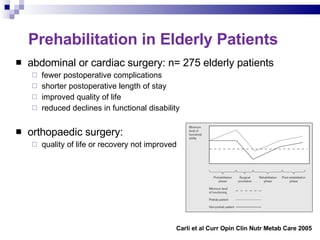
Prehabilitation in Elderly Patients abdominal or cardiac surgery: n= 275 elderly patients fewer postoperative complications shorter postoperative length of stay improved quality of life reduced declines in functional disability orthopaedic surgery:  quality of life or recovery not improved  Carli et al Curr Opin Clin Nutr Metab Care 2005
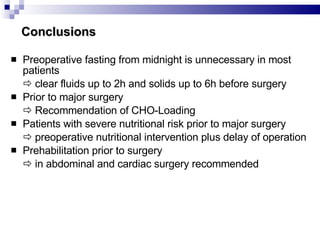
Conclusions Preoperative fasting from midnight is unnecessary in most patients    clear fluids up to 2h and solids up to 6h before surgery Prior to major surgery    Recommendation of CHO-Loading Patients with severe nutritional risk prior to major surgery    preoperative nutritional intervention plus delay of operation Prehabilitation prior to surgery    in abdominal and cardiac surgery recommended
Thank you very much!

Preoperative Metabolic Conditioning

  • 1.
    Preoperative metabolic conditioning J.-Philipp Breuer Departments of Anaesthesiology and Intensive Care Medicine Campus Charité Mitte und Campus Virchow-Klinikum CHARITÉ – Universitätsmedizin Berlin
  • 2.
     ? Preoperative metabolic conditioning
  • 3.
    ± 49 min± 30 min 5 h 8 min 3 h 8 min 4 h 30 min 4 h 30 min to 20 h 15 h 12 h 30 min 14 h 20 min 12 h 28 min Solids Fluids 95 % CI SD Range Median Mean 2 Number of cases 6 4 2 0 8 10 12 1 3 4 5 6 7 8 9 10 11 12 13 14 15 16 17 18 19 20 Fasting (h) Preoperative Fasting (n = 153) Pearse et al Eur J Anesthesiol 1999 Preoperative metabolic conditioning
  • 4.
    Early morning  postabsorptive status  Liver glykogen   Proteolysis/lipolysis  C ontrolled catabolism Operation  stress metabolism  Stress hormones  , cytokines   Hypercatabolism Substrat supply  insulin   Glykogen synthesis & peripheral glucose up-take   Anabolism Hunger metabolism & Operation Breuer et al Akt Ernähr Med 2006 Preoperative metabolic conditioning
  • 5.
    Perioperative Nutrition Metabolicimpact Hyperglycemia Morbidity, Mortality Protein breakdown Depletion Rehabilitation – Length of stay Insulin resistance Intracellular energy sources Oxidative stress Organ function Intestinal barriers Bacterial translocation Insufficient nutritional status + Surgical trauma Breuer et al Akt Ernaehr Med 2006 Preoperative metabolic conditioning
  • 6.
    Cochrane-Analysis 38 randomizedcontrolled comparisons (22 trials) Objects: perioperative complications & comfort “ […] no evidence to suggest a shortened fluid fast results in an increased risk of aspiration or related morbidity […].” Level of Evidence = 1a “ […] appraise this evidence for themselves and […] adjust any remaining standard fasting policies for patients that are not considered `at risk´ during anaesthesia.” Grade of Recommendation = A Brady et al The Cochrane Collaboration 2003 Preoperative metabolic conditioning
  • 7.
    Clear fluids up to 2 hours before induction of anesthesia Solid food (small meal or milk) up to 6 hours before anesthesia Stellungnahme der DGAI und des BDA. Anaesth Intensivmed 2004 Spies, Breuer et al Anaesthesist 2003 Preoperative metabolic conditioning Update on preoperative fasting
  • 8.
    Clear fluids shortlybefore surgery - Discomfort & Outcome - Thirst / Hunger  Anxiety  Postoperative pain  PONV  Dehydration  Postoperative delirium  Brady et al The Cochrane Database 2003 Castillo-Zamora et al Paediatr Anaesth 2005 Maharaj et al Anesth Analg 2005 Hausel et al B J Surg 2006 Radke et al Anaesth Intensivmed 2007 Preoperative metabolic conditioning
  • 9.
    Preoperative Metabolic ConditioningFeeding vs Fasting before Stress stimmulus Stress hormons  Hemostasis  Intenstinal barrier function  Bacterial translocation  M uscle function  Cardiac performance  Bouritius JPEN 2008 Ljungqvist et al Circ Shock 1987 Eshaili et al Eur J Surg 1991 Ljungqvist et al Can J Physiol Pharm 1986 Friberg et al Surg Res Comm 1994 Bark et al Eur J Surg 1995 Aligobevic et al Circ Shock 1993 Nettelbladt et al Nutrtion 1996 Van Hoorn Nutrition 2005 Preoperative metabolic conditioning
  • 10.
    E nhanced R ecovery A fter S urgery (ERAS) / Fast-Track-Chirurgie Kehlet et al Am J Surg 2002 Preoperative metabolic conditioning Schwenk et al Int J Colorectal Dis 2008 Preoperative fasting  CHO Load POD 0 from 2. postoperative hour  tea, protein drinks/ yoghurt POD 1 regular food + protein drinks POD 2 regular food + 1,5L fluids to drink
  • 11.
    Postoperative Insulin ResistanceThorell et al. Curr Opin Clin Nutr Metab Care 1999 p < 0.001, ANOVA n = 6-13 Insulin sensitiviy (%) Lapar. Cholecyst- ectomy Hernio- tomy Chole- cyst- ectomy Colo- rectal- surgery Preoperative metabolic conditioning 0 20 40 60 80 100
  • 12.
    Change in insulinsensitivity (%) 0 -10 -20 -30 -40 -50 -60 Glc i.v. Control p < 0.01 0 -10 -20 -30 -40 -50 -60 Placebo p < 0.05 Verum Ljungqvist et al J Am Coll Surg 1994 Soop et al Am J Physiol Endokrinol Metab 2001 Glucose i.v. before cholecystectomy Glucose oral before hip replacement n = 15 n = 12 Preoperative metabolic conditioning
  • 13.
    Preoperative carbohydrates &Skeletal muscle mass Double blind, randomised, placebo-controlled Yuill et al Clin Nutr 2005 TSF = triceps skinfold thickness, AMC = mid-arm muscle circumference (CHOD = 12.6g CHOD/100mL) Evening before surgery: 800mL (Placebo/CHOD) Morning 2 hours before surgery: 400mL (Placebo/CHOD) N = 65 Preoperative metabolic conditioning p=0.05
  • 14.
    Preoperative Carbohydrates &Skeletal muscle mass randomised, controlled Noblet et al Colorec Dis 2006 n = 12, CHOD (100g/800mL evening + 50g/400mL 3h preop) n = 11, Water (800mL evening+ 400mL 3h preop) n = 12, Fasting (NPO after midnight) Preoperative metabolic conditioning 10 5.7 13 p=0.01 p=0.06 -11% p=0.05 -8% p=0.7 -5% p=0.6
  • 15.
    Carbohydrates before cardiacsurgery Double blind, randomised, placebo-controlled Breuer et al Anesth Analg 2006 Preoperative metabolic conditioning
  • 16.
    van Hoorn etal Nutrition 2005 Preoperative metabolic conditioning
  • 17.
    Cardiac function vanHoorn et al Nutrition 2005 Preoperative metabolic conditioning
  • 18.
    Energy status lungvan Hoorn et al Nutrition 2005 liver intestine Preoperative metabolic conditioning Oxidative stress
  • 19.
    Ischemia/Reperfusion model Randomizationsham fasted I/R fasted I/R CHOD Parameters of organ dysfunction Kreatinin, Urea Asymmetrical dimethylarginine (ADMA) Interleukin (IL)-6 van Hoorn Clin Nutr 2005 Preoperative metabolic conditioning
  • 20.
    Renal function vanhoorn Clin Nutr 2005 Liver glycogen Sham I/R CHOD I/R fasted Sham I/R CHOD I/R fasted Preoperative metabolic conditioning
  • 21.
    van hoorn ClinNutr 2005 ADMA IL-6 Sham I/R CHOD I/R fasted Sham I/R CHOD I/R fasted Preoperative metabolic conditioning
  • 22.
    „ From themetabolic and nutritional point of view, the key aspects of perioperative care include: avoidance of long periods of pre-operative fasting; re-establishment of oral feeding as early as possible after surgery; integration of nutrition into the overall management of the patient; […]“ Weimann et al Clin Nutr 2006
  • 23.
    ESPEN – GuidelinesEnteral Nutrition 2006 ( oral nutritional supplements & tube feeding) A = ≥ one randomised study, B = non-randomised study, C = clinical experience, experts´ opinion Weimann et al Clin Nutr 2006 Indications – perioperative Patients with severe nutritional risk prior to major surgery  nutritional support for 10 to 14 days ( A ) Weight loss 10-15% within 6 months BMI < 18,5 kg / m 2 Subjective Global Assessment Grad C Serum Albumin < 30 g / l Initiate nutritional support … even in patients without obvious undernutrition, if it is anticipated that the patient will be unable to eat for more than 7 days perioperatively ( C ) in patients who cannot maintain oral intake above 60% of recommended intake for more than 10 days ( C ) Preoperative physical and metabolic conditioning 21st ESICM Annual Congress Lisbon 2008
  • 24.
    Preoperative Immunonutrition 13 RCTs / gastrointestinal cancer n=1269 not significant postoperative mortality OR = 0.91 (p= 0.84) significant postoperative infection rate OR =0.41 (p<0.00001) length of hospital stay WMD=-3.48 (p<0.00001)                                                                                                                                                         Zheng et al Asia Pac J Clin Nutr 2007
  • 25.
    Prehabilitation in ElderlyPatients abdominal or cardiac surgery: n= 275 elderly patients fewer postoperative complications shorter postoperative length of stay improved quality of life reduced declines in functional disability orthopaedic surgery: quality of life or recovery not improved Carli et al Curr Opin Clin Nutr Metab Care 2005
  • 26.
    Conclusions Preoperative fastingfrom midnight is unnecessary in most patients  clear fluids up to 2h and solids up to 6h before surgery Prior to major surgery  Recommendation of CHO-Loading Patients with severe nutritional risk prior to major surgery  preoperative nutritional intervention plus delay of operation Prehabilitation prior to surgery  in abdominal and cardiac surgery recommended
  • 27.