WATER
RESOURCES
OF
INDIA
Chapter-7
IMPORTANCE OF WATER
• Life line of living being
• Essential for agriculture
• Industries
• Hydro electricity generation
• Means of navigation
• Sources of sports & recreation
OCEANS
FRESH
DISTRIBUTION OF WATER
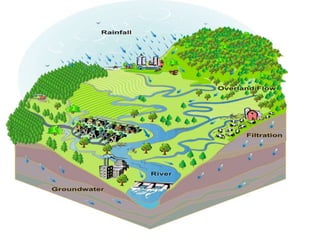
WATER CYCLE
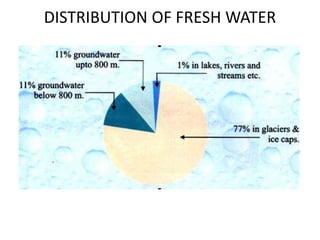
DISTRIBUTION OF FRESH WATER
LAND AREA 2.4%
POPULATION 16%
LIVESTOCK 20%
WATER RESOURCES 4%
Facts About India
Annual Precipitation Volume
(Including snowfall)
4000 km3
Average Annual Potential flow in Rivers 1869 km3
Water Resources of India
Estimated Utilizable Water Resources 1122 km3
(i) Surface Water Resources 690 km3
(ii) Ground Water Resources 432 km3
Sources of water in India
• Precipitation- total water=4000km³
– Monsoon= 3000 km³`
– Rest by
• Shallow cyclonic disturbances
• Shallow cyclonic depressions
• Local storms
Requirements for various purposes
• Food grain production
• Domestic use
• Irrigation
• Hydroelectric power generation
• Industrial water requirement
How
do
we
fulfill
these
requirements
?
IRRIGATION
What is irrigation?
THIS?
THIS?
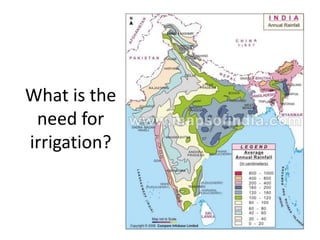
What is the
need for
irrigation?
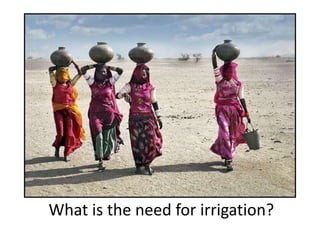
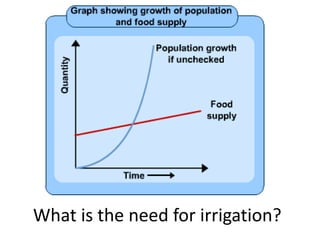
What is the need for irrigation?
CROP WATER REQUIREMENTS
Wheat 75 To 100 cm
Millets 50 cm
Sugarcane
150 to 300 cm;
alternating wet and dry conditions
Rubber 250 cm
What is the need for irrigation?
NEED :
• Rainfall seasonal, uncertain, uneven and
sporadic.
• Different crop has different water requirement.
• Indispensible in semi arid regions of Gujarat,
Andhra Pradesh, Rajasthan etc.
• Necessary to extend the frontiers of cultivation
into semi-arid regions.
Factors Required for Development
of Irrigation in India
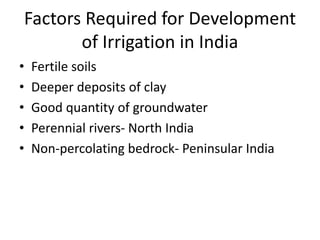
• Fertile soils
• Deeper deposits of clay
• Good quantity of groundwater
• Perennial rivers- North India
• Non-percolating bedrock- Peninsular India
MODES OF IRRIGATION
PRIMITIVE
• Wells
• Tanks
• Inundatiosn canals
MODERN
• Tube wells
• Canals
• Multi purpose projects
WELLS
Suitable conditions for a well - 1
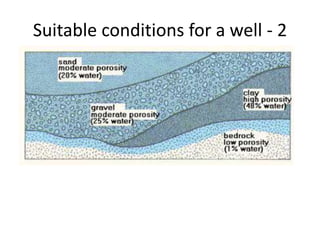
Suitable conditions for a well - 2
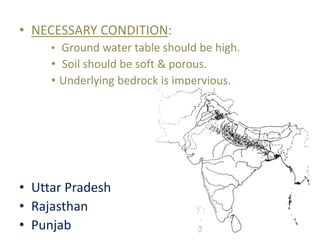
• NECESSARY CONDITION:
• Ground water table should be high.
• Soil should be soft & porous.
• Underlying bedrock is impervious.
• Uttar Pradesh
• Rajasthan
• Punjab
WELLS
Method used to draw water from the well
are
– Persian wheel
– Rehat
– Charas
– Mohte
– Picottah
– Dhenkhali
Drawing water from the well
ADVANTAGES :
 Cheapest source of irrigation.
 Can be dug at any convenient place.
 Independent source of irrigation.
DISADVANTAGES :
 Fail to provide water during the dry
summer months
Well can water only 1 to 2 hectares of land.
 Time consuming.
 In many parts it is brackish.
TANK IRRIGATION
TANK
• Construction of earthen or masonry wall
across a stream or depression.
• Rainwater collects in the depression.
• Water used when needed or during dry
season.
Construction of a tank
Tank irrigation - requirements
Tank
Embankment
subsurface
Reasons for the predominance of tank irrigation in the
Deccan region
• Underlying hard rocks does not allow percolation
• The undulating surface forms natural depression
• Construction of well is difficult in the peninsular region
• Underlying hard rocks
does not allow
percolation
• Undulating surface
forms natural
depressions
• Construction of well is
difficult in the
peninsular region
• ADVANTAGES OF TANK IRRIGATION
• Simple, easy & cheap
• Stores rain water, prevents wastage
• Helps in raising the underground water level
• Also provide water for domestic purpose`
 DISADVANTAGES
 Occupies large area which otherwise could have
been used for cultivation
 Many tanks dry up in the dry months
 Silting of tank is a problem
 Water is lost by evaporation
Tank irrigation in India
•Andhra Pradesh
•Tamil Nadu
•West Bengal
•Karnataka
•Bihar
•Orissa
CANALS
• Inundation canals
• Perennial canals
INUNDATION CANALS
• Flood water canals – have water in them only
when the river is in flood.
• Solely dependent on rainfall.
• Do not have any regulating system like weirs at
their heads.
• Many are being converted to perennial canals.
• Many are found near Sutlej river.
Inundation
canals
Advantages
• Easily built
• Cheap
• Useful in controlling
floods
• Uncertainty of water
supply
• Only low lands areas
are irrigated
• Useful only during
floods
Disadvantages
MODERN METHODS
– More reliable.
– Provide irrigation whenever needed.
– Easy to operate.
– Irrigate a much larger area.
– Large amount of water can be pumped by electric
or diesel driven motor.
Perennial canals
Perennial canal source
ADVANTAGES OF PERENNIAL CANALS
• Perennial source of irrigation
• Water rich in sediments
• Although initial cost is high, it is
quite cheap in the long run
DISADVANTAGES
• Leads to the problem of water logging if
canals are unlined
• Problem of soil Salinization or ‘reh’
• Marshy areas near canal become
breeding ground for mosquito resulting
in Malaria.
Canal systems in North India
• Ganga Canal
• Nangal Dam Canal
• Indira Gandhi Canal
• Chambal Project Canal
Canal systems in South India
• Godavari Canal
• Tungabhadra Dam Canal
• Hirakud Dam Canal
• Periyar Project Canal
• Mettur Project Canal
TUBE WELLS
TUBE WELLS
Necessary conditions:
• Sufficient supply of ground water
• Regular supply of cheap electricity
• Region must be fertile and productive
TUBE WELLS
• Mainly found in Indo-gangetic plain
• Groundwater is available in plenty
• Water table is close to the surface
Advantages:
• Can water larger area(400hectares)
• More reliable during the period of drought
• Also suited for areas of small holding
• Disadvantage:
• Salt water ingression
• Depletion of ground water
Drawback of tube well
Tube wells in India
UP
Bihar
Punjab
Haryana
West Bengal .
MULTIPURPOSE PROJECT
• Why is it so called?
– Store water for irrigation
– Generate electricity
– Control flood
– Provide afforestation in the catchment areas
– Soil conservation
– Provide drinking water
– Use canal for navigation
– Develop pisciculture
– Develop recreational centre
BHAKRA NANGAL DAM
(Biggest & Oldest)
River Sutlej
States
irrigated
Punjab, Haryana, UP
Main
Purpose
Irrigation
MAITHON DAM
(Part of DVC Prpject)
River Damodar
States
irrigated
West Bengal
Main
Purpose
Flood Control
HIRAKUD DAM
(Longest)
River Mahanadi
States
irrigated
Orissa
Main
Purpose
Irrigation,
Flood Control
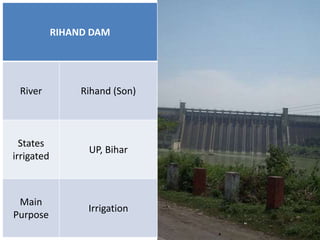
RIHAND DAM
River Rihand (Son)
States
irrigated
UP, Bihar
Main
Purpose
Irrigation
TUNGABHADRA DAM
(Vishweshsaraiya)
River Tungabhadra
States
irrigated
Andhra Pradesh,
Karnataka
Main
Purpose
Irrigation
CONSERVATION OF WATER RESOURCES
Need for Conservation of Water
0
20
40
60
80
100
120 1994
1995
1996
1997
1998
1999
2000
2001
2002
2003
2004
2005
2006
2007
2008
2009
Average annual rainfall in India
(% of normal)
Water Supply
0
500
1000
1500
2000
2500
1991 2001 2025 2050
Per capita water availability in India (m3)
<1700 m³, water stressed country
<1000 m³, water scarce country
• Short supply
• Increased demand
• Large scale pollution
• Uneven distribution
• Industrialization
Our influence on the Hydrologic cycle
• Modified by various activities
– Affect runoff by diverting water from surface
resources
– Modifying the river channels, making reservoirs &
ponds
– Agricultural practices, drainage of swamps,
deforestation, urbanization- runoff modified
– Induce climate change, increase greenhouse
gases, increased evaporation.
Factors raising water demand
What is happening to our water?
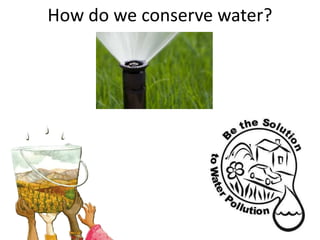
How do we conserve water?
METHODS OF CONSERVATION
• Developing water saving technology
• Preventing pollution of water
• watershed management
• rainwater harvesting
• reuse & recycle of water
WATER SAVING TECHNOLOGY
SPRINKLER IRRIGATION
• Overhead irrigation
• Water supplied by hoses
• Does not involve loss of water by seepage
• No water loss by evaporation
• Mainly practiced in arid, semi arid and uneven
topography
• Quite expensive
• Relatively new in India
DRIP IRRIGATION
DRIP IRRIGATION
• Water taken directly to the roots of plants
• Water drips through plastic tubes
Bamboo irrigation
• Tapping rain water, especially in NE India
• Through bamboo pipes from streams
• 20 litres water can be held in a bamboo pipe
• Transported over hundreds of meters
• Economical-no fuel used to transport water-
hill slopes
• Can be implemented in areas of cheap or free
availability ofbamboo
• Needs to be rebuild- bamboo rots
WATERSHED MANAGEMENT
WATERSHED DEVELOPMENT
• Conserve water resource
• Increase agricultural production
• Stops environmental degradation
• Improves standard of living
RAIN WATER HARVESTING
RAIN WATER
HARVESTING
•Rain water collected on
roof top
•Directed to a storage area
•Recharges groundwater
level
•Water used later
From 100sq m rooftop area
50,000lts of rainwater harvested
Simple technique,
Cost effective
Can be practiced both in towns & villages
Should be made compulsory
Mandatory in Andhra, Assam, Rajasthan & TN
Benefits of Rain Water Harvesting
METHODS OF RECHARGING GROUND
WATER
• Roof water harvesting
• Recharging hand pumps
• Recharge through trenches and bunds
• Stop-dams on small streams
Johad in Rajasthan
National Water Policy
• National water grid
• Conservation of water
• Reduce water pollution
• Reduce surface run off and river bed silting
• Recharging of groundwater
• Provide water to deficit areas
Updated-Water Resources.ppt

Updated-Water Resources.ppt