Source Citation and
Credibility
Alyssa Meyer
Tian Shan Policy Center
Visiting Research Fellow
11/2/2015
What We Will Cover
 When do you need to cite a source?
 How do you cite a source?
 How do you decide which sources are
legitimate?
11/2/2015
What is Plagiarism?
Plagiarism is using another
person’s words, expressions,
language, or ideas without
giving proper credit.
11/2/2015
Common Concerns
 When might you unintentionally
plagiarize?
 Paraphrasing incorrectly
 Citing incorrectly
 Omitting a citation
11/2/2015
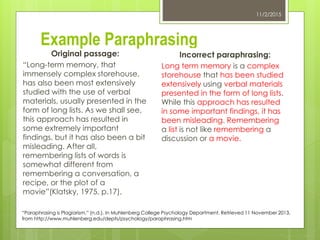
Example Paraphrasing
Original passage:
“Long-term memory, that
immensely complex storehouse,
has also been most extensively
studied with the use of verbal
materials, usually presented in the
form of long lists. As we shall see,
this approach has resulted in
some extremely important
findings, but it has also been a bit
misleading. After all,
remembering lists of words is
somewhat different from
remembering a conversation, a
recipe, or the plot of a
movie”(Klatsky, 1975, p.17).
11/2/2015
“Paraphrasing is Plagiarism.” (n.d.). In Muhlenberg College Psychology Department. Retrieved 11 November 2013,
from http://www.muhlenberg.edu/depts/psychology/paraphrasing.htm
Incorrect paraphrasing:
Long term memory is a complex
storehouse that has been studied
extensively using verbal materials
presented in the form of long lists.
While this approach has resulted
in some important findings, it has
been misleading. Remembering
a list is not like remembering a
discussion or a movie.
Incorrect paraphrasing:
Long term memory is a complex
storehouse that has been studied
extensively using verbal materials
presented in the form of long lists.
While this approach has resulted
in some important findings, it has
been misleading. Remembering
a list is not like remembering a
discussion or a movie.
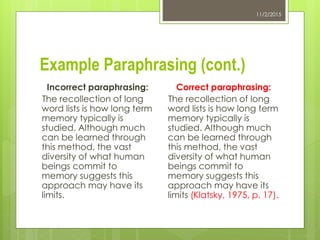
Example Paraphrasing (cont.)
11/2/2015
Incorrect paraphrasing:
The recollection of long
word lists is how long term
memory typically is
studied. Although much
can be learned through
this method, the vast
diversity of what human
beings commit to
memory suggests this
approach may have its
limits.
Correct paraphrasing:
The recollection of long
word lists is how long term
memory typically is
studied. Although much
can be learned through
this method, the vast
diversity of what human
beings commit to
memory suggests this
approach may have its
limits (Klatsky, 1975, p. 17).
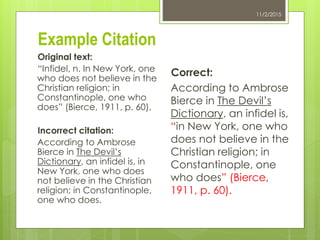
Example Citation
Original text:
“Infidel, n. In New York, one
who does not believe in the
Christian religion; in
Constantinople, one who
does” (Bierce, 1911, p. 60).
Incorrect citation:
According to Ambrose
Bierce in The Devil’s
Dictionary, an infidel is, in
New York, one who does
not believe in the Christian
religion; in Constantinople,
one who does.
Correct:
According to Ambrose
Bierce in The Devil’s
Dictionary, an infidel is,
“in New York, one who
does not believe in the
Christian religion; in
Constantinople, one
who does” (Bierce,
1911, p. 60).
11/2/2015
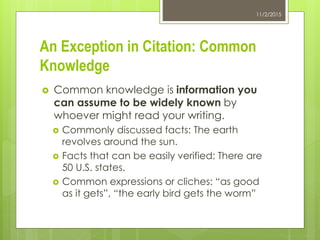
An Exception in Citation: Common
Knowledge
 Common knowledge is information you
can assume to be widely known by
whoever might read your writing.
 Commonly discussed facts: The earth
revolves around the sun.
 Facts that can be easily verified: There are
50 U.S. states.
 Common expressions or cliches: “as good
as it gets”, “the early bird gets the worm”
11/2/2015
Choosing a Citation Style
 The citation style sometimes depends on the
academic discipline involved.
 APA (American Psychological Association) style is
used by often in the field of education, psychology,
and sciences. See APA Citation Style for a guide.
 MLA (Modern Language Association) style is used
by the humanities. See MLA Citation Style for a
guide.
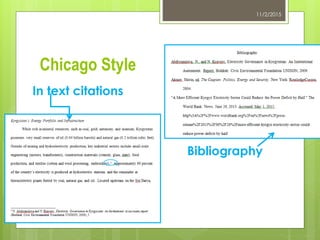
 Chicago/Turabian style is generally used by
business, history, and the fine arts. This style does not
use in-text citations; instead it uses footnotes. See
Chicago/Turabian Citation Style for a guide.
 But it’s always best to ask your professor if they
have a preference!
11/2/2015
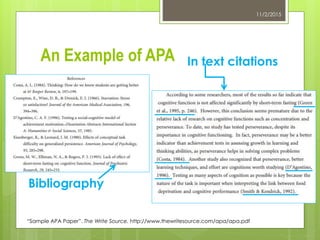
An Example of APA
11/2/2015
“Sample APA Paper”. The Write Source. http://www.thewritesource.com/apa/apa.pdf
Bibliography
In text citations
APA Style
 Book:
 In-text direct citation (Pollan, 2006, p. 49).
 General reference to book’s argument: (Pollan, 2006).
 In your bibliography: Pollan, Michael (2006). The omnivore’s
dilemma. New York: Penguin Group. Print.
 Journal:
 In text direct citation: (Bagchi, “Conflicting Nationalism,” 1996, p.
45).
 In your bibliography: Bagchi, A (1999). Conflicting nationalisms: the
voice of the subaltern in mahasweta devi’s bashai tudu. Tulsa
Studies in Women’s Literature 15.1, 41-50. Print.
 Internet:
 In-text: (“Plagiarism”).
 In your bibliography: "Plagiarism." Wikipedia, The free encyclopedia.
Wikimedia Foundation, Inc. (2004, July 22). Retrieved 11 Nov. 2013.
Web.
11/2/2015
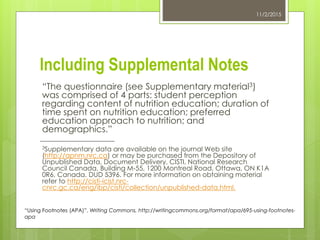
Including Supplemental Notes
“The questionnaire (see Supplementary material3)
was comprised of 4 parts: student perception
regarding content of nutrition education; duration of
time spent on nutrition education; preferred
education approach to nutrition; and
demographics.”
3Supplementary data are available on the journal Web site
(http://apnm.nrc.ca) or may be purchased from the Depository of
Unpublished Data, Document Delivery, CISTI, National Research
Council Canada, Building M-55, 1200 Montreal Road, Ottawa, ON K1A
0R6, Canada. DUD 5396. For more information on obtaining material
refer to http://cisti-icist.nrc-
cnrc.gc.ca/eng/ibp/cisti/collection/unpublished-data.html.
11/2/2015
“Using Footnotes (APA)”. Writing Commons, http://writingcommons.org/format/apa/695-using-footnotes-
apa
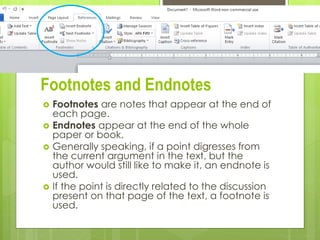
Footnotes and Endnotes
 Footnotes are notes that appear at the end of
each page.
 Endnotes appear at the end of the whole
paper or book.
 Generally speaking, if a point digresses from
the current argument in the text, but the
author would still like to make it, an endnote is
used.
 If the point is directly related to the discussion
present on that page of the text, a footnote is
used.
11/2/2015
Chicago Style
11/2/2015
Bibliography
In text citations
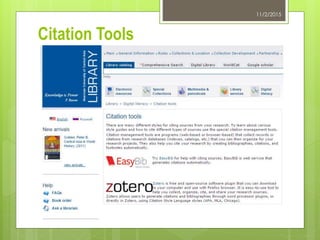
Citation Tools
11/2/2015
Is Your Source Legitimate?
 Who wrote it?
 What else have they written?
 What was their rhetorical purpose?
 Is the argument properly supported?
 Does the argument differ from other that
sources on the same topic?
 How?
11/2/2015
Finding Legitimate Sources
11/2/2015
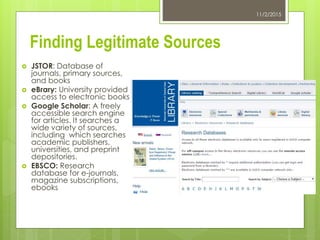
 JSTOR: Database of
journals, primary sources,
and books
 eBrary: University provided
access to electronic books
 Google Scholar: A freely
accessible search engine
for articles. It searches a
wide variety of sources,
including which searches
academic publishers,
universities, and preprint
depositories.
 EBSCO: Research
database for e-journals,
magazine subscriptions,
ebooks
If you have questions…
WARC: Room 237
warc@auca.kg
11/2/2015

Source Citation & Credibility

  • 1.
    Source Citation and Credibility AlyssaMeyer Tian Shan Policy Center Visiting Research Fellow 11/2/2015
  • 2.
    What We WillCover  When do you need to cite a source?  How do you cite a source?  How do you decide which sources are legitimate? 11/2/2015
  • 3.
    What is Plagiarism? Plagiarismis using another person’s words, expressions, language, or ideas without giving proper credit. 11/2/2015
  • 4.
    Common Concerns  Whenmight you unintentionally plagiarize?  Paraphrasing incorrectly  Citing incorrectly  Omitting a citation 11/2/2015
  • 5.
    Example Paraphrasing Original passage: “Long-termmemory, that immensely complex storehouse, has also been most extensively studied with the use of verbal materials, usually presented in the form of long lists. As we shall see, this approach has resulted in some extremely important findings, but it has also been a bit misleading. After all, remembering lists of words is somewhat different from remembering a conversation, a recipe, or the plot of a movie”(Klatsky, 1975, p.17). 11/2/2015 “Paraphrasing is Plagiarism.” (n.d.). In Muhlenberg College Psychology Department. Retrieved 11 November 2013, from http://www.muhlenberg.edu/depts/psychology/paraphrasing.htm Incorrect paraphrasing: Long term memory is a complex storehouse that has been studied extensively using verbal materials presented in the form of long lists. While this approach has resulted in some important findings, it has been misleading. Remembering a list is not like remembering a discussion or a movie. Incorrect paraphrasing: Long term memory is a complex storehouse that has been studied extensively using verbal materials presented in the form of long lists. While this approach has resulted in some important findings, it has been misleading. Remembering a list is not like remembering a discussion or a movie.
  • 6.
    Example Paraphrasing (cont.) 11/2/2015 Incorrectparaphrasing: The recollection of long word lists is how long term memory typically is studied. Although much can be learned through this method, the vast diversity of what human beings commit to memory suggests this approach may have its limits. Correct paraphrasing: The recollection of long word lists is how long term memory typically is studied. Although much can be learned through this method, the vast diversity of what human beings commit to memory suggests this approach may have its limits (Klatsky, 1975, p. 17).
  • 7.
    Example Citation Original text: “Infidel,n. In New York, one who does not believe in the Christian religion; in Constantinople, one who does” (Bierce, 1911, p. 60). Incorrect citation: According to Ambrose Bierce in The Devil’s Dictionary, an infidel is, in New York, one who does not believe in the Christian religion; in Constantinople, one who does. Correct: According to Ambrose Bierce in The Devil’s Dictionary, an infidel is, “in New York, one who does not believe in the Christian religion; in Constantinople, one who does” (Bierce, 1911, p. 60). 11/2/2015
  • 8.
    An Exception inCitation: Common Knowledge  Common knowledge is information you can assume to be widely known by whoever might read your writing.  Commonly discussed facts: The earth revolves around the sun.  Facts that can be easily verified: There are 50 U.S. states.  Common expressions or cliches: “as good as it gets”, “the early bird gets the worm” 11/2/2015
  • 9.
    Choosing a CitationStyle  The citation style sometimes depends on the academic discipline involved.  APA (American Psychological Association) style is used by often in the field of education, psychology, and sciences. See APA Citation Style for a guide.  MLA (Modern Language Association) style is used by the humanities. See MLA Citation Style for a guide.  Chicago/Turabian style is generally used by business, history, and the fine arts. This style does not use in-text citations; instead it uses footnotes. See Chicago/Turabian Citation Style for a guide.  But it’s always best to ask your professor if they have a preference! 11/2/2015
  • 10.
    An Example ofAPA 11/2/2015 “Sample APA Paper”. The Write Source. http://www.thewritesource.com/apa/apa.pdf Bibliography In text citations
  • 11.
    APA Style  Book: In-text direct citation (Pollan, 2006, p. 49).  General reference to book’s argument: (Pollan, 2006).  In your bibliography: Pollan, Michael (2006). The omnivore’s dilemma. New York: Penguin Group. Print.  Journal:  In text direct citation: (Bagchi, “Conflicting Nationalism,” 1996, p. 45).  In your bibliography: Bagchi, A (1999). Conflicting nationalisms: the voice of the subaltern in mahasweta devi’s bashai tudu. Tulsa Studies in Women’s Literature 15.1, 41-50. Print.  Internet:  In-text: (“Plagiarism”).  In your bibliography: "Plagiarism." Wikipedia, The free encyclopedia. Wikimedia Foundation, Inc. (2004, July 22). Retrieved 11 Nov. 2013. Web. 11/2/2015
  • 12.
    Including Supplemental Notes “Thequestionnaire (see Supplementary material3) was comprised of 4 parts: student perception regarding content of nutrition education; duration of time spent on nutrition education; preferred education approach to nutrition; and demographics.” 3Supplementary data are available on the journal Web site (http://apnm.nrc.ca) or may be purchased from the Depository of Unpublished Data, Document Delivery, CISTI, National Research Council Canada, Building M-55, 1200 Montreal Road, Ottawa, ON K1A 0R6, Canada. DUD 5396. For more information on obtaining material refer to http://cisti-icist.nrc- cnrc.gc.ca/eng/ibp/cisti/collection/unpublished-data.html. 11/2/2015 “Using Footnotes (APA)”. Writing Commons, http://writingcommons.org/format/apa/695-using-footnotes- apa
  • 13.
    Footnotes and Endnotes Footnotes are notes that appear at the end of each page.  Endnotes appear at the end of the whole paper or book.  Generally speaking, if a point digresses from the current argument in the text, but the author would still like to make it, an endnote is used.  If the point is directly related to the discussion present on that page of the text, a footnote is used. 11/2/2015
  • 14.
  • 15.
  • 16.
    Is Your SourceLegitimate?  Who wrote it?  What else have they written?  What was their rhetorical purpose?  Is the argument properly supported?  Does the argument differ from other that sources on the same topic?  How? 11/2/2015
  • 17.
    Finding Legitimate Sources 11/2/2015 JSTOR: Database of journals, primary sources, and books  eBrary: University provided access to electronic books  Google Scholar: A freely accessible search engine for articles. It searches a wide variety of sources, including which searches academic publishers, universities, and preprint depositories.  EBSCO: Research database for e-journals, magazine subscriptions, ebooks
  • 18.
    If you havequestions… WARC: Room 237 warc@auca.kg 11/2/2015

Editor's Notes

  • #4 We know that you have all heard the word plagiarism—that you know, for instance, that blatently copying and pasting someone else’s work, or turning in a paper written by someone else is plagiarism. Today we will focus on several ways in which you might be unintentionally plagiarizing. For all of us, myself included, the risk of accidentially making these mistakes increases the closer you get to a deadline... My goal today is to help you recognize and prevent these mistakes in your own work.
  • #9 -delay examples -but it after paraphrasing
  • #13 It is recommended to refrain from extensive usage of footnotes as this practice may distract or confuse readers. When applicable, incorporate additional information in the main text of the paper, but avoid inserting irrelevant material. Footnotes should briefly present the reader with meaningful information that enhances your argument.
  • #18 Becoming comfortable with research and academic writing doesn’t mean that when someone asks me for a strong source about terrorism, that I have a list of sources committed to memory. Recognizing a strong, well-written source is a skill, that will only develop the more you write, read, and research. But until you become comfortable, research databases such as these can help you to locate sources. The articles, books, and journals in these databases are academically written works, sometimes even peer-reviewed.