Biographers Fall 2010 LIS 608 Human Information Seeking Behavior Lauren Orso Emily Fairey Caitlin Arndt People Seeking People
Defining Biography Biography as  History Biography as  Popular Literature Biographers
Our Research Question When  scholarly  biographers research their topics, are they searching in the same ways  and using the same resources  as their more  popular   counterparts? Biographers
Literature Review Biographers
Tibbo (2003) The study focuses on U.S. History  scholars   and their access to primary source materials According to Tibbo’s breakdown,  it’s clear that biographical historians make use of a  wide variety of resources  (digital, print or otherwise). Tibbo suggests that history scholars actually  want  digital resources, not necessarily technophobes. Biographers Tibbo, H.R. (2003). Primarily history in America: How U.S. historians search for primary materials at the dawn of the digital age. American Archivist 66(1), 9-50.
Tibbo (2003) What needs to be done? More directed study of  biographical   historians How can  archives  better serve the biographer’s need  for primary source material? Biographers
Dalton & Charnigo (2004) A study of historians that analyzes: and examines the use of  electronic materials . “… which materials historians consider to be the most important and how they discover them.” (p.400) Biographers Dalton, M. S., & Charnigo, L. (2004). Historians and their information sources.  College & Research Libraries, 65(5), 400-25.
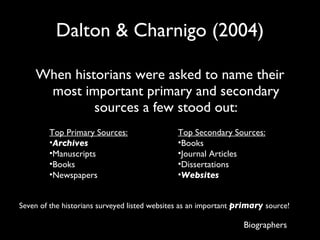
Dalton & Charnigo (2004) When historians were asked to name their most important primary and secondary sources a few stood out: Biographers Top Primary Sources: Archives Manuscripts Books Newspapers Top Secondary Sources: Books Journal Articles Dissertations Websites Seven of the historians surveyed listed websites as an important  primary  source!
Dalton & Charnigo (2004) They also assert that historians are lone wolves. Why? Because they rarely co-author publications… Biographers
Dalton & Charnigo (2004) What needs to be done? Are historians really anti-social? With such a wide range of desired materials,  how can librarians and archivists provide for them? Biographers
Historian / Biographer Miller (2005)  doesn’t view their methods as notably different Lee (2009)  suggests that the methods of popular biographers  are much more akin to investigative journalism. Biographers Lee, H. (2009). Biography: A very short introduction. Oxford: Oxford University Press. Miller, R. (2005). Biographical research methods. London: Sage.
Identifying key concepts Technology Use Import of Personal Contacts Use   of Archival Collections Biographers Is there a methodological divide?
Our Study
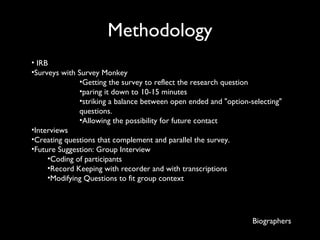
Methodology   IRB Surveys with Survey Monkey Getting the survey to reflect the research question  paring it down to 10-15 minutes striking a balance between open ended and "option-selecting" questions.  Allowing the possibility for future contact Interviews Creating questions that complement and parallel the survey. Future Suggestion: Group Interview Coding of participants Record Keeping with recorder and with transcriptions  Modifying Questions to fit group context Biographers
Data Collection  Pilot Invitation letter Identity, Incentive, Confidentiality Contacting participants: Methods: List-serves Facebook Direct Emails Personal Acquaintances Journals of Biography Societies of Biography Survey Monkey Automatic Collection Telephone Interview transcription
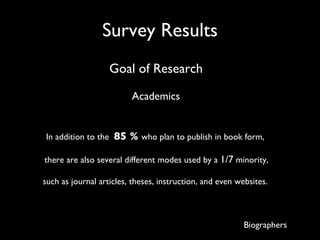
Survey Results Biographers In addition to the  85 %  who plan to publish in book form,  there are also several different modes used by a  1/7  minority, such as journal articles, theses, instruction, and even websites.  Goal of Research Academics
Size of circles relate number of responses  to number of respondents Biographers
Survey Results Biographers Conversely, popular biographers think primarily of book publication, with a small percentage  (28%)  aiming to publish in magazines. The overall majority of book publication  is significant. Goal of Research Popular
Size of circles relate number of responses  to number of respondents Biographers
Survey Results Surprise! Scholars like to talk with one another!
Survey Results 3 respondents added comments emphasizing the importance of interviews
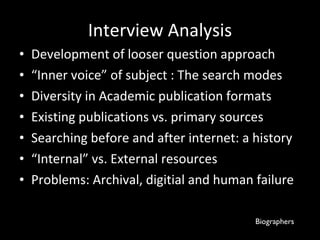
Interview Analysis Development of looser question approach  “ Inner voice” of subject : The search modes Diversity in Academic publication formats  Existing publications vs. primary sources Searching before and after internet: a history “ Internal” vs. External resources  Problems: Archival, digitial and human failure Biographers
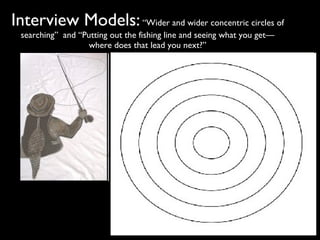
Interview Models:  “Wider and wider concentric circles of searching”  and “Putting out the fishing line and seeing what you get—where does that lead you next?”
Limitations Biographers
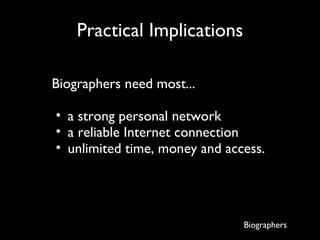
Practical Implications Biographers Biographers need most... a strong personal network a reliable Internet connection  unlimited time, money and access. 
Some Quick Demographics  57%  female  (8 respondents) 43%  male  (6 respondents) average age:  52 youngest:  27 oldest:  75 Tech Habits: 42%   check e-mail "constantly," or 16+ times per day 14%  (2 respondents) check e-mail 3 times or less per day.  Most have been writing professionally: mean= 14 years mode= 10 years Biographers
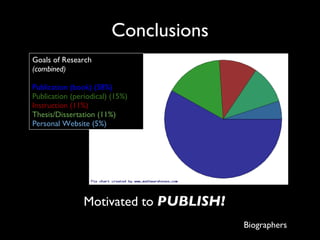
Conclusions Biographers Motivated to  PUBLISH!   Goals of Research (combined) Publication (book) (58%) Publication (periodical) (15%) Instruction (11%) Thesis/Dissertation (11%) Personal Website (5%)
Future Work Biographers outside the conventional realm of  written histories may benefit most  from new research regarding their habits.  These include: children's nonfiction writers documentary filmmakers  students Reliability and Usability of: personal sources Internet information Biographers
Questions?

LIS_608 Biographers

  • 1.
    Biographers Fall 2010LIS 608 Human Information Seeking Behavior Lauren Orso Emily Fairey Caitlin Arndt People Seeking People
  • 2.
    Defining Biography Biographyas History Biography as Popular Literature Biographers
  • 3.
    Our Research QuestionWhen scholarly biographers research their topics, are they searching in the same ways and using the same resources as their more popular counterparts? Biographers
  • 4.
  • 5.
    Tibbo (2003) Thestudy focuses on U.S. History scholars and their access to primary source materials According to Tibbo’s breakdown, it’s clear that biographical historians make use of a wide variety of resources (digital, print or otherwise). Tibbo suggests that history scholars actually want digital resources, not necessarily technophobes. Biographers Tibbo, H.R. (2003). Primarily history in America: How U.S. historians search for primary materials at the dawn of the digital age. American Archivist 66(1), 9-50.
  • 6.
    Tibbo (2003) Whatneeds to be done? More directed study of biographical historians How can archives better serve the biographer’s need for primary source material? Biographers
  • 7.
    Dalton & Charnigo(2004) A study of historians that analyzes: and examines the use of electronic materials . “… which materials historians consider to be the most important and how they discover them.” (p.400) Biographers Dalton, M. S., & Charnigo, L. (2004). Historians and their information sources. College & Research Libraries, 65(5), 400-25.
  • 8.
    Dalton & Charnigo(2004) When historians were asked to name their most important primary and secondary sources a few stood out: Biographers Top Primary Sources: Archives Manuscripts Books Newspapers Top Secondary Sources: Books Journal Articles Dissertations Websites Seven of the historians surveyed listed websites as an important primary source!
  • 9.
    Dalton & Charnigo(2004) They also assert that historians are lone wolves. Why? Because they rarely co-author publications… Biographers
  • 10.
    Dalton & Charnigo(2004) What needs to be done? Are historians really anti-social? With such a wide range of desired materials, how can librarians and archivists provide for them? Biographers
  • 11.
    Historian / BiographerMiller (2005) doesn’t view their methods as notably different Lee (2009) suggests that the methods of popular biographers are much more akin to investigative journalism. Biographers Lee, H. (2009). Biography: A very short introduction. Oxford: Oxford University Press. Miller, R. (2005). Biographical research methods. London: Sage.
  • 12.
    Identifying key conceptsTechnology Use Import of Personal Contacts Use of Archival Collections Biographers Is there a methodological divide?
  • 13.
  • 14.
    Methodology   IRBSurveys with Survey Monkey Getting the survey to reflect the research question paring it down to 10-15 minutes striking a balance between open ended and "option-selecting" questions. Allowing the possibility for future contact Interviews Creating questions that complement and parallel the survey. Future Suggestion: Group Interview Coding of participants Record Keeping with recorder and with transcriptions Modifying Questions to fit group context Biographers
  • 15.
    Data Collection Pilot Invitation letter Identity, Incentive, Confidentiality Contacting participants: Methods: List-serves Facebook Direct Emails Personal Acquaintances Journals of Biography Societies of Biography Survey Monkey Automatic Collection Telephone Interview transcription
  • 16.
    Survey Results BiographersIn addition to the 85 % who plan to publish in book form, there are also several different modes used by a 1/7 minority, such as journal articles, theses, instruction, and even websites. Goal of Research Academics
  • 17.
    Size of circlesrelate number of responses to number of respondents Biographers
  • 18.
    Survey Results BiographersConversely, popular biographers think primarily of book publication, with a small percentage (28%) aiming to publish in magazines. The overall majority of book publication is significant. Goal of Research Popular
  • 19.
    Size of circlesrelate number of responses to number of respondents Biographers
  • 20.
    Survey Results Surprise!Scholars like to talk with one another!
  • 21.
    Survey Results 3respondents added comments emphasizing the importance of interviews
  • 22.
    Interview Analysis Developmentof looser question approach “ Inner voice” of subject : The search modes Diversity in Academic publication formats Existing publications vs. primary sources Searching before and after internet: a history “ Internal” vs. External resources Problems: Archival, digitial and human failure Biographers
  • 23.
    Interview Models: “Wider and wider concentric circles of searching” and “Putting out the fishing line and seeing what you get—where does that lead you next?”
  • 24.
  • 25.
    Practical Implications BiographersBiographers need most... a strong personal network a reliable Internet connection  unlimited time, money and access. 
  • 26.
    Some Quick Demographics 57% female (8 respondents) 43% male (6 respondents) average age: 52 youngest: 27 oldest: 75 Tech Habits: 42% check e-mail "constantly," or 16+ times per day 14% (2 respondents) check e-mail 3 times or less per day.  Most have been writing professionally: mean= 14 years mode= 10 years Biographers
  • 27.
    Conclusions Biographers Motivatedto PUBLISH!   Goals of Research (combined) Publication (book) (58%) Publication (periodical) (15%) Instruction (11%) Thesis/Dissertation (11%) Personal Website (5%)
  • 28.
    Future Work Biographersoutside the conventional realm of written histories may benefit most from new research regarding their habits. These include: children's nonfiction writers documentary filmmakers  students Reliability and Usability of: personal sources Internet information Biographers
  • 29.

Editor's Notes

  • #3 Discussion of the weight of literature being behind historical biography. What exactly is the relationship between history and biography? Discussion of biography as a form of entertainment for popular consumption. The existence of non-historian professional biographers and mass-market biographies shows that biography can also serve as enjoyment and diversion. This leads us to question…
  • #4 Do the information needs and seeking strategies match between these two types? In terms of their research what divides and unites these groups?
  • #6 I figure we can include in this section the articles we choose for the class to read and then maybe one or two more? However many we need to get across the gist of our literature review. I’ll gladly put together the other slides if you let me know of the other articles you want to include.
  • #7 Following a short discussion of the study, we can mention what about the study/ies led us to question further for each article?
  • #10 They doubt historian’s connectedness will their colleagues.
  • #13 Three aspects of the research process of biography stand out as key and we hope to learn the perspective of each group on these matters and see what discrepancies or similarities arise.