SCA 2017, Manila
June 16th, 2017
Soonchang Yoon
Korean Academy of Science and Technology
Future Earth Korea
1. Public concern on fine dust (PM2.5) and their impact on
human health in Korea, which became one of the hottest
campaign pledges of the presidential election, last
month in Korea.
2. Status and analysis of PM2.5 pollution in Korea
3. Contents of the National Strategic Project
4. International collaboration in Asia and Pacific Region
under Future Earth
In this presentation I will talk about :
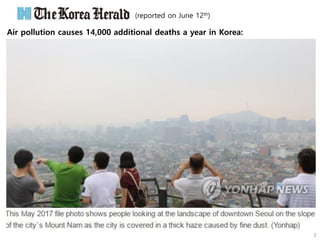
Air pollution causes 14,000 additional deaths a year in Korea:
(reported on June 12th)
Report says:
- The number of premature deaths in South Korea caused by air pollution
was tallied at 13,703 in 2013 in the IHME report, said Prof. Cheong Hae-
kwan on Monday, citing a report by the US-based Institute for Health
Metrics and Evaluation
- The figure translates into 4.5 percent of the country's entire deaths in
the reported year or one every 20 deaths per year resulting from polluted
air.
- The main culprit was the emission of dangerous air particles, known as
PM2.5, which was responsible for 12,037 deaths comprising 4,274 deaths
from lung cancer, 1,901 ones from ischemic heart disease and 5,862 ones
from cerebral stroke.
- The OECD projection said that in South Korea, there will be an
estimated 1,109 deaths per 1 million people caused by air pollution in
2060, about three times the 359 deaths reported in 2010. South Korea's
proportion of air pollution-related economic losses in its gross domestic
product was projected at 0.63 percent, higher than Japan with 0.42
percent and the United States with 0.21 percent. (Yonhap)
- MOE invested more that 3 billion US$ to install DPF filters or to
replace diesel engines to LNG engines free for 10 years, 2005~2014.
- MOE regulated to cut down the emissions of PM10, SOx, NOx and
VOCs during the same period.
- All diesel buses are replaced to CNG buses
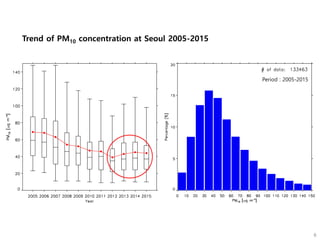
- All these measures improved air quality in Seoul steadily until 2012.
However, it became worse again starting 2013.
- OECD warned mortality caused by air pollution in Korea will become
the highest among the OCED countries in 2060.
- The President ordered Ministers to make a concrete strategy to
resolve the fine dust problem at a Cabinet meeting in May, 2016.
Air quality management in Seoul and vicinity since 2005:
1. Apr 2001 – Feb 2002 [Kim, 2006]
2. Apr 2001 – Feb 2002 [Kang et al., 2006]
3. 2003 – 2004 [Kim, 2006]
4. Mar 2003 – Feb 2005 [Kim et al., 2007]
5. 2003 – 2004 [Kim, 2006]
6. Mar 2003 – Feb 2005 [Kim et al., 2007]
7. Winter 2005 [Jung et al., 2009; Dec 2005 – Nov 2007]
8. Spring 2006 [Jung et al., 2009]
9. Summer 2006 [Jung et al., 2009]
10. Fall 2006 [Jung et al., 2009]
11. Winter 2006 [Jung et al., 2009]
12. Spring 2007 [Jung et al., 2009]
13. Summer 2007 [Jung et al., 2009]
14. Fall 2007 [Jung et al., 2009]
15. Jan 2009 – Dec 2009 [Park et al., 2012]
16. Jan 2010 – Dec 2010 [Shon et al., 2012]
17. Fall 2012 [KIST]
18. Winter 2013 [KIST]
19. Spring 2013 [KIST]
20. Summer 2013 [KIST]
1 2
3
5
4
6 11
107
8 9
12
13
14 15
16
17
19
18
20
↓ ↑
ECMassConcentration(μgm-3)
Year
Trend of PM2.5 elemental carbon (EC) concentrations in Seoul
Air Quality, Atmosphere & Health (in print)
Trend of PM10 concentration at Seoul 2005-2015
Period : 2005-2015
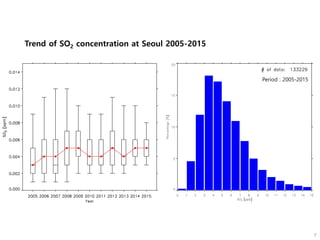
Trend of SO2 concentration at Seoul 2005-2015
Period : 2005-2015
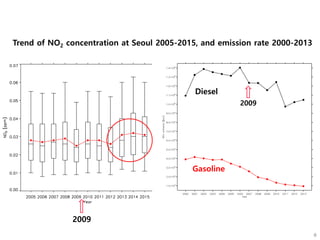
Trend of NO2 concentration at Seoul 2005-2015, and emission rate 2000-2013
Diesel
Gasoline
2009
2009
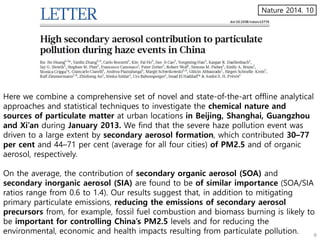
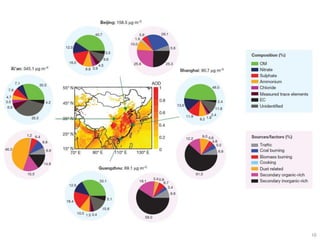
Here we combine a comprehensive set of novel and state-of-the-art offline analytical
approaches and statistical techniques to investigate the chemical nature and
sources of particulate matter at urban locations in Beijing, Shanghai, Guangzhou
and Xi’an during January 2013. We find that the severe haze pollution event was
driven to a large extent by secondary aerosol formation, which contributed 30–77
per cent and 44–71 per cent (average for all four cities) of PM2.5 and of organic
aerosol, respectively.
On the average, the contribution of secondary organic aerosol (SOA) and
secondary inorganic aerosol (SIA) are found to be of similar importance (SOA/SIA
ratios range from 0.6 to 1.4). Our results suggest that, in addition to mitigating
primary particulate emissions, reducing the emissions of secondary aerosol
precursors from, for example, fossil fuel combustion and biomass burning is likely to
be important for controlling China’s PM2.5 levels and for reducing the
environmental, economic and health impacts resulting from particulate pollution.
Nature 2014. 10
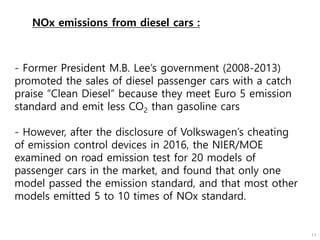
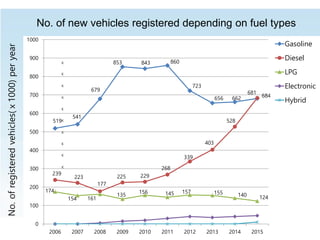
- Former President M.B. Lee’s government (2008-2013)
promoted the sales of diesel passenger cars with a catch
praise “Clean Diesel” because they meet Euro 5 emission
standard and emit less CO2 than gasoline cars
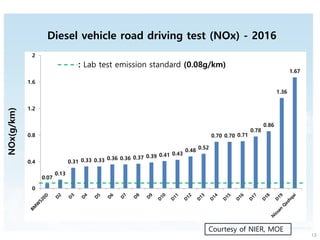
- However, after the disclosure of Volkswagen’s cheating
of emission control devices in 2016, the NIER/MOE
examined on road emission test for 20 models of
passenger cars in the market, and found that only one
model passed the emission standard, and that most other
models emitted 5 to 10 times of NOx standard.
NOx emissions from diesel cars :
No. of new vehicles registered depending on fuel types
519
541
679
853 843 860
723
656 662
681
239
223
177
225 229
268
339
403
528
684
174
154 161
135
156 145 157 155 140 124
0
100
200
300
400
500
600
700
800
900
1000
2006 2007 2008 2009 2010 2011 2012 2013 2014 2015
Gasoline
Diesel
LPG
Electronic
Hybrid
No.ofregisteredvehicles(ⅹ1000)peryear
K
K
K
K
K
K
K
K
K
K
0.07
0.13
0.31 0.33 0.33 0.36 0.36 0.37 0.39 0.41 0.43
0.48 0.52
0.70 0.70 0.71
0.78
0.86
1.36
1.67
0
0.4
0.8
1.2
1.6
2
Diesel vehicle road driving test (NOx) - 2016
NOx(g/km)
: Lab test emission standard (0.08g/km)
Courtesy of NIER, MOE
Meteorological conditions :
- Recent studies show that the wind circulation is
weakened in recent years, which means that the air
pollutants poorly ventilate but accumulate, causing
severe smog/haze.
- Some other studies show that more frequent severe
hazy days are expected due to the climate change.
Science Advances 2017. 3
- The East China Plains (ECP) region experienced the worst haze pollution on
record for January in 2013. We show that the unprecedented haze event is due
to the extremely poor ventilation conditions, which had not been seen in the
preceding three decades.
- Statistical analysis suggests that the extremely poor ventilation conditions are
linked to Arctic sea ice loss in the preceding autumn and extensive boreal snowfall
in the earlier winter. We identify the regional circulation mode that leads to
extremely poor ventilation over the ECP region. Climate model simulations
indicate that boreal cryospheric forcing enhances the regional circulation mode of
poor ventilation in the ECP region and provides conducive conditions for extreme
haze such as that of 2013.
- Consequently, extreme haze events in winter will likely occur at a higher
frequency in China as a result of the changing boreal cryosphere, posing difficult
challenges for winter haze mitigation but providing a strong incentive for
greenhouse gas emission reduction.
- Conducive weather conditions are an important ingredient of severe haze
episodes, and include reduced surface winter northerlies weakened north-westerlies
in the mid-troposphere, and enhanced thermal stability of the lower atmosphere.
How such weather conditions may respond to climate change is not clear. Here we
project a 50% increase in the frequency and an 80% increase in the persistence of
conducive weather conditions similar to those in January 2013, in response to climate
change.
- The increased frequency is consistent with large-scale circulation changes, including
an Arctic Oscillation upward trend, weakening East Asian winter monsoon, and faster
warming in the lower troposphere. Thus, circulation changes induced by global
greenhouse gas emissions can contribute to the increased Beijing severe haze
more frequently.
2017. 3
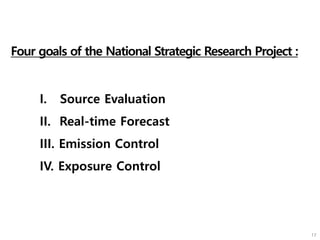
Four goals of the National Strategic Research Project :
I. Source Evaluation
II. Real-time Forecast
III. Emission Control
IV. Exposure Control
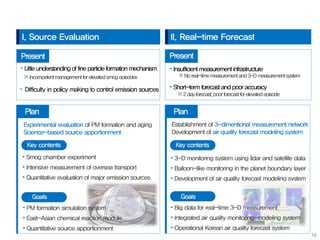
I. Source Evaluation II. Real-time Forecast
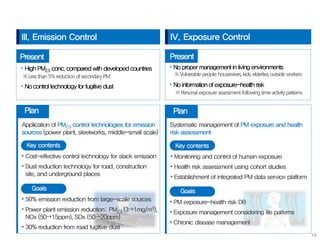
III. Emission Control IV. Exposure Control
3
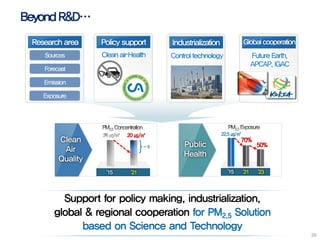
Support for policy making, industrialization,
global & regional cooperation for PM2.5 Solution
based on Science and Technology
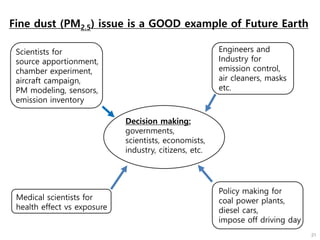
Fine dust (PM2.5) issue is a GOOD example of Future Earth
Scientists for
source apportionment,
chamber experiment,
aircraft campaign,
PM modeling, sensors,
emission inventory
Engineers and
Industry for
emission control,
air cleaners, masks
etc.
Medical scientists for
health effect vs exposure
Policy making for
coal power plants,
diesel cars,
impose off driving day
Decision making:
governments,
scientists, economists,
industry, citizens, etc.
Thanks for attention!

Soonchang yoon

  • 1.
    SCA 2017, Manila June16th, 2017 Soonchang Yoon Korean Academy of Science and Technology Future Earth Korea
  • 2.
    1. Public concernon fine dust (PM2.5) and their impact on human health in Korea, which became one of the hottest campaign pledges of the presidential election, last month in Korea. 2. Status and analysis of PM2.5 pollution in Korea 3. Contents of the National Strategic Project 4. International collaboration in Asia and Pacific Region under Future Earth In this presentation I will talk about :
  • 3.
    Air pollution causes14,000 additional deaths a year in Korea: (reported on June 12th)
  • 4.
    Report says: - Thenumber of premature deaths in South Korea caused by air pollution was tallied at 13,703 in 2013 in the IHME report, said Prof. Cheong Hae- kwan on Monday, citing a report by the US-based Institute for Health Metrics and Evaluation - The figure translates into 4.5 percent of the country's entire deaths in the reported year or one every 20 deaths per year resulting from polluted air. - The main culprit was the emission of dangerous air particles, known as PM2.5, which was responsible for 12,037 deaths comprising 4,274 deaths from lung cancer, 1,901 ones from ischemic heart disease and 5,862 ones from cerebral stroke. - The OECD projection said that in South Korea, there will be an estimated 1,109 deaths per 1 million people caused by air pollution in 2060, about three times the 359 deaths reported in 2010. South Korea's proportion of air pollution-related economic losses in its gross domestic product was projected at 0.63 percent, higher than Japan with 0.42 percent and the United States with 0.21 percent. (Yonhap)
  • 5.
    - MOE investedmore that 3 billion US$ to install DPF filters or to replace diesel engines to LNG engines free for 10 years, 2005~2014. - MOE regulated to cut down the emissions of PM10, SOx, NOx and VOCs during the same period. - All diesel buses are replaced to CNG buses - All these measures improved air quality in Seoul steadily until 2012. However, it became worse again starting 2013. - OECD warned mortality caused by air pollution in Korea will become the highest among the OCED countries in 2060. - The President ordered Ministers to make a concrete strategy to resolve the fine dust problem at a Cabinet meeting in May, 2016. Air quality management in Seoul and vicinity since 2005:
  • 6.
    1. Apr 2001– Feb 2002 [Kim, 2006] 2. Apr 2001 – Feb 2002 [Kang et al., 2006] 3. 2003 – 2004 [Kim, 2006] 4. Mar 2003 – Feb 2005 [Kim et al., 2007] 5. 2003 – 2004 [Kim, 2006] 6. Mar 2003 – Feb 2005 [Kim et al., 2007] 7. Winter 2005 [Jung et al., 2009; Dec 2005 – Nov 2007] 8. Spring 2006 [Jung et al., 2009] 9. Summer 2006 [Jung et al., 2009] 10. Fall 2006 [Jung et al., 2009] 11. Winter 2006 [Jung et al., 2009] 12. Spring 2007 [Jung et al., 2009] 13. Summer 2007 [Jung et al., 2009] 14. Fall 2007 [Jung et al., 2009] 15. Jan 2009 – Dec 2009 [Park et al., 2012] 16. Jan 2010 – Dec 2010 [Shon et al., 2012] 17. Fall 2012 [KIST] 18. Winter 2013 [KIST] 19. Spring 2013 [KIST] 20. Summer 2013 [KIST] 1 2 3 5 4 6 11 107 8 9 12 13 14 15 16 17 19 18 20 ↓ ↑ ECMassConcentration(μgm-3) Year Trend of PM2.5 elemental carbon (EC) concentrations in Seoul Air Quality, Atmosphere & Health (in print)
  • 7.
    Trend of PM10concentration at Seoul 2005-2015 Period : 2005-2015
  • 8.
    Trend of SO2concentration at Seoul 2005-2015 Period : 2005-2015
  • 9.
    Trend of NO2concentration at Seoul 2005-2015, and emission rate 2000-2013 Diesel Gasoline 2009 2009
  • 10.
    Here we combinea comprehensive set of novel and state-of-the-art offline analytical approaches and statistical techniques to investigate the chemical nature and sources of particulate matter at urban locations in Beijing, Shanghai, Guangzhou and Xi’an during January 2013. We find that the severe haze pollution event was driven to a large extent by secondary aerosol formation, which contributed 30–77 per cent and 44–71 per cent (average for all four cities) of PM2.5 and of organic aerosol, respectively. On the average, the contribution of secondary organic aerosol (SOA) and secondary inorganic aerosol (SIA) are found to be of similar importance (SOA/SIA ratios range from 0.6 to 1.4). Our results suggest that, in addition to mitigating primary particulate emissions, reducing the emissions of secondary aerosol precursors from, for example, fossil fuel combustion and biomass burning is likely to be important for controlling China’s PM2.5 levels and for reducing the environmental, economic and health impacts resulting from particulate pollution. Nature 2014. 10
  • 12.
    - Former PresidentM.B. Lee’s government (2008-2013) promoted the sales of diesel passenger cars with a catch praise “Clean Diesel” because they meet Euro 5 emission standard and emit less CO2 than gasoline cars - However, after the disclosure of Volkswagen’s cheating of emission control devices in 2016, the NIER/MOE examined on road emission test for 20 models of passenger cars in the market, and found that only one model passed the emission standard, and that most other models emitted 5 to 10 times of NOx standard. NOx emissions from diesel cars :
  • 13.
    No. of newvehicles registered depending on fuel types 519 541 679 853 843 860 723 656 662 681 239 223 177 225 229 268 339 403 528 684 174 154 161 135 156 145 157 155 140 124 0 100 200 300 400 500 600 700 800 900 1000 2006 2007 2008 2009 2010 2011 2012 2013 2014 2015 Gasoline Diesel LPG Electronic Hybrid No.ofregisteredvehicles(ⅹ1000)peryear K K K K K K K K K K
  • 14.
    0.07 0.13 0.31 0.33 0.330.36 0.36 0.37 0.39 0.41 0.43 0.48 0.52 0.70 0.70 0.71 0.78 0.86 1.36 1.67 0 0.4 0.8 1.2 1.6 2 Diesel vehicle road driving test (NOx) - 2016 NOx(g/km) : Lab test emission standard (0.08g/km) Courtesy of NIER, MOE
  • 15.
    Meteorological conditions : -Recent studies show that the wind circulation is weakened in recent years, which means that the air pollutants poorly ventilate but accumulate, causing severe smog/haze. - Some other studies show that more frequent severe hazy days are expected due to the climate change.
  • 16.
    Science Advances 2017.3 - The East China Plains (ECP) region experienced the worst haze pollution on record for January in 2013. We show that the unprecedented haze event is due to the extremely poor ventilation conditions, which had not been seen in the preceding three decades. - Statistical analysis suggests that the extremely poor ventilation conditions are linked to Arctic sea ice loss in the preceding autumn and extensive boreal snowfall in the earlier winter. We identify the regional circulation mode that leads to extremely poor ventilation over the ECP region. Climate model simulations indicate that boreal cryospheric forcing enhances the regional circulation mode of poor ventilation in the ECP region and provides conducive conditions for extreme haze such as that of 2013. - Consequently, extreme haze events in winter will likely occur at a higher frequency in China as a result of the changing boreal cryosphere, posing difficult challenges for winter haze mitigation but providing a strong incentive for greenhouse gas emission reduction.
  • 17.
    - Conducive weatherconditions are an important ingredient of severe haze episodes, and include reduced surface winter northerlies weakened north-westerlies in the mid-troposphere, and enhanced thermal stability of the lower atmosphere. How such weather conditions may respond to climate change is not clear. Here we project a 50% increase in the frequency and an 80% increase in the persistence of conducive weather conditions similar to those in January 2013, in response to climate change. - The increased frequency is consistent with large-scale circulation changes, including an Arctic Oscillation upward trend, weakening East Asian winter monsoon, and faster warming in the lower troposphere. Thus, circulation changes induced by global greenhouse gas emissions can contribute to the increased Beijing severe haze more frequently. 2017. 3
  • 18.
    Four goals ofthe National Strategic Research Project : I. Source Evaluation II. Real-time Forecast III. Emission Control IV. Exposure Control
  • 19.
    I. Source EvaluationII. Real-time Forecast
  • 20.
    III. Emission ControlIV. Exposure Control
  • 21.
    3 Support for policymaking, industrialization, global & regional cooperation for PM2.5 Solution based on Science and Technology
  • 22.
    Fine dust (PM2.5)issue is a GOOD example of Future Earth Scientists for source apportionment, chamber experiment, aircraft campaign, PM modeling, sensors, emission inventory Engineers and Industry for emission control, air cleaners, masks etc. Medical scientists for health effect vs exposure Policy making for coal power plants, diesel cars, impose off driving day Decision making: governments, scientists, economists, industry, citizens, etc.
  • 23.