Research	Challenges	for	Air	Pollution	in	Asia
Perspectives	from	IGAC
Hiroshi	Tanimoto
Global	Atmospheric	Chemistry	Section,	
National	Institute	for	Environmental	Studies,	Japanemail:	tanimoto@nies.go.jp
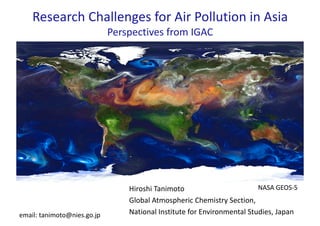
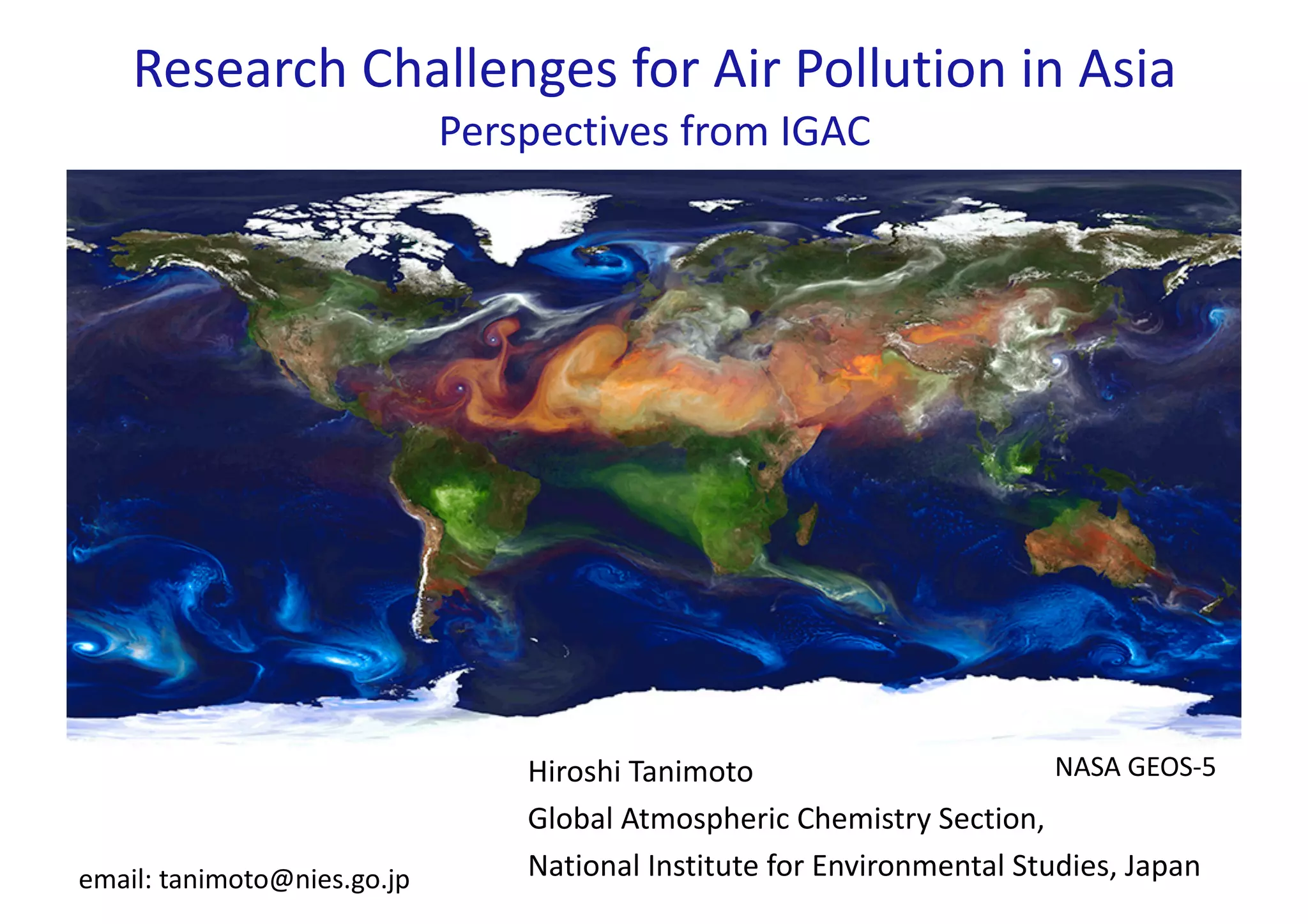
NASA	GEOS-5
Fostering	Community•	Building	Capacity	•	Providing	Leadership
Facilitating	atmospheric	chemistry	research	
toward	a	sustainable	world
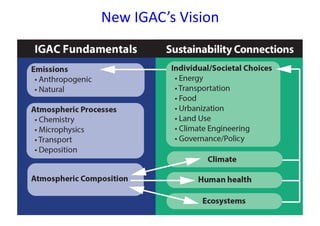
New	IGAC’s	Vision
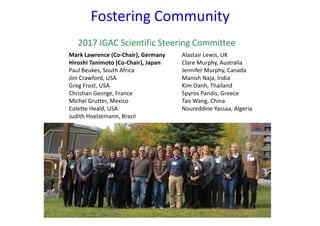
2017	IGAC	Scientific	Steering	Committee
Fostering	Community
Mark	Lawrence	(Co-Chair),	Germany
Hiroshi	Tanimoto (Co-Chair),	Japan
Paul	Beukes,	South	Africa
Jim	Crawford,	USA
Greg	Frost,	USA
Christian	George,	France
Michel	Grutter,	Mexico
Colette	Heald,	USA
Judith	Hoelzemann,	Brazil
Alastair	Lewis,	UK
Clare	Murphy,	Australia
Jennifer	Murphy,	Canada
Manish	Naja,	India
Kim	Oanh,	Thailand
Spyros	Pandis,	Greece
Tao	Wang,	China
Noureddine Yassaa,	Algeria
CATCH
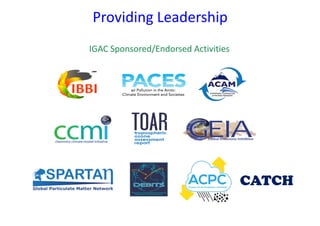
Providing	Leadership
IGAC	Sponsored/Endorsed	Activities
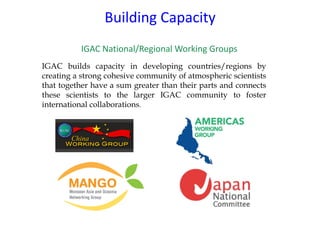
IGAC	National/Regional	Working	Groups
Building	Capacity
IGAC builds capacity in developing countries/regions by
creating a strong cohesive community of atmospheric scientists
that together have a sum greater than their parts and connects
these scientists to the larger IGAC community to foster
international collaborations.
Research	Challenge	for	Air	Pollution
n Why?	:	Impacts	on	
n human	health	– toxicity,	acute/chronic	effects
n climate	change	– warming	effects
n How	can	we	challenge	the	AP-HH	&	AP-CC	issues	in	Asia?	
n Better	understanding	the	processes	controlling	O3 and	PM2.5
n Emissions
n Building	scientific	community/capacity	to	link	to	policy	processes	
Three	Perspectives	from	IGAC:	
International,	Global,	and	Atmospheric	Chemistry point	of	view
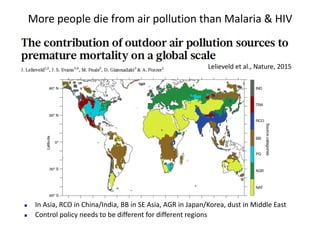
More	people	die	from	air	pollution	than	Malaria	&	HIV
n In	Asia,	RCO	in	China/India,	BB	in	SE	Asia,	AGR	in	Japan/Korea,	dust	in	Middle	East
n Control	policy	needs	to	be	different	for	different	regions
Lelieveld et	al.,	Nature,	2015
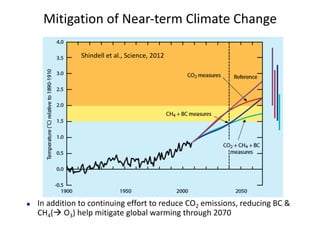
Mitigation	of	Near-term	Climate	Change
n In	addition	to	continuing	effort	to	reduce	CO2 emissions,	reducing	BC	&	
CH4(à O3)	help	mitigate	global	warming	through	2070
Shindell et	al.,	Science,	2012
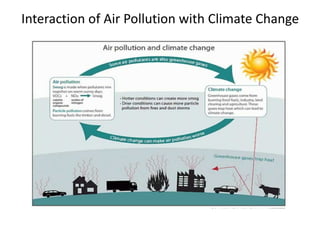
Interaction	of	Air	Pollution	with	Climate	Change
Research	Challenge	for	Air	Pollution
n Why?	:	Impacts	on	
n human	health	– toxicity,	acute/chronic	effects
n climate	change	– warming	effects
n How	can	we	challenge	the	AP-HH	&	AP-CC	issues	in	Asia?	
n Better	understanding	the	processes	controlling	O3 and	PM2.5
n Emissions
n Building	scientific	community/capacity	to	link	to	policy	processes
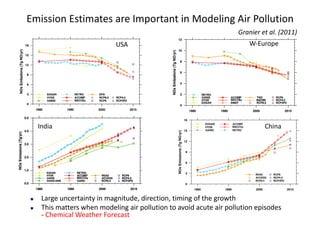
Emission	Estimates	are	Important	in	Modeling	Air	Pollution
India
USA W-Europe
Granier et	al.	(2011)
China
n Large	uncertainty	in	magnitude,	direction,	timing	of	the	growth
n This	matters	when	modeling	air	pollution	to	avoid	acute	air	pollution	episodes	
- Chemical	Weather	Forecast
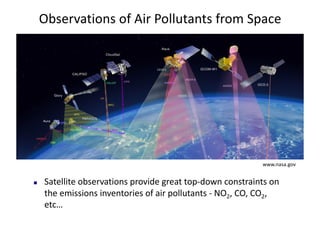
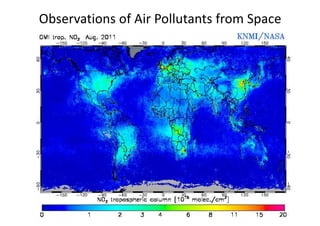
Observations	of	Air	Pollutants	from	Space
n Satellite	observations	provide	great	top-down	constraints	on	
the	emissions	inventories	of	air	pollutants	- NO2,	CO,	CO2,	
etc…	
www.nasa.gov
OMIObservations	of	Air	Pollutants	from	Space
OMI
?
?
?
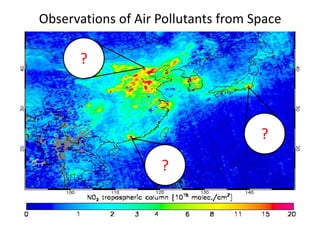
Observations	of	Air	Pollutants	from	Space
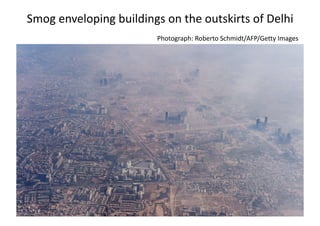
Smog	enveloping	buildings	on	the	outskirts	of	Delhi
Photograph:	Roberto	Schmidt/AFP/Getty	Images
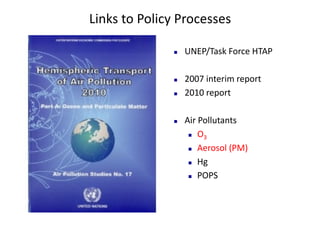
Links	to	Policy	Processes
n UNEP/Task	Force	HTAP
n 2007	interim	report
n 2010	report
n Air	Pollutants
n O3
n Aerosol	(PM)
n Hg
n POPS
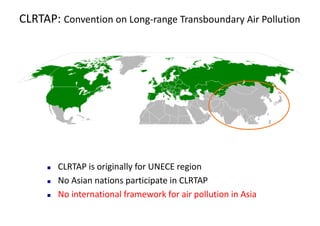
CLRTAP:	Convention	on	Long-range	Transboundary Air	Pollution
n CLRTAP	is	originally	for	UNECE	region
n No	Asian	nations	participate	in	CLRTAP	
n No	international	framework	for	air	pollution	in	Asia
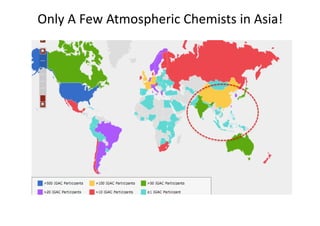
Only	A	Few	Atmospheric	Chemists	in	Asia!
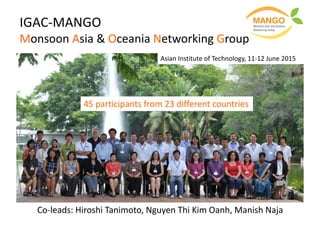
IGAC-MANGO	
Monsoon	Asia	&	Oceania	Networking	Group
Co-leads:	Hiroshi	Tanimoto,	Nguyen	Thi Kim	Oanh,	Manish	Naja
Asian	Institute	of	Technology,	11-12	June	2015
45	participants	from	23	different	countries
Common	Questions/Issues	in	Asia
n Common	questions
n air	quality,	biomass	burning,	haze-transboundary	pollution
n health	impact,	indoor	air	quality	
n Common	issues	(severity	depends	on	country)
n air	quality	is	not	concerned,	relative	to	water	quality
n limited	funding	at	national	level
n #	of	scientists
n local	networking	of	scientists
n instruments/equipments	
n modeling	capability	
n int’l	collaboration	(JICA,	NASA,	…)
n Funding	and	infrastructure	are	needed	to	foster	scientific	
research,	capacity	building,	and	regional	collaborations
Towards	Equal	Opportunity	for	Air	Quality
n The	ultimate	goals	of	air	pollution	research	are:	
n to	better	protect	people’s	health	and	ecosystems
n to	better	mitigate	global	warming	
n Accurate	emission	estimates	are	one	of	key	scientific	
challenges.	Satellites	with	higher	spatial	resolution	help	us	
better	identify	sector-specific	emissions,	and	investigate	NOx-
saturated	regimes	in	urban	grid	for	non-linear	chemistry.	This	
initiative	needs	strong	community	support.
n There	is	no	international	framework	for	air	pollution	in	Asia,	
and	definitely	needs	one	
n Scientific	community	in	Asia	should	be	strengthened,	with	an	
emphasis	on	air	pollution

Hiroshi tanimoto