Air Pollution and Human Health in Asia:
Experience in adopting and promoting the
systems approach
for transdisciplinary research on air pollution
and health in Asia
Nordin Hasan
Chair
Regional Advisory Committee for Future Earth in Asia
Presentation
• Background and context
• Two tier planning of the research
– The ICSU ROAP Science Plans
– The Transdisciplinary Urban Health Research
planning process
• Systems approach and transdisciplinary
research
Experience in adopting and promoting
the systems approach
for transdisciplinary research (on air
pollution and health in Asia)
Context summary
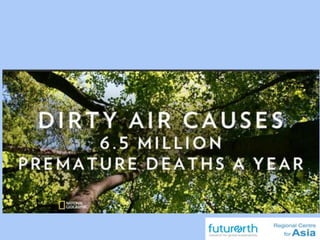
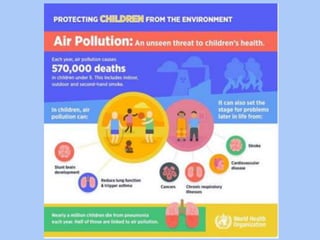
• Air pollution continues to be a serious health
concern – urban; rural/agricultural
• Complex (“wicked problem”) with multiple
drivers, causes, layers of effects
• Need systemic knowledge on causes and effects
their linkages
• Compartmental single sector knowledge has been
useful but unable to address what is essentially a
“wicked problem”
ICSU ROAP two-tier research
planning
• 1st Tier: A Science plan for Systems Approach
to Health and Wellbeing
• 2nd Tier: Plans for individual collaborative
research on health and wellbeing employing
the systems approach
Development of the work on systems
approach to health and wellbeing
(first tier plan)
Priority
area of
work
Health and
wellbeing in a
changing
environment
Science
plan
2011
Details
the
systems
approach
Pilot
project
proposals
Science Planning Group members
(formed in 2010)
Members
 Indira Nath, India, Chair
 Tony Capon, Australia
 Yong Guan Zhu, China
 Phillipa-Howden Chapman,
New Zealand
 Reiko Kishi, Japan
 Jaime Montoya , Phillipines
 Katrina Proust , Australia
 Nordin Hasan (Ex officio)
Method Specialist
 Barry Newell, Australia
ICSU ROAP
 BHJ Mckellar, Chair RCAP
Australia
 Nor Zaneedarwaty Norman,
Malaysia
 Hizam Jaafar, Malaysia
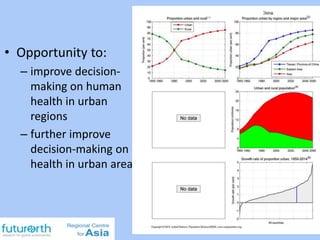
• Opportunity to:
– improve decision-
making on human
health in urban
regions
– further improve
decision-making on
health in urban areas
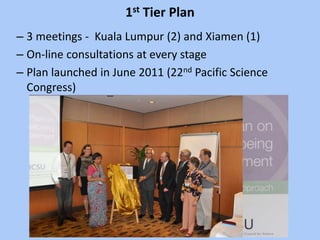
1st Tier Plan
– 3 meetings - Kuala Lumpur (2) and Xiamen (1)
– On-line consultations at every stage
– Plan launched in June 2011 (22nd Pacific Science
Congress)
Features of the Science Plan
• Recognises that urban health issues are
complex, and require multi-disciplinary
approaches
• Promotes research into urban health and
wellbeing where researchers address multi-
sectoral issues and involve a wide range of
stakeholders
• Adopts a system dynamics approach
The System Analysis Challenge
• The behaviour of a human-environment system
emerges from feedback interactions between its
parts.
• These interactions make it difficult to develop
reliable, high-leverage policies without the insights
generated by dynamical modelling.

• But conventional forms of modelling are hampered
by complexity, lack of suitable data, and the
unpredictable aspects of human behaviour.
14
Collaborative Conceptual Modelling (CCM) is emerging from
our research into practical ways to overcome these
problems (Newell & Proust 2012).
Basic Hypothesis: Involvement in the construction of low-
order system-dynamics (LOSD) models can increase a
policy maker’s capacity to understand and avoid policy
resistance.
Main Aim: To develop ways to use collaborative construction
of LOSD models to help policy makers to design effective
policies in complex systems.
Collaborative Conceptual Modelling
16
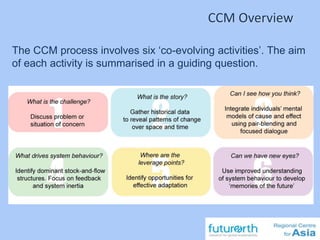
CCM Overview
The CCM process involves six ‘co-evolving activities’. The aim
of each activity is summarised in a guiding question.
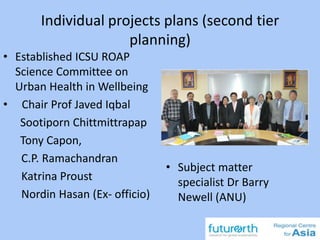
Individual projects plans (second tier
planning)
• Established ICSU ROAP
Science Committee on
Urban Health in Wellbeing
• Chair Prof Javed Iqbal
Sootiporn Chittmittrapap
Tony Capon,
C.P. Ramachandran
Katrina Proust
Nordin Hasan (Ex- officio)
• Subject matter
specialist Dr Barry
Newell (ANU)
Tier-2 Step-1
• Pre-scoping Workshop, Hyderabad, 28 – 29
June 2012.
– Multidisciplinary, multi stakeholder workshop
– Identified needs and priorities
– Explored potential research teams with merit and
output-oriented focus
– Discussed possibilities for research funding and
support
– Developed call for pre-proposals
Tier-2 Step-2
• Scoping Workshop Bangkok, 28 – 29 August
2012
– Reviewed concept proposals received (6/8
accepted for development to full proposal)
– Achieved
• clarification of research aims of projects,
• identification of training needs in systems approaches,
• identification of complementary activities required for
successful management of pilot projects
• agreement of selected projects
…contd
– Agreed design features:
• Used systems thinking via the CCM approach
• Recognise that urban-health problems are
multi-sectoral, and solving them require multi-
disciplinary approaches, and
• Projects takes into account the interests of a
wide range of stakeholders
Tier-2 Step-3
• Systems Workshop, Kuala Lumpur January
2013
– Leaders of selected projects with advanced copies
of projects proposals
– Introduction to dynamic modelling and
collaborative conceptual modelling (CCM)
methodologies
– Assistance to finalise proposals for submission to
funding bodies on-going
Features of desired research
22
• Policy-relevant, and outcomes have impact in the
policy sector
• Recognises: urban health issues are complex, and
require multi-disciplinary approaches
• Adopts a system dynamics approach – Collaborative
Conceptual Modelling (CCM)
• Promotes research into urban health and wellbeing
where researchers involve a wide range of
stakeholders and address cross-sector issues
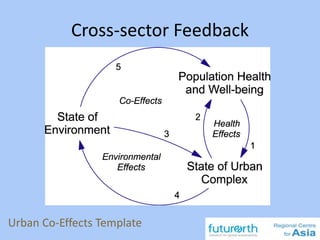
• Cross-sector feedback is important, but invisible:
– Governance is fragmented – communication outside silos
is rare
• Absence of historical perspectives and data
– feedback effects are slow to appear
– timescales can be decades or longer
• Tackling these problems is the main aim of using the
systems approach.
Cross-sector Feedback
24
Urban Co-Effects Template
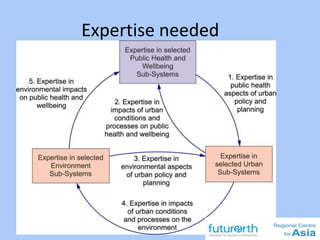
Expertise needed
25
Example: Successful pilot project
Green transportation for better urban health, Taipei
• Energy demand in urban areas results in substantial
emissions of CO2 (cause of climate change) and toxic
pollutants (harmful to human health)
• Transportation sector counts for over 61.5% of world
oil consumption of year 2010 (IEA, 2012)
• Green transportation has potentials to achieve co-
benefits to slow down climate change processes and
improve urban health
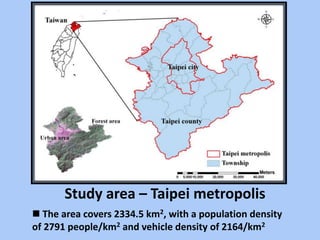
 The area covers 2334.5 km2, with a population density
of 2791 people/km2 and vehicle density of 2164/km2
Study area – Taipei metropolis
Aims of project
• Explore potential co-benefits of environmental
impacts and health risks of green powertrain
technologies under current and future climate
change scenarios
• Establish an integrated cross-disciplinary research
framework to link transportation, air quality (and
climate), and urban health
• Construct a conceptual tool kit which is capable to
assess important determinants and streamline
science-policy dialogue for better urban health
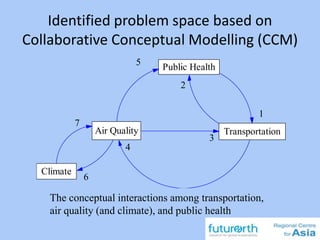
Identified problem space based on
Collaborative Conceptual Modelling (CCM)
Public Health
TransportationAir Quality
Climate
1
2
5
3
4
6
7
The conceptual interactions among transportation,
air quality (and climate), and public health
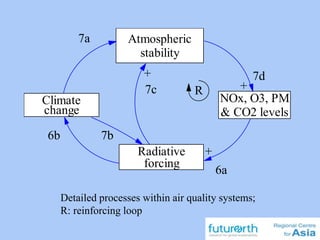
Detailed processes within air quality systems;
R: reinforcing loop
Atmospheric
stability
NOx, O3, PM
& CO2 levels
Radiative
forcing
Climate
change
+
+
+
R
6a
7c
6b
7a
7b
7d
Climate
modeling
Air Quality
1.modeling
2.monitoring
3.emission inventory
Epidemiology study:
exposure, time-activity,
health impacts
1.panel study
2.population study
Behavior and
Vulnerability assessment:
social drivers
Air quality management:
1.Cost-benefit analysis
2.Short-term intervention
3.Long-term improvement
4.Decision making processes
Transportation
modeling
Exposure modeling &
health risk assessment
Air quality modeling
Integration
Integration
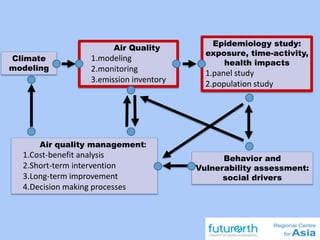
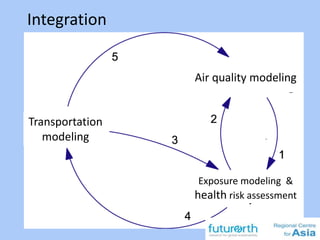
• The CCM approach enabled integration of
expert views from transportation, air quality,
climate, and health fields
• Frameworks for science-policy interface
– Four project members are members of
• A. Transportation Committee, Taipei City Government
• B. Sustainable Development Committee, Taipei City
Government
• C. Advisory Committee of Taiwan Environmental
Protection Administration
• D. Committee of Climate Mitigation and Adaptation,
Taiwan
Outcome
• Enabled establishment of cross-disciplinary research framework
incorporating transportation, air quality, and health
• Provided tool to evaluate health risks in urban areas with
different green transportation options and population
commuting patterns under current and future climate scenarios
• Identified major determinants and controllable pathways of the
complex interactions among green transportation, air quality, and
urban health
• Assessed potential co-benefits of various green transportation
options and population commuting patterns
Challenges
• How do we encourage researchers and urban
planners who have not collaborated to think
collectively?
• How do we get researchers from diverse
disciplines and fields of interest to collectively
develop a multidisciplinary research
project/programme?
Current capacity development activities
• April 2017 Advanced Institute of Disaster Risk
Reduction – Systems Approach for Knowledge-based
Actions (AI-DRR-SAKA) – Academia Sinica
• July 2017 AI-DRR Systems Approach for Slow Onset
Climate Disaster
Relevance to Future Earth
• Transformative, solutions oriented research integrating
science, policy and communities
• Approach fits very well as a tool for planning multidisciplinary
integrated research, the core concept underlying new 10-year
global platform for research on global sustainability Future
Earth
• Co-design, co-produced and co-implemented research
involving multiple sectors and stakeholders
• CCM and systems approach provides a means of more holistic
engagement, design and analysis of complex research issues
Acknowledgements
• Members of various ICSU ROAP Science
Planning and Regional Advisory Committees
• Professor Candice Lung, Academia Sinica
• Dr Barry Newell, Australian National University
• Dr K. Proust, Australian National University
• Dr A. Capon, University of Sydney (formerly of
United Nations University)
Thank you for your attention!

Nordin hassan

  • 1.
    Air Pollution andHuman Health in Asia: Experience in adopting and promoting the systems approach for transdisciplinary research on air pollution and health in Asia Nordin Hasan Chair Regional Advisory Committee for Future Earth in Asia
  • 2.
    Presentation • Background andcontext • Two tier planning of the research – The ICSU ROAP Science Plans – The Transdisciplinary Urban Health Research planning process • Systems approach and transdisciplinary research
  • 3.
    Experience in adoptingand promoting the systems approach for transdisciplinary research (on air pollution and health in Asia)
  • 7.
    Context summary • Airpollution continues to be a serious health concern – urban; rural/agricultural • Complex (“wicked problem”) with multiple drivers, causes, layers of effects • Need systemic knowledge on causes and effects their linkages • Compartmental single sector knowledge has been useful but unable to address what is essentially a “wicked problem”
  • 8.
    ICSU ROAP two-tierresearch planning • 1st Tier: A Science plan for Systems Approach to Health and Wellbeing • 2nd Tier: Plans for individual collaborative research on health and wellbeing employing the systems approach
  • 9.
    Development of thework on systems approach to health and wellbeing (first tier plan) Priority area of work Health and wellbeing in a changing environment Science plan 2011 Details the systems approach Pilot project proposals
  • 10.
    Science Planning Groupmembers (formed in 2010) Members  Indira Nath, India, Chair  Tony Capon, Australia  Yong Guan Zhu, China  Phillipa-Howden Chapman, New Zealand  Reiko Kishi, Japan  Jaime Montoya , Phillipines  Katrina Proust , Australia  Nordin Hasan (Ex officio) Method Specialist  Barry Newell, Australia ICSU ROAP  BHJ Mckellar, Chair RCAP Australia  Nor Zaneedarwaty Norman, Malaysia  Hizam Jaafar, Malaysia
  • 11.
    • Opportunity to: –improve decision- making on human health in urban regions – further improve decision-making on health in urban areas
  • 12.
    1st Tier Plan –3 meetings - Kuala Lumpur (2) and Xiamen (1) – On-line consultations at every stage – Plan launched in June 2011 (22nd Pacific Science Congress)
  • 13.
    Features of theScience Plan • Recognises that urban health issues are complex, and require multi-disciplinary approaches • Promotes research into urban health and wellbeing where researchers address multi- sectoral issues and involve a wide range of stakeholders • Adopts a system dynamics approach
  • 14.
    The System AnalysisChallenge • The behaviour of a human-environment system emerges from feedback interactions between its parts. • These interactions make it difficult to develop reliable, high-leverage policies without the insights generated by dynamical modelling. • But conventional forms of modelling are hampered by complexity, lack of suitable data, and the unpredictable aspects of human behaviour. 14
  • 15.
    Collaborative Conceptual Modelling(CCM) is emerging from our research into practical ways to overcome these problems (Newell & Proust 2012). Basic Hypothesis: Involvement in the construction of low- order system-dynamics (LOSD) models can increase a policy maker’s capacity to understand and avoid policy resistance. Main Aim: To develop ways to use collaborative construction of LOSD models to help policy makers to design effective policies in complex systems. Collaborative Conceptual Modelling
  • 16.
    16 CCM Overview The CCMprocess involves six ‘co-evolving activities’. The aim of each activity is summarised in a guiding question.
  • 17.
    Individual projects plans(second tier planning) • Established ICSU ROAP Science Committee on Urban Health in Wellbeing • Chair Prof Javed Iqbal Sootiporn Chittmittrapap Tony Capon, C.P. Ramachandran Katrina Proust Nordin Hasan (Ex- officio) • Subject matter specialist Dr Barry Newell (ANU)
  • 18.
    Tier-2 Step-1 • Pre-scopingWorkshop, Hyderabad, 28 – 29 June 2012. – Multidisciplinary, multi stakeholder workshop – Identified needs and priorities – Explored potential research teams with merit and output-oriented focus – Discussed possibilities for research funding and support – Developed call for pre-proposals
  • 19.
    Tier-2 Step-2 • ScopingWorkshop Bangkok, 28 – 29 August 2012 – Reviewed concept proposals received (6/8 accepted for development to full proposal) – Achieved • clarification of research aims of projects, • identification of training needs in systems approaches, • identification of complementary activities required for successful management of pilot projects • agreement of selected projects
  • 20.
    …contd – Agreed designfeatures: • Used systems thinking via the CCM approach • Recognise that urban-health problems are multi-sectoral, and solving them require multi- disciplinary approaches, and • Projects takes into account the interests of a wide range of stakeholders
  • 21.
    Tier-2 Step-3 • SystemsWorkshop, Kuala Lumpur January 2013 – Leaders of selected projects with advanced copies of projects proposals – Introduction to dynamic modelling and collaborative conceptual modelling (CCM) methodologies – Assistance to finalise proposals for submission to funding bodies on-going
  • 22.
    Features of desiredresearch 22 • Policy-relevant, and outcomes have impact in the policy sector • Recognises: urban health issues are complex, and require multi-disciplinary approaches • Adopts a system dynamics approach – Collaborative Conceptual Modelling (CCM) • Promotes research into urban health and wellbeing where researchers involve a wide range of stakeholders and address cross-sector issues
  • 23.
    • Cross-sector feedbackis important, but invisible: – Governance is fragmented – communication outside silos is rare • Absence of historical perspectives and data – feedback effects are slow to appear – timescales can be decades or longer • Tackling these problems is the main aim of using the systems approach.
  • 24.
  • 25.
  • 26.
    Example: Successful pilotproject Green transportation for better urban health, Taipei • Energy demand in urban areas results in substantial emissions of CO2 (cause of climate change) and toxic pollutants (harmful to human health) • Transportation sector counts for over 61.5% of world oil consumption of year 2010 (IEA, 2012) • Green transportation has potentials to achieve co- benefits to slow down climate change processes and improve urban health
  • 27.
     The areacovers 2334.5 km2, with a population density of 2791 people/km2 and vehicle density of 2164/km2 Study area – Taipei metropolis
  • 28.
    Aims of project •Explore potential co-benefits of environmental impacts and health risks of green powertrain technologies under current and future climate change scenarios • Establish an integrated cross-disciplinary research framework to link transportation, air quality (and climate), and urban health • Construct a conceptual tool kit which is capable to assess important determinants and streamline science-policy dialogue for better urban health
  • 29.
    Identified problem spacebased on Collaborative Conceptual Modelling (CCM) Public Health TransportationAir Quality Climate 1 2 5 3 4 6 7 The conceptual interactions among transportation, air quality (and climate), and public health
  • 30.
    Detailed processes withinair quality systems; R: reinforcing loop Atmospheric stability NOx, O3, PM & CO2 levels Radiative forcing Climate change + + + R 6a 7c 6b 7a 7b 7d
  • 31.
    Climate modeling Air Quality 1.modeling 2.monitoring 3.emission inventory Epidemiologystudy: exposure, time-activity, health impacts 1.panel study 2.population study Behavior and Vulnerability assessment: social drivers Air quality management: 1.Cost-benefit analysis 2.Short-term intervention 3.Long-term improvement 4.Decision making processes
  • 32.
    Transportation modeling Exposure modeling & healthrisk assessment Air quality modeling Integration
  • 33.
    Integration • The CCMapproach enabled integration of expert views from transportation, air quality, climate, and health fields • Frameworks for science-policy interface – Four project members are members of • A. Transportation Committee, Taipei City Government • B. Sustainable Development Committee, Taipei City Government • C. Advisory Committee of Taiwan Environmental Protection Administration • D. Committee of Climate Mitigation and Adaptation, Taiwan
  • 34.
    Outcome • Enabled establishmentof cross-disciplinary research framework incorporating transportation, air quality, and health • Provided tool to evaluate health risks in urban areas with different green transportation options and population commuting patterns under current and future climate scenarios • Identified major determinants and controllable pathways of the complex interactions among green transportation, air quality, and urban health • Assessed potential co-benefits of various green transportation options and population commuting patterns
  • 35.
    Challenges • How dowe encourage researchers and urban planners who have not collaborated to think collectively? • How do we get researchers from diverse disciplines and fields of interest to collectively develop a multidisciplinary research project/programme?
  • 36.
    Current capacity developmentactivities • April 2017 Advanced Institute of Disaster Risk Reduction – Systems Approach for Knowledge-based Actions (AI-DRR-SAKA) – Academia Sinica • July 2017 AI-DRR Systems Approach for Slow Onset Climate Disaster
  • 37.
    Relevance to FutureEarth • Transformative, solutions oriented research integrating science, policy and communities • Approach fits very well as a tool for planning multidisciplinary integrated research, the core concept underlying new 10-year global platform for research on global sustainability Future Earth • Co-design, co-produced and co-implemented research involving multiple sectors and stakeholders • CCM and systems approach provides a means of more holistic engagement, design and analysis of complex research issues
  • 38.
    Acknowledgements • Members ofvarious ICSU ROAP Science Planning and Regional Advisory Committees • Professor Candice Lung, Academia Sinica • Dr Barry Newell, Australian National University • Dr K. Proust, Australian National University • Dr A. Capon, University of Sydney (formerly of United Nations University)
  • 39.
    Thank you foryour attention!