CONTENTS
Introduction
Historical background
Classification
Dhanyabheda-Description
cereals-Modern view
Conclusion
INTRODUCTION
ž€-ž “€š“
That which makes thin on seperation
’ÝÛ™-ऽ  Ý’ š  ™ Q ’ÝÛ™˜ Q  ो¡ ’Ýۙ݀
A division of ANNA VARGA
In this era we group sooka dhanya under
cereals
Cereals are the edible seeds or grains of the
grass family.cereals and cereal products are
an important source of energy,
ceres, is the name of the pre-Roman goddess
of harvest and agriculture. The word cereal
derives from Ceres.
IMPORTANT CEREALS:
Maize, Rice, Wheat, Barley, Sorghum, Millets,
Oats,  Rye
HISTORICAL BACKGROUND
IN AYURVEDA
In Yajurveda and Atharvaveda -mentions about
dhanyas.
The term Thandula used for threshed out paddy
grain .
Unhusked pounded rice mixed known as
AKSHATA used in religious ceremonies homam.
In Paneneeya ashtadyayi there is mentioning of
shashtika rice.
12000 yrs ago human used rice as food
U.N.General assembly has celebrated 2004 as the
International Year of rice(IYR)
CLASSIFICATION
Divisions of Dhanya
In Charaka samhitha- 1.sooka
2.simbi
In Ashtanga hrudaya- 1.sooka
2.simbi
3.truna
In Bavaprakasa - 1.Sali
2.vrihi
3.sooka
4.simbi
5.kshudra
DIVISIONS OF SOOKA
In Ashtanga hrudaya- Sali
Vrihi
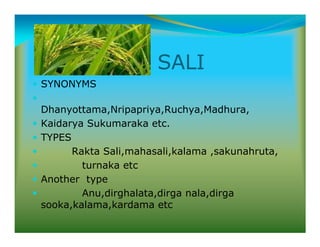
SALI
SYNONYMS
Dhanyottama,Nripapriya,Ruchya,Madhura,
Kaidarya Sukumaraka etc.
TYPES
Rakta Sali,mahasali,kalama ,sakunahruta,
turnaka etc
Another type
Anu,dirghalata,dirga nala,dirga
sooka,kalama,kardama etc
Best one -RAKTASALI
then -Mahasali
-Kalama
etc in the order of
succession.
Pharmacological properties
Rasa :madhura
Anurasa :kashaya
Guna :laghu,snigdha
Virya :seetha
Vipaka :katu(madhura)
Dosha karma :vatha kaphahara
Pharmacological properties
of
Raktha sali
Rasa :madura
Guna :lagu snigda
Virya :not mentioned
Vipaka :not mentioned
Dosha karma:tridosha samana
MAIN KARMAS-SALI
Baddavarcha
Balya
Brimhana
Chakshushya
Hridya
Mootrla
Ruchya
Svarya
Vrushya
ROLE IN RITHUCHARYA
In Charaka samhita
Sali+cold mantha,sugar etc advised in
Summer
Sali+meat of arid animals vegetable
soup
advised in Varsha
Significance in treatment
Sukra vega dharanaja rogas will cured by
taking Sali
In charaka Upakalpaneeya adyaya
Sali,shashtika,yava are said to collect before
undergoing emesis purgation .
In kaphaja diseases-due to anabishyandi
In karsya chikitsa
In raktapitta raktapradara
Various food preparations
Peya
Vilepi
Manda
Roasted flour of fried paddy
Diff. rice preparations
Pressed paddy preparations-prthuka
Fermented preparations-sukta
VRIHI
Synonyms
krshnavrihi,salahmukam,jatumukha,nandimuka,
lavaksha,paravatah,patalah
TYPES -13
jatumuka,krishnavrihi,patla,kukudantaka,salamuk
a,shalayu,nandi,nandimuka,rajvaksha,turitaka,lav
akshaka,paravataka,borava.
PROPERTIES ACTIONS
Rasa :madhura
Guna :guru
Virya :seetha
Vipaka :madhura
Doshakarma :tridosha vardhaka
MAIN KARMAS
Alpabhishynda
Baddavarcha
Sthambana
Svedavardhaka
Brimhana
Balya
Sukrala
Varnya
SHASTIKA
(njavara)
Matures in sixty days
Best among vrihis
Synonyms
masadvayotbava,shashtisali,shashtija,shastivas
araja,vrihisreshta,garbapaki,shastihayana
TYPES
Almost 15 types
shatapushpa
Pramoda
mukundaka
mahashastika
goura
nila
etc………………….
PROPERTIESACTIONS
Rasa :madhura
Guna :lagu,snigda,mridu
Virya :seetha
Vipaka :madhura(?)
Dosha karma :tridoshasamana
MAIN KARMAS
Grahi
Balya
Sukrajanaka
Brimhana
Pathya
moothrala
THERAPEUTIC
INDICATIONS
BOOKS INDICATIONS
BPN
SGN
AVC
JVARA
SRAMAM,KRICHRAM,SVASAM,KSATAKSHAYAM,
KASAM
JVARAM
shastika pinda sweda
Kerala speciality treatment
It is a modified form of pinda sweda
INDICATIONS:
In various degenerative
conditionsrejuvenative purposes like
paraplegia,hemiplegia ,muscle dystrophy etc.
ADVANTAGE;
Improve muscle strengthbulk of muscles
Produce snehanaswedana effect at a time.
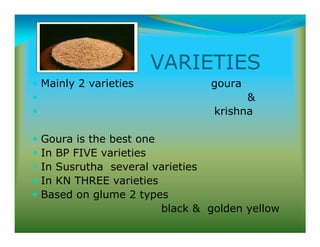
VARIETIES
Mainly 2 varieties goura

krishna
Goura is the best one
In BP FIVE varieties
In Susrutha several varieties
In KN THREE varieties
Based on glume 2 types
black  golden yellow
Njavara theppu
Process by which direct application of rice on
body of an individual.
Massage generally for 1 hr either whole body
or affected part only.
RICE
BOTANICAL NAME :Oryza sativa
FAMILY : Graminae
Useful Part :grain,spirit
Rice is the seed of a monocot plant Oryza sativa, of the
grass family (Poaceae). As a cereal grain, it is the most
important staple food for a large part of the world's human
population, especially in East, South, Southeast Asia, the
Middle East, Latin America, and the West Indies. It is the
grain with the second highest worldwide production, after
maize (corn)
Taxonomical order
Kingdom - plantae
Subkingdom - Tracheobionata
Division - Magnoliophyta
Class - Liliopsida
Order - cyperales
Family - Poaceae
Genus - Oryza
Species - sativa
Nutritional value per 100 g (3.5 oz)
Energy 370 kcal 1530 kJ
Carbohydrates 79 g –
Sugars 0.12 g –
Dietary fiber 1.3 g
Fat 0.66 g
Protein 7.13 g
Water 11.62 g
Thiamine (Vit. B1) 0.070 mg 5%
Riboflavin (Vit. B2) 0.049 mg 3%
Niacin (Vit. B3) 1.6 mg 11%
Pantothenic acid (B5) 1.014 mg 20%
Vitamin B6 0.164 mg 13%
Folate (Vit. B9) 8 µg 2%
Calcium 28 mg 3%
Iron 0.80 mg 6%
Magnesium 25 mg 7%
Manganese 1.088 mg 54% Phosphorus 115 mg 16%
Potassium 115 mg 2% Zinc 1.09 mg 11%
chemical composition
contents rice husk bran Polished
rice
moisture 12.4 3.2 9.7 10
Ash 0.4 13.2 10 6.7
Crude fiber 0.2 35.7 9.5 6.3
carbohydrate 79.2 38.6 49.9 59
protein 7.4 3.6 12.1 11.7
fat 0.4 0.7 8.8 7.3
What are the nutritional
benefits of Rice?
Excellent source of carbohydrates
Good energy source
Low fat, Low salt, No cholesterol
A good source of vitamins and minerals
such as thiamine, niacin, iron, riboflavin,
vitamin D, calcium, and fiber
high sugar
No gluten
No additives and preservatives
cont………
Contains resistant starch
Non-allergenic
Cancer prevention and diet
Rice is a low-sodium food for those with
hypertension.
It is a fair source of protein containing all
eight amino acids
some important
facts about rice
More than 90 percent of the world's rice is
grown and consumed in Asia, where people
typically eat rice two or three times a daily.
Rice is the staple diet of half the world's
population
Rice farming has been traced back to around
5,000 BC
Hundreds of millions of the poor spend half to
three fourths of their incomes on rice and only
rice
More than 140,000 varieties of cultivated rice
(the grass family Oryza sativa) are thought to
exist but the exact number remains a mystery
Three of the world's four most populous
nations are rice-based societies: China, India,
and Indonesia. Together, they have nearly 2.5
billion people almost half of the world's
population
In kerala Rice is thrown on newly married
couples as a symbol of fertility, luck and
wealth
Medicinal Uses of Rice
Philippines: Rice polishings-the bran-is extracted and used as an
excellent source of Vitamin B to prevent and cure beri-beri.
Malaysia: In the Medicinal Book of Malayan Medicine, it is
prescribed that boiled rice greens can be used as an eye lotion
and for use with acute inflammation of the inner body tissues. The
book also recommends applying a mixture of dried, powdered rice
on certain skin ailments.
Cambodia: The hulls (husk) of mature rice plants are considered
useful for treating dysentery. The hulls of a three-month old rice
plant are thought to be diuretic.
China: The Chinese believe rice strengthens the spleen, as well as
weak stomach, increases appetite, and cures indigestion. Dried
sprouted rice grains were once used as an external medicine to aid
in digestion, give tone to muscles, and expel gas from the stomach
and intestines.
India: Rice water is prescribed by the Pharmacopoeia of India as
an ointment to counteract inflamed surface
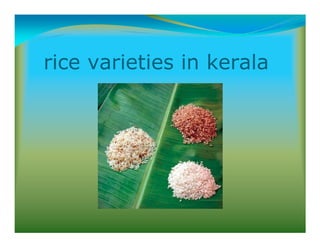
rice varieties in kerala
South indian favourite rice varities are
JAYA  SUREKHA
In Kerala most accepteble is jaya type.
Palakadan Matta  njavara - another types
they got GI status from India govt.
MATTA red rice with a unique taste,grown
largely in Palakad  thrissur.
POKKKALI –Developed by kerala agriculture
university.
KURUVA RICE-prefered in north kerala.
BASMATHI RICE
Basmati is a variety of long grain rice grown in India and
Pakistan, notable for its fragrance and delicate,
nuanced flavour. Its name means the fragrant one
in Sanskrit, but it can also mean the soft riceThe grains of
basmati rice are longer than most other types of rice.
Cooked grains of Basmati rice are characteristically free
flowing rather than sticky, as with most long-grain rice.
Cooked basmati rice can be uniquely identified by its
fragrance. Basmati rice is available in two varieties -
white and brown
basmathi rice nutrition
Basmati rice, 1 cup (200g) (cooked)
Calories: 205
Protein: 4.2g
Carbohydrate: 44.5g
Total Fat: 0.44g
Fiber: 0.63g
*Good source
of: Iron (1.9mg), Selenium (11.8mcg),
Thiamine (0.26mg), and Niacin (2.3mg)
YAVA
In Bava prakasa two types
nisooka 
haritha
various other types like
anuyava,athiyava,harita etc……..
SYNONYMS
sitasooka
tikshnasooka
vajipriya
suchi
akshata
divya
medya etc…………
PROPERTIES  ACTIONS
Rasa :madhura,kashaya
Guna :guru,sara,rooksha
Virya :seetha
Vipaka :katu
Doshakarma :vathavardhaka
main karmas
Vit vardhaka
Moothra samaka
Vrushya
Sthairya kruth
Medosamaka
Lekhana
Medhya
Rakthakrit
Agnivardhaka
Balya
therapeutic indications
Types of yava books indications
Anuyava AS Pinasa,svasa,kasa,uru
stamba,kanda
twakamaya
Yava AH
Yava BPN Pinasa,kasa,svasa,trit
Yava AC
Venuyava CS Meda,krimi,visha
Yava KDN Meha,trit,pinasa,svas
a,kasa,urustamba,ka
nda twakamaya
Yava RN Prameha
Venuyava RN Meha,krimi,visha
Yava VSS Trit
Yava SGN Svasa,kasa
BARLEY
BOTANICAL NAME: Hordeum vulgare
FAMILY :Graminae
. It serves as a major animal feed crop, with
smaller amounts used for malting and in
health food, as well as the making of the
alcoholic beverages beer and whisky.
Hordeum vulgare, divided into subspecies
spontaneum (wild) and subspecies vulgare
(domesticated). The main difference between
the two forms is the brittle spike on the seeds
of the spontaneum, which assists dispersal
Taxonomical classification
Kingdom :plantae
Division :Magnoliphyta
Class :Liliopsida
Order :Poales
Family :poaceae
Genus :Hordeum
Species :vulgare
How many types are there?
Barley can be classified according to the
number of kernel rows in the head. Two forms
have been cultivated; two-row barley
(formerly known as Hordeum distichum but
now also classed as Hordeum vulgare), and
six-row barley (Hordeum vulgare) Two-row
barley has a lower protein content than six-
row barley and thus more fermentable sugar
content.
CHEMICAL
CONSTITUENTS
Water 12.5 pc
Albuminoids 11.5pc
Starch 70pc
Fat 1.3pc
Fiber 2.6pc
ash 2.1pc
NUTRITIONAL VALUE
Raw barley
Nutritional value per 100 g (3.5 oz)
Energy 350 kcal 1470 kJ
Carbohydrates
77.7 g
- Sugars 0.8 g
- Dietary fiber 15.6 g
Fat
1.2 g
Protein
9.9 g
CONT…….
Thiamine (Vit. B1) 0.2 mg
15%
Riboflavin (Vit. B2) 0.1 mg
7%
Niacin (Vit. B3) 4.6 mg
31%
Pantothenic acid (B5) 0.3 mg
6%
Alcoholic beverages made of
barley
It is a key ingredient in beer and whisky production. Two-
row barley is traditionally used in German and English
beers. Six-row barley was traditionally used in US beers, but
both varieties are in common usage now. Distilled from
green beer, whisky has been made from barley in Ireland
and Scotland
Non-alcoholic drinks such as barley water and barley tea
(called mugicha in Japan), have been made by boiling
barley in water. Barley wine was an alcoholic drink made in
the 1700s, prepared from recipes of ancient Greek origin.
DO you know?
Barley contains all eight essential amino acids.
According to a recent study, eating whole
grain barley can regulate blood sugar for up
to 10 hours after consumption compared to
white or even whole-grain wheat, which has a
similar glycemic index.
Barley can also be used as a coffee substitute
Barley grains were used for measurement in
England
uses
As nutritious food
Its decoction used as demulscent.
Barley gruel is diuretic
Is laxative.
GODHUMA
‚’˜:  ˜“:  ˜
‚’˜: ‚’ ” šžÒŽ which whorls around
 ˜“: ۇݓ which gives good knowledge
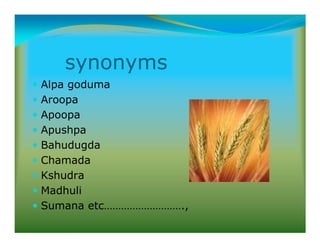
synonyms
Alpa goduma
Aroopa
Apoopa
Apushpa
Bahudugda
Chamada
Kshudra
Madhuli
Sumana etc……………………….,
TYPES
In charaka -maduli

nandimuki
In Bavaprakasa -mahagoduma
maduli
dirga goduma
In Kaiyadeva nigantu -maduli

dirgagoduma
properties  actions
Rasa :madura
Guna :guru,snigda,sara
Virya :seetha
Dosha karma :vathapitthasamana
MAIN KARMAS
Sukrala
Pathya
Brmhana
Varnya
Pushtivardaka
Balya
Hridya
Madakrit
Ruchya
Vrushya
WHEAT
BOTANICAL NAME : Triticum aestivum
FAMILY : Graminae
Synonyms;
T.sativum Lam,T.vulgare vill.,
Common wheat,Breadwheat
Wheat (Triticum spp.) is a worldwide
cultivated grass from the Levant region of the
Middle East. Globally, after maize, wheat is
the second most-produced food among the
cereal crops just above rice Wheat grain is a
staple food used to make flour for leavened,
flat and steamed breads; cookies, cakes,
breakfast cereal, pasta, juice, noodles and
couscous; and for fermentation to make beer,
alcohol, vodka or biofuel
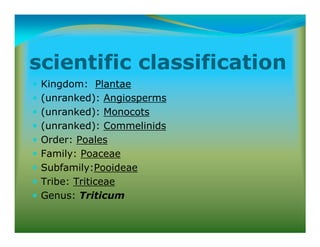
scientific classification
Kingdom: Plantae
(unranked): Angiosperms
(unranked): Monocots
(unranked): Commelinids
Order: Poales
Family: Poaceae
Subfamily:Pooideae
Tribe: Triticeae
Genus: Triticum
Species
T. aestivum
T. aethiopicumT. turanicum
T. turgidum
T. urartu
T. compactum
T. dicoccoides
T. dicoccon
T. durum
T. ispahanicum
T. karamyschevii
T. macha
T. araraticum
T. boeoticum
T. carthlicumT. militinae
T. monococcum
T. polonicum
T. spelta
T. sphaerococcum
T. timopheevii
Important artificial species 
mutants
Triticum ×borisovii Zhebrak - (T. aestivum × T. timopheevi)
Triticum ×fungicidum Zhuk. - Hexaploid, artificial cross (T. carthlicum × T.
timopheevi)
Triticum jakubzineri Udaczin  Schachm.
Triticum militinae Zhuk.  Migush. - Mutant form of T. timopheevi.
Triticum petropavlovskyi Udaczin  Migush.
Triticum sinskajae A.A.Filatenko  U.K.Kurkiev - mutant, free-threshing
form of T. monococcum.
Triticum ×timococcum Kostov
Triticum timonovum Heslot - Hexaploid, artificial cross.
Triticum zhukovskyi Menabde  Ericzjan (T. timopheevi × T. monococcum)
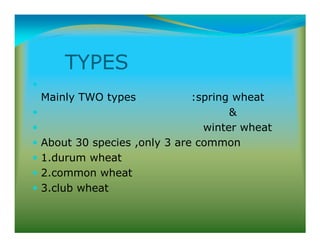
TYPES
Mainly TWO types :spring wheat

winter wheat
About 30 species ,only 3 are common
1.durum wheat
2.common wheat
3.club wheat
cont……..
4 most common types of wheat
1.hard red
2.soft red
3.white
4.durum
WHEAT FLOUR
Is a powder made of cereal grains or roots.
- main ingredient of bread
-one of the most important food in European
culture
-Flour contain high amount of starchs.
Nutritive facts
For 1 cup wheat
Calories-657kcl
Total fat-3.3g
Saturated fat-0.5g
Poly unsaturated-1.4g
Protein-21.7g
Iron-49%
ATTA and MAIDA
Atta and Maida are wheat flour but maida is
from refined wheat and Atta is made by
grinding wheat.
Maida is of white colour,Atta have wheat
colour
ATTA is nutritive food and MAIDA not so.
MAIZE
Is a tall,annual grass.deep rooted,requires
abundant moisture for best development.
Require 100-140 days for ripening
Corn kernels vary in size.
Maize is the most widely grown crop in the
Americas
Which are the different
types of maize?
Flour corn — Zea mays var. amylacea
Popcorn — Zea mays var. everta
Dent corn — Zea mays var. indentata
Flint corn — Zea mays var. indurata
Sweet corn — Zea mays var. saccharata and Zea mays var.
rugosa
Waxy corn — Zea mays var. ceratina
Amylomaize — Zea mays
Pod corn — Zea mays var. tunicata Larrañaga ex A. St. Hil
TAXONOMICAL
CLASSIFICATION
Kingdom :plantae
Order :poales
Family :poaceae
Genus :zea
Species :Z.mays
nutritive value of sweet corn?
Sweet corn (seeds only)
Nutritional value per 100 g (3.5 oz)
Energy 90 kcal 360 kJ
Carbohydrates 19 g
- Sugars 3.2 g
- Dietary fiber 2.7 g
Fat 1.2 g
Protein 3.2 g
Vitamin A equiv. 10 µg 1%
cont………
Thiamine (Vit. B1) 0.2 mg 15%
Niacin (Vit. B3) 1.7 mg 11%
Folate (Vit. B9) 46 µg 12%
Vitamin C 7 mg 12%
Iron 0.5 mg 4%
Magnesium 37 mg 10%
Potassium 270 mg 6%
useful forms of maize
Flour corn — Zea mays var. amylacea
Popcorn — Zea mays var. everta
Dent corn — Zea mays var. indentata
Flint corn — Zea mays var. indurata
Sweet corn — Zea mays var. saccharata and Zea
mays var. rugosa
Waxy corn — Zea mays var. ceratina
Amylomaize — Zea mays
Pod corn — Zea mays var. tunicata Larrañaga ex
A. St. Hil.
Striped maize — Zea mays var. japonica
maize- uses
As food
Chemical  medicines
Biofuel
Ornamental  other uses also.
Triticale
Triticale (× Triticosecale) is a hybrid of
wheat (Triticum) and rye (Secale) first bred
in laboratories during the late 19th century.
. It is grown mostly for forage or animal feed
although some triticale-based foods can be
purchased at health food stores or are to be
found in some breakfast cereals
. The word 'triticale' is a fusion of the latin
words triticum (or wheat) and secale (rye).
When crossing wheat and rye,
Sorghum
Sorghum is a genus of numerous species of
grasses, some of which are raised for grain
and many of which are used as fodder plants
either cultivated or as part of pasture
Numerous Sorghum species are used for food
(as grain and in sorghum syrup or sorghum
molasses), fodder the production of alcoholic
beverages, as well as biofuels. Most species
are drought tolerant and heat tolerant and are
especially important in arid regions. They
form an important component of pastures in
many tropical regions. Sorghum species are
an important food crop in Africa, Central
America, and South Asia and is the fifth most
important cereal crop grown in the world
Millet
The millets are a group of small-seeded
species of cereal crops or grains, widely
grown around the world for food and fodder.
They do not form a taxonomic group, but
rather a functional or agronomic one. Their
essential similarities are that they are small-
seeded grasses grown in difficult production
environments. It was millets, rather than rice,
that formed important parts of prehistoric diet
in Chinese Neolithic and Korean Mumun
societies.
varieties-millet
Pearl millet (Pennisetum glaucum)
Foxtail millet (Setaria italica)
Proso millet also known as common millet,
broom corn millet, hog millet or white
millet (Panicum miliaceum)
Finger millet
CONT………
The protein content in millet is very close to
that of wheat; both provide about 11%
protein by weight.
Millets are rich in B vitamins, especially niacin,
B17 (see nitrilosides), B6 and folic acid,
calcium, iron, potassium, magnesium, and
zinc. Millets contain no gluten, so they are not
suitable for raised bread. When combined with
wheat or xanthan gum (for those who have
coeliac disease), however, they can be used
for raised bread. Alone, they are suited for
flatbread.
Rye
Rye (Secale cereale) is a grass grown
extensively as a grain and forage crop. It is a
member of the wheat tribe (Triticeae) and is
closely related to barley and wheat. Rye grain
is used for flour, rye bread, rye beer, some
whiskies, some vodkas, and animal fodder. It
can also be eaten whole, either as boiled rye
berries, or by being rolled, similar to rolled
oats.
OATS
Scientific classification
Kingdom: Plantae
Order: Poales
Family: Poaceae
Genus: Avena
Species: A. sativa
The common oat (Avena sativa) is a species
of cereal grain grown for its seed.
consumption as oatmeal and rolled oats, one
of the most common uses is as livestock feed.
Oats make up a large part of the diet of
horses and are regularly fed to cattle as well.
Oats are also used in some brands of dog and
chicken feed.
USES
Oats have numerous uses in food; most
commonly, they are rolled or crushed into
oatmeal, or ground into fine oat flour.
Oatmeal is chiefly eaten as porridge, but may
also be used in a variety of baked goods, such
as oatcakes, oatmeal cookies
Oats are also occasionally used in Britain for
brewing beer.
A cold, sweet drink made of ground oats and
milk is a popular refreshment throughout
Latin America.
CONT…….
Oats are also commonly used as feed for
horses.
Oat straw is prized by cattle and horse
producers as bedding, due to its soft,
relatively dust-free, and absorbent nature.
Oat extract can also be used to soothe skin
conditions, e.g. skin lotions.
Pseudocereals
Pseudocereals are broadleaf plants (non-
grasses) that are used in much the same way
as cereal (true cereals are grasses). Their
seed can be ground into flour and otherwise
used as cereals. Examples of pseudocereals
are amaranth, quinoa and buckwheat.
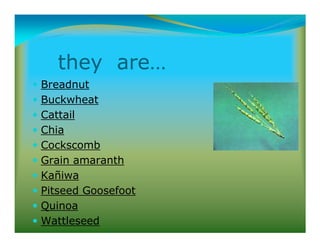
they are…
Breadnut
Buckwheat
Cattail
Chia
Cockscomb
Grain amaranth
Kañiwa
Pitseed Goosefoot
Quinoa
Wattleseed
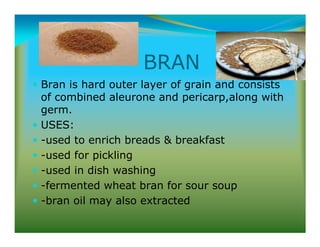
BRAN
Bran is hard outer layer of grain and consists
of combined aleurone and pericarp,along with
germ.
USES:
-used to enrich breads  breakfast
-used for pickling
-used in dish washing
-fermented wheat bran for sour soup
-bran oil may also extracted
conclusion
As dhanyas are important part of our day to
day life we must protect them.
Better field preparation,crop management and
post harvest storage will lead to better quality
of crops as well as yields.
THANK YOU
BY
ANJU.K.P

Sookadhanyavarga

  • 2.
  • 3.
    INTRODUCTION ž€-ž “€š“ That whichmakes thin on seperation ’ÝÛ™-ऽ  Ý’ š  ™ Q ’ÝÛ™˜ Q  ो¡ ’Ýۙ݀ A division of ANNA VARGA
  • 4.
    In this erawe group sooka dhanya under cereals Cereals are the edible seeds or grains of the grass family.cereals and cereal products are an important source of energy,
  • 5.
    ceres, is thename of the pre-Roman goddess of harvest and agriculture. The word cereal derives from Ceres. IMPORTANT CEREALS: Maize, Rice, Wheat, Barley, Sorghum, Millets, Oats, Rye
  • 6.
    HISTORICAL BACKGROUND IN AYURVEDA InYajurveda and Atharvaveda -mentions about dhanyas. The term Thandula used for threshed out paddy grain . Unhusked pounded rice mixed known as AKSHATA used in religious ceremonies homam. In Paneneeya ashtadyayi there is mentioning of shashtika rice. 12000 yrs ago human used rice as food U.N.General assembly has celebrated 2004 as the International Year of rice(IYR)
  • 7.
  • 8.
    Divisions of Dhanya InCharaka samhitha- 1.sooka 2.simbi In Ashtanga hrudaya- 1.sooka 2.simbi 3.truna In Bavaprakasa - 1.Sali 2.vrihi 3.sooka 4.simbi 5.kshudra
  • 9.
    DIVISIONS OF SOOKA InAshtanga hrudaya- Sali Vrihi
  • 10.
    SALI SYNONYMS Dhanyottama,Nripapriya,Ruchya,Madhura, Kaidarya Sukumaraka etc. TYPES RaktaSali,mahasali,kalama ,sakunahruta, turnaka etc Another type Anu,dirghalata,dirga nala,dirga sooka,kalama,kardama etc
  • 11.
    Best one -RAKTASALI then-Mahasali -Kalama etc in the order of succession.
  • 12.
    Pharmacological properties Rasa :madhura Anurasa:kashaya Guna :laghu,snigdha Virya :seetha Vipaka :katu(madhura) Dosha karma :vatha kaphahara
  • 13.
    Pharmacological properties of Raktha sali Rasa:madura Guna :lagu snigda Virya :not mentioned Vipaka :not mentioned Dosha karma:tridosha samana
  • 14.
  • 15.
    ROLE IN RITHUCHARYA InCharaka samhita Sali+cold mantha,sugar etc advised in Summer Sali+meat of arid animals vegetable soup advised in Varsha
  • 16.
    Significance in treatment Sukravega dharanaja rogas will cured by taking Sali In charaka Upakalpaneeya adyaya Sali,shashtika,yava are said to collect before undergoing emesis purgation . In kaphaja diseases-due to anabishyandi In karsya chikitsa In raktapitta raktapradara
  • 17.
    Various food preparations Peya Vilepi Manda Roastedflour of fried paddy Diff. rice preparations Pressed paddy preparations-prthuka Fermented preparations-sukta
  • 18.
  • 19.
    PROPERTIES ACTIONS Rasa :madhura Guna:guru Virya :seetha Vipaka :madhura Doshakarma :tridosha vardhaka
  • 20.
  • 21.
    SHASTIKA (njavara) Matures in sixtydays Best among vrihis Synonyms masadvayotbava,shashtisali,shashtija,shastivas araja,vrihisreshta,garbapaki,shastihayana
  • 22.
  • 23.
    PROPERTIESACTIONS Rasa :madhura Guna :lagu,snigda,mridu Virya:seetha Vipaka :madhura(?) Dosha karma :tridoshasamana
  • 24.
  • 25.
  • 26.
    shastika pinda sweda Keralaspeciality treatment It is a modified form of pinda sweda INDICATIONS: In various degenerative conditionsrejuvenative purposes like paraplegia,hemiplegia ,muscle dystrophy etc. ADVANTAGE; Improve muscle strengthbulk of muscles Produce snehanaswedana effect at a time.
  • 27.
    VARIETIES Mainly 2 varietiesgoura krishna Goura is the best one In BP FIVE varieties In Susrutha several varieties In KN THREE varieties Based on glume 2 types black golden yellow
  • 28.
    Njavara theppu Process bywhich direct application of rice on body of an individual. Massage generally for 1 hr either whole body or affected part only.
  • 29.
    RICE BOTANICAL NAME :Oryzasativa FAMILY : Graminae Useful Part :grain,spirit
  • 30.
    Rice is theseed of a monocot plant Oryza sativa, of the grass family (Poaceae). As a cereal grain, it is the most important staple food for a large part of the world's human population, especially in East, South, Southeast Asia, the Middle East, Latin America, and the West Indies. It is the grain with the second highest worldwide production, after maize (corn)
  • 31.
    Taxonomical order Kingdom -plantae Subkingdom - Tracheobionata Division - Magnoliophyta Class - Liliopsida Order - cyperales Family - Poaceae Genus - Oryza Species - sativa
  • 32.
    Nutritional value per100 g (3.5 oz) Energy 370 kcal 1530 kJ Carbohydrates 79 g – Sugars 0.12 g – Dietary fiber 1.3 g Fat 0.66 g Protein 7.13 g Water 11.62 g Thiamine (Vit. B1) 0.070 mg 5% Riboflavin (Vit. B2) 0.049 mg 3% Niacin (Vit. B3) 1.6 mg 11% Pantothenic acid (B5) 1.014 mg 20% Vitamin B6 0.164 mg 13% Folate (Vit. B9) 8 µg 2% Calcium 28 mg 3% Iron 0.80 mg 6% Magnesium 25 mg 7% Manganese 1.088 mg 54% Phosphorus 115 mg 16% Potassium 115 mg 2% Zinc 1.09 mg 11%
  • 33.
    chemical composition contents ricehusk bran Polished rice moisture 12.4 3.2 9.7 10 Ash 0.4 13.2 10 6.7 Crude fiber 0.2 35.7 9.5 6.3 carbohydrate 79.2 38.6 49.9 59 protein 7.4 3.6 12.1 11.7 fat 0.4 0.7 8.8 7.3
  • 34.
    What are thenutritional benefits of Rice?
  • 35.
    Excellent source ofcarbohydrates Good energy source Low fat, Low salt, No cholesterol A good source of vitamins and minerals such as thiamine, niacin, iron, riboflavin, vitamin D, calcium, and fiber high sugar No gluten No additives and preservatives
  • 36.
    cont……… Contains resistant starch Non-allergenic Cancerprevention and diet Rice is a low-sodium food for those with hypertension. It is a fair source of protein containing all eight amino acids
  • 37.
    some important facts aboutrice More than 90 percent of the world's rice is grown and consumed in Asia, where people typically eat rice two or three times a daily. Rice is the staple diet of half the world's population Rice farming has been traced back to around 5,000 BC Hundreds of millions of the poor spend half to three fourths of their incomes on rice and only rice
  • 38.
    More than 140,000varieties of cultivated rice (the grass family Oryza sativa) are thought to exist but the exact number remains a mystery Three of the world's four most populous nations are rice-based societies: China, India, and Indonesia. Together, they have nearly 2.5 billion people almost half of the world's population In kerala Rice is thrown on newly married couples as a symbol of fertility, luck and wealth
  • 39.
    Medicinal Uses ofRice Philippines: Rice polishings-the bran-is extracted and used as an excellent source of Vitamin B to prevent and cure beri-beri. Malaysia: In the Medicinal Book of Malayan Medicine, it is prescribed that boiled rice greens can be used as an eye lotion and for use with acute inflammation of the inner body tissues. The book also recommends applying a mixture of dried, powdered rice on certain skin ailments. Cambodia: The hulls (husk) of mature rice plants are considered useful for treating dysentery. The hulls of a three-month old rice plant are thought to be diuretic. China: The Chinese believe rice strengthens the spleen, as well as weak stomach, increases appetite, and cures indigestion. Dried sprouted rice grains were once used as an external medicine to aid in digestion, give tone to muscles, and expel gas from the stomach and intestines. India: Rice water is prescribed by the Pharmacopoeia of India as an ointment to counteract inflamed surface
  • 40.
  • 41.
    South indian favouriterice varities are JAYA SUREKHA In Kerala most accepteble is jaya type. Palakadan Matta njavara - another types they got GI status from India govt. MATTA red rice with a unique taste,grown largely in Palakad thrissur. POKKKALI –Developed by kerala agriculture university. KURUVA RICE-prefered in north kerala.
  • 42.
    BASMATHI RICE Basmati isa variety of long grain rice grown in India and Pakistan, notable for its fragrance and delicate, nuanced flavour. Its name means the fragrant one in Sanskrit, but it can also mean the soft riceThe grains of basmati rice are longer than most other types of rice. Cooked grains of Basmati rice are characteristically free flowing rather than sticky, as with most long-grain rice. Cooked basmati rice can be uniquely identified by its fragrance. Basmati rice is available in two varieties - white and brown
  • 43.
    basmathi rice nutrition Basmatirice, 1 cup (200g) (cooked) Calories: 205 Protein: 4.2g Carbohydrate: 44.5g Total Fat: 0.44g Fiber: 0.63g *Good source of: Iron (1.9mg), Selenium (11.8mcg), Thiamine (0.26mg), and Niacin (2.3mg)
  • 44.
    YAVA In Bava prakasatwo types nisooka haritha various other types like anuyava,athiyava,harita etc……..
  • 45.
  • 46.
    PROPERTIES ACTIONS Rasa:madhura,kashaya Guna :guru,sara,rooksha Virya :seetha Vipaka :katu Doshakarma :vathavardhaka
  • 47.
    main karmas Vit vardhaka Moothrasamaka Vrushya Sthairya kruth Medosamaka Lekhana Medhya Rakthakrit Agnivardhaka Balya
  • 48.
    therapeutic indications Types ofyava books indications Anuyava AS Pinasa,svasa,kasa,uru stamba,kanda twakamaya Yava AH Yava BPN Pinasa,kasa,svasa,trit Yava AC Venuyava CS Meda,krimi,visha Yava KDN Meha,trit,pinasa,svas a,kasa,urustamba,ka nda twakamaya Yava RN Prameha Venuyava RN Meha,krimi,visha Yava VSS Trit Yava SGN Svasa,kasa
  • 49.
    BARLEY BOTANICAL NAME: Hordeumvulgare FAMILY :Graminae
  • 50.
    . It servesas a major animal feed crop, with smaller amounts used for malting and in health food, as well as the making of the alcoholic beverages beer and whisky. Hordeum vulgare, divided into subspecies spontaneum (wild) and subspecies vulgare (domesticated). The main difference between the two forms is the brittle spike on the seeds of the spontaneum, which assists dispersal
  • 51.
    Taxonomical classification Kingdom :plantae Division:Magnoliphyta Class :Liliopsida Order :Poales Family :poaceae Genus :Hordeum Species :vulgare
  • 52.
    How many typesare there? Barley can be classified according to the number of kernel rows in the head. Two forms have been cultivated; two-row barley (formerly known as Hordeum distichum but now also classed as Hordeum vulgare), and six-row barley (Hordeum vulgare) Two-row barley has a lower protein content than six- row barley and thus more fermentable sugar content.
  • 53.
    CHEMICAL CONSTITUENTS Water 12.5 pc Albuminoids11.5pc Starch 70pc Fat 1.3pc Fiber 2.6pc ash 2.1pc
  • 54.
    NUTRITIONAL VALUE Raw barley Nutritionalvalue per 100 g (3.5 oz) Energy 350 kcal 1470 kJ Carbohydrates 77.7 g - Sugars 0.8 g - Dietary fiber 15.6 g Fat 1.2 g Protein 9.9 g
  • 55.
    CONT……. Thiamine (Vit. B1)0.2 mg 15% Riboflavin (Vit. B2) 0.1 mg 7% Niacin (Vit. B3) 4.6 mg 31% Pantothenic acid (B5) 0.3 mg 6%
  • 56.
    Alcoholic beverages madeof barley It is a key ingredient in beer and whisky production. Two- row barley is traditionally used in German and English beers. Six-row barley was traditionally used in US beers, but both varieties are in common usage now. Distilled from green beer, whisky has been made from barley in Ireland and Scotland Non-alcoholic drinks such as barley water and barley tea (called mugicha in Japan), have been made by boiling barley in water. Barley wine was an alcoholic drink made in the 1700s, prepared from recipes of ancient Greek origin.
  • 57.
    DO you know? Barleycontains all eight essential amino acids. According to a recent study, eating whole grain barley can regulate blood sugar for up to 10 hours after consumption compared to white or even whole-grain wheat, which has a similar glycemic index. Barley can also be used as a coffee substitute Barley grains were used for measurement in England
  • 58.
    uses As nutritious food Itsdecoction used as demulscent. Barley gruel is diuretic Is laxative.
  • 59.
    GODHUMA ‚’˜:  ˜“:  ˜ ‚’˜:‚’ ” šžÒŽ which whorls around  ˜“: ۇݓ which gives good knowledge
  • 60.
  • 61.
    TYPES In charaka -maduli nandimuki InBavaprakasa -mahagoduma maduli dirga goduma In Kaiyadeva nigantu -maduli dirgagoduma
  • 62.
    properties actions Rasa:madura Guna :guru,snigda,sara Virya :seetha Dosha karma :vathapitthasamana
  • 63.
  • 64.
    WHEAT BOTANICAL NAME :Triticum aestivum FAMILY : Graminae Synonyms; T.sativum Lam,T.vulgare vill., Common wheat,Breadwheat
  • 65.
    Wheat (Triticum spp.)is a worldwide cultivated grass from the Levant region of the Middle East. Globally, after maize, wheat is the second most-produced food among the cereal crops just above rice Wheat grain is a staple food used to make flour for leavened, flat and steamed breads; cookies, cakes, breakfast cereal, pasta, juice, noodles and couscous; and for fermentation to make beer, alcohol, vodka or biofuel
  • 66.
    scientific classification Kingdom: Plantae (unranked):Angiosperms (unranked): Monocots (unranked): Commelinids Order: Poales Family: Poaceae Subfamily:Pooideae Tribe: Triticeae Genus: Triticum
  • 67.
    Species T. aestivum T. aethiopicumT.turanicum T. turgidum T. urartu T. compactum T. dicoccoides T. dicoccon T. durum T. ispahanicum T. karamyschevii T. macha T. araraticum T. boeoticum T. carthlicumT. militinae T. monococcum T. polonicum T. spelta T. sphaerococcum T. timopheevii
  • 68.
    Important artificial species mutants Triticum ×borisovii Zhebrak - (T. aestivum × T. timopheevi) Triticum ×fungicidum Zhuk. - Hexaploid, artificial cross (T. carthlicum × T. timopheevi) Triticum jakubzineri Udaczin Schachm. Triticum militinae Zhuk. Migush. - Mutant form of T. timopheevi. Triticum petropavlovskyi Udaczin Migush. Triticum sinskajae A.A.Filatenko U.K.Kurkiev - mutant, free-threshing form of T. monococcum. Triticum ×timococcum Kostov Triticum timonovum Heslot - Hexaploid, artificial cross. Triticum zhukovskyi Menabde Ericzjan (T. timopheevi × T. monococcum)
  • 69.
    TYPES Mainly TWO types:spring wheat winter wheat About 30 species ,only 3 are common 1.durum wheat 2.common wheat 3.club wheat
  • 70.
    cont…….. 4 most commontypes of wheat 1.hard red 2.soft red 3.white 4.durum
  • 71.
    WHEAT FLOUR Is apowder made of cereal grains or roots. - main ingredient of bread -one of the most important food in European culture -Flour contain high amount of starchs.
  • 72.
    Nutritive facts For 1cup wheat Calories-657kcl Total fat-3.3g Saturated fat-0.5g Poly unsaturated-1.4g Protein-21.7g Iron-49%
  • 73.
    ATTA and MAIDA Attaand Maida are wheat flour but maida is from refined wheat and Atta is made by grinding wheat. Maida is of white colour,Atta have wheat colour ATTA is nutritive food and MAIDA not so.
  • 74.
    MAIZE Is a tall,annualgrass.deep rooted,requires abundant moisture for best development. Require 100-140 days for ripening Corn kernels vary in size. Maize is the most widely grown crop in the Americas
  • 75.
    Which are thedifferent types of maize? Flour corn — Zea mays var. amylacea Popcorn — Zea mays var. everta Dent corn — Zea mays var. indentata Flint corn — Zea mays var. indurata Sweet corn — Zea mays var. saccharata and Zea mays var. rugosa Waxy corn — Zea mays var. ceratina Amylomaize — Zea mays Pod corn — Zea mays var. tunicata Larrañaga ex A. St. Hil
  • 76.
  • 77.
    nutritive value ofsweet corn? Sweet corn (seeds only) Nutritional value per 100 g (3.5 oz) Energy 90 kcal 360 kJ Carbohydrates 19 g - Sugars 3.2 g - Dietary fiber 2.7 g Fat 1.2 g Protein 3.2 g Vitamin A equiv. 10 µg 1%
  • 78.
    cont……… Thiamine (Vit. B1)0.2 mg 15% Niacin (Vit. B3) 1.7 mg 11% Folate (Vit. B9) 46 µg 12% Vitamin C 7 mg 12% Iron 0.5 mg 4% Magnesium 37 mg 10% Potassium 270 mg 6%
  • 79.
    useful forms ofmaize Flour corn — Zea mays var. amylacea Popcorn — Zea mays var. everta Dent corn — Zea mays var. indentata Flint corn — Zea mays var. indurata Sweet corn — Zea mays var. saccharata and Zea mays var. rugosa Waxy corn — Zea mays var. ceratina Amylomaize — Zea mays Pod corn — Zea mays var. tunicata Larrañaga ex A. St. Hil. Striped maize — Zea mays var. japonica
  • 80.
    maize- uses As food Chemical medicines Biofuel Ornamental other uses also.
  • 81.
    Triticale Triticale (× Triticosecale)is a hybrid of wheat (Triticum) and rye (Secale) first bred in laboratories during the late 19th century. . It is grown mostly for forage or animal feed although some triticale-based foods can be purchased at health food stores or are to be found in some breakfast cereals . The word 'triticale' is a fusion of the latin words triticum (or wheat) and secale (rye). When crossing wheat and rye,
  • 82.
    Sorghum Sorghum is agenus of numerous species of grasses, some of which are raised for grain and many of which are used as fodder plants either cultivated or as part of pasture
  • 83.
    Numerous Sorghum speciesare used for food (as grain and in sorghum syrup or sorghum molasses), fodder the production of alcoholic beverages, as well as biofuels. Most species are drought tolerant and heat tolerant and are especially important in arid regions. They form an important component of pastures in many tropical regions. Sorghum species are an important food crop in Africa, Central America, and South Asia and is the fifth most important cereal crop grown in the world
  • 84.
    Millet The millets area group of small-seeded species of cereal crops or grains, widely grown around the world for food and fodder. They do not form a taxonomic group, but rather a functional or agronomic one. Their essential similarities are that they are small- seeded grasses grown in difficult production environments. It was millets, rather than rice, that formed important parts of prehistoric diet in Chinese Neolithic and Korean Mumun societies.
  • 85.
    varieties-millet Pearl millet (Pennisetumglaucum) Foxtail millet (Setaria italica) Proso millet also known as common millet, broom corn millet, hog millet or white millet (Panicum miliaceum) Finger millet
  • 86.
    CONT……… The protein contentin millet is very close to that of wheat; both provide about 11% protein by weight. Millets are rich in B vitamins, especially niacin, B17 (see nitrilosides), B6 and folic acid, calcium, iron, potassium, magnesium, and zinc. Millets contain no gluten, so they are not suitable for raised bread. When combined with wheat or xanthan gum (for those who have coeliac disease), however, they can be used for raised bread. Alone, they are suited for flatbread.
  • 87.
    Rye Rye (Secale cereale)is a grass grown extensively as a grain and forage crop. It is a member of the wheat tribe (Triticeae) and is closely related to barley and wheat. Rye grain is used for flour, rye bread, rye beer, some whiskies, some vodkas, and animal fodder. It can also be eaten whole, either as boiled rye berries, or by being rolled, similar to rolled oats.
  • 88.
    OATS Scientific classification Kingdom: Plantae Order:Poales Family: Poaceae Genus: Avena Species: A. sativa
  • 89.
    The common oat(Avena sativa) is a species of cereal grain grown for its seed. consumption as oatmeal and rolled oats, one of the most common uses is as livestock feed. Oats make up a large part of the diet of horses and are regularly fed to cattle as well. Oats are also used in some brands of dog and chicken feed.
  • 90.
    USES Oats have numeroususes in food; most commonly, they are rolled or crushed into oatmeal, or ground into fine oat flour. Oatmeal is chiefly eaten as porridge, but may also be used in a variety of baked goods, such as oatcakes, oatmeal cookies Oats are also occasionally used in Britain for brewing beer. A cold, sweet drink made of ground oats and milk is a popular refreshment throughout Latin America.
  • 91.
    CONT……. Oats are alsocommonly used as feed for horses. Oat straw is prized by cattle and horse producers as bedding, due to its soft, relatively dust-free, and absorbent nature. Oat extract can also be used to soothe skin conditions, e.g. skin lotions.
  • 92.
    Pseudocereals Pseudocereals are broadleafplants (non- grasses) that are used in much the same way as cereal (true cereals are grasses). Their seed can be ground into flour and otherwise used as cereals. Examples of pseudocereals are amaranth, quinoa and buckwheat.
  • 93.
  • 94.
    BRAN Bran is hardouter layer of grain and consists of combined aleurone and pericarp,along with germ. USES: -used to enrich breads breakfast -used for pickling -used in dish washing -fermented wheat bran for sour soup -bran oil may also extracted
  • 95.
    conclusion As dhanyas areimportant part of our day to day life we must protect them. Better field preparation,crop management and post harvest storage will lead to better quality of crops as well as yields.
  • 96.
  • 97.